NCERT
Solutions
Solutions
Solutions
Geography
For Revised Syllabus Session 2024-25
Artham
Resource Material
8
Powered by
Class
Chapter 1: Resources
Question 1:
CHAPTER – 1
Resources
Let’s do
List out five resources you use in your home and five you use in
your classroom.
Answer:
Existence of creatures on this planet is supported by numerous
resources. While species other than human beings use only
natural resources for their subsistence, human beings use both
natural and manmade resources to lead their lives. Below we list
down both natural and manmade resources used by us at our
homes and classrooms.
Resources used in homes:
a. Natural resources:
i. Water: Water is one of the bare necessities of human life on
this planet. Most of the water, however, that is found in nature is
not fit for human consumption. It has to be, thus, chemically
treated by different procedures in order to make it edible and
safe.
ii. Air: Air is another bare necessity of life. All creatures need
Oxygen to survive on this planet. Without it, there would be no
sign of life on Earth.
iii. Mineral like salt and sugar: Salt and sugar is basically used
in our kitchens to enhance the taste of our food.
b. Human made resources:
i. Washing machines: Washing machine can be considered a
luxury. It is used by people to wash clothes electronically in
order to reduce their time and effort.
ii. Geyser: Geyser is again a luxury. It is used to heat water. It is
mostly used in urban areas.
Resources used in classroom:
a. Natural resources: Natural resources that we use remain same
irrespective of where we are.
i. Water ii. Air
b. Human made resources:
i. Benches: Benches are made out of wood and is used for
seating in classrooms.
ii. Duster: Duster is simple manmade equipment which is used
to erase anything written on blackboard/whiteboard with
chalk/marker.
iii. Computer: Computer is an electronic device used to perform
various functions like typing documents, surfing internet and
many more. It’s presence in school is important to make
children ready to function in an electronic age.
Activity
Question 1:
Circle those resources from Amma’s list that have no
commercial values:
Amma’s list: Cotton cloth, iron ore, intelligence, coal deposits,
beautiful scenery, agricultural land, clean environment, old folk
songs, good weather, resourcefulness, a good singing voice,
grandmother’s home remedies, affection from friends and
family.
Answer:
Ans. Old folk songs, good weather, a good singing voice,
grandmother’s home remedies, affection from friends and
family. The circled entities do not have any commercial value in
the sense that you cannot take them to market to sell and earn
money immediately. However, each of these resources plays an
important role in improving the quality of our life. They have a
positive psychological impact on our lives and are something for
which we feel as much gratitude as we do for things that have
monetary value.
These resources are- intelligence, beautiful scenery, clean
environment, old folk songs, good weather, a good singing
voice, grandmother’s home remedies, affection from friends and
family.
Let’s do
Question 1:
Think of a few renewable resources and mention how their stock
may get affected by overuse.
Answer:
Renewable Resources: Solar energy, water (hydro) energy, wind
energy and to some extent, plants and shrubs.
While it is true that renewable energy resources are available in
plenty and can be used repeatedly. However, its overuse can
have some negative effects. In case of plants and vegetables, as
the growth will increase to meet the increasing demand, it will
have adverse impact on the underground water table and mineral
content. This might lead to delay in growth of plants and
vegetables. Secondly, while solar energy and wind energy is
available in abundance, the stock of hydro energy is being
affected by over use. This is because with the change in climate,
rains are becoming lesser especially in tropical regions. This
leads to decrease in the water levels of rivers which affect the
production of hydro energy.
Let’s do
Question 1:
Make a list of five human-made resources that you can observe
around you.
Answer:
Human made resources are the sign of human civilization and
development. These are resources that have been developed by
human beings in order to develop themselves economically,
reduce time and effort, enhance their quality of life etc. These
resources are made by combining both natural as well as
manmade resources. Some such human made resources are:
(i) Roads: Roads are basically pathways of development. They
connect different cities and towns to each other so that people
can move from one place to other easily in search of jobs,
business, trade etc.
(ii) Cars: Cars are a medium of transportation. They help a
person to be self-reliant and not depend on public transport to
travel from one place to another. They also play a role in
increasing one’s social status.
(iii) Buildings: Buildings are brick and mortar setups for
different establishments. Buildings are used for setting up
homes, schools, colleges, factories, and other institutions that
work in our society.
(iv) Machines: Machines are basically used to reduce human
time and effort. In today’s time, there is a machine for smallest
task like cutting vegetables to most difficult jobs like installing
satellites in outer space.
(v) Refrigerator: Refrigerator is a machine that is used to keep
eatable items like fruits, vegetables, dairy products etc. fresh and
cold.
Question 2:
What are the principles of Sustainable Development?
Answer:
Sustainable development simply means leading our lives in a
way that we leave this world as good, and even better, for future
generations than how we inherited it. Sustainable development
means using our resources judiciously and keeping our climate
clean and safe for future generations. There are some principles
of sustainable development. These are:
1. Respect and care for all forms of life. Striving towards co-
existence should be our aim.
2. Improve the quality of human life in an environment friendly
manner.
3. Conserve the earth’s vitality and diversity.
4. Minimise the depletion of natural resources to ensure its
supply for generations to come.
5. Change the personal attitude and practices towards the
environment in order to minimize damage do our ecosystem.
6. Enable communities to care for their own environment be
creating awareness and educating them about benefits of
sustainable living.
Exercise
Answer the following questions.
Question 1 A:
Why are resources distributed unequally over the earth?
Answer:
Resources are unequally distributed over the earth because of
differences in many physical features like terrains, climate and
altitude which affect the production of resources.
Question 1 B:
What is resources conservation?
Answer:
Resource conservation is the careful management and use of
resources in order to ensure that their benefits reach to every
member of our society and also for future generations. If we
keep using them at a fast pace, they may end up, thus posing
problems for the future. We should use resources in such a
balanced way that we satisfy our needs as well as conserve them
for the future.
Question 1 C:
Why are human resources important?
Answer:
They are important because human resources can make efficient
use of resources through effective management and skillful
utilization. They use their skill and knowledge to transform the
natural material into valuable products.
Question 1 D:
What is sustainable development?
Answer:
Balancing the need to use resources and also conserve them for
the future is called sustainable development. It refers to the
overall development of human civilization especially without
damaging our natural resources so that enough resources are
available for future generation. Each person can contribute by
reducing consumption, recycling and reusing things.
Question 2 A: Tick the correct answer:
(i) Which one of the following does not make substance a
resource?
(a) utility
(b) value
(c) quantity
Answer:
Quantity of resource does not affect its classification as a
resource. We have many such substances which are available in
very less quantity but still classify as resources because of their
value and utility.
Question 2 B:
(ii) Which one of the following is a human made resources?
(a) Medicines to treat cancer
(b) Spring water
(c) Tropical forests
Answer:
Medicines to treat cancer are developed after years of research
by trained scientists in labs using specialized techniques.
Question 2 C:
(iii) Complete the statement Non-renewable resources are-
a) those which have limited stock
b) made by human beings
c) derived from non-living things
Answer:
Biotic resources are derived from living organisms of the
ecosystem like plants, animals and other living substances.
Question 3:
Activity
“Rahiman paani raakhiye
Bin Paani sab soon,
Paani gaye na ubere
Moti, Manus choon”
(says Rahim, keep water, as without water there is nothing.
Without water, pearl, swan and dough cannot exist)
These lines were written by the poet Abdul Rahim Khankhana,
one of the nine gems of Akbar’s court. What kind of resources is
the poet referring to? Write in 100 words what would happen if
this resources disappeared.
Answer:
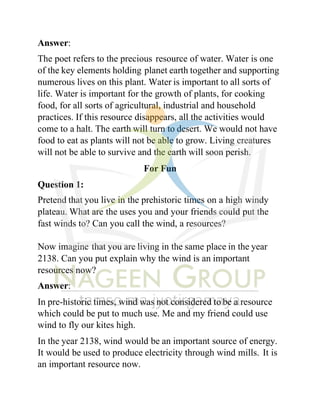
The poet refers to the precious resource of water. Water is one
of the key elements holding planet earth together and supporting
numerous lives on this plant. Water is important to all sorts of
life. Water is important for the growth of plants, for cooking
food, for all sorts of agricultural, industrial and household
practices. If this resource disappears, all the activities would
come to a halt. The earth will turn to desert. We would not have
food to eat as plants will not be able to grow. Living creatures
will not be able to survive and the earth will soon perish.
For Fun
Question 1:
Pretend that you live in the prehistoric times on a high windy
plateau. What are the uses you and your friends could put the
fast winds to? Can you call the wind, a resources?
Now imagine that you are living in the same place in the year
2138. Can you put explain why the wind is an important
resources now?
Answer:
In pre-historic times, wind was not considered to be a resource
which could be put to much use. Me and my friend could use
wind to fly our kites high.
In the year 2138, wind would be an important source of energy.
It would be used to produce electricity through wind mills. It is
an important resource now.
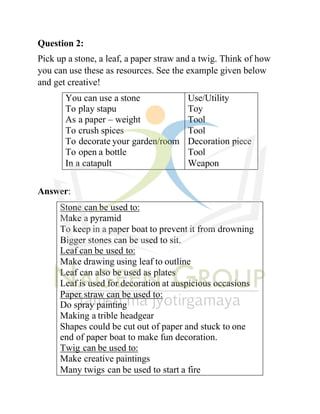
Stone can be used to:
Make a pyramid
To keep in a paper boat to prevent it from drowning
Bigger stones can be used to sit.
Leaf can be used to:
Make drawing using leaf to outline
Leaf can also be used as plates
Leaf is used for decoration at auspicious occasions
Paper straw can be used to:
Do spray painting
Making a trible headgear
Shapes could be cut out of paper and stuck to one
end of paper boat to make fun decoration.
Twig can be used to:
Make creative paintings
Many twigs can be used to start a fire
Question 2:
Pick up a stone, a leaf, a paper straw and a twig. Think of how
you can use these as resources. See the example given below
and get creative!
You can use a stone Use/Utility
To play stapu Toy
As a paper – weight Tool
To crush spices Tool
To decorate your garden/room Decoration piece
To open a bottle Tool
In a catapult Weapon
Answer:
CLICK TO DOWNLOAD NCERT SOLUTIONS
CLASS 8 (ALL SUBJECTS)
Dear Teachers and Students,
Join School of Educators' exclusive WhatsApp, Telegram, and Signal groups for FREE access
to a vast range of educational resources designed to help you achieve 100/100 in exams!
Separate groups for teachers and students are available, packed with valuable content to
boost your performance.
Additionally, benefit from expert tips, practical advice, and study hacks designed to enhance
performance in both CBSE exams and competitive entrance tests.
Don’t miss out—join today and take the first step toward academic excellence!
Join the Teachers and Students
Group by Clicking the Link Below
JOIN OUR
WHATSAPP
GROUPS
FOR FREE EDUCATIONAL
RESOURCES
JOIN SCHOOL OF EDUCATORS WHATSAPP GROUPS
FOR FREE EDUCATIONAL RESOURCES
BENEFITS OF SOE WHATSAPP GROUPS
We are thrilled to introduce the School of Educators WhatsApp Group, a
platform designed exclusively for educators to enhance your teaching & Learning
experience and learning outcomes. Here are some of the key benefits you can
expect from joining our group:
Abundance of Content: Members gain access to an extensive repository of
educational materials tailored to their class level. This includes various formats such
as PDFs, Word files, PowerPoint presentations, lesson plans, worksheets, practical
tips, viva questions, reference books, smart content, curriculum details, syllabus,
marking schemes, exam patterns, and blueprints. This rich assortment of resources
enhances teaching and learning experiences.
Immediate Doubt Resolution: The group facilitates quick clarification of doubts.
Members can seek assistance by sending messages, and experts promptly respond
to queries. This real-time interaction fosters a supportive learning environment
where educators and students can exchange knowledge and address concerns
effectively.
Access to Previous Years' Question Papers and Topper Answers: The group
provides access to previous years' question papers (PYQ) and exemplary answer
scripts of toppers. This resource is invaluable for exam preparation, allowing
individuals to familiarize themselves with the exam format, gain insights into scoring
techniques, and enhance their performance in assessments.
Free and Unlimited Resources: Members enjoy the benefit of accessing an array of
educational resources without any cost restrictions. Whether its study materials,
teaching aids, or assessment tools, the group offers an abundance of resources
tailored to individual needs. This accessibility ensures that educators and students
have ample support in their academic endeavors without financial constraints.
Instant Access to Educational Content: SOE WhatsApp groups are a platform where
teachers can access a wide range of educational content instantly. This includes study
materials, notes, sample papers, reference materials, and relevant links shared by
group members and moderators.
Timely Updates and Reminders: SOE WhatsApp groups serve as a source of timely
updates and reminders about important dates, exam schedules, syllabus changes, and
academic events. Teachers can stay informed and well-prepared for upcoming
assessments and activities.
Interactive Learning Environment: Teachers can engage in discussions, ask questions,
and seek clarifications within the group, creating an interactive learning environment.
This fosters collaboration, peer learning, and knowledge sharing among group
members, enhancing understanding and retention of concepts.
Access to Expert Guidance: SOE WhatsApp groups are moderated by subject matter
experts, teachers, or experienced educators can benefit from their guidance,
expertise, and insights on various academic topics, exam strategies, and study
techniques.
Join the School of Educators WhatsApp Group today and unlock a world of resources,
support, and collaboration to take your teaching to new heights. To join, simply click
on the group links provided below or send a message to +91-95208-77777 expressing
your interest.
Together, let's empower ourselves & Our Students and
inspire the next generation of learners.
Best Regards,
Team
School of Educators
Join School of Educators WhatsApp Groups
You will get Pre- Board Papers PDF, Word file, PPT, Lesson Plan, Worksheet, practical
tips and Viva questions, reference books, smart content, curriculum, syllabus,
marking scheme, toppers answer scripts, revised exam pattern, revised syllabus,
Blue Print etc. here . Join Your Subject / Class WhatsApp Group.
Kindergarten to Class XII (For Teachers Only)
Class 1 Class 2 Class 3
Class 4 Class 5 Class 6
Class 7 Class 8 Class 9
Class 10 Class 11 (Science) Class 11 (Humanities)
Class 11 (Commerce)
Class 12 (Commerce)
Class 12 (Science) Class 12 (Humanities)
Kindergarten
Subject Wise Secondary and Senior Secondary Groups
(IX & X For Teachers Only)
Secondary Groups (IX & X)
Senior Secondary Groups (XI & XII For Teachers Only)
SST Mathematics Science
English Hindi-A IT Code-402
Physics Chemistry English
Mathematics
Economics
Biology
BST
Accountancy
History
Hindi-B Artificial Intelligence
Hindi Core Home Science Sanskrit
Psychology Political Science Painting
Vocal Music Comp. Science IP
Physical Education APP. Mathematics Legal Studies
Entrepreneurship French
Teachers Jobs
Principal’s Group IIT/NEET
Other Important Groups (For Teachers & Principal’s)
IT
Sociology Hindi Elective
Geography
Artificial Intelligence
Join School of Educators WhatsApp Groups
You will get Pre- Board Papers PDF, Word file, PPT, Lesson Plan, Worksheet, practical
tips and Viva questions, reference books, smart content, curriculum, syllabus,
marking scheme, toppers answer scripts, revised exam pattern, revised syllabus,
Blue Print etc. here . Join Your Subject / Class WhatsApp Group.
Kindergarten to Class XII (For Students Only)
Class 1 Class 2 Class 3
Class 4 Class 5 Class 6
Class 7 Class 8 Class 9
Class 10 Class 11 (Science) Class 11 (Humanities)
Class 11 (Commerce)
Class 12 (Commerce)
Class 12 (Science) Class 12 (Humanities)
Artificial Intelligence
(VI TO VIII)
Subject Wise Secondary and Senior Secondary Groups
(IX & X For Students Only)
Secondary Groups (IX & X)
Senior Secondary Groups (XI & XII For Students Only)
SST Mathematics Science
English Hindi IT Code
Physics Chemistry English
Mathematics
Economics
Biology
BST
Accountancy
History
Artificial Intelligence
Hindi Core Home Science Sanskrit
Psychology Political Science Painting
Music Comp. Science IP
Physical Education APP. Mathematics Legal Studies
Entrepreneurship French IT
Sociology Hindi Elective
Geography
IIT/NEET
AI CUET
To maximize the benefits of these WhatsApp groups, follow these guidelines:
1. Share your valuable resources with the group.
2. Help your fellow educators by answering their queries.
3. Watch and engage with shared videos in the group.
4. Distribute WhatsApp group resources among your students.
5. Encourage your colleagues to join these groups.
Additional notes:
1. Avoid posting messages between 9 PM and 7 AM.
2. After sharing resources with students, consider deleting outdated data if necessary.
3. It's a NO Nuisance groups, single nuisance and you will be removed.
No introductions.
No greetings or wish messages.
No personal chats or messages.
No spam. Or voice calls
Share and seek learning resources only.
Groups Rules & Regulations:
Please only share and request learning resources. For assistance,
contact the helpline via WhatsApp: +91-95208-77777.
Join Premium WhatsApp Groups
Ultimate Educational Resources!!
Join our premium groups and just Rs. 1000 and gain access to all our exclusive
materials for the entire academic year. Whether you're a student in Class IX, X, XI, or
XII, or a teacher for these grades, Artham Resources provides the ultimate tools to
enhance learning. Pay now to delve into a world of premium educational content!
Class 9 Class 10 Class 11
Click here for more details
📣 Don't Miss Out! Elevate your academic journey with top-notch study materials and secure
your path to top scores! Revolutionize your study routine and reach your academic goals with
our comprehensive resources. Join now and set yourself up for success! 📚🌟
Best Wishes,
Team
School of Educators & Artham Resources
Class 12
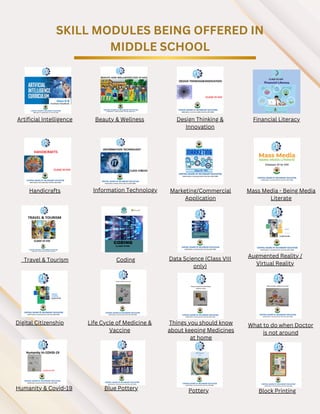
SKILL MODULES BEING OFFERED IN
MIDDLE SCHOOL
Artificial Intelligence Beauty & Wellness Design Thinking &
Innovation
Financial Literacy
Handicrafts Information Technology Marketing/Commercial
Application
Mass Media - Being Media
Literate
Travel & Tourism Coding Data Science (Class VIII
only)
Augmented Reality /
Virtual Reality
Digital Citizenship Life Cycle of Medicine &
Vaccine
Things you should know
about keeping Medicines
at home
What to do when Doctor
is not around
Humanity & Covid-19 Blue Pottery Pottery Block Printing
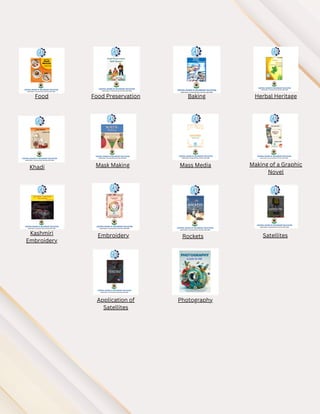
Food Food Preservation Baking Herbal Heritage
Khadi Mask Making Mass Media Making of a Graphic
Novel
Kashmiri
Embroidery
Embroidery Rockets Satellites
Application of
Satellites
Photography
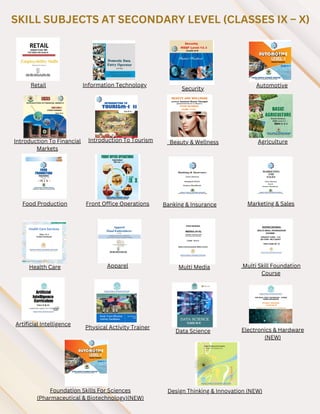
SKILL SUBJECTS AT SECONDARY LEVEL (CLASSES IX – X)
Retail Information Technology
Security
Automotive
Introduction To Financial
Markets
Introduction To Tourism Beauty & Wellness Agriculture
Food Production Front Office Operations Banking & Insurance Marketing & Sales
Health Care Apparel Multi Media Multi Skill Foundation
Course
Artificial Intelligence
Physical Activity Trainer
Data Science Electronics & Hardware
(NEW)
Design Thinking & Innovation (NEW)
Foundation Skills For Sciences
(Pharmaceutical & Biotechnology)(NEW)
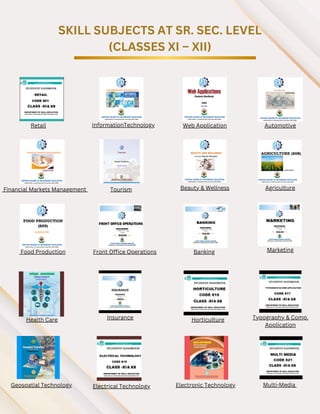
SKILL SUBJECTS AT SR. SEC. LEVEL
(CLASSES XI – XII)
Retail InformationTechnology Web Application Automotive
Financial Markets Management Tourism Beauty & Wellness Agriculture
Food Production Front Office Operations Banking Marketing
Health Care Insurance Horticulture Typography & Comp.
Application
Geospatial Technology Electrical Technology Electronic Technology Multi-Media
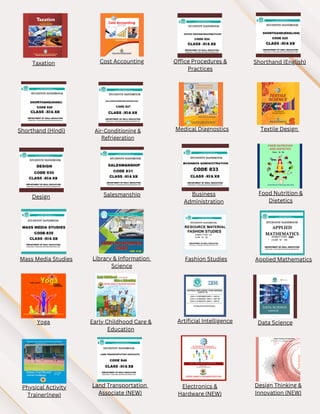
Taxation Cost Accounting Office Procedures &
Practices
Shorthand (English)
Shorthand (Hindi) Air-Conditioning &
Refrigeration
Medical Diagnostics Textile Design
Design Salesmanship Business
Administration
Food Nutrition &
Dietetics
Mass Media Studies Library & Information
Science
Fashion Studies Applied Mathematics
Yoga Early Childhood Care &
Education
Artificial Intelligence Data Science
Physical Activity
Trainer(new)
Land Transportation
Associate (NEW)
Electronics &
Hardware (NEW)
Design Thinking &
Innovation (NEW)
Join School of Educators Signal Groups
You will get Pre- Board Papers PDF, Word file, PPT, Lesson Plan, Worksheet, practical
tips and Viva questions, reference books, smart content, curriculum, syllabus,
marking scheme, toppers answer scripts, revised exam pattern, revised syllabus,
Blue Print etc. here . Join Your Subject / Class signal Group.
Kindergarten to Class XII
Class 2 Class 3
Class 4
Class 5 Class 6
Class 7 Class 8 Class 9
Class 10
Class 1
Class 11 (Humanities)
Class 11 (Science)
Class 11 (Commerce) Class 12 (Science) Class 12 (Humanities)
Class 12 (Commerce) Kindergarten Artifical intelligence
Subject Wise Secondary and Senior Secondary
Groups IX & X
Secondary Groups (IX & X)
SST Mathematics Science
English Hindi-A
IT Code-402
Hindi-B
Senior Secondary Groups XI & XII
Physics Chemistry English
Mathematics Biology Accountancy
Economics
BST History
IT Artifical intelligence
Geography Sociology Hindi Elective
Hindi Core Home Science Sanskrit
Psychology Political Science Painting
Vocal Music Comp. Science
IP
Physical Education APP. Mathematics Legal Studies
Entrepreneurship French
Artifical intelligence CUET
IIT/NEET
Join School of Educators CBSE Telegram Groups
Kindergarten
All classes Class 1 Class 2
Class 3 Class 4 Class 5
Class 6 Class 7 Class 8
Class 9 Class 10 Class 11 (Sci)
Class 11 (Com) Class 11 (Hum) Class 12 (Sci)
Class 12 (Com) Class 12 (Hum) JEE/NEET
CUET NDA, OLYMPIAD, NTSE Principal Professional Group
Teachers Professional Group Project File Group
Join School of Educators ICSE Telegram Groups
Kindergarten Class 1 Class 2
Class 3 Class 4 Class 5
Class 6 Class 7 Class 8
Class 9 Class 10 Class 11 (Sci)
Class 11 (Com) Class 11 (Hum) Class 12 (Sci)
Class 12 (Com) Class 12 (Hum)
Scan QR Code to join
Telegram Groups &
Channels for more free
resources.
Pdf Purchase
Print Purchase
Amazon Print Purchase
Join our
Telegram Group
for more sample
papers
Join our
Join our
Telegram Channel
Telegram Channel
for more books &
for more books &
Notes
Notes
Join our
Telegram Channel
for more books &
Notes

Class 8 Geography NCERT Solution Chapter 1 Resources

  • 1.
    NCERT Solutions Solutions Solutions Geography For Revised SyllabusSession 2024-25 Artham Resource Material 8 Powered by Class Chapter 1: Resources
  • 2.
    Question 1: CHAPTER –1 Resources Let’s do List out five resources you use in your home and five you use in your classroom. Answer: Existence of creatures on this planet is supported by numerous resources. While species other than human beings use only natural resources for their subsistence, human beings use both natural and manmade resources to lead their lives. Below we list down both natural and manmade resources used by us at our homes and classrooms. Resources used in homes: a. Natural resources: i. Water: Water is one of the bare necessities of human life on this planet. Most of the water, however, that is found in nature is not fit for human consumption. It has to be, thus, chemically treated by different procedures in order to make it edible and safe. ii. Air: Air is another bare necessity of life. All creatures need Oxygen to survive on this planet. Without it, there would be no sign of life on Earth. iii. Mineral like salt and sugar: Salt and sugar is basically used in our kitchens to enhance the taste of our food.
  • 3.
    b. Human maderesources: i. Washing machines: Washing machine can be considered a luxury. It is used by people to wash clothes electronically in order to reduce their time and effort. ii. Geyser: Geyser is again a luxury. It is used to heat water. It is mostly used in urban areas. Resources used in classroom: a. Natural resources: Natural resources that we use remain same irrespective of where we are. i. Water ii. Air b. Human made resources: i. Benches: Benches are made out of wood and is used for seating in classrooms. ii. Duster: Duster is simple manmade equipment which is used to erase anything written on blackboard/whiteboard with chalk/marker. iii. Computer: Computer is an electronic device used to perform various functions like typing documents, surfing internet and many more. It’s presence in school is important to make children ready to function in an electronic age.
  • 4.
    Activity Question 1: Circle thoseresources from Amma’s list that have no commercial values: Amma’s list: Cotton cloth, iron ore, intelligence, coal deposits, beautiful scenery, agricultural land, clean environment, old folk songs, good weather, resourcefulness, a good singing voice, grandmother’s home remedies, affection from friends and family. Answer: Ans. Old folk songs, good weather, a good singing voice, grandmother’s home remedies, affection from friends and family. The circled entities do not have any commercial value in the sense that you cannot take them to market to sell and earn money immediately. However, each of these resources plays an important role in improving the quality of our life. They have a positive psychological impact on our lives and are something for which we feel as much gratitude as we do for things that have monetary value. These resources are- intelligence, beautiful scenery, clean environment, old folk songs, good weather, a good singing voice, grandmother’s home remedies, affection from friends and family.
  • 5.
    Let’s do Question 1: Thinkof a few renewable resources and mention how their stock may get affected by overuse. Answer: Renewable Resources: Solar energy, water (hydro) energy, wind energy and to some extent, plants and shrubs. While it is true that renewable energy resources are available in plenty and can be used repeatedly. However, its overuse can have some negative effects. In case of plants and vegetables, as the growth will increase to meet the increasing demand, it will have adverse impact on the underground water table and mineral content. This might lead to delay in growth of plants and vegetables. Secondly, while solar energy and wind energy is available in abundance, the stock of hydro energy is being affected by over use. This is because with the change in climate, rains are becoming lesser especially in tropical regions. This leads to decrease in the water levels of rivers which affect the production of hydro energy. Let’s do Question 1: Make a list of five human-made resources that you can observe around you. Answer:
  • 6.
    Human made resourcesare the sign of human civilization and development. These are resources that have been developed by human beings in order to develop themselves economically, reduce time and effort, enhance their quality of life etc. These resources are made by combining both natural as well as manmade resources. Some such human made resources are: (i) Roads: Roads are basically pathways of development. They connect different cities and towns to each other so that people can move from one place to other easily in search of jobs, business, trade etc. (ii) Cars: Cars are a medium of transportation. They help a person to be self-reliant and not depend on public transport to travel from one place to another. They also play a role in increasing one’s social status. (iii) Buildings: Buildings are brick and mortar setups for different establishments. Buildings are used for setting up homes, schools, colleges, factories, and other institutions that work in our society. (iv) Machines: Machines are basically used to reduce human time and effort. In today’s time, there is a machine for smallest task like cutting vegetables to most difficult jobs like installing satellites in outer space. (v) Refrigerator: Refrigerator is a machine that is used to keep eatable items like fruits, vegetables, dairy products etc. fresh and cold.
  • 7.
    Question 2: What arethe principles of Sustainable Development? Answer: Sustainable development simply means leading our lives in a way that we leave this world as good, and even better, for future generations than how we inherited it. Sustainable development means using our resources judiciously and keeping our climate clean and safe for future generations. There are some principles of sustainable development. These are: 1. Respect and care for all forms of life. Striving towards co- existence should be our aim. 2. Improve the quality of human life in an environment friendly manner. 3. Conserve the earth’s vitality and diversity. 4. Minimise the depletion of natural resources to ensure its supply for generations to come. 5. Change the personal attitude and practices towards the environment in order to minimize damage do our ecosystem. 6. Enable communities to care for their own environment be creating awareness and educating them about benefits of sustainable living.
  • 8.
    Exercise Answer the followingquestions. Question 1 A: Why are resources distributed unequally over the earth? Answer: Resources are unequally distributed over the earth because of differences in many physical features like terrains, climate and altitude which affect the production of resources. Question 1 B: What is resources conservation? Answer: Resource conservation is the careful management and use of resources in order to ensure that their benefits reach to every member of our society and also for future generations. If we keep using them at a fast pace, they may end up, thus posing problems for the future. We should use resources in such a balanced way that we satisfy our needs as well as conserve them for the future. Question 1 C: Why are human resources important? Answer: They are important because human resources can make efficient use of resources through effective management and skillful utilization. They use their skill and knowledge to transform the natural material into valuable products.
  • 9.
    Question 1 D: Whatis sustainable development? Answer: Balancing the need to use resources and also conserve them for the future is called sustainable development. It refers to the overall development of human civilization especially without damaging our natural resources so that enough resources are available for future generation. Each person can contribute by reducing consumption, recycling and reusing things. Question 2 A: Tick the correct answer: (i) Which one of the following does not make substance a resource? (a) utility (b) value (c) quantity Answer: Quantity of resource does not affect its classification as a resource. We have many such substances which are available in very less quantity but still classify as resources because of their value and utility. Question 2 B: (ii) Which one of the following is a human made resources? (a) Medicines to treat cancer (b) Spring water (c) Tropical forests Answer: Medicines to treat cancer are developed after years of research by trained scientists in labs using specialized techniques.
  • 10.
    Question 2 C: (iii)Complete the statement Non-renewable resources are- a) those which have limited stock b) made by human beings c) derived from non-living things Answer: Biotic resources are derived from living organisms of the ecosystem like plants, animals and other living substances. Question 3: Activity “Rahiman paani raakhiye Bin Paani sab soon, Paani gaye na ubere Moti, Manus choon” (says Rahim, keep water, as without water there is nothing. Without water, pearl, swan and dough cannot exist) These lines were written by the poet Abdul Rahim Khankhana, one of the nine gems of Akbar’s court. What kind of resources is the poet referring to? Write in 100 words what would happen if this resources disappeared.
  • 11.
    Answer: The poet refersto the precious resource of water. Water is one of the key elements holding planet earth together and supporting numerous lives on this plant. Water is important to all sorts of life. Water is important for the growth of plants, for cooking food, for all sorts of agricultural, industrial and household practices. If this resource disappears, all the activities would come to a halt. The earth will turn to desert. We would not have food to eat as plants will not be able to grow. Living creatures will not be able to survive and the earth will soon perish. For Fun Question 1: Pretend that you live in the prehistoric times on a high windy plateau. What are the uses you and your friends could put the fast winds to? Can you call the wind, a resources? Now imagine that you are living in the same place in the year 2138. Can you put explain why the wind is an important resources now? Answer: In pre-historic times, wind was not considered to be a resource which could be put to much use. Me and my friend could use wind to fly our kites high. In the year 2138, wind would be an important source of energy. It would be used to produce electricity through wind mills. It is an important resource now.
  • 12.
    Stone can beused to: Make a pyramid To keep in a paper boat to prevent it from drowning Bigger stones can be used to sit. Leaf can be used to: Make drawing using leaf to outline Leaf can also be used as plates Leaf is used for decoration at auspicious occasions Paper straw can be used to: Do spray painting Making a trible headgear Shapes could be cut out of paper and stuck to one end of paper boat to make fun decoration. Twig can be used to: Make creative paintings Many twigs can be used to start a fire Question 2: Pick up a stone, a leaf, a paper straw and a twig. Think of how you can use these as resources. See the example given below and get creative! You can use a stone Use/Utility To play stapu Toy As a paper – weight Tool To crush spices Tool To decorate your garden/room Decoration piece To open a bottle Tool In a catapult Weapon Answer:
  • 14.
    CLICK TO DOWNLOADNCERT SOLUTIONS CLASS 8 (ALL SUBJECTS)
  • 15.
    Dear Teachers andStudents, Join School of Educators' exclusive WhatsApp, Telegram, and Signal groups for FREE access to a vast range of educational resources designed to help you achieve 100/100 in exams! Separate groups for teachers and students are available, packed with valuable content to boost your performance. Additionally, benefit from expert tips, practical advice, and study hacks designed to enhance performance in both CBSE exams and competitive entrance tests. Don’t miss out—join today and take the first step toward academic excellence! Join the Teachers and Students Group by Clicking the Link Below
  • 16.
    JOIN OUR WHATSAPP GROUPS FOR FREEEDUCATIONAL RESOURCES
  • 17.
    JOIN SCHOOL OFEDUCATORS WHATSAPP GROUPS FOR FREE EDUCATIONAL RESOURCES BENEFITS OF SOE WHATSAPP GROUPS We are thrilled to introduce the School of Educators WhatsApp Group, a platform designed exclusively for educators to enhance your teaching & Learning experience and learning outcomes. Here are some of the key benefits you can expect from joining our group: Abundance of Content: Members gain access to an extensive repository of educational materials tailored to their class level. This includes various formats such as PDFs, Word files, PowerPoint presentations, lesson plans, worksheets, practical tips, viva questions, reference books, smart content, curriculum details, syllabus, marking schemes, exam patterns, and blueprints. This rich assortment of resources enhances teaching and learning experiences. Immediate Doubt Resolution: The group facilitates quick clarification of doubts. Members can seek assistance by sending messages, and experts promptly respond to queries. This real-time interaction fosters a supportive learning environment where educators and students can exchange knowledge and address concerns effectively. Access to Previous Years' Question Papers and Topper Answers: The group provides access to previous years' question papers (PYQ) and exemplary answer scripts of toppers. This resource is invaluable for exam preparation, allowing individuals to familiarize themselves with the exam format, gain insights into scoring techniques, and enhance their performance in assessments.
  • 18.
    Free and UnlimitedResources: Members enjoy the benefit of accessing an array of educational resources without any cost restrictions. Whether its study materials, teaching aids, or assessment tools, the group offers an abundance of resources tailored to individual needs. This accessibility ensures that educators and students have ample support in their academic endeavors without financial constraints. Instant Access to Educational Content: SOE WhatsApp groups are a platform where teachers can access a wide range of educational content instantly. This includes study materials, notes, sample papers, reference materials, and relevant links shared by group members and moderators. Timely Updates and Reminders: SOE WhatsApp groups serve as a source of timely updates and reminders about important dates, exam schedules, syllabus changes, and academic events. Teachers can stay informed and well-prepared for upcoming assessments and activities. Interactive Learning Environment: Teachers can engage in discussions, ask questions, and seek clarifications within the group, creating an interactive learning environment. This fosters collaboration, peer learning, and knowledge sharing among group members, enhancing understanding and retention of concepts. Access to Expert Guidance: SOE WhatsApp groups are moderated by subject matter experts, teachers, or experienced educators can benefit from their guidance, expertise, and insights on various academic topics, exam strategies, and study techniques. Join the School of Educators WhatsApp Group today and unlock a world of resources, support, and collaboration to take your teaching to new heights. To join, simply click on the group links provided below or send a message to +91-95208-77777 expressing your interest. Together, let's empower ourselves & Our Students and inspire the next generation of learners. Best Regards, Team School of Educators
  • 19.
    Join School ofEducators WhatsApp Groups You will get Pre- Board Papers PDF, Word file, PPT, Lesson Plan, Worksheet, practical tips and Viva questions, reference books, smart content, curriculum, syllabus, marking scheme, toppers answer scripts, revised exam pattern, revised syllabus, Blue Print etc. here . Join Your Subject / Class WhatsApp Group. Kindergarten to Class XII (For Teachers Only) Class 1 Class 2 Class 3 Class 4 Class 5 Class 6 Class 7 Class 8 Class 9 Class 10 Class 11 (Science) Class 11 (Humanities) Class 11 (Commerce) Class 12 (Commerce) Class 12 (Science) Class 12 (Humanities) Kindergarten
  • 20.
    Subject Wise Secondaryand Senior Secondary Groups (IX & X For Teachers Only) Secondary Groups (IX & X) Senior Secondary Groups (XI & XII For Teachers Only) SST Mathematics Science English Hindi-A IT Code-402 Physics Chemistry English Mathematics Economics Biology BST Accountancy History Hindi-B Artificial Intelligence
  • 21.
    Hindi Core HomeScience Sanskrit Psychology Political Science Painting Vocal Music Comp. Science IP Physical Education APP. Mathematics Legal Studies Entrepreneurship French Teachers Jobs Principal’s Group IIT/NEET Other Important Groups (For Teachers & Principal’s) IT Sociology Hindi Elective Geography Artificial Intelligence
  • 22.
    Join School ofEducators WhatsApp Groups You will get Pre- Board Papers PDF, Word file, PPT, Lesson Plan, Worksheet, practical tips and Viva questions, reference books, smart content, curriculum, syllabus, marking scheme, toppers answer scripts, revised exam pattern, revised syllabus, Blue Print etc. here . Join Your Subject / Class WhatsApp Group. Kindergarten to Class XII (For Students Only) Class 1 Class 2 Class 3 Class 4 Class 5 Class 6 Class 7 Class 8 Class 9 Class 10 Class 11 (Science) Class 11 (Humanities) Class 11 (Commerce) Class 12 (Commerce) Class 12 (Science) Class 12 (Humanities) Artificial Intelligence (VI TO VIII)
  • 23.
    Subject Wise Secondaryand Senior Secondary Groups (IX & X For Students Only) Secondary Groups (IX & X) Senior Secondary Groups (XI & XII For Students Only) SST Mathematics Science English Hindi IT Code Physics Chemistry English Mathematics Economics Biology BST Accountancy History Artificial Intelligence
  • 24.
    Hindi Core HomeScience Sanskrit Psychology Political Science Painting Music Comp. Science IP Physical Education APP. Mathematics Legal Studies Entrepreneurship French IT Sociology Hindi Elective Geography IIT/NEET AI CUET
  • 25.
    To maximize thebenefits of these WhatsApp groups, follow these guidelines: 1. Share your valuable resources with the group. 2. Help your fellow educators by answering their queries. 3. Watch and engage with shared videos in the group. 4. Distribute WhatsApp group resources among your students. 5. Encourage your colleagues to join these groups. Additional notes: 1. Avoid posting messages between 9 PM and 7 AM. 2. After sharing resources with students, consider deleting outdated data if necessary. 3. It's a NO Nuisance groups, single nuisance and you will be removed. No introductions. No greetings or wish messages. No personal chats or messages. No spam. Or voice calls Share and seek learning resources only. Groups Rules & Regulations: Please only share and request learning resources. For assistance, contact the helpline via WhatsApp: +91-95208-77777.
  • 26.
    Join Premium WhatsAppGroups Ultimate Educational Resources!! Join our premium groups and just Rs. 1000 and gain access to all our exclusive materials for the entire academic year. Whether you're a student in Class IX, X, XI, or XII, or a teacher for these grades, Artham Resources provides the ultimate tools to enhance learning. Pay now to delve into a world of premium educational content! Class 9 Class 10 Class 11 Click here for more details 📣 Don't Miss Out! Elevate your academic journey with top-notch study materials and secure your path to top scores! Revolutionize your study routine and reach your academic goals with our comprehensive resources. Join now and set yourself up for success! 📚🌟 Best Wishes, Team School of Educators & Artham Resources Class 12
  • 27.
    SKILL MODULES BEINGOFFERED IN MIDDLE SCHOOL Artificial Intelligence Beauty & Wellness Design Thinking & Innovation Financial Literacy Handicrafts Information Technology Marketing/Commercial Application Mass Media - Being Media Literate Travel & Tourism Coding Data Science (Class VIII only) Augmented Reality / Virtual Reality Digital Citizenship Life Cycle of Medicine & Vaccine Things you should know about keeping Medicines at home What to do when Doctor is not around Humanity & Covid-19 Blue Pottery Pottery Block Printing
  • 28.
    Food Food PreservationBaking Herbal Heritage Khadi Mask Making Mass Media Making of a Graphic Novel Kashmiri Embroidery Embroidery Rockets Satellites Application of Satellites Photography
  • 29.
    SKILL SUBJECTS ATSECONDARY LEVEL (CLASSES IX – X) Retail Information Technology Security Automotive Introduction To Financial Markets Introduction To Tourism Beauty & Wellness Agriculture Food Production Front Office Operations Banking & Insurance Marketing & Sales Health Care Apparel Multi Media Multi Skill Foundation Course Artificial Intelligence Physical Activity Trainer Data Science Electronics & Hardware (NEW) Design Thinking & Innovation (NEW) Foundation Skills For Sciences (Pharmaceutical & Biotechnology)(NEW)
  • 30.
    SKILL SUBJECTS ATSR. SEC. LEVEL (CLASSES XI – XII) Retail InformationTechnology Web Application Automotive Financial Markets Management Tourism Beauty & Wellness Agriculture Food Production Front Office Operations Banking Marketing Health Care Insurance Horticulture Typography & Comp. Application Geospatial Technology Electrical Technology Electronic Technology Multi-Media
  • 31.
    Taxation Cost AccountingOffice Procedures & Practices Shorthand (English) Shorthand (Hindi) Air-Conditioning & Refrigeration Medical Diagnostics Textile Design Design Salesmanship Business Administration Food Nutrition & Dietetics Mass Media Studies Library & Information Science Fashion Studies Applied Mathematics Yoga Early Childhood Care & Education Artificial Intelligence Data Science Physical Activity Trainer(new) Land Transportation Associate (NEW) Electronics & Hardware (NEW) Design Thinking & Innovation (NEW)
  • 32.
    Join School ofEducators Signal Groups You will get Pre- Board Papers PDF, Word file, PPT, Lesson Plan, Worksheet, practical tips and Viva questions, reference books, smart content, curriculum, syllabus, marking scheme, toppers answer scripts, revised exam pattern, revised syllabus, Blue Print etc. here . Join Your Subject / Class signal Group. Kindergarten to Class XII Class 2 Class 3 Class 4 Class 5 Class 6 Class 7 Class 8 Class 9 Class 10 Class 1 Class 11 (Humanities) Class 11 (Science) Class 11 (Commerce) Class 12 (Science) Class 12 (Humanities) Class 12 (Commerce) Kindergarten Artifical intelligence
  • 33.
    Subject Wise Secondaryand Senior Secondary Groups IX & X Secondary Groups (IX & X) SST Mathematics Science English Hindi-A IT Code-402 Hindi-B Senior Secondary Groups XI & XII Physics Chemistry English Mathematics Biology Accountancy Economics BST History IT Artifical intelligence
  • 34.
    Geography Sociology HindiElective Hindi Core Home Science Sanskrit Psychology Political Science Painting Vocal Music Comp. Science IP Physical Education APP. Mathematics Legal Studies Entrepreneurship French Artifical intelligence CUET IIT/NEET
  • 35.
    Join School ofEducators CBSE Telegram Groups Kindergarten All classes Class 1 Class 2 Class 3 Class 4 Class 5 Class 6 Class 7 Class 8 Class 9 Class 10 Class 11 (Sci) Class 11 (Com) Class 11 (Hum) Class 12 (Sci) Class 12 (Com) Class 12 (Hum) JEE/NEET CUET NDA, OLYMPIAD, NTSE Principal Professional Group Teachers Professional Group Project File Group
  • 36.
    Join School ofEducators ICSE Telegram Groups Kindergarten Class 1 Class 2 Class 3 Class 4 Class 5 Class 6 Class 7 Class 8 Class 9 Class 10 Class 11 (Sci) Class 11 (Com) Class 11 (Hum) Class 12 (Sci) Class 12 (Com) Class 12 (Hum)
  • 37.
    Scan QR Codeto join Telegram Groups & Channels for more free resources. Pdf Purchase Print Purchase Amazon Print Purchase Join our Telegram Group for more sample papers Join our Join our Telegram Channel Telegram Channel for more books & for more books & Notes Notes Join our Telegram Channel for more books & Notes