B.J.P.S Samiti’s
M.V.HERWADKAR ENGLISH MEDIUM HIGH SCHOOL
CLASS: 7th CHAPTER 1: INTEGERS
Program:
Semester:
Course: NAME OF THE COURSE
Staff Name: VINAYAK PATIL 1
INTRODUCTION
•We have learnt about whole numbers and
integers.
•We know that integers form a bigger collection
of numbers which contains whole numbers and
negative numbers.
•In this chapter, we will study more about
integers, their properties and operations.
M.V.HERWADKAR ENGLISH MEDIUM SCHOOL 2
•We know how to represent integers on a number
line. Some integers are marked on the number
line given below.
M.V.HERWADKAR ENGLISH MEDIUM SCHOOL 3
M.V.HERWADKAR ENGLISH MEDIUM SCHOOL 4
• On a number line when we
(i) add a positive integer, we move to the right.
(ii) add a negative integer, we move to the left.
(iii) subtract a positive integer, we move to the left.
(iv) subtract a negative integer, we move to the right.
INTEGERS
M.V.HERWADKAR ENGLISH MEDIUM SCHOOL 5
M.V.HERWADKAR ENGLISH MEDIUM SCHOOL 6
M.V.HERWADKAR ENGLISH MEDIUM SCHOOL 7
RULES FOR ADDING AND
SUBTRACTING INTEGERS
M.V.HERWADKAR ENGLISH MEDIUM SCHOOL 8
M.V.HERWADKAR ENGLISH MEDIUM SCHOOL 9
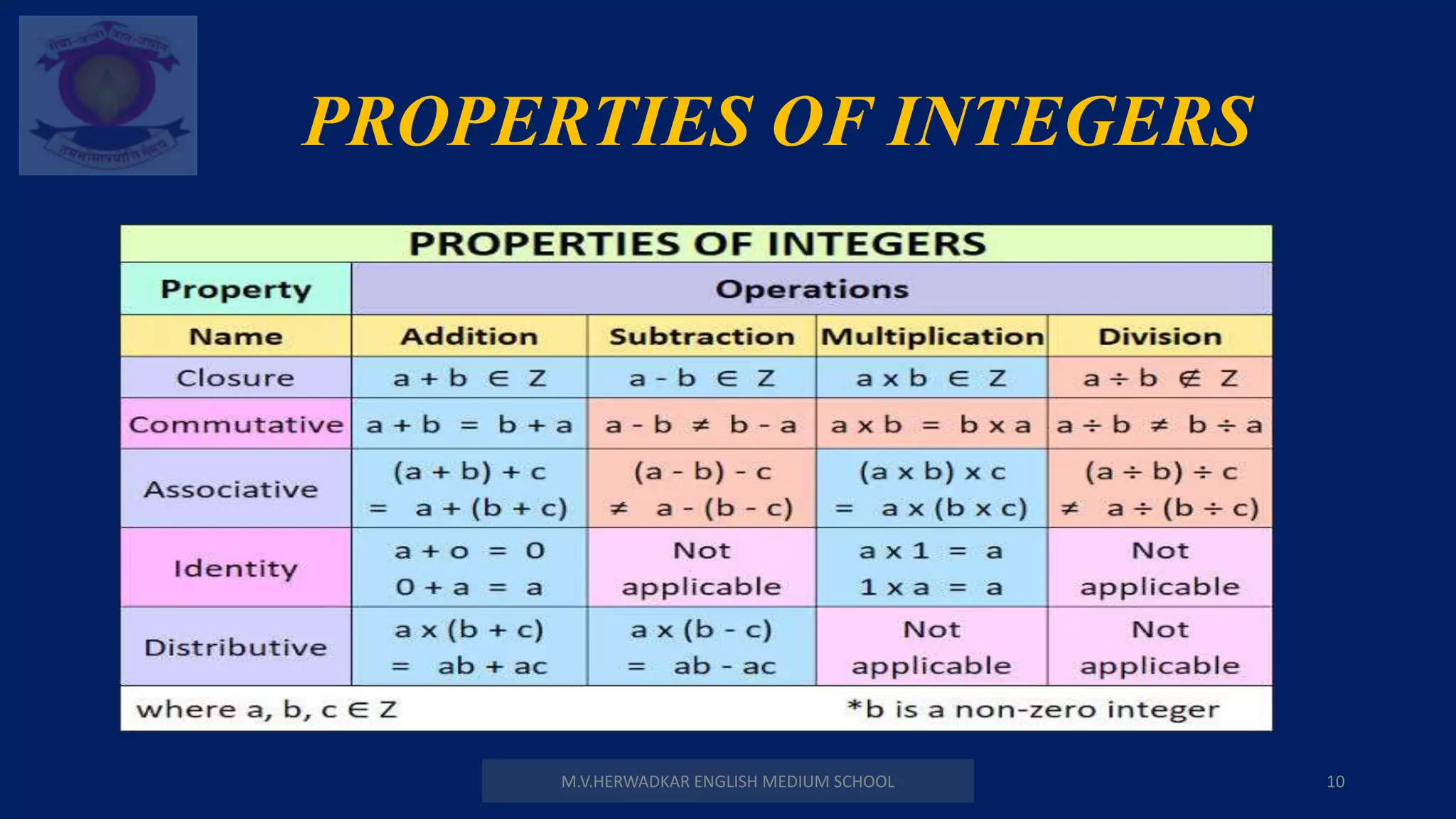
PROPERTIES OF INTEGERS
M.V.HERWADKAR ENGLISH MEDIUM SCHOOL 10
M.V.HERWADKAR ENGLISH MEDIUM SCHOOL 11
M.V.HERWADKAR ENGLISH MEDIUM SCHOOL 12
M.V.HERWADKAR ENGLISH MEDIUM SCHOOL 13
DIVISION OF INTEGERS
• We know that division is the inverse operation of
multiplication.
Let us see an example for whole numbers.
Since 3 × 5 = 15 So 15 ÷ 5 = 3 and 15 ÷ 3 = 5
Similarly, 4 × 3 = 12 gives 12 ÷ 4 = 3 and 12 ÷ 3 = 4
We can say for each multiplication statement of whole
numbers there are two division statements.
M.V.HERWADKAR ENGLISH MEDIUM SCHOOL 14
M.V.HERWADKAR ENGLISH MEDIUM SCHOOL 15
• Example (i) (–12) ÷ 2 = (– 6)
• When we divide a negative integer by a positive integer, we
divide them as whole numbers and then put a minus sign (–)
before the quotient.
• Example (i) 72 ÷ (–8) = –9
• When we divide a positive integer by a negative integer, we first
divide them as whole numbers and then put a minus sign (–)
before the quotient.
• In general, for any two positive integers a and b
• a ÷ (–b) = (–a) ÷ b where b ≠ 0
M.V.HERWADKAR ENGLISH MEDIUM SCHOOL 16
M.V.HERWADKAR ENGLISH MEDIUM SCHOOL 17
• Example (i) (–12) ÷ (– 6) = 2
• When we divide a negative integer by a negative integer, we first
divide them as whole numbers and then put a positive sign (+).
• In general, for any two positive integers a and b
• (– a) ÷ (–b) = a ÷ b where b ≠ 0
• Example (i) (12) ÷ ( 6) = 2
• When we divide a positive integer by a positive integer, we first
divide them as whole numbers and then put a positive sign (+).
• In general, for any two positive integers a and b
• ( a) ÷ (b) = a ÷ b where b ≠ 0
Example (i) (– 8) ÷ (–1) = 8
(ii) 11 ÷ (–1) = –11
•From the above : We can say that if any integer
is divided by (–1) it does not give the same
integer.
M.V.HERWADKAR ENGLISH MEDIUM SCHOOL 18
HOME WORK
1) Define integers
2) Write the four fundamental operations of integers.
3) Write the properties of integers.
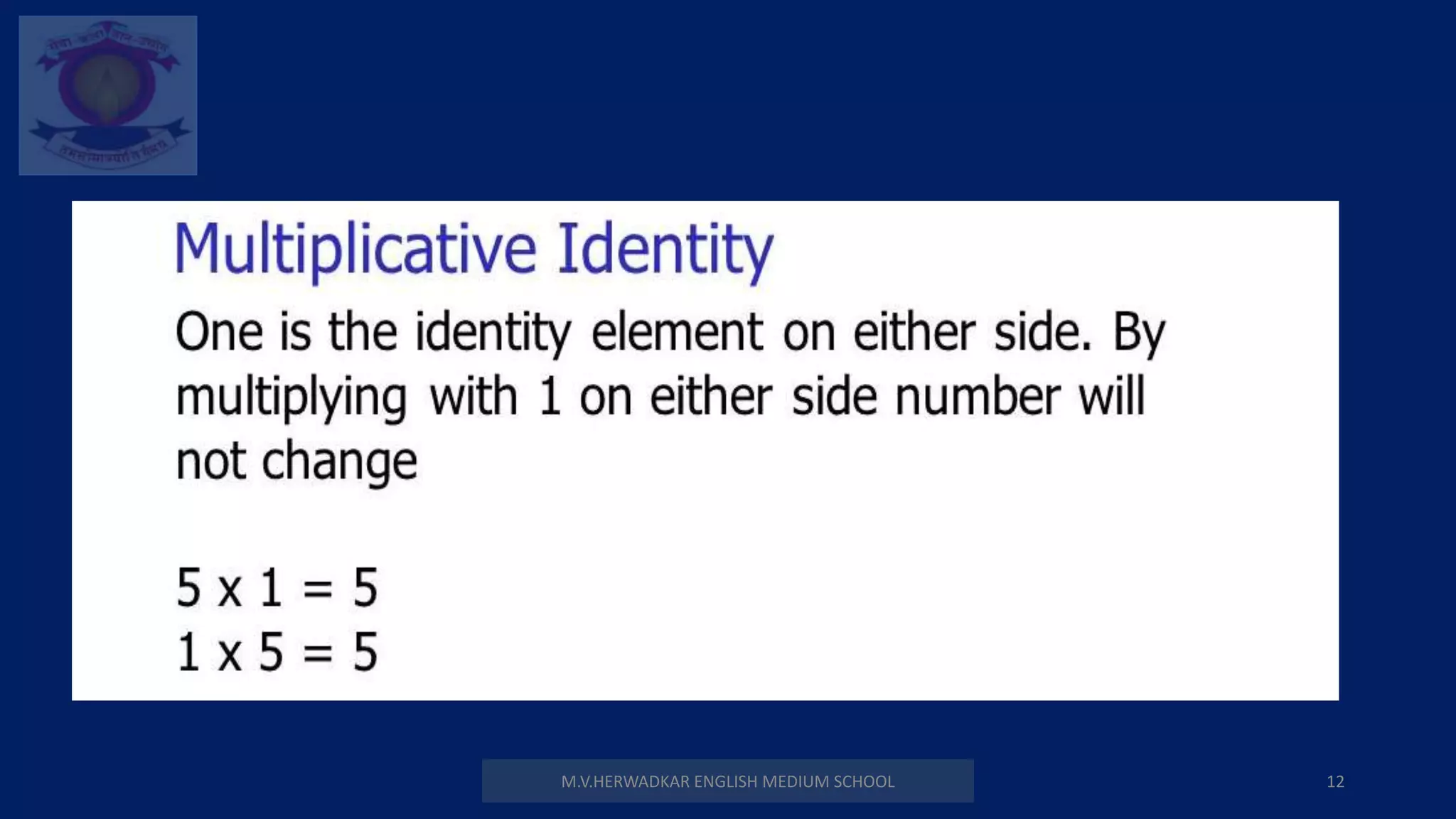
4) Write the additive and multiplicative identity
M.V.HERWADKAR ENGLISH MEDIUM SCHOOL 19

class 7 integers.pptx

  • 1.
    B.J.P.S Samiti’s M.V.HERWADKAR ENGLISHMEDIUM HIGH SCHOOL CLASS: 7th CHAPTER 1: INTEGERS Program: Semester: Course: NAME OF THE COURSE Staff Name: VINAYAK PATIL 1
  • 2.
    INTRODUCTION •We have learntabout whole numbers and integers. •We know that integers form a bigger collection of numbers which contains whole numbers and negative numbers. •In this chapter, we will study more about integers, their properties and operations. M.V.HERWADKAR ENGLISH MEDIUM SCHOOL 2
  • 3.
    •We know howto represent integers on a number line. Some integers are marked on the number line given below. M.V.HERWADKAR ENGLISH MEDIUM SCHOOL 3
  • 4.
    M.V.HERWADKAR ENGLISH MEDIUMSCHOOL 4 • On a number line when we (i) add a positive integer, we move to the right. (ii) add a negative integer, we move to the left. (iii) subtract a positive integer, we move to the left. (iv) subtract a negative integer, we move to the right.
  • 5.
  • 6.
  • 7.
  • 8.
    RULES FOR ADDINGAND SUBTRACTING INTEGERS M.V.HERWADKAR ENGLISH MEDIUM SCHOOL 8
  • 9.
  • 10.
    PROPERTIES OF INTEGERS M.V.HERWADKARENGLISH MEDIUM SCHOOL 10
  • 11.
  • 12.
  • 13.
  • 14.
    DIVISION OF INTEGERS •We know that division is the inverse operation of multiplication. Let us see an example for whole numbers. Since 3 × 5 = 15 So 15 ÷ 5 = 3 and 15 ÷ 3 = 5 Similarly, 4 × 3 = 12 gives 12 ÷ 4 = 3 and 12 ÷ 3 = 4 We can say for each multiplication statement of whole numbers there are two division statements. M.V.HERWADKAR ENGLISH MEDIUM SCHOOL 14
  • 15.
  • 16.
    • Example (i)(–12) ÷ 2 = (– 6) • When we divide a negative integer by a positive integer, we divide them as whole numbers and then put a minus sign (–) before the quotient. • Example (i) 72 ÷ (–8) = –9 • When we divide a positive integer by a negative integer, we first divide them as whole numbers and then put a minus sign (–) before the quotient. • In general, for any two positive integers a and b • a ÷ (–b) = (–a) ÷ b where b ≠ 0 M.V.HERWADKAR ENGLISH MEDIUM SCHOOL 16
  • 17.
    M.V.HERWADKAR ENGLISH MEDIUMSCHOOL 17 • Example (i) (–12) ÷ (– 6) = 2 • When we divide a negative integer by a negative integer, we first divide them as whole numbers and then put a positive sign (+). • In general, for any two positive integers a and b • (– a) ÷ (–b) = a ÷ b where b ≠ 0 • Example (i) (12) ÷ ( 6) = 2 • When we divide a positive integer by a positive integer, we first divide them as whole numbers and then put a positive sign (+). • In general, for any two positive integers a and b • ( a) ÷ (b) = a ÷ b where b ≠ 0
  • 18.
    Example (i) (–8) ÷ (–1) = 8 (ii) 11 ÷ (–1) = –11 •From the above : We can say that if any integer is divided by (–1) it does not give the same integer. M.V.HERWADKAR ENGLISH MEDIUM SCHOOL 18
  • 19.
    HOME WORK 1) Defineintegers 2) Write the four fundamental operations of integers. 3) Write the properties of integers. 4) Write the additive and multiplicative identity M.V.HERWADKAR ENGLISH MEDIUM SCHOOL 19