LEVEL 1
TOPIC: INTEGERS
Name : SANDHIYA G
Dept no: 22-EDM-22
INTRODUCTION
Integers are the collection of natural
numbers, zero and negative
numbers.
We denote this collection by (Z)
 
ZERO
Zero is neither a
positive nor a
negative integer. It
is a neutral
number i.e. zero
has no sign (+ or -)
POSITIVE INTEGER
The positive integers are the
natural numbers or also called
counting numbers. These
integers are also sometimes
denoted by Z+. The positive
integers lie on the right side of 0
on a number line. (Eg: +2,+6,+7)
NEGATIVE E INTEGER
The negative integers are
the negative of natural
numbers. They are denoted
by Z–. The negative integers
lie on the left side of 0 on a
number line.(Eg: -5,-7-1)
NUMBER LINE
Zero is the centre of integers on a
number line. Positive integers lie
on the right side of zero and
negative integers lie on the left.
NUMBER LINE DERIVATIONS
RULES FOR INTEGERS
Sum of two positive integers is an integer.
Sum of two negative integers is an integer.
Product of two positive integers is an integer.
Product of two negative integers is an integer.
Sum of an integer and its inverse is equal to
zero
Product of an integer and its reciprocal equal
to 1
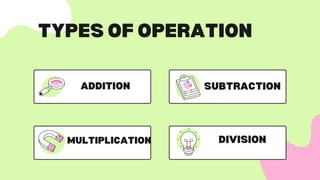
TYPES OF OPERATION
ADDITION
DIVISION
SUBTRACTION
MULTIPLICATION
ADDITION OF INTEGERS
While adding the two integers with the same sign,
add the absolute values, and write down the sum
with the sign provided with the numbers.
Example (+4) + (+7) = +11
While adding two integers with different signs,
subtract the absolute values, and write. down the
difference with the sign of the number which has
the largest absolute value.,example (-4) + (+2) = -2
SUBTRACTION OF INTEGERS
While subtracting two integers, change the sign of
the second number which is being subtracted, and
follow the rules of addition.For example,
(-7) – (+4) = (-7) + (-4) = -11
(+8) – (+3) = (+8) + (-3) = +5
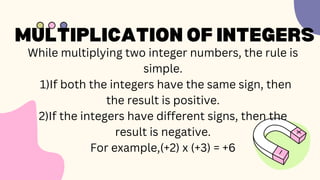
MULTIPLICATION OF INTEGERS
While multiplying two integer numbers, the rule is
simple.
1)If both the integers have the same sign, then
the result is positive.
2)If the integers have different signs, then the
result is negative.
For example,(+2) x (+3) = +6
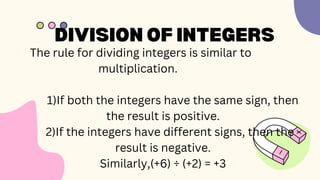
DIVISION OF INTEGERS
The rule for dividing integers is similar to
multiplication.
1)If both the integers have the same sign, then
the result is positive.
2)If the integers have different signs, then the
result is negative.
Similarly,(+6) ÷ (+2) = +3
THANK
YOU

Integers

  • 1.
    LEVEL 1 TOPIC: INTEGERS Name: SANDHIYA G Dept no: 22-EDM-22
  • 2.
    INTRODUCTION Integers are thecollection of natural numbers, zero and negative numbers. We denote this collection by (Z)  
  • 3.
    ZERO Zero is neithera positive nor a negative integer. It is a neutral number i.e. zero has no sign (+ or -)
  • 4.
    POSITIVE INTEGER The positiveintegers are the natural numbers or also called counting numbers. These integers are also sometimes denoted by Z+. The positive integers lie on the right side of 0 on a number line. (Eg: +2,+6,+7)
  • 5.
    NEGATIVE E INTEGER Thenegative integers are the negative of natural numbers. They are denoted by Z–. The negative integers lie on the left side of 0 on a number line.(Eg: -5,-7-1)
  • 6.
  • 7.
    Zero is thecentre of integers on a number line. Positive integers lie on the right side of zero and negative integers lie on the left. NUMBER LINE DERIVATIONS
  • 8.
    RULES FOR INTEGERS Sumof two positive integers is an integer. Sum of two negative integers is an integer. Product of two positive integers is an integer. Product of two negative integers is an integer. Sum of an integer and its inverse is equal to zero Product of an integer and its reciprocal equal to 1
  • 9.
  • 10.
    ADDITION OF INTEGERS Whileadding the two integers with the same sign, add the absolute values, and write down the sum with the sign provided with the numbers. Example (+4) + (+7) = +11 While adding two integers with different signs, subtract the absolute values, and write. down the difference with the sign of the number which has the largest absolute value.,example (-4) + (+2) = -2
  • 11.
    SUBTRACTION OF INTEGERS Whilesubtracting two integers, change the sign of the second number which is being subtracted, and follow the rules of addition.For example, (-7) – (+4) = (-7) + (-4) = -11 (+8) – (+3) = (+8) + (-3) = +5
  • 12.
    MULTIPLICATION OF INTEGERS Whilemultiplying two integer numbers, the rule is simple. 1)If both the integers have the same sign, then the result is positive. 2)If the integers have different signs, then the result is negative. For example,(+2) x (+3) = +6
  • 13.
    DIVISION OF INTEGERS Therule for dividing integers is similar to multiplication. 1)If both the integers have the same sign, then the result is positive. 2)If the integers have different signs, then the result is negative. Similarly,(+6) ÷ (+2) = +3
  • 14.