e4
Online class
Class 6
Prepared by:
Jeevan Subedi
A machine capable of following instruction to
alter data in a desirable way and to perform at
least some of these operations without human
intervention.
A computer is a programmable machine that
receives input, stores and manipulates data,
and provides output in a useful format.
Computer was used as an electronic device that
allows inputting data and having it stored,
processed, or otherwise manipulated quickly
and efficiently.
The repetitive process of computation
leads to people becoming bored in
computing such as navigational table,
tide charts, and planetary positions for
astronomical almanacs. People were
doing these things everyday and this is
the reason why people invented
computers, that is to aid in numerous
computation required everyday.
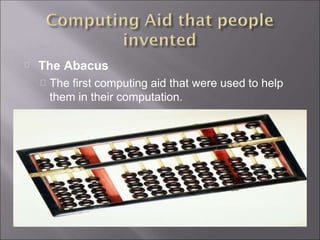
The Abacus
The first computing aid that were used to help
them in their computation.
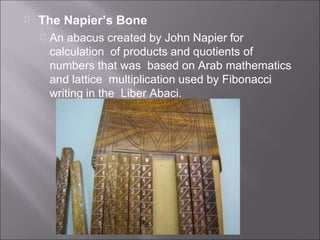
The Napier’s Bone
An abacus created by John Napier for
calculation of products and quotients of
numbers that was based on Arab mathematics
and lattice multiplication used by Fibonacci
writing in the Liber Abaci.
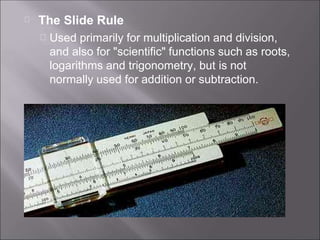
The Slide Rule
Used primarily for multiplication and division,
and also for "scientific" functions such as roots,
logarithms and trigonometry, but is not
normally used for addition or subtraction.
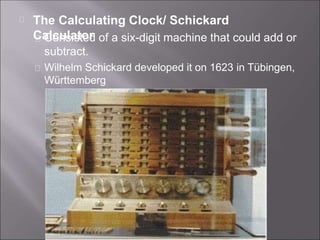
The Calculating Clock/ Schickard
Calculator
Consisted of a six-digit machine that could add or
subtract.
Wilhelm Schickard developed it on 1623 in Tübingen,
Württemberg
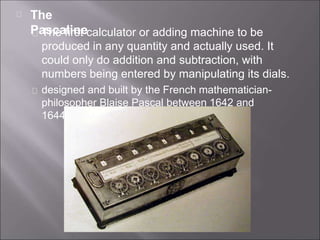
The
Pascaline
The first calculator or adding machine to be
produced in any quantity and actually used. It
could only do addition and subtraction, with
numbers being entered by manipulating its dials.
designed and built by the French mathematician-
philosopher Blaise Pascal between 1642 and
1644
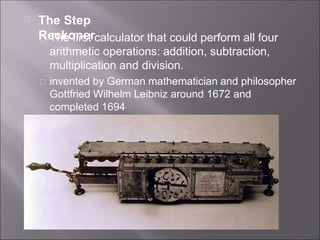
The Step
Reckoner
The first calculator that could perform all four
arithmetic operations: addition, subtraction,
multiplication and division.
invented by German mathematician and philosopher
Gottfried Wilhelm Leibniz around 1672 and
completed 1694
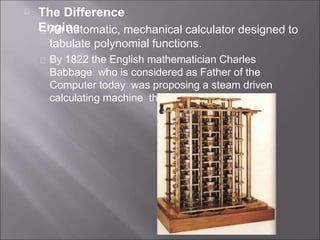
The Difference
Engine
An automatic, mechanical calculator designed to
tabulate polynomial functions.
By 1822 the English mathematician Charles
Babbage who is considered as Father of the
Computer today was proposing a steam driven
calculating machine the size of a room
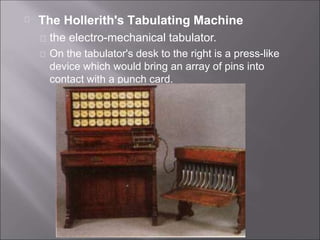
The Hollerith's Tabulating Machine
the electro-mechanical tabulator.
On the tabulator's desk to the right is a press-like
device which would bring an array of pins into
contact with a punch card.
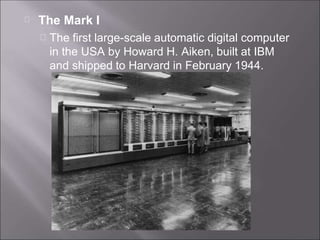
The Mark I
The first large-scale automatic digital computer
in the USA by Howard H. Aiken, built at IBM
and shipped to Harvard in February 1944.
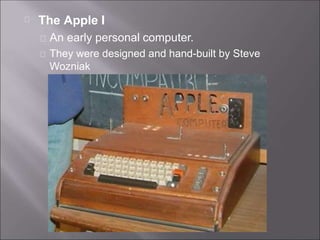
The Apple I
An early personal computer.
They were designed and hand-built by Steve
Wozniak
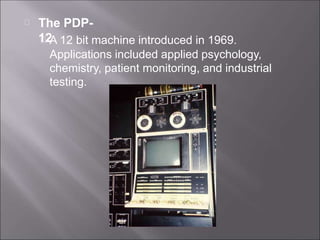
The PDP-
12
A 12 bit machine introduced in 1969.
Applications included applied psychology,
chemistry, patient monitoring, and industrial
testing.
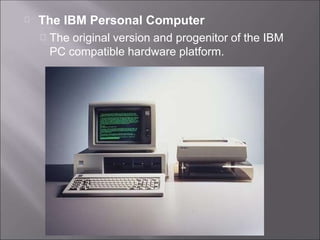
The IBM Personal Computer
The original version and progenitor of the IBM
PC compatible hardware platform.
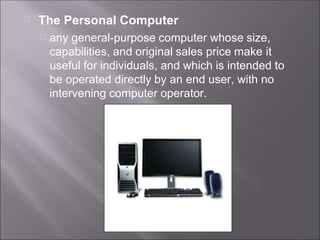
The Personal Computer
any general-purpose computer whose size,
capabilities, and original sales price make it
useful for individuals, and which is intended to
be operated directly by an end user, with no
intervening computer operator.
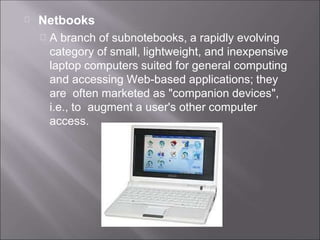
Netbooks
A branch of subnotebooks, a rapidly evolving
category of small, lightweight, and inexpensive
laptop computers suited for general computing
and accessing Web-based applications; they
are often marketed as "companion devices",
i.e., to augment a user's other computer
access.

Class 6 computer part 1

  • 1.
  • 3.
    A machine capableof following instruction to alter data in a desirable way and to perform at least some of these operations without human intervention. A computer is a programmable machine that receives input, stores and manipulates data, and provides output in a useful format. Computer was used as an electronic device that allows inputting data and having it stored, processed, or otherwise manipulated quickly and efficiently.
  • 4.
    The repetitive processof computation leads to people becoming bored in computing such as navigational table, tide charts, and planetary positions for astronomical almanacs. People were doing these things everyday and this is the reason why people invented computers, that is to aid in numerous computation required everyday.
  • 5.
    The Abacus The firstcomputing aid that were used to help them in their computation.
  • 6.
    The Napier’s Bone Anabacus created by John Napier for calculation of products and quotients of numbers that was based on Arab mathematics and lattice multiplication used by Fibonacci writing in the Liber Abaci.
  • 7.
    The Slide Rule Usedprimarily for multiplication and division, and also for "scientific" functions such as roots, logarithms and trigonometry, but is not normally used for addition or subtraction.
  • 8.
    The Calculating Clock/Schickard Calculator Consisted of a six-digit machine that could add or subtract. Wilhelm Schickard developed it on 1623 in Tübingen, Württemberg
  • 9.
    The Pascaline The first calculatoror adding machine to be produced in any quantity and actually used. It could only do addition and subtraction, with numbers being entered by manipulating its dials. designed and built by the French mathematician- philosopher Blaise Pascal between 1642 and 1644
  • 10.
    The Step Reckoner The firstcalculator that could perform all four arithmetic operations: addition, subtraction, multiplication and division. invented by German mathematician and philosopher Gottfried Wilhelm Leibniz around 1672 and completed 1694
  • 11.
    The Difference Engine An automatic,mechanical calculator designed to tabulate polynomial functions. By 1822 the English mathematician Charles Babbage who is considered as Father of the Computer today was proposing a steam driven calculating machine the size of a room
  • 12.
    The Hollerith's TabulatingMachine the electro-mechanical tabulator. On the tabulator's desk to the right is a press-like device which would bring an array of pins into contact with a punch card.
  • 13.
    The Mark I Thefirst large-scale automatic digital computer in the USA by Howard H. Aiken, built at IBM and shipped to Harvard in February 1944.
  • 14.
    The Apple I Anearly personal computer. They were designed and hand-built by Steve Wozniak
  • 15.
    The PDP- 12 A 12bit machine introduced in 1969. Applications included applied psychology, chemistry, patient monitoring, and industrial testing.
  • 16.
    The IBM PersonalComputer The original version and progenitor of the IBM PC compatible hardware platform.
  • 17.
    The Personal Computer anygeneral-purpose computer whose size, capabilities, and original sales price make it useful for individuals, and which is intended to be operated directly by an end user, with no intervening computer operator.
  • 18.
    Netbooks A branch ofsubnotebooks, a rapidly evolving category of small, lightweight, and inexpensive laptop computers suited for general computing and accessing Web-based applications; they are often marketed as "companion devices", i.e., to augment a user's other computer access.