What Is Organizational Structure?What Is Organizational Structure?
 Organizational Structure
– How job tasks are formally divided, grouped, and
coordinated
– Key Elements:
1. Work specialization
2. Departmentalization
3. Chain of command
4. Span of control
5. Centralization and decentralization
6. Formalization
15-1
Copyright © 2012 Dorling Kindersley (India) Pvt. Ltd
Authorized adaptation from the United States edition of Organizational Behavior, 14e
1. Work Specialization1. Work Specialization
 The degree to which tasks in the organization are
subdivided into separate jobs
 Division of Labor
– Makes efficient use of employee skills
– Increases employee skills through repetition
– Less between-job downtime increases productivity
– Specialized training is more efficient
– Allows use of specialized equipment
15-2
E X H I B I T 15-1
E X H I B I T 15-1
Copyright © 2012 Dorling Kindersley (India) Pvt. Ltd
Authorized adaptation from the United States edition of Organizational Behavior, 14e
2. Departmentalization2. Departmentalization
 The basis by which jobs are grouped together
 Grouping Activities by:
– Function
– Product
– Geography
– Process
– Customer
15-3
Copyright © 2012 Dorling Kindersley (India) Pvt. Ltd
Authorized adaptation from the United States edition of Organizational Behavior, 14e
3. Chain of Command3. Chain of Command
Chain of Command
– The unbroken line of authority that extends from the top of
the organization to the lowest echelon and clarifies who
reports to whom
 Authority
– The rights inherent in a managerial position to give orders
and to expect the orders to be obeyed
 Unity of Command
– A subordinate should have only one superior to whom he or
she is directly responsible
15-4
Copyright © 2012 Dorling Kindersley (India) Pvt. Ltd
Authorized adaptation from the United States edition of Organizational Behavior, 14e
4. Span of Control4. Span of Control
The number of subordinates a manager can efficiently and
effectively direct
– Wider span of management
control increases
organizational efficiency
– Drawbacks of narrow span of
control:
• Expense of additional layers of
management
• Increased complexity of vertical
communication
• Encouragement of overly tight
supervision and discouragement
of employee autonomy
15-5
Copyright © 2012 Dorling Kindersley (India) Pvt. Ltd
Authorized adaptation from the United States edition of Organizational Behavior, 14e
5. Centralization and Decentralization5. Centralization and Decentralization
 Centralization
– The degree to which decision making is concentrated at a
single point in the organization.
 Decentralization
– The degree to which decision making is spread throughout
the organization.
15-6
Copyright © 2012 Dorling Kindersley (India) Pvt. Ltd
Authorized adaptation from the United States edition of Organizational Behavior, 14e
6. Formalization6. Formalization
The degree to which jobs within the organization are
standardized.
– High formalization
• Minimum worker discretion in how to get the job done
• Many rules and procedures to follow
– Low formalization
• Job behaviors are nonprogrammed
• Employees have maximum discretion
15-7
Copyright © 2012 Dorling Kindersley (India) Pvt. Ltd
Authorized adaptation from the United States edition of Organizational Behavior, 14e
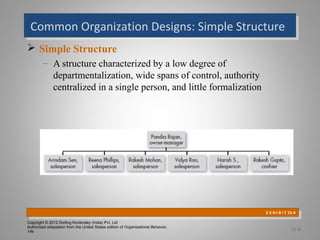
Common Organization Designs: Simple StructureCommon Organization Designs: Simple Structure
 Simple Structure
– A structure characterized by a low degree of
departmentalization, wide spans of control, authority
centralized in a single person, and little formalization
15-8
E X H I B I T 15-4
E X H I B I T 15-4
Copyright © 2012 Dorling Kindersley (India) Pvt. Ltd
Authorized adaptation from the United States edition of Organizational Behavior,
14e
Common Organizational Designs: BureaucracyCommon Organizational Designs: Bureaucracy
 Bureaucracy
– A structure of highly routine
operating tasks achieved through
specialization, very formalized
rules and regulations, tasks that
are grouped into functional
departments, centralized authority,
narrow spans of control, and
decision making that follows the
chain of command
15-9
Copyright © 2012 Dorling Kindersley (India) Pvt. Ltd
Authorized adaptation from the United States edition of Organizational Behavior, 14e
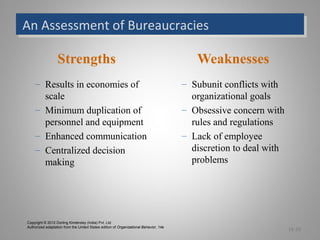
An Assessment of BureaucraciesAn Assessment of Bureaucracies
Strengths
– Results in economies of
scale
– Minimum duplication of
personnel and equipment
– Enhanced communication
– Centralized decision
making
Weaknesses
– Subunit conflicts with
organizational goals
– Obsessive concern with
rules and regulations
– Lack of employee
discretion to deal with
problems
15-10
Copyright © 2012 Dorling Kindersley (India) Pvt. Ltd
Authorized adaptation from the United States edition of Organizational Behavior, 14e

Class 15 organizational structure

  • 1.
    What Is OrganizationalStructure?What Is Organizational Structure?  Organizational Structure – How job tasks are formally divided, grouped, and coordinated – Key Elements: 1. Work specialization 2. Departmentalization 3. Chain of command 4. Span of control 5. Centralization and decentralization 6. Formalization 15-1 Copyright © 2012 Dorling Kindersley (India) Pvt. Ltd Authorized adaptation from the United States edition of Organizational Behavior, 14e
  • 2.
    1. Work Specialization1.Work Specialization  The degree to which tasks in the organization are subdivided into separate jobs  Division of Labor – Makes efficient use of employee skills – Increases employee skills through repetition – Less between-job downtime increases productivity – Specialized training is more efficient – Allows use of specialized equipment 15-2 E X H I B I T 15-1 E X H I B I T 15-1 Copyright © 2012 Dorling Kindersley (India) Pvt. Ltd Authorized adaptation from the United States edition of Organizational Behavior, 14e
  • 3.
    2. Departmentalization2. Departmentalization The basis by which jobs are grouped together  Grouping Activities by: – Function – Product – Geography – Process – Customer 15-3 Copyright © 2012 Dorling Kindersley (India) Pvt. Ltd Authorized adaptation from the United States edition of Organizational Behavior, 14e
  • 4.
    3. Chain ofCommand3. Chain of Command Chain of Command – The unbroken line of authority that extends from the top of the organization to the lowest echelon and clarifies who reports to whom  Authority – The rights inherent in a managerial position to give orders and to expect the orders to be obeyed  Unity of Command – A subordinate should have only one superior to whom he or she is directly responsible 15-4 Copyright © 2012 Dorling Kindersley (India) Pvt. Ltd Authorized adaptation from the United States edition of Organizational Behavior, 14e
  • 5.
    4. Span ofControl4. Span of Control The number of subordinates a manager can efficiently and effectively direct – Wider span of management control increases organizational efficiency – Drawbacks of narrow span of control: • Expense of additional layers of management • Increased complexity of vertical communication • Encouragement of overly tight supervision and discouragement of employee autonomy 15-5 Copyright © 2012 Dorling Kindersley (India) Pvt. Ltd Authorized adaptation from the United States edition of Organizational Behavior, 14e
  • 6.
    5. Centralization andDecentralization5. Centralization and Decentralization  Centralization – The degree to which decision making is concentrated at a single point in the organization.  Decentralization – The degree to which decision making is spread throughout the organization. 15-6 Copyright © 2012 Dorling Kindersley (India) Pvt. Ltd Authorized adaptation from the United States edition of Organizational Behavior, 14e
  • 7.
    6. Formalization6. Formalization Thedegree to which jobs within the organization are standardized. – High formalization • Minimum worker discretion in how to get the job done • Many rules and procedures to follow – Low formalization • Job behaviors are nonprogrammed • Employees have maximum discretion 15-7 Copyright © 2012 Dorling Kindersley (India) Pvt. Ltd Authorized adaptation from the United States edition of Organizational Behavior, 14e
  • 8.
    Common Organization Designs:Simple StructureCommon Organization Designs: Simple Structure  Simple Structure – A structure characterized by a low degree of departmentalization, wide spans of control, authority centralized in a single person, and little formalization 15-8 E X H I B I T 15-4 E X H I B I T 15-4 Copyright © 2012 Dorling Kindersley (India) Pvt. Ltd Authorized adaptation from the United States edition of Organizational Behavior, 14e
  • 9.
    Common Organizational Designs:BureaucracyCommon Organizational Designs: Bureaucracy  Bureaucracy – A structure of highly routine operating tasks achieved through specialization, very formalized rules and regulations, tasks that are grouped into functional departments, centralized authority, narrow spans of control, and decision making that follows the chain of command 15-9 Copyright © 2012 Dorling Kindersley (India) Pvt. Ltd Authorized adaptation from the United States edition of Organizational Behavior, 14e
  • 10.
    An Assessment ofBureaucraciesAn Assessment of Bureaucracies Strengths – Results in economies of scale – Minimum duplication of personnel and equipment – Enhanced communication – Centralized decision making Weaknesses – Subunit conflicts with organizational goals – Obsessive concern with rules and regulations – Lack of employee discretion to deal with problems 15-10 Copyright © 2012 Dorling Kindersley (India) Pvt. Ltd Authorized adaptation from the United States edition of Organizational Behavior, 14e

Editor's Notes

  • #2 Organizational structure depicts how job tasks are formally divided, grouped, and coordinated. The key elements of organizational structure include work specialization, departmentalization, chain of command, span of control, centralization and decentralization, and formalization.
  • #3 A key part of organizational structure is understanding the degree to which tasks are divided into separate jobs or work specialization. The division of labor is helpful in creating the most efficient way to utilize employee skills, increase their skills, and maximize their input. When division of labor is utilized an organization can more effectively use specialized training and specialized equipment to accomplish their desired productivity and quality goals.
  • #4 Departmentalization defines how jobs are grouped together. There are a number of options to choose from when grouping jobs – you could organize around function, product, location, process, or customer. When jobs are grouped, departments are formed.
  • #5 The chain of command represents the line of authority present in decision making. Embedded in the chain of command is the inherent right of a manager to give orders and expect the orders to be followed. Unity of command is the idea that a subordinate should have only one superior to report to so that directions and the chain of command are clear.
  • #6 The fourth element of structure is span of control. This concept looks at how many workers a manager can effectively direct toward organizational goals. Wider span allows for more efficiency because you need fewer managers. However, it can also limit the amount of time and direction a manager can give to their employees. A narrow span can allow for more direction but can add layers of management, increase the complexity of the vertical communication, and encourage overly tight supervision, limiting employee autonomy.
  • #7 The fifth aspect of structure deals with centralization and decentralization. Centralization is the degree to which decision making is concentrated at a single point in the organization, typically at the top. Decentralization represents an organization that spreads decision making throughout the organization.
  • #8 Formalization is the degree to which jobs within the organization are standardized. When there is high formalization, workers have very little control over how they do their work and they will be required to follow a number of rules and procedures. Lower formalization will tend to allow for different job behaviors to get the job done, giving workers more control over their work.
  • #9 There are a number of organizational structures available to companies. We will look at a number of options over the next several slides. The first and most basic structure is the simple structure. This structure has a low degree of departmentalization, wide spans of control, and centralized decision making with little formalization in job design.
  • #10 Another type of organizational design is bureaucracy. In a bureaucratic organization, there will be a great deal of structure. The tasks will be completed through specialization and they tend to be formalized through rules and regulations. Departments will be highly defined and authority is centralized. Decision making will follow a strict chain of command and there will be narrow spans of control. The bureaucratic organization will be one that is highly defined and very controlled.
  • #11 Bureaucracies have both strengths and weaknesses. They tend to offer economies of scale that are beneficial to the organization. This structure will minimize duplication of personnel and equipment through organization of jobs and departments. Communication will be strong and decision making is centralized. However, this type of structure is not without its weaknesses. In a bureaucratic environment, conflict often arises around organizational goals and unit goals, people can become obsessive about rules and regulations, and employees don’t always know how to deal with problems because employees are not empowered to make decisions.