8P43
Student Inquiry
Collaborative Teacher Inquiry
Class 2
2020
Agenda
• Social Justice Picture Book: 30 min
• Asking Questions: Mars One
• Student Inquiry
• Collaborative Teacher Inquiry
• Inquiry Project: Group time
– Monograph
– Essential Question
– Meeting Log
Support on Sakai
• ETFO: A Social Justice Approach
– Lesson plan and picture book for each grade
“It is, in fact, nothing short of a miracle that the
modern methods of instruction have not yet
entirely strangled the holy curiosity of inquiry.”
Albert Einstein
Creative Commons
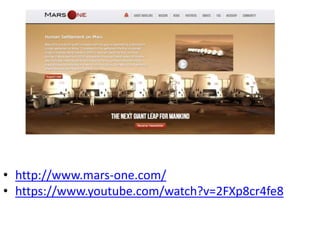
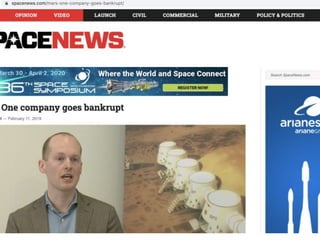
• http://www.mars-one.com/
• https://www.youtube.com/watch?v=2FXp8cr4fe8
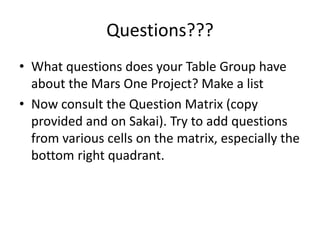
Questions???
• What questions does your Table Group have
about the Mars One Project? Make a list
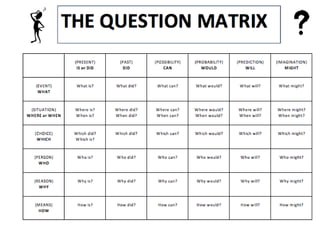
• Now consult the Question Matrix (copy
provided and on Sakai). Try to add questions
from various cells on the matrix, especially the
bottom right quadrant.
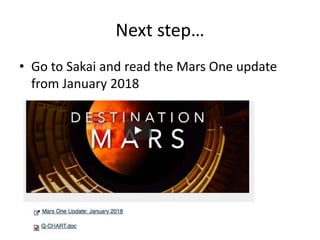
Next step…
• Go to Sakai and read the Mars One update
from January 2018
• Which of your questions have been answered
by this source?
• What further or remaining questions do you
have?
• How will you find the answers?
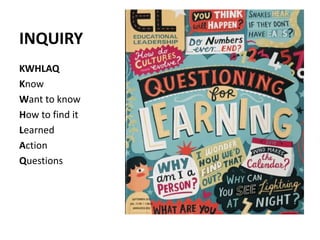
INQUIRY
KWHLAQ
Know
Want to know
How to find it
Learned
Action
Questions
Inquiry-Based Learning: Developing
Student-Driven Questions
• https://www.youtube.com/watch?v=OdYev6
MXTOA
4 Steps of Inquiry-based Learning
1. Students develop questions they are hungry
to answer.
2. Research the topic using time in class.
3. Have students present what they’ve learned.
4. Ask students to reflect on what worked about
the process and what didn’t.
Teacher Involvement
• “While flexibility is key to success with inquiry,
class time is not a free-for-all. Teachers always
need to guide the inquiry toward further
learning and keep students from being
sidetracked.”
• Source: Inquiry-based learning: Developing student-driven
questions http://goo.gl/5NvXHN
4 Steps of Inquiry-based Learning
Now it’s your turn!!
1. Teacher candidates develop questions they
are hungry to answer.
2. Research the topic using time in class.
3. Present what you’ve learned.
4. Reflect on what worked about the process
and what didn’t.
Inquiry Project – Monograph
• To be created by your group
• Worth 25% of final grade
• See Syllabus and Evaluation Components
(Sakai – Syllabus tab) for rubrics
• Due Jan. 23 (sec. 5) or Jan. 24 (sec. 6)
Monograph Support
• Checklist and structure
• Exemplars from 2016 - 2018
• Sakai: Resources/Monograph samples
• Research for journal articles:
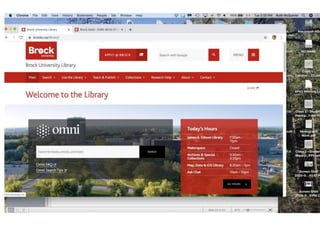
– Brock Library: Omni
• Brocku.ca/library
Meeting Logs
• Sign up for being facilitator/recorder
• On your assigned day, complete and upload
Meeting Log to Sakai Forum by end of day
• Designed for goal setting, reflection on
collaboration, division of responsibility etc.
• Log forms are on Sakai under Resources and in
each Forum.
Collaborative Inquiry Time
• Tasks:
– Narrow inquiry focus
– Identify inquiry question
– Brainstorm Learning Objects
– Complete Meeting Log #1
• Post it to Forum by end of today

Class 2 student inquiry 2020 final

  • 1.
  • 2.
    Agenda • Social JusticePicture Book: 30 min • Asking Questions: Mars One • Student Inquiry • Collaborative Teacher Inquiry • Inquiry Project: Group time – Monograph – Essential Question – Meeting Log
  • 3.
    Support on Sakai •ETFO: A Social Justice Approach – Lesson plan and picture book for each grade
  • 5.
    “It is, infact, nothing short of a miracle that the modern methods of instruction have not yet entirely strangled the holy curiosity of inquiry.” Albert Einstein Creative Commons
  • 6.
  • 7.
    Questions??? • What questionsdoes your Table Group have about the Mars One Project? Make a list • Now consult the Question Matrix (copy provided and on Sakai). Try to add questions from various cells on the matrix, especially the bottom right quadrant.
  • 9.
    Next step… • Goto Sakai and read the Mars One update from January 2018
  • 10.
    • Which ofyour questions have been answered by this source? • What further or remaining questions do you have? • How will you find the answers?
  • 12.
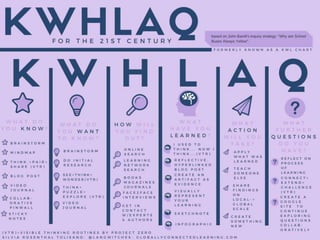
    INQUIRY KWHLAQ Know Want to know Howto find it Learned Action Questions
  • 14.
    Inquiry-Based Learning: Developing Student-DrivenQuestions • https://www.youtube.com/watch?v=OdYev6 MXTOA
  • 15.
    4 Steps ofInquiry-based Learning 1. Students develop questions they are hungry to answer. 2. Research the topic using time in class. 3. Have students present what they’ve learned. 4. Ask students to reflect on what worked about the process and what didn’t.
  • 16.
    Teacher Involvement • “Whileflexibility is key to success with inquiry, class time is not a free-for-all. Teachers always need to guide the inquiry toward further learning and keep students from being sidetracked.” • Source: Inquiry-based learning: Developing student-driven questions http://goo.gl/5NvXHN
  • 17.
    4 Steps ofInquiry-based Learning Now it’s your turn!! 1. Teacher candidates develop questions they are hungry to answer. 2. Research the topic using time in class. 3. Present what you’ve learned. 4. Reflect on what worked about the process and what didn’t.
  • 19.
    Inquiry Project –Monograph • To be created by your group • Worth 25% of final grade • See Syllabus and Evaluation Components (Sakai – Syllabus tab) for rubrics • Due Jan. 23 (sec. 5) or Jan. 24 (sec. 6)
  • 20.
    Monograph Support • Checklistand structure • Exemplars from 2016 - 2018 • Sakai: Resources/Monograph samples • Research for journal articles: – Brock Library: Omni • Brocku.ca/library
  • 22.
    Meeting Logs • Signup for being facilitator/recorder • On your assigned day, complete and upload Meeting Log to Sakai Forum by end of day • Designed for goal setting, reflection on collaboration, division of responsibility etc. • Log forms are on Sakai under Resources and in each Forum.
  • 23.
    Collaborative Inquiry Time •Tasks: – Narrow inquiry focus – Identify inquiry question – Brainstorm Learning Objects – Complete Meeting Log #1 • Post it to Forum by end of today

Editor's Notes

  • #6 This is a lead-in to the video on inquiry that stresses the importance of meeting the needs of students in a 21st. Century context.
  • #7 This trailer (second link) gives a brief overview of Mars One, and is the lead-in to the newspaper article that follows
  • #12 https://senoraferguson.edublogs.org/files/2015/07/KWHLAQ-v2-tolisano-2g7unms.png A version of KWL chart that reflects an inquiry-based focus with addition of “How”, “Action” and Q (further questions). The slide that follows identifies each letter.
  • #13 This ties into critical literacy approaches, which stress asking deeper questions and acting on perceived social injustices
  • #15 Good examples of students generating questions for inquiry
  • #16 Very simple framework for inquiry but easy for TCs to grasp. Following this, slides try to show that the teacher’s role is crucial in inquiry and that much scaffolding, monitoring, and coaching are usually needed by the teacher. Very important that we show how the student inquiry process is also the process they will follow in their Collaborative Teacher Inquiry groups. We, also, have built in scaffolding in the form of in-class time to work with us present, supports for developing Learning Objects, clear criteria, group logs (with goal setting), reflections etc.
  • #17 I will explain that while the teacher’s role in an inquiry classroom is different than with teacher-directed lessons, the teacher is still a vital component of successful inquiry. Will then link with Learning Skills and Research Skills. [and will at the same time connect this with how we have built in accountability and professionalism into the project (log etc.) as well as our attendance policy and marks for professionalism]
  • #18 Repeating slide to show how we are modelling these steps. . Week 1, class 2: They developed questions . Week 2, class 1: They will begin to refine their inquiry question and research the topic
  • #20 Indicate that this relates to Step 2 in the Inquiry Process in previous slide: “Research the topic using time in class.” I have made a handout that is another support for the structure of the monograph (attached) in addition to what is in the Evaluation document on Sakai.
  • #24 Lots to cover – as usual, we do what we can 