Assessment for active
learning
Dr Clarissa Wilks
Dean of Learning and Teaching
Kingston University
Session outline
 Designing assessment
 Integrating assessment into learning: loading and timing
 Engaging students with assessment: presentation, practice and feedforward
 Developing skills for assessment: confidence and academic integrity
 Ensuring fairness in assessment: grade and assessment/marking criteria
Principles for assessment design at
course level
The overall assessment regime for the course should be designed to
help students learn and to demonstrate that they have met the
learning outcomes of the programme and of each level of study.
Has the assessment experience been mapped from the student perspective to ensure that helps
them to build knowledge and skills progressively through the course?
Are the types of assessment carefully planned across levels and the course as a whole?
Do all modules provide explicit formative opportunities for practice and ‘feed forward’
designed to help students reach their full potential in summative assessment?
Has the loading and timing of assessment been planned from the students’ perspective?
Does the assessment reinforce the overall coherence of the course, e.g. through a final year
‘capstone’ project?
The ultimate aim…
Assessment done
with students not
to students
Integrating assessment: loadings and timing
How does your course team ensure equivalence of
loadings across the course?
How does your team map assessments across the
year to ensure the best learning experience for
students?
Engaging students with assessment
What forms of formative and feedforward
assessment do you find most effective?
How can we present assessment to students most
effectively?
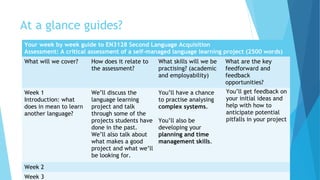
At a glance guides?
Your week by week guide to EN3128 Second Language Acquisition
Assessment: A critical assessment of a self-managed language learning project (2500 words)
What will we cover? How does it relate to
the assessment?
What skills will we be
practising? (academic
and employability)
What are the key
feedforward and
feedback
opportunities?
Week 1
Introduction: what
does in mean to learn
another language?
We’ll discuss the
language learning
project and talk
through some of the
projects students have
done in the past.
We’ll also talk about
what makes a good
project and what we’ll
be looking for.
You’ll have a chance
to practise analysing
complex systems.
You’ll also be
developing your
planning and time
management skills.
You’ll get feedback on
your initial ideas and
help with how to
anticipate potential
pitfalls in your project
Week 2
Week 3
Developing skills for assessment
 Confidence
 What have you found most effective in building students’
confidence for assessment?
 Academic integrity
 How can we develop students’ understanding of academic
integrity in relation to assessment?
Supporting students and ensuring
fairness
 Grade criteria and assessment/marking criteria
 What’s the difference between the two?
 Do you, and your students, use your institution’s
grade criteria?
Grade criteria and assessment criteria
 Make the language accessible
 Use them actively with students as a formative resource
 Tailor your formative and summative feedback to match the criteria
Learn to love assessment…
 Assessment is NOT just a necessary evil – but don’t overassess
 Don’t be afraid to ‘teach to the assessment’
 Work as a team

Assessment for learning

  • 1.
    Assessment for active learning DrClarissa Wilks Dean of Learning and Teaching Kingston University
  • 2.
    Session outline  Designingassessment  Integrating assessment into learning: loading and timing  Engaging students with assessment: presentation, practice and feedforward  Developing skills for assessment: confidence and academic integrity  Ensuring fairness in assessment: grade and assessment/marking criteria
  • 3.
    Principles for assessmentdesign at course level The overall assessment regime for the course should be designed to help students learn and to demonstrate that they have met the learning outcomes of the programme and of each level of study. Has the assessment experience been mapped from the student perspective to ensure that helps them to build knowledge and skills progressively through the course? Are the types of assessment carefully planned across levels and the course as a whole? Do all modules provide explicit formative opportunities for practice and ‘feed forward’ designed to help students reach their full potential in summative assessment? Has the loading and timing of assessment been planned from the students’ perspective? Does the assessment reinforce the overall coherence of the course, e.g. through a final year ‘capstone’ project?
  • 4.
    The ultimate aim… Assessmentdone with students not to students
  • 5.
    Integrating assessment: loadingsand timing How does your course team ensure equivalence of loadings across the course? How does your team map assessments across the year to ensure the best learning experience for students? Engaging students with assessment What forms of formative and feedforward assessment do you find most effective? How can we present assessment to students most effectively?
  • 6.
    At a glanceguides? Your week by week guide to EN3128 Second Language Acquisition Assessment: A critical assessment of a self-managed language learning project (2500 words) What will we cover? How does it relate to the assessment? What skills will we be practising? (academic and employability) What are the key feedforward and feedback opportunities? Week 1 Introduction: what does in mean to learn another language? We’ll discuss the language learning project and talk through some of the projects students have done in the past. We’ll also talk about what makes a good project and what we’ll be looking for. You’ll have a chance to practise analysing complex systems. You’ll also be developing your planning and time management skills. You’ll get feedback on your initial ideas and help with how to anticipate potential pitfalls in your project Week 2 Week 3
  • 7.
    Developing skills forassessment  Confidence  What have you found most effective in building students’ confidence for assessment?  Academic integrity  How can we develop students’ understanding of academic integrity in relation to assessment?
  • 8.
    Supporting students andensuring fairness  Grade criteria and assessment/marking criteria  What’s the difference between the two?  Do you, and your students, use your institution’s grade criteria?
  • 9.
    Grade criteria andassessment criteria  Make the language accessible  Use them actively with students as a formative resource  Tailor your formative and summative feedback to match the criteria
  • 10.
    Learn to loveassessment…  Assessment is NOT just a necessary evil – but don’t overassess  Don’t be afraid to ‘teach to the assessment’  Work as a team