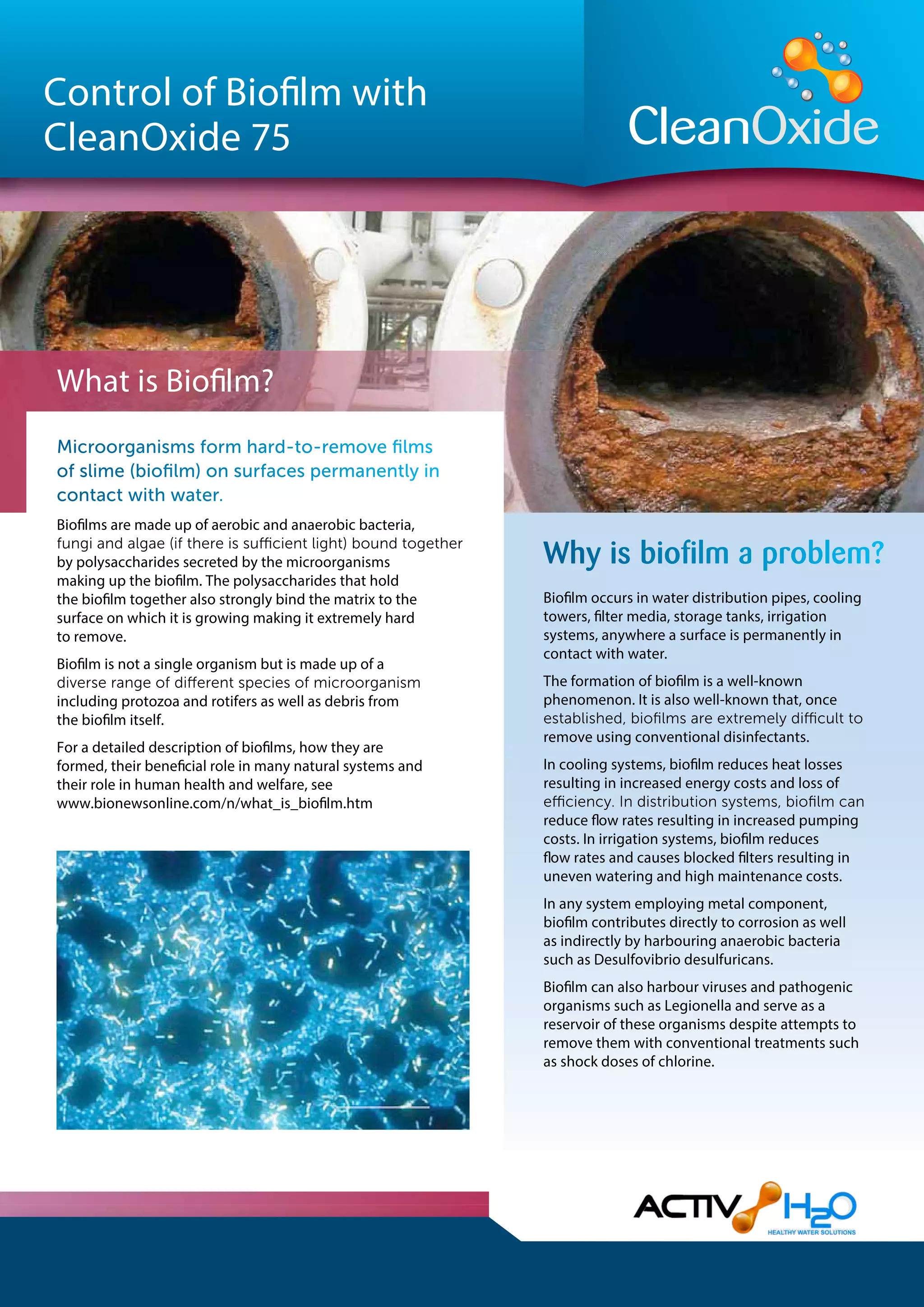
What is Biofilm?
Control of Biofilm with
CleanOxide 75
Biofilms are made up of aerobic and anaerobic bacteria,
by polysaccharides secreted by the microorganisms
making up the biofilm. The polysaccharides that hold
the biofilm together also strongly bind the matrix to the
surface on which it is growing making it extremely hard
to remove.
Biofilm is not a single organism but is made up of a
including protozoa and rotifers as well as debris from
the biofilm itself.
For a detailed description of biofilms, how they are
formed, their beneficial role in many natural systems and
their role in human health and welfare, see
www.bionewsonline.com/n/what_is_biofilm.htm
Biofilm occurs in water distribution pipes, cooling
towers, filter media, storage tanks, irrigation
systems, anywhere a surface is permanently in
contact with water.
The formation of biofilm is a well-known
phenomenon. It is also well-known that, once
remove using conventional disinfectants.
In cooling systems, biofilm reduces heat losses
resulting in increased energy costs and loss of
reduce flow rates resulting in increased pumping
costs. In irrigation systems, biofilm reduces
flow rates and causes blocked filters resulting in
uneven watering and high maintenance costs.
In any system employing metal component,
biofilm contributes directly to corrosion as well
as indirectly by harbouring anaerobic bacteria
such as Desulfovibrio desulfuricans.
Biofilm can also harbour viruses and pathogenic
organisms such as Legionella and serve as a
reservoir of these organisms despite attempts to
remove them with conventional treatments such
as shock doses of chlorine.
Control of Biofilm by Conventional Methods
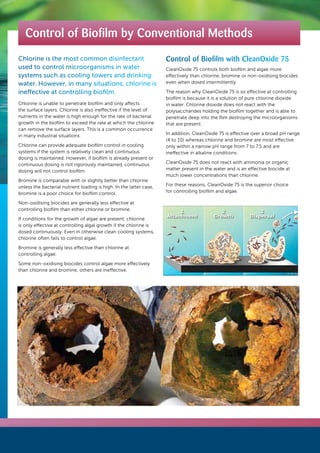
Chlorine is the most common disinfectant
used to control microorganisms in water
systems such as cooling towers and drinking
water. However, in many situations, chlorine is
ineffective at controlling biofilm.
Chlorine is unable to penetrate biofilm and only affects
the surface layers. Chlorine is also ineffective if the level of
nutrients in the water is high enough for the rate of bacterial
growth in the biofilm to exceed the rate at which the chlorine
can remove the surface layers. This is a common occurrence
in many industrial situations.
Chlorine can provide adequate biofilm control in cooling
systems if the system is relatively clean and continuous
dosing is maintained. However, if biofilm is already present or
continuous dosing is not rigorously maintained, continuous
dosing will not control biofilm.
Bromine is comparable with or slightly better than chlorine
unless the bacterial nutrient loading is high. In the latter case,
bromine is a poor choice for biofilm control.
Non-oxidising biocides are generally less effective at
controlling biofilm than either chlorine or bromine.
If conditions for the growth of algae are present, chlorine
is only effective at controlling algal growth if the chlorine is
dosed continuously. Even in otherwise clean cooling systems,
chlorine often fails to control algae.
Bromine is generally less effective than chlorine at
controlling algae.
Some non-oxidising biocides control algae more effectively
than chlorine and bromine, others are ineffective.
Control of Biofilm with CleanOxide 75
CleanOxide 75 controls both biofilm and algae more
effectively than chlorine, bromine or non-oxidising biocides
even when dosed intermittently.
The reason why CleanOxide 75 is so effective at controlling
biofilm is because it is a solution of pure chlorine dioxide
in water. Chlorine dioxide does not react with the
polysaccharides holding the biofilm together and is able to
penetrate deep into the film destroying the microorganisms
that are present.
In addition, CleanOxide 75 is effective over a broad pH range
(4 to 10) whereas chlorine and bromine are most effective
only within a narrow pH range from 7 to 7.5 and are
ineffective in alkaline conditions.
CleanOxide 75 does not react with ammonia or organic
matter present in the water and is an effective biocide at
much lower concentrations than chlorine.
For these reasons, CleanOxide 75 is the superior choice
for controlling biofilm and algae.
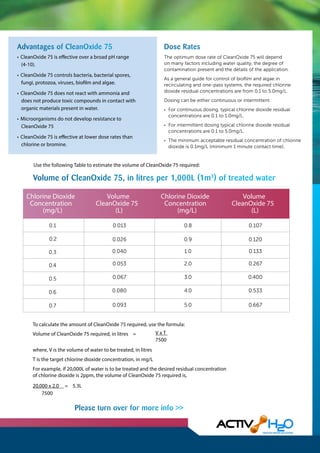
Use the following Table to estimate the volume of CleanOxide 75 required:
Chlorine Dioxide
Concentration
(mg/L)
Volume
CleanOxide 75
(L)
Chlorine Dioxide
Concentration
(mg/L)
Volume
CleanOxide 75
(L)
• CleanOxide 75 is effective over a broad pH range
(4-10).
• CleanOxide 75 controls bacteria, bacterial spores,
fungi, protozoa, viruses, biofilm and algae.
• CleanOxide 75 does not react with ammonia and
does not produce toxic compounds in contact with
organic materials present in water.
• Microorganisms do not develop resistance to
CleanOxide 75
• CleanOxide 75 is effective at lower dose rates than
chlorine or bromine.
•
•
•
To calculate the amount of CleanOxide 75 required, use the formula:
Volume of CleanOxide 75 required, in litres =
where, V is the volume of water to be treated, in litres
T is the target chlorine dioxide concentration, in mg/L
For example, if 20,000L of water is to be treated and the desired residual concentration
of chlorine dioxide is 2ppm, the volume of CleanOxide 75 required is,
V x T
7500
20,000 x 2.0 = 5.3L
7500
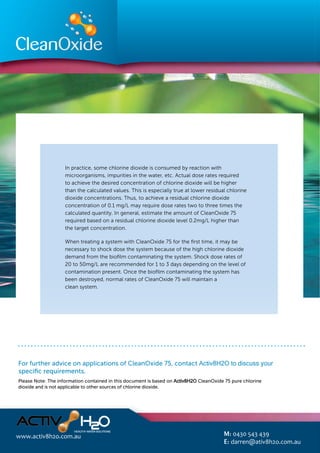
In practice, some chlorine dioxide is consumed by reaction with
microorganisms, impurities in the water, etc. Actual dose rates required
to achieve the desired concentration of chlorine dioxide will be higher
than the calculated values. This is especially true at lower residual chlorine
dioxide concentrations. Thus, to achieve a residual chlorine dioxide
concentration of 0.1 mg/L may require dose rates two to three times the
calculated quantity. In general, estimate the amount of CleanOxide 75
required based on a residual chlorine dioxide level 0.2mg/L higher than
the target concentration.
When treating a system with CleanOxide 75 for the first time, it may be
necessary to shock dose the system because of the high chlorine dioxide
demand from the biofilm contaminating the system. Shock dose rates of
20 to 50mg/L are recommended for 1 to 3 days depending on the level of
contamination present. Once the biofilm contaminating the system has
been destroyed, normal rates of CleanOxide 75 will maintain a
clean system.
discuss your specific requirements.
Please Note: The information contained in this document is based on Activ8H2O CleanOxide 75 pure chlorine
dioxide and is not applicable to other sources of chlorine dioxide.
For further advice on applications of CleanOxide 75, contact Activ8H2O to discuss your
specific requirements.
www.activ8h2o.com.au M: 0430 543 439
E: darren@ativ8h2o.com.au

biofilm

  • 1.
    What is Biofilm? Controlof Biofilm with CleanOxide 75 Biofilms are made up of aerobic and anaerobic bacteria, by polysaccharides secreted by the microorganisms making up the biofilm. The polysaccharides that hold the biofilm together also strongly bind the matrix to the surface on which it is growing making it extremely hard to remove. Biofilm is not a single organism but is made up of a including protozoa and rotifers as well as debris from the biofilm itself. For a detailed description of biofilms, how they are formed, their beneficial role in many natural systems and their role in human health and welfare, see www.bionewsonline.com/n/what_is_biofilm.htm Biofilm occurs in water distribution pipes, cooling towers, filter media, storage tanks, irrigation systems, anywhere a surface is permanently in contact with water. The formation of biofilm is a well-known phenomenon. It is also well-known that, once remove using conventional disinfectants. In cooling systems, biofilm reduces heat losses resulting in increased energy costs and loss of reduce flow rates resulting in increased pumping costs. In irrigation systems, biofilm reduces flow rates and causes blocked filters resulting in uneven watering and high maintenance costs. In any system employing metal component, biofilm contributes directly to corrosion as well as indirectly by harbouring anaerobic bacteria such as Desulfovibrio desulfuricans. Biofilm can also harbour viruses and pathogenic organisms such as Legionella and serve as a reservoir of these organisms despite attempts to remove them with conventional treatments such as shock doses of chlorine.
  • 2.
    Control of Biofilmby Conventional Methods Chlorine is the most common disinfectant used to control microorganisms in water systems such as cooling towers and drinking water. However, in many situations, chlorine is ineffective at controlling biofilm. Chlorine is unable to penetrate biofilm and only affects the surface layers. Chlorine is also ineffective if the level of nutrients in the water is high enough for the rate of bacterial growth in the biofilm to exceed the rate at which the chlorine can remove the surface layers. This is a common occurrence in many industrial situations. Chlorine can provide adequate biofilm control in cooling systems if the system is relatively clean and continuous dosing is maintained. However, if biofilm is already present or continuous dosing is not rigorously maintained, continuous dosing will not control biofilm. Bromine is comparable with or slightly better than chlorine unless the bacterial nutrient loading is high. In the latter case, bromine is a poor choice for biofilm control. Non-oxidising biocides are generally less effective at controlling biofilm than either chlorine or bromine. If conditions for the growth of algae are present, chlorine is only effective at controlling algal growth if the chlorine is dosed continuously. Even in otherwise clean cooling systems, chlorine often fails to control algae. Bromine is generally less effective than chlorine at controlling algae. Some non-oxidising biocides control algae more effectively than chlorine and bromine, others are ineffective. Control of Biofilm with CleanOxide 75 CleanOxide 75 controls both biofilm and algae more effectively than chlorine, bromine or non-oxidising biocides even when dosed intermittently. The reason why CleanOxide 75 is so effective at controlling biofilm is because it is a solution of pure chlorine dioxide in water. Chlorine dioxide does not react with the polysaccharides holding the biofilm together and is able to penetrate deep into the film destroying the microorganisms that are present. In addition, CleanOxide 75 is effective over a broad pH range (4 to 10) whereas chlorine and bromine are most effective only within a narrow pH range from 7 to 7.5 and are ineffective in alkaline conditions. CleanOxide 75 does not react with ammonia or organic matter present in the water and is an effective biocide at much lower concentrations than chlorine. For these reasons, CleanOxide 75 is the superior choice for controlling biofilm and algae.
  • 3.
    Use the followingTable to estimate the volume of CleanOxide 75 required: Chlorine Dioxide Concentration (mg/L) Volume CleanOxide 75 (L) Chlorine Dioxide Concentration (mg/L) Volume CleanOxide 75 (L) • CleanOxide 75 is effective over a broad pH range (4-10). • CleanOxide 75 controls bacteria, bacterial spores, fungi, protozoa, viruses, biofilm and algae. • CleanOxide 75 does not react with ammonia and does not produce toxic compounds in contact with organic materials present in water. • Microorganisms do not develop resistance to CleanOxide 75 • CleanOxide 75 is effective at lower dose rates than chlorine or bromine. • • • To calculate the amount of CleanOxide 75 required, use the formula: Volume of CleanOxide 75 required, in litres = where, V is the volume of water to be treated, in litres T is the target chlorine dioxide concentration, in mg/L For example, if 20,000L of water is to be treated and the desired residual concentration of chlorine dioxide is 2ppm, the volume of CleanOxide 75 required is, V x T 7500 20,000 x 2.0 = 5.3L 7500
  • 4.
    In practice, somechlorine dioxide is consumed by reaction with microorganisms, impurities in the water, etc. Actual dose rates required to achieve the desired concentration of chlorine dioxide will be higher than the calculated values. This is especially true at lower residual chlorine dioxide concentrations. Thus, to achieve a residual chlorine dioxide concentration of 0.1 mg/L may require dose rates two to three times the calculated quantity. In general, estimate the amount of CleanOxide 75 required based on a residual chlorine dioxide level 0.2mg/L higher than the target concentration. When treating a system with CleanOxide 75 for the first time, it may be necessary to shock dose the system because of the high chlorine dioxide demand from the biofilm contaminating the system. Shock dose rates of 20 to 50mg/L are recommended for 1 to 3 days depending on the level of contamination present. Once the biofilm contaminating the system has been destroyed, normal rates of CleanOxide 75 will maintain a clean system. discuss your specific requirements. Please Note: The information contained in this document is based on Activ8H2O CleanOxide 75 pure chlorine dioxide and is not applicable to other sources of chlorine dioxide. For further advice on applications of CleanOxide 75, contact Activ8H2O to discuss your specific requirements. www.activ8h2o.com.au M: 0430 543 439 E: darren@ativ8h2o.com.au