TRICARBOXYLIC
ACID CYCLE
Dr. Apeksha Niraula
Junior Resident
Department of Biochemistry
“The wheel is turning and the sugar is
burning”
By the end :
 Basic concept : TCA Cycle
 Steps of TCA Cycle
 Elaboration of each step
 Enzyme Complexes
 Regulation of the cycle.
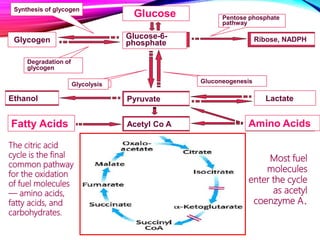
Glucose
Glucose-6-
phosphate
Pyruvate
Glycogen Ribose, NADPH
Pentose phosphate
pathway
Synthesis of glycogen
Degradation of
glycogen
Glycolysis Gluconeogenesis
LactateEthanol
Acetyl Co AFatty Acids Amino Acids
The citric acid
cycle is the final
common pathway
for the oxidation
of fuel molecules
— amino acids,
fatty acids, and
carbohydrates.
Most fuel
molecules
enter the cycle
as acetyl
coenzyme A.
Synonyms:
The Citric Acid Cycle
Tricarboxylic Acid
Cycle
Krebs Cycle
In eukaryotes
the reactions
of the citric
acid cycle
take place
inside
mitochondria
Hans Adolf Krebs.
Biochemist; born in
Germany. Worked in
Britain. His discovery in
1937 of the ‘Krebs cycle’
of chemical reactions was
critical to the
understanding of cell
metabolism and earned
him the 1953 Nobel Prize
for Physiology or
Medicine.
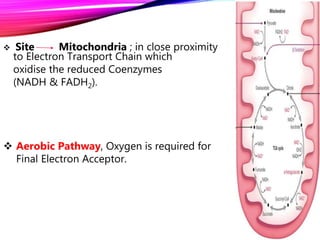
 Site Mitochondria ; in close proximity
to Electron Transport Chain which
oxidise the reduced Coenzymes
(NADH & FADH2).
 Aerobic Pathway, Oxygen is required for
Final Electron Acceptor.
 Final Pathway where the oxidative catabolism of
Carbohydrates, Amino Acids and Fatty Acids Converge
Their Carbon Skeletons being converted to CO2.
Production of Acetyl-CoA (Activated
Acetate)
 Before entering the citric acid cycle, the carbon
skeletons of sugars and fatty acids are degraded to
the acetyl group of Acetyl-CoA.
 Oxidative decarboxylation of Pyruvate.
Acetyl CoA
Glucose
Pyruvate
Fatty Acids
Ketogenic
Amino Acids
Oxidation
Fatty Acid
Cholesterol
Steroid
Hormones
Ketone Bodies
Pyruvate Dehydrogenase Complex
 Multienzyme complex series of chemical
intermediates remain bound to the enzyme molecules as a
substrate is transformed into the final product.
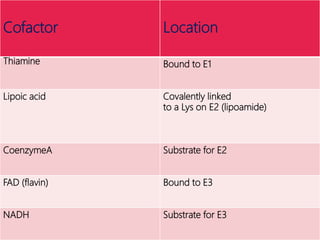
 Five Co-factors, Four derived from vitamins is needed.
 Prototype for two other important enzyme complexes:
a-ketoglutarate dehydrogenase, of the citric acid cycle
and the branched-chain a-keto acid
dehydrogenase, of the oxidative pathways of several
amino acids.
Cofactor Location
Thiamine Bound to E1
Lipoic acid Covalently linked
to a Lys on E2 (lipoamide)
CoenzymeA Substrate for E2
FAD (flavin) Bound to E3
NADH Substrate for E3
E2 subunits E1 orange, E3 Red a and b
together
1. Enzymatic reactions rates are limited by diffusion, with
shorter distance between subunits a enzyme can
almost direct the substrate from one subunit(catalytic
site) to another.
2. Substrate Channeling:
Channeling metabolic
intermediates between successive enzymes
minimizes side reactions.
3. The reactions of a multienzyme complex
can be coordinately controlled.
Why such a complex set of
enzymes?
1.) Citrate Synthase is the Gateway to the
TCA Cycle
 First step of TCA Cycle catalyzed by Citrate
Synthase.
 Acetyl-CoA enters the cycle, complexes with Oxaloacetate
and Citrate is formed.
 Reaction is an Aldol Condensation.
 Reaction is highly favourable thermodynamically,
because the concentration of Oxaloacetate in
cells is extremely low.
 OAA first condenses with Acetyl CoA Citroyl CoA
Citrate Synthase
∆G0= -32.2 KJ/mol
Citrate Synthase:
 Two domains, one large and
rigid, the other smaller and more
flexible, with the active site
between them.
 Oxaloacetate first substrate to
bind to the enzyme, induces a
large conformational change in
the flexible domain, creating a
binding site for the second
substrate, acetyl-CoA.
2.) Aconitase Catalyzes the Isomerization of
Citrate to Isocitrate
 Dehydration followed by Hydration reaction.
 Cis aconitate; a transient compound with a very short
half-life.
Aconitase
 The Ferris Wheel
 Contains an Iron-Sulphur center
which acts both in the
binding of the substrate at the
active site and in the catalytic
addition or removal of H2O.
 Aconitase is one of many enzymes
known to "moonlight" in a second
Role.
Moonlighting Enzymes: Protein with more than
one Job
 “One Gene-One Enzyme” Dictum violated by the
exception in which a single protein encoded by a single
gene clearly does more than one job in the
cell.
 Aconitase is one such Protein: Acts both as an Enzyme
and as a regulator of protein synthesis.
 Two Isoenzymes of Aconitase.
 Mitochondrial Isozyme converts Citrate to Isocitrate in TCA
Cycle.
 Cytosolic Isozyme: 2 Distinct functions
Catalyzes the conversion of Citrate to Isocitrate providing the
substrate for a cytosolic Isocitrate Dehydrogenase
Generates NADH for Fatty Acid Synthesis and other
anabolic processes in the cytosol.
 Role in Cellular Iron Homeostasis.
 Transferrin
 Transferrin Receptor Principal proteins for regulation of
Iron
 Ferritin
 Aconitase in its “Moonlighting” job plays a key regulatory
role.
 Aconitase Fe-S Cluster at its active site.
 When a cell is depleted of iron, Fe-S cluster is
disassembled and the enzyme loses its Aconitase activity.
 Apoenzyme(Apo-Aconitase lacking its Fe-S Cluster) now
acquired the second activity.
Ability to bind to the specific sequences in the mRNA’s
for the Transferrin receptor and Ferritin, thus regulating
protein synthesis at the translational level.
 Two Iron Regulatory Proteins: IRP1 and IRP2.
 IRP1 Identical to Cytosolic Apo-Aconitase.
 Both IRP1 and IRP2 bind to regions in the mRNA’s encoding
Ferritin and the Transferrin receptor with effects on Iron
mobilization and Iron uptake.
 These mRNA sequences are part of hairpin structures called Iron
Response Elements(IREs) located at the 5’ and 3’ ends of the
mRNAs.
Effect of IRP1 and 2 on the mRNA’s for
Ferritin and Transferrin receptor
Aconitase Binding Iron/RNA
 To become an iron response
regulator, aconitase changes
it shape (due to lack of iron)
so it can bind RNA).
Other Moon-Lighting Enzymes
 Pyruvate Kinase : Acts in the nucleus to regulate the
transcription of genes that respond to Thyroid
Hormone.
 Glyceraldehyde-3-Phosphate Dehydrogenase: moonlights
both as Uracil DNA glycosylase effecting the repair of
DNA and as a regulator of Histone H2B transcription.
 Phosphoglycerate Kinase
 Triose Phosphate Isomerase
3.) Isocitrate Dehyrogenase catalyses the
First Oxidation in the TCA Cycle
 First Oxidative conversion in the TCA Cycle.
 2 Steps : First oxidation to Oxalosuccinate followed by β
decarboxylation.
 Product is Alpha-Ketoglutarate.
4.) Alpha-Ketoglutarate Dehydrogenase
catalyzes the decarboxylation of
Alpha-Ketoglutarate to Succinyl CoA
 Second Oxidative Decarboxylation of TCA Cycle.
 Reaction Catalysed by Alpha-Ketoglutarate
Dehydrogenase complex.
 Enzyme similar to PDH Complex.
 The same Dihydrolipoyl Dehydrogenase subunit is
used in both complexes.
The -Ketoglutarate Dehydrogenase Co
• Similar to pyruvate dehydrogenase complex.
• Same coenzymes, identical mechanisms.
E1 - a-ketoglutarate dehydrogenase (with TPP)
E2 – dihydrolipoyl succinyltransferase (with flexible lipoamide
prosthetic group)
E3 - dihydrolipoyl dehydrogenase (with FAD)
-ketoglutarate
dehydrogenase
5.) Succinate Thiokinase Couples the
conversion of Succinyl-CoA the
conversion of Succinyl- CoA
 Succinyl-CoA Activated Intermediate.
Useful for the small amount of
Succinyl-CoA used in Heme
Synthesis.
 Nearly, all of the Succinyl CoA is retained in the TCA
cycle leading to the regeneration of
Oxaloacetate needed for condensation
with Acetyl-CoA to keep the cycle
operating.
 Substrate-Level Phosphorylation
HS-+
GTP + ADP GDP + ATP
Succinyl-CoA
Synthetase
6.) Succinate Dehydrogenase catalyzes the
oxidation of Succinate to Fumarate
 Oxidation of Succinate to Fumarate involves insertion of
a double bond into a saturated hydrocarbon chain:
Succinate Dehydrogenase
 This is not an easy or common reaction in Organic Chemistry.
 Nature of the reaction demands a strong oxidizing agent.
 NAD+ not a stong oxidizing agent to allow a reasonable
equilibrium constant.
 FAD Stronger oxidizing agents than NAD+.
 Succinate Dehydrogenase Flavoprotein Enzyme.
Only enzyme of TCA
cycle present in Inner
Mitochondrial
membrane.
 Oxidation of Succinate by the Electron acceptor of
Succinate Dehydrogenase is about 16 kcal (65kJ) more
favourable than it would be if the electron acceptor were
NAD+.
 Hence, FAD is a better oxidizing agent than NAD+, NADH
a better reducing agent than FADH2.
7.) Fumarase catalyses the addition of water
to Fumarate to form Malate
 Fumarase – Stereospecific Enzyme.
Fumarase
Don’t Confuse Malate And Maleate
8.) Malate Dehrogenase Catalyses the
Oxidation of Malate to Oxaloacetate
 Final Oxidation; surprisingly use NAD+ as an oxidizing agent.
 Standard free energy change 7 kcal/mole
 Steady-state concentration of Oxaloacetate is very low
Drives the reaction towards Right
(Oxaloacetate).
Malate DH Is Endothermic
Stereochemical Aspects of TCA Cycle Reactions
 Citrate a Symmetric molecule that reacts assymetrically.
 Citrate have no Chiral center but are potentially
capable of reacting asymmetric active site are now
called Prochiral Molecules.
Watch Where The Label Goes
Citrate Is Prochiral
TCA Cycle as an Amphibolic Pathway:
 Serves in both Catabolic and Anabolic Processes.
 Role in Catabolism: Catabolism of Carbohydrates,Fatty
Acids and Amino Acids.
 Also provides precursors for many biosynthetic pathways:
 Alpha-Ketoglutarate and OAA Aspartate
and Glutamate
by
Transamination
 Succinyl-CoA Synthesis of the Porphyrin Ring of Heme
Groups serve as oxygen carriers( In Hemoglobin and
Myoglobin) and Electron Carriers ( Cytochromes)
Role of Citric Acid Cycle in Anabolism
Anaplerotic Reactions (Filling-Up Reactions
Step No Reactions Co-Enzyme ATP Generated
3 Isocitrate Alpha-
Ketoglutarate
NADH 2.5
4 Alpha-Ketoglutarate
Succinyl CoA
NADH 2.5
5 Succinyl CoA Succinate GTP 1
6 Succinate Fumarate FADH2 1.5
8 Malate Oxaloacetate NADH 2.5
Total: 10
Glyoxylate
Cycle
Regulation of the Citric Acid
Cycle
• Pathway controlled by:
I. Substrate Availability
II. Allosteric Regulation
III. Covalent Modification
Three enzymes have regulatory properties
 Citrate synthase
Allosterically inhibited by NADH, ATP, succinyl CoA,
Citrate – feedback inhibition.
 Isocitrate dehydrogenase
Allosteric effectors: (+) ADP; (-) NADH, ATP. Bacterial
ICDH can be covalently modified by kinase/phosphatase.
 -ketoglutarate dehydrogenase complex
Inhibition by ATP, succinyl CoA and NADH.
Regulation of TCA Cycle
Thank You

Citric acid cycle

  • 2.
    TRICARBOXYLIC ACID CYCLE Dr. ApekshaNiraula Junior Resident Department of Biochemistry “The wheel is turning and the sugar is burning”
  • 3.
    By the end:  Basic concept : TCA Cycle  Steps of TCA Cycle  Elaboration of each step  Enzyme Complexes  Regulation of the cycle.
  • 4.
    Glucose Glucose-6- phosphate Pyruvate Glycogen Ribose, NADPH Pentosephosphate pathway Synthesis of glycogen Degradation of glycogen Glycolysis Gluconeogenesis LactateEthanol Acetyl Co AFatty Acids Amino Acids The citric acid cycle is the final common pathway for the oxidation of fuel molecules — amino acids, fatty acids, and carbohydrates. Most fuel molecules enter the cycle as acetyl coenzyme A.
  • 5.
    Synonyms: The Citric AcidCycle Tricarboxylic Acid Cycle Krebs Cycle In eukaryotes the reactions of the citric acid cycle take place inside mitochondria Hans Adolf Krebs. Biochemist; born in Germany. Worked in Britain. His discovery in 1937 of the ‘Krebs cycle’ of chemical reactions was critical to the understanding of cell metabolism and earned him the 1953 Nobel Prize for Physiology or Medicine.
  • 6.
     Site Mitochondria; in close proximity to Electron Transport Chain which oxidise the reduced Coenzymes (NADH & FADH2).  Aerobic Pathway, Oxygen is required for Final Electron Acceptor.
  • 7.
     Final Pathwaywhere the oxidative catabolism of Carbohydrates, Amino Acids and Fatty Acids Converge Their Carbon Skeletons being converted to CO2.
  • 8.
    Production of Acetyl-CoA(Activated Acetate)  Before entering the citric acid cycle, the carbon skeletons of sugars and fatty acids are degraded to the acetyl group of Acetyl-CoA.  Oxidative decarboxylation of Pyruvate.
  • 9.
    Acetyl CoA Glucose Pyruvate Fatty Acids Ketogenic AminoAcids Oxidation Fatty Acid Cholesterol Steroid Hormones Ketone Bodies
  • 10.
    Pyruvate Dehydrogenase Complex Multienzyme complex series of chemical intermediates remain bound to the enzyme molecules as a substrate is transformed into the final product.  Five Co-factors, Four derived from vitamins is needed.  Prototype for two other important enzyme complexes: a-ketoglutarate dehydrogenase, of the citric acid cycle and the branched-chain a-keto acid dehydrogenase, of the oxidative pathways of several amino acids.
  • 12.
    Cofactor Location Thiamine Boundto E1 Lipoic acid Covalently linked to a Lys on E2 (lipoamide) CoenzymeA Substrate for E2 FAD (flavin) Bound to E3 NADH Substrate for E3
  • 13.
    E2 subunits E1orange, E3 Red a and b together
  • 14.
    1. Enzymatic reactionsrates are limited by diffusion, with shorter distance between subunits a enzyme can almost direct the substrate from one subunit(catalytic site) to another. 2. Substrate Channeling: Channeling metabolic intermediates between successive enzymes minimizes side reactions. 3. The reactions of a multienzyme complex can be coordinately controlled. Why such a complex set of enzymes?
  • 15.
    1.) Citrate Synthaseis the Gateway to the TCA Cycle  First step of TCA Cycle catalyzed by Citrate Synthase.  Acetyl-CoA enters the cycle, complexes with Oxaloacetate and Citrate is formed.  Reaction is an Aldol Condensation.
  • 16.
     Reaction ishighly favourable thermodynamically, because the concentration of Oxaloacetate in cells is extremely low.  OAA first condenses with Acetyl CoA Citroyl CoA Citrate Synthase ∆G0= -32.2 KJ/mol
  • 17.
    Citrate Synthase:  Twodomains, one large and rigid, the other smaller and more flexible, with the active site between them.  Oxaloacetate first substrate to bind to the enzyme, induces a large conformational change in the flexible domain, creating a binding site for the second substrate, acetyl-CoA.
  • 19.
    2.) Aconitase Catalyzesthe Isomerization of Citrate to Isocitrate  Dehydration followed by Hydration reaction.  Cis aconitate; a transient compound with a very short half-life.
  • 20.
    Aconitase  The FerrisWheel  Contains an Iron-Sulphur center which acts both in the binding of the substrate at the active site and in the catalytic addition or removal of H2O.  Aconitase is one of many enzymes known to "moonlight" in a second Role.
  • 21.
    Moonlighting Enzymes: Proteinwith more than one Job  “One Gene-One Enzyme” Dictum violated by the exception in which a single protein encoded by a single gene clearly does more than one job in the cell.  Aconitase is one such Protein: Acts both as an Enzyme and as a regulator of protein synthesis.  Two Isoenzymes of Aconitase.
  • 22.
     Mitochondrial Isozymeconverts Citrate to Isocitrate in TCA Cycle.  Cytosolic Isozyme: 2 Distinct functions Catalyzes the conversion of Citrate to Isocitrate providing the substrate for a cytosolic Isocitrate Dehydrogenase Generates NADH for Fatty Acid Synthesis and other anabolic processes in the cytosol.  Role in Cellular Iron Homeostasis.
  • 23.
     Transferrin  TransferrinReceptor Principal proteins for regulation of Iron  Ferritin  Aconitase in its “Moonlighting” job plays a key regulatory role.  Aconitase Fe-S Cluster at its active site.
  • 24.
     When acell is depleted of iron, Fe-S cluster is disassembled and the enzyme loses its Aconitase activity.  Apoenzyme(Apo-Aconitase lacking its Fe-S Cluster) now acquired the second activity. Ability to bind to the specific sequences in the mRNA’s for the Transferrin receptor and Ferritin, thus regulating protein synthesis at the translational level.
  • 25.
     Two IronRegulatory Proteins: IRP1 and IRP2.  IRP1 Identical to Cytosolic Apo-Aconitase.  Both IRP1 and IRP2 bind to regions in the mRNA’s encoding Ferritin and the Transferrin receptor with effects on Iron mobilization and Iron uptake.  These mRNA sequences are part of hairpin structures called Iron Response Elements(IREs) located at the 5’ and 3’ ends of the mRNAs.
  • 26.
    Effect of IRP1and 2 on the mRNA’s for Ferritin and Transferrin receptor
  • 27.
    Aconitase Binding Iron/RNA To become an iron response regulator, aconitase changes it shape (due to lack of iron) so it can bind RNA).
  • 28.
    Other Moon-Lighting Enzymes Pyruvate Kinase : Acts in the nucleus to regulate the transcription of genes that respond to Thyroid Hormone.  Glyceraldehyde-3-Phosphate Dehydrogenase: moonlights both as Uracil DNA glycosylase effecting the repair of DNA and as a regulator of Histone H2B transcription.  Phosphoglycerate Kinase  Triose Phosphate Isomerase
  • 29.
    3.) Isocitrate Dehyrogenasecatalyses the First Oxidation in the TCA Cycle  First Oxidative conversion in the TCA Cycle.  2 Steps : First oxidation to Oxalosuccinate followed by β decarboxylation.  Product is Alpha-Ketoglutarate.
  • 31.
    4.) Alpha-Ketoglutarate Dehydrogenase catalyzesthe decarboxylation of Alpha-Ketoglutarate to Succinyl CoA  Second Oxidative Decarboxylation of TCA Cycle.  Reaction Catalysed by Alpha-Ketoglutarate Dehydrogenase complex.  Enzyme similar to PDH Complex.  The same Dihydrolipoyl Dehydrogenase subunit is used in both complexes.
  • 34.
    The -Ketoglutarate DehydrogenaseCo • Similar to pyruvate dehydrogenase complex. • Same coenzymes, identical mechanisms. E1 - a-ketoglutarate dehydrogenase (with TPP) E2 – dihydrolipoyl succinyltransferase (with flexible lipoamide prosthetic group) E3 - dihydrolipoyl dehydrogenase (with FAD) -ketoglutarate dehydrogenase
  • 35.
    5.) Succinate ThiokinaseCouples the conversion of Succinyl-CoA the conversion of Succinyl- CoA  Succinyl-CoA Activated Intermediate. Useful for the small amount of Succinyl-CoA used in Heme Synthesis.  Nearly, all of the Succinyl CoA is retained in the TCA cycle leading to the regeneration of Oxaloacetate needed for condensation with Acetyl-CoA to keep the cycle operating.
  • 36.
     Substrate-Level Phosphorylation HS-+ GTP+ ADP GDP + ATP Succinyl-CoA Synthetase
  • 37.
    6.) Succinate Dehydrogenasecatalyzes the oxidation of Succinate to Fumarate  Oxidation of Succinate to Fumarate involves insertion of a double bond into a saturated hydrocarbon chain: Succinate Dehydrogenase
  • 38.
     This isnot an easy or common reaction in Organic Chemistry.  Nature of the reaction demands a strong oxidizing agent.  NAD+ not a stong oxidizing agent to allow a reasonable equilibrium constant.  FAD Stronger oxidizing agents than NAD+.  Succinate Dehydrogenase Flavoprotein Enzyme. Only enzyme of TCA cycle present in Inner Mitochondrial membrane.
  • 39.
     Oxidation ofSuccinate by the Electron acceptor of Succinate Dehydrogenase is about 16 kcal (65kJ) more favourable than it would be if the electron acceptor were NAD+.  Hence, FAD is a better oxidizing agent than NAD+, NADH a better reducing agent than FADH2.
  • 40.
    7.) Fumarase catalysesthe addition of water to Fumarate to form Malate  Fumarase – Stereospecific Enzyme. Fumarase
  • 41.
  • 42.
    8.) Malate DehrogenaseCatalyses the Oxidation of Malate to Oxaloacetate  Final Oxidation; surprisingly use NAD+ as an oxidizing agent.  Standard free energy change 7 kcal/mole  Steady-state concentration of Oxaloacetate is very low Drives the reaction towards Right (Oxaloacetate).
  • 43.
    Malate DH IsEndothermic
  • 45.
    Stereochemical Aspects ofTCA Cycle Reactions  Citrate a Symmetric molecule that reacts assymetrically.  Citrate have no Chiral center but are potentially capable of reacting asymmetric active site are now called Prochiral Molecules.
  • 46.
    Watch Where TheLabel Goes
  • 47.
  • 48.
    TCA Cycle asan Amphibolic Pathway:  Serves in both Catabolic and Anabolic Processes.  Role in Catabolism: Catabolism of Carbohydrates,Fatty Acids and Amino Acids.  Also provides precursors for many biosynthetic pathways:  Alpha-Ketoglutarate and OAA Aspartate and Glutamate by Transamination  Succinyl-CoA Synthesis of the Porphyrin Ring of Heme Groups serve as oxygen carriers( In Hemoglobin and Myoglobin) and Electron Carriers ( Cytochromes)
  • 49.
    Role of CitricAcid Cycle in Anabolism
  • 51.
  • 52.
    Step No ReactionsCo-Enzyme ATP Generated 3 Isocitrate Alpha- Ketoglutarate NADH 2.5 4 Alpha-Ketoglutarate Succinyl CoA NADH 2.5 5 Succinyl CoA Succinate GTP 1 6 Succinate Fumarate FADH2 1.5 8 Malate Oxaloacetate NADH 2.5 Total: 10
  • 53.
  • 54.
    Regulation of theCitric Acid Cycle • Pathway controlled by: I. Substrate Availability II. Allosteric Regulation III. Covalent Modification
  • 56.
    Three enzymes haveregulatory properties  Citrate synthase Allosterically inhibited by NADH, ATP, succinyl CoA, Citrate – feedback inhibition.  Isocitrate dehydrogenase Allosteric effectors: (+) ADP; (-) NADH, ATP. Bacterial ICDH can be covalently modified by kinase/phosphatase.  -ketoglutarate dehydrogenase complex Inhibition by ATP, succinyl CoA and NADH.
  • 57.
  • 59.