Version Date [March 2015]
MALAYSIAN
CONSTITUTION
by
Mohamed Abdi Mohamed
Federation of Malaya
31 Aug 1957
The Federation was established on this day.
Federation of Malaya
The Federation was initially called
the Federation of Malaya (Persekutuan Tanah Melayu).
Johor
Kedah
Kelantan
Melaka
Negeri Sembilan
Pahang
Pulau Pinang
Perak
Perlis
Selangor
Terengganu
Malaysia
16 Sept 1963
The Federation was enlarged with 3 new member states, Sabah,
Sarawak and Singapore.
Malaysia
At the same time, its name was changed to Malaysia.
+ Sabah
+ Sarawak
+ Singapore
left the Federation in 1965
The Constitution is the SUPREME
LAW
of Malaysia
Any law passed after 31 Aug 1957 which is inconsistent with the
Constitution shall be void. Article 4(1).
Any court or tribunal applying the provision of any law in operation
immediately before 31 Aug 1957 may apply it with such modifications as
may be necessary to bring it into accord with the Constitution. Article
162(6).
Malaysia is a
CONSTITUTIONAL MONARCHY
Head of State Five-year reign Advice
The Yang di-
Pertuan Agong
(King) is
Malaysia’s
Constitutional
Head of State.
He is elected by
the Conference of
Rulers, by
rotation, from the
Rulers of the nine
Malay States.
Each King is elected
for a five year reign
The King
exercises his
executive powers
on the advice of
the Cabinet,
except on limited
matters.
The three branches of government are the
LEGISLATURE
EXECUTIVE
JUDICIARY
The Legislature make laws.
The Executive administers the laws.
The Judiciary interpret the laws.
Legislative Power
Parliament
Article 44
The Malaysian parliament is a bi-cameral legislature:
Dewan Negara
The Dewan Negara (the Senate) is the upper house
Dewan Rakyat
The Dewan Negara (House of Representatives)
is the lower house
PARLIAMENT BUILDING, KL
Executive Power
Articles 39 - 40
King acting on cabinet advice
Executive authority is vested in the King but, as a constitutional monarch, he
must act in accordance with the advice of the Cabinet, except on certain limited
matters such as the giving of consent to the early dissolution of Parliament.
Judiciary Power
Articles 121 – 131A
The judiciary deals with all civil and
criminal matters, other than those
which are under the Syariah courts.
The Federal Court is the highest civil
court. It has the power to determine
Constitutional issues.
Federal Court
Court of Appeal
High Courts
Subordinate Courts
PALACE OF JUSTICE, PUTRAJAYA
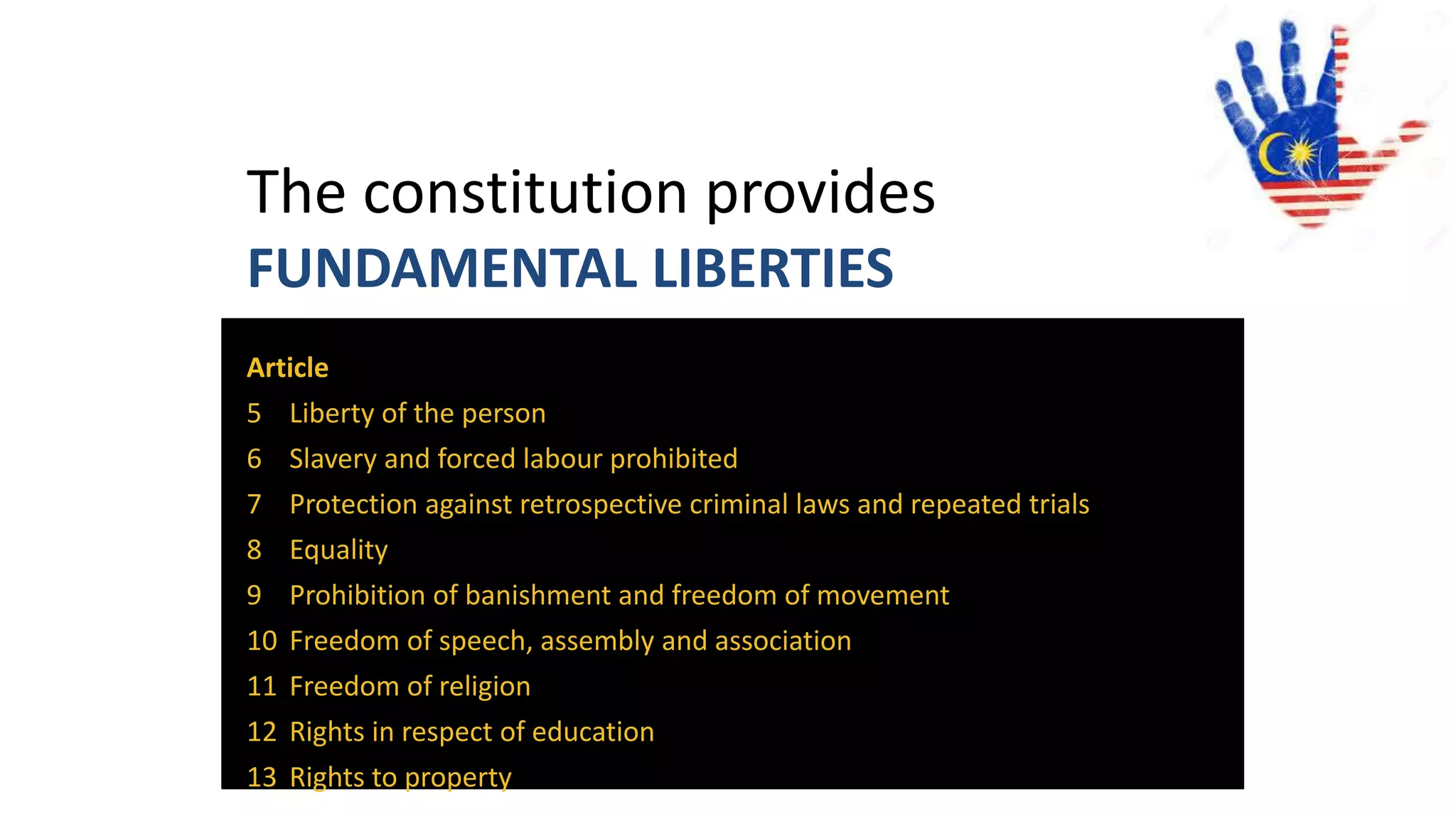
The constitution provides
FUNDAMENTAL LIBERTIES
Article
5 Liberty of the person
6 Slavery and forced labour prohibited
7 Protection against retrospective criminal laws and repeated trials
8 Equality
9 Prohibition of banishment and freedom of movement
10 Freedom of speech, assembly and association
11 Freedom of religion
12 Rights in respect of education
13 Rights to property
Federal Goverment
Federal List
State List
ConcurrentList
Article 74 of Federal Constitution :
State Goverment
Federal +
State
Goverment
-External affairs
-National defence
-Internal security
-Citizenship
-Etc.
-Islamic law
-Land
-Agriculture and
forestry
-Local services
-Etc.
Constitution of malaysia

Constitution of malaysia

  • 1.
    Version Date [March2015] MALAYSIAN CONSTITUTION by Mohamed Abdi Mohamed
  • 2.
    Federation of Malaya 31Aug 1957 The Federation was established on this day. Federation of Malaya The Federation was initially called the Federation of Malaya (Persekutuan Tanah Melayu). Johor Kedah Kelantan Melaka Negeri Sembilan Pahang Pulau Pinang Perak Perlis Selangor Terengganu
  • 3.
    Malaysia 16 Sept 1963 TheFederation was enlarged with 3 new member states, Sabah, Sarawak and Singapore. Malaysia At the same time, its name was changed to Malaysia. + Sabah + Sarawak + Singapore left the Federation in 1965
  • 4.
    The Constitution isthe SUPREME LAW of Malaysia Any law passed after 31 Aug 1957 which is inconsistent with the Constitution shall be void. Article 4(1). Any court or tribunal applying the provision of any law in operation immediately before 31 Aug 1957 may apply it with such modifications as may be necessary to bring it into accord with the Constitution. Article 162(6).
  • 5.
    Malaysia is a CONSTITUTIONALMONARCHY Head of State Five-year reign Advice The Yang di- Pertuan Agong (King) is Malaysia’s Constitutional Head of State. He is elected by the Conference of Rulers, by rotation, from the Rulers of the nine Malay States. Each King is elected for a five year reign The King exercises his executive powers on the advice of the Cabinet, except on limited matters.
  • 6.
    The three branchesof government are the LEGISLATURE EXECUTIVE JUDICIARY The Legislature make laws. The Executive administers the laws. The Judiciary interpret the laws.
  • 7.
    Legislative Power Parliament Article 44 TheMalaysian parliament is a bi-cameral legislature: Dewan Negara The Dewan Negara (the Senate) is the upper house Dewan Rakyat The Dewan Negara (House of Representatives) is the lower house PARLIAMENT BUILDING, KL
  • 8.
    Executive Power Articles 39- 40 King acting on cabinet advice Executive authority is vested in the King but, as a constitutional monarch, he must act in accordance with the advice of the Cabinet, except on certain limited matters such as the giving of consent to the early dissolution of Parliament.
  • 9.
    Judiciary Power Articles 121– 131A The judiciary deals with all civil and criminal matters, other than those which are under the Syariah courts. The Federal Court is the highest civil court. It has the power to determine Constitutional issues. Federal Court Court of Appeal High Courts Subordinate Courts PALACE OF JUSTICE, PUTRAJAYA
  • 10.
    The constitution provides FUNDAMENTALLIBERTIES Article 5 Liberty of the person 6 Slavery and forced labour prohibited 7 Protection against retrospective criminal laws and repeated trials 8 Equality 9 Prohibition of banishment and freedom of movement 10 Freedom of speech, assembly and association 11 Freedom of religion 12 Rights in respect of education 13 Rights to property
  • 11.
    Federal Goverment Federal List StateList ConcurrentList Article 74 of Federal Constitution : State Goverment Federal + State Goverment -External affairs -National defence -Internal security -Citizenship -Etc. -Islamic law -Land -Agriculture and forestry -Local services -Etc.