#CDPCities
#COP21
...the combined population of
three G7 nations - America,
Britain and France.
of emissions (CO2
e) for
all reporting cities.
the number that
reported in the survey’s
first year, 2011.
IT’S
6X
MORE people live in these cities,
accounting for 6% of global
population, or...
446,
000,
000reported to the world’s
definitive study on cities and
climate change.
IN 2015,
308
CITIES
CAN CITIES
QUIT FOSSIL
FUELS?
YES.of the 162 cities report that
already more than
35% of their
electricity is
from non-fossil
fuel sources.
75%
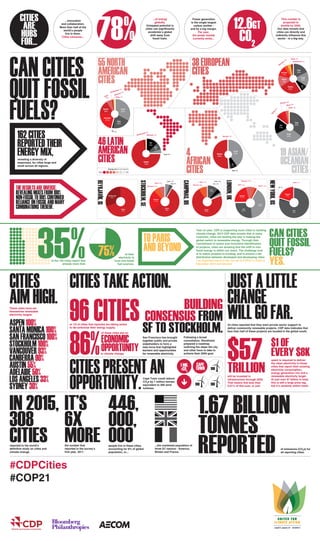
Year on year, CDP is supporting more cities in tackling
climate change. 2015 CDP data reveals that in many
countries, cities are leading the way in making the
global switch to renewable energy. Through their
commitment to action and innovative identification
of projects, cities are showing that the shift to non-
fossil energy is within our reach. The challenge now
is to match projects to funding, and to ensure a fair
distribution between developed and developing cities
- an important issue in the run up to COP21 in Paris in
December 2015 and beyond.
TOPARIS
ANDBEYOND
...innovation
and collaboration.
More than half of the
world’s people
live in them.
Cities consume...
CITIES
ARE
HUBS
FOR... 78% 12.6gt
CO2
...of energy
globally.
Untapped potential in
cities can significantly
accelerate a global
shift away from
fossil fuels.
Power generation
is the single largest
carbon emitter -
and by a big margin.
Per year,
the power market
currently emits...
This number is
projected to
double by 2040.
Our data reveals that
cities can directly and
indirectly influence this
sector - in a big way.
Gas 2%
Geothermal 2%
46LATIN
AMERICAN
CITIES
55NORTH
AMERICAN
CITIES
4
AFRICAN
CITIES
38EUROPEAN
CITIES
19ASIAN/
OCEANIAN
CITIESEnergy mix by non-fossil %
76% 0%
Coal
33%
Gas
20%
Nuclear
21%
Hydro
16%
Oil 1%
Wind
6%
Geothermal 1%
Biomass 1%
Solar 1%
Hydro
72%
Geothermal 2%
Biomass 2%
Oil
13%
Gas
8%
Coal 4%
Hydro
25%
Wind
13%
Nuclear
11%
Gas
18%
Coal
16%
Oil
7%
Biom
ass
4%
Solar 4%
Gas
36%
Coal
32%
Oil
17%
H
ydro
6%
Nuclear 5%
Wind 3%
Solar 1%
Hydro
50%
Coal
40%
Nuclear 1%
Oil
7%
revealing a diversity of
responses, for cities large and
small across all regions.
LONDON,UK
Hydro 1.2%
Gas
26.7%
Wind 7.7%
Coal
40.7%
Nuclear
21.1%
Biomass 2.8%
NEWYORK,US
Hydro 1%
Nuclear
19%
Gas
78%
Oil 1%
CITIES
AIMHIGH.These cities have set
themselves renewable
electricity targets:
JUSTALITTLE
CHANGE
WILLGOFAR.
$57TRILLIONwill be invested in
infrastructure through 2030.
That means that less than
0.01% of this sum, or just
$1 OF
EVERY $8Kspent is required to deliver
the clean electricity in those
cities that report their existing
electricity consumption,
energy generation mix and a
renewable electricity target.
At just over $7 billion in total,
this is still a large price tag,
but it’s certainly within reach.
43 cities reported that they want private sector support to
deliver community renewable projects. CDP data indicates that
less than half of these projects are located in the global south.
96CITIESor 1/3 of cities that reported are taking action
to de-carbonize their energy supply.
CANCITIES
QUITFOSSIL
FUELS?
162CITIES
REPORTEDTHEIR
ENERGYMIX,
REYKJAVÍK,IS
Hydro
70%
Geothermal
30%
Oil 4.4%
Wind 1.1%
Biomass 7.6%
CAMPINAS,BR
Hydro
70.6%
Gas
11.3%
Coal 2.6%
1.67 BILLION
TONNES
REPORTED
ASPEN100%
SANTAMONICA100%
SANFRANCISCO100%
STOCKHOLM100%
VANCOUVER93%
CANBERRA90%
AUSTIN55%
ADELAIDE50%
LOSANGELES33%
SYDNEY30%
CITIESTAKEACTION.
CITIESPRESENTAN
OPPORTUNITY.
THERESULTSAREDIVERSE.
REVEALINGMIXESFROM100%
NON-FOSSILTO100%CONTINUED
RELIANCEONFOSSILANDMANY
COMBINATIONSTHEREOF.
86%
of these cities see an
San Francisco has brought
together public and private
stakeholders to form a
task force that highlighted
barriers and opportunities
for renewable electricity.
BUILDING
CONSENSUS FROM
SF TO STOCKHOLM.Following a broad
consultation, Stockholm
prepared a roadmap
outlining the steps the city
and other have to take to
achieve their 2050 goal.
1 MIL
tCO2
Cape Town could reduce
CO2
e by 1 million tonnes,
equivalent to 300 wind
turbines.
CAPE
TOWN
ECONOMIC
OPPORTUNITYin climate change.
Biomass 6.5%
STOCKHOLM,SE
Hydro
58%
Nuclear
21.5%
Wind 5.5%
Coal 4.5%
Gas 4%
100
100100

Cities infographic-2015

  • 1.
    #CDPCities #COP21 ...the combined populationof three G7 nations - America, Britain and France. of emissions (CO2 e) for all reporting cities. the number that reported in the survey’s first year, 2011. IT’S 6X MORE people live in these cities, accounting for 6% of global population, or... 446, 000, 000reported to the world’s definitive study on cities and climate change. IN 2015, 308 CITIES CAN CITIES QUIT FOSSIL FUELS? YES.of the 162 cities report that already more than 35% of their electricity is from non-fossil fuel sources. 75% Year on year, CDP is supporting more cities in tackling climate change. 2015 CDP data reveals that in many countries, cities are leading the way in making the global switch to renewable energy. Through their commitment to action and innovative identification of projects, cities are showing that the shift to non- fossil energy is within our reach. The challenge now is to match projects to funding, and to ensure a fair distribution between developed and developing cities - an important issue in the run up to COP21 in Paris in December 2015 and beyond. TOPARIS ANDBEYOND ...innovation and collaboration. More than half of the world’s people live in them. Cities consume... CITIES ARE HUBS FOR... 78% 12.6gt CO2 ...of energy globally. Untapped potential in cities can significantly accelerate a global shift away from fossil fuels. Power generation is the single largest carbon emitter - and by a big margin. Per year, the power market currently emits... This number is projected to double by 2040. Our data reveals that cities can directly and indirectly influence this sector - in a big way. Gas 2% Geothermal 2% 46LATIN AMERICAN CITIES 55NORTH AMERICAN CITIES 4 AFRICAN CITIES 38EUROPEAN CITIES 19ASIAN/ OCEANIAN CITIESEnergy mix by non-fossil % 76% 0% Coal 33% Gas 20% Nuclear 21% Hydro 16% Oil 1% Wind 6% Geothermal 1% Biomass 1% Solar 1% Hydro 72% Geothermal 2% Biomass 2% Oil 13% Gas 8% Coal 4% Hydro 25% Wind 13% Nuclear 11% Gas 18% Coal 16% Oil 7% Biom ass 4% Solar 4% Gas 36% Coal 32% Oil 17% H ydro 6% Nuclear 5% Wind 3% Solar 1% Hydro 50% Coal 40% Nuclear 1% Oil 7% revealing a diversity of responses, for cities large and small across all regions. LONDON,UK Hydro 1.2% Gas 26.7% Wind 7.7% Coal 40.7% Nuclear 21.1% Biomass 2.8% NEWYORK,US Hydro 1% Nuclear 19% Gas 78% Oil 1% CITIES AIMHIGH.These cities have set themselves renewable electricity targets: JUSTALITTLE CHANGE WILLGOFAR. $57TRILLIONwill be invested in infrastructure through 2030. That means that less than 0.01% of this sum, or just $1 OF EVERY $8Kspent is required to deliver the clean electricity in those cities that report their existing electricity consumption, energy generation mix and a renewable electricity target. At just over $7 billion in total, this is still a large price tag, but it’s certainly within reach. 43 cities reported that they want private sector support to deliver community renewable projects. CDP data indicates that less than half of these projects are located in the global south. 96CITIESor 1/3 of cities that reported are taking action to de-carbonize their energy supply. CANCITIES QUITFOSSIL FUELS? 162CITIES REPORTEDTHEIR ENERGYMIX, REYKJAVÍK,IS Hydro 70% Geothermal 30% Oil 4.4% Wind 1.1% Biomass 7.6% CAMPINAS,BR Hydro 70.6% Gas 11.3% Coal 2.6% 1.67 BILLION TONNES REPORTED ASPEN100% SANTAMONICA100% SANFRANCISCO100% STOCKHOLM100% VANCOUVER93% CANBERRA90% AUSTIN55% ADELAIDE50% LOSANGELES33% SYDNEY30% CITIESTAKEACTION. CITIESPRESENTAN OPPORTUNITY. THERESULTSAREDIVERSE. REVEALINGMIXESFROM100% NON-FOSSILTO100%CONTINUED RELIANCEONFOSSILANDMANY COMBINATIONSTHEREOF. 86% of these cities see an San Francisco has brought together public and private stakeholders to form a task force that highlighted barriers and opportunities for renewable electricity. BUILDING CONSENSUS FROM SF TO STOCKHOLM.Following a broad consultation, Stockholm prepared a roadmap outlining the steps the city and other have to take to achieve their 2050 goal. 1 MIL tCO2 Cape Town could reduce CO2 e by 1 million tonnes, equivalent to 300 wind turbines. CAPE TOWN ECONOMIC OPPORTUNITYin climate change. Biomass 6.5% STOCKHOLM,SE Hydro 58% Nuclear 21.5% Wind 5.5% Coal 4.5% Gas 4% 100 100100