Citing evidence
to support a
general
statement
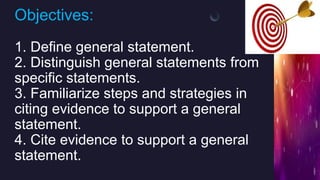
Objectives:
1. Define general statement.
2. Distinguish general statements from
specific statements.
3. Familiarize steps and strategies in
citing evidence to support a general
statement.
4. Cite evidence to support a general
statement.
General Statement is a main idea that is
supported by specific statements or
details.
We can identify the main idea/general
idea by asking the following:
1. What key point about the topic does the
author wants me know?
2. What is this all about?
Supporting statements are the
details or small ideas that support
the main idea/ general statement.
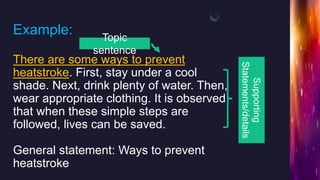
Example:
There are some ways to prevent
heatstroke. First, stay under a cool
shade. Next, drink plenty of water. Then,
wear appropriate clothing. It is observed
that when these simple steps are
followed, lives can be saved.
General statement: Ways to prevent
heatstroke
Topic
sentence
Supporting
Statements/details
What is meant by citing textual evidence?
Text is a written work.
Evidence is a proof that's essential to an
author creating a strong argument or
claim. All texts, or reading passages,
contain evidence.
Text + evidence is citing proof in the
reading.
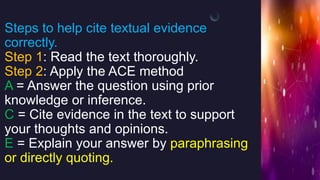
Steps to help cite textual evidence
correctly.
Step 1: Read the text thoroughly.
Step 2: Apply the ACE method
A = Answer the question using prior
knowledge or inference.
C = Cite evidence in the text to support
your thoughts and opinions.
E = Explain your answer by paraphrasing
or directly quoting.
Paraphrasing is translating something into
your own words. When putting information
into your own words, it makes you think
about what you have read, and you will be
more likely to understand and remember
it. You can begin paraphrasing by using
these introductory words:
The author explains…
The text shows….
Quoting is copying exactly what the author is
saying in your answer. Make sure to use
quotation marks.
Example: John said: "I saw Mary today.”
Other introductory words are as follows:
The author says, “…”
The text states, “….”
The author clearly states that, "...
For example, readers learn that "...
According to the text, "...
Research shows that “…
Example:
Original text: Students who study their lessons
regularly have better performance in school.
Paraphrase: The text states that learners who
are diligent in their studies do well in school.
Quote: The text states, "Students who study
their lessons regularly have better performance
in school.”
Step 3: Take Notes
-To take notes is a valuable tool
that is used to write something
down or remember it carefully.
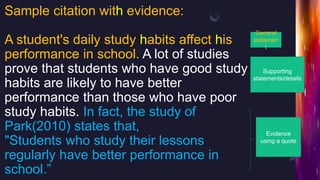
Sample citation with evidence:
A student's daily study habits affect his
performance in school. A lot of studies
prove that students who have good study
habits are likely to have better
performance than those who have poor
study habits. In fact, the study of
Park(2010) states that,
"Students who study their lessons
regularly have better performance in
school.”
General
statemen
t
Supporting
statements/details
Evidence
using a quote
Exercise
Directions: Read the text carefully.
Choose the letter that cites
evidence about the given passage.
1. Liz and Annie went to eat lunch in a
restaurant. A few minutes later both felt
stomach discomforts. They decided to see
the restaurant’s manager to make a
complaint. What evidence could support
their complaint?
A. They have eaten too much that day.
B. Lunch was the only food they ate before
the incident.
C. This is the only restaurant that caused
them stomach discomforts.
1. Liz and Annie went to eat lunch in a
restaurant. A few minutes later both felt
stomach discomforts. They decided to see
the restaurant’s manager to make a
complaint. What evidence could support
their complaint?
A. They have eaten too much that day.
B. Lunch was the only food they ate before
the incident.
C. This is the only restaurant that caused
them stomach discomforts.
2. You had so much work to do and
decided to leave for work after
everything was done. Your boss thinks
that you are a dedicated worker.
What evidence could support your boss’
idea?
A. You decided to work overtime.
B. You won’t leave your work unfinished.
C. Your boss left for home ahead of you.
2. You had so much work to do and
decided to leave for work after
everything was done. Your boss thinks
that you are a dedicated worker.
What evidence could support your boss’
idea?
A. You decided to work overtime.
B. You won’t leave your work unfinished.
C. Your boss left for home ahead of you.
3. Jose saw a twenty- peso bill under a
classmate’s chair. He took the money and
gave it to the teacher and told her where he
found it. The teacher said that Jose is an
honest boy.
What supports the teacher’s claim?
A. Jose returned the money to its owner.
B. The teacher asked Jose to pick up the
money.
C. Jose found something, gave it to his
teacher and told her about it
3. Jose saw a twenty- peso bill under a
classmate’s chair. He took the money and
gave it to the teacher and told her where he
found it. The teacher said that Jose is an
honest boy.
What supports the teacher’s claim?
A. Jose returned the money to its owner.
B. The teacher asked Jose to pick up the
money.
C. Jose found something, gave it to his
teacher and told her about it
4. You arrived in the cafeteria five minutes after the
break time bell rang. There were already a lot of
students around. You were hoping to find an empty
table and chair for you to enjoy eating your snacks but
there was none. A student commented, “You won’t have
a chair if you come late to the cafeteria on break times.”
What supports his statement?
A. A lot of students go to the cafeteria during breaktime.
B. A lot of students crowd in the cafeteria after
breaktime.
C. The cafeteria only has few tables and chairs for
students.
4. You arrived in the cafeteria five minutes after the
break time bell rang. There were already a lot of
students around. You were hoping to find an empty
table and chair for you to enjoy eating your snacks but
there was none. A student commented, “You won’t have
a chair if you come late to the cafeteria on break times.”
What supports his statement?
A. A lot of students go to the cafeteria during breaktime.
B. A lot of students crowd in the cafeteria after
breaktime.
C. The cafeteria only has few tables and chairs for
students.
5. Five friends decided to watch a movie on
Netflix. However, each one has his/her own
movie preference. One of the five friends sighed
and commented “I should have stayed home
and helped my mother with the chores.” What
made him utter such comment? What evidence
can support this?
A. They will spend the entire afternoon watching
different movies.
B. They will end up not watching anything at all.
C. They forgot the access code to open Netflix.
5. Five friends decided to watch a movie on
Netflix. However, each one has his/her own
movie preference. One of the five friends sighed
and commented “I should have stayed home
and helped my mother with the chores.” What
made him utter such comment? What evidence
can support this?
A. They will spend the entire afternoon watching
different movies.
B. They will end up not watching anything at all.
C. They forgot the access code to open Netflix.
Summing it up
The steps in citing
evidence are:
1._______________
2._______________
3._______________

Cite evidence to support a general statement.pptx

  • 1.
    Citing evidence to supporta general statement
  • 2.
    Objectives: 1. Define generalstatement. 2. Distinguish general statements from specific statements. 3. Familiarize steps and strategies in citing evidence to support a general statement. 4. Cite evidence to support a general statement.
  • 3.
    General Statement isa main idea that is supported by specific statements or details. We can identify the main idea/general idea by asking the following: 1. What key point about the topic does the author wants me know? 2. What is this all about?
  • 4.
    Supporting statements arethe details or small ideas that support the main idea/ general statement.
  • 5.
    Example: There are someways to prevent heatstroke. First, stay under a cool shade. Next, drink plenty of water. Then, wear appropriate clothing. It is observed that when these simple steps are followed, lives can be saved. General statement: Ways to prevent heatstroke Topic sentence Supporting Statements/details
  • 6.
    What is meantby citing textual evidence? Text is a written work. Evidence is a proof that's essential to an author creating a strong argument or claim. All texts, or reading passages, contain evidence. Text + evidence is citing proof in the reading.
  • 7.
    Steps to helpcite textual evidence correctly. Step 1: Read the text thoroughly. Step 2: Apply the ACE method A = Answer the question using prior knowledge or inference. C = Cite evidence in the text to support your thoughts and opinions. E = Explain your answer by paraphrasing or directly quoting.
  • 8.
    Paraphrasing is translatingsomething into your own words. When putting information into your own words, it makes you think about what you have read, and you will be more likely to understand and remember it. You can begin paraphrasing by using these introductory words: The author explains… The text shows….
  • 9.
    Quoting is copyingexactly what the author is saying in your answer. Make sure to use quotation marks. Example: John said: "I saw Mary today.” Other introductory words are as follows: The author says, “…” The text states, “….” The author clearly states that, "... For example, readers learn that "... According to the text, "... Research shows that “…
  • 10.
    Example: Original text: Studentswho study their lessons regularly have better performance in school. Paraphrase: The text states that learners who are diligent in their studies do well in school. Quote: The text states, "Students who study their lessons regularly have better performance in school.”
  • 11.
    Step 3: TakeNotes -To take notes is a valuable tool that is used to write something down or remember it carefully.
  • 12.
    Sample citation withevidence: A student's daily study habits affect his performance in school. A lot of studies prove that students who have good study habits are likely to have better performance than those who have poor study habits. In fact, the study of Park(2010) states that, "Students who study their lessons regularly have better performance in school.” General statemen t Supporting statements/details Evidence using a quote
  • 13.
    Exercise Directions: Read thetext carefully. Choose the letter that cites evidence about the given passage.
  • 14.
    1. Liz andAnnie went to eat lunch in a restaurant. A few minutes later both felt stomach discomforts. They decided to see the restaurant’s manager to make a complaint. What evidence could support their complaint? A. They have eaten too much that day. B. Lunch was the only food they ate before the incident. C. This is the only restaurant that caused them stomach discomforts.
  • 15.
    1. Liz andAnnie went to eat lunch in a restaurant. A few minutes later both felt stomach discomforts. They decided to see the restaurant’s manager to make a complaint. What evidence could support their complaint? A. They have eaten too much that day. B. Lunch was the only food they ate before the incident. C. This is the only restaurant that caused them stomach discomforts.
  • 16.
    2. You hadso much work to do and decided to leave for work after everything was done. Your boss thinks that you are a dedicated worker. What evidence could support your boss’ idea? A. You decided to work overtime. B. You won’t leave your work unfinished. C. Your boss left for home ahead of you.
  • 17.
    2. You hadso much work to do and decided to leave for work after everything was done. Your boss thinks that you are a dedicated worker. What evidence could support your boss’ idea? A. You decided to work overtime. B. You won’t leave your work unfinished. C. Your boss left for home ahead of you.
  • 18.
    3. Jose sawa twenty- peso bill under a classmate’s chair. He took the money and gave it to the teacher and told her where he found it. The teacher said that Jose is an honest boy. What supports the teacher’s claim? A. Jose returned the money to its owner. B. The teacher asked Jose to pick up the money. C. Jose found something, gave it to his teacher and told her about it
  • 19.
    3. Jose sawa twenty- peso bill under a classmate’s chair. He took the money and gave it to the teacher and told her where he found it. The teacher said that Jose is an honest boy. What supports the teacher’s claim? A. Jose returned the money to its owner. B. The teacher asked Jose to pick up the money. C. Jose found something, gave it to his teacher and told her about it
  • 20.
    4. You arrivedin the cafeteria five minutes after the break time bell rang. There were already a lot of students around. You were hoping to find an empty table and chair for you to enjoy eating your snacks but there was none. A student commented, “You won’t have a chair if you come late to the cafeteria on break times.” What supports his statement? A. A lot of students go to the cafeteria during breaktime. B. A lot of students crowd in the cafeteria after breaktime. C. The cafeteria only has few tables and chairs for students.
  • 21.
    4. You arrivedin the cafeteria five minutes after the break time bell rang. There were already a lot of students around. You were hoping to find an empty table and chair for you to enjoy eating your snacks but there was none. A student commented, “You won’t have a chair if you come late to the cafeteria on break times.” What supports his statement? A. A lot of students go to the cafeteria during breaktime. B. A lot of students crowd in the cafeteria after breaktime. C. The cafeteria only has few tables and chairs for students.
  • 22.
    5. Five friendsdecided to watch a movie on Netflix. However, each one has his/her own movie preference. One of the five friends sighed and commented “I should have stayed home and helped my mother with the chores.” What made him utter such comment? What evidence can support this? A. They will spend the entire afternoon watching different movies. B. They will end up not watching anything at all. C. They forgot the access code to open Netflix.
  • 23.
    5. Five friendsdecided to watch a movie on Netflix. However, each one has his/her own movie preference. One of the five friends sighed and commented “I should have stayed home and helped my mother with the chores.” What made him utter such comment? What evidence can support this? A. They will spend the entire afternoon watching different movies. B. They will end up not watching anything at all. C. They forgot the access code to open Netflix.
  • 24.
    Summing it up Thesteps in citing evidence are: 1._______________ 2._______________ 3._______________