Citation Machine
THIS IS SUCH AN IMPORTANT LESSON! MAKE SURE YOU HAVE YOUR NOTEBOOK
OUT FOR NOTES!
Warm Up
 In your writer’s notebook, spend a few minutes jotting down your thinking about
this questions:
 What is citation?
 What is the purpose of a citation?
 When is citation appropriate?
What is citation?
 A line taken from a piece of work (book, speech, website, magazine) and used as a
quote.
What is the purpose of a citation?
 to avoid plagiarism, to assign proper authority to a statement
 Well, what is PLAGIARISM?
pla‧gia‧ris‧m /ˈpleɪdʒərɪzəm/ ●○○ noun
1 [uncountable] when someone uses another person’s words, ideas, or work and pretends they are their own
The journal accused the professor of plagiarism.
2 [countable] an idea, phrase, or story that has been copied from another person’s work, without stating where
it came from
http://www.ldoceonline.com/dictionary/plagiarism
More on plagiarism
 WHY WE CITE SOURCES IN ACADEMIC PAPERS A WRITING CENTRE HANDOUT
 Plagiarism is academic misconduct. Plagiarism might involve:
 using another person’s writing as your own
 misrepresenting your research
 (excluding used sources or including unused sources (“padding”) in your bibliography)
 paraphrasing too closely
 misrepresenting an author’s argument
 In the worst case scenario, plagiarism can get you expelled from university. While some
students do plagiarize intentionally, the majority of students do it unintentionally.
Why do we cite?
1. We cite in order to distinguish between citation and interpretation.
1. How can you demonstrate which ideas and insights are yours if the reader can’t tell where your citations
end and your interpretation of them begins?
2. We cite in order to show how knowledge is formed.
1. Citation shows where you got your understanding of a given topic and whose ideas you’re building upon
– it demonstrates the extent to which your argument is reliable.
3. We cite sources in order to demonstrate context and significance.
1. Citation helps you develop an argument that addresses the proverbial “so what?” question.
https://legacy.wlu.ca//forms/1693/Why_We_Cite_Sources_in_Academic_Papers_(revised).pdf
When is a citation appropriate?
 When you use, reference or quote someone else’s work in any way, shape or form.
 Someone else’s work is work that did not come organically from your mind.
 A citation proves that you are giving credit where credit is due!
Citations are a process
 The first step in the citation process is finding evidence to support your claim.
 This evidence comes from a source (in our case, our class novel) and the source
will need to be cited to give credit to the author of that source.
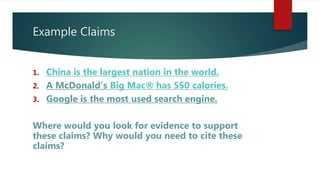
Example Claims
1. China is the largest nation in the world.
2. A McDonald’s Big Mac® has 550 calories.
3. Google is the most used search engine.
Where would you look for evidence to support
these claims? Why would you need to cite these
claims?
Supporting Claims
 Wherever you find evidence to support these claims, you need to cite those
sources.
 Today, we are going to have a citation competition.
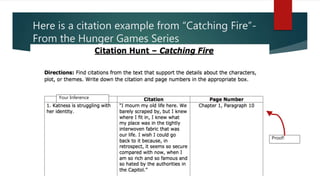
Here is a citation example from “Catching Fire”-
From the Hunger Games Series
Your Inference
Proof!
Now, it is our turn
 We are going to pull citations from our class novel.
 We are going to share their favorite piece of evidence to their classmates.
 We are toing to support the excerpts from our book and can be written in the
word doc that is attached.
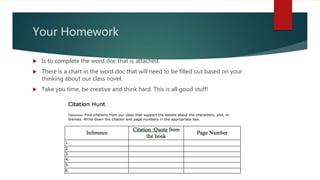
 We will use the information in this chart in our literary essays to support our
thinking about our class novel.
Your Homework
 Is to complete the word doc that is attached.
 There is a chart in the word doc that will need to be filled out based on your
thinking about our class novel.
 Take you time, be creative and think hard. This is all good stuff!

Citations mini lesson

  • 1.
    Citation Machine THIS ISSUCH AN IMPORTANT LESSON! MAKE SURE YOU HAVE YOUR NOTEBOOK OUT FOR NOTES!
  • 2.
    Warm Up  Inyour writer’s notebook, spend a few minutes jotting down your thinking about this questions:  What is citation?  What is the purpose of a citation?  When is citation appropriate?
  • 3.
    What is citation? A line taken from a piece of work (book, speech, website, magazine) and used as a quote.
  • 4.
    What is thepurpose of a citation?  to avoid plagiarism, to assign proper authority to a statement  Well, what is PLAGIARISM? pla‧gia‧ris‧m /ˈpleɪdʒərɪzəm/ ●○○ noun 1 [uncountable] when someone uses another person’s words, ideas, or work and pretends they are their own The journal accused the professor of plagiarism. 2 [countable] an idea, phrase, or story that has been copied from another person’s work, without stating where it came from http://www.ldoceonline.com/dictionary/plagiarism
  • 5.
    More on plagiarism WHY WE CITE SOURCES IN ACADEMIC PAPERS A WRITING CENTRE HANDOUT  Plagiarism is academic misconduct. Plagiarism might involve:  using another person’s writing as your own  misrepresenting your research  (excluding used sources or including unused sources (“padding”) in your bibliography)  paraphrasing too closely  misrepresenting an author’s argument  In the worst case scenario, plagiarism can get you expelled from university. While some students do plagiarize intentionally, the majority of students do it unintentionally.
  • 6.
    Why do wecite? 1. We cite in order to distinguish between citation and interpretation. 1. How can you demonstrate which ideas and insights are yours if the reader can’t tell where your citations end and your interpretation of them begins? 2. We cite in order to show how knowledge is formed. 1. Citation shows where you got your understanding of a given topic and whose ideas you’re building upon – it demonstrates the extent to which your argument is reliable. 3. We cite sources in order to demonstrate context and significance. 1. Citation helps you develop an argument that addresses the proverbial “so what?” question. https://legacy.wlu.ca//forms/1693/Why_We_Cite_Sources_in_Academic_Papers_(revised).pdf
  • 7.
    When is acitation appropriate?  When you use, reference or quote someone else’s work in any way, shape or form.  Someone else’s work is work that did not come organically from your mind.  A citation proves that you are giving credit where credit is due!
  • 8.
    Citations are aprocess  The first step in the citation process is finding evidence to support your claim.  This evidence comes from a source (in our case, our class novel) and the source will need to be cited to give credit to the author of that source.
  • 9.
    Example Claims 1. Chinais the largest nation in the world. 2. A McDonald’s Big Mac® has 550 calories. 3. Google is the most used search engine. Where would you look for evidence to support these claims? Why would you need to cite these claims?
  • 10.
    Supporting Claims  Whereveryou find evidence to support these claims, you need to cite those sources.  Today, we are going to have a citation competition.
  • 11.
    Here is acitation example from “Catching Fire”- From the Hunger Games Series Your Inference Proof!
  • 12.
    Now, it isour turn  We are going to pull citations from our class novel.  We are going to share their favorite piece of evidence to their classmates.  We are toing to support the excerpts from our book and can be written in the word doc that is attached.  We will use the information in this chart in our literary essays to support our thinking about our class novel.
  • 13.
    Your Homework  Isto complete the word doc that is attached.  There is a chart in the word doc that will need to be filled out based on your thinking about our class novel.  Take you time, be creative and think hard. This is all good stuff!