Prepared by: Jheel D. Barad
Dept of English, MKBU (sem 3)
Dt.: 09/08/2022
Two- Day ICT Workshop
organised by Department of English, MKBU
Department of English
Maharaja Krishnakumarsinhji Bhavnagar University
Bhavnagar
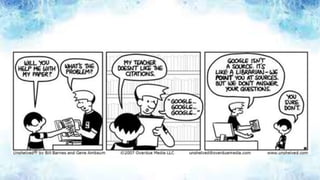
What is Citation?
A “citation” is the way you tell your readers that certain material in your work came from another
source. It also gives your readers the information necessary to find the location details of that
source on the reference or Works Cited page.
Why should you cite sources?
● To give credit to the source authors
● To help your audience/reader find out more about your research/arguments/ideas/topic
● To strengthen your work be providing outside support to your ideas
● To keep you from failing a paper, a course or being sued in the real world
When do I need to cite?
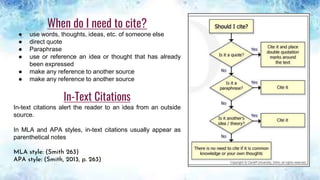
● use words, thoughts, ideas, etc. of someone else
● direct quote
● Paraphrase
● use or reference an idea or thought that has already
been expressed
● make any reference to another source
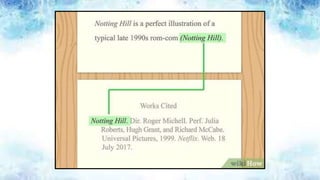
In-Text Citations
In-text citations alert the reader to an idea from an outside
source.
In MLA and APA styles, in-text citations usually appear as
parenthetical notes
MLA style: (Smith 263)
APA style: (Smith, 2013, p. 263)
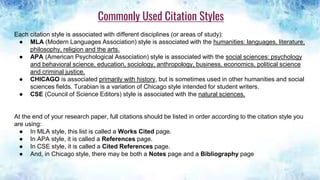
Commonly Used Citation Styles
Each citation style is associated with different disciplines (or areas of study):
● MLA (Modern Languages Association) style is associated with the humanities: languages, literature,
philosophy, religion and the arts.
● APA (American Psychological Association) style is associated with the social sciences: psychology
and behavioral science, education, sociology, anthropology, business, economics, political science
and criminal justice.
● CHICAGO is associated primarily with history, but is sometimes used in other humanities and social
sciences fields. Turabian is a variation of Chicago style intended for student writers.
● CSE (Council of Science Editors) style is associated with the natural sciences.
At the end of your research paper, full citations should be listed in order according to the citation style you
are using:
● In MLA style, this list is called a Works Cited page.
● In APA style, it is called a References page.
● In CSE style, it is called a Cited References page.
● And, in Chicago style, there may be both a Notes page and a Bibliography page
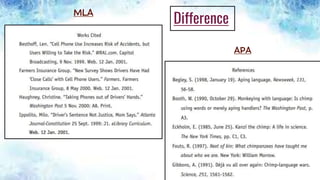
MLA
APA
Difference
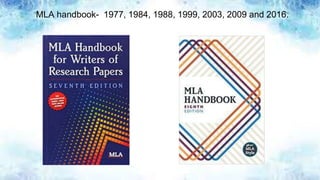
MLA handbook- 1977, 1984, 1988, 1999, 2003, 2009 and 2016.
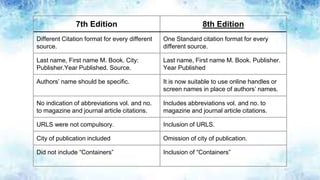
7th Edition 8th Edition
Different Citation format for every different
source.
One Standard citation format for every
different source.
Last name, First name M. Book. City:
Publisher.Year Published. Source.
Last name, First name M. Book. Publisher.
Year Published
Authors’ name should be specific. It is now suitable to use online handles or
screen names in place of authors’ names.
No indication of abbreviations vol. and no.
to magazine and journal article citations.
Includes abbreviations vol. and no. to
magazine and journal article citations.
URLS were not compulsory. Inclusion of URLS.
City of publication included Omission of city of publication.
Did not include “Containers” Inclusion of “Containers”
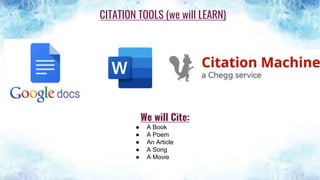
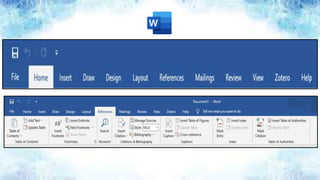
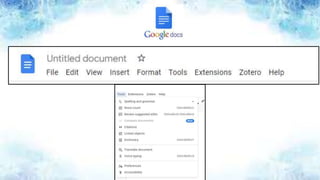
CITATION TOOLS (we will LEARN)
We will Cite:
● A Book
● A Poem
● An Article
● A Song
● A Movie
www.citationmachine.net
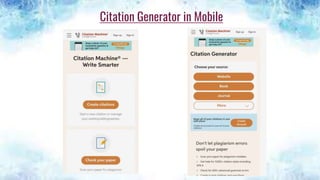
Citation Generator in Mobile
Citation

Citation

  • 1.
    Prepared by: JheelD. Barad Dept of English, MKBU (sem 3) Dt.: 09/08/2022 Two- Day ICT Workshop organised by Department of English, MKBU Department of English Maharaja Krishnakumarsinhji Bhavnagar University Bhavnagar
  • 2.
    What is Citation? A“citation” is the way you tell your readers that certain material in your work came from another source. It also gives your readers the information necessary to find the location details of that source on the reference or Works Cited page. Why should you cite sources? ● To give credit to the source authors ● To help your audience/reader find out more about your research/arguments/ideas/topic ● To strengthen your work be providing outside support to your ideas ● To keep you from failing a paper, a course or being sued in the real world
  • 3.
    When do Ineed to cite? ● use words, thoughts, ideas, etc. of someone else ● direct quote ● Paraphrase ● use or reference an idea or thought that has already been expressed ● make any reference to another source ● make any reference to another source In-Text Citations In-text citations alert the reader to an idea from an outside source. In MLA and APA styles, in-text citations usually appear as parenthetical notes MLA style: (Smith 263) APA style: (Smith, 2013, p. 263)
  • 6.
    Commonly Used CitationStyles Each citation style is associated with different disciplines (or areas of study): ● MLA (Modern Languages Association) style is associated with the humanities: languages, literature, philosophy, religion and the arts. ● APA (American Psychological Association) style is associated with the social sciences: psychology and behavioral science, education, sociology, anthropology, business, economics, political science and criminal justice. ● CHICAGO is associated primarily with history, but is sometimes used in other humanities and social sciences fields. Turabian is a variation of Chicago style intended for student writers. ● CSE (Council of Science Editors) style is associated with the natural sciences. At the end of your research paper, full citations should be listed in order according to the citation style you are using: ● In MLA style, this list is called a Works Cited page. ● In APA style, it is called a References page. ● In CSE style, it is called a Cited References page. ● And, in Chicago style, there may be both a Notes page and a Bibliography page
  • 7.
  • 9.
    MLA handbook- 1977,1984, 1988, 1999, 2003, 2009 and 2016.
  • 10.
    7th Edition 8thEdition Different Citation format for every different source. One Standard citation format for every different source. Last name, First name M. Book. City: Publisher.Year Published. Source. Last name, First name M. Book. Publisher. Year Published Authors’ name should be specific. It is now suitable to use online handles or screen names in place of authors’ names. No indication of abbreviations vol. and no. to magazine and journal article citations. Includes abbreviations vol. and no. to magazine and journal article citations. URLS were not compulsory. Inclusion of URLS. City of publication included Omission of city of publication. Did not include “Containers” Inclusion of “Containers”
  • 14.
    CITATION TOOLS (wewill LEARN) We will Cite: ● A Book ● A Poem ● An Article ● A Song ● A Movie
  • 17.
  • 18.