2009 
    CISSP summary 
        Version 1.1 
                       Maarten de Frankrijker 
                                                 Revised by Christian Reina, CISSP 


    This document may be used only for informational, training and noncommercial purposes. You are free to copy, distribute, publish and alter this document under the conditions that you give credit to the original author. 
    2009 ‐ Maarten de Frankrijker.  Revised by Christian Reina, CISSP. 
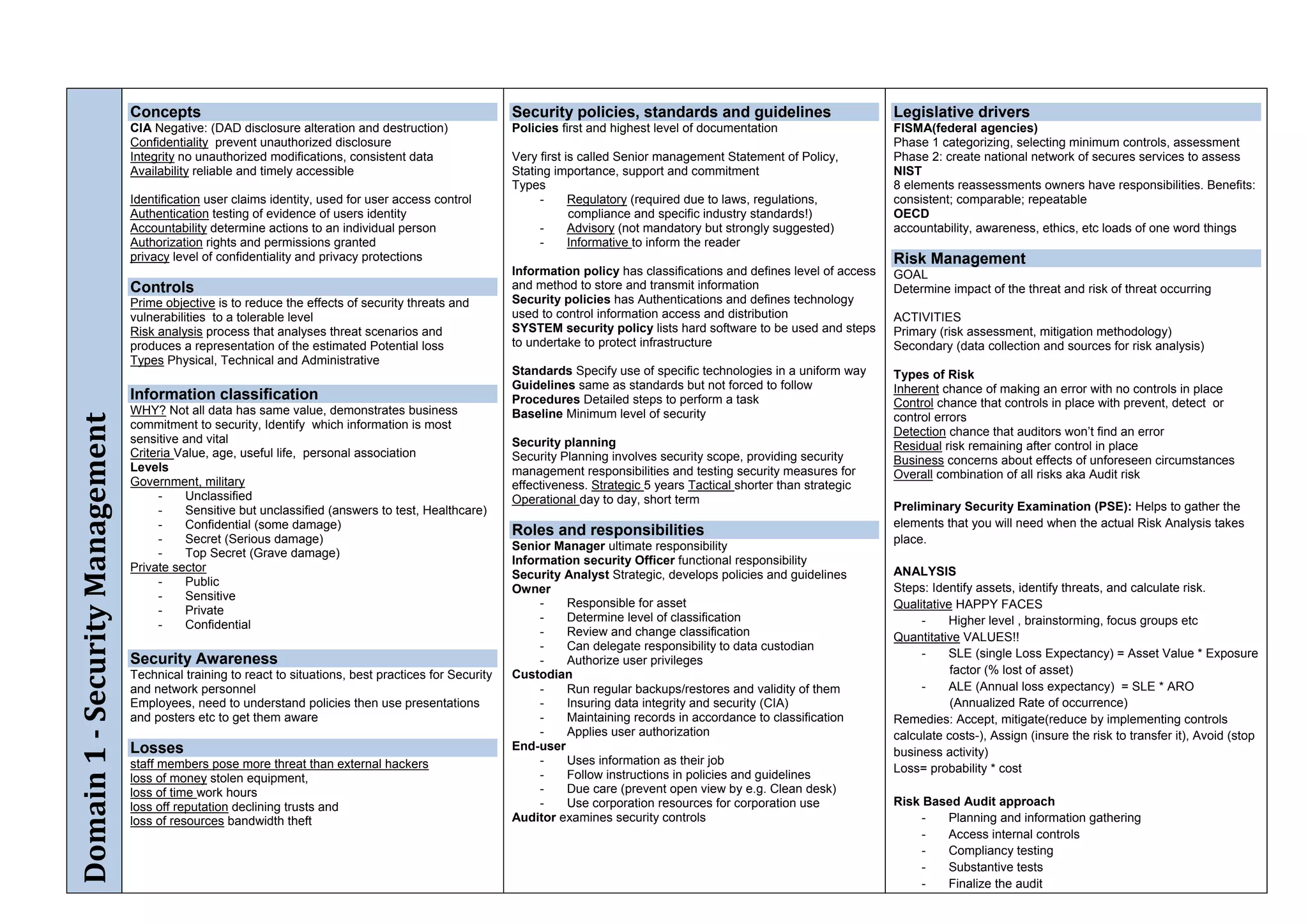
Concepts                                                                 Security policies, standards and guidelines                          Legislative drivers
                                 CIA Negative: (DAD disclosure alteration and destruction)                Policies first and highest level of documentation                    FISMA(federal agencies)
                                 Confidentiality prevent unauthorized disclosure                                                                                               Phase 1 categorizing, selecting minimum controls, assessment
                                 Integrity no unauthorized modifications, consistent data                 Very first is called Senior management Statement of Policy,          Phase 2: create national network of secures services to assess
                                 Availability reliable and timely accessible                              Stating importance, support and commitment                           NIST
                                                                                                          Types                                                                8 elements reassessments owners have responsibilities. Benefits:
                                 Identification user claims identity, used for user access control             -      Regulatory (required due to laws, regulations,           consistent; comparable; repeatable
                                 Authentication testing of evidence of users identity                                 compliance and specific industry standards!)             OECD
                                 Accountability determine actions to an individual person                      -      Advisory (not mandatory but strongly suggested)          accountability, awareness, ethics, etc loads of one word things
                                 Authorization rights and permissions granted                                  -      Informative to inform the reader
                                 privacy level of confidentiality and privacy protections                                                                                      Risk Management
                                                                                                          Information policy has classifications and defines level of access   GOAL
                                 Controls                                                                 and method to store and transmit information                         Determine impact of the threat and risk of threat occurring
                                 Prime objective is to reduce the effects of security threats and         Security policies has Authentications and defines technology
                                 vulnerabilities to a tolerable level                                     used to control information access and distribution                  ACTIVITIES
                                 Risk analysis process that analyses threat scenarios and                 SYSTEM security policy lists hard software to be used and steps      Primary (risk assessment, mitigation methodology)
                                 produces a representation of the estimated Potential loss                to undertake to protect infrastructure                               Secondary (data collection and sources for risk analysis)
                                 Types Physical, Technical and Administrative
                                                                                                          Standards Specify use of specific technologies in a uniform way      Types of Risk
                                                                                                          Guidelines same as standards but not forced to follow                Inherent chance of making an error with no controls in place
                                 Information classification                                               Procedures Detailed steps to perform a task                          Control chance that controls in place with prevent, detect or
                                 WHY? Not all data has same value, demonstrates business                  Baseline Minimum level of security
Domain 1 ­ Security Management


                                                                                                                                                                               control errors
                                 commitment to security, Identify which information is most
                                                                                                                                                                               Detection chance that auditors won’t find an error
                                 sensitive and vital                                                      Security planning                                                    Residual risk remaining after control in place
                                 Criteria Value, age, useful life, personal association                   Security Planning involves security scope, providing security        Business concerns about effects of unforeseen circumstances
                                 Levels                                                                   management responsibilities and testing security measures for        Overall combination of all risks aka Audit risk
                                 Government, military                                                     effectiveness. Strategic 5 years Tactical shorter than strategic
                                      -    Unclassified                                                   Operational day to day, short term
                                      -    Sensitive but unclassified (answers to test, Healthcare)                                                                            Preliminary Security Examination (PSE): Helps to gather the
                                      -    Confidential (some damage)                                                                                                          elements that you will need when the actual Risk Analysis takes
                                      -    Secret (Serious damage)
                                                                                                          Roles and responsibilities
                                                                                                                                                                               place.
                                                                                                          Senior Manager ultimate responsibility
                                      -    Top Secret (Grave damage)
                                                                                                          Information security Officer functional responsibility
                                 Private sector                                                                                                                                ANALYSIS
                                                                                                          Security Analyst Strategic, develops policies and guidelines
                                      -    Public                                                                                                                              Steps: Identify assets, identify threats, and calculate risk.
                                                                                                          Owner
                                      -    Sensitive
                                                                                                               -   Responsible for asset                                       Qualitative HAPPY FACES
                                      -    Private
                                                                                                               -   Determine level of classification                                -    Higher level , brainstorming, focus groups etc
                                      -    Confidential
                                                                                                               -   Review and change classification                            Quantitative VALUES!!
                                                                                                               -   Can delegate responsibility to data custodian
                                                                                                                                                                                    -    SLE (single Loss Expectancy) = Asset Value * Exposure
                                 Security Awareness                                                            -   Authorize user privileges
                                 Technical training to react to situations, best practices for Security   Custodian                                                                       factor (% lost of asset)
                                 and network personnel                                                         -   Run regular backups/restores and validity of them                -    ALE (Annual loss expectancy) = SLE * ARO
                                 Employees, need to understand policies then use presentations                 -   Insuring data integrity and security (CIA)                             (Annualized Rate of occurrence)
                                 and posters etc to get them aware                                             -   Maintaining records in accordance to classification         Remedies: Accept, mitigate(reduce by implementing controls
                                                                                                               -   Applies user authorization                                  calculate costs-), Assign (insure the risk to transfer it), Avoid (stop
                                 Losses                                                                   End-user                                                             business activity)
                                 staff members pose more threat than external hackers                          -   Uses information as their job
                                                                                                               -   Follow instructions in policies and guidelines              Loss= probability * cost
                                 loss of money stolen equipment,
                                 loss of time work hours                                                       -   Due care (prevent open view by e.g. Clean desk)
                                 loss off reputation declining trusts and                                      -   Use corporation resources for corporation use               Risk Based Audit approach
                                 loss of resources bandwidth theft                                        Auditor examines security controls                                        -  Planning and information gathering
                                                                                                                                                                                    -  Access internal controls
                                                                                                                                                                                    -  Compliancy testing
                                                                                                                                                                                    -  Substantive tests
                                                                                                                                                                                    -  Finalize the audit
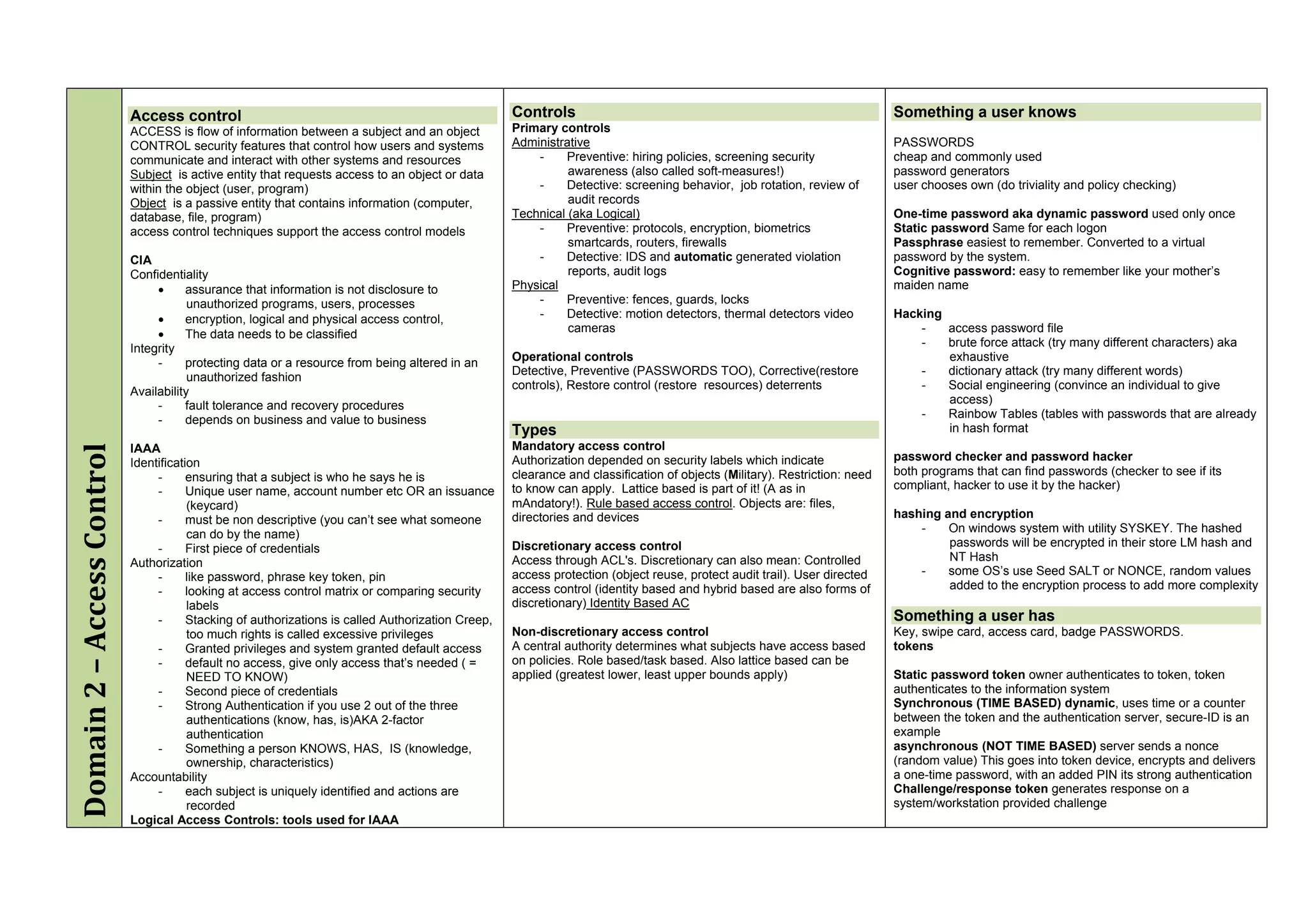
Access control                                                          Controls                                                                Something a user knows
                             ACCESS is flow of information between a subject and an object           Primary controls
                             CONTROL security features that control how users and systems            Administrative                                                          PASSWORDS
                             communicate and interact with other systems and resources                   -     Preventive: hiring policies, screening security               cheap and commonly used
                             Subject is active entity that requests access to an object or data                awareness (also called soft-measures!)                        password generators
                             within the object (user, program)                                           -     Detective: screening behavior, job rotation, review of        user chooses own (do triviality and policy checking)
                             Object is a passive entity that contains information (computer,                   audit records
                             database, file, program)                                                Technical (aka Logical)                                                 One-time password aka dynamic password used only once
                             access control techniques support the access control models                 -     Preventive: protocols, encryption, biometrics                 Static password Same for each logon
                                                                                                               smartcards, routers, firewalls                                Passphrase easiest to remember. Converted to a virtual
                             CIA                                                                         -     Detective: IDS and automatic generated violation              password by the system.
                             Confidentiality                                                                   reports, audit logs                                           Cognitive password: easy to remember like your mother’s
                                       assurance that information is not disclosure to              Physical                                                                maiden name
                                         unauthorized programs, users, processes                         -     Preventive: fences, guards, locks
                                       encryption, logical and physical access control,                 -     Detective: motion detectors, thermal detectors video          Hacking
                                       The data needs to be classified                                        cameras                                                           -   access password file
                             Integrity                                                                                                                                           -   brute force attack (try many different characters) aka
                                  -     protecting data or a resource from being altered in an       Operational controls                                                            exhaustive
                                         unauthorized fashion                                        Detective, Preventive (PASSWORDS TOO), Corrective(restore                   -   dictionary attack (try many different words)
                             Availability                                                            controls), Restore control (restore resources) deterrents                   -   Social engineering (convince an individual to give
                                  -     fault tolerance and recovery procedures                                                                                                      access)
                                  -     depends on business and value to business                                                                                                -   Rainbow Tables (tables with passwords that are already
                                                                                                     Types                                                                           in hash format
Domain 2 – Access Control 


                             IAAA                                                                    Mandatory access control
                             Identification                                                          Authorization depended on security labels which indicate                password checker and password hacker
                                  -      ensuring that a subject is who he says he is                clearance and classification of objects (Military). Restriction: need   both programs that can find passwords (checker to see if its
                                  -      Unique user name, account number etc OR an issuance         to know can apply. Lattice based is part of it! (A as in                compliant, hacker to use it by the hacker)
                                         (keycard)                                                   mAndatory!). Rule based access control. Objects are: files,
                                  -      must be non descriptive (you can’t see what someone         directories and devices                                                 hashing and encryption
                                         can do by the name)                                                                                                                     -    On windows system with utility SYSKEY. The hashed
                                  -      First piece of credentials                                  Discretionary access control                                                     passwords will be encrypted in their store LM hash and
                             Authorization                                                           Access through ACL's. Discretionary can also mean: Controlled                    NT Hash
                                  -      like password, phrase key token, pin                        access protection (object reuse, protect audit trail). User directed        -    some OS’s use Seed SALT or NONCE, random values
                                  -      looking at access control matrix or comparing security      access control (identity based and hybrid based are also forms of                added to the encryption process to add more complexity
                                         labels                                                      discretionary) Identity Based AC
                                  -      Stacking of authorizations is called Authorization Creep,                                                                           Something a user has
                                         too much rights is called excessive privileges              Non-discretionary access control                                        Key, swipe card, access card, badge PASSWORDS.
                                  -      Granted privileges and system granted default access        A central authority determines what subjects have access based          tokens
                                  -      default no access, give only access that’s needed ( =       on policies. Role based/task based. Also lattice based can be
                                         NEED TO KNOW)                                               applied (greatest lower, least upper bounds apply)                      Static password token owner authenticates to token, token
                                  -      Second piece of credentials                                                                                                         authenticates to the information system
                                  -      Strong Authentication if you use 2 out of the three                                                                                 Synchronous (TIME BASED) dynamic, uses time or a counter
                                         authentications (know, has, is)AKA 2-factor                                                                                         between the token and the authentication server, secure-ID is an
                                         authentication                                                                                                                      example
                                  -      Something a person KNOWS, HAS, IS (knowledge,                                                                                       asynchronous (NOT TIME BASED) server sends a nonce
                                         ownership, characteristics)                                                                                                         (random value) This goes into token device, encrypts and delivers
                             Accountability                                                                                                                                  a one-time password, with an added PIN its strong authentication
                                  -      each subject is uniquely identified and actions are                                                                                 Challenge/response token generates response on a
                                         recorded                                                                                                                            system/workstation provided challenge
                             Logical Access Controls: tools used for IAAA
Access control methodologies
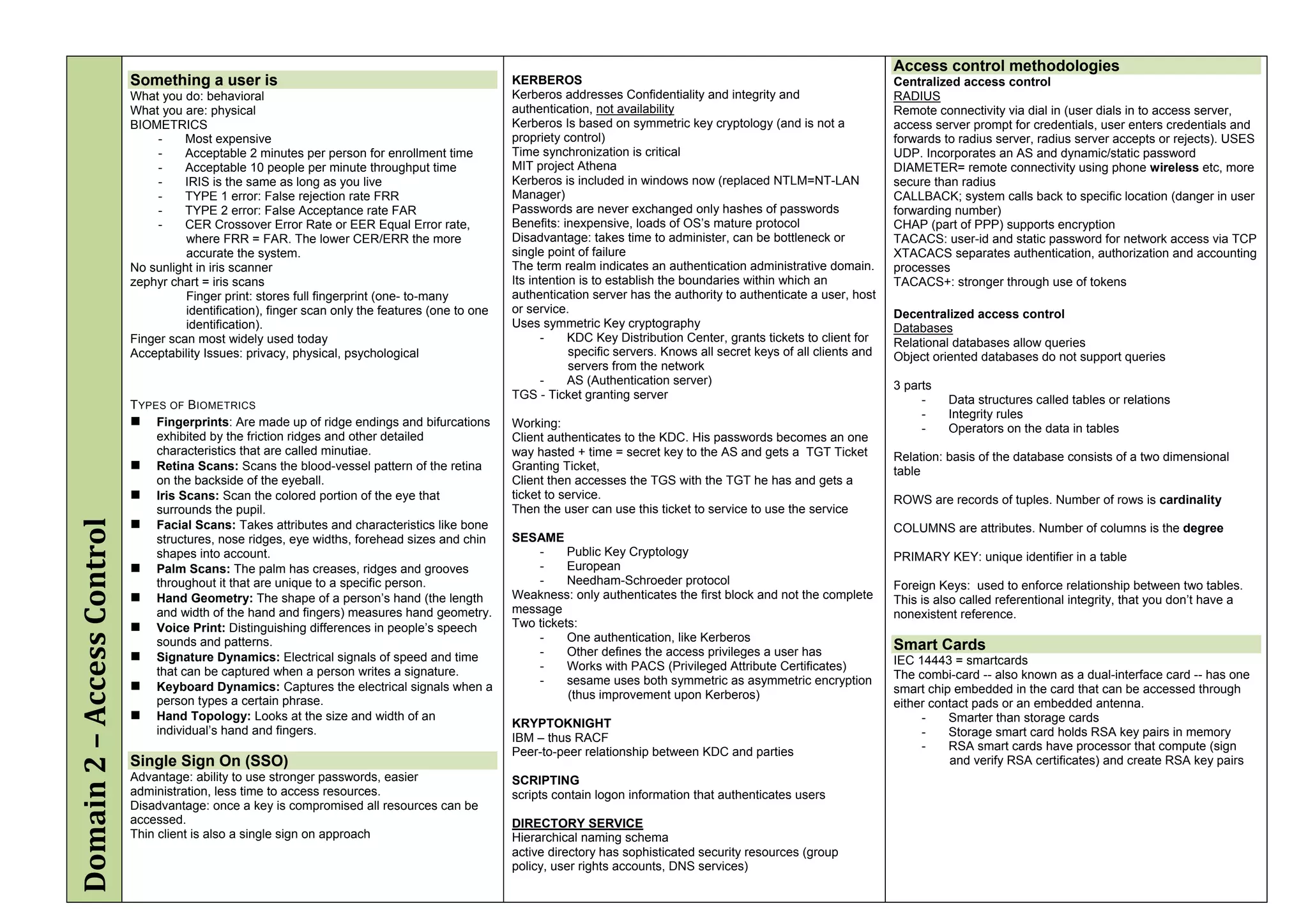
                            Something a user is                                                    KERBEROS                                                                 Centralized access control
                            What you do: behavioral                                                Kerberos addresses Confidentiality and integrity and                     RADIUS
                            What you are: physical                                                 authentication, not availability                                         Remote connectivity via dial in (user dials in to access server,
                            BIOMETRICS                                                             Kerberos Is based on symmetric key cryptology (and is not a              access server prompt for credentials, user enters credentials and
                                 -    Most expensive                                               propriety control)                                                       forwards to radius server, radius server accepts or rejects). USES
                                 -    Acceptable 2 minutes per person for enrollment time          Time synchronization is critical                                         UDP. Incorporates an AS and dynamic/static password
                                 -    Acceptable 10 people per minute throughput time              MIT project Athena                                                       DIAMETER= remote connectivity using phone wireless etc, more
                                 -    IRIS is the same as long as you live                         Kerberos is included in windows now (replaced NTLM=NT-LAN                secure than radius
                                 -    TYPE 1 error: False rejection rate FRR                       Manager)                                                                 CALLBACK; system calls back to specific location (danger in user
                                 -    TYPE 2 error: False Acceptance rate FAR                      Passwords are never exchanged only hashes of passwords                   forwarding number)
                                 -    CER Crossover Error Rate or EER Equal Error rate,            Benefits: inexpensive, loads of OS’s mature protocol                     CHAP (part of PPP) supports encryption
                                      where FRR = FAR. The lower CER/ERR the more                  Disadvantage: takes time to administer, can be bottleneck or             TACACS: user-id and static password for network access via TCP
                                      accurate the system.                                         single point of failure                                                  XTACACS separates authentication, authorization and accounting
                            No sunlight in iris scanner                                            The term realm indicates an authentication administrative domain.        processes
                            zephyr chart = iris scans                                              Its intention is to establish the boundaries within which an             TACACS+: stronger through use of tokens
                                      Finger print: stores full fingerprint (one- to-many          authentication server has the authority to authenticate a user, host
                                      identification), finger scan only the features (one to one   or service.                                                              Decentralized access control
                                      identification).                                             Uses symmetric Key cryptography                                          Databases
                            Finger scan most widely used today                                           -     KDC Key Distribution Center, grants tickets to client for    Relational databases allow queries
                            Acceptability Issues: privacy, physical, psychological                             specific servers. Knows all secret keys of all clients and   Object oriented databases do not support queries
                                                                                                               servers from the network
                                                                                                         -     AS (Authentication server)                                   3 parts
                                                                                                   TGS - Ticket granting server                                                  -    Data structures called tables or relations
                            T YPES OF B IOMETRICS
                                                                                                                                                                                 -    Integrity rules
                             Fingerprints: Are made up of ridge endings and bifurcations          Working:                                                                      -    Operators on the data in tables
                                 exhibited by the friction ridges and other detailed               Client authenticates to the KDC. His passwords becomes an one
                                 characteristics that are called minutiae.                         way hasted + time = secret key to the AS and gets a TGT Ticket           Relation: basis of the database consists of a two dimensional
                             Retina Scans: Scans the blood-vessel pattern of the retina           Granting Ticket,                                                         table
                                 on the backside of the eyeball.                                   Client then accesses the TGS with the TGT he has and gets a
                             Iris Scans: Scan the colored portion of the eye that                 ticket to service.                                                       ROWS are records of tuples. Number of rows is cardinality
                                 surrounds the pupil.                                              Then the user can use this ticket to service to use the service
                             Facial Scans: Takes attributes and characteristics like bone
Domain 2 – Access Control


                                                                                                                                                                            COLUMNS are attributes. Number of columns is the degree
                                 structures, nose ridges, eye widths, forehead sizes and chin      SESAME
                                 shapes into account.                                                  -     Public Key Cryptology                                          PRIMARY KEY: unique identifier in a table
                             Palm Scans: The palm has creases, ridges and grooves                     -     European
                                 throughout it that are unique to a specific person.                   -     Needham-Schroeder protocol                                     Foreign Keys: used to enforce relationship between two tables.
                             Hand Geometry: The shape of a person’s hand (the length              Weakness: only authenticates the first block and not the complete        This is also called referentional integrity, that you don’t have a
                                 and width of the hand and fingers) measures hand geometry.        message                                                                  nonexistent reference.
                             Voice Print: Distinguishing differences in people’s speech           Two tickets:
                                 sounds and patterns.                                                  -     One authentication, like Kerberos
                                                                                                       -     Other defines the access privileges a user has
                                                                                                                                                                            Smart Cards
                             Signature Dynamics: Electrical signals of speed and time                                                                                      IEC 14443 = smartcards
                                 that can be captured when a person writes a signature.                -     Works with PACS (Privileged Attribute Certificates)
                                                                                                       -     sesame uses both symmetric as asymmetric encryption            The combi-card -- also known as a dual-interface card -- has one
                             Keyboard Dynamics: Captures the electrical signals when a                                                                                     smart chip embedded in the card that can be accessed through
                                 person types a certain phrase.                                              (thus improvement upon Kerberos)
                                                                                                                                                                            either contact pads or an embedded antenna.
                             Hand Topology: Looks at the size and width of an                                                                                                   -    Smarter than storage cards
                                                                                                   KRYPTOKNIGHT
                                 individual’s hand and fingers.                                                                                                                  -    Storage smart card holds RSA key pairs in memory
                                                                                                   IBM – thus RACF
                                                                                                   Peer-to-peer relationship between KDC and parties                             -    RSA smart cards have processor that compute (sign
                            Single Sign On (SSO)                                                                                                                                      and verify RSA certificates) and create RSA key pairs
                            Advantage: ability to use stronger passwords, easier                   SCRIPTING
                            administration, less time to access resources.                         scripts contain logon information that authenticates users
                            Disadvantage: once a key is compromised all resources can be
                            accessed.                                                              DIRECTORY SERVICE
                            Thin client is also a single sign on approach                          Hierarchical naming schema
                                                                                                   active directory has sophisticated security resources (group
                                                                                                   policy, user rights accounts, DNS services)
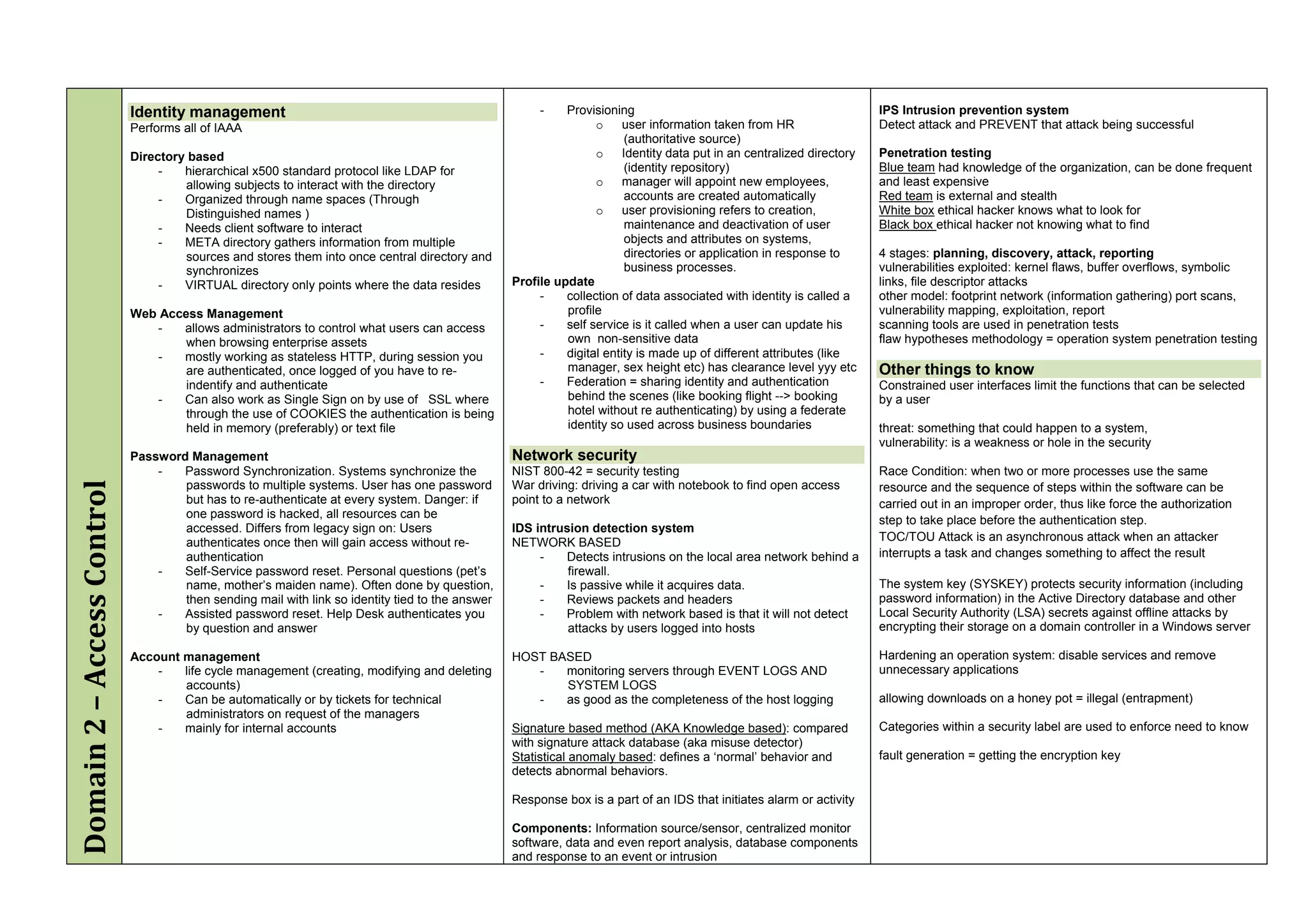
Identity management                                                       -    Provisioning                                                IPS Intrusion prevention system
                            Performs all of IAAA                                                                 o     user information taken from HR                  Detect attack and PREVENT that attack being successful
                                                                                                                        (authoritative source)
                            Directory based                                                                      o     Identity data put in an centralized directory   Penetration testing
                                 -   hierarchical x500 standard protocol like LDAP for                                  (identity repository)                          Blue team had knowledge of the organization, can be done frequent
                                     allowing subjects to interact with the directory                            o     manager will appoint new employees,             and least expensive
                                 -   Organized through name spaces (Through                                             accounts are created automatically             Red team is external and stealth
                                     Distinguished names )                                                       o     user provisioning refers to creation,           White box ethical hacker knows what to look for
                                 -   Needs client software to interact                                                  maintenance and deactivation of user           Black box ethical hacker not knowing what to find
                                 -   META directory gathers information from multiple                                   objects and attributes on systems,
                                     sources and stores them into once central directory and                            directories or application in response to      4 stages: planning, discovery, attack, reporting
                                     synchronizes                                                                       business processes.                            vulnerabilities exploited: kernel flaws, buffer overflows, symbolic
                                 -   VIRTUAL directory only points where the data resides        Profile update                                                        links, file descriptor attacks
                                                                                                      -    collection of data associated with identity is called a     other model: footprint network (information gathering) port scans,
                            Web Access Management                                                          profile                                                     vulnerability mapping, exploitation, report
                               -   allows administrators to control what users can access             -    self service is it called when a user can update his        scanning tools are used in penetration tests
                                    when browsing enterprise assets                                        own non-sensitive data                                      flaw hypotheses methodology = operation system penetration testing
                               -   mostly working as stateless HTTP, during session you               -    digital entity is made up of different attributes (like
                                    are authenticated, once logged of you have to re-                      manager, sex height etc) has clearance level yyy etc        Other things to know
                                    indentify and authenticate                                        -    Federation = sharing identity and authentication            Constrained user interfaces limit the functions that can be selected
                               -   Can also work as Single Sign on by use of SSL where                     behind the scenes (like booking flight --> booking          by a user
                                    through the use of COOKIES the authentication is being                 hotel without re authenticating) by using a federate
                                    held in memory (preferably) or text file                               identity so used across business boundaries                 threat: something that could happen to a system,
                                                                                                                                                                       vulnerability: is a weakness or hole in the security
                            Password Management                                                  Network security
                                -   Password Synchronization. Systems synchronize the            NIST 800-42 = security testing                                        Race Condition: when two or more processes use the same
Domain 2 – Access Control


                                    passwords to multiple systems. User has one password         War driving: driving a car with notebook to find open access          resource and the sequence of steps within the software can be
                                    but has to re-authenticate at every system. Danger: if       point to a network                                                    carried out in an improper order, thus like force the authorization
                                    one password is hacked, all resources can be
                                                                                                                                                                       step to take place before the authentication step.
                                    accessed. Differs from legacy sign on: Users                 IDS intrusion detection system
                                    authenticates once then will gain access without re-         NETWORK BASED                                                         TOC/TOU Attack is an asynchronous attack when an attacker
                                    authentication                                                    -   Detects intrusions on the local area network behind a        interrupts a task and changes something to affect the result
                                -   Self-Service password reset. Personal questions (pet’s                 firewall.
                                    name, mother’s maiden name). Often done by question,              -   Is passive while it acquires data.                           The system key (SYSKEY) protects security information (including
                                    then sending mail with link so identity tied to the answer        -   Reviews packets and headers                                  password information) in the Active Directory database and other
                                -   Assisted password reset. Help Desk authenticates you              -   Problem with network based is that it will not detect        Local Security Authority (LSA) secrets against offline attacks by
                                    by question and answer                                                 attacks by users logged into hosts                          encrypting their storage on a domain controller in a Windows server

                            Account management                                                   HOST BASED                                                            Hardening an operation system: disable services and remove
                                -   life cycle management (creating, modifying and deleting         -   monitoring servers through EVENT LOGS AND                      unnecessary applications
                                    accounts)                                                           SYSTEM LOGS
                                -   Can be automatically or by tickets for technical                -   as good as the completeness of the host logging                allowing downloads on a honey pot = illegal (entrapment)
                                    administrators on request of the managers
                                -   mainly for internal accounts                                 Signature based method (AKA Knowledge based): compared                Categories within a security label are used to enforce need to know
                                                                                                 with signature attack database (aka misuse detector)
                                                                                                 Statistical anomaly based: defines a ‘normal’ behavior and            fault generation = getting the encryption key
                                                                                                 detects abnormal behaviors.

                                                                                                 Response box is a part of an IDS that initiates alarm or activity

                                                                                                 Components: Information source/sensor, centralized monitor
                                                                                                 software, data and even report analysis, database components
                                                                                                 and response to an event or intrusion
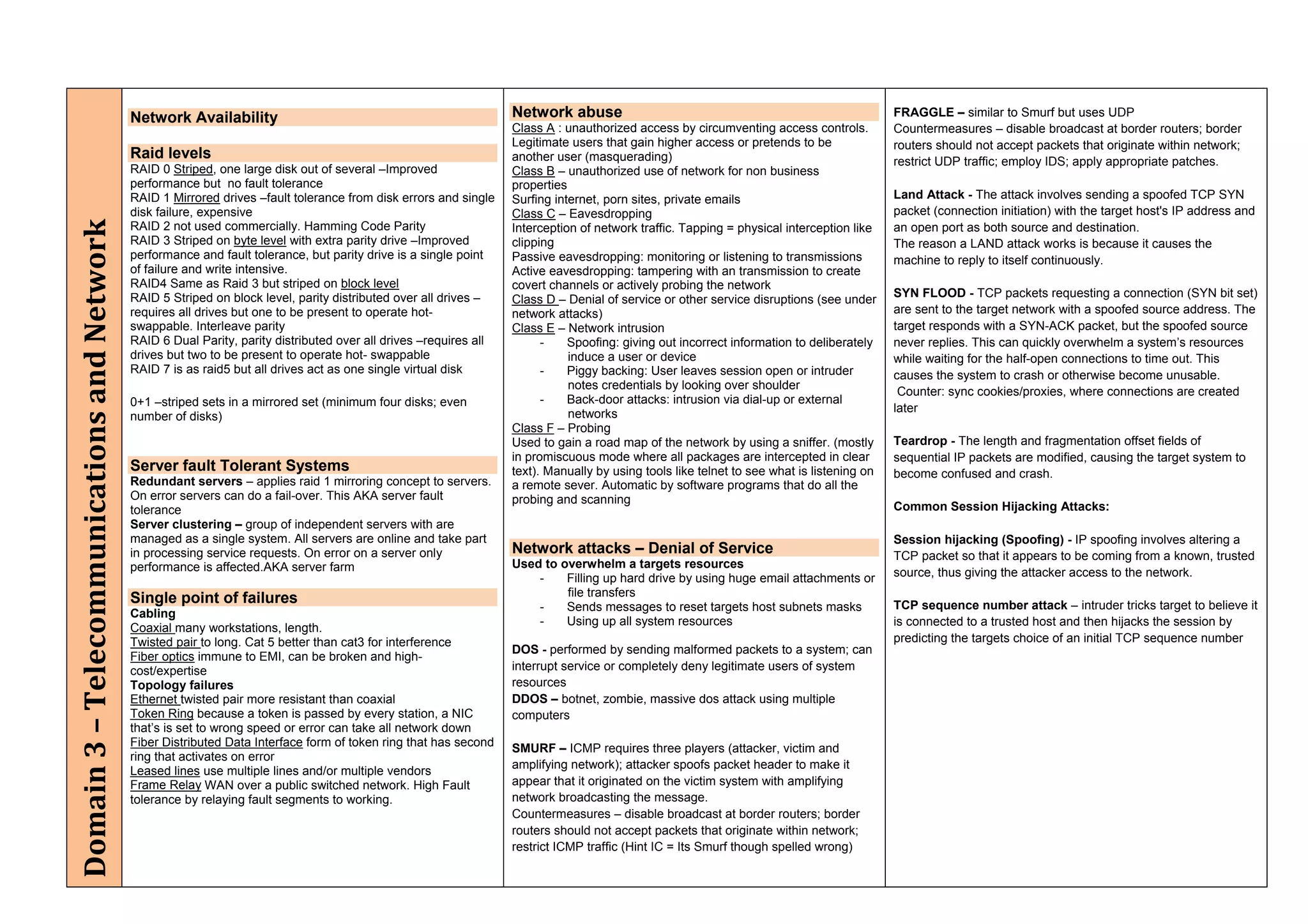
Network Availability                                                   Network abuse                                                            FRAGGLE – similar to Smurf but uses UDP
                                                                                                                    Class A : unauthorized access by circumventing access controls.          Countermeasures – disable broadcast at border routers; border
                                                                                                                    Legitimate users that gain higher access or pretends to be               routers should not accept packets that originate within network;
                                             Raid levels                                                            another user (masquerading)                                              restrict UDP traffic; employ IDS; apply appropriate patches.
                                             RAID 0 Striped, one large disk out of several –Improved                Class B – unauthorized use of network for non business
                                             performance but no fault tolerance                                     properties
                                             RAID 1 Mirrored drives –fault tolerance from disk errors and single    Surfing internet, porn sites, private emails                             Land Attack - The attack involves sending a spoofed TCP SYN
                                             disk failure, expensive                                                Class C – Eavesdropping                                                  packet (connection initiation) with the target host's IP address and
Domain 3 – Telecommunications and Network 


                                             RAID 2 not used commercially. Hamming Code Parity                      Interception of network traffic. Tapping = physical interception like    an open port as both source and destination.
                                             RAID 3 Striped on byte level with extra parity drive –Improved         clipping                                                                 The reason a LAND attack works is because it causes the
                                             performance and fault tolerance, but parity drive is a single point    Passive eavesdropping: monitoring or listening to transmissions          machine to reply to itself continuously.
                                             of failure and write intensive.                                        Active eavesdropping: tampering with an transmission to create
                                             RAID4 Same as Raid 3 but striped on block level                        covert channels or actively probing the network
                                             RAID 5 Striped on block level, parity distributed over all drives –                                                                             SYN FLOOD - TCP packets requesting a connection (SYN bit set)
                                                                                                                    Class D – Denial of service or other service disruptions (see under
                                             requires all drives but one to be present to operate hot-              network attacks)                                                         are sent to the target network with a spoofed source address. The
                                             swappable. Interleave parity                                           Class E – Network intrusion                                              target responds with a SYN-ACK packet, but the spoofed source
                                             RAID 6 Dual Parity, parity distributed over all drives –requires all         -    Spoofing: giving out incorrect information to deliberately    never replies. This can quickly overwhelm a system’s resources
                                             drives but two to be present to operate hot- swappable                            induce a user or device                                       while waiting for the half-open connections to time out. This
                                             RAID 7 is as raid5 but all drives act as one single virtual disk             -    Piggy backing: User leaves session open or intruder           causes the system to crash or otherwise become unusable.
                                                                                                                               notes credentials by looking over shoulder
                                                                                                                                                                                              Counter: sync cookies/proxies, where connections are created
                                             0+1 –striped sets in a mirrored set (minimum four disks; even                -    Back-door attacks: intrusion via dial-up or external
                                                                                                                               networks                                                      later
                                             number of disks)
                                                                                                                    Class F – Probing
                                                                                                                    Used to gain a road map of the network by using a sniffer. (mostly       Teardrop - The length and fragmentation offset fields of
                                                                                                                    in promiscuous mode where all packages are intercepted in clear          sequential IP packets are modified, causing the target system to
                                             Server fault Tolerant Systems                                          text). Manually by using tools like telnet to see what is listening on   become confused and crash.
                                             Redundant servers – applies raid 1 mirroring concept to servers.       a remote sever. Automatic by software programs that do all the
                                             On error servers can do a fail-over. This AKA server fault             probing and scanning
                                             tolerance                                                                                                                                       Common Session Hijacking Attacks:
                                             Server clustering – group of independent servers with are
                                             managed as a single system. All servers are online and take part                                                                                Session hijacking (Spoofing) - IP spoofing involves altering a
                                             in processing service requests. On error on a server only              Network attacks – Denial of Service                                      TCP packet so that it appears to be coming from a known, trusted
                                             performance is affected.AKA server farm                                Used to overwhelm a targets resources
                                                                                                                        -    Filling up hard drive by using huge email attachments or        source, thus giving the attacker access to the network.
                                                                                                                             file transfers
                                             Single point of failures                                                                                                                        TCP sequence number attack – intruder tricks target to believe it
                                                                                                                        -    Sends messages to reset targets host subnets masks
                                             Cabling
                                                                                                                        -    Using up all system resources                                   is connected to a trusted host and then hijacks the session by
                                             Coaxial many workstations, length.
                                             Twisted pair to long. Cat 5 better than cat3 for interference                                                                                   predicting the targets choice of an initial TCP sequence number
                                                                                                                    DOS - performed by sending malformed packets to a system; can
                                             Fiber optics immune to EMI, can be broken and high-
                                             cost/expertise                                                         interrupt service or completely deny legitimate users of system
                                             Topology failures                                                      resources
                                             Ethernet twisted pair more resistant than coaxial                      DDOS – botnet, zombie, massive dos attack using multiple
                                             Token Ring because a token is passed by every station, a NIC           computers
                                             that’s is set to wrong speed or error can take all network down
                                             Fiber Distributed Data Interface form of token ring that has second    SMURF – ICMP requires three players (attacker, victim and
                                             ring that activates on error
                                                                                                                    amplifying network); attacker spoofs packet header to make it
                                             Leased lines use multiple lines and/or multiple vendors
                                             Frame Relay WAN over a public switched network. High Fault             appear that it originated on the victim system with amplifying
                                             tolerance by relaying fault segments to working.                       network broadcasting the message.
                                                                                                                    Countermeasures – disable broadcast at border routers; border
                                                                                                                    routers should not accept packets that originate within network;
                                                                                                                    restrict ICMP traffic (Hint IC = Its Smurf though spelled wrong)
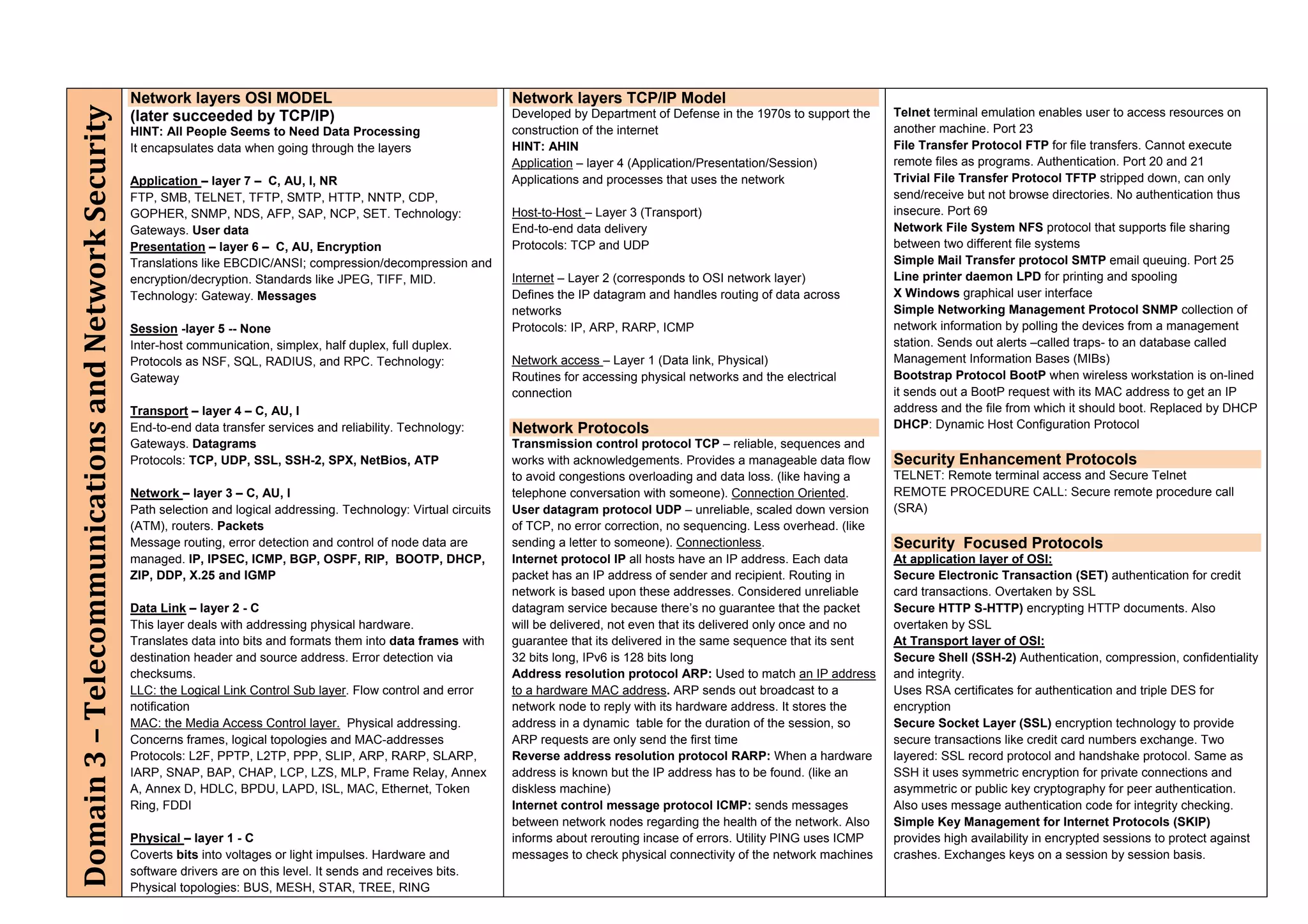
Domain 3 – Telecommunications and Network Security    Network layers OSI MODEL                                              Network layers TCP/IP Model
                                                      (later succeeded by TCP/IP)                                           Developed by Department of Defense in the 1970s to support the     Telnet terminal emulation enables user to access resources on
                                                      HINT: All People Seems to Need Data Processing                        construction of the internet                                       another machine. Port 23
                                                      It encapsulates data when going through the layers                    HINT: AHIN                                                         File Transfer Protocol FTP for file transfers. Cannot execute
                                                                                                                            Application – layer 4 (Application/Presentation/Session)           remote files as programs. Authentication. Port 20 and 21
                                                      Application – layer 7 – C, AU, I, NR                                  Applications and processes that uses the network                   Trivial File Transfer Protocol TFTP stripped down, can only
                                                      FTP, SMB, TELNET, TFTP, SMTP, HTTP, NNTP, CDP,                                                                                           send/receive but not browse directories. No authentication thus
                                                      GOPHER, SNMP, NDS, AFP, SAP, NCP, SET. Technology:                    Host-to-Host – Layer 3 (Transport)                                 insecure. Port 69
                                                      Gateways. User data                                                   End-to-end data delivery                                           Network File System NFS protocol that supports file sharing
                                                      Presentation – layer 6 – C, AU, Encryption                            Protocols: TCP and UDP                                             between two different file systems
                                                      Translations like EBCDIC/ANSI; compression/decompression and                                                                             Simple Mail Transfer protocol SMTP email queuing. Port 25
                                                      encryption/decryption. Standards like JPEG, TIFF, MID.                Internet – Layer 2 (corresponds to OSI network layer)              Line printer daemon LPD for printing and spooling
                                                      Technology: Gateway. Messages                                         Defines the IP datagram and handles routing of data across         X Windows graphical user interface
                                                                                                                            networks                                                           Simple Networking Management Protocol SNMP collection of
                                                      Session -layer 5 -- None                                              Protocols: IP, ARP, RARP, ICMP                                     network information by polling the devices from a management
                                                      Inter-host communication, simplex, half duplex, full duplex.                                                                             station. Sends out alerts –called traps- to an database called
                                                      Protocols as NSF, SQL, RADIUS, and RPC. Technology:                   Network access – Layer 1 (Data link, Physical)                     Management Information Bases (MIBs)
                                                      Gateway                                                               Routines for accessing physical networks and the electrical        Bootstrap Protocol BootP when wireless workstation is on-lined
                                                                                                                            connection                                                         it sends out a BootP request with its MAC address to get an IP
                                                      Transport – layer 4 – C, AU, I                                                                                                           address and the file from which it should boot. Replaced by DHCP
                                                      End-to-end data transfer services and reliability. Technology:        Network Protocols                                                  DHCP: Dynamic Host Configuration Protocol
                                                      Gateways. Datagrams                                                   Transmission control protocol TCP – reliable, sequences and
                                                      Protocols: TCP, UDP, SSL, SSH-2, SPX, NetBios, ATP                    works with acknowledgements. Provides a manageable data flow       Security Enhancement Protocols
                                                                                                                            to avoid congestions overloading and data loss. (like having a     TELNET: Remote terminal access and Secure Telnet
                                                      Network – layer 3 – C, AU, I                                          telephone conversation with someone). Connection Oriented.         REMOTE PROCEDURE CALL: Secure remote procedure call
                                                      Path selection and logical addressing. Technology: Virtual circuits   User datagram protocol UDP – unreliable, scaled down version       (SRA)
                                                      (ATM), routers. Packets                                               of TCP, no error correction, no sequencing. Less overhead. (like
                                                      Message routing, error detection and control of node data are         sending a letter to someone). Connectionless.                      Security Focused Protocols
                                                      managed. IP, IPSEC, ICMP, BGP, OSPF, RIP, BOOTP, DHCP,                Internet protocol IP all hosts have an IP address. Each data       At application layer of OSI:
                                                      ZIP, DDP, X.25 and IGMP                                               packet has an IP address of sender and recipient. Routing in       Secure Electronic Transaction (SET) authentication for credit
                                                                                                                            network is based upon these addresses. Considered unreliable       card transactions. Overtaken by SSL
                                                      Data Link – layer 2 - C                                               datagram service because there’s no guarantee that the packet      Secure HTTP S-HTTP) encrypting HTTP documents. Also
                                                      This layer deals with addressing physical hardware.                   will be delivered, not even that its delivered only once and no    overtaken by SSL
                                                      Translates data into bits and formats them into data frames with      guarantee that its delivered in the same sequence that its sent    At Transport layer of OSI:
                                                      destination header and source address. Error detection via            32 bits long, IPv6 is 128 bits long                                Secure Shell (SSH-2) Authentication, compression, confidentiality
                                                      checksums.                                                            Address resolution protocol ARP: Used to match an IP address       and integrity.
                                                      LLC: the Logical Link Control Sub layer. Flow control and error       to a hardware MAC address. ARP sends out broadcast to a            Uses RSA certificates for authentication and triple DES for
                                                      notification                                                          network node to reply with its hardware address. It stores the     encryption
                                                      MAC: the Media Access Control layer. Physical addressing.             address in a dynamic table for the duration of the session, so     Secure Socket Layer (SSL) encryption technology to provide
                                                      Concerns frames, logical topologies and MAC-addresses                 ARP requests are only send the first time                          secure transactions like credit card numbers exchange. Two
                                                      Protocols: L2F, PPTP, L2TP, PPP, SLIP, ARP, RARP, SLARP,              Reverse address resolution protocol RARP: When a hardware          layered: SSL record protocol and handshake protocol. Same as
                                                      IARP, SNAP, BAP, CHAP, LCP, LZS, MLP, Frame Relay, Annex              address is known but the IP address has to be found. (like an      SSH it uses symmetric encryption for private connections and
                                                      A, Annex D, HDLC, BPDU, LAPD, ISL, MAC, Ethernet, Token               diskless machine)                                                  asymmetric or public key cryptography for peer authentication.
                                                      Ring, FDDI                                                            Internet control message protocol ICMP: sends messages             Also uses message authentication code for integrity checking.
                                                                                                                            between network nodes regarding the health of the network. Also    Simple Key Management for Internet Protocols (SKIP)
                                                      Physical – layer 1 - C                                                informs about rerouting incase of errors. Utility PING uses ICMP   provides high availability in encrypted sessions to protect against
                                                      Coverts bits into voltages or light impulses. Hardware and            messages to check physical connectivity of the network machines    crashes. Exchanges keys on a session by session basis.
                                                      software drivers are on this level. It sends and receives bits.
                                                      Physical topologies: BUS, MESH, STAR, TREE, RING
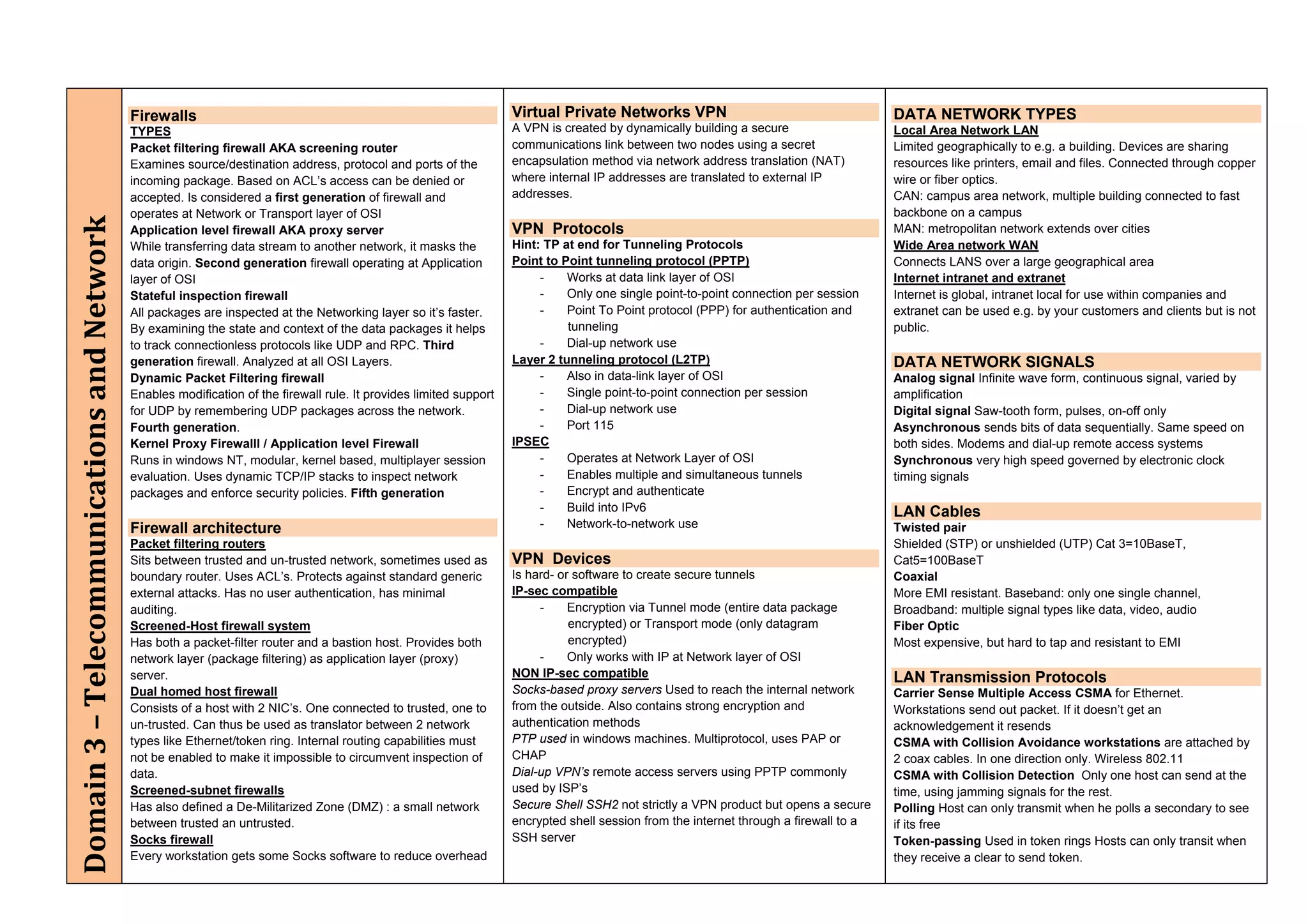
Firewalls                                                                Virtual Private Networks VPN                                        DATA NETWORK TYPES
                                             TYPES                                                                    A VPN is created by dynamically building a secure                   Local Area Network LAN
                                             Packet filtering firewall AKA screening router                           communications link between two nodes using a secret                Limited geographically to e.g. a building. Devices are sharing
                                             Examines source/destination address, protocol and ports of the           encapsulation method via network address translation (NAT)          resources like printers, email and files. Connected through copper
                                             incoming package. Based on ACL’s access can be denied or                 where internal IP addresses are translated to external IP           wire or fiber optics.
                                             accepted. Is considered a first generation of firewall and               addresses.                                                          CAN: campus area network, multiple building connected to fast
                                                                                                                                                                                          backbone on a campus
Domain 3 – Telecommunications and Network 


                                             operates at Network or Transport layer of OSI
                                             Application level firewall AKA proxy server                              VPN Protocols                                                       MAN: metropolitan network extends over cities
                                             While transferring data stream to another network, it masks the          Hint: TP at end for Tunneling Protocols                             Wide Area network WAN
                                             data origin. Second generation firewall operating at Application         Point to Point tunneling protocol (PPTP)                            Connects LANS over a large geographical area
                                             layer of OSI                                                                  -    Works at data link layer of OSI                           Internet intranet and extranet
                                             Stateful inspection firewall                                                  -    Only one single point-to-point connection per session     Internet is global, intranet local for use within companies and
                                             All packages are inspected at the Networking layer so it’s faster.            -    Point To Point protocol (PPP) for authentication and      extranet can be used e.g. by your customers and clients but is not
                                             By examining the state and context of the data packages it helps                   tunneling                                                 public.
                                             to track connectionless protocols like UDP and RPC. Third                     -    Dial-up network use
                                             generation firewall. Analyzed at all OSI Layers.                         Layer 2 tunneling protocol (L2TP)                                   DATA NETWORK SIGNALS
                                             Dynamic Packet Filtering firewall                                             -    Also in data-link layer of OSI                            Analog signal Infinite wave form, continuous signal, varied by
                                             Enables modification of the firewall rule. It provides limited support        -    Single point-to-point connection per session              amplification
                                             for UDP by remembering UDP packages across the network.                       -    Dial-up network use                                       Digital signal Saw-tooth form, pulses, on-off only
                                             Fourth generation.                                                            -    Port 115                                                  Asynchronous sends bits of data sequentially. Same speed on
                                             Kernel Proxy Firewalll / Application level Firewall                      IPSEC                                                               both sides. Modems and dial-up remote access systems
                                             Runs in windows NT, modular, kernel based, multiplayer session                -    Operates at Network Layer of OSI                          Synchronous very high speed governed by electronic clock
                                             evaluation. Uses dynamic TCP/IP stacks to inspect network                     -    Enables multiple and simultaneous tunnels                 timing signals
                                             packages and enforce security policies. Fifth generation                      -    Encrypt and authenticate
                                                                                                                           -    Build into IPv6                                           LAN Cables
                                             Firewall architecture                                                         -    Network-to-network use                                    Twisted pair
                                             Packet filtering routers                                                                                                                     Shielded (STP) or unshielded (UTP) Cat 3=10BaseT,
                                             Sits between trusted and un-trusted network, sometimes used as           VPN Devices                                                         Cat5=100BaseT
                                             boundary router. Uses ACL’s. Protects against standard generic           Is hard- or software to create secure tunnels                       Coaxial
                                             external attacks. Has no user authentication, has minimal                IP-sec compatible                                                   More EMI resistant. Baseband: only one single channel,
                                             auditing.                                                                     -     Encryption via Tunnel mode (entire data package          Broadband: multiple signal types like data, video, audio
                                             Screened-Host firewall system                                                       encrypted) or Transport mode (only datagram              Fiber Optic
                                             Has both a packet-filter router and a bastion host. Provides both                   encrypted)                                               Most expensive, but hard to tap and resistant to EMI
                                             network layer (package filtering) as application layer (proxy)                -     Only works with IP at Network layer of OSI
                                             server.                                                                  NON IP-sec compatible                                               LAN Transmission Protocols
                                             Dual homed host firewall                                                 Socks-based proxy servers Used to reach the internal network        Carrier Sense Multiple Access CSMA for Ethernet.
                                             Consists of a host with 2 NIC’s. One connected to trusted, one to        from the outside. Also contains strong encryption and               Workstations send out packet. If it doesn’t get an
                                             un-trusted. Can thus be used as translator between 2 network             authentication methods                                              acknowledgement it resends
                                             types like Ethernet/token ring. Internal routing capabilities must       PTP used in windows machines. Multiprotocol, uses PAP or            CSMA with Collision Avoidance workstations are attached by
                                             not be enabled to make it impossible to circumvent inspection of         CHAP                                                                2 coax cables. In one direction only. Wireless 802.11
                                             data.                                                                    Dial-up VPN’s remote access servers using PPTP commonly             CSMA with Collision Detection Only one host can send at the
                                             Screened-subnet firewalls                                                used by ISP’s                                                       time, using jamming signals for the rest.
                                             Has also defined a De-Militarized Zone (DMZ) : a small network           Secure Shell SSH2 not strictly a VPN product but opens a secure     Polling Host can only transmit when he polls a secondary to see
                                             between trusted an untrusted.                                            encrypted shell session from the internet through a firewall to a   if its free
                                             Socks firewall                                                           SSH server                                                          Token-passing Used in token rings Hosts can only transit when
                                             Every workstation gets some Socks software to reduce overhead                                                                                they receive a clear to send token.
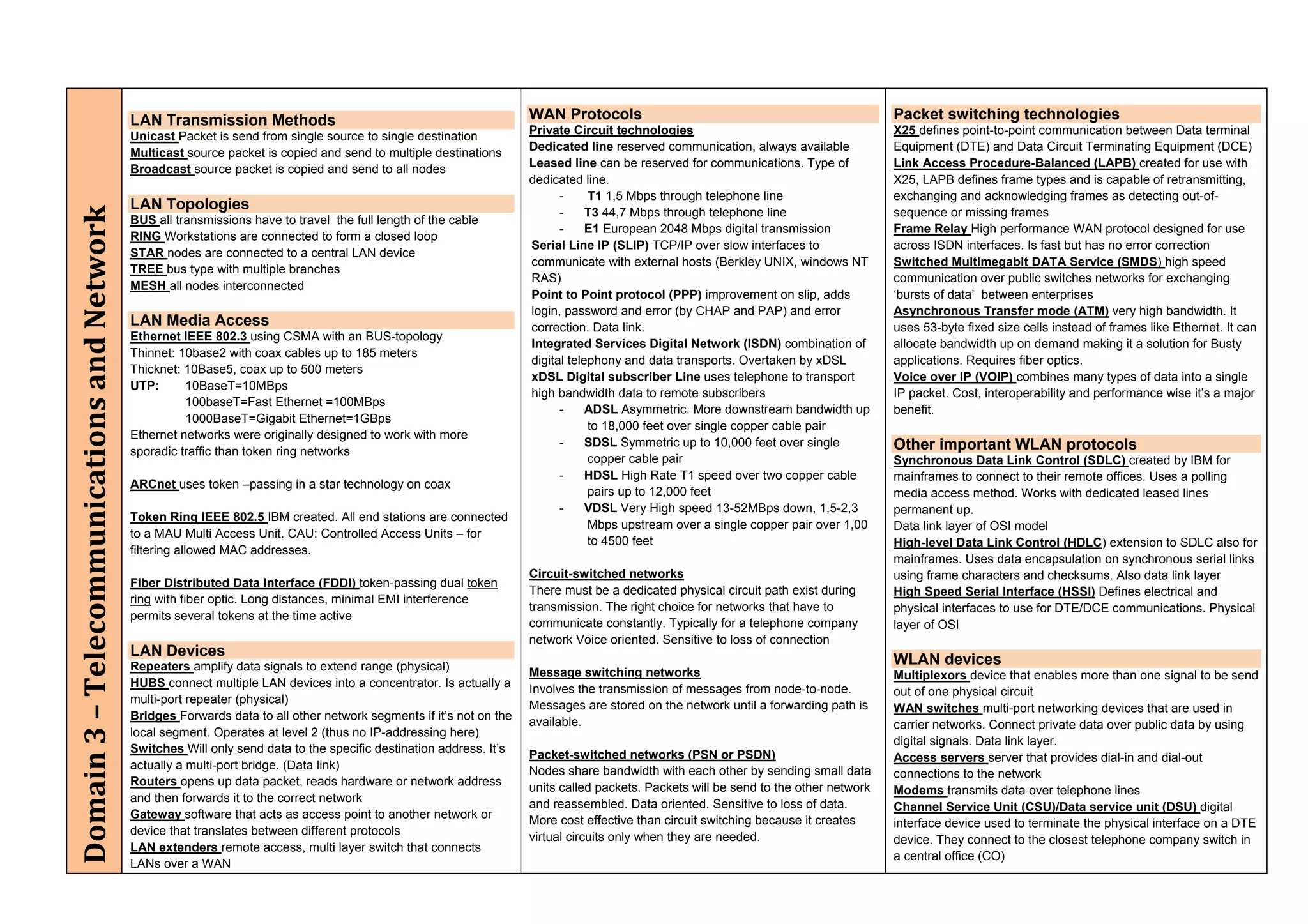
LAN Transmission Methods                                                 WAN Protocols                                                     Packet switching technologies
                                             Unicast Packet is send from single source to single destination          Private Circuit technologies                                      X25 defines point-to-point communication between Data terminal
                                             Multicast source packet is copied and send to multiple destinations      Dedicated line reserved communication, always available           Equipment (DTE) and Data Circuit Terminating Equipment (DCE)
                                             Broadcast source packet is copied and send to all nodes                  Leased line can be reserved for communications. Type of           Link Access Procedure-Balanced (LAPB) created for use with
                                                                                                                      dedicated line.                                                   X25, LAPB defines frame types and is capable of retransmitting,
                                                                                                                            -     T1 1,5 Mbps through telephone line                    exchanging and acknowledging frames as detecting out-of-
                                             LAN Topologies
Domain 3 – Telecommunications and Network 


                                                                                                                            -     T3 44,7 Mbps through telephone line                   sequence or missing frames
                                             BUS all transmissions have to travel the full length of the cable
                                                                                                                            -     E1 European 2048 Mbps digital transmission            Frame Relay High performance WAN protocol designed for use
                                             RING Workstations are connected to form a closed loop
                                                                                                                      Serial Line IP (SLIP) TCP/IP over slow interfaces to              across ISDN interfaces. Is fast but has no error correction
                                             STAR nodes are connected to a central LAN device
                                                                                                                      communicate with external hosts (Berkley UNIX, windows NT         Switched Multimegabit DATA Service (SMDS) high speed
                                             TREE bus type with multiple branches
                                                                                                                      RAS)                                                              communication over public switches networks for exchanging
                                             MESH all nodes interconnected
                                                                                                                      Point to Point protocol (PPP) improvement on slip, adds           ‘bursts of data’ between enterprises
                                                                                                                      login, password and error (by CHAP and PAP) and error             Asynchronous Transfer mode (ATM) very high bandwidth. It
                                             LAN Media Access                                                         correction. Data link.                                            uses 53-byte fixed size cells instead of frames like Ethernet. It can
                                             Ethernet IEEE 802.3 using CSMA with an BUS-topology
                                                                                                                      Integrated Services Digital Network (ISDN) combination of         allocate bandwidth up on demand making it a solution for Busty
                                             Thinnet: 10base2 with coax cables up to 185 meters
                                                                                                                      digital telephony and data transports. Overtaken by xDSL          applications. Requires fiber optics.
                                             Thicknet: 10Base5, coax up to 500 meters
                                                                                                                      xDSL Digital subscriber Line uses telephone to transport          Voice over IP (VOIP) combines many types of data into a single
                                             UTP:      10BaseT=10MBps
                                                                                                                      high bandwidth data to remote subscribers                         IP packet. Cost, interoperability and performance wise it’s a major
                                                       100baseT=Fast Ethernet =100MBps
                                                                                                                            -     ADSL Asymmetric. More downstream bandwidth up         benefit.
                                                       1000BaseT=Gigabit Ethernet=1GBps
                                                                                                                                  to 18,000 feet over single copper cable pair
                                             Ethernet networks were originally designed to work with more
                                                                                                                            -     SDSL Symmetric up to 10,000 feet over single          Other important WLAN protocols
                                             sporadic traffic than token ring networks
                                                                                                                                  copper cable pair                                     Synchronous Data Link Control (SDLC) created by IBM for
                                                                                                                            -     HDSL High Rate T1 speed over two copper cable         mainframes to connect to their remote offices. Uses a polling
                                             ARCnet uses token –passing in a star technology on coax
                                                                                                                                  pairs up to 12,000 feet                               media access method. Works with dedicated leased lines
                                                                                                                            -     VDSL Very High speed 13-52MBps down, 1,5-2,3          permanent up.
                                             Token Ring IEEE 802.5 IBM created. All end stations are connected
                                                                                                                                  Mbps upstream over a single copper pair over 1,00     Data link layer of OSI model
                                             to a MAU Multi Access Unit. CAU: Controlled Access Units – for
                                                                                                                                  to 4500 feet                                          High-level Data Link Control (HDLC) extension to SDLC also for
                                             filtering allowed MAC addresses.
                                                                                                                                                                                        mainframes. Uses data encapsulation on synchronous serial links
                                                                                                                      Circuit-switched networks                                         using frame characters and checksums. Also data link layer
                                             Fiber Distributed Data Interface (FDDI) token-passing dual token
                                                                                                                      There must be a dedicated physical circuit path exist during      High Speed Serial Interface (HSSI) Defines electrical and
                                             ring with fiber optic. Long distances, minimal EMI interference
                                                                                                                      transmission. The right choice for networks that have to          physical interfaces to use for DTE/DCE communications. Physical
                                             permits several tokens at the time active
                                                                                                                      communicate constantly. Typically for a telephone company         layer of OSI
                                                                                                                      network Voice oriented. Sensitive to loss of connection
                                             LAN Devices
                                             Repeaters amplify data signals to extend range (physical)                                                                                  WLAN devices
                                                                                                                      Message switching networks                                        Multiplexors device that enables more than one signal to be send
                                             HUBS connect multiple LAN devices into a concentrator. Is actually a     Involves the transmission of messages from node-to-node.          out of one physical circuit
                                             multi-port repeater (physical)                                           Messages are stored on the network until a forwarding path is     WAN switches multi-port networking devices that are used in
                                             Bridges Forwards data to all other network segments if it’s not on the   available.                                                        carrier networks. Connect private data over public data by using
                                             local segment. Operates at level 2 (thus no IP-addressing here)
                                                                                                                                                                                        digital signals. Data link layer.
                                             Switches Will only send data to the specific destination address. It’s   Packet-switched networks (PSN or PSDN)                            Access servers server that provides dial-in and dial-out
                                             actually a multi-port bridge. (Data link)                                Nodes share bandwidth with each other by sending small data       connections to the network
                                             Routers opens up data packet, reads hardware or network address          units called packets. Packets will be send to the other network   Modems transmits data over telephone lines
                                             and then forwards it to the correct network                              and reassembled. Data oriented. Sensitive to loss of data.        Channel Service Unit (CSU)/Data service unit (DSU) digital
                                             Gateway software that acts as access point to another network or         More cost effective than circuit switching because it creates     interface device used to terminate the physical interface on a DTE
                                             device that translates between different protocols                       virtual circuits only when they are needed.                       device. They connect to the closest telephone company switch in
                                             LAN extenders remote access, multi layer switch that connects
                                                                                                                                                                                        a central office (CO)
                                             LANs over a WAN
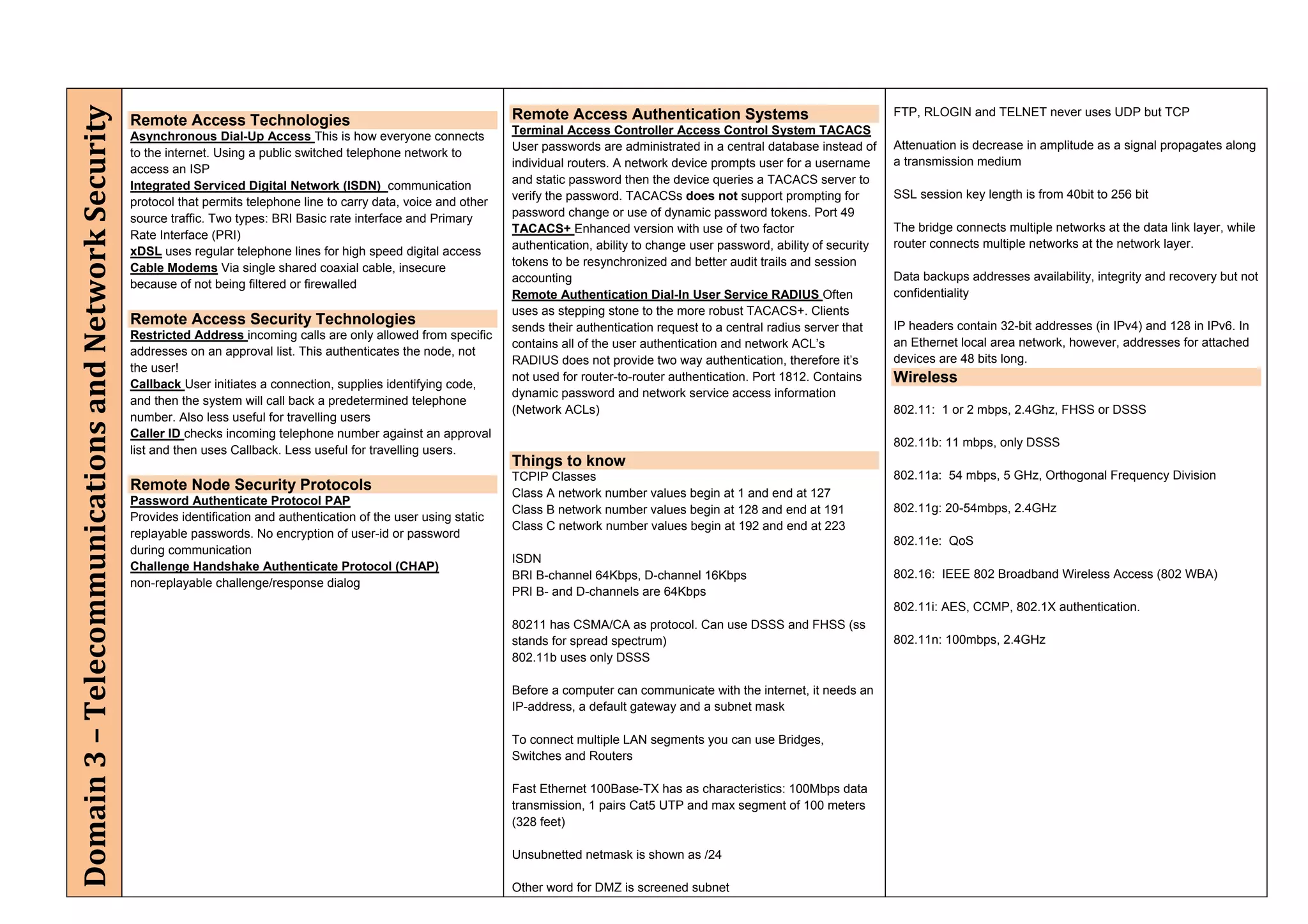
Domain 3 – Telecommunications and Network Security                                                                         Remote Access Authentication Systems                                   FTP, RLOGIN and TELNET never uses UDP but TCP
                                                     Remote Access Technologies
                                                     Asynchronous Dial-Up Access This is how everyone connects             Terminal Access Controller Access Control System TACACS
                                                                                                                           User passwords are administrated in a central database instead of      Attenuation is decrease in amplitude as a signal propagates along
                                                     to the internet. Using a public switched telephone network to
                                                                                                                           individual routers. A network device prompts user for a username       a transmission medium
                                                     access an ISP
                                                     Integrated Serviced Digital Network (ISDN) communication              and static password then the device queries a TACACS server to
                                                                                                                           verify the password. TACACSs does not support prompting for            SSL session key length is from 40bit to 256 bit
                                                     protocol that permits telephone line to carry data, voice and other
                                                     source traffic. Two types: BRI Basic rate interface and Primary       password change or use of dynamic password tokens. Port 49
                                                                                                                           TACACS+ Enhanced version with use of two factor                        The bridge connects multiple networks at the data link layer, while
                                                     Rate Interface (PRI)
                                                                                                                           authentication, ability to change user password, ability of security   router connects multiple networks at the network layer.
                                                     xDSL uses regular telephone lines for high speed digital access
                                                     Cable Modems Via single shared coaxial cable, insecure                tokens to be resynchronized and better audit trails and session
                                                                                                                           accounting                                                             Data backups addresses availability, integrity and recovery but not
                                                     because of not being filtered or firewalled
                                                                                                                           Remote Authentication Dial-In User Service RADIUS Often                confidentiality
                                                                                                                           uses as stepping stone to the more robust TACACS+. Clients
                                                     Remote Access Security Technologies                                   sends their authentication request to a central radius server that     IP headers contain 32-bit addresses (in IPv4) and 128 in IPv6. In
                                                     Restricted Address incoming calls are only allowed from specific
                                                                                                                           contains all of the user authentication and network ACL’s              an Ethernet local area network, however, addresses for attached
                                                     addresses on an approval list. This authenticates the node, not
                                                                                                                           RADIUS does not provide two way authentication, therefore it’s         devices are 48 bits long.
                                                     the user!
                                                     Callback User initiates a connection, supplies identifying code,
                                                                                                                           not used for router-to-router authentication. Port 1812. Contains      Wireless
                                                                                                                           dynamic password and network service access information
                                                     and then the system will call back a predetermined telephone
                                                                                                                           (Network ACLs)                                                         802.11: 1 or 2 mbps, 2.4Ghz, FHSS or DSSS
                                                     number. Also less useful for travelling users
                                                     Caller ID checks incoming telephone number against an approval
                                                                                                                                                                                                  802.11b: 11 mbps, only DSSS
                                                     list and then uses Callback. Less useful for travelling users.
                                                                                                                           Things to know
                                                                                                                           TCPIP Classes                                                          802.11a: 54 mbps, 5 GHz, Orthogonal Frequency Division
                                                     Remote Node Security Protocols                                        Class A network number values begin at 1 and end at 127
                                                     Password Authenticate Protocol PAP
                                                                                                                           Class B network number values begin at 128 and end at 191              802.11g: 20-54mbps, 2.4GHz
                                                     Provides identification and authentication of the user using static
                                                                                                                           Class C network number values begin at 192 and end at 223
                                                     replayable passwords. No encryption of user-id or password
                                                                                                                                                                                                  802.11e: QoS
                                                     during communication
                                                                                                                           ISDN
                                                     Challenge Handshake Authenticate Protocol (CHAP)
                                                                                                                           BRI B-channel 64Kbps, D-channel 16Kbps                                 802.16: IEEE 802 Broadband Wireless Access (802 WBA)
                                                     non-replayable challenge/response dialog
                                                                                                                           PRI B- and D-channels are 64Kbps
                                                                                                                                                                                                  802.11i: AES, CCMP, 802.1X authentication.
                                                                                                                           80211 has CSMA/CA as protocol. Can use DSSS and FHSS (ss
                                                                                                                           stands for spread spectrum)                                            802.11n: 100mbps, 2.4GHz
                                                                                                                           802.11b uses only DSSS

                                                                                                                           Before a computer can communicate with the internet, it needs an
                                                                                                                           IP-address, a default gateway and a subnet mask

                                                                                                                           To connect multiple LAN segments you can use Bridges,
                                                                                                                           Switches and Routers

                                                                                                                           Fast Ethernet 100Base-TX has as characteristics: 100Mbps data
                                                                                                                           transmission, 1 pairs Cat5 UTP and max segment of 100 meters
                                                                                                                           (328 feet)

                                                                                                                           Unsubnetted netmask is shown as /24

                                                                                                                           Other word for DMZ is screened subnet
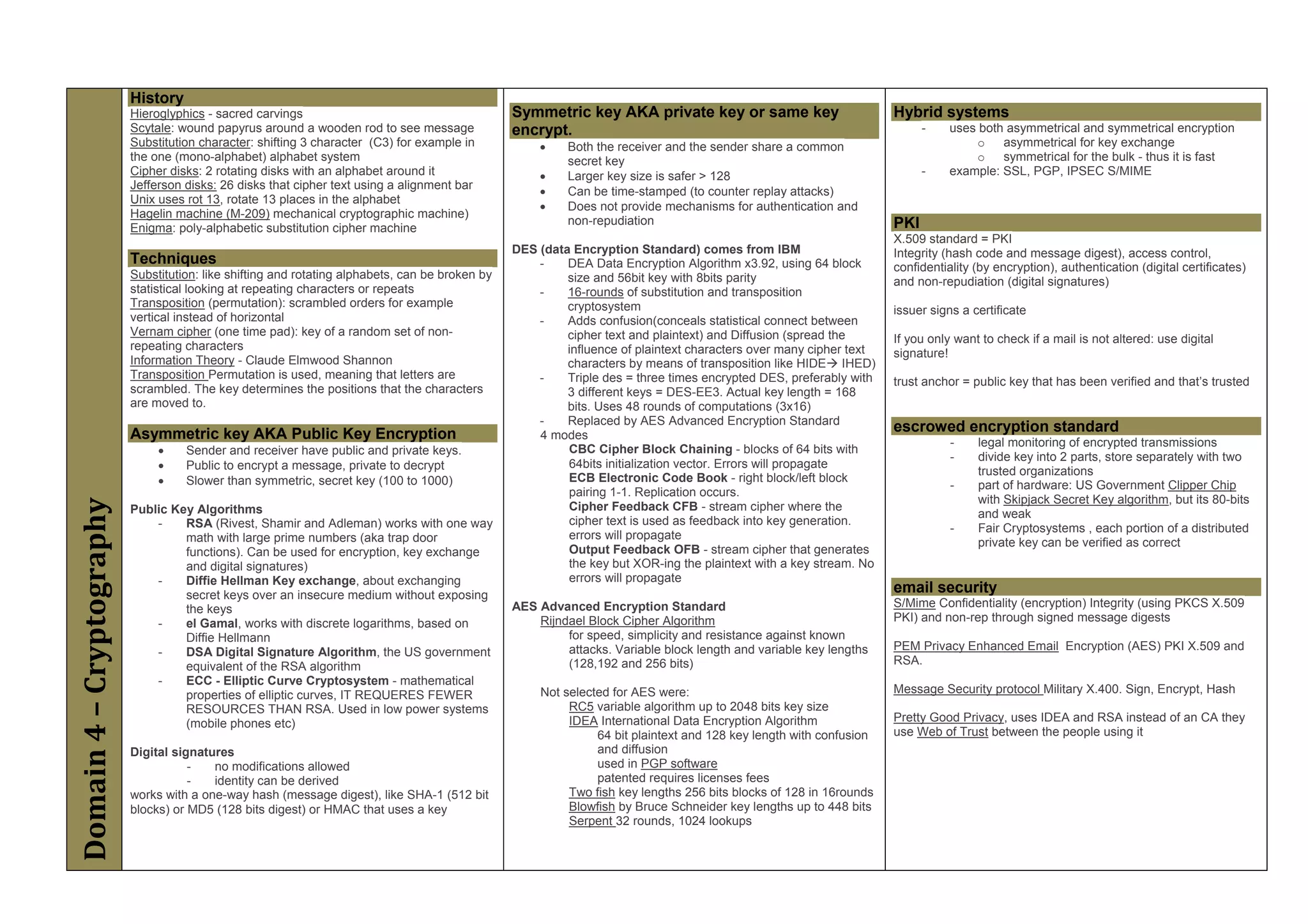
History
                           Hieroglyphics - sacred carvings                                        Symmetric key AKA private key or same key                           Hybrid systems
                           Scytale: wound papyrus around a wooden rod to see message              encrypt.                                                                  -    uses both asymmetrical and symmetrical encryption
                           Substitution character: shifting 3 character (C3) for example in                Both the receiver and the sender share a common                          o    asymmetrical for key exchange
                           the one (mono-alphabet) alphabet system                                          secret key                                                               o    symmetrical for the bulk - thus it is fast
                           Cipher disks: 2 rotating disks with an alphabet around it                       Larger key size is safer > 128                                  -    example: SSL, PGP, IPSEC S/MIME
                           Jefferson disks: 26 disks that cipher text using a alignment bar                Can be time-stamped (to counter replay attacks)
                           Unix uses rot 13, rotate 13 places in the alphabet
                                                                                                           Does not provide mechanisms for authentication and
                           Hagelin machine (M-209) mechanical cryptographic machine)
                                                                                                            non-repudiation                                           PKI
                           Enigma: poly-alphabetic substitution cipher machine
                                                                                                                                                                      X.509 standard = PKI
                                                                                                  DES (data Encryption Standard) comes from IBM                       Integrity (hash code and message digest), access control,
                           Techniques                                                                 -    DEA Data Encryption Algorithm x3.92, using 64 block        confidentiality (by encryption), authentication (digital certificates)
                           Substitution: like shifting and rotating alphabets, can be broken by            size and 56bit key with 8bits parity                       and non-repudiation (digital signatures)
                           statistical looking at repeating characters or repeats                     -    16-rounds of substitution and transposition
                           Transposition (permutation): scrambled orders for example                       cryptosystem                                               issuer signs a certificate
                           vertical instead of horizontal                                             -    Adds confusion(conceals statistical connect between
                           Vernam cipher (one time pad): key of a random set of non-                       cipher text and plaintext) and Diffusion (spread the       If you only want to check if a mail is not altered: use digital
                           repeating characters                                                            influence of plaintext characters over many cipher text    signature!
                           Information Theory - Claude Elmwood Shannon                                     characters by means of transposition like HIDE IHED)
                           Transposition Permutation is used, meaning that letters are                -    Triple des = three times encrypted DES, preferably with    trust anchor = public key that has been verified and that’s trusted
                           scrambled. The key determines the positions that the characters                 3 different keys = DES-EE3. Actual key length = 168
                           are moved to.                                                                   bits. Uses 48 rounds of computations (3x16)
                                                                                                      -    Replaced by AES Advanced Encryption Standard
                           Asymmetric key AKA Public Key Encryption                                   4 modes
                                                                                                                                                                      escrowed encryption standard
                                                                                                                                                                                 -    legal monitoring of encrypted transmissions
                                    Sender and receiver have public and private keys.                     CBC Cipher Block Chaining - blocks of 64 bits with
                                                                                                                                                                                 -    divide key into 2 parts, store separately with two
                                    Public to encrypt a message, private to decrypt                       64bits initialization vector. Errors will propagate
                                                                                                                                                                                      trusted organizations
                                    Slower than symmetric, secret key (100 to 1000)                       ECB Electronic Code Book - right block/left block
                                                                                                                                                                                 -    part of hardware: US Government Clipper Chip
                                                                                                           pairing 1-1. Replication occurs.
Domain 4 – Cryptography 


                                                                                                                                                                                      with Skipjack Secret Key algorithm, but its 80-bits
                           Public Key Algorithms                                                           Cipher Feedback CFB - stream cipher where the
                                                                                                                                                                                      and weak
                               -    RSA (Rivest, Shamir and Adleman) works with one way                    cipher text is used as feedback into key generation.
                                                                                                                                                                                 -    Fair Cryptosystems , each portion of a distributed
                                    math with large prime numbers (aka trap door                           errors will propagate
                                                                                                                                                                                      private key can be verified as correct
                                    functions). Can be used for encryption, key exchange                   Output Feedback OFB - stream cipher that generates
                                    and digital signatures)                                                the key but XOR-ing the plaintext with a key stream. No
                               -    Diffie Hellman Key exchange, about exchanging                          errors will propagate
                                    secret keys over an insecure medium without exposing
                                                                                                                                                                      email security
                                    the keys                                                      AES Advanced Encryption Standard                                    S/Mime Confidentiality (encryption) Integrity (using PKCS X.509
                               -    el Gamal, works with discrete logarithms, based on                Rijndael Block Cipher Algorithm                                 PKI) and non-rep through signed message digests
                                    Diffie Hellmann                                                        for speed, simplicity and resistance against known
                               -    DSA Digital Signature Algorithm, the US government                     attacks. Variable block length and variable key lengths    PEM Privacy Enhanced Email Encryption (AES) PKI X.509 and
                                    equivalent of the RSA algorithm                                        (128,192 and 256 bits)                                     RSA.
                               -    ECC - Elliptic Curve Cryptosystem - mathematical
                                    properties of elliptic curves, IT REQUERES FEWER                   Not selected for AES were:                                     Message Security protocol Military X.400. Sign, Encrypt, Hash
                                    RESOURCES THAN RSA. Used in low power systems                           RC5 variable algorithm up to 2048 bits key size
                                    (mobile phones etc)                                                     IDEA International Data Encryption Algorithm              Pretty Good Privacy, uses IDEA and RSA instead of an CA they
                                                                                                                 64 bit plaintext and 128 key length with confusion   use Web of Trust between the people using it
                           Digital signatures                                                                    and diffusion
                                      -   no modifications allowed                                               used in PGP software
                                      -   identity can be derived                                                patented requires licenses fees
                           works with a one-way hash (message digest), like SHA-1 (512 bit                  Two fish key lengths 256 bits blocks of 128 in 16rounds
                           blocks) or MD5 (128 bits digest) or HMAC that uses a key                         Blowfish by Bruce Schneider key lengths up to 448 bits
                                                                                                            Serpent 32 rounds, 1024 lookups
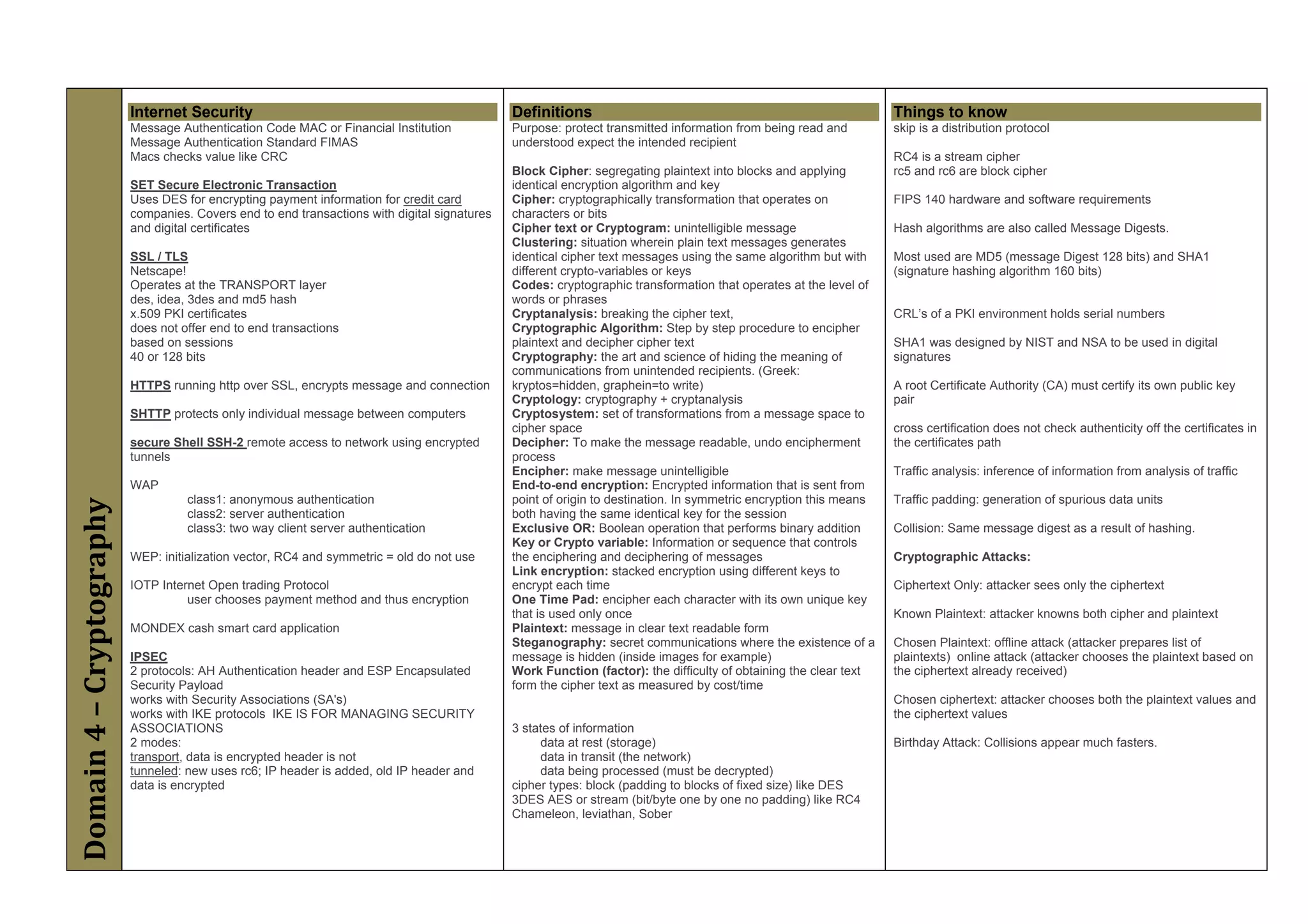
Internet Security                                                   Definitions                                                          Things to know
                          Message Authentication Code MAC or Financial Institution            Purpose: protect transmitted information from being read and         skip is a distribution protocol
                          Message Authentication Standard FIMAS                               understood expect the intended recipient
                          Macs checks value like CRC                                                                                                               RC4 is a stream cipher
                                                                                              Block Cipher: segregating plaintext into blocks and applying         rc5 and rc6 are block cipher
                          SET Secure Electronic Transaction                                   identical encryption algorithm and key
                          Uses DES for encrypting payment information for credit card         Cipher: cryptographically transformation that operates on            FIPS 140 hardware and software requirements
                          companies. Covers end to end transactions with digital signatures   characters or bits
                          and digital certificates                                            Cipher text or Cryptogram: unintelligible message                    Hash algorithms are also called Message Digests.
                                                                                              Clustering: situation wherein plain text messages generates
                          SSL / TLS                                                           identical cipher text messages using the same algorithm but with     Most used are MD5 (message Digest 128 bits) and SHA1
                          Netscape!                                                           different crypto-variables or keys                                   (signature hashing algorithm 160 bits)
                          Operates at the TRANSPORT layer                                     Codes: cryptographic transformation that operates at the level of
                          des, idea, 3des and md5 hash                                        words or phrases
                          x.509 PKI certificates                                              Cryptanalysis: breaking the cipher text,                             CRL’s of a PKI environment holds serial numbers
                          does not offer end to end transactions                              Cryptographic Algorithm: Step by step procedure to encipher
                          based on sessions                                                   plaintext and decipher cipher text                                   SHA1 was designed by NIST and NSA to be used in digital
                          40 or 128 bits                                                      Cryptography: the art and science of hiding the meaning of           signatures
                                                                                              communications from unintended recipients. (Greek:
                          HTTPS running http over SSL, encrypts message and connection        kryptos=hidden, graphein=to write)                                   A root Certificate Authority (CA) must certify its own public key
                                                                                              Cryptology: cryptography + cryptanalysis                             pair
                          SHTTP protects only individual message between computers            Cryptosystem: set of transformations from a message space to
                                                                                              cipher space                                                         cross certification does not check authenticity off the certificates in
                          secure Shell SSH-2 remote access to network using encrypted         Decipher: To make the message readable, undo encipherment            the certificates path
                          tunnels                                                             process
                                                                                              Encipher: make message unintelligible                                Traffic analysis: inference of information from analysis of traffic
                          WAP                                                                 End-to-end encryption: Encrypted information that is sent from
                                    class1: anonymous authentication                          point of origin to destination. In symmetric encryption this means   Traffic padding: generation of spurious data units
Domain 4 – Cryptography


                                    class2: server authentication                             both having the same identical key for the session
                                    class3: two way client server authentication              Exclusive OR: Boolean operation that performs binary addition        Collision: Same message digest as a result of hashing.
                                                                                              Key or Crypto variable: Information or sequence that controls
                          WEP: initialization vector, RC4 and symmetric = old do not use      the enciphering and deciphering of messages                          Cryptographic Attacks:
                                                                                              Link encryption: stacked encryption using different keys to
                          IOTP Internet Open trading Protocol                                 encrypt each time                                                    Ciphertext Only: attacker sees only the ciphertext
                                    user chooses payment method and thus encryption           One Time Pad: encipher each character with its own unique key
                                                                                              that is used only once                                               Known Plaintext: attacker knowns both cipher and plaintext
                          MONDEX cash smart card application                                  Plaintext: message in clear text readable form
                                                                                              Steganography: secret communications where the existence of a        Chosen Plaintext: offline attack (attacker prepares list of
                          IPSEC                                                               message is hidden (inside images for example)                        plaintexts) online attack (attacker chooses the plaintext based on
                          2 protocols: AH Authentication header and ESP Encapsulated          Work Function (factor): the difficulty of obtaining the clear text   the ciphertext already received)
                          Security Payload                                                    form the cipher text as measured by cost/time
                          works with Security Associations (SA's)                                                                                                  Chosen ciphertext: attacker chooses both the plaintext values and
                          works with IKE protocols IKE IS FOR MANAGING SECURITY                                                                                    the ciphertext values
                          ASSOCIATIONS                                                        3 states of information
                          2 modes:                                                                 data at rest (storage)                                          Birthday Attack: Collisions appear much fasters.
                          transport, data is encrypted header is not                               data in transit (the network)
                          tunneled: new uses rc6; IP header is added, old IP header and            data being processed (must be decrypted)
                          data is encrypted                                                   cipher types: block (padding to blocks of fixed size) like DES
                                                                                              3DES AES or stream (bit/byte one by one no padding) like RC4
                                                                                              Chameleon, leviathan, Sober
Computer Architecture                                                   Protection mechanisms                                               Recovery procedures
                                               Primary Storage is a temporary storage area for data entering
                                               and leaving the CPU                                                     Protection domain                                                   Recovery procedures: system should restart in secure mode
                                               Random Access Memory (RAM) is a temporary holding place for             Execution and memory space assigned to each process                 Startup should occur in maintenance mode that permits access
                                               data used by the operating systems. It is volatile; meaning if it is
                                                                                                                                                                                           only by privileged users from privileged terminals
                                               turned off the data will be lost. Two types of RAM are dynamic          TRUSTED COMPUTER BASE
                                               and static. Dynamic RAM needs to be refreshed from time to time         Combination of protection systems within a computer system,         Fault-tolerant continues to function despite failure
Domain 5 – Security Architecture and Models 


                                               or the data will be lost. Static RAM does not need to be refreshed.     which include the hardware, software and firmware that are          Fail safe system, program execution is terminated and system
                                               Read-Only Memory (ROM) is non-volatile, which means when a              trusted to enforce the security policy.                             protected from compromise when hardware or software failure
                                               computer is turned off the data is not lost; for the most part ROM      Security Kernel is hardware, software, firmware, elements of        occurs
                                               cannot be altered. ROM is sometimes referred to as firmware.            TCB that implement the reference monitor concept — must be          Fail soft or resilient system, selected, non-critical processing is
                                               Erasable and Programmable Read-Only Memory (EPROM) is                   isolated from reference monitor (reference monitor: isolation,      terminated when failure occurs
                                               non-volatile like ROM, however EPROM can be altered.                    completeness and verifiability, that compares the security labels
                                                                                                                                                                                           Failover, switches to hot backup.
                                               Process states: Stopped, waiting, running, ready                        of subjects and objects)
                                               Multitasking: execute more than one task at the same time
                                               Multiprocessing more than one CPU is involved.                          Protection rings (MIT’s MULTICS design)                             Assurance
                                               Multi Threading: execute different parts of a program                   Ring 0 - Operating system kernel. The OS’ core. The kernel          Degree of confidence in satisfaction of security requirements
                                               simultaneously                                                          manages the hardware (for example, processor cycles and
                                               Single state machine operates in the security environment at the        memory) and supplies fundamental services that the hardware
                                               highest level of classification of the information within the           does not provide.
                                                                                                                                                                                           Evaluation criteria
                                               computer. In other words, all users on that system must have            Ring 1 - Remaining parts of the operating system                    Trusted Computer System Evaluation Criteria
                                               clearance to access the info on that system.                            Ring 2 - I/O drivers and utilities                                  TCSEC: (Orange book) From the U.S. DoD, it evaluates operating
                                               Multi-state machine can offer several security levels without risk      Ring 3 - Applications and programs                                  systems, application and systems. It doesn’t touch the network
                                               of compromising the system’s integrity.                                                                                                     part. It only addresses confidentiality!
                                                                                                                       Security Modes (used in MAC)                                             -    D minimal protection, any systems that fails higher
                                               CICS complex instructions. Many operations per instruction. Less        Dedicated security mode :
                                               number of fetches                                                                                                                                     levels
                                                                                                                             -     All users can access all data.                               -    C1 Discretionary protection (identification,
                                               RISC reduced instructions. Simpler operations per instruction.                -     Clearance for all information.
                                               More fetches.                                                                                                                                         authentication, resource protection).
                                                                                                                             -     Need to know for ALL data                                    -    C2 – AND Controlled access protection (object reuse,
                                               Software                                                                system high security mode:
                                               1 GL: machine language (used directly by a computer)                                                                                                  protect audit trail).
                                                                                                                             -     All users can access some data, based on need to             -    B1 Mandatory protection (security labels) based on Bell-
                                               2GL: assembler                                                                      know
                                               3GL: FORTRAN. basic pl/1 and C++                                                                                                                      LaPadula security model. Labeled security (process
                                                                                                                             -     Clearance for all information                                     isolation, devices labels).
                                               4GL: Natural / focus and SQL                                                  -     Need to know for SOME data
                                               5GL: Prolog, lisp artificial intelligence languages based on logic                                                                               -    B2 AND Structured protection (trusted path, covert
                                                                                                                       compartmented security mode:                                                  channel analysis). Separate operator/admin roles.
                                                                                                                             -     All users can access some data, based on their need               Configration management
                                               Certification and accreditation                                                     to know and approval.                                        -    B3 AND security domain (trusted recovery, Monitor
                                               Certification is evaluation of security features and safeguards if it         -     Clearance for all information they access                         event and notification).
                                               meets requirements                                                            -     Need to know for SOME data                                   -    A1 – verified design
                                                                                                                             -     Use of information labels                                    -    A – verified protection
                                               DITSCAP                                                                 Multi level:
                                               US defense and government certification                                       -     All users can access some data, based on their need     Operational assurance requirements for TCSEC are:
                                               Definition (Phase 1), Verification (Phase 2), Validation (Phase 3),                 to know, approval and clearance.                            -    System Architecture
                                               Post Accreditation (Phase 4)                                                  -     Clearance for all information they access                   -    System Integrity
                                               AND NIACAP                                                                    -     Need to know for SOME data                                  -    Covert Channel analysis
                                               National security certification                                         Others:                                                                 -    Trusted Facility Management
                                               Keyword: lifecycle                                                      controlled type of multilevel security where a limited amount of        -    Trusted recovery
                                               Offers: Site, Type and System accreditation                             trust is placed in the system’s hardware/software along with
                                               Accreditation is the formally acceptance of outcome of                  classification
                                               evaluation by management                                                limited access: minimum user clearance is not cleared and the
                                                                                                                       maximum data classification is unclassified but sensitive
Rainbow series:                                                      Models                                                                 Information flow model
                                               Red = trusted network,                                               MATRIX                                                                 Each object is assigned a security class and value, and
                                               Orange = TCSEC evaluation                                            Provides access rights to subjects for objects                         information is constrained to flow in the directions that are
                                               Brown =trusted facilities management,                                Access rights are read, write and execute                              permitted by the security policy. Thus flow off information from
                                               Tan=audit,                                                           Columns are ACL’s                                                      one security level to another.
                                               Aqua=glossary.                                                       Rows are capability lists
                                               Green = password management                                          Supports discretionary access control                                  Covert channels
                                                                                                                                                                                           Is a way to receive information in an unauthorized manner.
                                               Information Technology Security Evaluation Criteria                  TAKE-GRANT                                                             Information flood that is not protected by a security mechanism.
                                               ITSEC: it is used in Europe only, not USA. Addresses CIA. Unlike        -   uses a direct graph to specify the rights that subjects         2 types
                                               TCSEC it evaluates functionality and assurance separately.                  can transfer to objects or that subjects can take from          Storage covert channel: processes communicate via storage
                                               Assurance from E0 to E6 (highest) and F1 to F10 (highest).                  other subjects                                                  space on the system
                                               Therefore a system can provide low assurance and high                   -   Uses STATES and STATE TRANSTIONS                                Covert timing channel: one process relays to another by
Domain 5 – Security Architecture and Models 


                                               functionality or vice-versa.                                                                                                                modulating its use of system resources.
                                                                                                                    BELL-LAPADULA                                                          Countermeasures: eal6 systems have less than eal3 systems
                                               Common Criteria ISO 15408                                               -   Confidentiality model                                           because covert channels are normally a flaw in design.
                                               Defines a protection profile that specifies the security                -   developed by DOD, thus classification
                                               requirements and protections of a product that is to be evaluated.      -   Cannot read up (simple e=read security rule)                    Non interference model
                                               Organized around TCB entities. Evaluation Assurance Levels              -   Cannot write down (* property rule AKA                          Groups of users are separated with their commands. Ensures that
                                               (EAL)                                                                       CONFINEMENT PROPERTY). Exception is a trusted                   activities performed at a higher security level do not affect the
                                                                                                                           subject.                                                        activities at a lower security level
                                               •EAL0 –Inadequate assurance                                             -   Uses access matrix to specify discretionary access
                                                                                                                           control                                                         Brewer and Nash
                                               •EAL1 –Functionally tested                                              -   Use need to know principle
                                                                                                                                                                                           The Chinese Wall model provides a dynamic access control
                                                                                                                       -   Strong star rule: read and write capabilities at the same
                                                                                                                           level                                                           depending on user’s previous actions. This model prevents
                                               •EAL2 –Structurally tested
                                                                                                                       -   First mathematical model defined                                conflict of interests from members of the same organization to
                                               •EAL3 –Methodically tested and checked                                  -   tranquility principle in Bell-LaPadula prevents security        look at information that creates a conflict of another member of
                                                                                                                           level of subjects from being changed once they are              that organization. Ex. Lawyers in a law firm with client oppositional
                                               •EAL4 –Methodically designed, tested and reviewed                           created

                                               •EAL5 –Semi formally designed and tested                             BIBA
                                                                                                                        -     Integrity model                                              Other things to know
                                               •EAL6 –Semi formally verified design and tested                          -     Cannot read down (simple e=read integrity rule)
                                                                                                                        -     cannot write up (* integrity)                                Objects of sensitivity labels are: single classification and
                                               •EAL7 –Formally verified design and tested                               -     lattice based (least upper bound, greatest lower bound,      component set
                                                                                                                              flow policy)
                                                                                                                         -    subject at one level of integrity cant invoke subject at a   Trusted recovery is: after failure or crash system is still secure
                                               Target of Evaluation (TOE): the product
                                                                                                                              higher level of integrity
                                                                                                                                                                                           ‘dominate’ in access control means access to higher or equal
                                               Protection Profile (PP): Security requirements for a class of
                                                                                                                    CLARK WILSON                                                           access class
                                               security devices
                                                                                                                       -   integrity model
                                                                                                                       -   Cannot be tampered, logged, and consistency                     Security perimeter = line between TCB and outside
                                               Security Target (ST): identifies the security properties of TOE
                                                                                                                       -   Enforces segregation of duty
                                                                                                                       -   Requires auditing                                               Validating TCB = formal for system integrity
                                               Security Functional Requirements (SFRs): Specific individual
                                                                                                                       -   Commercial use
                                               security functions
                                                                                                                       -   Works with SCI Constrained Data items, data item                Tempest: shielding and other emanations-reducing mechanism
                                                                                                                           whose integrity is to be preserved
                                                                                                                       -   Access to objects only through programs
Categories of Controls                                                Trusted recovery                                                      Threats and vulnerabilities
                                  Preventive lower the amount and impact of unintended errors           Ensures that the security is not breached when a system crash or      Accidental loss occurs unintentionally
                                  and prevent unauthorized intruders to access the systems              failure occurs. Only required for a B3 and A1 level systems.          Examples: user input errors deletion errors faulty data or
                                  Detective used to detect an error once it has occurred, operate       Failure preparation Backup critical information thus enabling         application programs
                                  after the fact. E.g. audit trail                                      data recovery                                                         Inappropriate activities computer behavior that does not rise the
                                  Corrective implemented to help mitigate the impact of a loss e.g.                                                                           level of criminal activity, but may y be grounds for job action or
                                  restoring data                                                                                                                              dismissal
                                  Deterrent controls used to encourage compliance. e.g Directive        System recovery after a system crash                                        -     Inappropriate content using corporate property to
                                  controls                                                                  1. Rebooting system in single user mode or recovery                           store illegal content as porno, entertainment political
                                  Application controls minimize and detect the software’s                        console, so no user access is enabled                                    data
                                  operational irregulatrities.                                              2. Recovering all file systems that were active during                  -     Waste of corporate resources using corporate
                                  Transaction Controls initiation to output through testing and                  failure                                                                  resources for private use
                                  change control.                                                           3. Restoring missing or damaged files
                                                                                                                                                                                    - Sexual or Racial Harassment using computer
                                        -     Input controls input must be properly and valid. E.g.         4. Recovering the required security characteristic, such as
                                                                                                                                                                                          resources
                                              time stamping and counting                                         file security labels
                                        -     Processing controls transactions have to be valid and         5. Checking security-critical files such as system password             - Abuse of Privileges and Rights
                                              improper transactions have to be dealt with                        file                                                         Illegal Computer Operations
                                        -     Output controls protecting confidentiality and verify                                                                                 -     Eavesdropping – sniffing, dumpster diving, social
                                              integrity by comparing with input data                                                                                                      engineering
                                        -     Change controls preserve data integrity while changes                                                                                 -     Fraud – collusion, falsified transactions
                                              are made                                                  Common criteria hierarchical recovery types                                 -     Theft – information or trade secrets, physical hardware
                                        -     Test controls during testing confidentiality has to be       1. Manual System administrator intervention is required to                     and software theft
                                              protected thus sanitized data has to be used                     return the system to a secure state                                  -     Sabotage – Denial of Service (DoS), production delays
                                                                                                           2. Automatic Recovery to an secure state is automatic                    -     External Attacks – malicious cracking, scanning, war
                                                                                                               when resolving a single failure (though system                             dialing
                                                                                                               administrators are needed to resolve additional failures)      Other things to know
                                                                                                           3. Automatic without Undo Loss Higher level of                     OPSEC process- Understanding your day-to-day operations from
Domain 6 – Operational Security


                                  Administrative Management controls
                                  Separation of duties assigns parts of tasks to different                     recovery defining prevention against the undue loss of         the viewpoint of a competitor, enemy, or hacker and then
                                  individuals thus no single person has total control of the system’s          protected objects                                              developing and applying countermeasures.
                                  security mechanisms
                                  Least privilege a system’s user should have the lowest level of                                                                             Pen-test – testing of network security as would a hacker do to find
                                  rights and privileges necessary to perform their work and should                                                                            vulnerabilities. Always get management approvement firs!
                                  only have them for the shortest time. Three types: Read only,         Types of system failure
                                  Read/write and Access/change                                          System reboot System shuts itself down in a controlled manner         Port scanner: program that attempts to determine whether any of
                                  Two-man control two persons review and approve the work of            after detecting inconsistent data structures or runs out of           a range of ports is open on a particular computer or device
                                  each other                                                            resources
                                  Dual control two persons are needed to complete a task                Emergency restart when a system restarts after a failure              Ring zero- inner code of the operating system. Reserved for
                                  Rotation of duties limiting the amount of time a person is            happens in an uncontrolled manner. E.g. when a low privileged         privileged instructions by the OS itself
                                  assigned to perform a security related task before being moved to     user tries to access restricted memory segments                       War dialer: dials a range of phone numbers as in the movie war-
                                  different task to prevent fraud                                       System cold start when an unexpected kernel or media failure          games
                                  Mandatory vacations prevent fraud and allowing investigations         happens and the regular recovery procedure cannot recover the
                                  Need to know the subject is given only the amount of information      system in a more consistent state.                                    Assurance = other word for security
                                  required to perform an assigned task
                                  Employment screening or background checks                                                                                                   Superzapping: system utility or application that bypasses all
                                                                                                        Monitoring and auditing                                               access controls and audit/logging functions to make updates to
                                                                                                        Companies can set predefined thresholds for the number of             code or data
                                  Violation Analysis
                                  Clipping levels must be established to be effective                   certain types of errors that will be allowed before the activity is
                                                                                                        considered suspicious. This baseline is referred to as clipping       Operational assurance – Verification that a system is operating
                                  Clipping Level – baseline of normal activity, used to ignore normal                                                                         according to its security requirements
                                  user errors                                                           level
                                                                                                                                                                                      Design & development reviews
                                  Profile Based Anomaly Detection
                                                                                                        Audit trails                                                                  Formal modeling
                                  Looking for:
                                       Repetitive Mistakes                                                        -     Transaction date/time                                         Security architecture
                                       Individuals who exceed authority                                           -     Who processed the transaction                                 ISO 9000 quality techniques
                                       Too many people with unrestricted access                                   -     At witch terminal                                             Assurance – degree of confidence that the implemented
                                       Patterns indication serious intrusion attempts                             -     Various security events                                         security measures work as intended

                                                                                                                                                                              Piggybacking: when an unauthorized person goes through a door
                                                                                                                                                                              behind an authorized person.
                                                                                                                                                                              Supervisor mode: processes running in inner protected ring
Operational Assurance                                                       Configuration Change Management – Required B2, B3 and             Media Resource Protection
                                                                                                                A1
                                    Operational Assurance – focuses on basic features and                                                                                         Media Security Controls – prevent the loss of sensitive information
                                    architecture of a system                                                             Process of tracking and approving changes               when the media is stored outside the system
                                              System Architecture                                                       Identify, control and audit changes                              Logging – log the use of the media, provides
                                              System Integrity                                                          Changes to the system must not diminish security                 accountability
                                             Covert Channel Analysis                                                    Includes roll back procedures                                    Access Control – physical access control
                                             Trusted Facility Management                                                Documentation updates to reflect changes                         Proper Disposal – sanitization of data – rewriting,
                                             Trusted Recovery                                                           Recommended for systems below the required B2, B3                degaussing, destruction
                                                                                                                          and A1
                                    Covert Channel Analysis                                                              Change Control Functions:                               Media Viability Controls – protect during handling, shipping and
                                    An information path that is not normally within a system and is therefore                        Orderly manner and formalized testing        storage
                                    not protected by the systems’ normal security mechanism.                                         Users informed of changes                             Marking – label and mark media, bar codes
                                    Secret ways to convey information to another program or person                                   Analyze effects of changes                            Handling – physical protection of data
                                              Covert Storage Channels - convey information by changing                              Reduce negative impact of changes                     Storage – security and environmental protection from
                                               stored data (B2)                                                          Configuration Management required for Development                heat, humidity, liquids, dust, smoke, magnetism
                                                                                                                          and Implementation stages for B2 and B3
                                              Covert Timing Channels – convey information by altering                   Configuration Management required for life cycle of     Physical Protection
                                               the performance of or modifying the timing of system                       system for A1                                           Protection from physical access
                                               resources in measurable way. (B3, A1= Storage and                                                                                       Hardware – routers, firewalls, computers, printers
                                                                                                                                                                                       Software – libraries, vendor software, OS software
                                               Timing)                                                          Operations Controls
                                    Combat Covert Channel Analysis - with noise and traffic generation                                                                            Physical piggybacking – following an authorized person through a
                                                                                                                Resource Protection
                                                                                                                                                                                  door
                                                                                                                Protecting Resources from disclosure alteration or misuse
                                    Trusted Facility Management - Required for B2, B3, and A1                             Hardware – routers, firewalls, computers, printers
                                    Defined as assignment of a specific individual to administer the security             Software – libraries, vendor software, OS software      Penetration Testing
  Domain 6 – Operational Security


                                    of a system. (Security Administrator)                                                 Data Resource – backup data, user data, logs            Testing a networks defenses by using the same techniques as
                                                                                                                                                                                  external intruders
                                              Separation of Duties                                             Hardware Controls
                                               B2 security level requires that systems must support             Hardware Maintenance                                                       Scanning and Probing – port scanners
                                               separate operator and system administrator roles.                    Requires physical and logical access by support and vendors            Demon Dialing – war dialing for modems
                                               B3 and A1, systems must clearly identify the functions               Supervision of vendors and maintenance, background                     Sniffing – capture data packets
                                               of the security administrator to perform the security-               checks                                                                 Dumpster Diving – searching paper disposal areas
                                               related functions.                                               Maintenance Accounts                                                       Social Engineering – most common, get information by
                                              Rotation of duties                                                   Disable maintenance accounts when not needed                            asking
                                                                                                                    Rename default passwords
                                                                                                                Diagnostic Port Control
                                                                                                                                                                                  Problem Management
                                    Trusted Recovery - Required for B3 and A1 levels
                                                                                                                    Specific ports for maintenance
                                                                                                                                                                                  Goals of problem management:
                                                                                                                    Should be blocked from external access
                                    Life Cycle Assurance                                                        Hardware Physical Controls – require locks and alarms                      Reduce failures to a manageable level
                                                                                                                    Sensitive operator terminals                                           Prevent occurrence of a problem
                                    Life Cycle Assurance – controls and standards required for
                                                                                                                    Media storage rooms                                                    Mitigate the impact of problems
                                    building and maintaining a system
                                                                                                                    Server and communications equipment
                                             Security Testing                                                      Modem pools and circuit rooms                                 Potential Problems:
                                             Design Specification and testing                                                                                                             Performance and availability of computing resources
                                             Configuration Management                                          Software Controls                                                          The system and networking infrastructure
                                             Trusted Distribution                                              Anti-virus Management – prevent download of viruses                        Procedures and transactions
                                                                                                                Software Testing – formal rigid software testing process                   Safety and security of personnel
                                                                                                                Software Utilities – control of powerful utilities
                                                                                                                Safe software Storage – prevent modification of software and      Abnormal Events - that can be discovered by an audit
                                                                                                                copies of backups                                                       Degraded resource availability
                                                                                                                Back up Controls – test and restore backups                             Deviations from the standard transaction procedures
                                                                                                                                                                                        Unexplained occurrences in a processing chain
                                                                                                                Privileged Entity Controls –“ privileged operations functions”
                                                                                                                Extended special access to system commands                        Objective of problem management is resolution of the problem
                                                                                                                Access to special parameters
                                                                                                                Access to system control program – some only run in particular
                                                                                                                state
Change control: recreating and analyzing the problem,                 Poly-instantiation: development of detailed version of an object
                                                  Software Life Cycle Development                                       developing the change, quality control, tools, documentation,
Domain 7 – Applications and Systems development
                                                                                                                                                                                              from another object using different values in the new object
                                                                                                                        restrictions and recertification and accreditation if necessary
                                                  MODELS
                                                                                                                        Release control: issuing latest release of software                   5 phases of object orientation
                                                  Simplistic model
                                                  This model was simplistic in that it assumed that each step could                                                                           Requirements analysis (OORA) defines classes of objects and
                                                                                                                        Configuration management                                              their interactions
                                                  be completed and finalized without any effect from the later
                                                                                                                        Configuration item (CI) component whose state is recorded             Analysis (OOA) understanding and modeling a particular problem
                                                  stages that may require rework.
                                                                                                                        Version: recorded state of the CI                                     Domain Analysis (DA) seeks to identify classes and objects that
                                                  Waterfall model
                                                                                                                        Configuration: collection of component CI’s that make another CI      are common to all applications in a domain
                                                  Can be managed if developers are limited going back only one
                                                                                                                        Building: assembling a version of a CI using component CI’s           Design (OOD)Objects are the basic units, and instances of
                                                  step. If rework may be done at any stage it’s not manageable.
                                                                                                                        Build list: set of versions of component CI’s used to build a CI      classes
                                                  Problem: it assumes that a phase or stage ends at a specific time.
                                                                                                                        Software Library: controlled area only accessible for approved        Programming (OOP) employment of objects and methods
                                                  System Requirements-> Software Requirements -> Analysis ->
                                                                                                                        users
                                                  Program Design -> Coding -> Testing -> Operations &
                                                  Maintenance                                                                                                                                 If class = airplane, objects like fighter plane, cargo plane,
                                                  Waterfall including Validation and Verification (V&V)                 Software capability maturity model (CMM)                              passenger plane can be created. Method would be what a plane
                                                  Reinterpretation of the waterfall model where verification            Quality of software is a direct function of quality of development    would do with a message like: climb, dive, and roll.
                                                  evaluates the product during development against specification        and maintenance
                                                  and validation refers to the work product satisfying the real-world   Defined by Carnegie Mellon University SEI (Software Engineering       Object Request Brokers (ORBs): middleware that acts as locators
                                                  requirements and concepts.                                            Institute)                                                            and distributors of the objects across networks.
                                                  Verification=doing the job right                                      Describes procedures, principles, and practices that underlie
                                                  Validation:= doing the right job                                      software development process maturity                                 Standards
                                                  Spiral model                                                                                                                                Common object request broker (CORBA) architecture enables
                                                  Angular = progress made                                               5 levels                                                              programs written in different languages and using different
                                                  Radial = cost                                                         1- initiating – competent people, informal processes ad-hoc           platforms and OS’s through IDL (Interface Definition Language)
                                                  Lower left = development plans                                        2- repeatable – project management processes                          Common object Model (COM) support exchange of objects
                                                  Upper left = objectives of the plans, alternatives checked            3 - defined – engineering processes                                   amongst programs. This used to be called OLE. DCOM is the
                                                  Upper right = assessing alternatives, risk analysis                   4 – managed – product and process improvement, quantitatively         network variant (distributed)
                                                  Lower right = final development                                       controlled
                                                  Left horizontal axis = includes the major review required to          5 – Optimizing – continuous process improvement                       Conclusion: Object orientation (e.g. with C++ and Smalltalk)
                                                  complete each full cycle                                              Works with an IDEAL model.                                            supports reuse of objects and reduces development risk, natural
                                                                                                                        Initiate begin effort, Diagnose perform assessment, Establish an      in its representation of real world entities.
                                                  LIFECYCLE                                                             action plan, Action implement improvements, Leverage
                                                  Information security in Lifecycle Management                          reassesses and continuously improve                                   Cohesion: ability to perform without use of other programs
                                                  Conception phase: Policies, standards, threats vulnerabilities                                                                              High cohesion: without use of other modules
                                                  legal, cost etc.                                                                                                                            Low cohesion: Must interact with other modules
                                                  Initiation phase: think about encryption and security specs           Object-Orientated systems
                                                  Development phase: incorporate security specs. Determine              Objects behave as black box; they are encapsulated to perform         Coupling: affect on other modules.
                                                  access controls, verification                                         an action. Can be substituted if they have compatible operations.     High coupling: module largely affects many more modules
                                                  Implementation phase: install security software                       It can store objects like video and pictures                          Low coupling: it doesn’t affect many other
                                                  Testing phase: test security software and controls, documentation     Message: communication to object to perform an action                 Security Life Cycle Components
                                                  Maintenance phase: revalidate controls pen test, change process       Method: code that defines an action an object performs in             System feasibility: ISP, Standards, Legal, validation concepts
                                                  Testing issues                                                        response to a message                                                 Software Plans & Requirements: Due diligence, Threats,
                                                  Personnel separate from developers should test.                       Behavior: results exhibited by an object in response to a message     Security requirements
                                                  Should also check for incorrect data types and data out of range      Class: collection of methods that defines the behavior of objects     Product Design: incorporate security specs, Design docs,
                                                  (live of actual data might not do so)                                 Instance: objects are instances of classes that contain their         Determine access controls, Verification
                                                  UNIT TESTING; testing small piece of software during a                methods                                                               Detailed Design: Design access controls & security controls,
                                                  development stage by developers and quality assurance                 Inheritance: methods from a class are by subclass                     detailed docs, verification, Consider BCP, employ encryption
                                                  Maintenance and change control                                        Multiple Inheritance: class inherits characteristics from more than   Coding: Unit testing, Support BCP, develop docs
                                                  Request control: manages users requests, sets priority, costs         one parent class                                                      Integration product: Refine docs, integrate security, security
                                                  and interface                                                         Delegation: forwarding a request to another object                    verification, test integrated modules
                                                                                                                        Polymorphism: objects of many different classes that are related      Implementation: Install, Test security, Run system, Acceptance
                                                                                                                        by some common super class.                                           testing, Complete documentation, certification, and accreditation
                                                                                                                                                                                              Operations & Maintenance: Pen test, Change control, update
                                                                                                                                                                                              docs, recertification, revalidate security controls
Artificial intelligence systems                                     Database Security Issues                                               Real-time systems
                                                  Expert Systems                                                      Security can be provided through Views. That is a virtual relation     Acquire data from transducers or sensors in real time, and then
                                                      -    Based on human reasoning                                   that combines information from other relations. A view can be          making computations and control decisions in a fixed time
Domain 7 – Applications and Systems development
                                                      -    Knowledge base of the domain in the form of rules          used to restrict data made available for users based on their          window. (e.g. fly-by-wire on airplanes)
                                                      -    If-then statements=called forward chaining                 privileges and need-to-know.
                                                                                                                                                                                             Availability is crucial; hence RAID systems are in place.
                                                      -    Priority in rules are called salience                      operations: join, project and select (JPS)
                                                      -    Interference system = decision program                     Views will hide information that a user is not allowed to see, thus
                                                      -    Expert system = inference engine + knowledge base          implementing the LEAST Privilege.                                      Fault tolerant: the system has to detect a fault and take action to
                                                      -    Degree of uncertainty handled by approaches as                                                                                    recover
                                                           Bayesian networks(probability of events), certainty
                                                           factors(probability an event is true) or fuzzy logic(to    Granularity is the fineness in with access can be controlled or        OLTP Online Transaction Processing: clustered databases to
                                                           develop conclusions)                                       limited                                                                provide fault tolerance and high performance. Insure that
                                                      -    Two modes:                                                                                                                        transactions happen properly or not at all.
                                                                  o    Forward chaining: acquires info and comes to   Aggregation is the act of obtaining information of a higher            Transactions sometimes described as ideally ACID
                                                                       a conclusion                                   sensitivity by combining information of lower levels of sensitivity.   Atomic: divides transactions into units of work, all modifications
                                                                  o    Backward chaining: backtracks to determine                                                                            take effect or none ( then a rollback)
                                                                       IF a hypothesis is correct                     Inference: use the ability of users to deduce information about        Consistent: all records follow integrity constraints
                                                  Neural Networks                                                     data at unauthorized levels using inference channels                   Isolated: transactions executed in isolation until completed
                                                      -    Based on function of biologic neurons                                                                                             Durable: not reversible once committed
                                                      -    Works with weighted inputs                                 Data warehousing
                                                      -    If a threshold is exceeded there will be output            Data warehousing is a repository of information from
                                                      -    Single-layer : only one level of summoning codes           heterogeneous databases that is available for users for making         Things to know
                                                      -    Multi-level: more levels of summoning codes                queries. Data is normalized (Ensures that attributes in a table only   Noise and perturbatation: inserting bogus information to hope to
                                                      -    Training period needed to determine input vectors          depend on the primary key)                                             mislead an attacker
                                                      -    adaptability (learning process)                                                                                                   CASE= tool for development
                                                                                                                      Data mining                                                            First step by change process = management approval.
                                                                                                                      Data mining is searching for data correlations in the data             NB: when a question is about processes, there must always be
                                                  Database systems                                                    warehousing.
                                                  Database: general mechanism for defining, storing and                                                                                      management’s approval as First step.
                                                                                                                      The correlation of data about data is called metadata.
                                                  manipulating data without writing specific programs                 Can be stored in a separate database with high levels of
                                                  DBMS: refers to a suite of software programs that maintains and                                                                            PROTOTYPING: customer view taken into account
                                                                                                                      protection called the Data mart. The information obtained from         SQL -SUDIGR
                                                  provides controlled access to data components store in rows and     data marts can be send back to the data warehouse
                                                  columns of a table                                                                                                                         Select, Update, Delete, Insert, Grant, Revoke
                                                                                                                                                                                             Bind variables are placeholders for literal values in SQL query
                                                  Types                                                               Data dictionaries                                                      being sent to the database on a server
                                                      -     Hierarchical= tree (sons with only one parent)            Data dictionary is a database for system developers. It records all    Bind variables in SQL used to enhance performance of a
                                                      -     Network = tree (all interconnected)                       data structures used by an application. If a data dictionary is        database
                                                      -     Mesh                                                      separated, the primary dictionary provides the baseline of the data    Monitor progress and planning of projects through GANTT and
                                                      -     Object-orientated                                         and the central control, the secondary dictionary to separate          PERT charts
                                                      -     Relational –has DDL and DML, has TUPLES and               development projects, provide backup for primary and to serve as       Check digit: point of verification in an computerized application
                                                            ATTRIBUTES (rows and columns)                             a partition between the development and test databases                 Semantic integrity: make sure that the structural and semantic
                                                                                                                                                                                             rules are enforced on all data types, logical values that could
                                                  DDL – Data definition language defines structure and schema         Centralized Architecture                                               adversely affect the structure of the database
                                                  DML – Data manipulation language view, manipulate and use           Centralized systems are less difficult to protect because they are     Referential integrity: all foreign keys reference existing primary
                                                  the database via VIEW, ADD, MODIFY, SORT and DELETE                 not interconnected through a network                                   keys
                                                  commands.                                                                                                                                  Foreign and primary keys uniquely identify a record in a
                                                                                                                      Distributed systems are interconnected through a network.
                                                  DDE – Dynamic data exchange enables applications to work in a                                                                              database
                                                  client/server model by providing the interprocess communications                                                                           Dynamic Lifetime Objects: Objects created on the fly by
                                                  mechanism (IPC)                                                                                                                            software in an Object Oriented Programming environment.
                                                  DCL – Data control language subset of SQL used to control                                                                                  An object is preassembled code that is a self-contained module
                                                  access to data in a database, using GRANT and REVOKE
                                                  statements
Mobile code                                                         Virus                                                                  System Development Life Cycle
                                                  Java – sandboxes, no warnings, programs are compiled to byte-       Boot sector – moves or overwrites the boot sector with the virus       Project initiation: Feasibility, cost, risk analysis, Management
                                                  code                                                                code.                                                                  approval, basic security objectives
                                                  ActiveX – Authenticode, relies on digital signatures, annoying                                                                             Functional analysis and planning: Define need, requirements,
                                                  dialogs people click away                                           System infector – infects BIOS command other system files. It is       review proposed security controls
                                                                                                                      often a memory resident virus.
                                                                                                                                                                                             System design specifications: Develop detailed design specs,
                                                  Malicious code threats
Domain 7 – Applications and Systems development

                                                                                                                      Compression – appended to executables                                  Review support documentation, Examine security controls
                                                  Virus reproduces using a host application. It inserts or attaches
                                                                                                                                                                                             Software development: Programmers develop code. Unit testing
                                                  itself to the file
                                                                                                                      Companion virus - A specific type of virus where the infected          Check modules. Prototyping, Verification, Validation
                                                  Worm reproduces on its own without host application                 code is stored not in the host program, but in a separate              Acceptance testing and implementation: Separation of duties,
                                                                                                                      ‘companion’ files. For example, the virus might rename the             security testing, data validation, bounds checking, certification,
                                                  Logic Bomb/Code Bomb executes when a certain event                  standard NOTEPAD.EXE file to NOTEPAD.EXD and create a new              accreditation
                                                  happens (like accessing a bank account) or a data/time occurs       NOTEPAD.EXE containing the virus code. When the user
                                                                                                                                                                                             Operations and maintenance: release into production.
                                                                                                                      subsequently runs the Notepad application, the virus will run first
                                                                                                                      and then pass control to the original program, so the user doesn’t     Certification/accreditation
                                                  Trojan Horse program disguised as a useful program/tool
                                                                                                                      see anything suspicious. Takes advantage of search order of an         Revisions/ Disposal: remove. Sanitation and destruction of
                                                  HOAXES – False warnings like: DON’T OPEN X SEND TO ALL              OS                                                                     unneeded data
                                                  YOUR COLLEGUES                                                                                                                             Software Life Cycle
                                                                                                                      Stealth virus – hides modifications to files or boot records and       Requirements
                                                  Remote Access Trojan (RAT) remote control programs that have        itself
                                                                                                                                                                                             Design
                                                  the malicious code and allow for unauthorized remote access
                                                                                                                      Multipart virus - infects both the boot sector and executable files;   Programming
                                                  Back orifice, sub seven, net bus )
                                                                                                                      becomes resident first in memory and then infects the boot sector      Testing
                                                  Botnet compromise thousands of systems with zombie codes can        and finally the entire system                                          Conversion
                                                  be used in DDOS attacks or spammers                                                                                                        Operations
                                                                                                                      Self-garbling virus – attempts to hide by garbling its code; as it     Maintenance
                                                  Buffer Overflow Excessive information provided to a memory          spreads, it changes the way its code is encoded
                                                                                                                                                                                             More things to know
                                                  buffer without appropriate bounds checking which can result in an
                                                                                                                      Polymorphic virus – this is also a self-garbling virus where the                Black-box testing observes the system external
                                                  elevation of privilege. If executable code is loaded into the
                                                                                                                      virus changes the "garble" pattern each time is spreads. As a                    behavior.
                                                  overflow, it will be run as if it were the program.
                                                  Buffer overflows can be detected by disassembling programs and      result, it is also difficult to detect.                                         White-box testing is a detailed exam of a logical path,
                                                  looking at their operations.                                                                                                                         checking the possible conditions.
                                                  Buffer overflows must be corrected by the programmer or by          Macro virus – usually written in Word Basic, Visual Basic or                    Compiled code poses more risk than interpreted code
                                                  directly patching system memory.                                    VBScript and used with MS Office                                                 because malicious code can be embedded in the
                                                                                                                                                                                                       compiled code and can be difficult to detect.
                                                  Trap Door An undocumented access path through a system. This        Resident virus – Virus that loads when a program loads in                       Regression testing is the verification that what is being
                                                  typically bypasses the normal security mechanisms and is to plant   memory                                                                           installed does not affect any portion of the application
                                                  any of the malicious code forms.                                                                                                                     system already installed. It generally requires the
                                                                                                                      Non-resident virus - attached to .exe                                            support of automated process to repeat tests previously
                                                  Backdoor program installed by an attacker to enable him to come                                                                                      undertaken.
                                                  back on a later date without going through the proper                                                                                               Code comparison is normally used to identify the parts
                                                  authorization channels                                                                                                                               of the source code that have changed.
                                                                                                                      ANTI-Virus                                                                      Integration testing is aimed at finding bugs in the
                                                                                                                      Signature based cannot detect new malware                                        relationship and interfaces between pairs of
                                                  Covert Channel Is a way to receive information in an                Heuristic behavioral can detect new malware
                                                  unauthorized manner. Information flood that is not protected by a                                                                                    components. It does not normally test all functions.
                                                  security mechanism.                                                                                                                                 Unit testing is the testing of a piece of code. It will only
                                                  Covert Storage Channel Writing to storage by one process and        Programs                                                                         detect errors in the piece of code being tested.
                                                  reading by another of lower security level.                         Compiler Translates higher level program into an executable file
                                                                                                                      Interpreter reads higher level code, one line at the time to            Control           Accuracy         Security         Consistency
                                                  Covert Timing Channel One process relays to another by                                                                                      Preventative      Data checks,     Labels, traffic DBMS, data
                                                  modulating its use of system resources.                             produce machine instructions
                                                                                                                      Assembler converts machine-code into binary machine                                       validity         padding,         dictionary
                                                  Countermeasures: EAL6 systems have less than EAL3 systems
                                                  because covert channels are normally a flaw in design.              instructions. Translate assembly language into machine language.                          checks           encryption
                                                  LOKI is a tool used for covert channel that writes data directly                                                                            Detective         Cyclic           IDS, audit       Comparison
                                                  after the ICMP header                                                                                                                                         Redundancy       trails           tools
                                                                                                                                                                                              Corrective        Checkpoint,      Emergency        Database
                                                                                                                                                                                                                backups          response         controls
Domain 8 – Business Continuity & Disaster Recovery 
                                                      DRIVERS                                                                 Roles and responsibilities
                                                           -    Business need to minimize loss.                               BCP committee                                                       BIA
                                                                     o    Online service providers like Google and                -  Senior staff (ultimate responsibility, due care/diligence)   Goal: to create a document to be used to help understand what
                                                                         EBay and NYSE need to be online                          -  Various business units (identify and prioritize time         impact a disruptive event would have on the business
                                                                     o   Retain value. Customer records = high value,
                                                                                                                                     critical systems)
                                                                         lost data reduces brand quality                                                                                                -   Gathering assessment material
                                                           -    Regulatory compliance                                             -  Information Systems                                                        o    Org charts to determine functional
                                                                     o   Utility companies (gas energy water)                     -  Security Administrator                                                           relationships
                                                                     o   Government (FISMA, NIST)                                 -  People who will carry out the plan (execute)                               o    Examine business success factors
                                                                     o   Finance (sox, FFIEC Basel II)                            -  Representatives from all departments                               -   Vulnerability assessment
                                                                     o   Healthcare (HIPAA)                                                                                                                     o    Identify Critical IT resources out of critical
                                                                                                                                                                                                                      processes
                                                                                                                              Role of IT department                                                             o    Identify disruption impacts and Maximum
                                                      BCP                                                                          -    Make sure that adequate backup restore processes are                          Tolerable Downtime (MTD)
                                                      Plan for emergency response, backup operations and post-                          available, including off-site media storage                             o    Loss Quantitative (revenue, expenses for
                                                      disaster recovery maintained by an activity as a part of its security        -    Employ sufficient physical security mechanisms to                             repair) or qualitative (competitive edge, public
                                                      program that will ensure the availability of critical resources and                                                                                             embarrassment). Presented as low, high,
                                                                                                                                        protect network and hardware components
                                                      facilitate the continuity of operations in an emergency situation                                                                                               medium.
                                                                                                                                   -    Ensure that the organization uses sufficient logical
                                                                                                                                                                                                                o    Develop recovery procedures
                                                                                                                                        security measures for protecting sensitive data
                                                      NIST                                                                                                                                              -   Analyze the compiled information
                                                                                                                                   -    Ensure that departments implements adequate system                      o    Document the process
                                                      3 Phases of actions
                                                                                                                                        administration, including up-to-date inventories of                     o    Identify inter-dependability
                                                          -   Notification/activation
                                                          -   Recovery                                                                  hardware, software and media storage                                    o    Determine acceptable interruption periods
                                                          -   Reconstitution (back up and running)                                                                                                      -   Documentation and Recommendation
                                                                                                                                                                                                                o    Presentation to management
                                                                                                                              BCP goals
                                                                                                                                   -    Prevent interruption to normal business activity and
                                                      BCP&DRP Goals                                                                     critical business process                                 Business Continuity plans development
                                                      Business continuity- Ensuring the business can continue in an                -    Minimize the effects of a disaster                              -   Defining the continuity strategy
                                                      emergency                                                                    -    Quick recovery of all business                                           o    Computing: strategy to preserve the elements
                                                           -   Focus on business processes                                         -    Should cover:                                                                 of hardware/software/communication
                                                           -   Scope/plan initiation                                                          o    #1 PEOPLE (ALWAYS FIRST)                                           lines/applications/data
                                                           -   Part of your security program                                                  o    LAN/Wan                                                       o    Facilities: use of main buildings or any remote
                                                           -   Need for management support                                                    o    Telecom, data links
                                                                                                                                                                                                                      facilities
                                                           -   BIA – business impact analysis                                                 o    Workstations and workspace
                                                           -   BCP Development                                                                o    Application software and DATA                                 o    People: operators, management, technical
                                                           -   At least once a year testing                                                   o    Media and record storage                                           support persons
                                                                                                                                              o    Staff duties                                                  o    Supplies and equipment: paper, forms HVAC
                                                      Disaster Recovery – Recover as quickly as possible                                                                                                -   Documenting the continuity strategy
                                                          -     Heavy IT focus
                                                          -     Allows the execution of the BCP
                                                                                                                              BCP elements
                                                                                                                                   1.   Scope and plan initiation - Consider amount of work
                                                          -     Needs Planning
                                                                                                                                        required, resources required, management practice
                                                          -     Needs Testing
                                                                                                                                   2.   BIA – helps to understand impact of disruptive
                                                                                                                                        processes
                                                      Threats                                                                      3.   Business Continuity Plan development
                                                      Natural (Fires, explosions water, storm)                                               a. Use BIA to develop BCP
                                                      Man made (bombing, strikes, toxin spills)                                              b. Testing
                                                                                                                                   4.   Plan approval and implementation
                                                                                                                                             -     Management approval
                                                                                                                                             -     Create awareness
                                                                                                                                             -     Update plan as needed
Service bureaus
                                                      Disaster Recovery Planning                                             Contract with a service bureau to fully provide alternate backup
                                                                                                                                                                                                     Disaster recovery process
                                                      Statement of actions that have to be taken before, during and                                                                                  TEAMS
Domain 8 – Business Continuity & Disaster Recovery 
                                                                                                                             processing services. Advantage: quick response and availability,
                                                      after a disruptive event that causes a significant loss of                                                                                     Recovery team mandated to implement recovery after the
                                                                                                                             testing is possible. Disadvantage: expense and it is more of a
                                                      information Goal: provide organized way for decision making,                                                                                   declaration of the disaster
                                                                                                                             short time option.
                                                      reduce confusion and deal with the crisis. Planning and
                                                                                                                                                                                                     Salvage team goes back to the primary site to normal processing
                                                      development must occur before the disaster
                                                                                                                             Other data center backup alternatives                                   environmental conditions. Clean, repair, Salvage. Can declare
                                                                                                                                 -    Rolling/mobile sites. Mobile homes or HVAC trucks.             when primary site is available again
                                                      BIA has already been done, now were going to protect!
                                                                                                                                      Could be considered a cold site
                                                      Disaster Planning Process                                                  -    In-house or external supply of hardware replacements.          Normal Operations Resume plan has all procedures on how the
                                                           -    Disaster Processing Continuity plan                                   Stock of hardware either onsite or with a vendor. May          company will return processing from the alternate site
                                                           -    Disaster Recovery plan maintenance                                    be acceptable for warm site but not for hot site.              Other recovery issues
                                                                                                                                 -    Prefabricated buildings. A very cold site.                     Interfacing with other groups: everyone outside the corporation
                                                      Disaster Processing Continuity plan                                                                                                            Employee relations: responsibility towards employees and their
                                                      Mutual aid agreements (aka reciprocal agreement)                       Transaction Redundancy Implementations                                  families
                                                      Arrangement with another similar corporation to take over              Electronic vaulting transfer of backup data to an offsite storage       Fraud and Crime: like vandalism, looting and people grabbing the
                                                      processes. Advantage: cheap. Disadvantage: must be exact the
                                                                                                                             location via communication lines                                        opportunity
                                                      same, is there enough capability, only for short term and what if
                                                      disaster affects both corporations. Is not enforceable.                Remote Journaling parallel processing of transactions to an             Financial disbursement
                                                                                                                             alternative site via communication lines                                Media relations
                                                      Subscription services                                                  Database shadowing live processing of remote journaling and
                                                      Third party, commercial services provide alternate backups and         creating duplicates the database sets to multiple servers               Things to know
                                                      processing facilities. Most common of implementations!
                                                                                                                                                                                                     The disaster is not over until all operations have been returned to
                                                           -    HOT SITE Fully configured computer facility. All
                                                                applications are installed, up-to-date mirror of the
                                                                                                                             Disaster recovery plan test types                                       their normal location and function
                                                                production system. For extremely urgent critical                  1.   Checklist test copies of the plan are distributed to          It will be officially over when the data has been verified at the
                                                                transaction processing. Advantage: 24/7 availability and               management for review                                         primary site, as accurate
                                                                exclusive use are assured. Short and long term.                   2.   Structured Walk-Through test business unit
                                                                Disadvantage: extra administrative overhead, costly,                   management meets to review the plan                           RTO: recovery time objectives. Refers to business processes not
                                                                security controls needs to be installed at the remote             3.   Simulation test all support personnel meet in a               hardware.
                                                                facility too. Exclusive to one company                                 practice room                                                 RTO 5 minutes or hours Hot site; RTO 1-2 days  warm site
                                                           -    WARM SITE Cross between hot and cold site. The
                                                                computer facility is available but the applications may
                                                                                                                                  4.   Parallel test Critical systems are run at an alternate site   RTO 3-5 days  mobile site; RTO 1-2 weeks cold site
                                                                not be installed or need to be configured. External               5.   Full-Interruption test Normal production shut down,
                                                                connections and other data elements that take long time                with real disaster recovery processes                         Backup storage media
                                                                to order are present. Workstations have to be delivered                                                                              Tape: sequential, slow read, fast write 200GB an hour, historically
                                                                and data has to be restored. Advantage: Less costly,         Backup types                                                            cheaper than disk (now changing), robotic libraries
                                                                more choices of location, less administrative resources.     Full All files, archive bit and modify bit are cleared. Advantage:      Disk fast read/write, less robust than tape
                                                                Disadvantage: it will take some time to start production
                                                                                                                             only previous day needed for full restore, disadvantage: time           Optical drive: CD/DVD. Inexpensive
                                                                processing. Nonexclusive.
                                                           -    COLD SITE Least ready but most commonly used. Has            consuming                                                               Solid state: USB drive, security issues
                                                                no hardware installed only power and HVAC.                   Incremental only modified files, archive bit cleared, Advantage:        MTTF (mean time to failure)
                                                                Disadvantage: Very lengthy time of restoration, false        least time and space, Disadvantage: first restore full then all         MTTR (mean time to repair)
                                                                sense of security but better than nothing. Advantage:        incremental backups, thus less reliable because it depends on           MTBF Mean time between failures (Useful Life) = MTTF + MTTR
                                                                Cost, ease of location choice. Nonexclusive                  more components                                                         RPO -Recovery Point Objective: Point in time that application data
                                                                                                                                                                                                     must be recovered to resume business functions
                                                                                                                             Differential: only modified files, doesn’t clear archive bit.
                                                                                                                                                                                                     MTD -Maximum Tolerable Downtime: Maximum delay a business
                                                      Multiple centers (aka dual sites)                                      Advantage: full and only last diff needed, Intermediate time            can be down and still remain viable
                                                      Processing is spread over several computer centers. Can be             between full and diff.                                                            MTD minutes to hours: critical
                                                      managed by same corporation (in-house) or with another
                                                                                                                                                                                                               MTD 24 hours: urgent
                                                      organization (reciprocal agreement). Advantage: costs, multiple
                                                                                                                                                                                                               MTD 72 hours: important
                                                      sites will share resources and support. Disadvantage: a major
                                                                                                                                                                                                               MTD 7 days: normal
                                                      disaster could affect both sites; multiple configurations have to be
                                                                                                                                                                                                               MTD 30 days non-essential
                                                      administered.
Terms                                                               Ethics                                                                 Intellectual property laws
                                           Wire Tapping eavesdropping on communication -only legal with        Just because something is legal doesn’t make it right.                 Patent grants ownership of an invention and provides
                                           prior consent or warrant                                            Within the ISC context: Protecting information through CIA             enforcement for owner to exclude others from practicing the
                                           Dumpster Driving act of going through someone's trash to find                                                                              invention. After 20 years the idea is open source
                                           useful or confidential info -it is legal but unethical in nature    Code of Ethics Canons:                                                 Copyright protects the expression of ideas but not necessarily
                                           Phishing act of sending spoofed messages that pretend to            –Protect society, the commonwealth, and the infrastructure.            the idea itself
                                           originate from a source the user trusts (like a bank)               –Act honorably, honestly, justly, responsibly, and legally.            Trade Secret something that is propriety to a company and
                                           Social Engineering act of tricking someone into giving sensitive    –Provide diligent and competent service to principals.                 important for its survival and profitability (like formula of Coke or
                                           or confidential info that may be used against the company           –Advance and protect the profession.
                                                                                                                                                                                      Pepsi)
                                           Script kiddie someone with moderate hacking skills, gets code
                                           from the Internet.                                                  Internet Advisory Board (IAB)                                          Trademarks words, names, product shape, symbol, color or a
                                           Data Diddling act of modifying information, programs, or            Ethics and Internet (RFC 1087):                                        combination used to identify products and distinguish them from
                                           documents to commit fraud, tampers with INPUT data                  Access to and use of Internet is a privilege and should be treated     competitor products (McDonald’s M)
                                           Privacy Laws data collected must be collected fairly and lawfully   as such
                                           and used only for the purpose it was collected.                     It is defined as unacceptable and unethical if you for example gain
                                           Computer Crime Laws -3 types of harm                                unauthorized access to resources on the internet, destroy integrity    Incident Response
Domain 9 – Law, Investigation and Ethics


                                                 -     unauthorized intrusion,                                 waste resources or compromise privacy.                                 Events: anything that happens. Can be documented verified and
                                                 -     unauthorized alteration or destruction                                                                                         analyzed
                                                 -     malicious code                                          Corporate Officer Liability                                            Incident: event or series of events that adversely impact the ability
                                           Admissible evidence relevant, sufficient, reliable                  •Executives are now held liable if the organization they represent     of an organization to do business
                                           Red boxing: pay phones cracking                                     is not compliant with the law.
                                           Black Boxing manipulates toll-free line voltage to phone for free                                                                          Framework: Response Capability (policy, procedures, a team),
                                                                                                               •Negligence occurs if there is a failure to implement
                                           Blue Boxing tone simulation that mimics telephone co. system                                                                               Incident response and handling (Triage, investigation,
                                                                                                               recommended precautions, if there is no contingency/disaster
                                           and allows long distance call authorization                         recovery plan, failure to conduct appropriate background checks,       containment, and analysis & tracking), Recovery (Recovery /
                                           Phreakers hackers who commit crimes against phone companies         failure to institute appropriate information security measures,        Repair), Debriefing / Feedback (External Communications,
                                           Salami removal of a small amount of money otherwise known as        failure to follow policy or local laws and regulations.                Metrics)
                                           skimming
                                           Hearsay second-hand data not admissible in court
                                           Federal Sentencing provides judges and courts procedures on
                                                                                                               Law                                                                    Regulations
                                                                                                               Common law: USA, UK Australia Canada (judges)                          SOX 2002 after ENRON and World Online debacle
                                           Guidelines the prevention, detection and reporting of crimes that
                                           should occur by a company official and made company                 Civil law: Europe, south America                                       Independent review by external accountants.
                                           executives responsible for the company's actions                    Islamitic and other Religious laws: middle east Africa Indonesia       Section 302: CEO’s CFO’s can be sent to jail when information
                                           Due Care                                                                                                                                   they sign is incorrect.
                                           Which means when a company did all that it could have               USA                                                                    Section 404 is the about internal controls assessment: describing
                                           reasonably done to try and prevent security breach / compromise     3 branches for laws:                                                   logical controls over accounting files; good auditing and
                                           / disaster, let’s call it damage and took the necessary steps       Legislative: writing laws (statutory laws).
                                           required as countermeasures / controls, let’s call it safeguards.                                                                          information security.
                                                                                                               Executive: enforces laws (administrative laws)
                                           The benefit of "due care" can be seen as the difference between
                                           the damage with or without out "due care" safeguards in place.      Juridical: Interprets laws (makes common laws out of court             European laws:
                                           AKA doing something about the threats                               decisions)                                                             Need for information security to protect the individual.
                                           Due Diligence                                                                                                                              Privacy is the keyword here! Only use information of individuals
                                           means that the company properly investigated all of its possibly    3 categories                                                           for with it was gathered
                                           weaknesses and vulnerabilities AKA understanding the threats        Criminal law – individuals that violate government laws.               (remember ITSEC, the European version of TCSEC that came
                                           Enticement is the legal action of luring an intruder, like in a
                                                                                                               Punishment mostly imprisonment                                         from the USA/orange book, come together in Common criteria,
                                           honey-pot
                                           Entrapment is the illegal act of inducing a crime, the individual   Civil law – wrongs against individual or organization that result in   but there still is some overlap)
                                           had no intent of committing the crime at first                      a damage or loss. Punishment can include financial penalties.                     strong in anti spam and legitimate marketing
                                                                                                               AKA tort law (I’ll Sue You!) Jury decides upon liability                          Directs public directories to be subjected to tight
                                           Five rules of evidence:                                             Administrative/Regulatory law – how the industries, organizations                  controls
                                                    Be authentic                                              and officers have to act. Wrongs can be penalized with                            Takes an OPT-IN approach to unsolicited commercial
                                                    Be accurate                                               imprisonment or financial penalties                                                electronic communications
                                                    Be complete                                                                                                                                 User may refuse cookies to be stored and user must be
                                                    Be convincing                                                                                                                                provided with information
                                                    Be admissible                                                                                                                               Member states in the EU can make own laws of e.g.
                                                                                                                                                                                                  retention of data
Evidence                                                              Witnesses                                                          Investigation
                                           Sufficient –persuasive enough to convince one of the validity of      Opinion Rule                                                       MOM means, opportunity and motive
                                           the findings                                                          –Requires witnesses to testify only about the facts of the case,   Determine suspects
                                           Reliable –consistent with fact                                        cannot be used as evidence in the case.                            Victimology –why certain people are victims of crime and how
                                           Relevant –relationship to the findings must be reasonable and
                                                                                                                 Expert Witnesses                                                   lifestyle affects the chances that a certain person will fall victim to
                                           sensible
                                           Permissible – lawful obtaining of evidence                            –Used to educate the jury, can be used as evidence.                a crime Investigation
                                           Preserved and identifiable – collection, reconstruction               Admissibility of evidence                                          Target Risk Assessment –why was target chosen –history of
                                                                                                                 For evidence to be admissible it must be:                          target
                                           EVIDENCE LIFECYCLE                                                                                                                       •Crime scene characteristics
                                           1.     Discovery                                                      Relevant                                                           •Attacker skill level
                                           2.     Protection                                                     •Proof of crime, documentation of events, proof of acts and        •Intent
                                           3.     Recording                                                      methods used, motive proof, identification of acts
                                                                                                                                                                                    When investigating a hard drive, don’t use message digest
                                           4.     Collection and identification
                                           5.     Analysis                                                       Legally permissible obtained in a lawful manner                    because it will change the timestamps of the files when the file-
                                           6.     Storage, preservation, transportation                          •Avoid: unlawful search and seizure, secret recording, privacy     system is not set to Read-Only
                                           7.     Present in court                                               violations, forced confessions, unlawful obtaining of evidence     Slack space on a disk should be inspected for hidden data and
Domain 9 – Law, Investigation and Ethics


                                           8.     Return to owner                                                                                                                   should be included in a disk image
                                           Types of evidence                                                     Reliable evidence has not been tampered with or modified
                                           Best Evidence:                                                                                                                           Interviewing and Interrogation
                                           –Primary Evidence–is used at the trial because it is the most         Identification labeling, recording serial number etc.
                                                                                                                                                                                    Interviewing –To ultimately obtain a confession, discover
                                           reliable.                                                                                                                                information
                                                                                                                 Evidence must be preserved and identifiable
                                           –Original documents–are used to document things such as                •Collection, documentation, classification, comparison,           Interrogation–Evidence retrieval method
                                           contracts –NOTE: no copies!                                           reconstruction                                                     The Process
                                           –Note: Oral is not best evidence though it may provide                •Witnesses that evidence is trustworthy, description of            –Prepare questions and topics, put witness at ease, summarize
                                           interpretation of documents, etc.                                     procedures, normal business methods collections, error             information –interview/interrogation plan
                                           Secondary Evidence                                                    precaution and correction
                                                                                                                                                                                    –Have one person as lead and 1-2 others involved as well –never
                                           –Not as strong as best evidence.                                      Laws                                                               interrogate or interview alone
                                           –A copy, Secondary Evidence, is not permitted if the original, Best   1974 US Privacy Act: Protection of PII on federal databases
                                                                                                                 1980 Organization for Economic Cooperation and                     Things to know
                                           Evidence, is available                                                                                                                   Hackers and crackers want to verify their skills as intruders
                                                                                                                 Development (OECD): Provides for data collection,
                                           –Copies of documents.                                                 specifications, safeguards                                         Notebook: most preferred in the legal investigation is a bound
                                           –Oral evidence like Witness testimony                                 1986 (amended in 1996) US Computer Fraud and Abuse Act:            notebook, pages are attached to a binding.
                                           Direct Evidence:                                                      Trafficking in computer passwords or information that causes a     Exigent circumstances allows officials to seize evidence before
                                           –Can prove fact by itself and does not need any type of backup        loss of $1,000 or more or could impair medical treatment.
                                                                                                                                                                                    its destroyed (police team fall in)
                                           information.                                                          1986 Electronic Communications Privacy Act: Prohibits
                                                                                                                 eavesdropping or interception w/o distinguishing private/public    Data haven is a country or location that has no laws or poorly
                                           –Testimony from a witness –one of their 5 senses:                                                                                        enforced laws
                                                                                                                 1987 US Computer Security Act: Security training, develop a
                                           •Oral Evidence is a type of Secondary Evidence so the case can’t                                                                         Chain of custody = collection, analysis and preservation of data
                                                                                                                 security plan, and identify sensitive systems on govt agencies.
                                           simply stand on it alone                                              1991 US Federal Sentencing Guidelines: Responsibility on           Forensics uses bit-level copy of the disk
                                           •But it is Direct Evidence and does not need other evidence to        senior management with fines up to $290 million. Invoke prudent    Residual risk = where cost of applying extra countermeasures is
                                           substantiate it                                                       man rule. Address both individuals and organizations               more than the estimated loss resulting from a threat or
                                           Conclusive evidence                                                   1996 US Economic and Protection of Propriety Information
                                                                                                                                                                                    vulnerability (C > L). Legally the remaining residual risk is not
                                           –Irrefutable and cannot be contradicted                               Act: industrial and corporate espionage
                                                                                                                 1996 Health Insurance and Portability Accountability Act           counted when deciding whether a company is liable.
                                           –Requires no other corroboration
                                                                                                                 (HIPPA)
                                           Circumstantial evidence                                               1996 US National Information Infrastructure Protection Act:        FAIR INFORMATION PRACTICES
                                           –Used to help assume another fact                                     Encourage other countries to adopt similar framework.                     Openness
                                           –Cannot stand on its own to directly prove a fact
                                                                                                                                                                                           Collection Limitation
                                           Corroborative Evidence:                                               Interstate commerce clause: Federal government has power to
                                                                                                                 regulate all trade between states.                                        Purpose Specification
                                           –Supports or substantiates other evidence presented in a case
                                                                                                                                                                                           Use Limitation
                                           Hearsay Evidence something a witness hear another one say.
                                                                                                                                                                                           Data Quality
                                           Also business records are hearsay and all that’s printed or
                                                                                                                                                                                           Individual Participation
                                           displayed. One exception to business records: audit trails and
                                           business records are not considered hearsay when the                                                                                            Security Safeguards
                                           documents are created in the normal course of business.                                                                                         Accountability
Electrical power                                                 Fire
                                THREATS                                                               Interference                                                     Prevention
                                Natural environment threats (earthquakes floods, tornadoes)           Clean=no interference                                            Training construction, supplies, reach ability
                                Supply system threats (power communications water gas)                Line noise: can be EMI or RFI                                    Detection
                                Manmade threats (vandalism, fraud, theft)                             Transient: short duration of noise                               Manual: pull boxes
                                Politically motivated threats (terroristic attacks, riots bombings)   Counter: voltage regulators, grounding/shielding and line        Automatic dial- up: Fire department, aka Auxiliary station alarm
                                                                                                      conditioners                                                     Detectors:
                                Life safety takes precedence!!                                                                                                          -     Smoke activated,
                                                                                                      EMI                                                               -     Heat activated,
                                Layered defense model: all physical controls should be work                                                                             -     Flame activated(infrared)
                                                                                                      COMMON mode noise: difference between hot and ground
                                together in a tiered architecture (stacked layers)
                                                                                                      Traverse mode noise: difference between hot and neutral
                                                                                                      HINT: common--grounds                                            Classes
                                Vulnerability=weakness threat = someone will identify the                                                                              A Common WATER, SODA ACID
                                weakness and use it against you and becomes the threat agent                                                                           B Liquids----GAS/CO2, SODA ACID
                                                                                                      Excesses
                                                                                                      SPIKE: short high voltage                                        C Electrical-----GAS/CO2
                                Risk analysis-->Acceptable risk level -->baseline>implement           SURGE: long high voltage                                         D Metals----DRY POWDER
                                countermeasures                                                       Counter: surge protector
                                                                                                                                                                       WATER suppress temperature
                                Major sources:                                                        Losses                                                           SODA ACID reduces fuel supply
                                Temperature                                                           FAULT: short outage                                              CO2 reduces oxygen
                                Gases                                                                 BLACKOUT: long outage                                            HALON chemical reaction
                                Liquids                                                               Counter: Backup power
                                Organism: viruses, bacteria                                                                                                            Fire distinguishers should be 50 feet from equipment and toward
Domain 10 ­ Physical Security


                                                                                                      Long term: Backup Power generator
                                Projectiles: cars, trucks, bullets                                    Short term: UPS                                                  the door
                                Movement: Collapse, earthquakes                                       -Online uses ac line voltage to charge batteries, power always
                                Energy: radio, radiation                                              though UPS                                                       Heat
                                CONTROLS                                                              -Standby UPS, inactive till power down                           Computer hardware 175F (80c)
                                Physical (Fences Trees Locks)                                                                                                          Magnetic storage 100F (37c)
                                Administrative (badges clothing procedures)                           Degradation                                                      Paper 350F (176c)
                                Technical (Alarms Humidity AC heat cameras)                           SAG/DIP: short low voltage
                                                                                                      BROWNOUT: long low voltage                                       Sprinklers
                                                                                                      Counter: constant voltage transformers                           Wet pipe
                                TYPES OF CONTROL                                                                                                                       always contains water, fuse nozzle melts at 165F
                                Preventive (guards dogs firewall)
                                                                                                      Other                                                            Dry pipe
                                Detective (CCTV, motion detectors audit logs)
                                                                                                      Inrush Surge: surge of current required to power on devices      water in tank until clapper valve releases it
                                Corrective (IDS Antivirus)
                                                                                                      Common-mode noise: radiation from hot and ground wires           Deluge
                                Deterrents (fences, alarms personnel)
                                                                                                      Traverse-mode noise: radiation from hot and neutral wires.       Douches, large amounts of water/foam
                                Recover (backup)
                                                                                                                                                                       Pre-action (MOST RECOMMENDED)
                                Compensating (monitoring supervising)
                                                                                                                                                                       water in tanks, first water in pipes when air is lost when heat is
                                                                                                      Static charge                                                    detected, then thermal link in nozzle melts to release water
                                                                                                      40 sensitive circuits
                                                                                                      1000 scramble monitor display                                    HALON
                                                                                                      1500 disk drive data loss                                        1211 = portable
                                                                                                      2000 system shutdown                                             1301 = flooding
                                                                                                      4000 Printer Jam                                                 FM-200 most common replacement (others: CEA, NAF, FE-13
                                                                                                      17000 Permanent chip damage                                      Argon INERGEN Low Pressure Water)
                                                                                                      Use antistatic spray and flooring, ground rooms properly
                                                                                                                                                                       RESISTANCE
                                                                                                                                                                       Walls: 1 hour fire rating and adjacent room with paper 2 hours
                                                                                                      Humidity
                                                                                                      <40% static electricity up to 20.000 volts
                                                                                                      NORMAL 40-60% up to 4000 volts
                                                                                                      >60% corrosion
Locks                                                               CCTV                                                                 ALARMS
                                Warded lock hanging lock with a key                                 Multiplexer allows multiple camera screens shown over one cable      Local alarms audible alarm for at least 4000 feet far
                                Tumbler lock cylinder slot                                          on a monitor                                                         Central stations less than 10mins travel time for e.g. an private
                                Combination lock 3 digits with wheels                               Via coax cables (hence closed)                                       security firm
                                Cipher Lock Electrical                                              Attacks: replayed (video images)                                     Proprietary systems owned and operated by the customer.
                                Device lock bolt down hardware                                      Fixed mounting versus PTZ Pan Tilt Zoom                              System provides many of the features in-house
                                                                                                    accunicator system (detects movements on screen and alerts           Auxiliary Station systems on alarm ring out to local fire or police
                                Preset ordinary door lock                                           guards)
                                Programmable combination or electrical lock                         Recording (for later review) = detective control                     Line supervision check if no tampering is done with the alarm
                                                                                                                                                                         wires
                                Raking = circumvent a pin tumbler lock                                                                                                   Power supplies alarm systems needs separate circuitry and
                                                                                                    Intrusion detection                                                  backup power
                                                                                                    PHYSICAL PARAMETER DETECTION
                                                                                                    Electromechanical: detect a break or change in a circuit
                                Lightning                                                           magnets pulled lose, wires door, pressure pads                       Data destruction and reuse
                                Glare protection against blinding by lights                         Photoelectric: light beams interrupted (as in an store entrance)     Object reuse: use after initial use
Domain 10 ­ Physical Security


                                Continuous lightning evenly distributed lightning                   Passive infrared: detects changes in temperature                     Data remanence: remaining data after erasure
                                Controlled lightning no bleeding over no blinding                   acoustical detection: microphones, vibrations sensors                Format magnetic media 7 times (orange book)
                                Standby Lightning timers                                            MOTION
                                Responsive areas illumination IDS detects activities and turns on   wave pattern motion detectors: detects motions                       Clearing: overwriting media to be reused
                                lightning                                                           proximity or capacitance detector: magnetic field detects presence   Purging: degaussing or overwriting to be removed
                                                                                                    around an object                                                     Destruction: complete destroy preferably by burning
                                NIST: for critical areas the area should be illuminated 8 feet in
                                height with 2-foot candle power
                                                                                                    Audit trails
                                                                                                    Date and time stamps
                                Fences                                                              Successful or not attempt
                                Small mesh and high gauge is most secure                            Where the access was granted
                                                                                                                                                                         Other things to know
                                3-4 feet deters casual trespasser                                   Who attempted access
                                6-7 feet to hard to climb easily                                                                                                         Piggybacking: looking over someone’s shoulder to see how
                                                                                                    Who modified access privileges at supervisor level
                                8 feet + wires deters intruders,                                                                                                         someone gets access.
                                no one STOPS a determined intruder
                                                                                                    Security access cards                                                Data center should have:
                                                                                                    Photo id card: dumb cards                                                    Walls from floor to ceiling
                                Location                                                            Digital-coded cards:                                                         Floor: Concrete slab: 150 pounds square foot
                                CPTED Crime Prevention Through Environmental design                          Swipe cards                                                        No windows in a datacenter
                                      -     Natural Access control: guidance of people by doors              Smartcards                                                         Air-conditioning should have own Emergency Power Off
                                             fences bollards lightning. Security zones defined      Wireless proximity cards                                                      (EPO)
                                      -     Natural surveillance: cameras and guards                         User activated
                                      -     Territorial Reinforcements: walls fences flags                   System sensing                                             Electronic Access Control (EAC): proximity readers,
                                Target Hardening: focus on locks, cameras guards                                    o    Passive device, no battery, uses power of the   programmable locks or biometric systems
                                                                                              rd
                                Facility site: CORE OF BUILDING (thus with 6 stores, on 3 floor)                         field
                                                                                                                    o    Field Powered device: active electronics,
                                FAIL SAFE: doors UNLOCK                                                                  transmitter but gets power from the             Order of actions when fire is detected:
                                FAIL SECURE: doors LOCK                                                                  surrounding field from the reader                        Evacuate the facility
                                                                                                                    o    Transponders: both card and receiver holds               Shut down computer systems and power if possible
                                                                                                                         power, transmitter and electronics                       Inform facility management contract fire department

CISSP Summary V1.1

  • 1.
    2009  CISSP summary  Version 1.1  Maarten de Frankrijker  Revised by Christian Reina, CISSP      This document may be used only for informational, training and noncommercial purposes. You are free to copy, distribute, publish and alter this document under the conditions that you give credit to the original author.  2009 ‐ Maarten de Frankrijker.  Revised by Christian Reina, CISSP. 
  • 2.
    Concepts Security policies, standards and guidelines Legislative drivers CIA Negative: (DAD disclosure alteration and destruction) Policies first and highest level of documentation FISMA(federal agencies) Confidentiality prevent unauthorized disclosure Phase 1 categorizing, selecting minimum controls, assessment Integrity no unauthorized modifications, consistent data Very first is called Senior management Statement of Policy, Phase 2: create national network of secures services to assess Availability reliable and timely accessible Stating importance, support and commitment NIST Types 8 elements reassessments owners have responsibilities. Benefits: Identification user claims identity, used for user access control - Regulatory (required due to laws, regulations, consistent; comparable; repeatable Authentication testing of evidence of users identity compliance and specific industry standards!) OECD Accountability determine actions to an individual person - Advisory (not mandatory but strongly suggested) accountability, awareness, ethics, etc loads of one word things Authorization rights and permissions granted - Informative to inform the reader privacy level of confidentiality and privacy protections Risk Management Information policy has classifications and defines level of access GOAL Controls and method to store and transmit information Determine impact of the threat and risk of threat occurring Prime objective is to reduce the effects of security threats and Security policies has Authentications and defines technology vulnerabilities to a tolerable level used to control information access and distribution ACTIVITIES Risk analysis process that analyses threat scenarios and SYSTEM security policy lists hard software to be used and steps Primary (risk assessment, mitigation methodology) produces a representation of the estimated Potential loss to undertake to protect infrastructure Secondary (data collection and sources for risk analysis) Types Physical, Technical and Administrative Standards Specify use of specific technologies in a uniform way Types of Risk Guidelines same as standards but not forced to follow Inherent chance of making an error with no controls in place Information classification Procedures Detailed steps to perform a task Control chance that controls in place with prevent, detect or WHY? Not all data has same value, demonstrates business Baseline Minimum level of security Domain 1 ­ Security Management control errors commitment to security, Identify which information is most Detection chance that auditors won’t find an error sensitive and vital Security planning Residual risk remaining after control in place Criteria Value, age, useful life, personal association Security Planning involves security scope, providing security Business concerns about effects of unforeseen circumstances Levels management responsibilities and testing security measures for Overall combination of all risks aka Audit risk Government, military effectiveness. Strategic 5 years Tactical shorter than strategic - Unclassified Operational day to day, short term - Sensitive but unclassified (answers to test, Healthcare) Preliminary Security Examination (PSE): Helps to gather the - Confidential (some damage) elements that you will need when the actual Risk Analysis takes - Secret (Serious damage) Roles and responsibilities place. Senior Manager ultimate responsibility - Top Secret (Grave damage) Information security Officer functional responsibility Private sector ANALYSIS Security Analyst Strategic, develops policies and guidelines - Public Steps: Identify assets, identify threats, and calculate risk. Owner - Sensitive - Responsible for asset Qualitative HAPPY FACES - Private - Determine level of classification - Higher level , brainstorming, focus groups etc - Confidential - Review and change classification Quantitative VALUES!! - Can delegate responsibility to data custodian - SLE (single Loss Expectancy) = Asset Value * Exposure Security Awareness - Authorize user privileges Technical training to react to situations, best practices for Security Custodian factor (% lost of asset) and network personnel - Run regular backups/restores and validity of them - ALE (Annual loss expectancy) = SLE * ARO Employees, need to understand policies then use presentations - Insuring data integrity and security (CIA) (Annualized Rate of occurrence) and posters etc to get them aware - Maintaining records in accordance to classification Remedies: Accept, mitigate(reduce by implementing controls - Applies user authorization calculate costs-), Assign (insure the risk to transfer it), Avoid (stop Losses End-user business activity) staff members pose more threat than external hackers - Uses information as their job - Follow instructions in policies and guidelines Loss= probability * cost loss of money stolen equipment, loss of time work hours - Due care (prevent open view by e.g. Clean desk) loss off reputation declining trusts and - Use corporation resources for corporation use Risk Based Audit approach loss of resources bandwidth theft Auditor examines security controls - Planning and information gathering - Access internal controls - Compliancy testing - Substantive tests - Finalize the audit
  • 3.
    Access control Controls Something a user knows ACCESS is flow of information between a subject and an object Primary controls CONTROL security features that control how users and systems Administrative PASSWORDS communicate and interact with other systems and resources - Preventive: hiring policies, screening security cheap and commonly used Subject is active entity that requests access to an object or data awareness (also called soft-measures!) password generators within the object (user, program) - Detective: screening behavior, job rotation, review of user chooses own (do triviality and policy checking) Object is a passive entity that contains information (computer, audit records database, file, program) Technical (aka Logical) One-time password aka dynamic password used only once access control techniques support the access control models - Preventive: protocols, encryption, biometrics Static password Same for each logon smartcards, routers, firewalls Passphrase easiest to remember. Converted to a virtual CIA - Detective: IDS and automatic generated violation password by the system. Confidentiality reports, audit logs Cognitive password: easy to remember like your mother’s  assurance that information is not disclosure to Physical maiden name unauthorized programs, users, processes - Preventive: fences, guards, locks  encryption, logical and physical access control, - Detective: motion detectors, thermal detectors video Hacking  The data needs to be classified cameras - access password file Integrity - brute force attack (try many different characters) aka - protecting data or a resource from being altered in an Operational controls exhaustive unauthorized fashion Detective, Preventive (PASSWORDS TOO), Corrective(restore - dictionary attack (try many different words) Availability controls), Restore control (restore resources) deterrents - Social engineering (convince an individual to give - fault tolerance and recovery procedures access) - depends on business and value to business - Rainbow Tables (tables with passwords that are already Types in hash format Domain 2 – Access Control  IAAA Mandatory access control Identification Authorization depended on security labels which indicate password checker and password hacker - ensuring that a subject is who he says he is clearance and classification of objects (Military). Restriction: need both programs that can find passwords (checker to see if its - Unique user name, account number etc OR an issuance to know can apply. Lattice based is part of it! (A as in compliant, hacker to use it by the hacker) (keycard) mAndatory!). Rule based access control. Objects are: files, - must be non descriptive (you can’t see what someone directories and devices hashing and encryption can do by the name) - On windows system with utility SYSKEY. The hashed - First piece of credentials Discretionary access control passwords will be encrypted in their store LM hash and Authorization Access through ACL's. Discretionary can also mean: Controlled NT Hash - like password, phrase key token, pin access protection (object reuse, protect audit trail). User directed - some OS’s use Seed SALT or NONCE, random values - looking at access control matrix or comparing security access control (identity based and hybrid based are also forms of added to the encryption process to add more complexity labels discretionary) Identity Based AC - Stacking of authorizations is called Authorization Creep, Something a user has too much rights is called excessive privileges Non-discretionary access control Key, swipe card, access card, badge PASSWORDS. - Granted privileges and system granted default access A central authority determines what subjects have access based tokens - default no access, give only access that’s needed ( = on policies. Role based/task based. Also lattice based can be NEED TO KNOW) applied (greatest lower, least upper bounds apply) Static password token owner authenticates to token, token - Second piece of credentials authenticates to the information system - Strong Authentication if you use 2 out of the three Synchronous (TIME BASED) dynamic, uses time or a counter authentications (know, has, is)AKA 2-factor between the token and the authentication server, secure-ID is an authentication example - Something a person KNOWS, HAS, IS (knowledge, asynchronous (NOT TIME BASED) server sends a nonce ownership, characteristics) (random value) This goes into token device, encrypts and delivers Accountability a one-time password, with an added PIN its strong authentication - each subject is uniquely identified and actions are Challenge/response token generates response on a recorded system/workstation provided challenge Logical Access Controls: tools used for IAAA
  • 4.
    Access control methodologies Something a user is KERBEROS Centralized access control What you do: behavioral Kerberos addresses Confidentiality and integrity and RADIUS What you are: physical authentication, not availability Remote connectivity via dial in (user dials in to access server, BIOMETRICS Kerberos Is based on symmetric key cryptology (and is not a access server prompt for credentials, user enters credentials and - Most expensive propriety control) forwards to radius server, radius server accepts or rejects). USES - Acceptable 2 minutes per person for enrollment time Time synchronization is critical UDP. Incorporates an AS and dynamic/static password - Acceptable 10 people per minute throughput time MIT project Athena DIAMETER= remote connectivity using phone wireless etc, more - IRIS is the same as long as you live Kerberos is included in windows now (replaced NTLM=NT-LAN secure than radius - TYPE 1 error: False rejection rate FRR Manager) CALLBACK; system calls back to specific location (danger in user - TYPE 2 error: False Acceptance rate FAR Passwords are never exchanged only hashes of passwords forwarding number) - CER Crossover Error Rate or EER Equal Error rate, Benefits: inexpensive, loads of OS’s mature protocol CHAP (part of PPP) supports encryption where FRR = FAR. The lower CER/ERR the more Disadvantage: takes time to administer, can be bottleneck or TACACS: user-id and static password for network access via TCP accurate the system. single point of failure XTACACS separates authentication, authorization and accounting No sunlight in iris scanner The term realm indicates an authentication administrative domain. processes zephyr chart = iris scans Its intention is to establish the boundaries within which an TACACS+: stronger through use of tokens Finger print: stores full fingerprint (one- to-many authentication server has the authority to authenticate a user, host identification), finger scan only the features (one to one or service. Decentralized access control identification). Uses symmetric Key cryptography Databases Finger scan most widely used today - KDC Key Distribution Center, grants tickets to client for Relational databases allow queries Acceptability Issues: privacy, physical, psychological specific servers. Knows all secret keys of all clients and Object oriented databases do not support queries servers from the network - AS (Authentication server) 3 parts TGS - Ticket granting server - Data structures called tables or relations T YPES OF B IOMETRICS - Integrity rules  Fingerprints: Are made up of ridge endings and bifurcations Working: - Operators on the data in tables exhibited by the friction ridges and other detailed Client authenticates to the KDC. His passwords becomes an one characteristics that are called minutiae. way hasted + time = secret key to the AS and gets a TGT Ticket Relation: basis of the database consists of a two dimensional  Retina Scans: Scans the blood-vessel pattern of the retina Granting Ticket, table on the backside of the eyeball. Client then accesses the TGS with the TGT he has and gets a  Iris Scans: Scan the colored portion of the eye that ticket to service. ROWS are records of tuples. Number of rows is cardinality surrounds the pupil. Then the user can use this ticket to service to use the service  Facial Scans: Takes attributes and characteristics like bone Domain 2 – Access Control COLUMNS are attributes. Number of columns is the degree structures, nose ridges, eye widths, forehead sizes and chin SESAME shapes into account. - Public Key Cryptology PRIMARY KEY: unique identifier in a table  Palm Scans: The palm has creases, ridges and grooves - European throughout it that are unique to a specific person. - Needham-Schroeder protocol Foreign Keys: used to enforce relationship between two tables.  Hand Geometry: The shape of a person’s hand (the length Weakness: only authenticates the first block and not the complete This is also called referentional integrity, that you don’t have a and width of the hand and fingers) measures hand geometry. message nonexistent reference.  Voice Print: Distinguishing differences in people’s speech Two tickets: sounds and patterns. - One authentication, like Kerberos - Other defines the access privileges a user has Smart Cards  Signature Dynamics: Electrical signals of speed and time IEC 14443 = smartcards that can be captured when a person writes a signature. - Works with PACS (Privileged Attribute Certificates) - sesame uses both symmetric as asymmetric encryption The combi-card -- also known as a dual-interface card -- has one  Keyboard Dynamics: Captures the electrical signals when a smart chip embedded in the card that can be accessed through person types a certain phrase. (thus improvement upon Kerberos) either contact pads or an embedded antenna.  Hand Topology: Looks at the size and width of an - Smarter than storage cards KRYPTOKNIGHT individual’s hand and fingers. - Storage smart card holds RSA key pairs in memory IBM – thus RACF Peer-to-peer relationship between KDC and parties - RSA smart cards have processor that compute (sign Single Sign On (SSO) and verify RSA certificates) and create RSA key pairs Advantage: ability to use stronger passwords, easier SCRIPTING administration, less time to access resources. scripts contain logon information that authenticates users Disadvantage: once a key is compromised all resources can be accessed. DIRECTORY SERVICE Thin client is also a single sign on approach Hierarchical naming schema active directory has sophisticated security resources (group policy, user rights accounts, DNS services)
  • 5.
    Identity management - Provisioning IPS Intrusion prevention system Performs all of IAAA o user information taken from HR Detect attack and PREVENT that attack being successful (authoritative source) Directory based o Identity data put in an centralized directory Penetration testing - hierarchical x500 standard protocol like LDAP for (identity repository) Blue team had knowledge of the organization, can be done frequent allowing subjects to interact with the directory o manager will appoint new employees, and least expensive - Organized through name spaces (Through accounts are created automatically Red team is external and stealth Distinguished names ) o user provisioning refers to creation, White box ethical hacker knows what to look for - Needs client software to interact maintenance and deactivation of user Black box ethical hacker not knowing what to find - META directory gathers information from multiple objects and attributes on systems, sources and stores them into once central directory and directories or application in response to 4 stages: planning, discovery, attack, reporting synchronizes business processes. vulnerabilities exploited: kernel flaws, buffer overflows, symbolic - VIRTUAL directory only points where the data resides Profile update links, file descriptor attacks - collection of data associated with identity is called a other model: footprint network (information gathering) port scans, Web Access Management profile vulnerability mapping, exploitation, report - allows administrators to control what users can access - self service is it called when a user can update his scanning tools are used in penetration tests when browsing enterprise assets own non-sensitive data flaw hypotheses methodology = operation system penetration testing - mostly working as stateless HTTP, during session you - digital entity is made up of different attributes (like are authenticated, once logged of you have to re- manager, sex height etc) has clearance level yyy etc Other things to know indentify and authenticate - Federation = sharing identity and authentication Constrained user interfaces limit the functions that can be selected - Can also work as Single Sign on by use of SSL where behind the scenes (like booking flight --> booking by a user through the use of COOKIES the authentication is being hotel without re authenticating) by using a federate held in memory (preferably) or text file identity so used across business boundaries threat: something that could happen to a system, vulnerability: is a weakness or hole in the security Password Management Network security - Password Synchronization. Systems synchronize the NIST 800-42 = security testing Race Condition: when two or more processes use the same Domain 2 – Access Control passwords to multiple systems. User has one password War driving: driving a car with notebook to find open access resource and the sequence of steps within the software can be but has to re-authenticate at every system. Danger: if point to a network carried out in an improper order, thus like force the authorization one password is hacked, all resources can be step to take place before the authentication step. accessed. Differs from legacy sign on: Users IDS intrusion detection system authenticates once then will gain access without re- NETWORK BASED TOC/TOU Attack is an asynchronous attack when an attacker authentication - Detects intrusions on the local area network behind a interrupts a task and changes something to affect the result - Self-Service password reset. Personal questions (pet’s firewall. name, mother’s maiden name). Often done by question, - Is passive while it acquires data. The system key (SYSKEY) protects security information (including then sending mail with link so identity tied to the answer - Reviews packets and headers password information) in the Active Directory database and other - Assisted password reset. Help Desk authenticates you - Problem with network based is that it will not detect Local Security Authority (LSA) secrets against offline attacks by by question and answer attacks by users logged into hosts encrypting their storage on a domain controller in a Windows server Account management HOST BASED Hardening an operation system: disable services and remove - life cycle management (creating, modifying and deleting - monitoring servers through EVENT LOGS AND unnecessary applications accounts) SYSTEM LOGS - Can be automatically or by tickets for technical - as good as the completeness of the host logging allowing downloads on a honey pot = illegal (entrapment) administrators on request of the managers - mainly for internal accounts Signature based method (AKA Knowledge based): compared Categories within a security label are used to enforce need to know with signature attack database (aka misuse detector) Statistical anomaly based: defines a ‘normal’ behavior and fault generation = getting the encryption key detects abnormal behaviors. Response box is a part of an IDS that initiates alarm or activity Components: Information source/sensor, centralized monitor software, data and even report analysis, database components and response to an event or intrusion
  • 6.
    Network Availability Network abuse FRAGGLE – similar to Smurf but uses UDP Class A : unauthorized access by circumventing access controls. Countermeasures – disable broadcast at border routers; border Legitimate users that gain higher access or pretends to be routers should not accept packets that originate within network; Raid levels another user (masquerading) restrict UDP traffic; employ IDS; apply appropriate patches. RAID 0 Striped, one large disk out of several –Improved Class B – unauthorized use of network for non business performance but no fault tolerance properties RAID 1 Mirrored drives –fault tolerance from disk errors and single Surfing internet, porn sites, private emails Land Attack - The attack involves sending a spoofed TCP SYN disk failure, expensive Class C – Eavesdropping packet (connection initiation) with the target host's IP address and Domain 3 – Telecommunications and Network  RAID 2 not used commercially. Hamming Code Parity Interception of network traffic. Tapping = physical interception like an open port as both source and destination. RAID 3 Striped on byte level with extra parity drive –Improved clipping The reason a LAND attack works is because it causes the performance and fault tolerance, but parity drive is a single point Passive eavesdropping: monitoring or listening to transmissions machine to reply to itself continuously. of failure and write intensive. Active eavesdropping: tampering with an transmission to create RAID4 Same as Raid 3 but striped on block level covert channels or actively probing the network RAID 5 Striped on block level, parity distributed over all drives – SYN FLOOD - TCP packets requesting a connection (SYN bit set) Class D – Denial of service or other service disruptions (see under requires all drives but one to be present to operate hot- network attacks) are sent to the target network with a spoofed source address. The swappable. Interleave parity Class E – Network intrusion target responds with a SYN-ACK packet, but the spoofed source RAID 6 Dual Parity, parity distributed over all drives –requires all - Spoofing: giving out incorrect information to deliberately never replies. This can quickly overwhelm a system’s resources drives but two to be present to operate hot- swappable induce a user or device while waiting for the half-open connections to time out. This RAID 7 is as raid5 but all drives act as one single virtual disk - Piggy backing: User leaves session open or intruder causes the system to crash or otherwise become unusable. notes credentials by looking over shoulder Counter: sync cookies/proxies, where connections are created 0+1 –striped sets in a mirrored set (minimum four disks; even - Back-door attacks: intrusion via dial-up or external networks later number of disks) Class F – Probing Used to gain a road map of the network by using a sniffer. (mostly Teardrop - The length and fragmentation offset fields of in promiscuous mode where all packages are intercepted in clear sequential IP packets are modified, causing the target system to Server fault Tolerant Systems text). Manually by using tools like telnet to see what is listening on become confused and crash. Redundant servers – applies raid 1 mirroring concept to servers. a remote sever. Automatic by software programs that do all the On error servers can do a fail-over. This AKA server fault probing and scanning tolerance Common Session Hijacking Attacks: Server clustering – group of independent servers with are managed as a single system. All servers are online and take part Session hijacking (Spoofing) - IP spoofing involves altering a in processing service requests. On error on a server only Network attacks – Denial of Service TCP packet so that it appears to be coming from a known, trusted performance is affected.AKA server farm Used to overwhelm a targets resources - Filling up hard drive by using huge email attachments or source, thus giving the attacker access to the network. file transfers Single point of failures TCP sequence number attack – intruder tricks target to believe it - Sends messages to reset targets host subnets masks Cabling - Using up all system resources is connected to a trusted host and then hijacks the session by Coaxial many workstations, length. Twisted pair to long. Cat 5 better than cat3 for interference predicting the targets choice of an initial TCP sequence number DOS - performed by sending malformed packets to a system; can Fiber optics immune to EMI, can be broken and high- cost/expertise interrupt service or completely deny legitimate users of system Topology failures resources Ethernet twisted pair more resistant than coaxial DDOS – botnet, zombie, massive dos attack using multiple Token Ring because a token is passed by every station, a NIC computers that’s is set to wrong speed or error can take all network down Fiber Distributed Data Interface form of token ring that has second SMURF – ICMP requires three players (attacker, victim and ring that activates on error amplifying network); attacker spoofs packet header to make it Leased lines use multiple lines and/or multiple vendors Frame Relay WAN over a public switched network. High Fault appear that it originated on the victim system with amplifying tolerance by relaying fault segments to working. network broadcasting the message. Countermeasures – disable broadcast at border routers; border routers should not accept packets that originate within network; restrict ICMP traffic (Hint IC = Its Smurf though spelled wrong)
  • 7.
    Domain 3 – Telecommunications and Network Security  Network layers OSI MODEL Network layers TCP/IP Model (later succeeded by TCP/IP) Developed by Department of Defense in the 1970s to support the Telnet terminal emulation enables user to access resources on HINT: All People Seems to Need Data Processing construction of the internet another machine. Port 23 It encapsulates data when going through the layers HINT: AHIN File Transfer Protocol FTP for file transfers. Cannot execute Application – layer 4 (Application/Presentation/Session) remote files as programs. Authentication. Port 20 and 21 Application – layer 7 – C, AU, I, NR Applications and processes that uses the network Trivial File Transfer Protocol TFTP stripped down, can only FTP, SMB, TELNET, TFTP, SMTP, HTTP, NNTP, CDP, send/receive but not browse directories. No authentication thus GOPHER, SNMP, NDS, AFP, SAP, NCP, SET. Technology: Host-to-Host – Layer 3 (Transport) insecure. Port 69 Gateways. User data End-to-end data delivery Network File System NFS protocol that supports file sharing Presentation – layer 6 – C, AU, Encryption Protocols: TCP and UDP between two different file systems Translations like EBCDIC/ANSI; compression/decompression and Simple Mail Transfer protocol SMTP email queuing. Port 25 encryption/decryption. Standards like JPEG, TIFF, MID. Internet – Layer 2 (corresponds to OSI network layer) Line printer daemon LPD for printing and spooling Technology: Gateway. Messages Defines the IP datagram and handles routing of data across X Windows graphical user interface networks Simple Networking Management Protocol SNMP collection of Session -layer 5 -- None Protocols: IP, ARP, RARP, ICMP network information by polling the devices from a management Inter-host communication, simplex, half duplex, full duplex. station. Sends out alerts –called traps- to an database called Protocols as NSF, SQL, RADIUS, and RPC. Technology: Network access – Layer 1 (Data link, Physical) Management Information Bases (MIBs) Gateway Routines for accessing physical networks and the electrical Bootstrap Protocol BootP when wireless workstation is on-lined connection it sends out a BootP request with its MAC address to get an IP Transport – layer 4 – C, AU, I address and the file from which it should boot. Replaced by DHCP End-to-end data transfer services and reliability. Technology: Network Protocols DHCP: Dynamic Host Configuration Protocol Gateways. Datagrams Transmission control protocol TCP – reliable, sequences and Protocols: TCP, UDP, SSL, SSH-2, SPX, NetBios, ATP works with acknowledgements. Provides a manageable data flow Security Enhancement Protocols to avoid congestions overloading and data loss. (like having a TELNET: Remote terminal access and Secure Telnet Network – layer 3 – C, AU, I telephone conversation with someone). Connection Oriented. REMOTE PROCEDURE CALL: Secure remote procedure call Path selection and logical addressing. Technology: Virtual circuits User datagram protocol UDP – unreliable, scaled down version (SRA) (ATM), routers. Packets of TCP, no error correction, no sequencing. Less overhead. (like Message routing, error detection and control of node data are sending a letter to someone). Connectionless. Security Focused Protocols managed. IP, IPSEC, ICMP, BGP, OSPF, RIP, BOOTP, DHCP, Internet protocol IP all hosts have an IP address. Each data At application layer of OSI: ZIP, DDP, X.25 and IGMP packet has an IP address of sender and recipient. Routing in Secure Electronic Transaction (SET) authentication for credit network is based upon these addresses. Considered unreliable card transactions. Overtaken by SSL Data Link – layer 2 - C datagram service because there’s no guarantee that the packet Secure HTTP S-HTTP) encrypting HTTP documents. Also This layer deals with addressing physical hardware. will be delivered, not even that its delivered only once and no overtaken by SSL Translates data into bits and formats them into data frames with guarantee that its delivered in the same sequence that its sent At Transport layer of OSI: destination header and source address. Error detection via 32 bits long, IPv6 is 128 bits long Secure Shell (SSH-2) Authentication, compression, confidentiality checksums. Address resolution protocol ARP: Used to match an IP address and integrity. LLC: the Logical Link Control Sub layer. Flow control and error to a hardware MAC address. ARP sends out broadcast to a Uses RSA certificates for authentication and triple DES for notification network node to reply with its hardware address. It stores the encryption MAC: the Media Access Control layer. Physical addressing. address in a dynamic table for the duration of the session, so Secure Socket Layer (SSL) encryption technology to provide Concerns frames, logical topologies and MAC-addresses ARP requests are only send the first time secure transactions like credit card numbers exchange. Two Protocols: L2F, PPTP, L2TP, PPP, SLIP, ARP, RARP, SLARP, Reverse address resolution protocol RARP: When a hardware layered: SSL record protocol and handshake protocol. Same as IARP, SNAP, BAP, CHAP, LCP, LZS, MLP, Frame Relay, Annex address is known but the IP address has to be found. (like an SSH it uses symmetric encryption for private connections and A, Annex D, HDLC, BPDU, LAPD, ISL, MAC, Ethernet, Token diskless machine) asymmetric or public key cryptography for peer authentication. Ring, FDDI Internet control message protocol ICMP: sends messages Also uses message authentication code for integrity checking. between network nodes regarding the health of the network. Also Simple Key Management for Internet Protocols (SKIP) Physical – layer 1 - C informs about rerouting incase of errors. Utility PING uses ICMP provides high availability in encrypted sessions to protect against Coverts bits into voltages or light impulses. Hardware and messages to check physical connectivity of the network machines crashes. Exchanges keys on a session by session basis. software drivers are on this level. It sends and receives bits. Physical topologies: BUS, MESH, STAR, TREE, RING
  • 8.
    Firewalls Virtual Private Networks VPN DATA NETWORK TYPES TYPES A VPN is created by dynamically building a secure Local Area Network LAN Packet filtering firewall AKA screening router communications link between two nodes using a secret Limited geographically to e.g. a building. Devices are sharing Examines source/destination address, protocol and ports of the encapsulation method via network address translation (NAT) resources like printers, email and files. Connected through copper incoming package. Based on ACL’s access can be denied or where internal IP addresses are translated to external IP wire or fiber optics. accepted. Is considered a first generation of firewall and addresses. CAN: campus area network, multiple building connected to fast backbone on a campus Domain 3 – Telecommunications and Network  operates at Network or Transport layer of OSI Application level firewall AKA proxy server VPN Protocols MAN: metropolitan network extends over cities While transferring data stream to another network, it masks the Hint: TP at end for Tunneling Protocols Wide Area network WAN data origin. Second generation firewall operating at Application Point to Point tunneling protocol (PPTP) Connects LANS over a large geographical area layer of OSI - Works at data link layer of OSI Internet intranet and extranet Stateful inspection firewall - Only one single point-to-point connection per session Internet is global, intranet local for use within companies and All packages are inspected at the Networking layer so it’s faster. - Point To Point protocol (PPP) for authentication and extranet can be used e.g. by your customers and clients but is not By examining the state and context of the data packages it helps tunneling public. to track connectionless protocols like UDP and RPC. Third - Dial-up network use generation firewall. Analyzed at all OSI Layers. Layer 2 tunneling protocol (L2TP) DATA NETWORK SIGNALS Dynamic Packet Filtering firewall - Also in data-link layer of OSI Analog signal Infinite wave form, continuous signal, varied by Enables modification of the firewall rule. It provides limited support - Single point-to-point connection per session amplification for UDP by remembering UDP packages across the network. - Dial-up network use Digital signal Saw-tooth form, pulses, on-off only Fourth generation. - Port 115 Asynchronous sends bits of data sequentially. Same speed on Kernel Proxy Firewalll / Application level Firewall IPSEC both sides. Modems and dial-up remote access systems Runs in windows NT, modular, kernel based, multiplayer session - Operates at Network Layer of OSI Synchronous very high speed governed by electronic clock evaluation. Uses dynamic TCP/IP stacks to inspect network - Enables multiple and simultaneous tunnels timing signals packages and enforce security policies. Fifth generation - Encrypt and authenticate - Build into IPv6 LAN Cables Firewall architecture - Network-to-network use Twisted pair Packet filtering routers Shielded (STP) or unshielded (UTP) Cat 3=10BaseT, Sits between trusted and un-trusted network, sometimes used as VPN Devices Cat5=100BaseT boundary router. Uses ACL’s. Protects against standard generic Is hard- or software to create secure tunnels Coaxial external attacks. Has no user authentication, has minimal IP-sec compatible More EMI resistant. Baseband: only one single channel, auditing. - Encryption via Tunnel mode (entire data package Broadband: multiple signal types like data, video, audio Screened-Host firewall system encrypted) or Transport mode (only datagram Fiber Optic Has both a packet-filter router and a bastion host. Provides both encrypted) Most expensive, but hard to tap and resistant to EMI network layer (package filtering) as application layer (proxy) - Only works with IP at Network layer of OSI server. NON IP-sec compatible LAN Transmission Protocols Dual homed host firewall Socks-based proxy servers Used to reach the internal network Carrier Sense Multiple Access CSMA for Ethernet. Consists of a host with 2 NIC’s. One connected to trusted, one to from the outside. Also contains strong encryption and Workstations send out packet. If it doesn’t get an un-trusted. Can thus be used as translator between 2 network authentication methods acknowledgement it resends types like Ethernet/token ring. Internal routing capabilities must PTP used in windows machines. Multiprotocol, uses PAP or CSMA with Collision Avoidance workstations are attached by not be enabled to make it impossible to circumvent inspection of CHAP 2 coax cables. In one direction only. Wireless 802.11 data. Dial-up VPN’s remote access servers using PPTP commonly CSMA with Collision Detection Only one host can send at the Screened-subnet firewalls used by ISP’s time, using jamming signals for the rest. Has also defined a De-Militarized Zone (DMZ) : a small network Secure Shell SSH2 not strictly a VPN product but opens a secure Polling Host can only transmit when he polls a secondary to see between trusted an untrusted. encrypted shell session from the internet through a firewall to a if its free Socks firewall SSH server Token-passing Used in token rings Hosts can only transit when Every workstation gets some Socks software to reduce overhead they receive a clear to send token.
  • 9.
    LAN Transmission Methods WAN Protocols Packet switching technologies Unicast Packet is send from single source to single destination Private Circuit technologies X25 defines point-to-point communication between Data terminal Multicast source packet is copied and send to multiple destinations Dedicated line reserved communication, always available Equipment (DTE) and Data Circuit Terminating Equipment (DCE) Broadcast source packet is copied and send to all nodes Leased line can be reserved for communications. Type of Link Access Procedure-Balanced (LAPB) created for use with dedicated line. X25, LAPB defines frame types and is capable of retransmitting, - T1 1,5 Mbps through telephone line exchanging and acknowledging frames as detecting out-of- LAN Topologies Domain 3 – Telecommunications and Network  - T3 44,7 Mbps through telephone line sequence or missing frames BUS all transmissions have to travel the full length of the cable - E1 European 2048 Mbps digital transmission Frame Relay High performance WAN protocol designed for use RING Workstations are connected to form a closed loop Serial Line IP (SLIP) TCP/IP over slow interfaces to across ISDN interfaces. Is fast but has no error correction STAR nodes are connected to a central LAN device communicate with external hosts (Berkley UNIX, windows NT Switched Multimegabit DATA Service (SMDS) high speed TREE bus type with multiple branches RAS) communication over public switches networks for exchanging MESH all nodes interconnected Point to Point protocol (PPP) improvement on slip, adds ‘bursts of data’ between enterprises login, password and error (by CHAP and PAP) and error Asynchronous Transfer mode (ATM) very high bandwidth. It LAN Media Access correction. Data link. uses 53-byte fixed size cells instead of frames like Ethernet. It can Ethernet IEEE 802.3 using CSMA with an BUS-topology Integrated Services Digital Network (ISDN) combination of allocate bandwidth up on demand making it a solution for Busty Thinnet: 10base2 with coax cables up to 185 meters digital telephony and data transports. Overtaken by xDSL applications. Requires fiber optics. Thicknet: 10Base5, coax up to 500 meters xDSL Digital subscriber Line uses telephone to transport Voice over IP (VOIP) combines many types of data into a single UTP: 10BaseT=10MBps high bandwidth data to remote subscribers IP packet. Cost, interoperability and performance wise it’s a major 100baseT=Fast Ethernet =100MBps - ADSL Asymmetric. More downstream bandwidth up benefit. 1000BaseT=Gigabit Ethernet=1GBps to 18,000 feet over single copper cable pair Ethernet networks were originally designed to work with more - SDSL Symmetric up to 10,000 feet over single Other important WLAN protocols sporadic traffic than token ring networks copper cable pair Synchronous Data Link Control (SDLC) created by IBM for - HDSL High Rate T1 speed over two copper cable mainframes to connect to their remote offices. Uses a polling ARCnet uses token –passing in a star technology on coax pairs up to 12,000 feet media access method. Works with dedicated leased lines - VDSL Very High speed 13-52MBps down, 1,5-2,3 permanent up. Token Ring IEEE 802.5 IBM created. All end stations are connected Mbps upstream over a single copper pair over 1,00 Data link layer of OSI model to a MAU Multi Access Unit. CAU: Controlled Access Units – for to 4500 feet High-level Data Link Control (HDLC) extension to SDLC also for filtering allowed MAC addresses. mainframes. Uses data encapsulation on synchronous serial links Circuit-switched networks using frame characters and checksums. Also data link layer Fiber Distributed Data Interface (FDDI) token-passing dual token There must be a dedicated physical circuit path exist during High Speed Serial Interface (HSSI) Defines electrical and ring with fiber optic. Long distances, minimal EMI interference transmission. The right choice for networks that have to physical interfaces to use for DTE/DCE communications. Physical permits several tokens at the time active communicate constantly. Typically for a telephone company layer of OSI network Voice oriented. Sensitive to loss of connection LAN Devices Repeaters amplify data signals to extend range (physical) WLAN devices Message switching networks Multiplexors device that enables more than one signal to be send HUBS connect multiple LAN devices into a concentrator. Is actually a Involves the transmission of messages from node-to-node. out of one physical circuit multi-port repeater (physical) Messages are stored on the network until a forwarding path is WAN switches multi-port networking devices that are used in Bridges Forwards data to all other network segments if it’s not on the available. carrier networks. Connect private data over public data by using local segment. Operates at level 2 (thus no IP-addressing here) digital signals. Data link layer. Switches Will only send data to the specific destination address. It’s Packet-switched networks (PSN or PSDN) Access servers server that provides dial-in and dial-out actually a multi-port bridge. (Data link) Nodes share bandwidth with each other by sending small data connections to the network Routers opens up data packet, reads hardware or network address units called packets. Packets will be send to the other network Modems transmits data over telephone lines and then forwards it to the correct network and reassembled. Data oriented. Sensitive to loss of data. Channel Service Unit (CSU)/Data service unit (DSU) digital Gateway software that acts as access point to another network or More cost effective than circuit switching because it creates interface device used to terminate the physical interface on a DTE device that translates between different protocols virtual circuits only when they are needed. device. They connect to the closest telephone company switch in LAN extenders remote access, multi layer switch that connects a central office (CO) LANs over a WAN
  • 10.
    Domain 3 – Telecommunications and Network Security Remote Access Authentication Systems FTP, RLOGIN and TELNET never uses UDP but TCP Remote Access Technologies Asynchronous Dial-Up Access This is how everyone connects Terminal Access Controller Access Control System TACACS User passwords are administrated in a central database instead of Attenuation is decrease in amplitude as a signal propagates along to the internet. Using a public switched telephone network to individual routers. A network device prompts user for a username a transmission medium access an ISP Integrated Serviced Digital Network (ISDN) communication and static password then the device queries a TACACS server to verify the password. TACACSs does not support prompting for SSL session key length is from 40bit to 256 bit protocol that permits telephone line to carry data, voice and other source traffic. Two types: BRI Basic rate interface and Primary password change or use of dynamic password tokens. Port 49 TACACS+ Enhanced version with use of two factor The bridge connects multiple networks at the data link layer, while Rate Interface (PRI) authentication, ability to change user password, ability of security router connects multiple networks at the network layer. xDSL uses regular telephone lines for high speed digital access Cable Modems Via single shared coaxial cable, insecure tokens to be resynchronized and better audit trails and session accounting Data backups addresses availability, integrity and recovery but not because of not being filtered or firewalled Remote Authentication Dial-In User Service RADIUS Often confidentiality uses as stepping stone to the more robust TACACS+. Clients Remote Access Security Technologies sends their authentication request to a central radius server that IP headers contain 32-bit addresses (in IPv4) and 128 in IPv6. In Restricted Address incoming calls are only allowed from specific contains all of the user authentication and network ACL’s an Ethernet local area network, however, addresses for attached addresses on an approval list. This authenticates the node, not RADIUS does not provide two way authentication, therefore it’s devices are 48 bits long. the user! Callback User initiates a connection, supplies identifying code, not used for router-to-router authentication. Port 1812. Contains Wireless dynamic password and network service access information and then the system will call back a predetermined telephone (Network ACLs) 802.11: 1 or 2 mbps, 2.4Ghz, FHSS or DSSS number. Also less useful for travelling users Caller ID checks incoming telephone number against an approval 802.11b: 11 mbps, only DSSS list and then uses Callback. Less useful for travelling users. Things to know TCPIP Classes 802.11a: 54 mbps, 5 GHz, Orthogonal Frequency Division Remote Node Security Protocols Class A network number values begin at 1 and end at 127 Password Authenticate Protocol PAP Class B network number values begin at 128 and end at 191 802.11g: 20-54mbps, 2.4GHz Provides identification and authentication of the user using static Class C network number values begin at 192 and end at 223 replayable passwords. No encryption of user-id or password 802.11e: QoS during communication ISDN Challenge Handshake Authenticate Protocol (CHAP) BRI B-channel 64Kbps, D-channel 16Kbps 802.16: IEEE 802 Broadband Wireless Access (802 WBA) non-replayable challenge/response dialog PRI B- and D-channels are 64Kbps 802.11i: AES, CCMP, 802.1X authentication. 80211 has CSMA/CA as protocol. Can use DSSS and FHSS (ss stands for spread spectrum) 802.11n: 100mbps, 2.4GHz 802.11b uses only DSSS Before a computer can communicate with the internet, it needs an IP-address, a default gateway and a subnet mask To connect multiple LAN segments you can use Bridges, Switches and Routers Fast Ethernet 100Base-TX has as characteristics: 100Mbps data transmission, 1 pairs Cat5 UTP and max segment of 100 meters (328 feet) Unsubnetted netmask is shown as /24 Other word for DMZ is screened subnet
  • 11.
    History Hieroglyphics - sacred carvings Symmetric key AKA private key or same key Hybrid systems Scytale: wound papyrus around a wooden rod to see message encrypt. - uses both asymmetrical and symmetrical encryption Substitution character: shifting 3 character (C3) for example in  Both the receiver and the sender share a common o asymmetrical for key exchange the one (mono-alphabet) alphabet system secret key o symmetrical for the bulk - thus it is fast Cipher disks: 2 rotating disks with an alphabet around it  Larger key size is safer > 128 - example: SSL, PGP, IPSEC S/MIME Jefferson disks: 26 disks that cipher text using a alignment bar  Can be time-stamped (to counter replay attacks) Unix uses rot 13, rotate 13 places in the alphabet  Does not provide mechanisms for authentication and Hagelin machine (M-209) mechanical cryptographic machine) non-repudiation PKI Enigma: poly-alphabetic substitution cipher machine X.509 standard = PKI DES (data Encryption Standard) comes from IBM Integrity (hash code and message digest), access control, Techniques - DEA Data Encryption Algorithm x3.92, using 64 block confidentiality (by encryption), authentication (digital certificates) Substitution: like shifting and rotating alphabets, can be broken by size and 56bit key with 8bits parity and non-repudiation (digital signatures) statistical looking at repeating characters or repeats - 16-rounds of substitution and transposition Transposition (permutation): scrambled orders for example cryptosystem issuer signs a certificate vertical instead of horizontal - Adds confusion(conceals statistical connect between Vernam cipher (one time pad): key of a random set of non- cipher text and plaintext) and Diffusion (spread the If you only want to check if a mail is not altered: use digital repeating characters influence of plaintext characters over many cipher text signature! Information Theory - Claude Elmwood Shannon characters by means of transposition like HIDE IHED) Transposition Permutation is used, meaning that letters are - Triple des = three times encrypted DES, preferably with trust anchor = public key that has been verified and that’s trusted scrambled. The key determines the positions that the characters 3 different keys = DES-EE3. Actual key length = 168 are moved to. bits. Uses 48 rounds of computations (3x16) - Replaced by AES Advanced Encryption Standard Asymmetric key AKA Public Key Encryption 4 modes escrowed encryption standard - legal monitoring of encrypted transmissions  Sender and receiver have public and private keys. CBC Cipher Block Chaining - blocks of 64 bits with - divide key into 2 parts, store separately with two  Public to encrypt a message, private to decrypt 64bits initialization vector. Errors will propagate trusted organizations  Slower than symmetric, secret key (100 to 1000) ECB Electronic Code Book - right block/left block - part of hardware: US Government Clipper Chip pairing 1-1. Replication occurs. Domain 4 – Cryptography  with Skipjack Secret Key algorithm, but its 80-bits Public Key Algorithms Cipher Feedback CFB - stream cipher where the and weak - RSA (Rivest, Shamir and Adleman) works with one way cipher text is used as feedback into key generation. - Fair Cryptosystems , each portion of a distributed math with large prime numbers (aka trap door errors will propagate private key can be verified as correct functions). Can be used for encryption, key exchange Output Feedback OFB - stream cipher that generates and digital signatures) the key but XOR-ing the plaintext with a key stream. No - Diffie Hellman Key exchange, about exchanging errors will propagate secret keys over an insecure medium without exposing email security the keys AES Advanced Encryption Standard S/Mime Confidentiality (encryption) Integrity (using PKCS X.509 - el Gamal, works with discrete logarithms, based on Rijndael Block Cipher Algorithm PKI) and non-rep through signed message digests Diffie Hellmann for speed, simplicity and resistance against known - DSA Digital Signature Algorithm, the US government attacks. Variable block length and variable key lengths PEM Privacy Enhanced Email Encryption (AES) PKI X.509 and equivalent of the RSA algorithm (128,192 and 256 bits) RSA. - ECC - Elliptic Curve Cryptosystem - mathematical properties of elliptic curves, IT REQUERES FEWER Not selected for AES were: Message Security protocol Military X.400. Sign, Encrypt, Hash RESOURCES THAN RSA. Used in low power systems RC5 variable algorithm up to 2048 bits key size (mobile phones etc) IDEA International Data Encryption Algorithm Pretty Good Privacy, uses IDEA and RSA instead of an CA they 64 bit plaintext and 128 key length with confusion use Web of Trust between the people using it Digital signatures and diffusion - no modifications allowed used in PGP software - identity can be derived patented requires licenses fees works with a one-way hash (message digest), like SHA-1 (512 bit Two fish key lengths 256 bits blocks of 128 in 16rounds blocks) or MD5 (128 bits digest) or HMAC that uses a key Blowfish by Bruce Schneider key lengths up to 448 bits Serpent 32 rounds, 1024 lookups
  • 12.
    Internet Security Definitions Things to know Message Authentication Code MAC or Financial Institution Purpose: protect transmitted information from being read and skip is a distribution protocol Message Authentication Standard FIMAS understood expect the intended recipient Macs checks value like CRC RC4 is a stream cipher Block Cipher: segregating plaintext into blocks and applying rc5 and rc6 are block cipher SET Secure Electronic Transaction identical encryption algorithm and key Uses DES for encrypting payment information for credit card Cipher: cryptographically transformation that operates on FIPS 140 hardware and software requirements companies. Covers end to end transactions with digital signatures characters or bits and digital certificates Cipher text or Cryptogram: unintelligible message Hash algorithms are also called Message Digests. Clustering: situation wherein plain text messages generates SSL / TLS identical cipher text messages using the same algorithm but with Most used are MD5 (message Digest 128 bits) and SHA1 Netscape! different crypto-variables or keys (signature hashing algorithm 160 bits) Operates at the TRANSPORT layer Codes: cryptographic transformation that operates at the level of des, idea, 3des and md5 hash words or phrases x.509 PKI certificates Cryptanalysis: breaking the cipher text, CRL’s of a PKI environment holds serial numbers does not offer end to end transactions Cryptographic Algorithm: Step by step procedure to encipher based on sessions plaintext and decipher cipher text SHA1 was designed by NIST and NSA to be used in digital 40 or 128 bits Cryptography: the art and science of hiding the meaning of signatures communications from unintended recipients. (Greek: HTTPS running http over SSL, encrypts message and connection kryptos=hidden, graphein=to write) A root Certificate Authority (CA) must certify its own public key Cryptology: cryptography + cryptanalysis pair SHTTP protects only individual message between computers Cryptosystem: set of transformations from a message space to cipher space cross certification does not check authenticity off the certificates in secure Shell SSH-2 remote access to network using encrypted Decipher: To make the message readable, undo encipherment the certificates path tunnels process Encipher: make message unintelligible Traffic analysis: inference of information from analysis of traffic WAP End-to-end encryption: Encrypted information that is sent from class1: anonymous authentication point of origin to destination. In symmetric encryption this means Traffic padding: generation of spurious data units Domain 4 – Cryptography class2: server authentication both having the same identical key for the session class3: two way client server authentication Exclusive OR: Boolean operation that performs binary addition Collision: Same message digest as a result of hashing. Key or Crypto variable: Information or sequence that controls WEP: initialization vector, RC4 and symmetric = old do not use the enciphering and deciphering of messages Cryptographic Attacks: Link encryption: stacked encryption using different keys to IOTP Internet Open trading Protocol encrypt each time Ciphertext Only: attacker sees only the ciphertext user chooses payment method and thus encryption One Time Pad: encipher each character with its own unique key that is used only once Known Plaintext: attacker knowns both cipher and plaintext MONDEX cash smart card application Plaintext: message in clear text readable form Steganography: secret communications where the existence of a Chosen Plaintext: offline attack (attacker prepares list of IPSEC message is hidden (inside images for example) plaintexts) online attack (attacker chooses the plaintext based on 2 protocols: AH Authentication header and ESP Encapsulated Work Function (factor): the difficulty of obtaining the clear text the ciphertext already received) Security Payload form the cipher text as measured by cost/time works with Security Associations (SA's) Chosen ciphertext: attacker chooses both the plaintext values and works with IKE protocols IKE IS FOR MANAGING SECURITY the ciphertext values ASSOCIATIONS 3 states of information 2 modes: data at rest (storage) Birthday Attack: Collisions appear much fasters. transport, data is encrypted header is not data in transit (the network) tunneled: new uses rc6; IP header is added, old IP header and data being processed (must be decrypted) data is encrypted cipher types: block (padding to blocks of fixed size) like DES 3DES AES or stream (bit/byte one by one no padding) like RC4 Chameleon, leviathan, Sober
  • 13.
    Computer Architecture Protection mechanisms Recovery procedures Primary Storage is a temporary storage area for data entering and leaving the CPU Protection domain Recovery procedures: system should restart in secure mode Random Access Memory (RAM) is a temporary holding place for Execution and memory space assigned to each process Startup should occur in maintenance mode that permits access data used by the operating systems. It is volatile; meaning if it is only by privileged users from privileged terminals turned off the data will be lost. Two types of RAM are dynamic TRUSTED COMPUTER BASE and static. Dynamic RAM needs to be refreshed from time to time Combination of protection systems within a computer system, Fault-tolerant continues to function despite failure Domain 5 – Security Architecture and Models  or the data will be lost. Static RAM does not need to be refreshed. which include the hardware, software and firmware that are Fail safe system, program execution is terminated and system Read-Only Memory (ROM) is non-volatile, which means when a trusted to enforce the security policy. protected from compromise when hardware or software failure computer is turned off the data is not lost; for the most part ROM Security Kernel is hardware, software, firmware, elements of occurs cannot be altered. ROM is sometimes referred to as firmware. TCB that implement the reference monitor concept — must be Fail soft or resilient system, selected, non-critical processing is Erasable and Programmable Read-Only Memory (EPROM) is isolated from reference monitor (reference monitor: isolation, terminated when failure occurs non-volatile like ROM, however EPROM can be altered. completeness and verifiability, that compares the security labels Failover, switches to hot backup. Process states: Stopped, waiting, running, ready of subjects and objects) Multitasking: execute more than one task at the same time Multiprocessing more than one CPU is involved. Protection rings (MIT’s MULTICS design) Assurance Multi Threading: execute different parts of a program Ring 0 - Operating system kernel. The OS’ core. The kernel Degree of confidence in satisfaction of security requirements simultaneously manages the hardware (for example, processor cycles and Single state machine operates in the security environment at the memory) and supplies fundamental services that the hardware highest level of classification of the information within the does not provide. Evaluation criteria computer. In other words, all users on that system must have Ring 1 - Remaining parts of the operating system Trusted Computer System Evaluation Criteria clearance to access the info on that system. Ring 2 - I/O drivers and utilities TCSEC: (Orange book) From the U.S. DoD, it evaluates operating Multi-state machine can offer several security levels without risk Ring 3 - Applications and programs systems, application and systems. It doesn’t touch the network of compromising the system’s integrity. part. It only addresses confidentiality! Security Modes (used in MAC) - D minimal protection, any systems that fails higher CICS complex instructions. Many operations per instruction. Less Dedicated security mode : number of fetches levels - All users can access all data. - C1 Discretionary protection (identification, RISC reduced instructions. Simpler operations per instruction. - Clearance for all information. More fetches. authentication, resource protection). - Need to know for ALL data - C2 – AND Controlled access protection (object reuse, Software system high security mode: 1 GL: machine language (used directly by a computer) protect audit trail). - All users can access some data, based on need to - B1 Mandatory protection (security labels) based on Bell- 2GL: assembler know 3GL: FORTRAN. basic pl/1 and C++ LaPadula security model. Labeled security (process - Clearance for all information isolation, devices labels). 4GL: Natural / focus and SQL - Need to know for SOME data 5GL: Prolog, lisp artificial intelligence languages based on logic - B2 AND Structured protection (trusted path, covert compartmented security mode: channel analysis). Separate operator/admin roles. - All users can access some data, based on their need Configration management Certification and accreditation to know and approval. - B3 AND security domain (trusted recovery, Monitor Certification is evaluation of security features and safeguards if it - Clearance for all information they access event and notification). meets requirements - Need to know for SOME data - A1 – verified design - Use of information labels - A – verified protection DITSCAP Multi level: US defense and government certification - All users can access some data, based on their need Operational assurance requirements for TCSEC are: Definition (Phase 1), Verification (Phase 2), Validation (Phase 3), to know, approval and clearance. - System Architecture Post Accreditation (Phase 4) - Clearance for all information they access - System Integrity AND NIACAP - Need to know for SOME data - Covert Channel analysis National security certification Others: - Trusted Facility Management Keyword: lifecycle controlled type of multilevel security where a limited amount of - Trusted recovery Offers: Site, Type and System accreditation trust is placed in the system’s hardware/software along with Accreditation is the formally acceptance of outcome of classification evaluation by management limited access: minimum user clearance is not cleared and the maximum data classification is unclassified but sensitive
  • 14.
    Rainbow series: Models Information flow model Red = trusted network, MATRIX Each object is assigned a security class and value, and Orange = TCSEC evaluation Provides access rights to subjects for objects information is constrained to flow in the directions that are Brown =trusted facilities management, Access rights are read, write and execute permitted by the security policy. Thus flow off information from Tan=audit, Columns are ACL’s one security level to another. Aqua=glossary. Rows are capability lists Green = password management Supports discretionary access control Covert channels Is a way to receive information in an unauthorized manner. Information Technology Security Evaluation Criteria TAKE-GRANT Information flood that is not protected by a security mechanism. ITSEC: it is used in Europe only, not USA. Addresses CIA. Unlike - uses a direct graph to specify the rights that subjects 2 types TCSEC it evaluates functionality and assurance separately. can transfer to objects or that subjects can take from Storage covert channel: processes communicate via storage Assurance from E0 to E6 (highest) and F1 to F10 (highest). other subjects space on the system Therefore a system can provide low assurance and high - Uses STATES and STATE TRANSTIONS Covert timing channel: one process relays to another by Domain 5 – Security Architecture and Models  functionality or vice-versa. modulating its use of system resources. BELL-LAPADULA Countermeasures: eal6 systems have less than eal3 systems Common Criteria ISO 15408 - Confidentiality model because covert channels are normally a flaw in design. Defines a protection profile that specifies the security - developed by DOD, thus classification requirements and protections of a product that is to be evaluated. - Cannot read up (simple e=read security rule) Non interference model Organized around TCB entities. Evaluation Assurance Levels - Cannot write down (* property rule AKA Groups of users are separated with their commands. Ensures that (EAL) CONFINEMENT PROPERTY). Exception is a trusted activities performed at a higher security level do not affect the subject. activities at a lower security level •EAL0 –Inadequate assurance - Uses access matrix to specify discretionary access control Brewer and Nash •EAL1 –Functionally tested - Use need to know principle The Chinese Wall model provides a dynamic access control - Strong star rule: read and write capabilities at the same level depending on user’s previous actions. This model prevents •EAL2 –Structurally tested - First mathematical model defined conflict of interests from members of the same organization to •EAL3 –Methodically tested and checked - tranquility principle in Bell-LaPadula prevents security look at information that creates a conflict of another member of level of subjects from being changed once they are that organization. Ex. Lawyers in a law firm with client oppositional •EAL4 –Methodically designed, tested and reviewed created •EAL5 –Semi formally designed and tested BIBA - Integrity model Other things to know •EAL6 –Semi formally verified design and tested - Cannot read down (simple e=read integrity rule) - cannot write up (* integrity) Objects of sensitivity labels are: single classification and •EAL7 –Formally verified design and tested - lattice based (least upper bound, greatest lower bound, component set flow policy) - subject at one level of integrity cant invoke subject at a Trusted recovery is: after failure or crash system is still secure Target of Evaluation (TOE): the product higher level of integrity ‘dominate’ in access control means access to higher or equal Protection Profile (PP): Security requirements for a class of CLARK WILSON access class security devices - integrity model - Cannot be tampered, logged, and consistency Security perimeter = line between TCB and outside Security Target (ST): identifies the security properties of TOE - Enforces segregation of duty - Requires auditing Validating TCB = formal for system integrity Security Functional Requirements (SFRs): Specific individual - Commercial use security functions - Works with SCI Constrained Data items, data item Tempest: shielding and other emanations-reducing mechanism whose integrity is to be preserved - Access to objects only through programs
  • 15.
    Categories of Controls Trusted recovery Threats and vulnerabilities Preventive lower the amount and impact of unintended errors Ensures that the security is not breached when a system crash or Accidental loss occurs unintentionally and prevent unauthorized intruders to access the systems failure occurs. Only required for a B3 and A1 level systems. Examples: user input errors deletion errors faulty data or Detective used to detect an error once it has occurred, operate Failure preparation Backup critical information thus enabling application programs after the fact. E.g. audit trail data recovery Inappropriate activities computer behavior that does not rise the Corrective implemented to help mitigate the impact of a loss e.g. level of criminal activity, but may y be grounds for job action or restoring data dismissal Deterrent controls used to encourage compliance. e.g Directive System recovery after a system crash - Inappropriate content using corporate property to controls 1. Rebooting system in single user mode or recovery store illegal content as porno, entertainment political Application controls minimize and detect the software’s console, so no user access is enabled data operational irregulatrities. 2. Recovering all file systems that were active during - Waste of corporate resources using corporate Transaction Controls initiation to output through testing and failure resources for private use change control. 3. Restoring missing or damaged files - Sexual or Racial Harassment using computer - Input controls input must be properly and valid. E.g. 4. Recovering the required security characteristic, such as resources time stamping and counting file security labels - Processing controls transactions have to be valid and 5. Checking security-critical files such as system password - Abuse of Privileges and Rights improper transactions have to be dealt with file Illegal Computer Operations - Output controls protecting confidentiality and verify - Eavesdropping – sniffing, dumpster diving, social integrity by comparing with input data engineering - Change controls preserve data integrity while changes - Fraud – collusion, falsified transactions are made Common criteria hierarchical recovery types - Theft – information or trade secrets, physical hardware - Test controls during testing confidentiality has to be 1. Manual System administrator intervention is required to and software theft protected thus sanitized data has to be used return the system to a secure state - Sabotage – Denial of Service (DoS), production delays 2. Automatic Recovery to an secure state is automatic - External Attacks – malicious cracking, scanning, war when resolving a single failure (though system dialing administrators are needed to resolve additional failures) Other things to know 3. Automatic without Undo Loss Higher level of OPSEC process- Understanding your day-to-day operations from Domain 6 – Operational Security Administrative Management controls Separation of duties assigns parts of tasks to different recovery defining prevention against the undue loss of the viewpoint of a competitor, enemy, or hacker and then individuals thus no single person has total control of the system’s protected objects developing and applying countermeasures. security mechanisms Least privilege a system’s user should have the lowest level of Pen-test – testing of network security as would a hacker do to find rights and privileges necessary to perform their work and should vulnerabilities. Always get management approvement firs! only have them for the shortest time. Three types: Read only, Types of system failure Read/write and Access/change System reboot System shuts itself down in a controlled manner Port scanner: program that attempts to determine whether any of Two-man control two persons review and approve the work of after detecting inconsistent data structures or runs out of a range of ports is open on a particular computer or device each other resources Dual control two persons are needed to complete a task Emergency restart when a system restarts after a failure Ring zero- inner code of the operating system. Reserved for Rotation of duties limiting the amount of time a person is happens in an uncontrolled manner. E.g. when a low privileged privileged instructions by the OS itself assigned to perform a security related task before being moved to user tries to access restricted memory segments War dialer: dials a range of phone numbers as in the movie war- different task to prevent fraud System cold start when an unexpected kernel or media failure games Mandatory vacations prevent fraud and allowing investigations happens and the regular recovery procedure cannot recover the Need to know the subject is given only the amount of information system in a more consistent state. Assurance = other word for security required to perform an assigned task Employment screening or background checks Superzapping: system utility or application that bypasses all Monitoring and auditing access controls and audit/logging functions to make updates to Companies can set predefined thresholds for the number of code or data Violation Analysis Clipping levels must be established to be effective certain types of errors that will be allowed before the activity is considered suspicious. This baseline is referred to as clipping Operational assurance – Verification that a system is operating Clipping Level – baseline of normal activity, used to ignore normal according to its security requirements user errors level  Design & development reviews Profile Based Anomaly Detection Audit trails  Formal modeling Looking for: Repetitive Mistakes - Transaction date/time  Security architecture Individuals who exceed authority - Who processed the transaction  ISO 9000 quality techniques Too many people with unrestricted access - At witch terminal  Assurance – degree of confidence that the implemented Patterns indication serious intrusion attempts - Various security events security measures work as intended Piggybacking: when an unauthorized person goes through a door behind an authorized person. Supervisor mode: processes running in inner protected ring
  • 16.
    Operational Assurance Configuration Change Management – Required B2, B3 and Media Resource Protection A1 Operational Assurance – focuses on basic features and Media Security Controls – prevent the loss of sensitive information architecture of a system  Process of tracking and approving changes when the media is stored outside the system  System Architecture  Identify, control and audit changes Logging – log the use of the media, provides  System Integrity  Changes to the system must not diminish security accountability  Covert Channel Analysis  Includes roll back procedures Access Control – physical access control  Trusted Facility Management  Documentation updates to reflect changes Proper Disposal – sanitization of data – rewriting,  Trusted Recovery  Recommended for systems below the required B2, B3 degaussing, destruction and A1 Covert Channel Analysis  Change Control Functions: Media Viability Controls – protect during handling, shipping and An information path that is not normally within a system and is therefore Orderly manner and formalized testing storage not protected by the systems’ normal security mechanism. Users informed of changes Marking – label and mark media, bar codes Secret ways to convey information to another program or person Analyze effects of changes Handling – physical protection of data  Covert Storage Channels - convey information by changing Reduce negative impact of changes Storage – security and environmental protection from stored data (B2)  Configuration Management required for Development heat, humidity, liquids, dust, smoke, magnetism and Implementation stages for B2 and B3  Covert Timing Channels – convey information by altering  Configuration Management required for life cycle of Physical Protection the performance of or modifying the timing of system system for A1 Protection from physical access resources in measurable way. (B3, A1= Storage and Hardware – routers, firewalls, computers, printers Software – libraries, vendor software, OS software Timing) Operations Controls Combat Covert Channel Analysis - with noise and traffic generation Physical piggybacking – following an authorized person through a Resource Protection door Protecting Resources from disclosure alteration or misuse Trusted Facility Management - Required for B2, B3, and A1 Hardware – routers, firewalls, computers, printers Defined as assignment of a specific individual to administer the security Software – libraries, vendor software, OS software Penetration Testing   Domain 6 – Operational Security of a system. (Security Administrator) Data Resource – backup data, user data, logs Testing a networks defenses by using the same techniques as external intruders  Separation of Duties Hardware Controls B2 security level requires that systems must support Hardware Maintenance  Scanning and Probing – port scanners separate operator and system administrator roles. Requires physical and logical access by support and vendors  Demon Dialing – war dialing for modems B3 and A1, systems must clearly identify the functions Supervision of vendors and maintenance, background  Sniffing – capture data packets of the security administrator to perform the security- checks  Dumpster Diving – searching paper disposal areas related functions. Maintenance Accounts  Social Engineering – most common, get information by  Rotation of duties Disable maintenance accounts when not needed asking Rename default passwords Diagnostic Port Control Problem Management Trusted Recovery - Required for B3 and A1 levels Specific ports for maintenance Goals of problem management: Should be blocked from external access Life Cycle Assurance Hardware Physical Controls – require locks and alarms  Reduce failures to a manageable level Sensitive operator terminals  Prevent occurrence of a problem Life Cycle Assurance – controls and standards required for Media storage rooms  Mitigate the impact of problems building and maintaining a system Server and communications equipment  Security Testing Modem pools and circuit rooms Potential Problems:  Design Specification and testing  Performance and availability of computing resources  Configuration Management Software Controls  The system and networking infrastructure  Trusted Distribution Anti-virus Management – prevent download of viruses  Procedures and transactions Software Testing – formal rigid software testing process  Safety and security of personnel Software Utilities – control of powerful utilities Safe software Storage – prevent modification of software and Abnormal Events - that can be discovered by an audit copies of backups  Degraded resource availability Back up Controls – test and restore backups  Deviations from the standard transaction procedures  Unexplained occurrences in a processing chain Privileged Entity Controls –“ privileged operations functions” Extended special access to system commands Objective of problem management is resolution of the problem Access to special parameters Access to system control program – some only run in particular state
  • 17.
    Change control: recreatingand analyzing the problem, Poly-instantiation: development of detailed version of an object Software Life Cycle Development developing the change, quality control, tools, documentation, Domain 7 – Applications and Systems development from another object using different values in the new object restrictions and recertification and accreditation if necessary MODELS Release control: issuing latest release of software 5 phases of object orientation Simplistic model This model was simplistic in that it assumed that each step could Requirements analysis (OORA) defines classes of objects and Configuration management their interactions be completed and finalized without any effect from the later Configuration item (CI) component whose state is recorded Analysis (OOA) understanding and modeling a particular problem stages that may require rework. Version: recorded state of the CI Domain Analysis (DA) seeks to identify classes and objects that Waterfall model Configuration: collection of component CI’s that make another CI are common to all applications in a domain Can be managed if developers are limited going back only one Building: assembling a version of a CI using component CI’s Design (OOD)Objects are the basic units, and instances of step. If rework may be done at any stage it’s not manageable. Build list: set of versions of component CI’s used to build a CI classes Problem: it assumes that a phase or stage ends at a specific time. Software Library: controlled area only accessible for approved Programming (OOP) employment of objects and methods System Requirements-> Software Requirements -> Analysis -> users Program Design -> Coding -> Testing -> Operations & Maintenance If class = airplane, objects like fighter plane, cargo plane, Waterfall including Validation and Verification (V&V) Software capability maturity model (CMM) passenger plane can be created. Method would be what a plane Reinterpretation of the waterfall model where verification Quality of software is a direct function of quality of development would do with a message like: climb, dive, and roll. evaluates the product during development against specification and maintenance and validation refers to the work product satisfying the real-world Defined by Carnegie Mellon University SEI (Software Engineering Object Request Brokers (ORBs): middleware that acts as locators requirements and concepts. Institute) and distributors of the objects across networks. Verification=doing the job right Describes procedures, principles, and practices that underlie Validation:= doing the right job software development process maturity Standards Spiral model Common object request broker (CORBA) architecture enables Angular = progress made 5 levels programs written in different languages and using different Radial = cost 1- initiating – competent people, informal processes ad-hoc platforms and OS’s through IDL (Interface Definition Language) Lower left = development plans 2- repeatable – project management processes Common object Model (COM) support exchange of objects Upper left = objectives of the plans, alternatives checked 3 - defined – engineering processes amongst programs. This used to be called OLE. DCOM is the Upper right = assessing alternatives, risk analysis 4 – managed – product and process improvement, quantitatively network variant (distributed) Lower right = final development controlled Left horizontal axis = includes the major review required to 5 – Optimizing – continuous process improvement Conclusion: Object orientation (e.g. with C++ and Smalltalk) complete each full cycle Works with an IDEAL model. supports reuse of objects and reduces development risk, natural Initiate begin effort, Diagnose perform assessment, Establish an in its representation of real world entities. LIFECYCLE action plan, Action implement improvements, Leverage Information security in Lifecycle Management reassesses and continuously improve Cohesion: ability to perform without use of other programs Conception phase: Policies, standards, threats vulnerabilities High cohesion: without use of other modules legal, cost etc. Low cohesion: Must interact with other modules Initiation phase: think about encryption and security specs Object-Orientated systems Development phase: incorporate security specs. Determine Objects behave as black box; they are encapsulated to perform Coupling: affect on other modules. access controls, verification an action. Can be substituted if they have compatible operations. High coupling: module largely affects many more modules Implementation phase: install security software It can store objects like video and pictures Low coupling: it doesn’t affect many other Testing phase: test security software and controls, documentation Message: communication to object to perform an action Security Life Cycle Components Maintenance phase: revalidate controls pen test, change process Method: code that defines an action an object performs in System feasibility: ISP, Standards, Legal, validation concepts Testing issues response to a message Software Plans & Requirements: Due diligence, Threats, Personnel separate from developers should test. Behavior: results exhibited by an object in response to a message Security requirements Should also check for incorrect data types and data out of range Class: collection of methods that defines the behavior of objects Product Design: incorporate security specs, Design docs, (live of actual data might not do so) Instance: objects are instances of classes that contain their Determine access controls, Verification UNIT TESTING; testing small piece of software during a methods Detailed Design: Design access controls & security controls, development stage by developers and quality assurance Inheritance: methods from a class are by subclass detailed docs, verification, Consider BCP, employ encryption Maintenance and change control Multiple Inheritance: class inherits characteristics from more than Coding: Unit testing, Support BCP, develop docs Request control: manages users requests, sets priority, costs one parent class Integration product: Refine docs, integrate security, security and interface Delegation: forwarding a request to another object verification, test integrated modules Polymorphism: objects of many different classes that are related Implementation: Install, Test security, Run system, Acceptance by some common super class. testing, Complete documentation, certification, and accreditation Operations & Maintenance: Pen test, Change control, update docs, recertification, revalidate security controls
  • 18.
    Artificial intelligence systems Database Security Issues Real-time systems Expert Systems Security can be provided through Views. That is a virtual relation Acquire data from transducers or sensors in real time, and then - Based on human reasoning that combines information from other relations. A view can be making computations and control decisions in a fixed time Domain 7 – Applications and Systems development - Knowledge base of the domain in the form of rules used to restrict data made available for users based on their window. (e.g. fly-by-wire on airplanes) - If-then statements=called forward chaining privileges and need-to-know. Availability is crucial; hence RAID systems are in place. - Priority in rules are called salience operations: join, project and select (JPS) - Interference system = decision program Views will hide information that a user is not allowed to see, thus - Expert system = inference engine + knowledge base implementing the LEAST Privilege. Fault tolerant: the system has to detect a fault and take action to - Degree of uncertainty handled by approaches as recover Bayesian networks(probability of events), certainty factors(probability an event is true) or fuzzy logic(to Granularity is the fineness in with access can be controlled or OLTP Online Transaction Processing: clustered databases to develop conclusions) limited provide fault tolerance and high performance. Insure that - Two modes: transactions happen properly or not at all. o Forward chaining: acquires info and comes to Aggregation is the act of obtaining information of a higher Transactions sometimes described as ideally ACID a conclusion sensitivity by combining information of lower levels of sensitivity. Atomic: divides transactions into units of work, all modifications o Backward chaining: backtracks to determine take effect or none ( then a rollback) IF a hypothesis is correct Inference: use the ability of users to deduce information about Consistent: all records follow integrity constraints Neural Networks data at unauthorized levels using inference channels Isolated: transactions executed in isolation until completed - Based on function of biologic neurons Durable: not reversible once committed - Works with weighted inputs Data warehousing - If a threshold is exceeded there will be output Data warehousing is a repository of information from - Single-layer : only one level of summoning codes heterogeneous databases that is available for users for making Things to know - Multi-level: more levels of summoning codes queries. Data is normalized (Ensures that attributes in a table only Noise and perturbatation: inserting bogus information to hope to - Training period needed to determine input vectors depend on the primary key) mislead an attacker - adaptability (learning process) CASE= tool for development Data mining First step by change process = management approval. Data mining is searching for data correlations in the data NB: when a question is about processes, there must always be Database systems warehousing. Database: general mechanism for defining, storing and management’s approval as First step. The correlation of data about data is called metadata. manipulating data without writing specific programs Can be stored in a separate database with high levels of DBMS: refers to a suite of software programs that maintains and PROTOTYPING: customer view taken into account protection called the Data mart. The information obtained from SQL -SUDIGR provides controlled access to data components store in rows and data marts can be send back to the data warehouse columns of a table Select, Update, Delete, Insert, Grant, Revoke Bind variables are placeholders for literal values in SQL query Types Data dictionaries being sent to the database on a server - Hierarchical= tree (sons with only one parent) Data dictionary is a database for system developers. It records all Bind variables in SQL used to enhance performance of a - Network = tree (all interconnected) data structures used by an application. If a data dictionary is database - Mesh separated, the primary dictionary provides the baseline of the data Monitor progress and planning of projects through GANTT and - Object-orientated and the central control, the secondary dictionary to separate PERT charts - Relational –has DDL and DML, has TUPLES and development projects, provide backup for primary and to serve as Check digit: point of verification in an computerized application ATTRIBUTES (rows and columns) a partition between the development and test databases Semantic integrity: make sure that the structural and semantic rules are enforced on all data types, logical values that could DDL – Data definition language defines structure and schema Centralized Architecture adversely affect the structure of the database DML – Data manipulation language view, manipulate and use Centralized systems are less difficult to protect because they are Referential integrity: all foreign keys reference existing primary the database via VIEW, ADD, MODIFY, SORT and DELETE not interconnected through a network keys commands. Foreign and primary keys uniquely identify a record in a Distributed systems are interconnected through a network. DDE – Dynamic data exchange enables applications to work in a database client/server model by providing the interprocess communications Dynamic Lifetime Objects: Objects created on the fly by mechanism (IPC) software in an Object Oriented Programming environment. DCL – Data control language subset of SQL used to control An object is preassembled code that is a self-contained module access to data in a database, using GRANT and REVOKE statements
  • 19.
    Mobile code Virus System Development Life Cycle Java – sandboxes, no warnings, programs are compiled to byte- Boot sector – moves or overwrites the boot sector with the virus Project initiation: Feasibility, cost, risk analysis, Management code code. approval, basic security objectives ActiveX – Authenticode, relies on digital signatures, annoying Functional analysis and planning: Define need, requirements, dialogs people click away System infector – infects BIOS command other system files. It is review proposed security controls often a memory resident virus. System design specifications: Develop detailed design specs, Malicious code threats Domain 7 – Applications and Systems development Compression – appended to executables Review support documentation, Examine security controls Virus reproduces using a host application. It inserts or attaches Software development: Programmers develop code. Unit testing itself to the file Companion virus - A specific type of virus where the infected Check modules. Prototyping, Verification, Validation Worm reproduces on its own without host application code is stored not in the host program, but in a separate Acceptance testing and implementation: Separation of duties, ‘companion’ files. For example, the virus might rename the security testing, data validation, bounds checking, certification, Logic Bomb/Code Bomb executes when a certain event standard NOTEPAD.EXE file to NOTEPAD.EXD and create a new accreditation happens (like accessing a bank account) or a data/time occurs NOTEPAD.EXE containing the virus code. When the user Operations and maintenance: release into production. subsequently runs the Notepad application, the virus will run first and then pass control to the original program, so the user doesn’t Certification/accreditation Trojan Horse program disguised as a useful program/tool see anything suspicious. Takes advantage of search order of an Revisions/ Disposal: remove. Sanitation and destruction of HOAXES – False warnings like: DON’T OPEN X SEND TO ALL OS unneeded data YOUR COLLEGUES Software Life Cycle Stealth virus – hides modifications to files or boot records and Requirements Remote Access Trojan (RAT) remote control programs that have itself Design the malicious code and allow for unauthorized remote access Multipart virus - infects both the boot sector and executable files; Programming Back orifice, sub seven, net bus ) becomes resident first in memory and then infects the boot sector Testing Botnet compromise thousands of systems with zombie codes can and finally the entire system Conversion be used in DDOS attacks or spammers Operations Self-garbling virus – attempts to hide by garbling its code; as it Maintenance Buffer Overflow Excessive information provided to a memory spreads, it changes the way its code is encoded More things to know buffer without appropriate bounds checking which can result in an Polymorphic virus – this is also a self-garbling virus where the  Black-box testing observes the system external elevation of privilege. If executable code is loaded into the virus changes the "garble" pattern each time is spreads. As a behavior. overflow, it will be run as if it were the program. Buffer overflows can be detected by disassembling programs and result, it is also difficult to detect.  White-box testing is a detailed exam of a logical path, looking at their operations. checking the possible conditions. Buffer overflows must be corrected by the programmer or by Macro virus – usually written in Word Basic, Visual Basic or  Compiled code poses more risk than interpreted code directly patching system memory. VBScript and used with MS Office because malicious code can be embedded in the compiled code and can be difficult to detect. Trap Door An undocumented access path through a system. This Resident virus – Virus that loads when a program loads in  Regression testing is the verification that what is being typically bypasses the normal security mechanisms and is to plant memory installed does not affect any portion of the application any of the malicious code forms. system already installed. It generally requires the Non-resident virus - attached to .exe support of automated process to repeat tests previously Backdoor program installed by an attacker to enable him to come undertaken. back on a later date without going through the proper  Code comparison is normally used to identify the parts authorization channels of the source code that have changed. ANTI-Virus  Integration testing is aimed at finding bugs in the Signature based cannot detect new malware relationship and interfaces between pairs of Covert Channel Is a way to receive information in an Heuristic behavioral can detect new malware unauthorized manner. Information flood that is not protected by a components. It does not normally test all functions. security mechanism.  Unit testing is the testing of a piece of code. It will only Covert Storage Channel Writing to storage by one process and Programs detect errors in the piece of code being tested. reading by another of lower security level. Compiler Translates higher level program into an executable file Interpreter reads higher level code, one line at the time to Control Accuracy Security Consistency Covert Timing Channel One process relays to another by Preventative Data checks, Labels, traffic DBMS, data modulating its use of system resources. produce machine instructions Assembler converts machine-code into binary machine validity padding, dictionary Countermeasures: EAL6 systems have less than EAL3 systems because covert channels are normally a flaw in design. instructions. Translate assembly language into machine language. checks encryption LOKI is a tool used for covert channel that writes data directly Detective Cyclic IDS, audit Comparison after the ICMP header Redundancy trails tools Corrective Checkpoint, Emergency Database backups response controls
  • 20.
    Domain 8 – Business Continuity & Disaster Recovery  DRIVERS Roles and responsibilities - Business need to minimize loss. BCP committee BIA o Online service providers like Google and - Senior staff (ultimate responsibility, due care/diligence) Goal: to create a document to be used to help understand what EBay and NYSE need to be online - Various business units (identify and prioritize time impact a disruptive event would have on the business o Retain value. Customer records = high value, critical systems) lost data reduces brand quality - Gathering assessment material - Regulatory compliance - Information Systems o Org charts to determine functional o Utility companies (gas energy water) - Security Administrator relationships o Government (FISMA, NIST) - People who will carry out the plan (execute) o Examine business success factors o Finance (sox, FFIEC Basel II) - Representatives from all departments - Vulnerability assessment o Healthcare (HIPAA) o Identify Critical IT resources out of critical processes Role of IT department o Identify disruption impacts and Maximum BCP - Make sure that adequate backup restore processes are Tolerable Downtime (MTD) Plan for emergency response, backup operations and post- available, including off-site media storage o Loss Quantitative (revenue, expenses for disaster recovery maintained by an activity as a part of its security - Employ sufficient physical security mechanisms to repair) or qualitative (competitive edge, public program that will ensure the availability of critical resources and embarrassment). Presented as low, high, protect network and hardware components facilitate the continuity of operations in an emergency situation medium. - Ensure that the organization uses sufficient logical o Develop recovery procedures security measures for protecting sensitive data NIST - Analyze the compiled information - Ensure that departments implements adequate system o Document the process 3 Phases of actions administration, including up-to-date inventories of o Identify inter-dependability - Notification/activation - Recovery hardware, software and media storage o Determine acceptable interruption periods - Reconstitution (back up and running) - Documentation and Recommendation o Presentation to management BCP goals - Prevent interruption to normal business activity and BCP&DRP Goals critical business process Business Continuity plans development Business continuity- Ensuring the business can continue in an - Minimize the effects of a disaster - Defining the continuity strategy emergency - Quick recovery of all business o Computing: strategy to preserve the elements - Focus on business processes - Should cover: of hardware/software/communication - Scope/plan initiation o #1 PEOPLE (ALWAYS FIRST) lines/applications/data - Part of your security program o LAN/Wan o Facilities: use of main buildings or any remote - Need for management support o Telecom, data links facilities - BIA – business impact analysis o Workstations and workspace - BCP Development o Application software and DATA o People: operators, management, technical - At least once a year testing o Media and record storage support persons o Staff duties o Supplies and equipment: paper, forms HVAC Disaster Recovery – Recover as quickly as possible - Documenting the continuity strategy - Heavy IT focus - Allows the execution of the BCP BCP elements 1. Scope and plan initiation - Consider amount of work - Needs Planning required, resources required, management practice - Needs Testing 2. BIA – helps to understand impact of disruptive processes Threats 3. Business Continuity Plan development Natural (Fires, explosions water, storm) a. Use BIA to develop BCP Man made (bombing, strikes, toxin spills) b. Testing 4. Plan approval and implementation - Management approval - Create awareness - Update plan as needed
  • 21.
    Service bureaus Disaster Recovery Planning Contract with a service bureau to fully provide alternate backup Disaster recovery process Statement of actions that have to be taken before, during and TEAMS Domain 8 – Business Continuity & Disaster Recovery  processing services. Advantage: quick response and availability, after a disruptive event that causes a significant loss of Recovery team mandated to implement recovery after the testing is possible. Disadvantage: expense and it is more of a information Goal: provide organized way for decision making, declaration of the disaster short time option. reduce confusion and deal with the crisis. Planning and Salvage team goes back to the primary site to normal processing development must occur before the disaster Other data center backup alternatives environmental conditions. Clean, repair, Salvage. Can declare - Rolling/mobile sites. Mobile homes or HVAC trucks. when primary site is available again BIA has already been done, now were going to protect! Could be considered a cold site Disaster Planning Process - In-house or external supply of hardware replacements. Normal Operations Resume plan has all procedures on how the - Disaster Processing Continuity plan Stock of hardware either onsite or with a vendor. May company will return processing from the alternate site - Disaster Recovery plan maintenance be acceptable for warm site but not for hot site. Other recovery issues - Prefabricated buildings. A very cold site. Interfacing with other groups: everyone outside the corporation Disaster Processing Continuity plan Employee relations: responsibility towards employees and their Mutual aid agreements (aka reciprocal agreement) Transaction Redundancy Implementations families Arrangement with another similar corporation to take over Electronic vaulting transfer of backup data to an offsite storage Fraud and Crime: like vandalism, looting and people grabbing the processes. Advantage: cheap. Disadvantage: must be exact the location via communication lines opportunity same, is there enough capability, only for short term and what if disaster affects both corporations. Is not enforceable. Remote Journaling parallel processing of transactions to an Financial disbursement alternative site via communication lines Media relations Subscription services Database shadowing live processing of remote journaling and Third party, commercial services provide alternate backups and creating duplicates the database sets to multiple servers Things to know processing facilities. Most common of implementations! The disaster is not over until all operations have been returned to - HOT SITE Fully configured computer facility. All applications are installed, up-to-date mirror of the Disaster recovery plan test types their normal location and function production system. For extremely urgent critical 1. Checklist test copies of the plan are distributed to It will be officially over when the data has been verified at the transaction processing. Advantage: 24/7 availability and management for review primary site, as accurate exclusive use are assured. Short and long term. 2. Structured Walk-Through test business unit Disadvantage: extra administrative overhead, costly, management meets to review the plan RTO: recovery time objectives. Refers to business processes not security controls needs to be installed at the remote 3. Simulation test all support personnel meet in a hardware. facility too. Exclusive to one company practice room RTO 5 minutes or hours Hot site; RTO 1-2 days  warm site - WARM SITE Cross between hot and cold site. The computer facility is available but the applications may 4. Parallel test Critical systems are run at an alternate site RTO 3-5 days  mobile site; RTO 1-2 weeks cold site not be installed or need to be configured. External 5. Full-Interruption test Normal production shut down, connections and other data elements that take long time with real disaster recovery processes Backup storage media to order are present. Workstations have to be delivered Tape: sequential, slow read, fast write 200GB an hour, historically and data has to be restored. Advantage: Less costly, Backup types cheaper than disk (now changing), robotic libraries more choices of location, less administrative resources. Full All files, archive bit and modify bit are cleared. Advantage: Disk fast read/write, less robust than tape Disadvantage: it will take some time to start production only previous day needed for full restore, disadvantage: time Optical drive: CD/DVD. Inexpensive processing. Nonexclusive. - COLD SITE Least ready but most commonly used. Has consuming Solid state: USB drive, security issues no hardware installed only power and HVAC. Incremental only modified files, archive bit cleared, Advantage: MTTF (mean time to failure) Disadvantage: Very lengthy time of restoration, false least time and space, Disadvantage: first restore full then all MTTR (mean time to repair) sense of security but better than nothing. Advantage: incremental backups, thus less reliable because it depends on MTBF Mean time between failures (Useful Life) = MTTF + MTTR Cost, ease of location choice. Nonexclusive more components RPO -Recovery Point Objective: Point in time that application data must be recovered to resume business functions Differential: only modified files, doesn’t clear archive bit. MTD -Maximum Tolerable Downtime: Maximum delay a business Multiple centers (aka dual sites) Advantage: full and only last diff needed, Intermediate time can be down and still remain viable Processing is spread over several computer centers. Can be between full and diff. MTD minutes to hours: critical managed by same corporation (in-house) or with another MTD 24 hours: urgent organization (reciprocal agreement). Advantage: costs, multiple MTD 72 hours: important sites will share resources and support. Disadvantage: a major MTD 7 days: normal disaster could affect both sites; multiple configurations have to be MTD 30 days non-essential administered.
  • 22.
    Terms Ethics Intellectual property laws Wire Tapping eavesdropping on communication -only legal with Just because something is legal doesn’t make it right. Patent grants ownership of an invention and provides prior consent or warrant Within the ISC context: Protecting information through CIA enforcement for owner to exclude others from practicing the Dumpster Driving act of going through someone's trash to find invention. After 20 years the idea is open source useful or confidential info -it is legal but unethical in nature Code of Ethics Canons: Copyright protects the expression of ideas but not necessarily Phishing act of sending spoofed messages that pretend to –Protect society, the commonwealth, and the infrastructure. the idea itself originate from a source the user trusts (like a bank) –Act honorably, honestly, justly, responsibly, and legally. Trade Secret something that is propriety to a company and Social Engineering act of tricking someone into giving sensitive –Provide diligent and competent service to principals. important for its survival and profitability (like formula of Coke or or confidential info that may be used against the company –Advance and protect the profession. Pepsi) Script kiddie someone with moderate hacking skills, gets code from the Internet. Internet Advisory Board (IAB) Trademarks words, names, product shape, symbol, color or a Data Diddling act of modifying information, programs, or Ethics and Internet (RFC 1087): combination used to identify products and distinguish them from documents to commit fraud, tampers with INPUT data Access to and use of Internet is a privilege and should be treated competitor products (McDonald’s M) Privacy Laws data collected must be collected fairly and lawfully as such and used only for the purpose it was collected. It is defined as unacceptable and unethical if you for example gain Computer Crime Laws -3 types of harm unauthorized access to resources on the internet, destroy integrity Incident Response Domain 9 – Law, Investigation and Ethics - unauthorized intrusion, waste resources or compromise privacy. Events: anything that happens. Can be documented verified and - unauthorized alteration or destruction analyzed - malicious code Corporate Officer Liability Incident: event or series of events that adversely impact the ability Admissible evidence relevant, sufficient, reliable •Executives are now held liable if the organization they represent of an organization to do business Red boxing: pay phones cracking is not compliant with the law. Black Boxing manipulates toll-free line voltage to phone for free Framework: Response Capability (policy, procedures, a team), •Negligence occurs if there is a failure to implement Blue Boxing tone simulation that mimics telephone co. system Incident response and handling (Triage, investigation, recommended precautions, if there is no contingency/disaster and allows long distance call authorization recovery plan, failure to conduct appropriate background checks, containment, and analysis & tracking), Recovery (Recovery / Phreakers hackers who commit crimes against phone companies failure to institute appropriate information security measures, Repair), Debriefing / Feedback (External Communications, Salami removal of a small amount of money otherwise known as failure to follow policy or local laws and regulations. Metrics) skimming Hearsay second-hand data not admissible in court Federal Sentencing provides judges and courts procedures on Law Regulations Common law: USA, UK Australia Canada (judges) SOX 2002 after ENRON and World Online debacle Guidelines the prevention, detection and reporting of crimes that should occur by a company official and made company Civil law: Europe, south America Independent review by external accountants. executives responsible for the company's actions Islamitic and other Religious laws: middle east Africa Indonesia Section 302: CEO’s CFO’s can be sent to jail when information Due Care they sign is incorrect. Which means when a company did all that it could have USA Section 404 is the about internal controls assessment: describing reasonably done to try and prevent security breach / compromise 3 branches for laws: logical controls over accounting files; good auditing and / disaster, let’s call it damage and took the necessary steps Legislative: writing laws (statutory laws). required as countermeasures / controls, let’s call it safeguards. information security. Executive: enforces laws (administrative laws) The benefit of "due care" can be seen as the difference between the damage with or without out "due care" safeguards in place. Juridical: Interprets laws (makes common laws out of court European laws: AKA doing something about the threats decisions) Need for information security to protect the individual. Due Diligence Privacy is the keyword here! Only use information of individuals means that the company properly investigated all of its possibly 3 categories for with it was gathered weaknesses and vulnerabilities AKA understanding the threats Criminal law – individuals that violate government laws. (remember ITSEC, the European version of TCSEC that came Enticement is the legal action of luring an intruder, like in a Punishment mostly imprisonment from the USA/orange book, come together in Common criteria, honey-pot Entrapment is the illegal act of inducing a crime, the individual Civil law – wrongs against individual or organization that result in but there still is some overlap) had no intent of committing the crime at first a damage or loss. Punishment can include financial penalties.  strong in anti spam and legitimate marketing AKA tort law (I’ll Sue You!) Jury decides upon liability  Directs public directories to be subjected to tight Five rules of evidence: Administrative/Regulatory law – how the industries, organizations controls  Be authentic and officers have to act. Wrongs can be penalized with  Takes an OPT-IN approach to unsolicited commercial  Be accurate imprisonment or financial penalties electronic communications  Be complete  User may refuse cookies to be stored and user must be  Be convincing provided with information  Be admissible  Member states in the EU can make own laws of e.g. retention of data
  • 23.
    Evidence Witnesses Investigation Sufficient –persuasive enough to convince one of the validity of Opinion Rule MOM means, opportunity and motive the findings –Requires witnesses to testify only about the facts of the case, Determine suspects Reliable –consistent with fact cannot be used as evidence in the case. Victimology –why certain people are victims of crime and how Relevant –relationship to the findings must be reasonable and Expert Witnesses lifestyle affects the chances that a certain person will fall victim to sensible Permissible – lawful obtaining of evidence –Used to educate the jury, can be used as evidence. a crime Investigation Preserved and identifiable – collection, reconstruction Admissibility of evidence Target Risk Assessment –why was target chosen –history of For evidence to be admissible it must be: target EVIDENCE LIFECYCLE •Crime scene characteristics 1. Discovery Relevant •Attacker skill level 2. Protection •Proof of crime, documentation of events, proof of acts and •Intent 3. Recording methods used, motive proof, identification of acts When investigating a hard drive, don’t use message digest 4. Collection and identification 5. Analysis Legally permissible obtained in a lawful manner because it will change the timestamps of the files when the file- 6. Storage, preservation, transportation •Avoid: unlawful search and seizure, secret recording, privacy system is not set to Read-Only 7. Present in court violations, forced confessions, unlawful obtaining of evidence Slack space on a disk should be inspected for hidden data and Domain 9 – Law, Investigation and Ethics 8. Return to owner should be included in a disk image Types of evidence Reliable evidence has not been tampered with or modified Best Evidence: Interviewing and Interrogation –Primary Evidence–is used at the trial because it is the most Identification labeling, recording serial number etc. Interviewing –To ultimately obtain a confession, discover reliable. information Evidence must be preserved and identifiable –Original documents–are used to document things such as •Collection, documentation, classification, comparison, Interrogation–Evidence retrieval method contracts –NOTE: no copies! reconstruction The Process –Note: Oral is not best evidence though it may provide •Witnesses that evidence is trustworthy, description of –Prepare questions and topics, put witness at ease, summarize interpretation of documents, etc. procedures, normal business methods collections, error information –interview/interrogation plan Secondary Evidence precaution and correction –Have one person as lead and 1-2 others involved as well –never –Not as strong as best evidence. Laws interrogate or interview alone –A copy, Secondary Evidence, is not permitted if the original, Best 1974 US Privacy Act: Protection of PII on federal databases 1980 Organization for Economic Cooperation and Things to know Evidence, is available Hackers and crackers want to verify their skills as intruders Development (OECD): Provides for data collection, –Copies of documents. specifications, safeguards Notebook: most preferred in the legal investigation is a bound –Oral evidence like Witness testimony 1986 (amended in 1996) US Computer Fraud and Abuse Act: notebook, pages are attached to a binding. Direct Evidence: Trafficking in computer passwords or information that causes a Exigent circumstances allows officials to seize evidence before –Can prove fact by itself and does not need any type of backup loss of $1,000 or more or could impair medical treatment. its destroyed (police team fall in) information. 1986 Electronic Communications Privacy Act: Prohibits eavesdropping or interception w/o distinguishing private/public Data haven is a country or location that has no laws or poorly –Testimony from a witness –one of their 5 senses: enforced laws 1987 US Computer Security Act: Security training, develop a •Oral Evidence is a type of Secondary Evidence so the case can’t Chain of custody = collection, analysis and preservation of data security plan, and identify sensitive systems on govt agencies. simply stand on it alone 1991 US Federal Sentencing Guidelines: Responsibility on Forensics uses bit-level copy of the disk •But it is Direct Evidence and does not need other evidence to senior management with fines up to $290 million. Invoke prudent Residual risk = where cost of applying extra countermeasures is substantiate it man rule. Address both individuals and organizations more than the estimated loss resulting from a threat or Conclusive evidence 1996 US Economic and Protection of Propriety Information vulnerability (C > L). Legally the remaining residual risk is not –Irrefutable and cannot be contradicted Act: industrial and corporate espionage 1996 Health Insurance and Portability Accountability Act counted when deciding whether a company is liable. –Requires no other corroboration (HIPPA) Circumstantial evidence 1996 US National Information Infrastructure Protection Act: FAIR INFORMATION PRACTICES –Used to help assume another fact Encourage other countries to adopt similar framework.  Openness –Cannot stand on its own to directly prove a fact  Collection Limitation Corroborative Evidence: Interstate commerce clause: Federal government has power to regulate all trade between states.  Purpose Specification –Supports or substantiates other evidence presented in a case  Use Limitation Hearsay Evidence something a witness hear another one say.  Data Quality Also business records are hearsay and all that’s printed or  Individual Participation displayed. One exception to business records: audit trails and business records are not considered hearsay when the  Security Safeguards documents are created in the normal course of business.  Accountability
  • 24.
    Electrical power Fire THREATS Interference Prevention Natural environment threats (earthquakes floods, tornadoes) Clean=no interference Training construction, supplies, reach ability Supply system threats (power communications water gas) Line noise: can be EMI or RFI Detection Manmade threats (vandalism, fraud, theft) Transient: short duration of noise Manual: pull boxes Politically motivated threats (terroristic attacks, riots bombings) Counter: voltage regulators, grounding/shielding and line Automatic dial- up: Fire department, aka Auxiliary station alarm conditioners Detectors: Life safety takes precedence!! - Smoke activated, EMI - Heat activated, Layered defense model: all physical controls should be work - Flame activated(infrared) COMMON mode noise: difference between hot and ground together in a tiered architecture (stacked layers) Traverse mode noise: difference between hot and neutral HINT: common--grounds Classes Vulnerability=weakness threat = someone will identify the A Common WATER, SODA ACID weakness and use it against you and becomes the threat agent B Liquids----GAS/CO2, SODA ACID Excesses SPIKE: short high voltage C Electrical-----GAS/CO2 Risk analysis-->Acceptable risk level -->baseline>implement SURGE: long high voltage D Metals----DRY POWDER countermeasures Counter: surge protector WATER suppress temperature Major sources: Losses SODA ACID reduces fuel supply Temperature FAULT: short outage CO2 reduces oxygen Gases BLACKOUT: long outage HALON chemical reaction Liquids Counter: Backup power Organism: viruses, bacteria Fire distinguishers should be 50 feet from equipment and toward Domain 10 ­ Physical Security Long term: Backup Power generator Projectiles: cars, trucks, bullets Short term: UPS the door Movement: Collapse, earthquakes -Online uses ac line voltage to charge batteries, power always Energy: radio, radiation though UPS Heat CONTROLS -Standby UPS, inactive till power down Computer hardware 175F (80c) Physical (Fences Trees Locks) Magnetic storage 100F (37c) Administrative (badges clothing procedures) Degradation Paper 350F (176c) Technical (Alarms Humidity AC heat cameras) SAG/DIP: short low voltage BROWNOUT: long low voltage Sprinklers Counter: constant voltage transformers Wet pipe TYPES OF CONTROL always contains water, fuse nozzle melts at 165F Preventive (guards dogs firewall) Other Dry pipe Detective (CCTV, motion detectors audit logs) Inrush Surge: surge of current required to power on devices water in tank until clapper valve releases it Corrective (IDS Antivirus) Common-mode noise: radiation from hot and ground wires Deluge Deterrents (fences, alarms personnel) Traverse-mode noise: radiation from hot and neutral wires. Douches, large amounts of water/foam Recover (backup) Pre-action (MOST RECOMMENDED) Compensating (monitoring supervising) water in tanks, first water in pipes when air is lost when heat is Static charge detected, then thermal link in nozzle melts to release water 40 sensitive circuits 1000 scramble monitor display HALON 1500 disk drive data loss 1211 = portable 2000 system shutdown 1301 = flooding 4000 Printer Jam FM-200 most common replacement (others: CEA, NAF, FE-13 17000 Permanent chip damage Argon INERGEN Low Pressure Water) Use antistatic spray and flooring, ground rooms properly RESISTANCE Walls: 1 hour fire rating and adjacent room with paper 2 hours Humidity <40% static electricity up to 20.000 volts NORMAL 40-60% up to 4000 volts >60% corrosion
  • 25.
    Locks CCTV ALARMS Warded lock hanging lock with a key Multiplexer allows multiple camera screens shown over one cable Local alarms audible alarm for at least 4000 feet far Tumbler lock cylinder slot on a monitor Central stations less than 10mins travel time for e.g. an private Combination lock 3 digits with wheels Via coax cables (hence closed) security firm Cipher Lock Electrical Attacks: replayed (video images) Proprietary systems owned and operated by the customer. Device lock bolt down hardware Fixed mounting versus PTZ Pan Tilt Zoom System provides many of the features in-house accunicator system (detects movements on screen and alerts Auxiliary Station systems on alarm ring out to local fire or police Preset ordinary door lock guards) Programmable combination or electrical lock Recording (for later review) = detective control Line supervision check if no tampering is done with the alarm wires Raking = circumvent a pin tumbler lock Power supplies alarm systems needs separate circuitry and Intrusion detection backup power PHYSICAL PARAMETER DETECTION Electromechanical: detect a break or change in a circuit Lightning magnets pulled lose, wires door, pressure pads Data destruction and reuse Glare protection against blinding by lights Photoelectric: light beams interrupted (as in an store entrance) Object reuse: use after initial use Domain 10 ­ Physical Security Continuous lightning evenly distributed lightning Passive infrared: detects changes in temperature Data remanence: remaining data after erasure Controlled lightning no bleeding over no blinding acoustical detection: microphones, vibrations sensors Format magnetic media 7 times (orange book) Standby Lightning timers MOTION Responsive areas illumination IDS detects activities and turns on wave pattern motion detectors: detects motions Clearing: overwriting media to be reused lightning proximity or capacitance detector: magnetic field detects presence Purging: degaussing or overwriting to be removed around an object Destruction: complete destroy preferably by burning NIST: for critical areas the area should be illuminated 8 feet in height with 2-foot candle power Audit trails Date and time stamps Fences Successful or not attempt Small mesh and high gauge is most secure Where the access was granted Other things to know 3-4 feet deters casual trespasser Who attempted access 6-7 feet to hard to climb easily Piggybacking: looking over someone’s shoulder to see how Who modified access privileges at supervisor level 8 feet + wires deters intruders, someone gets access. no one STOPS a determined intruder Security access cards Data center should have: Photo id card: dumb cards  Walls from floor to ceiling Location Digital-coded cards:  Floor: Concrete slab: 150 pounds square foot CPTED Crime Prevention Through Environmental design  Swipe cards  No windows in a datacenter - Natural Access control: guidance of people by doors  Smartcards  Air-conditioning should have own Emergency Power Off fences bollards lightning. Security zones defined Wireless proximity cards (EPO) - Natural surveillance: cameras and guards  User activated - Territorial Reinforcements: walls fences flags  System sensing Electronic Access Control (EAC): proximity readers, Target Hardening: focus on locks, cameras guards o Passive device, no battery, uses power of the programmable locks or biometric systems rd Facility site: CORE OF BUILDING (thus with 6 stores, on 3 floor) field o Field Powered device: active electronics, FAIL SAFE: doors UNLOCK transmitter but gets power from the Order of actions when fire is detected: FAIL SECURE: doors LOCK surrounding field from the reader  Evacuate the facility o Transponders: both card and receiver holds  Shut down computer systems and power if possible power, transmitter and electronics  Inform facility management contract fire department