COAGULATION IN CIRRHOSIS
Presenter-Dr. Shiv Ratan Pathak.
Moderator – Dr. Sandip Pal.
INTRODUCTION
• Cirrhosis –
• Not” auto-anticoagulated state” as previously thought
• A state of delicately rebalanced hemostasis
• Increased risk of bleeding –variceal, non variceal GI bleed, procedure
related
• Increased risk of thrombosis-PVT,DVT and VTE
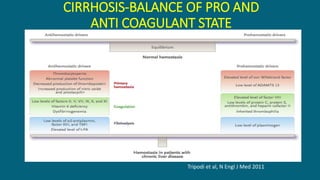
CIRRHOSIS-BALANCE OF PRO AND
ANTI COAGULANT STATE
Tripodi et al, N Engl J Med 2011
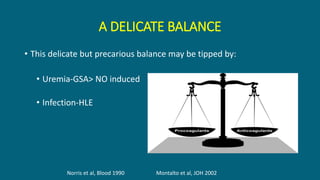
A DELICATE BALANCE
• This delicate but precarious balance may be tipped by:
• Uremia-GSA> NO induced
• Infection-HLE
Norris et al, Blood 1990 Montalto et al, JOH 2002
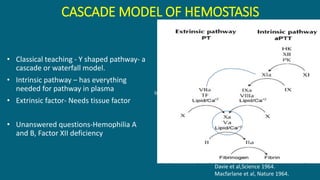
CASCADE MODEL OF HEMOSTASIS
Ist initiating Event
• Classical teaching - Y shaped pathway- a
cascade or waterfall model.
• Intrinsic pathway – has everything
needed for pathway in plasma
• Extrinsic factor- Needs tissue factor
• Unanswered questions-Hemophilia A
and B, Factor XII deficiency
Prothrombinase
complex
Davie et al,Science 1964.
Macfarlane et al, Nature 1964.
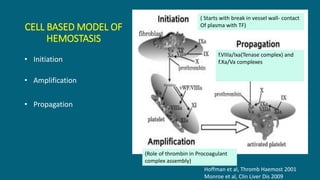
CELL BASED MODEL OF
HEMOSTASIS
• Initiation
• Amplification
• Propagation
Hoffman et al, Thromb Haemost 2001
Monroe et al, Clin Liver Dis 2009
( Starts with break in vessel wall- contact
Of plasma with TF)
(Role of thrombin in Procoagulant
complex assembly)
f.VIIIa/Ixa(Tenase complex) and
f.Xa/Va complexes
COAGULATION TESTING
• Conventional coagulation tests
• Viscoelastic testing
• Thrombin generation assays
PT-INR
• Two fold use conventionally-
• Synthetic function-prognosis(MELD,CTP)-fairly justified
• Bleeding risk assessment-wrong
• Measures time till clot formation after addition of CaCl2 and
thromboplastin(tissue factor)
• Utilises coagulation via extrinsic pathway (VII, X, V, II and I)
WHATS WRONG WITH PT AND INR
• PT detects procoagulant deficiency, not the counter balance by
anticoagulant deficiency
• Inter lab variabilty-thromboplastin use-extract /recombinant
• INR standardized for patients on VKA and not for liver ds.
• Does not correlate with in vivo environment as it does not count the
effect of thrombomodulin and protein C.
• Detects clot formation at 5% thrombin generation
• Multiple studies showing lack of correlation with bleeding risk.
Mann KG, Chest 2003
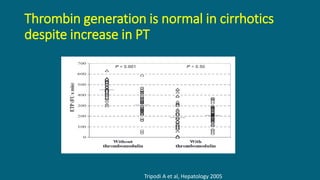
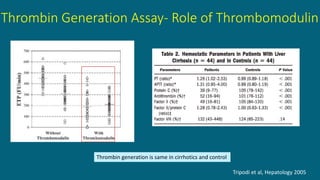
Thrombin generation is normal in cirrhotics
despite increase in PT
Tripodi A et al, Hepatology 2005
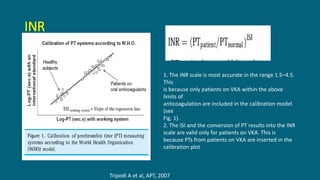
INR
1. The INR scale is most accurate in the range 1.5–4.5.
This
is because only patients on VKA within the above
limits of
anticoagulation are included in the calibration model
(see
Fig. 1).
2. The ISI and the conversion of PT results into the INR
scale are valid only for patients on VKA. This is
because PTs from patients on VKA are inserted in the
calibration plot
Tripodi A et al, APT, 2007
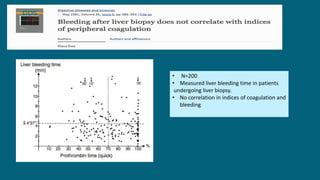
• N=200
• Measured liver bleeding time in patients
undergoing liver biopsy.
• No correlation in indices of coagulation and
bleeding
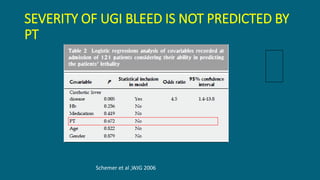
SEVERITY OF UGI BLEED IS NOT PREDICTED BY
PT
Schemer et al ,WJG 2006
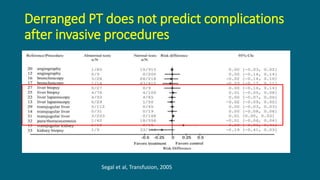
Derranged PT does not predict complications
after invasive procedures
Segal et al, Transfusion, 2005
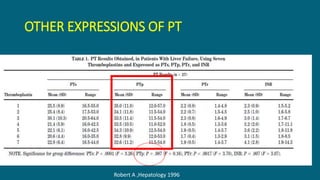
OTHER EXPRESSIONS OF PT
Robert A ,Hepatology 1996
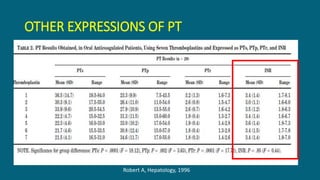
OTHER EXPRESSIONS OF PT
Robert A, Hepatology, 1996
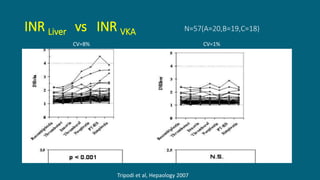
INR Liver vs INR VKA N=57(A=20,B=19,C=18)
CV=8% CV=1%
Tripodi et al, Hepaology 2007
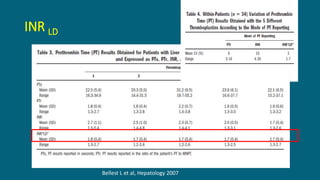
INR LD
Bellest L et al, Hepatology 2007
Do these modifications resolve
the issue of predicting
bleed/thrombosis in cirrhosis?
A BIG NO
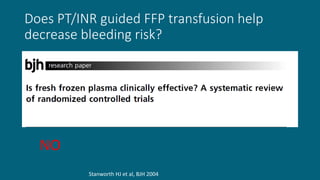
Does PT/INR guided FFP transfusion help
decrease bleeding risk?
NO
Stanworth HJ et al, BJH 2004
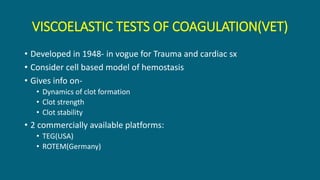
VISCOELASTIC TESTS OF COAGULATION(VET)
• Developed in 1948- in vogue for Trauma and cardiac sx
• Consider cell based model of hemostasis
• Gives info on-
• Dynamics of clot formation
• Clot strength
• Clot stability
• 2 commercially available platforms:
• TEG(USA)
• ROTEM(Germany)
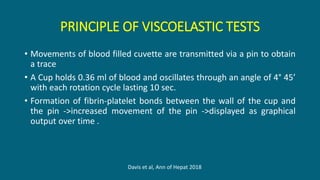
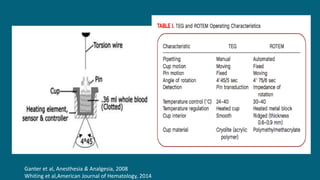
PRINCIPLE OF VISCOELASTIC TESTS
• Movements of blood filled cuvette are transmitted via a pin to obtain
a trace
• A Cup holds 0.36 ml of blood and oscillates through an angle of 4° 45’
with each rotation cycle lasting 10 sec.
• Formation of fibrin‐platelet bonds between the wall of the cup and
the pin ->increased movement of the pin ->displayed as graphical
output over time .
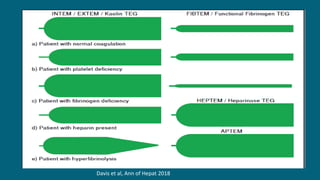
Davis et al, Ann of Hepat 2018
Ganter et al, Anesthesia & Analgesia, 2008
Whiting et al,American Journal of Hematology, 2014
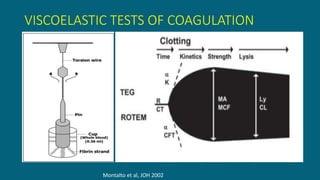
VISCOELASTIC TESTS OF COAGULATION
Montalto et al, JOH 2002
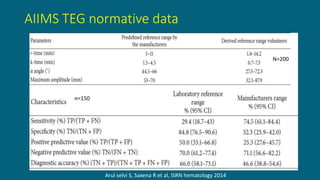
AIIMS TEG normative data
Arul selvi S, Saxena R et al, ISRN hematology 2014
N=200
n=150
Davis et al, Ann of Hepat 2018
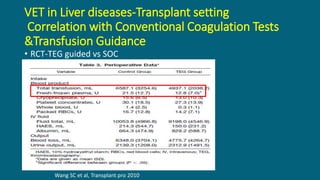
VET in Liver diseases-Transplant setting
Correlation with Conventional Coagulation Tests
&Transfusion Guidance
• RCT-TEG guided vs SOC
Wang SC et al, Transplant pro 2010
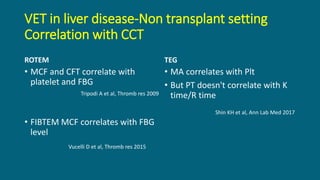
VET in liver disease-Non transplant setting
Correlation with CCT
ROTEM
• MCF and CFT correlate with
platelet and FBG
• FIBTEM MCF correlates with FBG
level
TEG
• MA correlates with Plt
• But PT doesn't correlate with K
time/R time
Tripodi A et al, Thromb res 2009
Vucelli D et al, Thromb res 2015
Shin KH et al, Ann Lab Med 2017
Pietri et al, Hepatology 2016
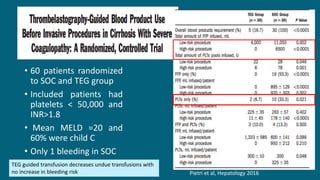
• 60 patients randomized
to SOC and TEG group
• Included patients had
platelets < 50,000 and
INR>1.8
• Mean MELD =20 and
60% were child C
• Only 1 bleeding in SOC
TEG guided transfusion decreases undue transfusions with
no increase in bleeding risk
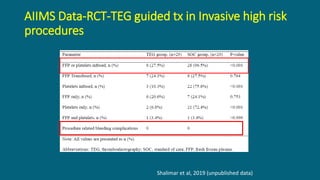
AIIMS Data-RCT-TEG guided tx in Invasive high risk
procedures
Shalimar et al, 2019 (unpublished data)
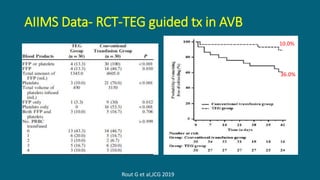
AIIMS Data- RCT-TEG guided tx in AVB
Rout G et al,JCG 2019
10.0%
36.0%
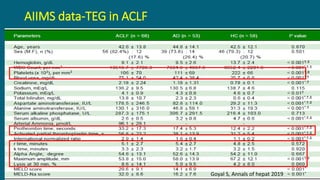
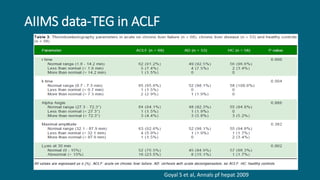
AIIMS data-TEG in ACLF
Goyal S, Annals of hepat 2019
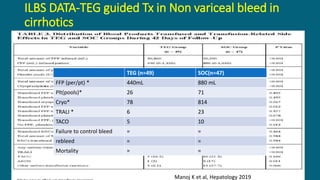
ILBS DATA-TEG guided Tx in Non variceal bleed in
cirrhotics
Manoj K et al, Hepatology 2019
TEG (n=49) SOC(n=47)
FFP (per/pt) * 440mL 880 mL
Plt(pools)* 26 71
Cryo* 78 814
TRALI * 6 23
TACO 5 10
Failure to control bleed = =
rebleed = =
Mortality = =
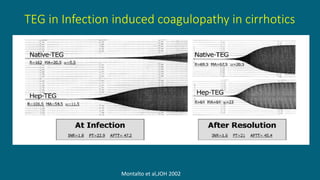
TEG in Infection induced coagulopathy in cirrhotics
Montalto et al,JOH 2002
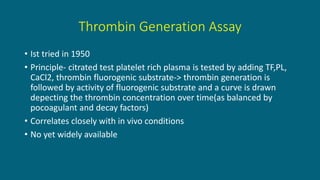
Thrombin Generation Assay
• Ist tried in 1950
• Principle- citrated test platelet rich plasma is tested by adding TF,PL,
CaCl2, thrombin fluorogenic substrate-> thrombin generation is
followed by activity of fluorogenic substrate and a curve is drawn
depecting the thrombin concentration over time(as balanced by
pocoagulant and decay factors)
• Correlates closely with in vivo conditions
• No yet widely available
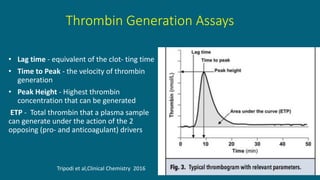
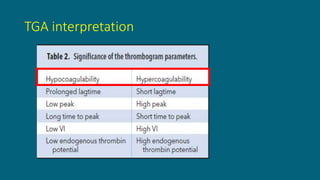
Thrombin Generation Assays
• Lag time - equivalent of the clot- ting time
• Time to Peak - the velocity of thrombin
generation
• Peak Height - Highest thrombin
concentration that can be generated
ETP - Total thrombin that a plasma sample
can generate under the action of the 2
opposing (pro- and anticoagulant) drivers
Tripodi et al,Clinical Chemistry 2016
TGA interpretation
Thrombin Generation Assay- Role of Thrombomodulin
Thrombin generation is same in cirrhotics and control
Tripodi et al, Hepatology 2005
CLINICAL ISSUES WITH
COAGULATION IN CIRRHOSIS
PVT
• Epidemiology:
• 1% in compensated cirrhosis
• 8-25% in decompensated cirrhosis
• 40% in HCC
• Not just prothrombotic state but other factors responsible-Virchows
triad:
• Venous stasis
• Vessel wall damage
• Viscosity
Okuda K et al,Gastroenterology 1985 Francoz C et al,Gut 2005
PVT
• Clinical significance:
• Increased decompensation and mortality
• Poorer outcomes of variceal bleed
• Poorer outcomes in LT
• Poor outcome in HCC
• Pretreatment assessment:
• UGIE screen for high risk vx and endoscopic or pharmacologic prophylaxis
warranted
Stine JG, et al World J Hepatol 2015 D’Amico G et al Hepatology 2003 Francoz C et alJ Hepatol 2012
Effects of Anticoagulants in Patients With
Cirrhosis and Portal Vein Thrombosis: A
Systematic Review and Meta-analysis
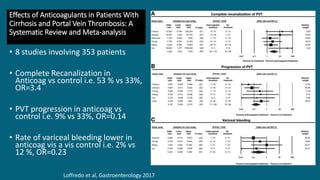
• 8 studies involving 353 patients
• Complete Recanalization in
Anticoag vs control i.e. 53 % vs 33%,
OR=3.4
• PVT progression in anticoag vs
control i.e. 9% vs 33%, OR=0.14
• Rate of variceal bleeding lower in
anticoag vis a vis control i.e. 2% vs
12 %, OR=0.23
Loffredo et al, Gastroenterology 2017
• LMWH not warfarin is significantly associated with complete PVT
resolution
• Both LMWH and warfarin associated with prevention of PVT progression
• No increased risk with anticoagulation and bleeding
• Most of the warfarin studies were retrospective
Anticoagulation in PVT – Meta-analysis
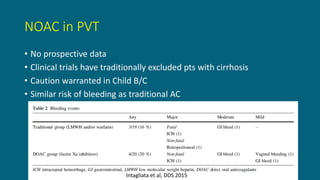
NOAC in PVT
• No prospective data
• Clinical trials have traditionally excluded pts with cirrhosis
• Caution warranted in Child B/C
• Similar risk of bleeding as traditional AC
Intagliata et al, DDS 2015
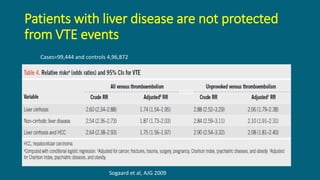
Patients with liver disease are not protected
from VTE events
Cases=99,444 and controls 4,96,872
Sogaard et al, AJG 2009
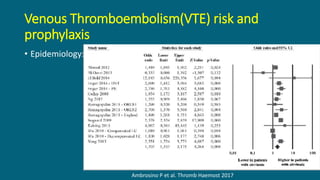
Venous Thromboembolism(VTE) risk and
prophylaxis
• Epidemiology:
Ambrosino P et al. Thromb Haemost 2017
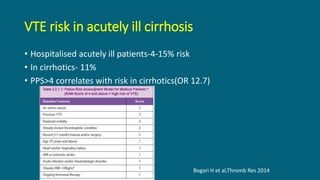
VTE risk in acutely ill cirrhosis
• Hospitalised acutely ill patients-4-15% risk
• In cirrhotics- 11%
• PPS>4 correlates with risk in cirrhotics(OR 12.7)
Bogari H et al,Thromb Res 2014
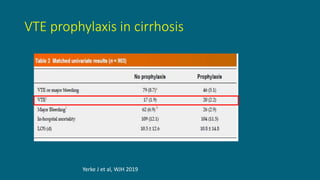
VTE prophylaxis in cirrhosis
Yerke J et al, WJH 2019
VTE treatment
• Majority of data extrapolated from use of AC in PVT
• In peripheral VTE alone sparse data
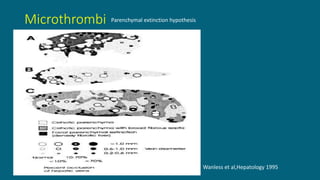
Microthrombi
• Parenchymal extinction hypothesis
Parenchymal extinction hypothesis
Wanless et al,Hepatology 1995
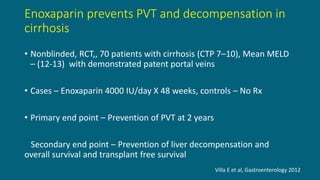
Enoxaparin prevents PVT and decompensation in
cirrhosis
• Nonblinded, RCT,, 70 patients with cirrhosis (CTP 7–10), Mean MELD
– (12-13) with demonstrated patent portal veins
• Cases – Enoxaparin 4000 IU/day X 48 weeks, controls – No Rx
• Primary end point – Prevention of PVT at 2 years
Secondary end point – Prevention of liver decompensation and
overall survival and transplant free survival
Villa E et al, Gastroenterology 2012
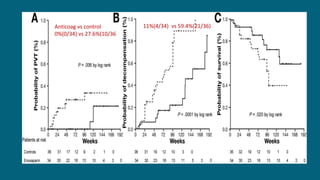
Anticoag vs control
0%(0/34) vs 27.6%(10/36
11%(4/34) vs 59.4%(21/36)
• Enoxaparin treated patients had improvement in Serum Bilirubin,
Albumin and INR at 48 weeks.
• Probability of worsening CTP scope was statistically significant in
control group vs enoxaparin group .
• More patients in control group have SBP/bacteremia vs Enoxaparin
group i.e. 33.3(12/36) vs 8%(3/34)
• Occurrence of bleeding episodes did not differ in two groups
TAKE HOME POINTS
• Cirrhosis patients are not auto-anticoagulated
• Cirrhosis is a state of rebalanced hemostasis
• Cirrhosis patients are at risk of thrombosis
• PT/INR not a useful marker of bleeding risk in cirrhosis
• VET perform better than CCT in cirrhosis
• VET guided Tx strategies are better
• AC is safe and effective in cirrhosis
THANK YOU
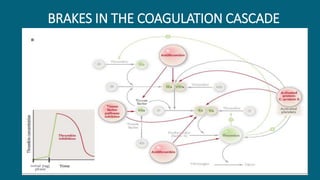
BRAKES IN THE COAGULATION CASCADE
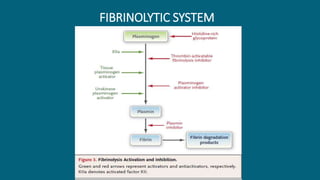
FIBRINOLYTIC SYSTEM
Coagulation in cirrhosis
Correction Of Abnormal Coagulation In Chronic Liver Disease By Combined
Use Of Fresh-frozen Plasma And Prothrombin Complex Concentrates.
30 patients randomized to FFP, PCC and both.
Improvement in INR and aPTT
Suggested role of transfusions before invasive procedure.
Mannucci, Lancet 1976
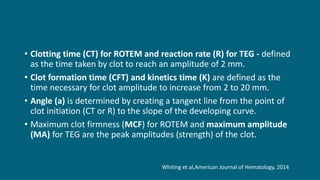
• Clotting time (CT) for ROTEM and reaction rate (R) for TEG - defined
as the time taken by clot to reach an amplitude of 2 mm.
• Clot formation time (CFT) and kinetics time (K) are defined as the
time necessary for clot amplitude to increase from 2 to 20 mm.
• Angle (a) is determined by creating a tangent line from the point of
clot initiation (CT or R) to the slope of the developing curve.
• Maximum clot firmness (MCF) for ROTEM and maximum amplitude
(MA) for TEG are the peak amplitudes (strength) of the clot.
Whiting et al,American Journal of Hematology, 2014
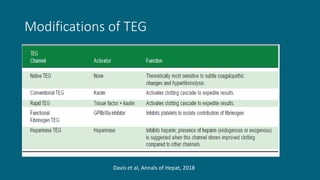
Modifications of TEG
Davis et al, Annals of Hepat, 2018
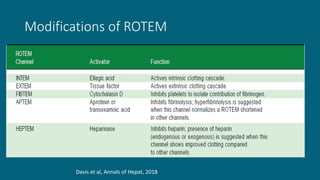
Modifications of ROTEM
Davis et al, Annals of Hepat, 2018
AIIMS data-TEG in ACLF
Goyal S et al, Annals pf hepat 2009
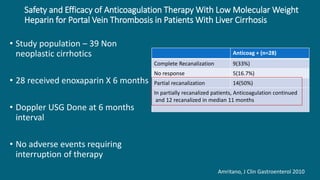
Safety and Efficacy of Anticoagulation Therapy With Low Molecular Weight
Heparin for Portal Vein Thrombosis in Patients With Liver Cirrhosis
• Study population – 39 Non
neoplastic cirrhotics
• 28 received enoxaparin X 6 months
• Doppler USG Done at 6 months
interval
• No adverse events requiring
interruption of therapy
Amritano, J Clin Gastroenterol 2010
Anticoag + (n=28)
Complete Recanalization 9(33%)
No response 5(16.7%)
Partial recanalization 14(50%)
In partially recanalized patients, Anticoagulation continued
and 12 recanalized in median 11 months
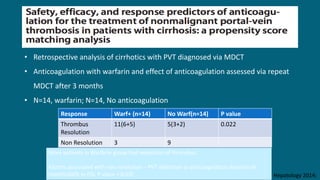
Clinical and Molecular Hepatology 2014;
• Retrospective analysis of cirrhotics with PVT diagnosed via MDCT
• Anticoagulation with warfarin and effect of anticoagulation assessed via repeat
MDCT after 3 months
• N=14, warfarin; N=14, No anticoagulation
Response Warf+ (n=14) No Warf(n=14) P value
Thrombus
Resolution
11(6+5) 5(3+2) 0.022
Non Resolution 3 9
More patients in Warfarin group had resolution of thrombus.
Factors associated with non resolution – PVT detection to anticoagulation duration>6
months(66% vs 0%; P value = 0.03)
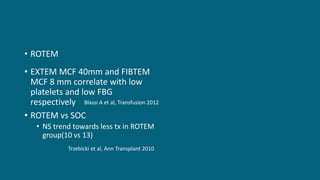
• ROTEM
• EXTEM MCF 40mm and FIBTEM
MCF 8 mm correlate with low
platelets and low FBG
respectively
• ROTEM vs SOC
• NS trend towards less tx in ROTEM
group(10 vs 13)
Blassi A et al, Transfusion 2012
Trzebicki et al, Ann Transplant 2010

Bleeding and coagulation in cirrhosis.pptx

  • 1.
    COAGULATION IN CIRRHOSIS Presenter-Dr.Shiv Ratan Pathak. Moderator – Dr. Sandip Pal.
  • 2.
    INTRODUCTION • Cirrhosis – •Not” auto-anticoagulated state” as previously thought • A state of delicately rebalanced hemostasis • Increased risk of bleeding –variceal, non variceal GI bleed, procedure related • Increased risk of thrombosis-PVT,DVT and VTE
  • 3.
    CIRRHOSIS-BALANCE OF PROAND ANTI COAGULANT STATE Tripodi et al, N Engl J Med 2011
  • 4.
    A DELICATE BALANCE •This delicate but precarious balance may be tipped by: • Uremia-GSA> NO induced • Infection-HLE Norris et al, Blood 1990 Montalto et al, JOH 2002
  • 5.
    CASCADE MODEL OFHEMOSTASIS Ist initiating Event • Classical teaching - Y shaped pathway- a cascade or waterfall model. • Intrinsic pathway – has everything needed for pathway in plasma • Extrinsic factor- Needs tissue factor • Unanswered questions-Hemophilia A and B, Factor XII deficiency Prothrombinase complex Davie et al,Science 1964. Macfarlane et al, Nature 1964.
  • 6.
    CELL BASED MODELOF HEMOSTASIS • Initiation • Amplification • Propagation Hoffman et al, Thromb Haemost 2001 Monroe et al, Clin Liver Dis 2009 ( Starts with break in vessel wall- contact Of plasma with TF) (Role of thrombin in Procoagulant complex assembly) f.VIIIa/Ixa(Tenase complex) and f.Xa/Va complexes
  • 7.
    COAGULATION TESTING • Conventionalcoagulation tests • Viscoelastic testing • Thrombin generation assays
  • 8.
    PT-INR • Two folduse conventionally- • Synthetic function-prognosis(MELD,CTP)-fairly justified • Bleeding risk assessment-wrong • Measures time till clot formation after addition of CaCl2 and thromboplastin(tissue factor) • Utilises coagulation via extrinsic pathway (VII, X, V, II and I)
  • 9.
    WHATS WRONG WITHPT AND INR • PT detects procoagulant deficiency, not the counter balance by anticoagulant deficiency • Inter lab variabilty-thromboplastin use-extract /recombinant • INR standardized for patients on VKA and not for liver ds. • Does not correlate with in vivo environment as it does not count the effect of thrombomodulin and protein C. • Detects clot formation at 5% thrombin generation • Multiple studies showing lack of correlation with bleeding risk. Mann KG, Chest 2003
  • 10.
    Thrombin generation isnormal in cirrhotics despite increase in PT Tripodi A et al, Hepatology 2005
  • 11.
    INR 1. The INRscale is most accurate in the range 1.5–4.5. This is because only patients on VKA within the above limits of anticoagulation are included in the calibration model (see Fig. 1). 2. The ISI and the conversion of PT results into the INR scale are valid only for patients on VKA. This is because PTs from patients on VKA are inserted in the calibration plot Tripodi A et al, APT, 2007
  • 12.
    • N=200 • Measuredliver bleeding time in patients undergoing liver biopsy. • No correlation in indices of coagulation and bleeding
  • 13.
    SEVERITY OF UGIBLEED IS NOT PREDICTED BY PT Schemer et al ,WJG 2006
  • 14.
    Derranged PT doesnot predict complications after invasive procedures Segal et al, Transfusion, 2005
  • 15.
    OTHER EXPRESSIONS OFPT Robert A ,Hepatology 1996
  • 16.
    OTHER EXPRESSIONS OFPT Robert A, Hepatology, 1996
  • 17.
    INR Liver vsINR VKA N=57(A=20,B=19,C=18) CV=8% CV=1% Tripodi et al, Hepaology 2007
  • 18.
    INR LD Bellest Let al, Hepatology 2007
  • 19.
    Do these modificationsresolve the issue of predicting bleed/thrombosis in cirrhosis? A BIG NO
  • 20.
    Does PT/INR guidedFFP transfusion help decrease bleeding risk? NO Stanworth HJ et al, BJH 2004
  • 21.
    VISCOELASTIC TESTS OFCOAGULATION(VET) • Developed in 1948- in vogue for Trauma and cardiac sx • Consider cell based model of hemostasis • Gives info on- • Dynamics of clot formation • Clot strength • Clot stability • 2 commercially available platforms: • TEG(USA) • ROTEM(Germany)
  • 22.
    PRINCIPLE OF VISCOELASTICTESTS • Movements of blood filled cuvette are transmitted via a pin to obtain a trace • A Cup holds 0.36 ml of blood and oscillates through an angle of 4° 45’ with each rotation cycle lasting 10 sec. • Formation of fibrin‐platelet bonds between the wall of the cup and the pin ->increased movement of the pin ->displayed as graphical output over time . Davis et al, Ann of Hepat 2018
  • 23.
    Ganter et al,Anesthesia & Analgesia, 2008 Whiting et al,American Journal of Hematology, 2014
  • 24.
    VISCOELASTIC TESTS OFCOAGULATION Montalto et al, JOH 2002
  • 25.
    AIIMS TEG normativedata Arul selvi S, Saxena R et al, ISRN hematology 2014 N=200 n=150
  • 26.
    Davis et al,Ann of Hepat 2018
  • 27.
    VET in Liverdiseases-Transplant setting Correlation with Conventional Coagulation Tests &Transfusion Guidance • RCT-TEG guided vs SOC Wang SC et al, Transplant pro 2010
  • 28.
    VET in liverdisease-Non transplant setting Correlation with CCT ROTEM • MCF and CFT correlate with platelet and FBG • FIBTEM MCF correlates with FBG level TEG • MA correlates with Plt • But PT doesn't correlate with K time/R time Tripodi A et al, Thromb res 2009 Vucelli D et al, Thromb res 2015 Shin KH et al, Ann Lab Med 2017
  • 29.
    Pietri et al,Hepatology 2016 • 60 patients randomized to SOC and TEG group • Included patients had platelets < 50,000 and INR>1.8 • Mean MELD =20 and 60% were child C • Only 1 bleeding in SOC TEG guided transfusion decreases undue transfusions with no increase in bleeding risk
  • 30.
    AIIMS Data-RCT-TEG guidedtx in Invasive high risk procedures Shalimar et al, 2019 (unpublished data)
  • 31.
    AIIMS Data- RCT-TEGguided tx in AVB Rout G et al,JCG 2019 10.0% 36.0%
  • 32.
    AIIMS data-TEG inACLF Goyal S, Annals of hepat 2019
  • 33.
    ILBS DATA-TEG guidedTx in Non variceal bleed in cirrhotics Manoj K et al, Hepatology 2019 TEG (n=49) SOC(n=47) FFP (per/pt) * 440mL 880 mL Plt(pools)* 26 71 Cryo* 78 814 TRALI * 6 23 TACO 5 10 Failure to control bleed = = rebleed = = Mortality = =
  • 34.
    TEG in Infectioninduced coagulopathy in cirrhotics Montalto et al,JOH 2002
  • 35.
    Thrombin Generation Assay •Ist tried in 1950 • Principle- citrated test platelet rich plasma is tested by adding TF,PL, CaCl2, thrombin fluorogenic substrate-> thrombin generation is followed by activity of fluorogenic substrate and a curve is drawn depecting the thrombin concentration over time(as balanced by pocoagulant and decay factors) • Correlates closely with in vivo conditions • No yet widely available
  • 36.
    Thrombin Generation Assays •Lag time - equivalent of the clot- ting time • Time to Peak - the velocity of thrombin generation • Peak Height - Highest thrombin concentration that can be generated ETP - Total thrombin that a plasma sample can generate under the action of the 2 opposing (pro- and anticoagulant) drivers Tripodi et al,Clinical Chemistry 2016
  • 37.
  • 38.
    Thrombin Generation Assay-Role of Thrombomodulin Thrombin generation is same in cirrhotics and control Tripodi et al, Hepatology 2005
  • 39.
  • 40.
    PVT • Epidemiology: • 1%in compensated cirrhosis • 8-25% in decompensated cirrhosis • 40% in HCC • Not just prothrombotic state but other factors responsible-Virchows triad: • Venous stasis • Vessel wall damage • Viscosity Okuda K et al,Gastroenterology 1985 Francoz C et al,Gut 2005
  • 41.
    PVT • Clinical significance: •Increased decompensation and mortality • Poorer outcomes of variceal bleed • Poorer outcomes in LT • Poor outcome in HCC • Pretreatment assessment: • UGIE screen for high risk vx and endoscopic or pharmacologic prophylaxis warranted Stine JG, et al World J Hepatol 2015 D’Amico G et al Hepatology 2003 Francoz C et alJ Hepatol 2012
  • 42.
    Effects of Anticoagulantsin Patients With Cirrhosis and Portal Vein Thrombosis: A Systematic Review and Meta-analysis • 8 studies involving 353 patients • Complete Recanalization in Anticoag vs control i.e. 53 % vs 33%, OR=3.4 • PVT progression in anticoag vs control i.e. 9% vs 33%, OR=0.14 • Rate of variceal bleeding lower in anticoag vis a vis control i.e. 2% vs 12 %, OR=0.23 Loffredo et al, Gastroenterology 2017
  • 43.
    • LMWH notwarfarin is significantly associated with complete PVT resolution • Both LMWH and warfarin associated with prevention of PVT progression • No increased risk with anticoagulation and bleeding • Most of the warfarin studies were retrospective Anticoagulation in PVT – Meta-analysis
  • 44.
    NOAC in PVT •No prospective data • Clinical trials have traditionally excluded pts with cirrhosis • Caution warranted in Child B/C • Similar risk of bleeding as traditional AC Intagliata et al, DDS 2015
  • 45.
    Patients with liverdisease are not protected from VTE events Cases=99,444 and controls 4,96,872 Sogaard et al, AJG 2009
  • 46.
    Venous Thromboembolism(VTE) riskand prophylaxis • Epidemiology: Ambrosino P et al. Thromb Haemost 2017
  • 47.
    VTE risk inacutely ill cirrhosis • Hospitalised acutely ill patients-4-15% risk • In cirrhotics- 11% • PPS>4 correlates with risk in cirrhotics(OR 12.7) Bogari H et al,Thromb Res 2014
  • 48.
    VTE prophylaxis incirrhosis Yerke J et al, WJH 2019
  • 49.
    VTE treatment • Majorityof data extrapolated from use of AC in PVT • In peripheral VTE alone sparse data
  • 50.
    Microthrombi • Parenchymal extinctionhypothesis Parenchymal extinction hypothesis Wanless et al,Hepatology 1995
  • 51.
    Enoxaparin prevents PVTand decompensation in cirrhosis • Nonblinded, RCT,, 70 patients with cirrhosis (CTP 7–10), Mean MELD – (12-13) with demonstrated patent portal veins • Cases – Enoxaparin 4000 IU/day X 48 weeks, controls – No Rx • Primary end point – Prevention of PVT at 2 years Secondary end point – Prevention of liver decompensation and overall survival and transplant free survival Villa E et al, Gastroenterology 2012
  • 52.
    Anticoag vs control 0%(0/34)vs 27.6%(10/36 11%(4/34) vs 59.4%(21/36)
  • 53.
    • Enoxaparin treatedpatients had improvement in Serum Bilirubin, Albumin and INR at 48 weeks. • Probability of worsening CTP scope was statistically significant in control group vs enoxaparin group . • More patients in control group have SBP/bacteremia vs Enoxaparin group i.e. 33.3(12/36) vs 8%(3/34) • Occurrence of bleeding episodes did not differ in two groups
  • 54.
    TAKE HOME POINTS •Cirrhosis patients are not auto-anticoagulated • Cirrhosis is a state of rebalanced hemostasis • Cirrhosis patients are at risk of thrombosis • PT/INR not a useful marker of bleeding risk in cirrhosis • VET perform better than CCT in cirrhosis • VET guided Tx strategies are better • AC is safe and effective in cirrhosis
  • 55.
  • 56.
    BRAKES IN THECOAGULATION CASCADE
  • 57.
  • 58.
    Coagulation in cirrhosis CorrectionOf Abnormal Coagulation In Chronic Liver Disease By Combined Use Of Fresh-frozen Plasma And Prothrombin Complex Concentrates. 30 patients randomized to FFP, PCC and both. Improvement in INR and aPTT Suggested role of transfusions before invasive procedure. Mannucci, Lancet 1976
  • 60.
    • Clotting time(CT) for ROTEM and reaction rate (R) for TEG - defined as the time taken by clot to reach an amplitude of 2 mm. • Clot formation time (CFT) and kinetics time (K) are defined as the time necessary for clot amplitude to increase from 2 to 20 mm. • Angle (a) is determined by creating a tangent line from the point of clot initiation (CT or R) to the slope of the developing curve. • Maximum clot firmness (MCF) for ROTEM and maximum amplitude (MA) for TEG are the peak amplitudes (strength) of the clot. Whiting et al,American Journal of Hematology, 2014
  • 61.
    Modifications of TEG Daviset al, Annals of Hepat, 2018
  • 62.
    Modifications of ROTEM Daviset al, Annals of Hepat, 2018
  • 63.
    AIIMS data-TEG inACLF Goyal S et al, Annals pf hepat 2009
  • 64.
    Safety and Efficacyof Anticoagulation Therapy With Low Molecular Weight Heparin for Portal Vein Thrombosis in Patients With Liver Cirrhosis • Study population – 39 Non neoplastic cirrhotics • 28 received enoxaparin X 6 months • Doppler USG Done at 6 months interval • No adverse events requiring interruption of therapy Amritano, J Clin Gastroenterol 2010 Anticoag + (n=28) Complete Recanalization 9(33%) No response 5(16.7%) Partial recanalization 14(50%) In partially recanalized patients, Anticoagulation continued and 12 recanalized in median 11 months
  • 65.
    Clinical and MolecularHepatology 2014; • Retrospective analysis of cirrhotics with PVT diagnosed via MDCT • Anticoagulation with warfarin and effect of anticoagulation assessed via repeat MDCT after 3 months • N=14, warfarin; N=14, No anticoagulation Response Warf+ (n=14) No Warf(n=14) P value Thrombus Resolution 11(6+5) 5(3+2) 0.022 Non Resolution 3 9 More patients in Warfarin group had resolution of thrombus. Factors associated with non resolution – PVT detection to anticoagulation duration>6 months(66% vs 0%; P value = 0.03)
  • 66.
    • ROTEM • EXTEMMCF 40mm and FIBTEM MCF 8 mm correlate with low platelets and low FBG respectively • ROTEM vs SOC • NS trend towards less tx in ROTEM group(10 vs 13) Blassi A et al, Transfusion 2012 Trzebicki et al, Ann Transplant 2010

Editor's Notes

  • #18 Suggested manufacturers should provide ISI vka and ISI liver so that interlaboratory diferences could be normalised for liver diseases as well as those on VKA
  • #39 44 patients of cirrhosis
  • #43 c PVT recanalization, which was 71% and 42% in anticoagulant- treated and untreated patients, respectively.
  • #44 7 of included 8 studies were non randomized. Heterogeneity in studies in subgroup of variceal bleeding
  • #52 absence of ascites, spontaneous bacterial peritonitis (SBP), portal hypertensive bleeding or portosystemic encephalopathy for at least 3 months before enrolment IL6, CD 14 ,IFABP and 16 s RNA were also measured. Italian USG – 3 monthly and CT yearly
  • #53 During the follow-up period, new decompensation occurred in 9 of 31 (29.0%) controls and 9 of 32 (28.0%) enoxaparin-treated patients (P .890). Overall, decom- pensation occurred in 30 of 36 (83.0%) controls and 13 of 34 (38.2%) enoxaparin-treated patients (P .0001)
  • #65 Portal cavernoma in 20% patients During the follow-up PVT progressed in 2 of the 5 patients who were nonresponders to AT, 50% had gi bleed, 10% had abdominal pain and 40% asymptomatic We considered complete ‘‘response’’ when complete recanalization of the vessel was obtained, partial response when a reduction of more than 50% of the thrombus was observed, and ‘‘no response’’ in the other cases was observed. Advocates longer duration of therapy
  • #66 Patients with malignant PVT, underly- ing primary hematologic disorders, Budd-Chiari syndrome, mem- branous obstruction of the inferior vena cava, or pre-existing ex- trahepatic thrombosis were excluded. Complete thrombosis was defined as disappearance of all evidence of thrombosis, as determined by transverse CT images. Partial resolution was de- fined as at least a 30% reduction in the long diameter of the main thrombus, that is, more than a 50% decrease in cross-sectional area without evidence of the appearance of new thrombi no patients in the warfarin treatment group developed additional PVT lesions while receiving warfarin, compared to three patients in control group who did.