BCS-DS-427B: PYTHON
Manav Rachna International Institute of Research and Studies, Faridabad
PYTHON
Loops
Swati Hans
Associate Professor, CSE
MRIIRS
BCS-DS-427B: PYTHON
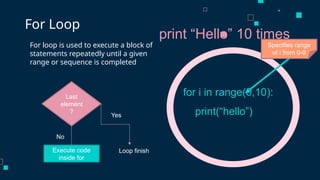
For loop is used to execute a block of
statements repeatedly until a given
range or sequence is completed
For Loop
for i in range(0,10):
print(“hello”)
Specifies range
of i from 0-9
print “Hello” 10 times
Last
element
?
Execute code
inside for
No
Yes
Loop finish
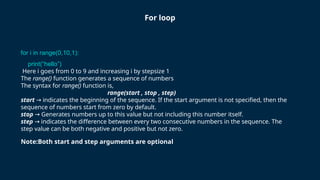
For loop
for i in range(0,10,1):
print(“hello”)
Here i goes from 0 to 9 and increasing i by stepsize 1
The range() function generates a sequence of numbers
The syntax for range() function is,
range(start , stop , step)
start → indicates the beginning of the sequence. If the start argument is not specified, then the
sequence of numbers start from zero by default.
stop → Generates numbers up to this value but not including this number itself.
step → indicates the difference between every two consecutive numbers in the sequence. The
step value can be both negative and positive but not zero.
Note:Both start and step arguments are optional
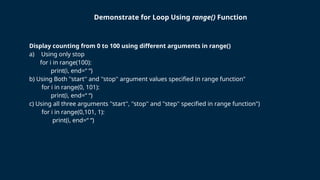
Demonstrate for Loop Using range() Function
Display counting from 0 to 100 using different arguments in range()
a) Using only stop
for i in range(100):
print(i, end=“ “)
b) Using Both ''start'' and ''stop'' argument values specified in range function"
for i in range(0, 101):
print(i, end=“ “)
c) Using all three arguments ''start'', ''stop'' and ''step'' specified in range function")
for i in range(0,101, 1):
print(i, end=“ “)
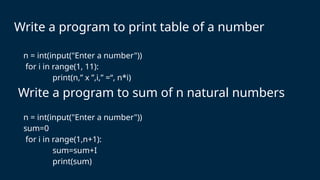
Write a program to print table of a number
n = int(input("Enter a number"))
sum=0
for i in range(1,n+1):
sum=sum+I
print(sum)
Write a program to sum of n natural numbers
n = int(input("Enter a number"))
for i in range(1, 11):
print(n,” x ”,i,” =“, n*i)
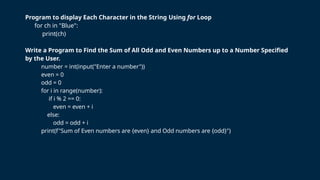
Program to display Each Character in the String Using for Loop
for ch in "Blue":
print(ch)
Write a Program to Find the Sum of All Odd and Even Numbers up to a Number Specified
by the User.
number = int(input("Enter a number"))
even = 0
odd = 0
for i in range(number):
if i % 2 == 0:
even = even + i
else:
odd = odd + i
print(f"Sum of Even numbers are {even} and Odd numbers are {odd}")
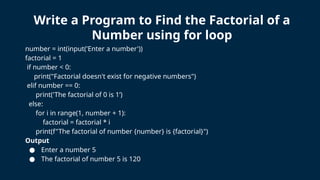
number = int(input('Enter a number'))
factorial = 1
if number < 0:
print("Factorial doesn't exist for negative numbers")
elif number == 0:
print('The factorial of 0 is 1’)
else:
for i in range(1, number + 1):
factorial = factorial * i
print(f"The factorial of number {number} is {factorial}")
Output
● Enter a number 5
● The factorial of number 5 is 120
Write a Program to Find the Factorial of a
Number using for loop
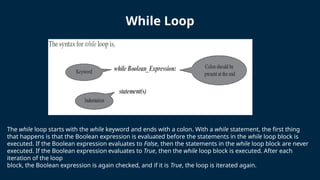
While Loop
The while loop starts with the while keyword and ends with a colon. With a while statement, the first thing
that happens is that the Boolean expression is evaluated before the statements in the while loop block is
executed. If the Boolean expression evaluates to False, then the statements in the while loop block are never
executed. If the Boolean expression evaluates to True, then the while loop block is executed. After each
iteration of the loop
block, the Boolean expression is again checked, and if it is True, the loop is iterated again.
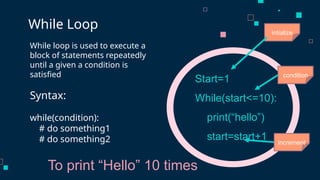
While loop is used to execute a
block of statements repeatedly
until a given a condition is
satisfied
Syntax:
while(condition):
# do something1
# do something2
While Loop
Start=1
While(start<=10):
print(“hello”)
start=start+1
intialize
condition
increment
To print “Hello” 10 times
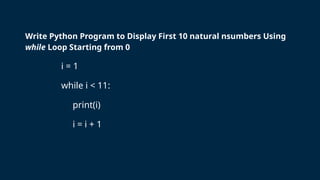
Write Python Program to Display First 10 natural nsumbers Using
while Loop Starting from 0
i = 1
while i < 11:
print(i)
i = i + 1
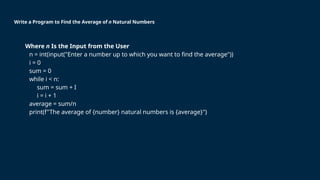
Write a Program to Find the Average of n Natural Numbers
Where n Is the Input from the User
n = int(input("Enter a number up to which you want to find the average"))
i = 0
sum = 0
while i < n:
sum = sum + I
i = i + 1
average = sum/n
print(f"The average of {number} natural numbers is {average}")
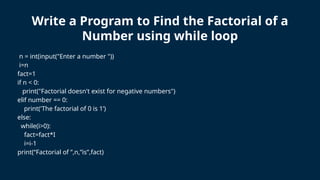
Write a Program to Find the Factorial of a
Number using while loop
n = int(input("Enter a number "))
i=n
fact=1
if n < 0:
print("Factorial doesn't exist for negative numbers")
elif number == 0:
print('The factorial of 0 is 1’)
else:
while(i>0):
fact=fact*I
i=i-1
print(“Factorial of ”,n,”is”,fact)
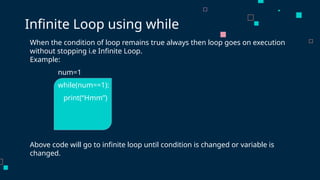
When the condition of loop remains true always then loop goes on execution
without stopping i.e Infinite Loop.
Example:
num=1
while(num==1):
print(“Hmm”)
Above code will go to infinite loop until condition is changed or variable is
changed.
Infinite Loop using while
Break and continue statements
● The break and continue statements provide greater control over the execution of code in a loop.
Whenever the break statement is encountered, the execution control immediately jumps to the
first instruction following the loop.
● To pass control to the next iteration without exiting the loop, use the continue statement. Both
continue and break statements can be used in while and for loops.
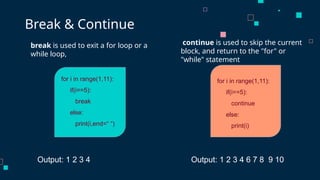
for i in range(1,11):
if(i==5):
break
else:
print(i,end=“ “)
break is used to exit a for loop or a
while loop,
Break & Continue
continue is used to skip the current
block, and return to the "for" or
"while" statement
for i in range(1,11):
if(i==5):
continue
else:
print(i)
Output: 1 2 3 4 Output: 1 2 3 4 6 7 8 9 10
Write a program to display Fibonacci series
Write a program to find number is prime or
not
Using Loops

loops _

  • 1.
    BCS-DS-427B: PYTHON Manav RachnaInternational Institute of Research and Studies, Faridabad
  • 2.
    PYTHON Loops Swati Hans Associate Professor,CSE MRIIRS BCS-DS-427B: PYTHON
  • 3.
    For loop isused to execute a block of statements repeatedly until a given range or sequence is completed For Loop for i in range(0,10): print(“hello”) Specifies range of i from 0-9 print “Hello” 10 times Last element ? Execute code inside for No Yes Loop finish
  • 4.
    For loop for iin range(0,10,1): print(“hello”) Here i goes from 0 to 9 and increasing i by stepsize 1 The range() function generates a sequence of numbers The syntax for range() function is, range(start , stop , step) start → indicates the beginning of the sequence. If the start argument is not specified, then the sequence of numbers start from zero by default. stop → Generates numbers up to this value but not including this number itself. step → indicates the difference between every two consecutive numbers in the sequence. The step value can be both negative and positive but not zero. Note:Both start and step arguments are optional
  • 5.
    Demonstrate for LoopUsing range() Function Display counting from 0 to 100 using different arguments in range() a) Using only stop for i in range(100): print(i, end=“ “) b) Using Both ''start'' and ''stop'' argument values specified in range function" for i in range(0, 101): print(i, end=“ “) c) Using all three arguments ''start'', ''stop'' and ''step'' specified in range function") for i in range(0,101, 1): print(i, end=“ “)
  • 6.
    Write a programto print table of a number n = int(input("Enter a number")) sum=0 for i in range(1,n+1): sum=sum+I print(sum) Write a program to sum of n natural numbers n = int(input("Enter a number")) for i in range(1, 11): print(n,” x ”,i,” =“, n*i)
  • 7.
    Program to displayEach Character in the String Using for Loop for ch in "Blue": print(ch) Write a Program to Find the Sum of All Odd and Even Numbers up to a Number Specified by the User. number = int(input("Enter a number")) even = 0 odd = 0 for i in range(number): if i % 2 == 0: even = even + i else: odd = odd + i print(f"Sum of Even numbers are {even} and Odd numbers are {odd}")
  • 8.
    number = int(input('Entera number')) factorial = 1 if number < 0: print("Factorial doesn't exist for negative numbers") elif number == 0: print('The factorial of 0 is 1’) else: for i in range(1, number + 1): factorial = factorial * i print(f"The factorial of number {number} is {factorial}") Output ● Enter a number 5 ● The factorial of number 5 is 120 Write a Program to Find the Factorial of a Number using for loop
  • 9.
    While Loop The whileloop starts with the while keyword and ends with a colon. With a while statement, the first thing that happens is that the Boolean expression is evaluated before the statements in the while loop block is executed. If the Boolean expression evaluates to False, then the statements in the while loop block are never executed. If the Boolean expression evaluates to True, then the while loop block is executed. After each iteration of the loop block, the Boolean expression is again checked, and if it is True, the loop is iterated again.
  • 10.
    While loop isused to execute a block of statements repeatedly until a given a condition is satisfied Syntax: while(condition): # do something1 # do something2 While Loop Start=1 While(start<=10): print(“hello”) start=start+1 intialize condition increment To print “Hello” 10 times
  • 11.
    Write Python Programto Display First 10 natural nsumbers Using while Loop Starting from 0 i = 1 while i < 11: print(i) i = i + 1
  • 12.
    Write a Programto Find the Average of n Natural Numbers Where n Is the Input from the User n = int(input("Enter a number up to which you want to find the average")) i = 0 sum = 0 while i < n: sum = sum + I i = i + 1 average = sum/n print(f"The average of {number} natural numbers is {average}")
  • 13.
    Write a Programto Find the Factorial of a Number using while loop n = int(input("Enter a number ")) i=n fact=1 if n < 0: print("Factorial doesn't exist for negative numbers") elif number == 0: print('The factorial of 0 is 1’) else: while(i>0): fact=fact*I i=i-1 print(“Factorial of ”,n,”is”,fact)
  • 14.
    When the conditionof loop remains true always then loop goes on execution without stopping i.e Infinite Loop. Example: num=1 while(num==1): print(“Hmm”) Above code will go to infinite loop until condition is changed or variable is changed. Infinite Loop using while
  • 15.
    Break and continuestatements ● The break and continue statements provide greater control over the execution of code in a loop. Whenever the break statement is encountered, the execution control immediately jumps to the first instruction following the loop. ● To pass control to the next iteration without exiting the loop, use the continue statement. Both continue and break statements can be used in while and for loops.
  • 16.
    for i inrange(1,11): if(i==5): break else: print(i,end=“ “) break is used to exit a for loop or a while loop, Break & Continue continue is used to skip the current block, and return to the "for" or "while" statement for i in range(1,11): if(i==5): continue else: print(i) Output: 1 2 3 4 Output: 1 2 3 4 6 7 8 9 10
  • 17.
    Write a programto display Fibonacci series Write a program to find number is prime or not Using Loops