Curriculum and Instructionfor Reading ProfessionalsRebecca ShapiroLiberty University
Introduction to Curriculum and Instruction for Reading Professionals
What words come to mind when you think of curriculum?Synonyms: course or program of study, subjects, modules (Online Thesaurus)the subjects comprising a course of study in a school or college (Online Dictionary)What words come to mind when you think of instruction?Synonyms: teaching, coaching guidance, training, preparation (Online Thesaurus)A direction or order; detailed information telling how something should be done, operated, or assembled, teaching (Online Dictionary)Curriculum and Instruction
Mix and Match: Curriculum and InstructionA course of study, planned by the instructor, to facilitate learning through instruction.Stop and Think: How would you define curriculum and instruction?
According to the IRA (International Reading Association)“Candidates  use instructional approaches, materials, and an integrated, comprehensive, balanced, curriculum to support student learning in reading and writing” (IRA Standards 2010)
CandidatesStop and Think:Think about the standard and its elements. How do you fulfill each of these requirements in your own teaching?What do you need to continue to improve on?Use foundational knowledge to design or implement and integrated, comprehensive, balanced curriculum.
Use appropriate and varied instructional approaches, including those that develop word recognition, language comprehension, strategic knowledge, and reading-writing connections.
Use a wide range of texts from traditional print, digital, and online resources.Elements of Standard 2: Curriculum and Instruction (IRA 2010).Continue to the next slide to learn about current issues in education that effect reading instruction.
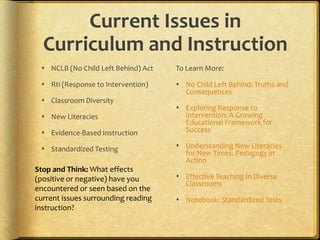
Current Issues in Curriculum and InstructionNCLB (No Child Left Behind) Act Rti (Response to Intervention)Classroom DiversityNew LiteraciesEvidence-Based InstructionStandardized TestingTo Learn More:No Child Left Behind: Truths and ConsequencesExploring Response to Intervention: A Growing Educational Framework for SuccessUnderstanding New Literacies for New Times: Pedagogy in ActionEffective Teaching In Diverse ClassroomsNotebook: Standardized TestsStop and Think: What effects (positive or negative) have you encountered or seen based on the current issues surrounding reading instruction?
Practical Application for Reading InstructionUse evidence-based instruction to facilitate learning.Consider the IRA Position Statement on evidence-based instruction to inform your decisions for reading instruction in your classroom.Examples of Instruction for the classroom:Guided ReadingReading RecoverySound PartnersProject CRISSYou will find more resources for information in the resource continued section of this presentation. These resources are filled with practical application for your practice.Stop and Think: What evidence-based instruction do you use? What are some other classroom activities that you use to support your evidence-based instruction?

C&i ppt project

  • 1.
    Curriculum and InstructionforReading ProfessionalsRebecca ShapiroLiberty University
  • 2.
    Introduction to Curriculumand Instruction for Reading Professionals
  • 3.
    What words cometo mind when you think of curriculum?Synonyms: course or program of study, subjects, modules (Online Thesaurus)the subjects comprising a course of study in a school or college (Online Dictionary)What words come to mind when you think of instruction?Synonyms: teaching, coaching guidance, training, preparation (Online Thesaurus)A direction or order; detailed information telling how something should be done, operated, or assembled, teaching (Online Dictionary)Curriculum and Instruction
  • 4.
    Mix and Match:Curriculum and InstructionA course of study, planned by the instructor, to facilitate learning through instruction.Stop and Think: How would you define curriculum and instruction?
  • 5.
    According to theIRA (International Reading Association)“Candidates use instructional approaches, materials, and an integrated, comprehensive, balanced, curriculum to support student learning in reading and writing” (IRA Standards 2010)
  • 6.
    CandidatesStop and Think:Thinkabout the standard and its elements. How do you fulfill each of these requirements in your own teaching?What do you need to continue to improve on?Use foundational knowledge to design or implement and integrated, comprehensive, balanced curriculum.
  • 7.
    Use appropriate andvaried instructional approaches, including those that develop word recognition, language comprehension, strategic knowledge, and reading-writing connections.
  • 8.
    Use a widerange of texts from traditional print, digital, and online resources.Elements of Standard 2: Curriculum and Instruction (IRA 2010).Continue to the next slide to learn about current issues in education that effect reading instruction.
  • 9.
    Current Issues inCurriculum and InstructionNCLB (No Child Left Behind) Act Rti (Response to Intervention)Classroom DiversityNew LiteraciesEvidence-Based InstructionStandardized TestingTo Learn More:No Child Left Behind: Truths and ConsequencesExploring Response to Intervention: A Growing Educational Framework for SuccessUnderstanding New Literacies for New Times: Pedagogy in ActionEffective Teaching In Diverse ClassroomsNotebook: Standardized TestsStop and Think: What effects (positive or negative) have you encountered or seen based on the current issues surrounding reading instruction?
  • 10.
    Practical Application forReading InstructionUse evidence-based instruction to facilitate learning.Consider the IRA Position Statement on evidence-based instruction to inform your decisions for reading instruction in your classroom.Examples of Instruction for the classroom:Guided ReadingReading RecoverySound PartnersProject CRISSYou will find more resources for information in the resource continued section of this presentation. These resources are filled with practical application for your practice.Stop and Think: What evidence-based instruction do you use? What are some other classroom activities that you use to support your evidence-based instruction?

Editor's Notes

  • #3 Welcome to curriculum and and instruction for reading professionals. As you make your way through this power point presentation you will review the meaning of curriculum and instruction and learn about the standards for reading professionals set by the International Reading Association. Additionally, you will be able to learn more about or review current issues in education that effect reading curriculum and instruction and find practical classroom applications for reading instruction. Finally, throughout this power point presentation, you will find questions to guide your thinking and provide a means for discussion.
  • #4 Consider these two questions: What words come to mind when you think of curriculum? What words come to mind when you think of instruction? Once you have finished thinking, continue clicking to see a few synonyms and the definition of these words.
  • #5 In short, I have defined curriculum and instruction as a course of study planned by the instructor, facilitate learning through instruction.Stop and Think: How would you define curriculum and instruction?
  • #6 The next two slides define what a reading professional must do to fulfill the standard of curriculum and instruction. Continue reading and think about the questions presented.
  • #9 Reading professionals have the responsibility of using evidence-based instruction in their practice because of the success it brings to learning. The IRA Position statement includes a guide on how to determine the best means of curriculum and instructions. If you click on the link it will take the IRA’s Position Statement where you can read more about what it means to be an evidence based practitioner. Finally, I have included a few evidence-based practices and questions for you to review as you consider how to instruct your students. Just click on the links and they will take you where you need to go.