LITERACY CURRICULUM
PRESENTATION
MAE JONES
GRAND CANYON UNIVERSITY
REA 520 INTRODUCTORY INSTRUCTIONAL METHODS FOR ELEMENTARY READING AND
WRITING
DR. MENDI DAVIS
SEPTEMBER 14, 2022,
RESEARCHED BASED CURRICULUM
• Children learn and develop in a way that is based on research-based (Early
Childhood Learning & Knowledge Center, n.d.). A researched-Based
Curriculum is based on the following criteria (Winginstitute, n.d.).
• Standards are aligned.
• Quantity and quality are visible.
• Competency has a definition.
• Response increases.
• Feed Backs are provided.
• Reconstructed feed back is provided, and remediation is design.
• High levels, Sequence and scopes are illustrated.
• Mastered Instructions.
• Formative assessments
CURRICULUM
I-READY
AMPLIFY
BENCHMARK
I-READY
• The I-ready curriculum is team with the educational research of America. The
curriculum was for K-8- and founded in 1979. The team collect information across
the globe and the student are assessments and their connections. ( Curriculum
Associates 2021). National Center Of Intensive Intervention is connected to the
assessment correlations.
I-READY
• Growth
• Meet the need of all learners regardless of learning styles. Provide support and structure to the learners.
Goals are met. Educators get reports and progress of their students. Data and instructions are collected
immediately. (Curriculum Associates, n.d.).
• Strength
• The educators can fill in the gaps through differentiated instructions and assessments, (Langevin, 2021).
Reports and progress are given, and students have activities that meet their learning needs,
• Weakness
• The curriculum is overused and burn out sometimes, sometimes the students become adaptive to the
curriculum and when this happens the curriculum becomes useless in the classroom environment. (Langevin,
2021).
I-READY
COLLABORATIONS
• Educators must collaborate because it is for the success of the students. It is critical stakeholders
and teachers understand the roles and connections. The following are the collaborators are:
• Reading Specialists
• Teachers
• Principals/Assistant Principals
• Mentors
• School boards
AMPLIFY
• Tier II-Moderate Evidence meets the amplified reading. The evidence is education
that succeeds and meet the student’s needs. (ESSA). The law was passed in 2015 and
is critical to schools and provides top quality education for all learners regardless of
their learning styles. (Amplify Education, n.d.). It is the demonstrations that provide
the evidence.
AMPLIFY
• Student’s growth
• Monthly assessments and progress reports. For example, “Curioso Skill Scan” This program measures growth and progress.
(Amplify, n.d.) Monitors the literacy development and activities of students.
• Strength
• Amplify measure the learning skills of students.
• Predictive tasks and reading skills
• Modified results for the understanding of collaborators.
• Weaknesses
• Teaches but sometimes not scaffold or spiral.
• Build on not so familiar content and student cannot identify sometimes.
• It removes teacher’s self-government
AMPLIFY COLLABORATIONS
• Educators must collaborate because it is for the success of the students. It is critical stakeholders
and teachers understand the roles and connections. The following are the collaborators are:
• Reading Specialists
• Teachers
• Principals/Assistant Principals
• Mentors
• School boards
BENCHMARK
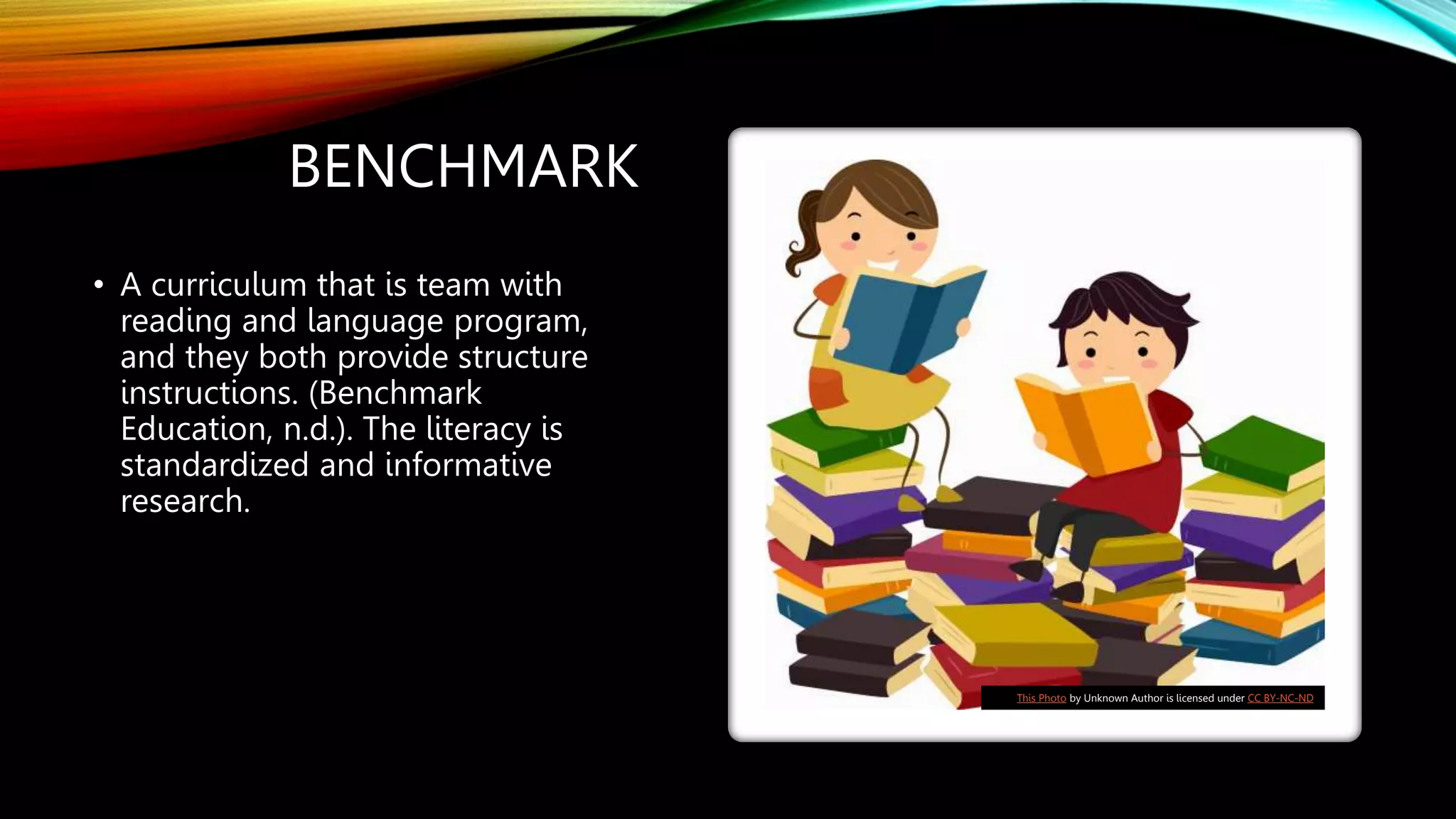
• A curriculum that is team with
reading and language program,
and they both provide structure
instructions. (Benchmark
Education, n.d.). The literacy is
standardized and informative
research.
This Photo by Unknown Author is licensed under CC BY-NC-ND
BENCHMARK
Growth
Proficiency growth.
(Benchmark, 2021).
Social-Emotional
blending and
development in
academic
instructions.
Guided reading
levels.
Consumable Texts
Student Growth
Assessments
comprehension
Tests and pretests.
Fictions and non-
fiction reading.
Weakness
Placing too much
emphasis on the
students
Overwhelming the
students.
It might be a
challenge to
students if it is
technology-based.
RECOMMENDATIONS
• I would choose I-ready to implement, the curriculum is research-based, and games
are included. It increases the students’ learning skills. The curriculum meets the
individual literacy needs of every student, regardless of their learning styles. The I-
ready curriculum allows the student to be independently, it helps them to
comprehend and build their vocabulary. I love the quality of the assessments and I
love seeing the students enjoy reading.
REFERENCES
• Benchmark advance &camp; Adelante core literacy programs. Benchmark Advance &
Adelante – Core Literacy Programs. (n.d.). Retrieved September 12, 2022, from
https://www.benchmarkeducation.com/benchmark-advance-adelante
• Problems surrounding amplifier's core knowledge language arts to teach reading. Nancy Bailey's
Education Website. (2021, September 20). Retrieved September 12, 2022, from
https://nancyebailey.com/2020/01/24/problems-surrounding-amplifys-core-knowledge-
language-arts-to-teach-reading/
• Amplify reading Texas K–5: Understanding growth and student progress. Texas Help Center.
(2020). Retrieved September 12, 2022, from https://help.texas.start.amplify.com/amplify-reading-
k-5-understanding-growth-and-student-progress
• Creators of I-ready: Curriculum associates. Creators of i-Ready | Curriculum Associates. (n.d.).
Retrieved September 12, 2022, from https://www.curriculumassociates.com/
• ECLKC. (n.d.). Retrieved September 12, 2022, from https://eclkc.ohs.acf.hhs.gov/
• Research: Amplify reading. Amplify. (2022, August 16). Retrieved September 12, 2022, from
https://amplify.com/research-and-case-studies/amplify-reading-research/
BENCHMARK COLLABORATION
• Educators must collaborate because it is for the success of the students. It is critical stakeholders and teachers
understand the roles and connections. The following are the collaborators are:
• Reading Specialists
• Teachers
• Principals/Assistant Principals
• Mentors
• School boards

Jones- Literacy Curriculum Presentation.pptx

  • 1.
    LITERACY CURRICULUM PRESENTATION MAE JONES GRANDCANYON UNIVERSITY REA 520 INTRODUCTORY INSTRUCTIONAL METHODS FOR ELEMENTARY READING AND WRITING DR. MENDI DAVIS SEPTEMBER 14, 2022,
  • 2.
    RESEARCHED BASED CURRICULUM •Children learn and develop in a way that is based on research-based (Early Childhood Learning & Knowledge Center, n.d.). A researched-Based Curriculum is based on the following criteria (Winginstitute, n.d.). • Standards are aligned. • Quantity and quality are visible. • Competency has a definition. • Response increases. • Feed Backs are provided. • Reconstructed feed back is provided, and remediation is design. • High levels, Sequence and scopes are illustrated. • Mastered Instructions. • Formative assessments
  • 3.
  • 4.
    I-READY • The I-readycurriculum is team with the educational research of America. The curriculum was for K-8- and founded in 1979. The team collect information across the globe and the student are assessments and their connections. ( Curriculum Associates 2021). National Center Of Intensive Intervention is connected to the assessment correlations.
  • 5.
    I-READY • Growth • Meetthe need of all learners regardless of learning styles. Provide support and structure to the learners. Goals are met. Educators get reports and progress of their students. Data and instructions are collected immediately. (Curriculum Associates, n.d.). • Strength • The educators can fill in the gaps through differentiated instructions and assessments, (Langevin, 2021). Reports and progress are given, and students have activities that meet their learning needs, • Weakness • The curriculum is overused and burn out sometimes, sometimes the students become adaptive to the curriculum and when this happens the curriculum becomes useless in the classroom environment. (Langevin, 2021).
  • 6.
    I-READY COLLABORATIONS • Educators mustcollaborate because it is for the success of the students. It is critical stakeholders and teachers understand the roles and connections. The following are the collaborators are: • Reading Specialists • Teachers • Principals/Assistant Principals • Mentors • School boards
  • 7.
    AMPLIFY • Tier II-ModerateEvidence meets the amplified reading. The evidence is education that succeeds and meet the student’s needs. (ESSA). The law was passed in 2015 and is critical to schools and provides top quality education for all learners regardless of their learning styles. (Amplify Education, n.d.). It is the demonstrations that provide the evidence.
  • 8.
    AMPLIFY • Student’s growth •Monthly assessments and progress reports. For example, “Curioso Skill Scan” This program measures growth and progress. (Amplify, n.d.) Monitors the literacy development and activities of students. • Strength • Amplify measure the learning skills of students. • Predictive tasks and reading skills • Modified results for the understanding of collaborators. • Weaknesses • Teaches but sometimes not scaffold or spiral. • Build on not so familiar content and student cannot identify sometimes. • It removes teacher’s self-government
  • 9.
    AMPLIFY COLLABORATIONS • Educatorsmust collaborate because it is for the success of the students. It is critical stakeholders and teachers understand the roles and connections. The following are the collaborators are: • Reading Specialists • Teachers • Principals/Assistant Principals • Mentors • School boards
  • 10.
    BENCHMARK • A curriculumthat is team with reading and language program, and they both provide structure instructions. (Benchmark Education, n.d.). The literacy is standardized and informative research. This Photo by Unknown Author is licensed under CC BY-NC-ND
  • 11.
    BENCHMARK Growth Proficiency growth. (Benchmark, 2021). Social-Emotional blendingand development in academic instructions. Guided reading levels. Consumable Texts Student Growth Assessments comprehension Tests and pretests. Fictions and non- fiction reading. Weakness Placing too much emphasis on the students Overwhelming the students. It might be a challenge to students if it is technology-based.
  • 12.
    RECOMMENDATIONS • I wouldchoose I-ready to implement, the curriculum is research-based, and games are included. It increases the students’ learning skills. The curriculum meets the individual literacy needs of every student, regardless of their learning styles. The I- ready curriculum allows the student to be independently, it helps them to comprehend and build their vocabulary. I love the quality of the assessments and I love seeing the students enjoy reading.
  • 13.
    REFERENCES • Benchmark advance&camp; Adelante core literacy programs. Benchmark Advance & Adelante – Core Literacy Programs. (n.d.). Retrieved September 12, 2022, from https://www.benchmarkeducation.com/benchmark-advance-adelante • Problems surrounding amplifier's core knowledge language arts to teach reading. Nancy Bailey's Education Website. (2021, September 20). Retrieved September 12, 2022, from https://nancyebailey.com/2020/01/24/problems-surrounding-amplifys-core-knowledge- language-arts-to-teach-reading/ • Amplify reading Texas K–5: Understanding growth and student progress. Texas Help Center. (2020). Retrieved September 12, 2022, from https://help.texas.start.amplify.com/amplify-reading- k-5-understanding-growth-and-student-progress • Creators of I-ready: Curriculum associates. Creators of i-Ready | Curriculum Associates. (n.d.). Retrieved September 12, 2022, from https://www.curriculumassociates.com/ • ECLKC. (n.d.). Retrieved September 12, 2022, from https://eclkc.ohs.acf.hhs.gov/ • Research: Amplify reading. Amplify. (2022, August 16). Retrieved September 12, 2022, from https://amplify.com/research-and-case-studies/amplify-reading-research/
  • 14.
    BENCHMARK COLLABORATION • Educatorsmust collaborate because it is for the success of the students. It is critical stakeholders and teachers understand the roles and connections. The following are the collaborators are: • Reading Specialists • Teachers • Principals/Assistant Principals • Mentors • School boards

Editor's Notes

  • #2 Presentation title page.
  • #3 Researched Based Curriculum.
  • #4 Literacy Curriculum.
  • #5 Description of I-Ready Curriculum.
  • #6 I-Ready strength and weakness.
  • #7 I-Ready Collaborators.
  • #8 AMPLIFY Description.
  • #9 Amplify students' strength and weakness.
  • #10  Amplify Collaborations
  • #11 Benchmark Presentation.
  • #12 Benchmark strength and weakness.
  • #13 Recommendations
  • #14 References.
  • #15  Benchmark Collaboration.