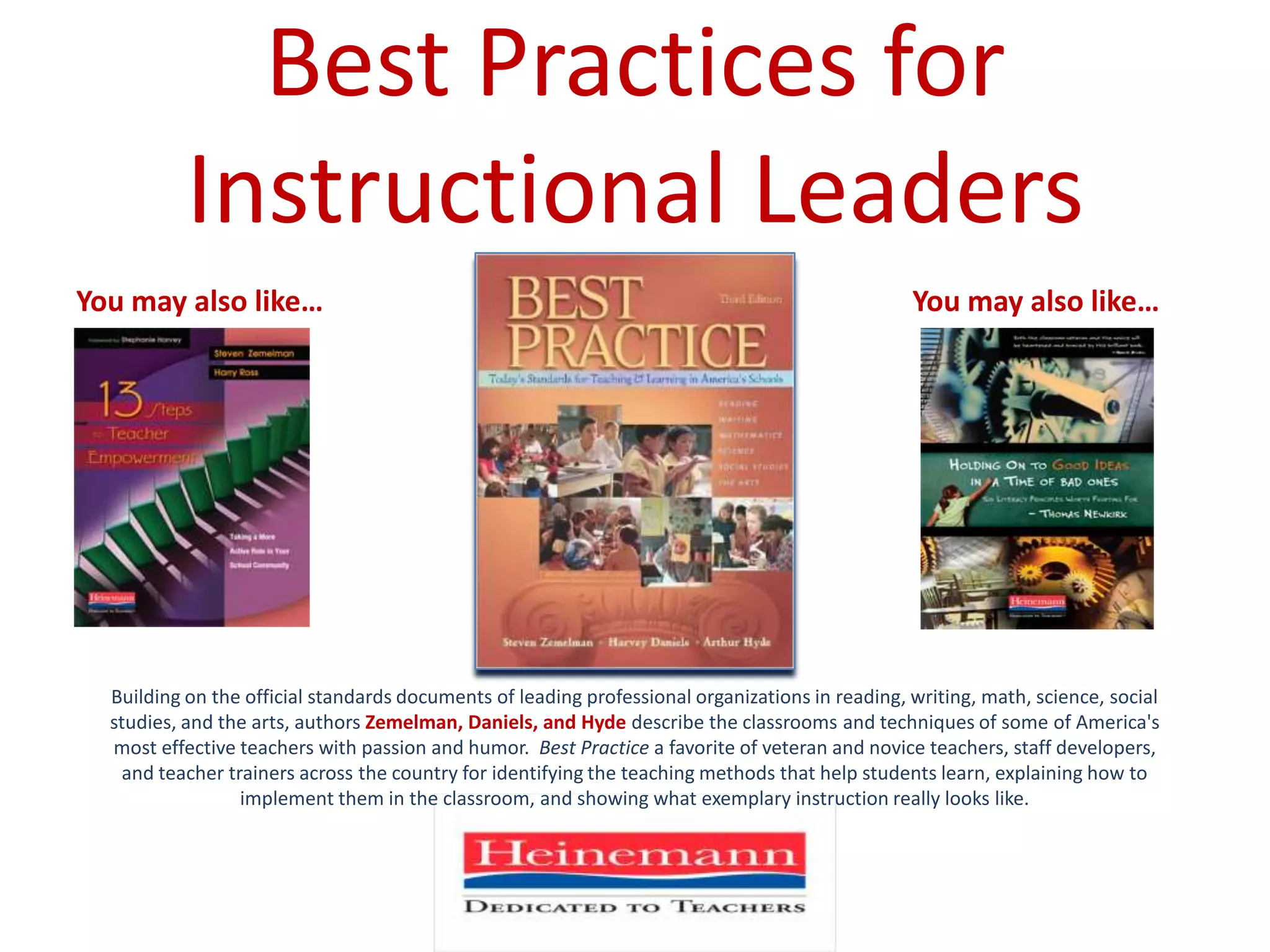
Best Practices for Instructional LeadersYou may also like…You may also like…Building on the official standards documents of leading professional organizations in reading, writing, math, science, social studies, and the arts, authors Zemelman, Daniels, and Hydedescribe the classrooms and techniques of some of America's most effective teachers with passion and humor.  Best Practice a favorite of veteran and novice teachers, staff developers, and teacher trainers across the country for identifying the teaching methods that help students learn, explaining how to implement them in the classroom, and showing what exemplary instruction really looks like.
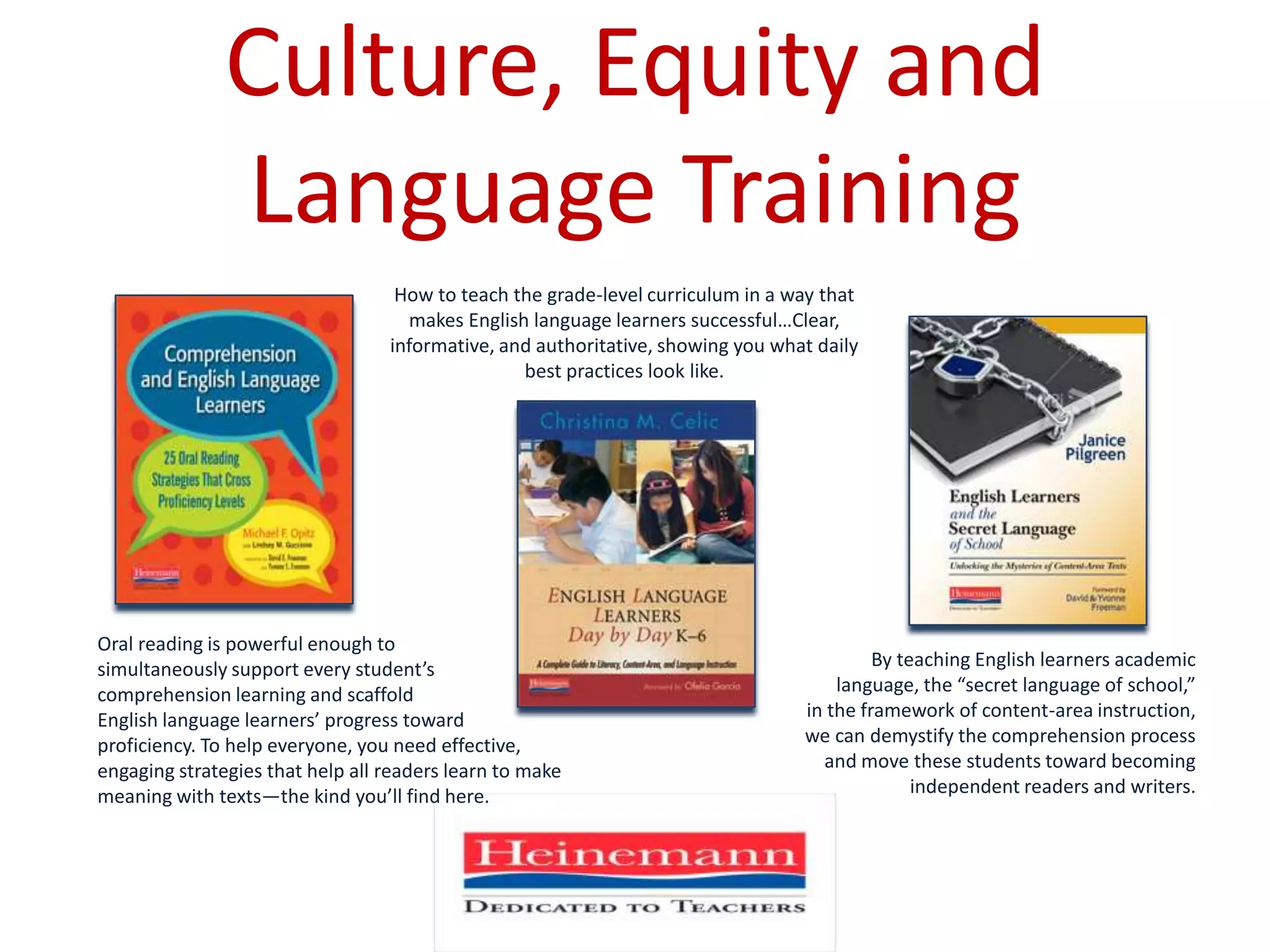
Culture, Equity and Language TrainingHow to teach the grade-level curriculum in a way that makes English language learners successful…Clear, informative, and authoritative, showing you what daily best practices look like.Oral reading is powerful enough to simultaneously support every student’s comprehension learning and scaffold English language learners’ progress toward proficiency. To help everyone, you need effective, engaging strategies that help all readers learn to make meaning with texts—the kind you’ll find here.By teaching English learners academic language, the “secret language of school,” in the framework of content-area instruction, we can demystify the comprehension process and move these students toward becoming independent readers and writers.
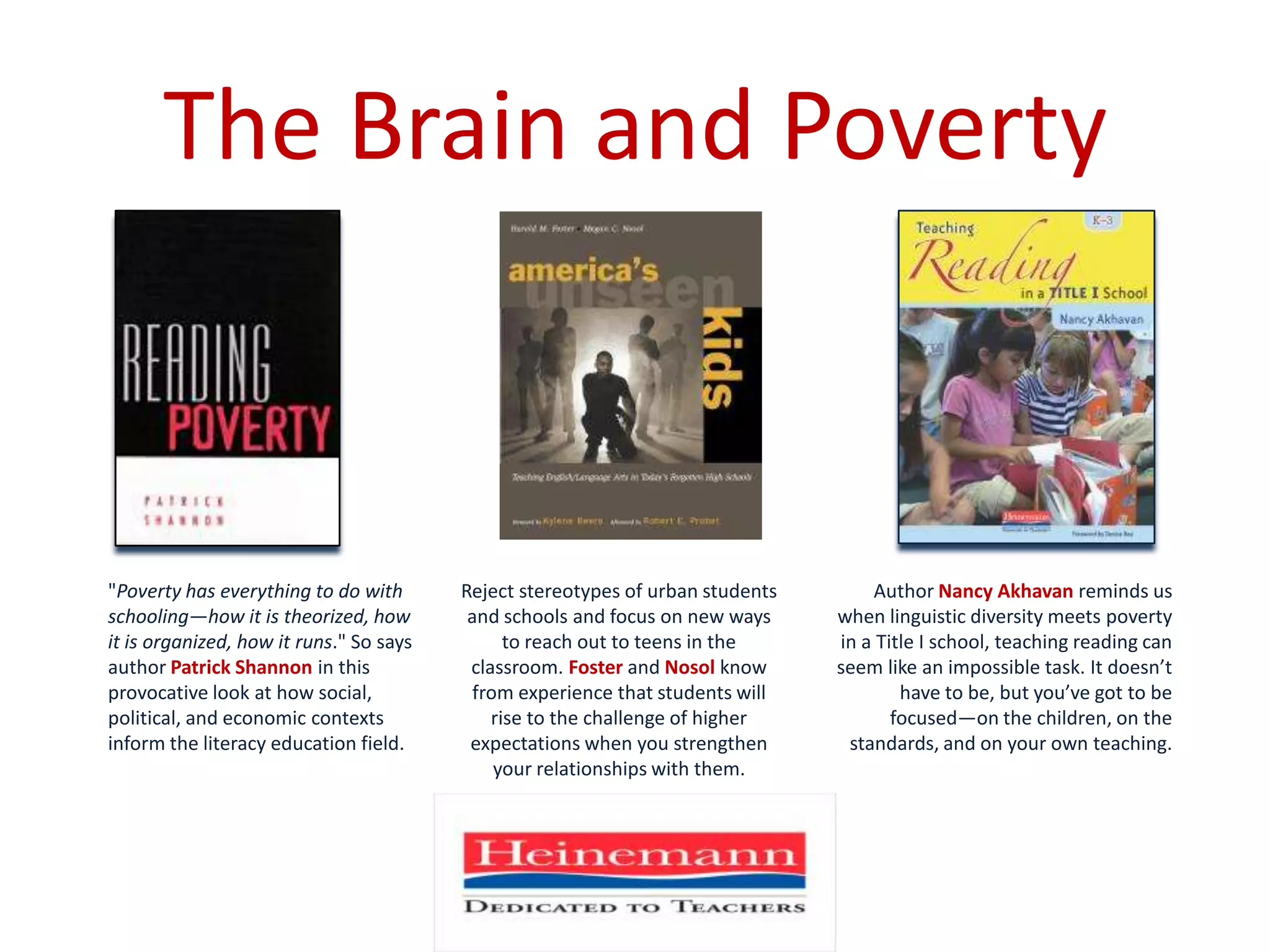
The Brain and Poverty"Poverty has everything to do with schooling—how it is theorized, how it is organized, how it runs." So says author Patrick Shannonin this provocative look at how social, political, and economic contexts inform the literacy education field. AuthorNancy Akhavan reminds us when linguistic diversity meets poverty in a Title I school, teaching reading can seem like an impossible task. It doesn’t have to be, but you’ve got to be focused—on the children, on the standards, and on your own teaching. Reject stereotypes of urban students and schools and focus on new ways to reach out to teens in the classroom. Foster and Nosol know from experience that students will rise to the challenge of higher expectations when you strengthen your relationships with them.
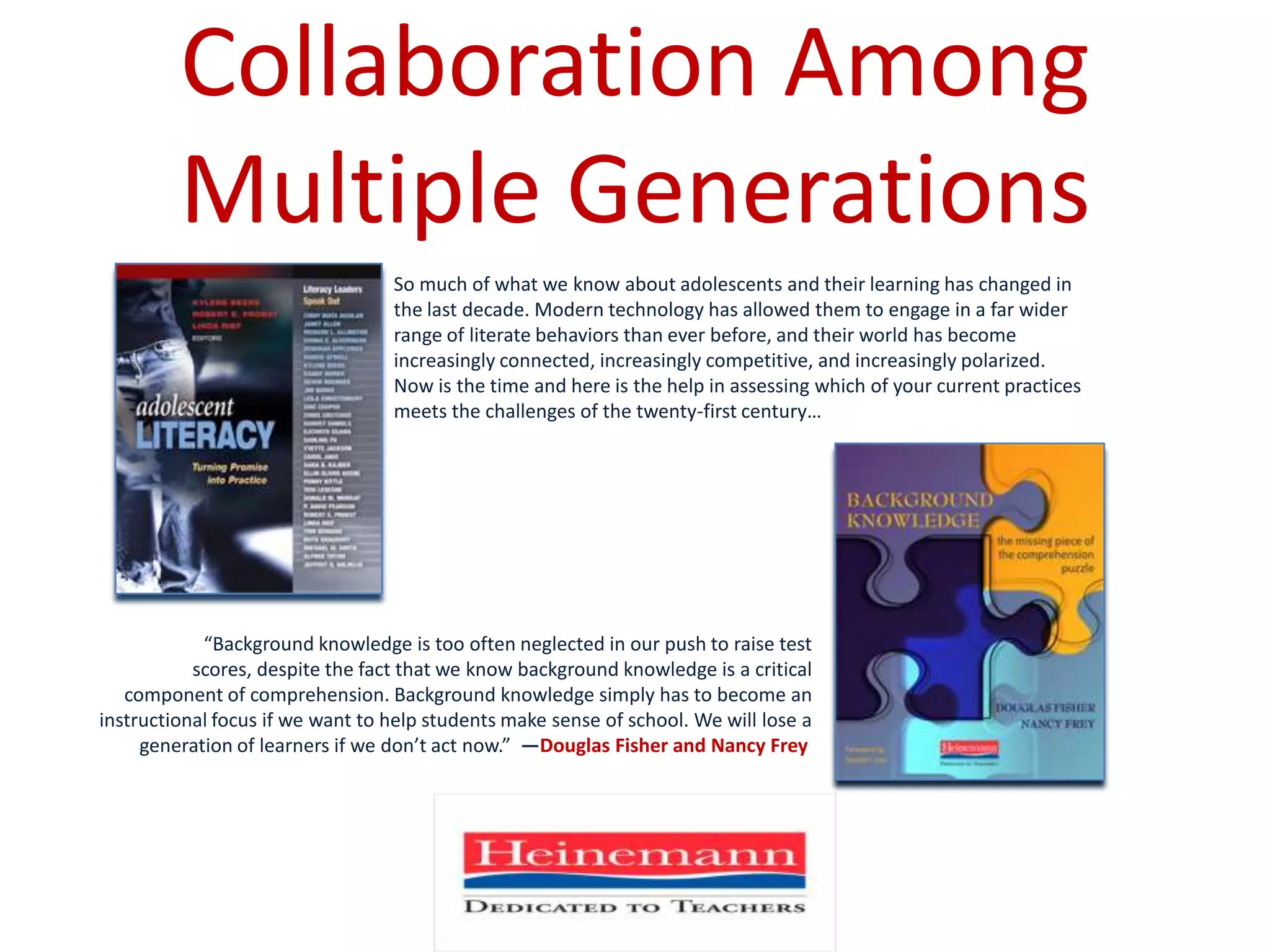
Collaboration Among Multiple GenerationsSo much of what we know about adolescents and their learning has changed in the last decade. Modern technology has allowed them to engage in a far wider range of literate behaviors than ever before, and their world has become increasingly connected, increasingly competitive, and increasingly polarized.  Now is the time and here is the help in assessing which of your current practices meets the challenges of the twenty-first century…“Background knowledge is too often neglected in our push to raise test scores, despite the fact that we know background knowledge is a critical component of comprehension. Background knowledge simply has to become an instructional focus if we want to help students make sense of school. We will lose a generation of learners if we don’t act now.”  —Douglas Fisher and Nancy Frey 
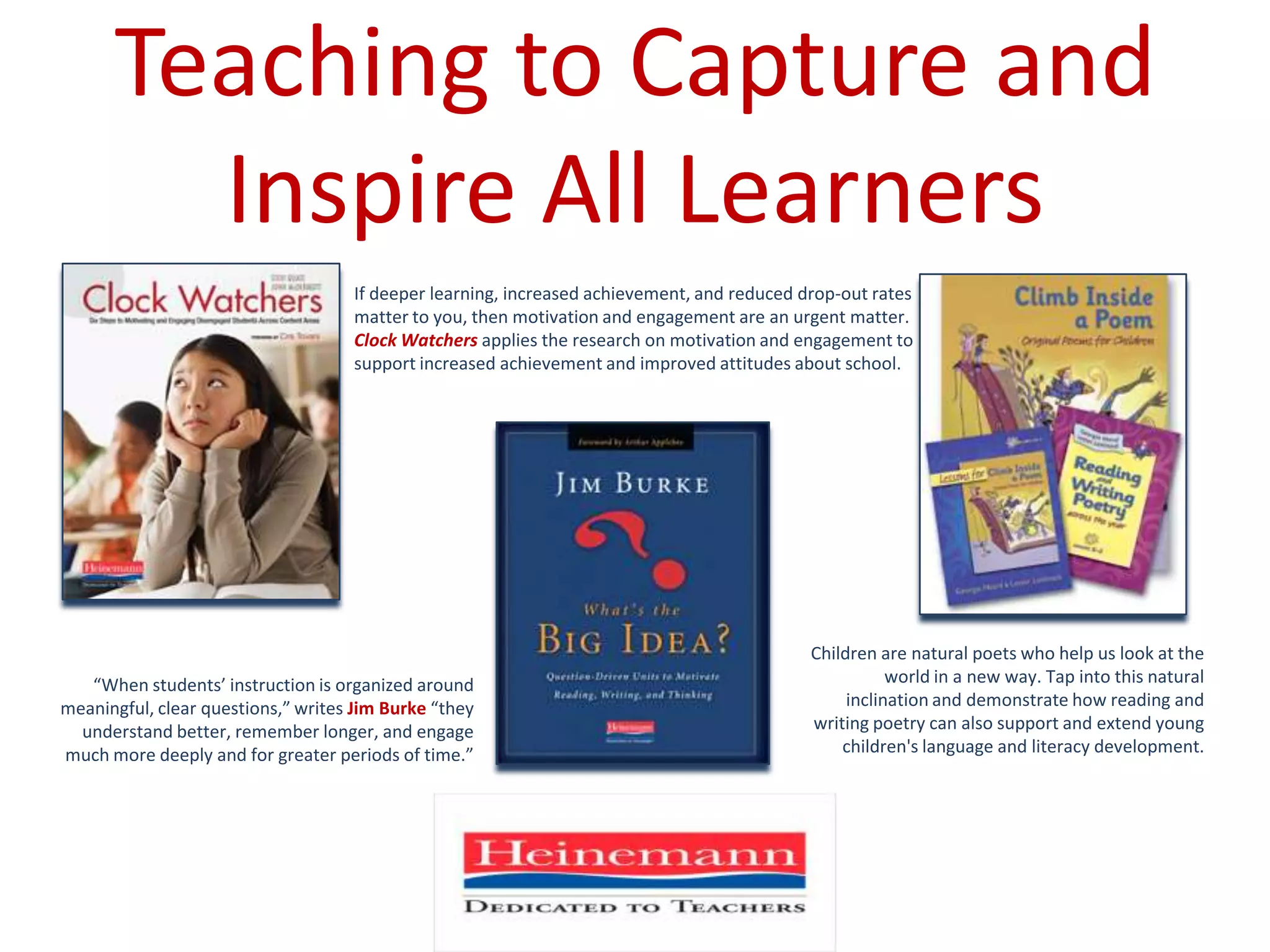
Teaching to Capture and Inspire All LearnersIf deeper learning, increased achievement, and reduced drop-out rates matter to you, then motivation and engagement are an urgent matter. Clock Watchersapplies the research on motivation and engagement to support increased achievement and improved attitudes about school.Children are natural poets who help us look at the world in a new way. Tap into this natural inclination and demonstrate how reading and writing poetry can also support and extend young children's language and literacy development.“When students’ instruction is organized around meaningful, clear questions,” writes Jim Burke “they understand better, remember longer, and engage much more deeply and for greater periods of time.”
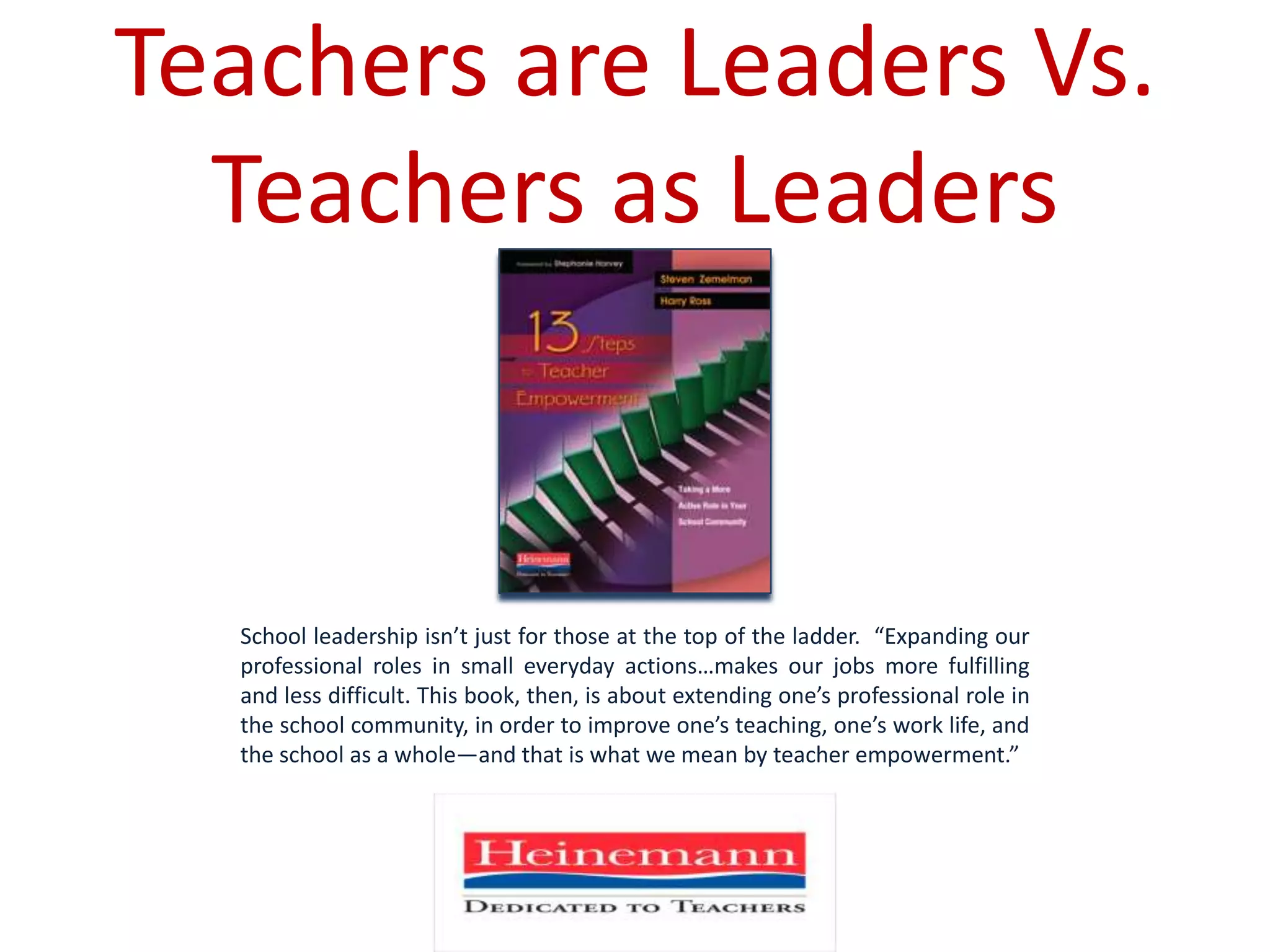
Teachers are Leaders Vs. Teachers as LeadersSchool leadership isn’t just for those at the top of the ladder.  “Expanding our professional roles in small everyday actions…makes our jobs more fulfilling and less difficult. This book, then, is about extending one’s professional role in the school community, in order to improve one’s teaching, one’s work life, and the school as a whole—and that is what we mean by teacher empowerment.”
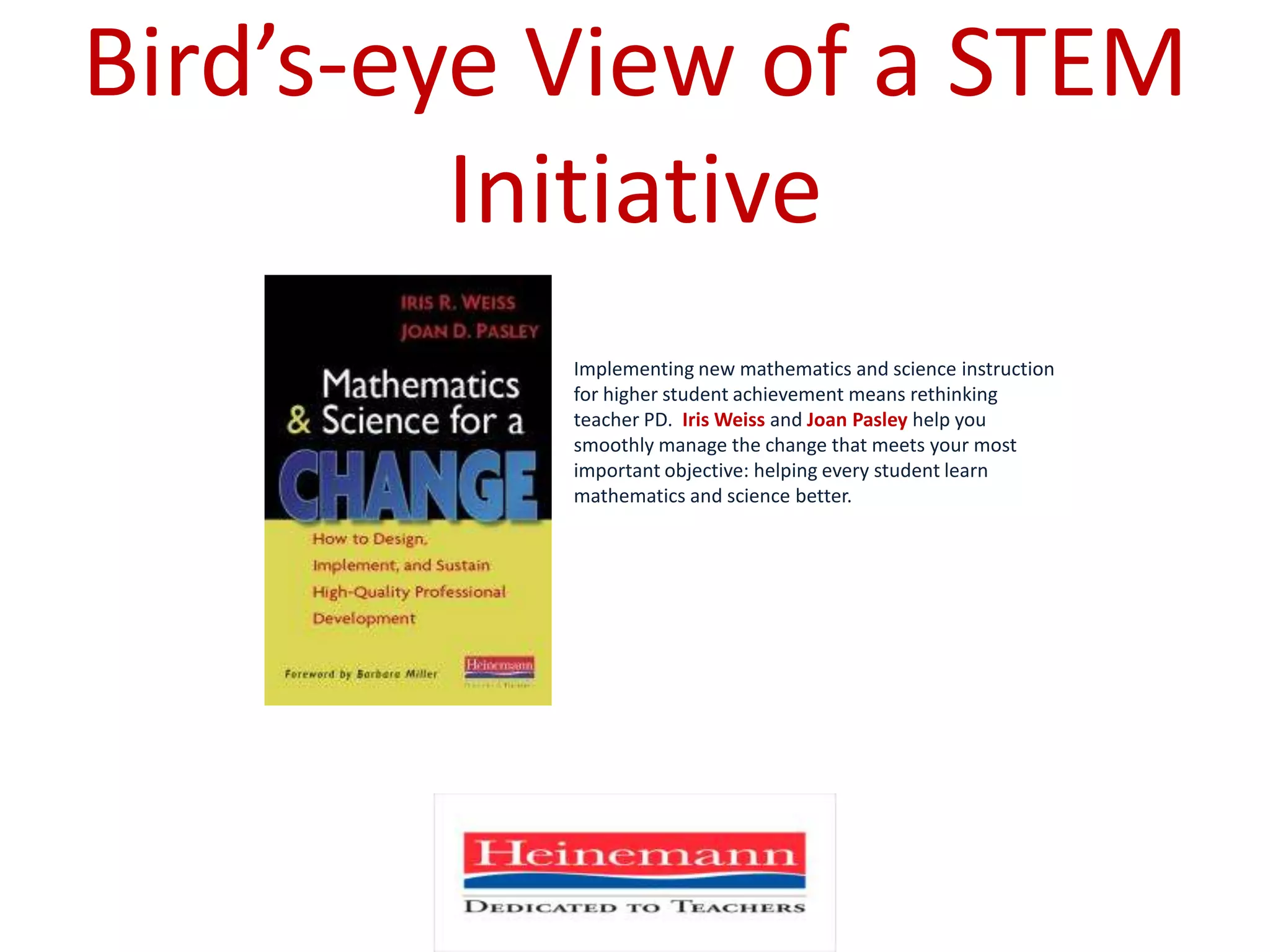
Bird’s-eye View of a STEM InitiativeImplementing new mathematics and science instruction for higher student achievement means rethinking teacher PD.  Iris Weiss and Joan Pasleyhelp you smoothly manage the change that meets your most important objective: helping every student learn mathematics and science better.
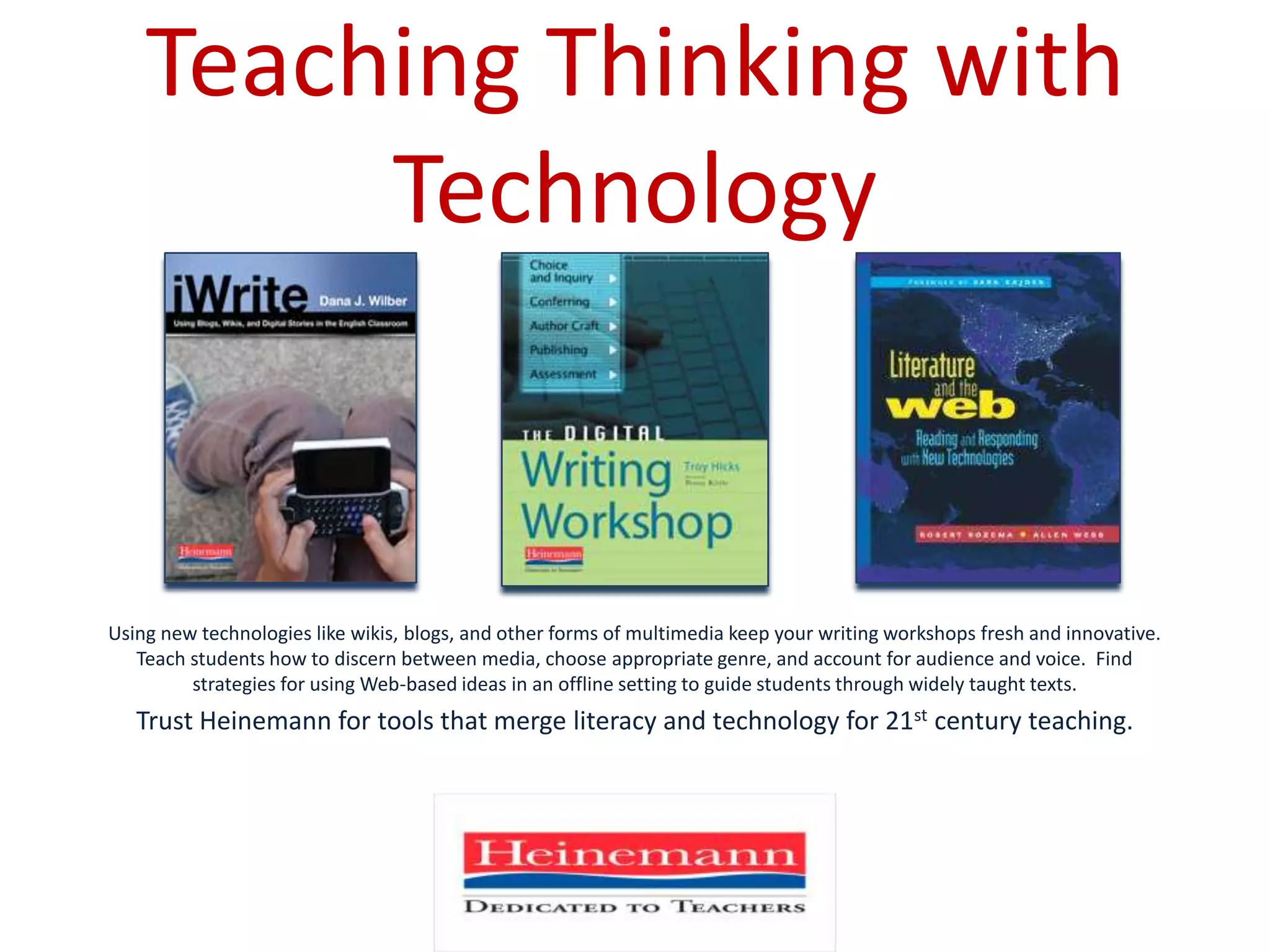
Teaching Thinking with TechnologyUsing new technologies like wikis, blogs, and other forms of multimedia keep your writing workshops fresh and innovative.  Teach students how to discern between media, choose appropriate genre, and account for audience and voice.  Find strategies for using Web-based ideas in an offline setting to guide students through widely taught texts.Trust Heinemann for tools that merge literacy and technology for 21st century teaching.
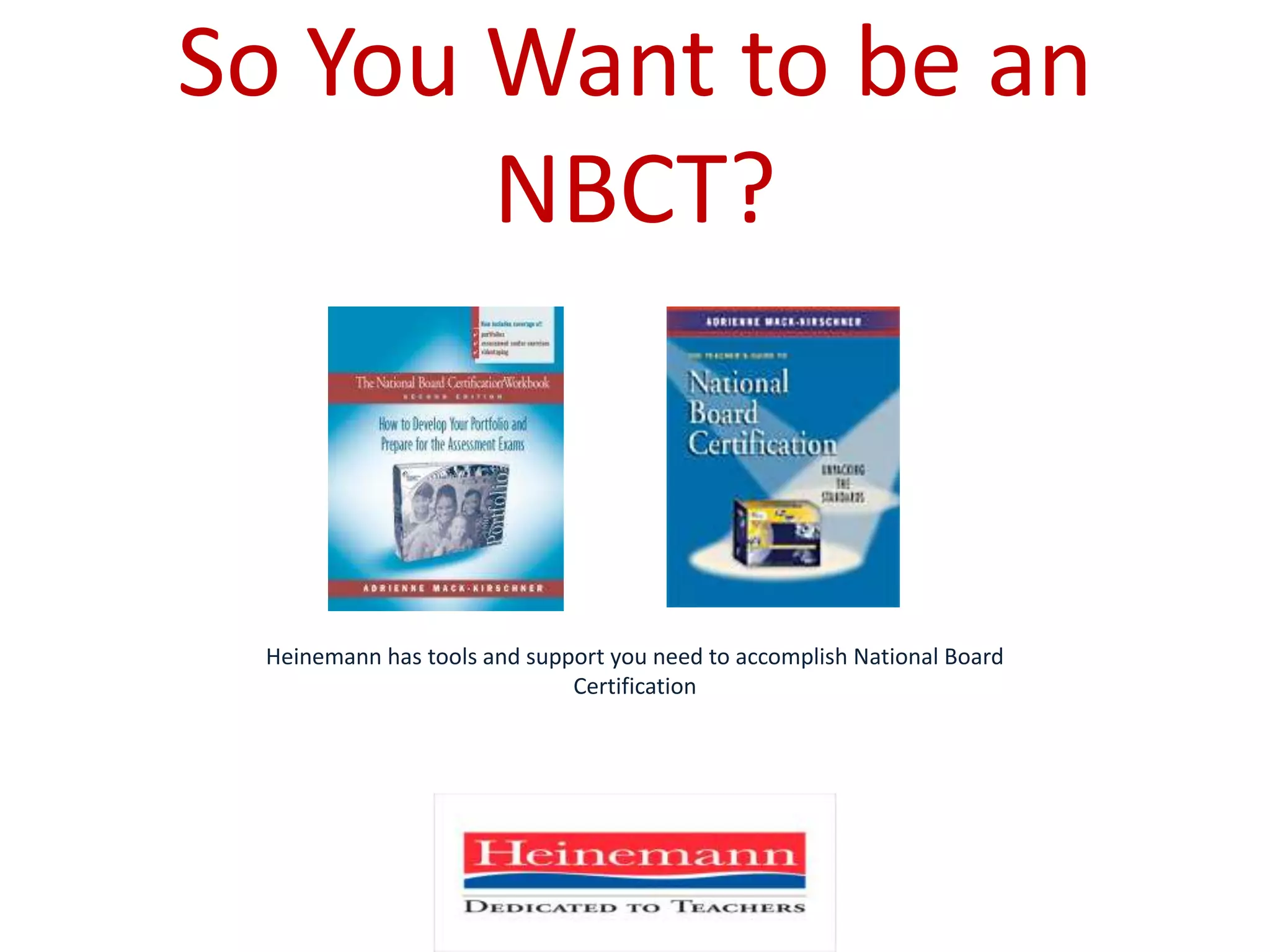
So You Want to be an NBCT?Heinemann has tools and support you need to accomplish National Board Certification
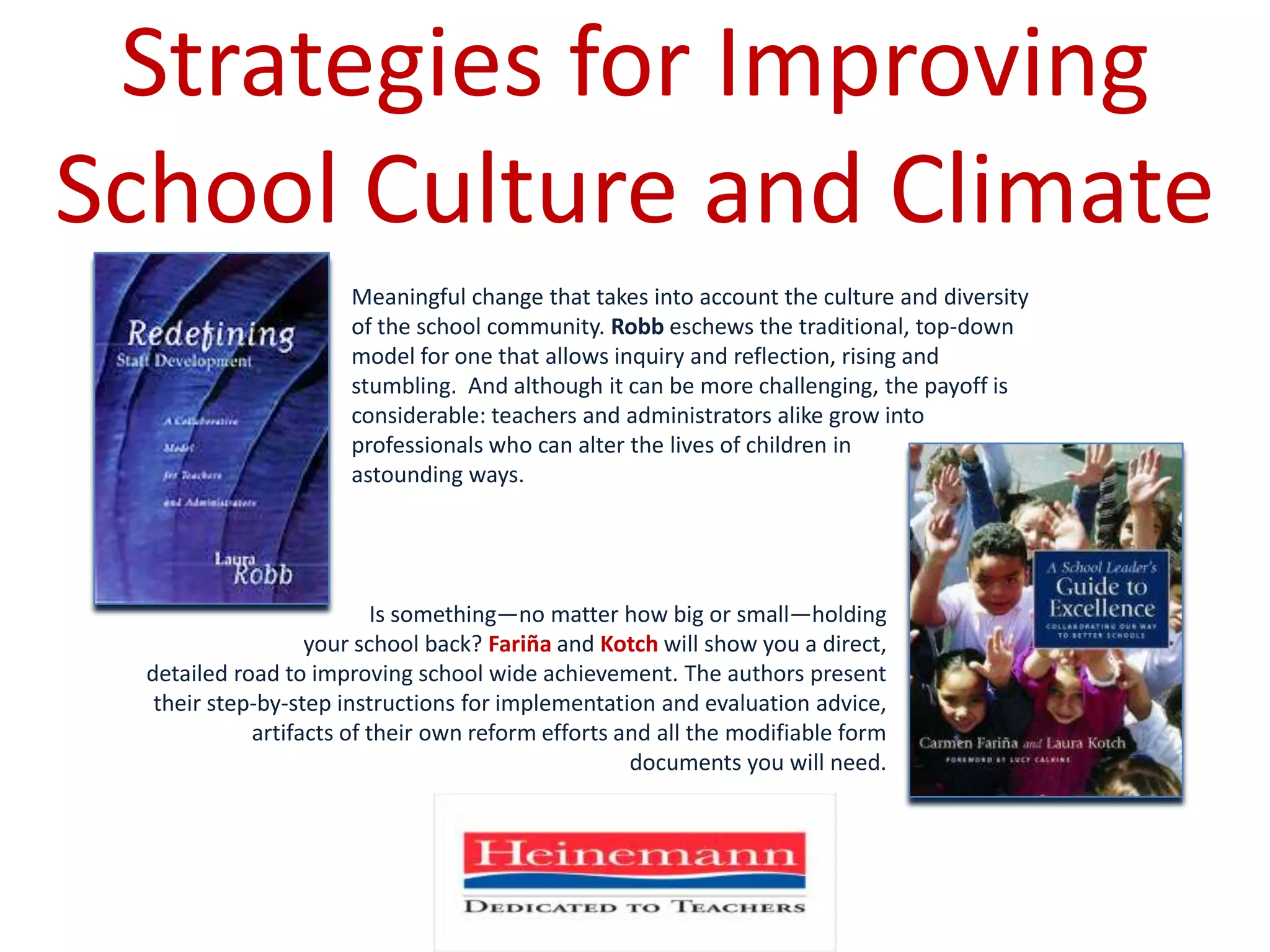
Strategies for Improving School Culture and ClimateMeaningful change that takes into account the culture and diversity of the school community. Robb eschews the traditional, top-down model for one that allows inquiry and reflection, rising and stumbling.  And although it can be more challenging, the payoff is considerable: teachers and administrators alike grow into professionals who can alter the lives of children in astounding ways.Is something—no matter how big or small—holding your school back? FariñaandKotchwill show you a direct, detailed road to improving school wide achievement. The authors present their step-by-step instructions for implementation and evaluation advice, artifacts of their own reform efforts and all the modifiable form documents you will need.
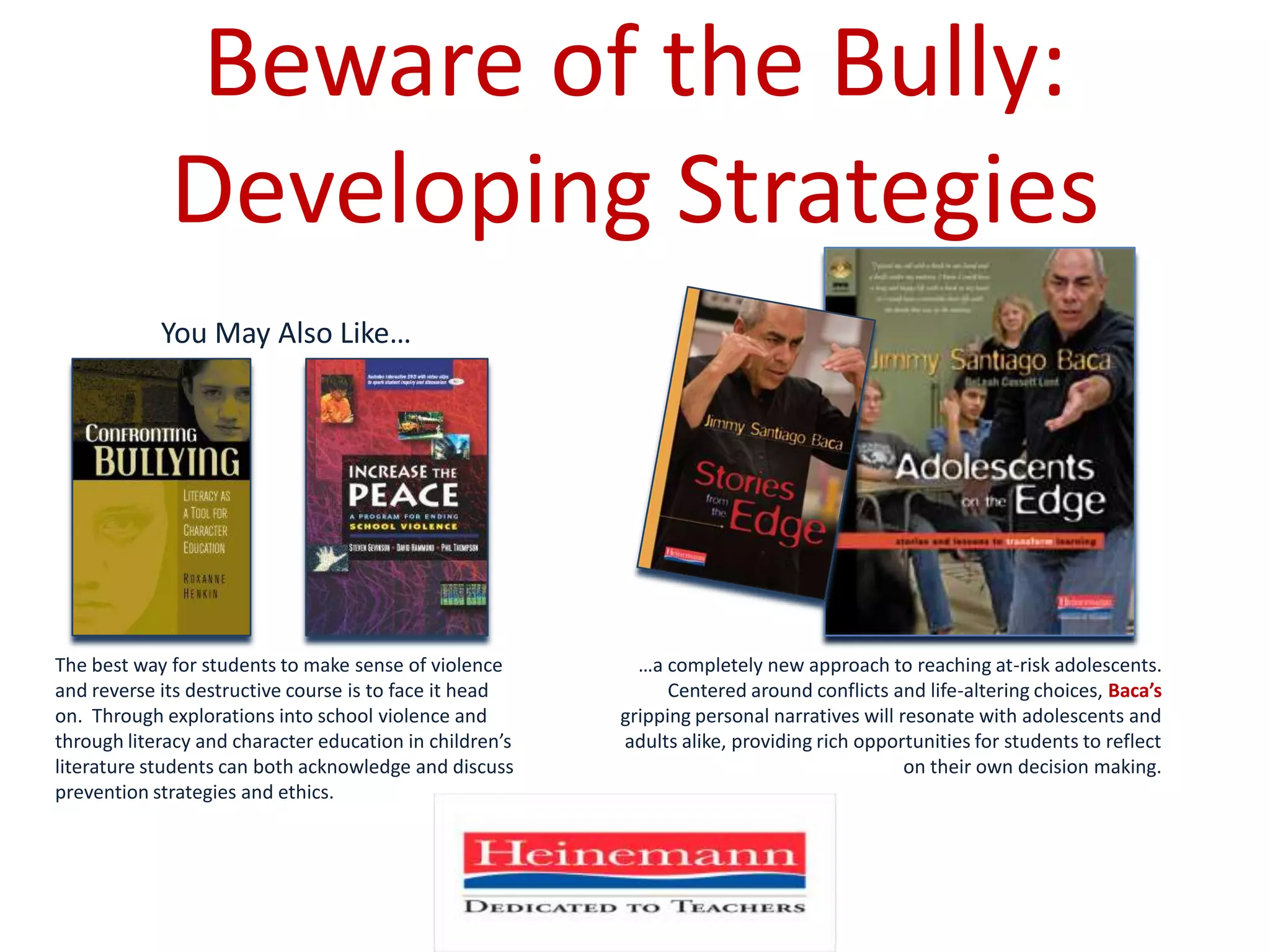
Beware of the Bully: Developing StrategiesYou May Also Like……a completely new approach to reaching at-risk adolescents. Centered around conflicts and life-altering choices, Baca’s gripping personal narratives will resonate with adolescents and adults alike, providing rich opportunities for students to reflect on their own decision making. The best way for students to make sense of violence and reverse its destructive course is to face it head on.  Through explorations into school violence and through literacy and character education in children’s literature students can both acknowledge and discuss prevention strategies and ethics.
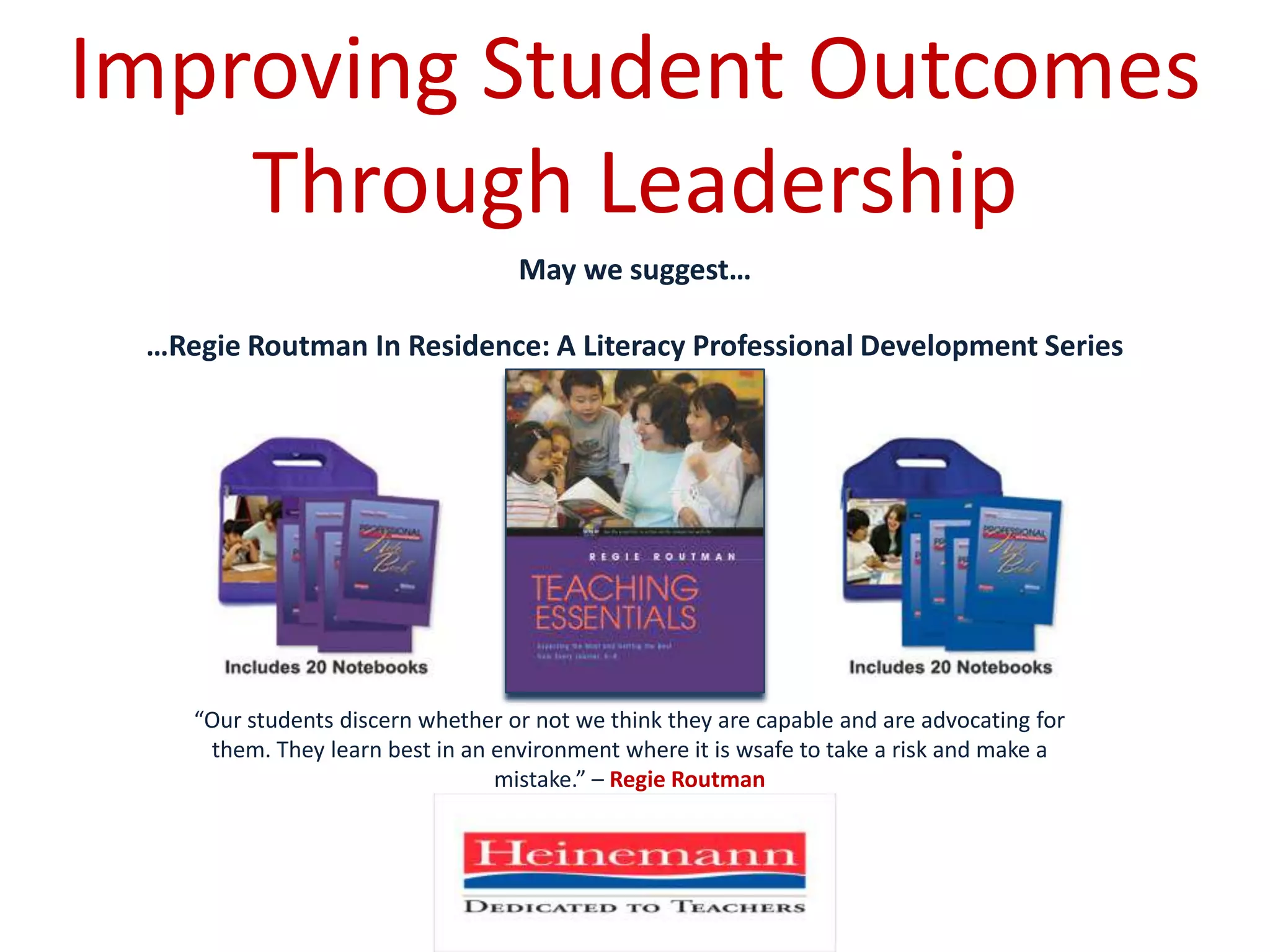
Improving Student Outcomes Through LeadershipMay we suggest……RegieRoutman In Residence: A Literacy Professional Development Series“Our students discern whether or not we think they are capable and are advocating for them. They learn best in an environment where it is wsafe to take a risk and make a mistake.” – RegieRoutman
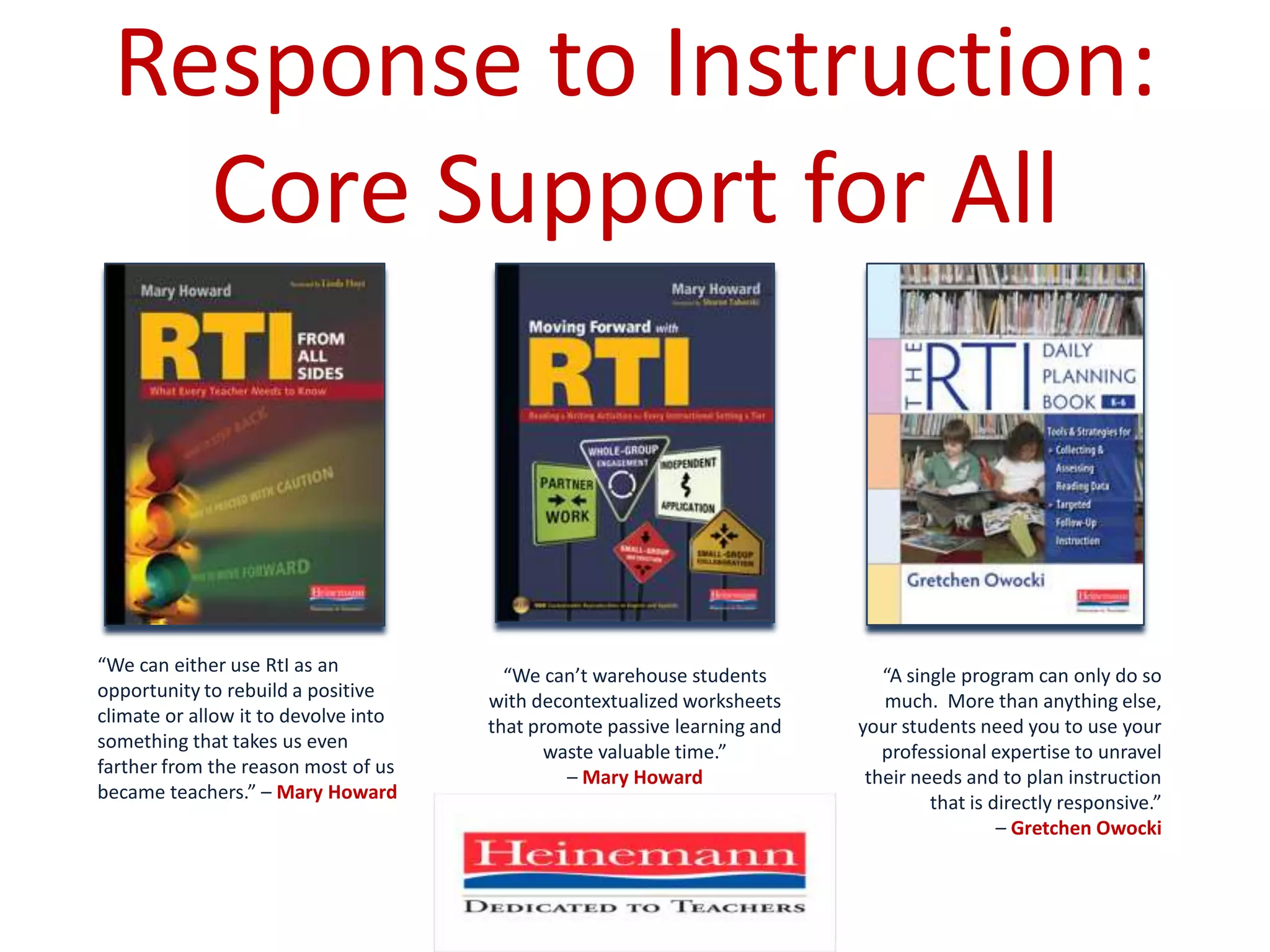
Response to Instruction: Core Support for All“We can either use RtI as an opportunity to rebuild a positive climate or allow it to devolve into something that takes us even farther from the reason most of us became teachers.” – Mary Howard“We can’t warehouse students with decontextualized worksheets that promote passive learning and waste valuable time.” – Mary Howard“A single program can only do so much.  More than anything else, your students need you to use your professional expertise to unravel their needs and to plan instruction that is directly responsive.” – Gretchen Owocki
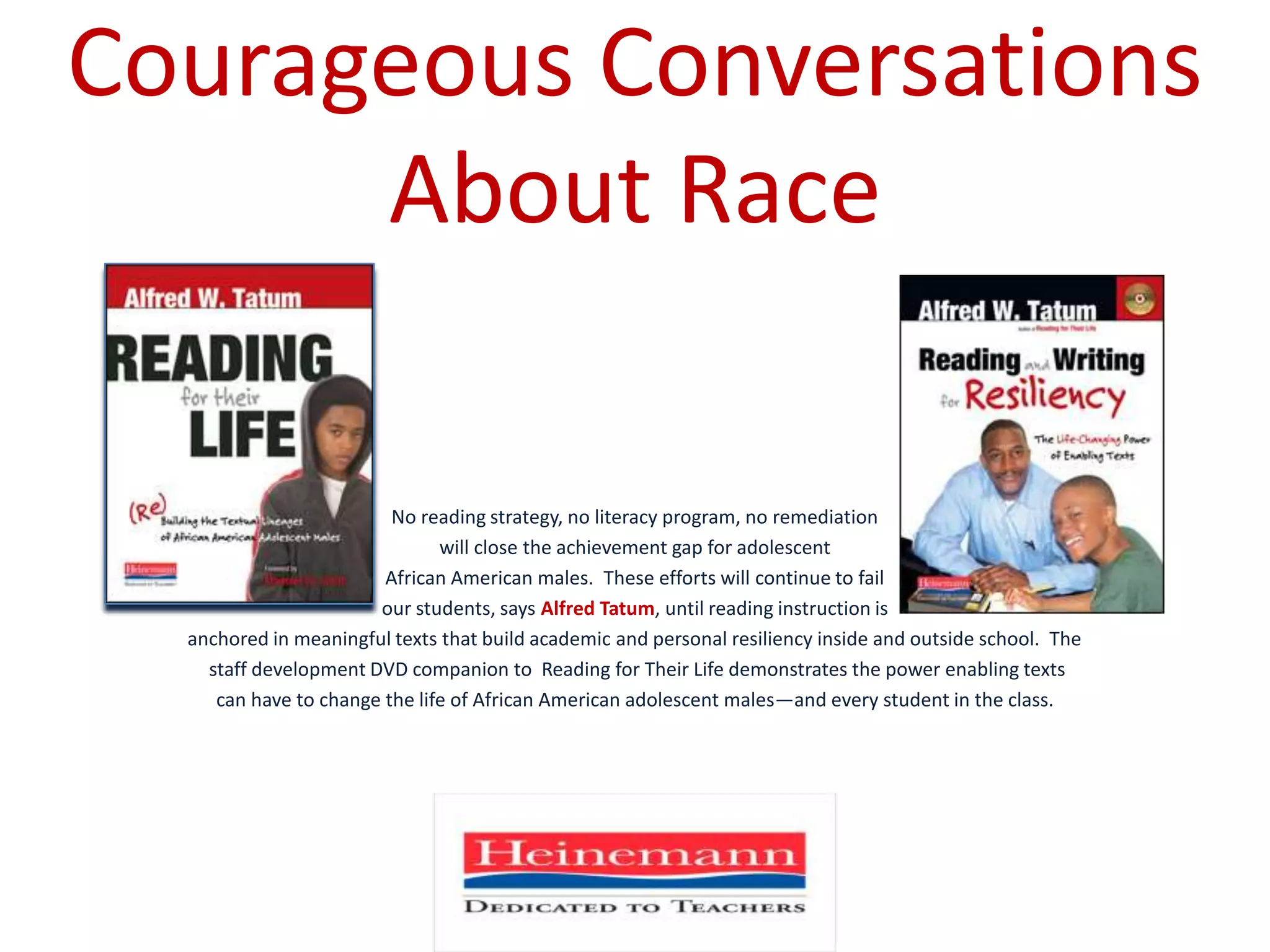
Courageous Conversations About RaceNo reading strategy, no literacy program, no remediation will close the achievement gap for adolescent African American males.  These efforts will continue to fail our students, says Alfred Tatum, until reading instruction is anchored in meaningful texts that build academic and personal resiliency inside and outside school.  The staff development DVD companion to  Reading for Their Life demonstrates the power enabling texts can have to change the life of African American adolescent males—and every student in the class.
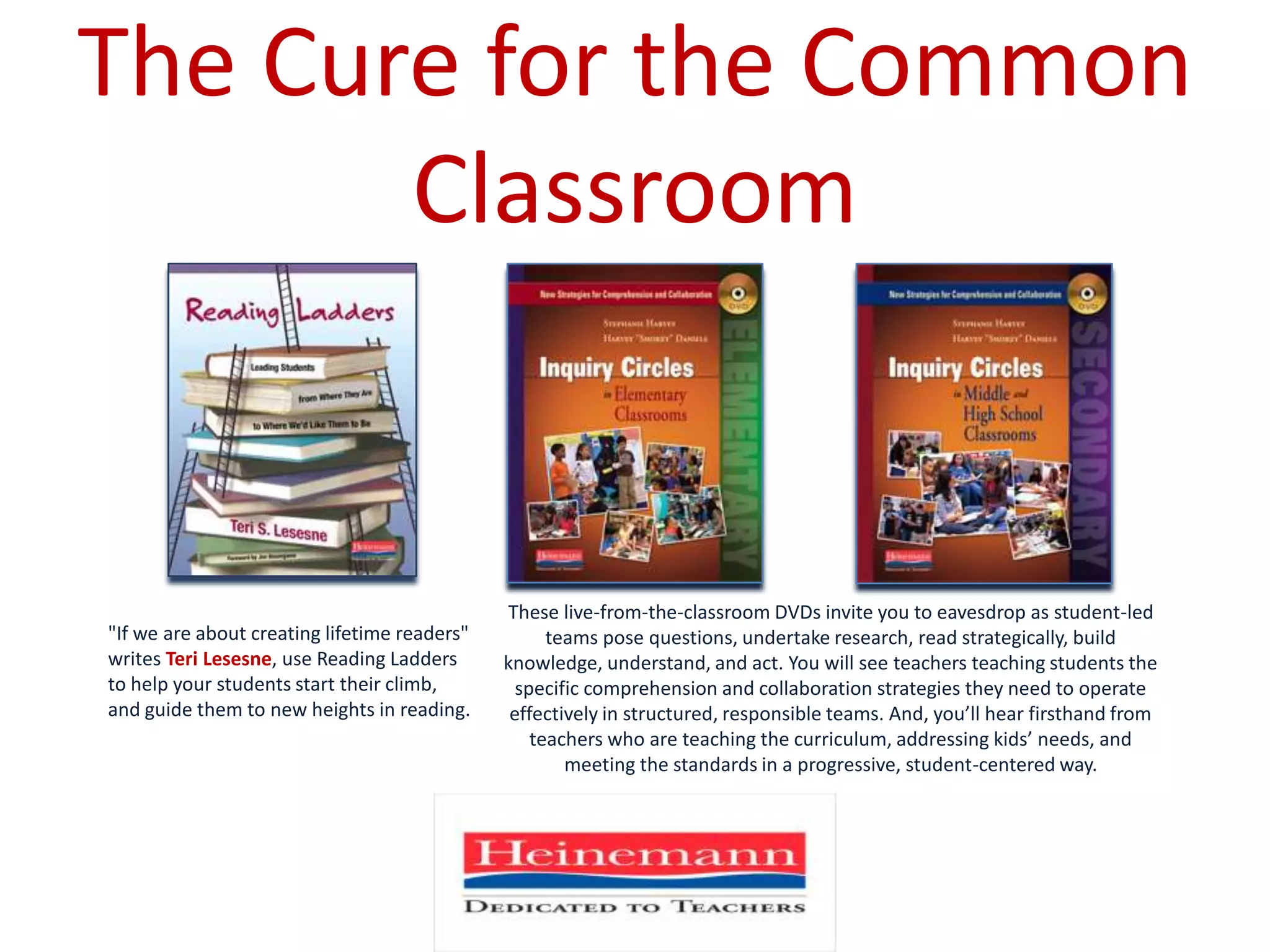
The Cure for the Common ClassroomThese live-from-the-classroom DVDs invite you to eavesdrop as student-led teams pose questions, undertake research, read strategically, build knowledge, understand, and act. You will see teachers teaching students the specific comprehension and collaboration strategies they need to operate effectively in structured, responsible teams. And, you’ll hear firsthand from teachers who are teaching the curriculum, addressing kids’ needs, and meeting the standards in a progressive, student-centered way. "If we are about creating lifetime readers" writes Teri Lesesne, use Reading Ladders to help your students start their climb, and guide them to new heights in reading.
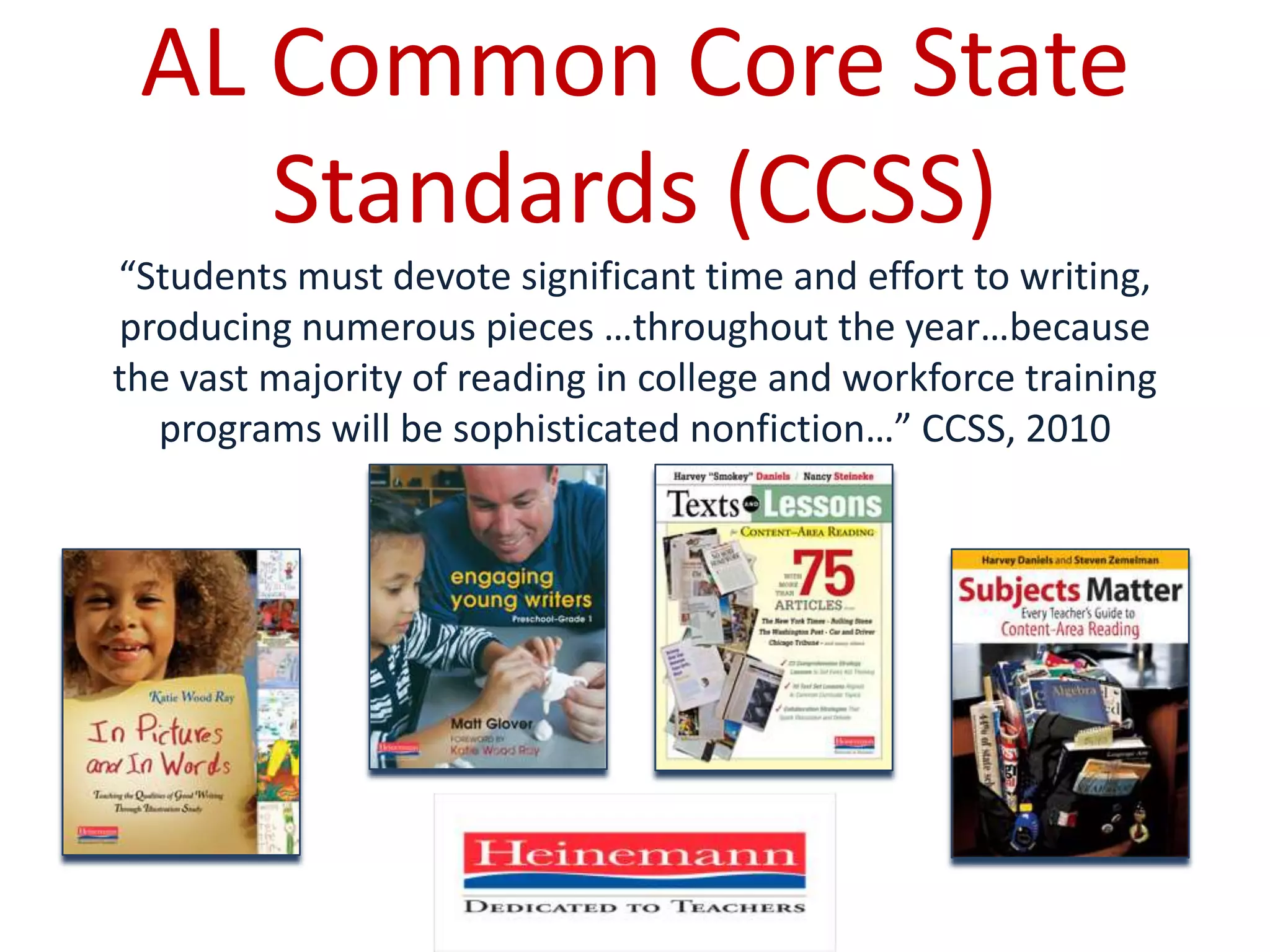
AL Common Core State Standards (CCSS)“Students must devote significant time and effort to writing, producing numerous pieces …throughout the year…because the vast majority of reading in college and workforce training programs will be sophisticated nonfiction…” CCSS, 2010
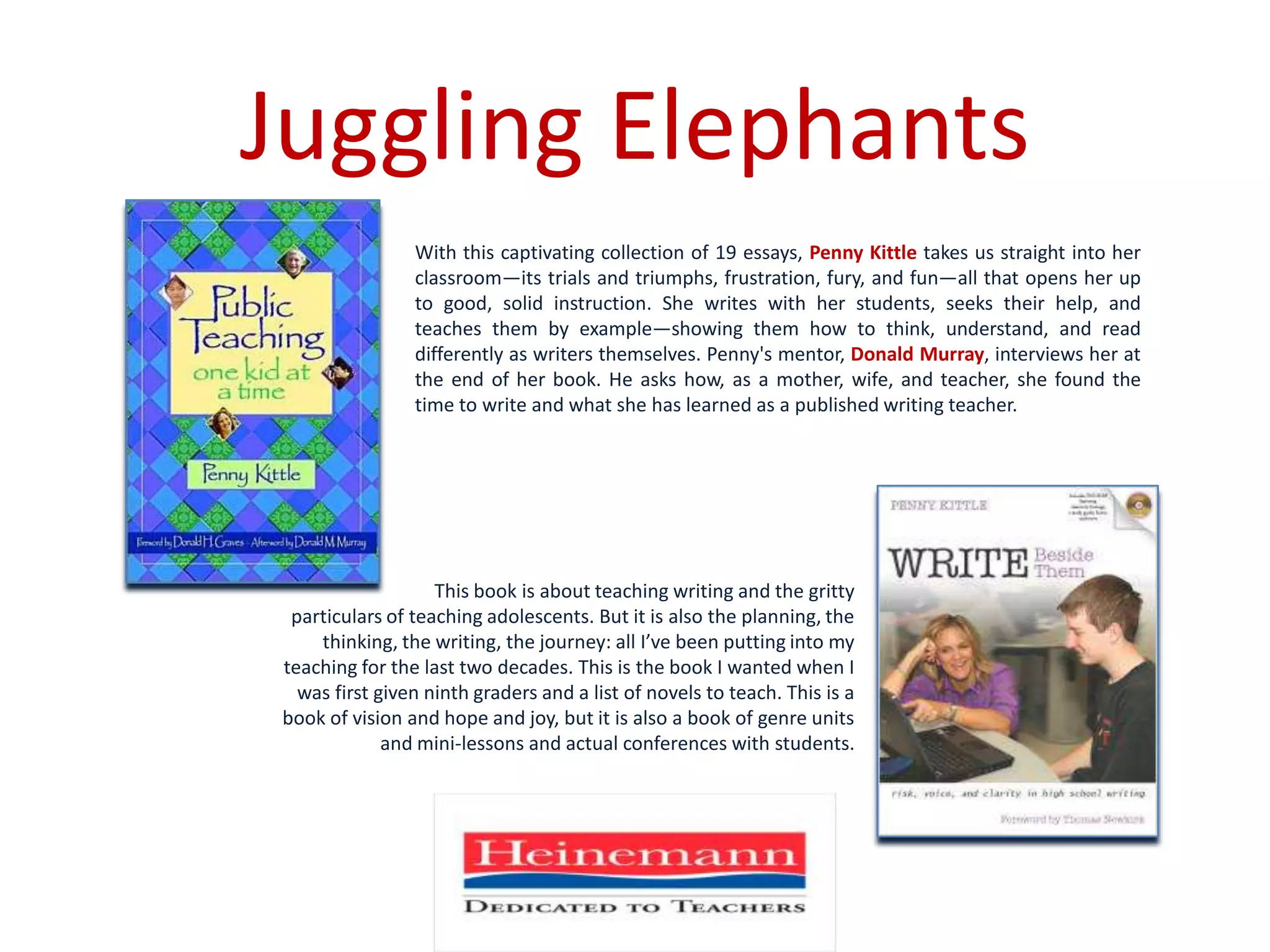
Juggling ElephantsWith this captivating collection of 19 essays, Penny Kittle takes us straight into her classroom—its trials and triumphs, frustration, fury, and fun—all that opens her up to good, solid instruction. She writes with her students, seeks their help, and teaches them by example—showing them how to think, understand, and read differently as writers themselves. Penny's mentor, Donald Murray, interviews her at the end of her book. He asks how, as a mother, wife, and teacher, she found the time to write and what she has learned as a published writing teacher. This book is about teaching writing and the gritty particulars of teaching adolescents. But it is also the planning, the thinking, the writing, the journey: all I’ve been putting into my teaching for the last two decades. This is the book I wanted when I was first given ninth graders and a list of novels to teach. This is a book of vision and hope and joy, but it is also a book of genre units and mini-lessons and actual conferences with students.
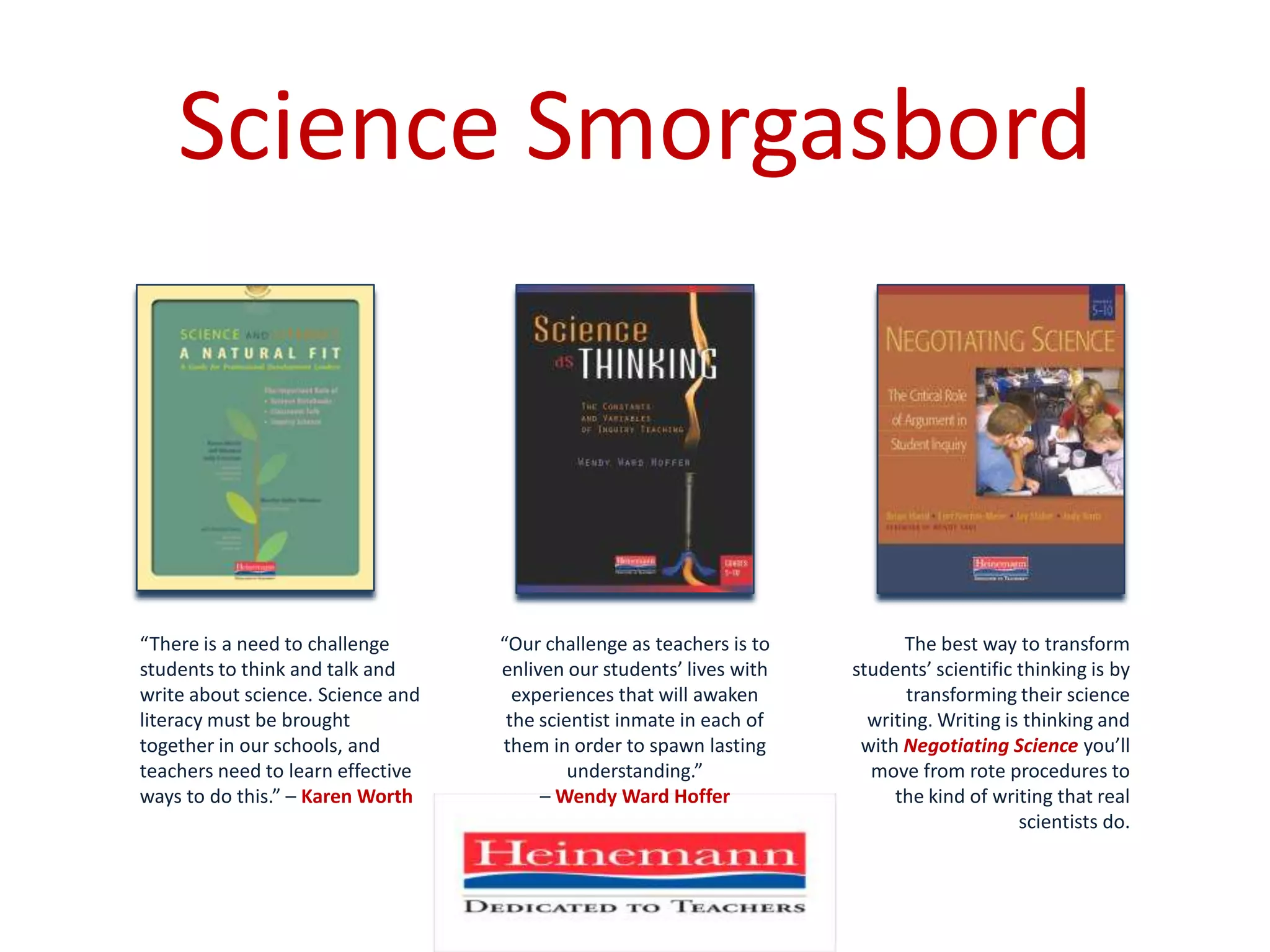
Science SmorgasbordThe best way to transform students’ scientific thinking is by transforming their science writing. Writing is thinking and with Negotiating Scienceyou’ll move from rote procedures to the kind of writing that real scientists do.“There is a need to challenge students to think and talk and write about science. Science and literacy must be brought together in our schools, and teachers need to learn effective ways to do this.” – Karen Worth“Our challenge as teachers is to enliven our students’ lives with experiences that will awaken the scientist inmate in each of them in order to spawn lasting understanding.” – Wendy Ward Hoffer

Conference.aea.book suggestions

  • 1.
    Best Practices forInstructional LeadersYou may also like…You may also like…Building on the official standards documents of leading professional organizations in reading, writing, math, science, social studies, and the arts, authors Zemelman, Daniels, and Hydedescribe the classrooms and techniques of some of America's most effective teachers with passion and humor. Best Practice a favorite of veteran and novice teachers, staff developers, and teacher trainers across the country for identifying the teaching methods that help students learn, explaining how to implement them in the classroom, and showing what exemplary instruction really looks like.
  • 2.
    Culture, Equity andLanguage TrainingHow to teach the grade-level curriculum in a way that makes English language learners successful…Clear, informative, and authoritative, showing you what daily best practices look like.Oral reading is powerful enough to simultaneously support every student’s comprehension learning and scaffold English language learners’ progress toward proficiency. To help everyone, you need effective, engaging strategies that help all readers learn to make meaning with texts—the kind you’ll find here.By teaching English learners academic language, the “secret language of school,” in the framework of content-area instruction, we can demystify the comprehension process and move these students toward becoming independent readers and writers.
  • 3.
    The Brain andPoverty"Poverty has everything to do with schooling—how it is theorized, how it is organized, how it runs." So says author Patrick Shannonin this provocative look at how social, political, and economic contexts inform the literacy education field. AuthorNancy Akhavan reminds us when linguistic diversity meets poverty in a Title I school, teaching reading can seem like an impossible task. It doesn’t have to be, but you’ve got to be focused—on the children, on the standards, and on your own teaching. Reject stereotypes of urban students and schools and focus on new ways to reach out to teens in the classroom. Foster and Nosol know from experience that students will rise to the challenge of higher expectations when you strengthen your relationships with them.
  • 4.
    Collaboration Among MultipleGenerationsSo much of what we know about adolescents and their learning has changed in the last decade. Modern technology has allowed them to engage in a far wider range of literate behaviors than ever before, and their world has become increasingly connected, increasingly competitive, and increasingly polarized. Now is the time and here is the help in assessing which of your current practices meets the challenges of the twenty-first century…“Background knowledge is too often neglected in our push to raise test scores, despite the fact that we know background knowledge is a critical component of comprehension. Background knowledge simply has to become an instructional focus if we want to help students make sense of school. We will lose a generation of learners if we don’t act now.” —Douglas Fisher and Nancy Frey 
  • 5.
    Teaching to Captureand Inspire All LearnersIf deeper learning, increased achievement, and reduced drop-out rates matter to you, then motivation and engagement are an urgent matter. Clock Watchersapplies the research on motivation and engagement to support increased achievement and improved attitudes about school.Children are natural poets who help us look at the world in a new way. Tap into this natural inclination and demonstrate how reading and writing poetry can also support and extend young children's language and literacy development.“When students’ instruction is organized around meaningful, clear questions,” writes Jim Burke “they understand better, remember longer, and engage much more deeply and for greater periods of time.”
  • 6.
    Teachers are LeadersVs. Teachers as LeadersSchool leadership isn’t just for those at the top of the ladder. “Expanding our professional roles in small everyday actions…makes our jobs more fulfilling and less difficult. This book, then, is about extending one’s professional role in the school community, in order to improve one’s teaching, one’s work life, and the school as a whole—and that is what we mean by teacher empowerment.”
  • 7.
    Bird’s-eye View ofa STEM InitiativeImplementing new mathematics and science instruction for higher student achievement means rethinking teacher PD. Iris Weiss and Joan Pasleyhelp you smoothly manage the change that meets your most important objective: helping every student learn mathematics and science better.
  • 8.
    Teaching Thinking withTechnologyUsing new technologies like wikis, blogs, and other forms of multimedia keep your writing workshops fresh and innovative. Teach students how to discern between media, choose appropriate genre, and account for audience and voice. Find strategies for using Web-based ideas in an offline setting to guide students through widely taught texts.Trust Heinemann for tools that merge literacy and technology for 21st century teaching.
  • 9.
    So You Wantto be an NBCT?Heinemann has tools and support you need to accomplish National Board Certification
  • 10.
    Strategies for ImprovingSchool Culture and ClimateMeaningful change that takes into account the culture and diversity of the school community. Robb eschews the traditional, top-down model for one that allows inquiry and reflection, rising and stumbling. And although it can be more challenging, the payoff is considerable: teachers and administrators alike grow into professionals who can alter the lives of children in astounding ways.Is something—no matter how big or small—holding your school back? FariñaandKotchwill show you a direct, detailed road to improving school wide achievement. The authors present their step-by-step instructions for implementation and evaluation advice, artifacts of their own reform efforts and all the modifiable form documents you will need.
  • 11.
    Beware of theBully: Developing StrategiesYou May Also Like……a completely new approach to reaching at-risk adolescents. Centered around conflicts and life-altering choices, Baca’s gripping personal narratives will resonate with adolescents and adults alike, providing rich opportunities for students to reflect on their own decision making. The best way for students to make sense of violence and reverse its destructive course is to face it head on. Through explorations into school violence and through literacy and character education in children’s literature students can both acknowledge and discuss prevention strategies and ethics.
  • 12.
    Improving Student OutcomesThrough LeadershipMay we suggest……RegieRoutman In Residence: A Literacy Professional Development Series“Our students discern whether or not we think they are capable and are advocating for them. They learn best in an environment where it is wsafe to take a risk and make a mistake.” – RegieRoutman
  • 13.
    Response to Instruction:Core Support for All“We can either use RtI as an opportunity to rebuild a positive climate or allow it to devolve into something that takes us even farther from the reason most of us became teachers.” – Mary Howard“We can’t warehouse students with decontextualized worksheets that promote passive learning and waste valuable time.” – Mary Howard“A single program can only do so much. More than anything else, your students need you to use your professional expertise to unravel their needs and to plan instruction that is directly responsive.” – Gretchen Owocki
  • 14.
    Courageous Conversations AboutRaceNo reading strategy, no literacy program, no remediation will close the achievement gap for adolescent African American males. These efforts will continue to fail our students, says Alfred Tatum, until reading instruction is anchored in meaningful texts that build academic and personal resiliency inside and outside school. The staff development DVD companion to Reading for Their Life demonstrates the power enabling texts can have to change the life of African American adolescent males—and every student in the class.
  • 15.
    The Cure forthe Common ClassroomThese live-from-the-classroom DVDs invite you to eavesdrop as student-led teams pose questions, undertake research, read strategically, build knowledge, understand, and act. You will see teachers teaching students the specific comprehension and collaboration strategies they need to operate effectively in structured, responsible teams. And, you’ll hear firsthand from teachers who are teaching the curriculum, addressing kids’ needs, and meeting the standards in a progressive, student-centered way. "If we are about creating lifetime readers" writes Teri Lesesne, use Reading Ladders to help your students start their climb, and guide them to new heights in reading.
  • 16.
    AL Common CoreState Standards (CCSS)“Students must devote significant time and effort to writing, producing numerous pieces …throughout the year…because the vast majority of reading in college and workforce training programs will be sophisticated nonfiction…” CCSS, 2010
  • 17.
    Juggling ElephantsWith thiscaptivating collection of 19 essays, Penny Kittle takes us straight into her classroom—its trials and triumphs, frustration, fury, and fun—all that opens her up to good, solid instruction. She writes with her students, seeks their help, and teaches them by example—showing them how to think, understand, and read differently as writers themselves. Penny's mentor, Donald Murray, interviews her at the end of her book. He asks how, as a mother, wife, and teacher, she found the time to write and what she has learned as a published writing teacher. This book is about teaching writing and the gritty particulars of teaching adolescents. But it is also the planning, the thinking, the writing, the journey: all I’ve been putting into my teaching for the last two decades. This is the book I wanted when I was first given ninth graders and a list of novels to teach. This is a book of vision and hope and joy, but it is also a book of genre units and mini-lessons and actual conferences with students.
  • 18.
    Science SmorgasbordThe bestway to transform students’ scientific thinking is by transforming their science writing. Writing is thinking and with Negotiating Scienceyou’ll move from rote procedures to the kind of writing that real scientists do.“There is a need to challenge students to think and talk and write about science. Science and literacy must be brought together in our schools, and teachers need to learn effective ways to do this.” – Karen Worth“Our challenge as teachers is to enliven our students’ lives with experiences that will awaken the scientist inmate in each of them in order to spawn lasting understanding.” – Wendy Ward Hoffer