
Reported by Johnny Berbano Chrysia Franco
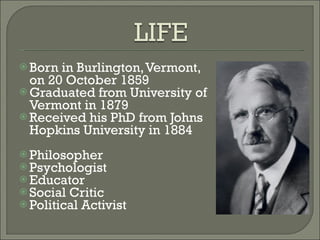
Born in Burlington, Vermont, on 20 October 1859 Graduated from University of Vermont in 1879 Received his PhD from Johns Hopkins University in 1884 Philosopher Psychologist Educator Social Critic Political Activist
My Pedagogic Creed (1897) The School and Society (1900) Child and the Curriculum (1902) Democracy and Education: An Introduction to the Philosophy of Education (1916) How We Think: A Restatement of the Relation of Reflective Thinking to the Educative Process (1933)Experience Education (1938)
  instrumentalism  in its theoretical aspect, and as  meliorism  in its ethical aspect.  According to him, nature is a continuously flowing stream. It uses thought as an  instrument  or  tool  to pass from a given situation, full of ambiguities and disharmonies, to a new and better situation. Dewey's "instrumentalism" affirms that cognition consists in forging ideal tools or instruments with which to cope with a given situation. 
Education is life itself -John Dewey
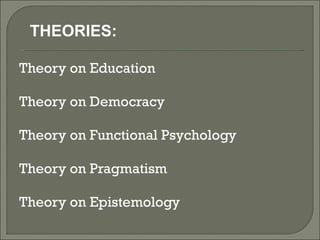
Theory on Education  Theory on Democracy  Theory on Functional Psychology  Theory on Pragmatism  Theory on Epistemology  THEORIES:
http://dewey.pragmatism.org/ http://www.wilderdom.com/experiential/JohnDeweyPhilosophyEducation.html http://lrs.ed.uiuc.edu/students/janicke/Dewey.html http://radicalacademy.com/phildewey.htm http://www.buzzle.com/articles/john-dewey-theories.html
 

Chrysia Johnny John Dewey

  • 1.
    Reported by JohnnyBerbano Chrysia Franco
  • 2.
    Born in Burlington,Vermont, on 20 October 1859 Graduated from University of Vermont in 1879 Received his PhD from Johns Hopkins University in 1884 Philosopher Psychologist Educator Social Critic Political Activist
  • 3.
    My Pedagogic Creed(1897) The School and Society (1900) Child and the Curriculum (1902) Democracy and Education: An Introduction to the Philosophy of Education (1916) How We Think: A Restatement of the Relation of Reflective Thinking to the Educative Process (1933)Experience Education (1938)
  • 4.
      instrumentalism  inits theoretical aspect, and as  meliorism  in its ethical aspect.  According to him, nature is a continuously flowing stream. It uses thought as an  instrument  or  tool  to pass from a given situation, full of ambiguities and disharmonies, to a new and better situation. Dewey's "instrumentalism" affirms that cognition consists in forging ideal tools or instruments with which to cope with a given situation. 
  • 5.
    Education is lifeitself -John Dewey
  • 6.
    Theory on Education Theory on Democracy Theory on Functional Psychology Theory on Pragmatism Theory on Epistemology THEORIES:
  • 7.
  • 8.