Philosophy of Education L5 Overview From Bacon to Dewey
Francis Bacon 1561-1626 in reign of Elizabeth I and James I Idols of  Cave  (idiosyncacy of individuals, pet likes and dislikes) Idols of  Tribe  (tendency to distort and exaggerate) Idols of the  Theatre  (hasty learning, hasty conclusions beguiled by impressions) Idols of the  Market Place  (fashionable thoughts might be wrong) Dr F.Long, Education
Bacon Influenced: The rise of the new science and its separation from the humanities The issue of the ‘two’ cultures Separation of science from religion Experimental method Dr F.Long, Education
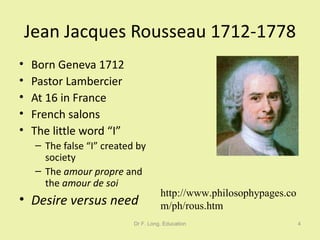
Jean Jacques Rousseau 1712-1778 Born Geneva 1712 Pastor Lambercier At 16 in France French salons The little word “I” The false “I” created by society The  amour propre  and the  amour de soi Desire versus need Dr F. Long, Education http://www.philosophypages.com/ph/rous.htm
Jean Jacques Rousseau 1712-1778 Emile 1762 Educated away from society – a corrupting influence Educated as an individual by nature  Robinson Crusoe as model Learn by tools, experiment rather than from books or social contacts Became the originator of child-centred learning, individualised learning plans Supported a rationale for orphanages, raising kids away from crippling poverty, violent or fanatical homes etc. Echoed the Renaissance call for experimentation and new knowledge Linked to romanticism and revolution – NEW generation Dr F.Long, Education
Emile , Book 1 (0-2) Child exposed to NATURE PEOPLE THINGS. Which first? Nature is the basic teacher; no community of learners, no culturally set curriculum, no languages, no geography, no history, no fables, no moral lessons Tutor’s role is to protect the child from society, to isolate the child, to keep social influences away from the child It is a short step from thinking about the work of nature  in  the child to thinking about the nature  of  the child – age specific pedagogy Dr F. Long, Education
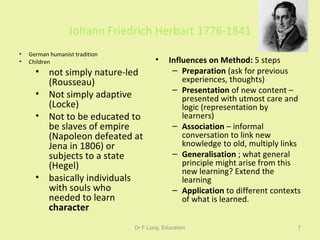
Johann Friedrich Herbart 1776-1841 German humanist tradition Children not simply nature-led (Rousseau) Not simply adaptive (Locke) Not to be educated to be slaves of empire (Napoleon defeated at Jena in 1806) or subjects to a state (Hegel) basically individuals with souls who needed to learn  character Influences on Method:  5 steps Preparation  (ask for previous experiences, thoughts) Presentation  of new content – presented with utmost care and logic (representation by learners) Association  – informal conversation to link new knowledge to old, multiply links Generalisation  ; what general principle might arise from this new learning? Extend the learning Application  to different contexts of what is learned. Dr F.Long, Education
Johann Friedrich Herbart 1776-1841 Need to mould/ shape/ form children Basing educational theory on psychology of learning The mind does not have separate faculties, one dealing with concepts (intellect), one with perception and feelings (aesthetics), one with desires  (will). Only one - MIND Moving from confusion to clarity Influences on Method: Child’s  experience  is the key starting point Child’s  interest  must be aroused  Child’s experience then needs  instruction The  presentation  by Teachers is key to the  re-presentation  of learners Dr F.Long, Education
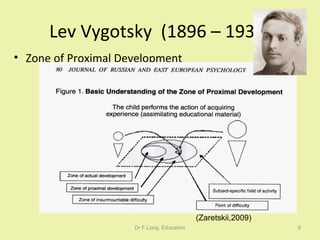
Lev Vygotsky  (1896 – 1934) Zone of Proximal Development Dr F.Long, Education (Zaretskii,2009)
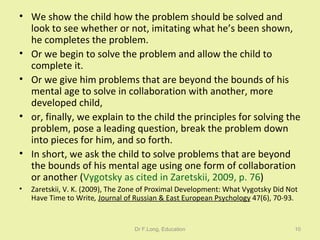
We show the child how the problem should be solved and look to see whether or not, imitating what he’s been shown, he completes the problem.  Or we begin to solve the problem and allow the child to complete it.  Or we give him problems that are beyond the bounds of his mental age to solve in collaboration with another, more developed child,  or, finally, we explain to the child the principles for solving the problem, pose a leading question, break the problem down into pieces for him, and so forth.  In short, we ask the child to solve problems that are beyond the bounds of his mental age using one form of collaboration or another ( Vygotsky as cited in Zaretskii, 2009, p. 76 ) Zaretskii, V. K. (2009), The Zone of Proximal Development: What Vygotsky Did Not Have Time to Write ,  Journal of Russian & East European Psychology  47(6), 70-93. Dr F.Long, Education
Some pdfs Blyth, A. (1981), From individuality to character: the Herbartian sociology applied to education.  British Journal of Educational Studies, 29 (1), 69-79. Roosevelt, G. (2006), Another Side of Rousseau.  Encounter, 19 (3), 14-21. Dr F.Long, Education

Pgde2012 l5 overview rousseau to dewey

  • 1.
    Philosophy of EducationL5 Overview From Bacon to Dewey
  • 2.
    Francis Bacon 1561-1626in reign of Elizabeth I and James I Idols of Cave (idiosyncacy of individuals, pet likes and dislikes) Idols of Tribe (tendency to distort and exaggerate) Idols of the Theatre (hasty learning, hasty conclusions beguiled by impressions) Idols of the Market Place (fashionable thoughts might be wrong) Dr F.Long, Education
  • 3.
    Bacon Influenced: Therise of the new science and its separation from the humanities The issue of the ‘two’ cultures Separation of science from religion Experimental method Dr F.Long, Education
  • 4.
    Jean Jacques Rousseau1712-1778 Born Geneva 1712 Pastor Lambercier At 16 in France French salons The little word “I” The false “I” created by society The amour propre and the amour de soi Desire versus need Dr F. Long, Education http://www.philosophypages.com/ph/rous.htm
  • 5.
    Jean Jacques Rousseau1712-1778 Emile 1762 Educated away from society – a corrupting influence Educated as an individual by nature Robinson Crusoe as model Learn by tools, experiment rather than from books or social contacts Became the originator of child-centred learning, individualised learning plans Supported a rationale for orphanages, raising kids away from crippling poverty, violent or fanatical homes etc. Echoed the Renaissance call for experimentation and new knowledge Linked to romanticism and revolution – NEW generation Dr F.Long, Education
  • 6.
    Emile , Book1 (0-2) Child exposed to NATURE PEOPLE THINGS. Which first? Nature is the basic teacher; no community of learners, no culturally set curriculum, no languages, no geography, no history, no fables, no moral lessons Tutor’s role is to protect the child from society, to isolate the child, to keep social influences away from the child It is a short step from thinking about the work of nature in the child to thinking about the nature of the child – age specific pedagogy Dr F. Long, Education
  • 7.
    Johann Friedrich Herbart1776-1841 German humanist tradition Children not simply nature-led (Rousseau) Not simply adaptive (Locke) Not to be educated to be slaves of empire (Napoleon defeated at Jena in 1806) or subjects to a state (Hegel) basically individuals with souls who needed to learn character Influences on Method: 5 steps Preparation (ask for previous experiences, thoughts) Presentation of new content – presented with utmost care and logic (representation by learners) Association – informal conversation to link new knowledge to old, multiply links Generalisation ; what general principle might arise from this new learning? Extend the learning Application to different contexts of what is learned. Dr F.Long, Education
  • 8.
    Johann Friedrich Herbart1776-1841 Need to mould/ shape/ form children Basing educational theory on psychology of learning The mind does not have separate faculties, one dealing with concepts (intellect), one with perception and feelings (aesthetics), one with desires (will). Only one - MIND Moving from confusion to clarity Influences on Method: Child’s experience is the key starting point Child’s interest must be aroused Child’s experience then needs instruction The presentation by Teachers is key to the re-presentation of learners Dr F.Long, Education
  • 9.
    Lev Vygotsky (1896 – 1934) Zone of Proximal Development Dr F.Long, Education (Zaretskii,2009)
  • 10.
    We show thechild how the problem should be solved and look to see whether or not, imitating what he’s been shown, he completes the problem. Or we begin to solve the problem and allow the child to complete it. Or we give him problems that are beyond the bounds of his mental age to solve in collaboration with another, more developed child, or, finally, we explain to the child the principles for solving the problem, pose a leading question, break the problem down into pieces for him, and so forth. In short, we ask the child to solve problems that are beyond the bounds of his mental age using one form of collaboration or another ( Vygotsky as cited in Zaretskii, 2009, p. 76 ) Zaretskii, V. K. (2009), The Zone of Proximal Development: What Vygotsky Did Not Have Time to Write , Journal of Russian & East European Psychology 47(6), 70-93. Dr F.Long, Education
  • 11.
    Some pdfs Blyth,A. (1981), From individuality to character: the Herbartian sociology applied to education. British Journal of Educational Studies, 29 (1), 69-79. Roosevelt, G. (2006), Another Side of Rousseau. Encounter, 19 (3), 14-21. Dr F.Long, Education