
Sherhan S. Abdurahman
Francis Raphael Monera
Sigmund Freud
Learning Theories
Biography
 Name: Sigmund Freud
 Birth Date: May 6, 1856
 Death Date: September 23, 1939
 Place of Birth: Freiberg, Moravia (now Czech Republic)
 Place of Death: London, England
 Nationality: Austrian
 Gender: Male
 Occupations: psychologist, author, psychoanalyst
Psychoanalysis
 a method of analyzing psychic phenomena and treating
emotional disorders that involves treatment sessions
during which the patient is encouraged to talk freely
about personal experiences and especially about early
childhood and dreams
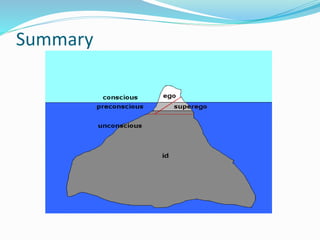
Conscious
 is what you are aware of at any particular moment, your
present perceptions, memories, thoughts, fantasies,
feelings, what have you done.
 Having an awareness of one's environment and one's
own existence, sensations, and thoughts.
Preconscious
 “Available memory”
 anything that can easily be made conscious, the memories
you are not at the moment thinking about but can readily
bring to mind.
 not present in consciousness but capable of being recalled
without encountering any inner resistance or repression
Unconscious
 It includes all the things that are not easily available to
awareness such as our drives or instincts.
 Simply not aware of what you are doing.
ID
 Instincts or drives
 Also called as wishes
 Keeps working with the pleasure principle
 It doesn't "know" what it wants in any adult sense; it
just knows that it wants it and it wants it now.
EGO
 Some of the ID becomes ego
 Functions in reality by means of its consciousness
 it searches for objects to satisfy the wishes that id
creates
Super Ego
 as the ego struggles to keep the “id” happy, it meets
with obstacles in the world. It occasionally meets
with objects that actually assist it in attaining its
goals. And it keeps a record of these obstacles and
aides.
 There are two aspects to the superego: One is the
conscience, which is an internalization of
punishments and warnings. The other is called the
ego ideal. It derives from rewards and positive
models presented to the child.
Summary
References
 http://webspace.ship.edu/cgboer/freud.html
 http://www.bookrags.com/Sigmund_Freud

Sherhan Francis Sigmund Freud

  • 1.
  • 2.
  • 3.
    Biography  Name: SigmundFreud  Birth Date: May 6, 1856  Death Date: September 23, 1939  Place of Birth: Freiberg, Moravia (now Czech Republic)  Place of Death: London, England  Nationality: Austrian  Gender: Male  Occupations: psychologist, author, psychoanalyst
  • 4.
    Psychoanalysis  a methodof analyzing psychic phenomena and treating emotional disorders that involves treatment sessions during which the patient is encouraged to talk freely about personal experiences and especially about early childhood and dreams
  • 5.
    Conscious  is whatyou are aware of at any particular moment, your present perceptions, memories, thoughts, fantasies, feelings, what have you done.  Having an awareness of one's environment and one's own existence, sensations, and thoughts.
  • 6.
    Preconscious  “Available memory” anything that can easily be made conscious, the memories you are not at the moment thinking about but can readily bring to mind.  not present in consciousness but capable of being recalled without encountering any inner resistance or repression
  • 7.
    Unconscious  It includesall the things that are not easily available to awareness such as our drives or instincts.  Simply not aware of what you are doing.
  • 8.
    ID  Instincts ordrives  Also called as wishes  Keeps working with the pleasure principle  It doesn't "know" what it wants in any adult sense; it just knows that it wants it and it wants it now.
  • 9.
    EGO  Some ofthe ID becomes ego  Functions in reality by means of its consciousness  it searches for objects to satisfy the wishes that id creates
  • 10.
    Super Ego  asthe ego struggles to keep the “id” happy, it meets with obstacles in the world. It occasionally meets with objects that actually assist it in attaining its goals. And it keeps a record of these obstacles and aides.  There are two aspects to the superego: One is the conscience, which is an internalization of punishments and warnings. The other is called the ego ideal. It derives from rewards and positive models presented to the child.
  • 11.
  • 12.