Approach to Chronic Liver
Disease
Nu’man AS Daud
Gatroentero Hepatology Division
Departement of Internal Medicine
Hasanuddin University
November 12, 2016
History
• Usually nonspecific
• Constitutional-malaise, listless, weight loss, nausea
• Alcohol ingestion
• Drugs-all of them, including IVDU
• Herbals
• Family history
• Transfusion
Physical exam
• HEAD: parotid, enlargement, JVP elevation
• HANDS: muscular wasting, palmarerythema, dupuytren’s
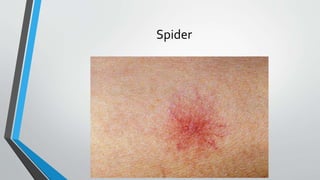
• CHEST: Spider nevi, gynecomastia, R pleural effusion
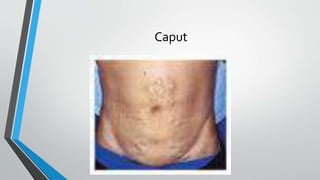
• Abdomen / pelvis : caput medusae, testicular atropy, lymphadenopathy,
ascites, splenomegaly, liver size, texture and tenderness, mass
Palmar erythema
Spider
Caput
Abnormal Liver Chemistry
• ALT (alanineaminotransferase)
• AST (asparateaminotransferase)
• SAP / ALP (serum alkaline phosphatase)
• GGTP (gamma glutamyltranspeptidase)
• Bilirubin (conjugated or not)
• Albumin (produced)
• INR
Liver injury / Hepatocellular
• AST and ALT released
• High levels with acute injury
• AST also from heart and skeletal muscle
Cholestatic injury
• Anything that impairs bile flow
• SAP, GGTP raised when chronic,
• Transaminas eselevated with acute obstruction, e.g., passing a stone
• Bilirubinrises with biliary obstruction.
• Mixed conjugated and unconjugated.
• Nearly pure unconjugated with hemolysis or Gilbert’s syndrome
Liver function
• Albumin decreased with advanced liver failure. Remember losses of albumin
from kidney and gut and malnutrition also decrease
• INR/prothrombintime. Also correlates with liver function
Liver function
• Albumin decreased with advanced liver failure.
• Remember losses of albumin from kidney and gut and malnutrition also decrease
• INR / prothrombin time.
• Also correlates with liver function.
Approach to Liver disease
• Start with pattern, degree and duration of enzyme changes.
• Hepatocellular vs. cholestatic
Hepatocellular
Viral heptitis
Source of
virus
feces blood/
blood-derived
body fluids
blood/
blood-derived
body fluids
blood/
blood-derived
body fluids
feces
Route of
transmission
fecal-oral percutaneous
permucosal
percutaneous
permucosal
percutaneous
permucosal
fecal-oral
Chronic
infection
no yes yes yes no
Prevention pre/post-
exposure
immunization
pre/post-
exposure
immunization
blood donor
screening;
risk behavior
modification
pre/post-
exposure
immunization;
risk behavior
modification
ensure safe
drinking
water
Type of Hepatitis
A B C D E
Hepatitis A
• Never chronic
• IgM HAV positive (IgG positive = previous infection)
• AST>ALT
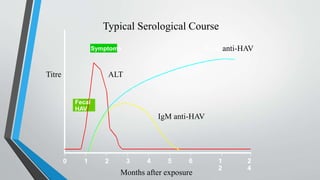
Fecal
HAV
Symptoms
0 1 2 3 4 5 6 1
2
2
4
Total anti-HAV
Titre ALT
IgM anti-HAV
Months after exposure
Typical Serological Course
Hepatitis B
• Contact with blood/body fluids
• Incubation 1-4 months
• 90% acute only, and 10 % chronic
• Chronic (IT, IC,LR dan Reactvasion)
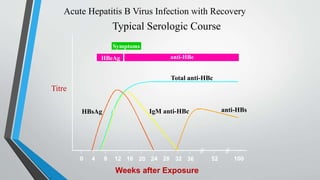
Symptoms
HBeAg anti-HBe
Total anti-HBc
IgM anti-HBc anti-HBs
HBsAg
0 4 8 12 16 20 24 28 32 36 52 100
Acute Hepatitis B Virus Infection with Recovery
Typical Serologic Course
Weeks after Exposure
Titre
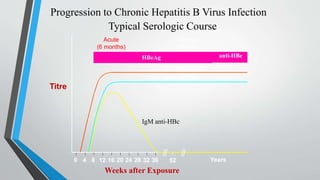
IgM anti-HBc
Total anti-HBc
HBsAg
Acute
(6 months)
HBeAg
Chronic
(Years)
anti-HBe
0 4 8 12 16 20 24 28 32 36 52 Years
Weeks after Exposure
Titre
Progression to Chronic Hepatitis B Virus Infection
Typical Serologic Course
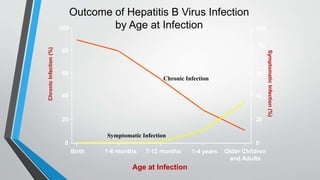
Symptomatic Infection
Chronic Infection
Age at Infection
Symptomatic
Infection
(%)
Birth 1-6 months 7-12 months 1-4 years Older Children
and Adults
0
20
40
60
80
100
100
80
60
40
20
0
Outcome of Hepatitis B Virus Infection
by Age at Infection
Chronic
Infection
(%)
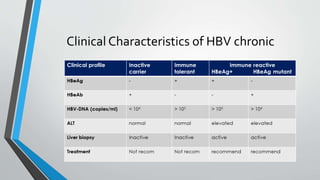
Clinical Characteristics of HBV chronic
Serologic test of HBV
HBsAg
appears before
symptoms; used to
screen blood donor;
negative = viral
clearence
Anti
HBeAg
HBeAg
IgM Anti-
HBcAg
HBcAg
Anti
HBsAg
HBV DNA
resolution of acute
disease & immunity (sole
marker after vaccination)
not found in blood test
1st AB to appear; acute infection
previous (HBsAg-) or chronic (HBsAg
+) HBV infection
IgG Anti-
HBcAg
by product (evidance) of viral
replication (↑ infectivity/acute
infection)
waning viral
replication, 
infectivity
active viral replication
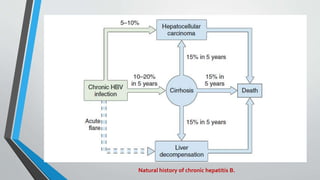
Natural history of chronic hepatitis B.
Hepatitis C
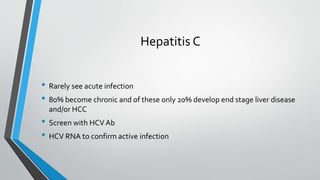
• Rarely see acute infection
• 80% become chronic and of these only 20% develop end stage liver disease
and/or HCC
• Screen with HCVAb
• HCV RNA to confirm active infection
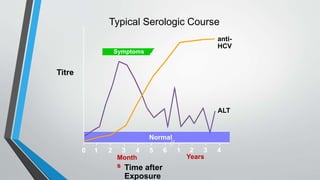
Symptoms
anti-
HCV
ALT
Normal
0 1 2 3 4 5 6 1 2 3 4
Typical Serologic Course
Titre
Month
s
Years
Time after
Exposure
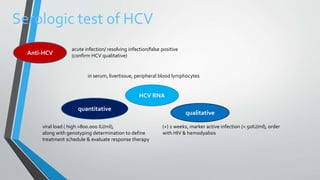
Serologic test of HCV
Anti-HCV
acute infection/ resolving infection/false positive
(confirm HCV qualitative)
quantitative
HCV RNA
qualitative
in serum, livertissue, peripheral blood lymphocytes
(+) 2 weeks, marker active infection (< 50IU/ml), order
with HIV & hemodyalisis
viral load ( high >800.000 IU/ml),
along with genotyping determination to define
treatment schedule & evaluate response therapy
Clinical Course HBV & HCV
HC
V
HB
V
Chronic
Infection
Portal
hypertension
Hepatic
syntetic
failure
HBV
10-39 x increase risk even
without cirrhosis
(highest: perinatal acquired
and HBeAg+/↑viral load)
neonatus approaching
100%, children 70%,
healthy adult 1%;
70-85%
HCV 20-30%
2-5% of HCV
cirrhotics/year
(usually after 20-30
years)
Alcoholic Liver Disease
• Starts with fatty liver and progresses to cirrhosis
• Need 60 gms/day in males and 30 gms/day in females. One drinks is 10 gms.
• Not everyone is susceptible
• Acute alcoholic hepatitis-AST>ALT.
• If severe consider corticosteroids for 1 month in consult with IM/Hepatology.
Drug /Toxic Hepatitis
• Acetaminophen (esp. with ethanol)
• INH, rifampin
• Minocycline, trimethaprim, clavulinicacid
• Diclofenac, phenytoin, valproic acid, DDI, tamoxifen, methotrexate,
amiodarone
• MANY herbals
Autoimmune Hepatitis
• Mostly female and middle aged
• High gammaglobulins (IgG increase for Girls)
• Raised AST/ALT
• Low SAP/ALP
• Positive ANA and ASM (smooth muscle)
• Treatable
Metabolic Liver Disease
• NASH/NAFLD
• 20% of obese, 2-3% cirrhosis
• assoc. with metabolic syndrome
• biopsy is AST/ALT>2ULN
• Statins
• treatment is weight loss
• similar biopsy to alcoholic liver disease
Metabolic Liver Disease
• Alpha 1 antitrypsin deficiency
• Protein electrophoresis
• Hemachromatosis sceenwith Fe /TIBC
• If >45% consider genetic testing and liver biopsy
Metabolic Liver Disease
• Metabolic: Wilson’s Disease
• acute or chronic,
• < 40 years
• association neurological disease and KF rings.
• Abnormal Cu excretion in bile
• Screen with ceruloplasmin
Cholestatic Liver Disease
• SAP/ALP elevates with age-esp in females
• GGTP/5’NT as elevated with liver disease
• Rule out extrahepatic obstruction/infiltrative with US, MRCP, or ERCP
• Primary BiliaryCirrhosis (PBC)
• AMA (mitochrondrial)
• Improved with Ursodiol.
The End
Questions?
Chronic_Liver_Disease.pptx

Chronic_Liver_Disease.pptx

  • 1.
    Approach to ChronicLiver Disease Nu’man AS Daud Gatroentero Hepatology Division Departement of Internal Medicine Hasanuddin University November 12, 2016
  • 2.
    History • Usually nonspecific •Constitutional-malaise, listless, weight loss, nausea • Alcohol ingestion • Drugs-all of them, including IVDU • Herbals • Family history • Transfusion
  • 3.
    Physical exam • HEAD:parotid, enlargement, JVP elevation • HANDS: muscular wasting, palmarerythema, dupuytren’s • CHEST: Spider nevi, gynecomastia, R pleural effusion • Abdomen / pelvis : caput medusae, testicular atropy, lymphadenopathy, ascites, splenomegaly, liver size, texture and tenderness, mass
  • 4.
  • 5.
  • 6.
  • 7.
    Abnormal Liver Chemistry •ALT (alanineaminotransferase) • AST (asparateaminotransferase) • SAP / ALP (serum alkaline phosphatase) • GGTP (gamma glutamyltranspeptidase) • Bilirubin (conjugated or not) • Albumin (produced) • INR
  • 8.
    Liver injury /Hepatocellular • AST and ALT released • High levels with acute injury • AST also from heart and skeletal muscle
  • 9.
    Cholestatic injury • Anythingthat impairs bile flow • SAP, GGTP raised when chronic, • Transaminas eselevated with acute obstruction, e.g., passing a stone • Bilirubinrises with biliary obstruction. • Mixed conjugated and unconjugated. • Nearly pure unconjugated with hemolysis or Gilbert’s syndrome
  • 10.
    Liver function • Albumindecreased with advanced liver failure. Remember losses of albumin from kidney and gut and malnutrition also decrease • INR/prothrombintime. Also correlates with liver function
  • 11.
    Liver function • Albumindecreased with advanced liver failure. • Remember losses of albumin from kidney and gut and malnutrition also decrease • INR / prothrombin time. • Also correlates with liver function.
  • 12.

    Approach to Liverdisease • Start with pattern, degree and duration of enzyme changes. • Hepatocellular vs. cholestatic
  • 13.
  • 14.
  • 15.
    Source of virus feces blood/ blood-derived bodyfluids blood/ blood-derived body fluids blood/ blood-derived body fluids feces Route of transmission fecal-oral percutaneous permucosal percutaneous permucosal percutaneous permucosal fecal-oral Chronic infection no yes yes yes no Prevention pre/post- exposure immunization pre/post- exposure immunization blood donor screening; risk behavior modification pre/post- exposure immunization; risk behavior modification ensure safe drinking water Type of Hepatitis A B C D E
  • 16.
    Hepatitis A • Neverchronic • IgM HAV positive (IgG positive = previous infection) • AST>ALT
  • 17.
    Fecal HAV Symptoms 0 1 23 4 5 6 1 2 2 4 Total anti-HAV Titre ALT IgM anti-HAV Months after exposure Typical Serological Course
  • 18.
    Hepatitis B • Contactwith blood/body fluids • Incubation 1-4 months • 90% acute only, and 10 % chronic • Chronic (IT, IC,LR dan Reactvasion)
  • 19.
    Symptoms HBeAg anti-HBe Total anti-HBc IgManti-HBc anti-HBs HBsAg 0 4 8 12 16 20 24 28 32 36 52 100 Acute Hepatitis B Virus Infection with Recovery Typical Serologic Course Weeks after Exposure Titre
  • 20.
    IgM anti-HBc Total anti-HBc HBsAg Acute (6months) HBeAg Chronic (Years) anti-HBe 0 4 8 12 16 20 24 28 32 36 52 Years Weeks after Exposure Titre Progression to Chronic Hepatitis B Virus Infection Typical Serologic Course
  • 21.
    Symptomatic Infection Chronic Infection Ageat Infection Symptomatic Infection (%) Birth 1-6 months 7-12 months 1-4 years Older Children and Adults 0 20 40 60 80 100 100 80 60 40 20 0 Outcome of Hepatitis B Virus Infection by Age at Infection Chronic Infection (%)
  • 22.
  • 23.
    Serologic test ofHBV HBsAg appears before symptoms; used to screen blood donor; negative = viral clearence Anti HBeAg HBeAg IgM Anti- HBcAg HBcAg Anti HBsAg HBV DNA resolution of acute disease & immunity (sole marker after vaccination) not found in blood test 1st AB to appear; acute infection previous (HBsAg-) or chronic (HBsAg +) HBV infection IgG Anti- HBcAg by product (evidance) of viral replication (↑ infectivity/acute infection) waning viral replication,  infectivity active viral replication
  • 24.
    Natural history ofchronic hepatitis B.
  • 25.
    Hepatitis C • Rarelysee acute infection • 80% become chronic and of these only 20% develop end stage liver disease and/or HCC • Screen with HCVAb • HCV RNA to confirm active infection
  • 26.
    Symptoms anti- HCV ALT Normal 0 1 23 4 5 6 1 2 3 4 Typical Serologic Course Titre Month s Years Time after Exposure
  • 27.
    Serologic test ofHCV Anti-HCV acute infection/ resolving infection/false positive (confirm HCV qualitative) quantitative HCV RNA qualitative in serum, livertissue, peripheral blood lymphocytes (+) 2 weeks, marker active infection (< 50IU/ml), order with HIV & hemodyalisis viral load ( high >800.000 IU/ml), along with genotyping determination to define treatment schedule & evaluate response therapy
  • 28.
    Clinical Course HBV& HCV HC V HB V Chronic Infection Portal hypertension Hepatic syntetic failure HBV 10-39 x increase risk even without cirrhosis (highest: perinatal acquired and HBeAg+/↑viral load) neonatus approaching 100%, children 70%, healthy adult 1%; 70-85% HCV 20-30% 2-5% of HCV cirrhotics/year (usually after 20-30 years)
  • 29.
    Alcoholic Liver Disease •Starts with fatty liver and progresses to cirrhosis • Need 60 gms/day in males and 30 gms/day in females. One drinks is 10 gms. • Not everyone is susceptible • Acute alcoholic hepatitis-AST>ALT. • If severe consider corticosteroids for 1 month in consult with IM/Hepatology.
  • 30.
    Drug /Toxic Hepatitis •Acetaminophen (esp. with ethanol) • INH, rifampin • Minocycline, trimethaprim, clavulinicacid • Diclofenac, phenytoin, valproic acid, DDI, tamoxifen, methotrexate, amiodarone • MANY herbals
  • 31.
    Autoimmune Hepatitis • Mostlyfemale and middle aged • High gammaglobulins (IgG increase for Girls) • Raised AST/ALT • Low SAP/ALP • Positive ANA and ASM (smooth muscle) • Treatable
  • 32.
  • 33.
    Metabolic Liver Disease •NASH/NAFLD • 20% of obese, 2-3% cirrhosis • assoc. with metabolic syndrome • biopsy is AST/ALT>2ULN • Statins • treatment is weight loss • similar biopsy to alcoholic liver disease
  • 34.
    Metabolic Liver Disease •Alpha 1 antitrypsin deficiency • Protein electrophoresis • Hemachromatosis sceenwith Fe /TIBC • If >45% consider genetic testing and liver biopsy
  • 35.
    Metabolic Liver Disease •Metabolic: Wilson’s Disease • acute or chronic, • < 40 years • association neurological disease and KF rings. • Abnormal Cu excretion in bile • Screen with ceruloplasmin
  • 36.
  • 37.
    Cholestatic Liver Disease •SAP/ALP elevates with age-esp in females • GGTP/5’NT as elevated with liver disease • Rule out extrahepatic obstruction/infiltrative with US, MRCP, or ERCP • Primary BiliaryCirrhosis (PBC) • AMA (mitochrondrial) • Improved with Ursodiol.
  • 38.

Editor's Notes