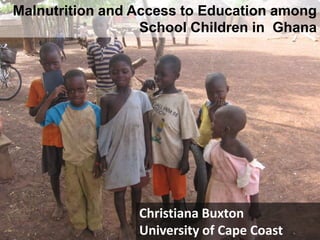
Malnutrition and Access to Education among School Children in  GhanaChristiana BuxtonUniversity of Cape Coast
OverviewNutrition has a significant effect on the age of enrolment of children in the two districts studied.Malnourished (stunted/underweight) children enrolled late in school.This leads to problems with overage in grade which is a major issue for meaningful access and educational outcome in Ghana.
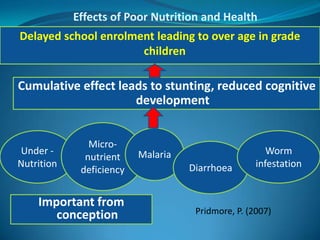
Effects of Poor Nutrition and HealthDelayed school enrolment leading to over age in grade childrenCumulative effect leads to stunting, reduced cognitive developmentMicro-nutrient deficiencyMalariaWorm infestation Under -NutritionDiarrhoeaImportant from conceptionPridmore, P. (2007)
Relationship between Malnutrition and Age of EnrolmentMajority of class 1 pupils fell within the overage categories in both districts
There was a significant negative correlation between stunting/BMI and age of enrolling into primary school in both districts.Relationship between Malnutrition and Age of  Enrolment (cont’d)In both districts a higher prevalence of stunting and thinness for age (low BMI) were found among the overage/older pupils (overage by 2 or more years)
These findings are consistent with similar studies (Glewwe and Jacoby 1995, Partnership for Child development 1998 & Brooker et al. 1999).  Some Key IssuesStunted growth/ thinness- for-age  influence decisions made by parents/guardians on when a child is ready for primary school.
Stunted growth and low BMI status may be barriers to accessing primary school on time (delayed  primary school enrolment).
 Stunted growth in early years of a child’s life may affect school performance later in life and may lead to dropping out  from school as reported in some studies.  Policy IssuesNutrition / health and education policies must  be linked together – MDGs on education and maternal/child health are also linked.MOH should consider free or subsidized distribution of food items during pregnancy and the first 24 months of the child’s life.Intensification of nutritional education  programmes during ANC/PNC visits.
Providing fortified complementary food products  to pre-school children especially in deprived rural settingsThank you!

Christiana create2

  • 1.
    Malnutrition and Accessto Education among School Children in GhanaChristiana BuxtonUniversity of Cape Coast
  • 2.
    OverviewNutrition has asignificant effect on the age of enrolment of children in the two districts studied.Malnourished (stunted/underweight) children enrolled late in school.This leads to problems with overage in grade which is a major issue for meaningful access and educational outcome in Ghana.
  • 3.
    Effects of PoorNutrition and HealthDelayed school enrolment leading to over age in grade childrenCumulative effect leads to stunting, reduced cognitive developmentMicro-nutrient deficiencyMalariaWorm infestation Under -NutritionDiarrhoeaImportant from conceptionPridmore, P. (2007)
  • 4.
    Relationship between Malnutritionand Age of EnrolmentMajority of class 1 pupils fell within the overage categories in both districts
  • 5.
    There was asignificant negative correlation between stunting/BMI and age of enrolling into primary school in both districts.Relationship between Malnutrition and Age of Enrolment (cont’d)In both districts a higher prevalence of stunting and thinness for age (low BMI) were found among the overage/older pupils (overage by 2 or more years)
  • 6.
    These findings areconsistent with similar studies (Glewwe and Jacoby 1995, Partnership for Child development 1998 & Brooker et al. 1999). Some Key IssuesStunted growth/ thinness- for-age influence decisions made by parents/guardians on when a child is ready for primary school.
  • 7.
    Stunted growth andlow BMI status may be barriers to accessing primary school on time (delayed primary school enrolment).
  • 8.
    Stunted growthin early years of a child’s life may affect school performance later in life and may lead to dropping out from school as reported in some studies. Policy IssuesNutrition / health and education policies must be linked together – MDGs on education and maternal/child health are also linked.MOH should consider free or subsidized distribution of food items during pregnancy and the first 24 months of the child’s life.Intensification of nutritional education programmes during ANC/PNC visits.
  • 9.
    Providing fortified complementaryfood products to pre-school children especially in deprived rural settingsThank you!

Editor's Notes

  • #4 There is evidence that the NS of a child can be affected right from conception, when a mother to- be does not have access to a highly nutritious food necessary to ensure adequate growth and development (physically and `\\\\mentally) of an unborn baby. So the problem of malnutrition can start right from conception. In addition to the effects of malnutrition, other health problems( such as malaria, diarrhoea) depending on their severity and frequency of attack particularly during the first 24 months of life, can lead to stunted growth, can affect the cognitive development of the child resulting in delayed school enrolment and leading to the issue of overage in grade children.
  • #6 Stunting cases were highly prevalent among the older population in class 1.Older children as a result of being stunted and thin for their age tend to delay entry into primary school/start schooling late.2.Suggesting that parents may judge the readiness of their children to start school based on their physical appearance (ht and wt) and not their ages 3. Results present an overall picture of delayed primary school enrolment for older children in both districts
  • #7 2.Suggesting that parents may judge the readiness of their children to start school based on their physical appearance (ht and wt). Their decisions were not based on the age of the child. 3. Results present an overall picture of delayed primary school enrolment for older children in both districts
  • #8 These policies fall within the domain of at least three of the MDGs, namely eradication of extreme poverty and hunger, MDG1, achievement of universal primary education, MDG 2, and the realization of reduction of maternal mortality(MDG 5) and child mortality(MDG 4)