All-Party Parliamentary Group
School Food
Position Paper for Packed Lunch Standards
Framework
June 2016
This paper is the collective thoughts from a range of
experts who advise the All-Party Parliamentary
Group (APPG) on School Food.
It is the fourth publication from the group that
identifies a school food-related issue, makes key
points, sign posts to further information, gives a view
and makes recommendations to address the
inequality seen between school food standards and
the lack of standards regarding packed lunches.
This paper aims to generate debate towards healthier
packed lunches becoming the norm in our school
dining halls, as part of a holistic approach to tackling
childhood obesity in the lead-up to the Government’s
pending Childhood Obesity Strategy.
Background
The current school food legislation only considers
food provided by schools, excluding packed lunches
brought from home, when looking at how healthy it is
for a child. Yet, evidence has shown that only 1% of
packed lunches taken into school met the school food
standards and were more likely to provide double the
recommended fat, sugar and salt intake and below
recommended nutrient levels and 80% had no
vegetables.i
This is why one of the key aims of the School Food
Plan was to move children away from packed
lunches to school meals to address the health issues
around packed lunches, but also to improve the
viability of the school meal service.
With a burgeoning childhood obesity crisis facing the
country, with one in five children in reception classed
as overweight or obese and rising to one in three by
the time they reach Year 6 this can be put off no
longer.ii
There is no silver bullet to tackling childhood
obesity, that is why there is a real need to look at
children’s food consumption in the round and the food
children eat during the school day, whether provided
by the school or brought in from home.
This is supported by the recent report by the Health
Select Committee; Childhood Obesity; Brave and
Bold Action, which stated: ‘that clear nutritional
guidelines should be published setting out food
standards recommended for packed lunches as well
as food supplied by schools’.iii
There are also concerns that children from low socio-
economic backgrounds can be disproportionately
represented amongst children affected by obesity,
diet-related diseases and dental health, and are more
likely to be on packed lunches if not entitled to free
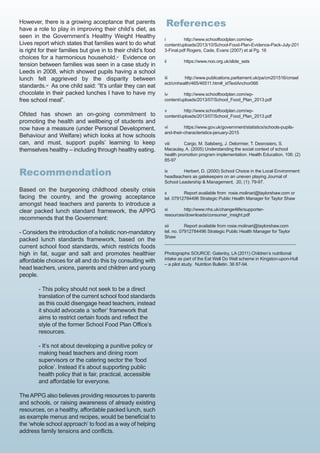
school meals. Figure 1 below illustrates the number
of children eating school meals according to their
socio-economic demographic, showing those families
who are just above the poverty line (and thus not
entitled to FSM) are more likely to choose a packed
lunch for their children.iv
Figure 1 Percentage of children eating a school
meal by socio-demographics
(SFP 2013 Pg. 116).v
Making a hot and healthy school meal the norm for
children to eat during the school day is priority,
however, it needs to be recognised that many children
still choose to eat a packed lunch and are falling under
the radar of school food standards that aim to improve
the health of children.
This is seen in data from the January 2015 school
census which shows that 15.6% of the total population
of pupils in primary school are eligible for FSM, yet only
13.5% take up the offer.vi
The School Food Plan
estimates that 30% of primary school pupils pay for a
school meal.vii
These figures suggest that of
approximately 2,500,000 key stage 2 pupils, about
1,400,000 (56.5%) have a lunch (packed lunch or
other) not covered by school food standards.
These facts show there is a need for action to be taken
to improve the nutritional quality of packed lunches.
Some schools have already begun to do this. Head
teachers are often reluctant to implement such policies
as to avoid conflict with parents fearing being seen as
‘a policy maker’ or ‘dictator’; despite their welcoming of
government policy that supports the ‘whole school
approach’ to foodviii
. A recent surveyix
by Taylor Shaw,
a school meal catering provider, found that 90% of
head teachers welcomed support to encourage
families to send their children to school with a healthier
packed lunch which was aligned with the new school
food standards.x
However, there is a growing acceptance that parents
have a role to play in improving their child’s diet, as
seen in the Government’s Healthy Weight Healthy
Lives report which states that families want to do what
is right for their families but give in to their child’s food
choices for a harmonious household.xi
Evidence on
tension between families was seen in a case study in
Leeds in 2008, which showed pupils having a school
lunch felt aggrieved by the disparity between
standards.xii
As one child said: “It’s unfair they can eat
chocolate in their packed lunches I have to have my
free school meal”.
Ofsted has shown an on-going commitment to
promoting the health and wellbeing of students and
now have a measure (under Personal Development,
Behaviour and Welfare) which looks at how schools
can, and must, support pupils’ learning to keep
themselves healthy – including through healthy eating.
Recommendation
Based on the burgeoning childhood obesity crisis
facing the country, and the growing acceptance
amongst head teachers and parents to introduce a
clear packed lunch standard framework, the APPG
recommends that the Government:
- Considers the introduction of a holistic non-mandatory
packed lunch standards framework, based on the
current school food standards, which restricts foods
high in fat, sugar and salt and promotes healthier
affordable choices for all and do this by consulting with
head teachers, unions, parents and children and young
people.
- This policy should not seek to be a direct
translation of the current school food standards
as this could disengage head teachers, instead
it should advocate a ‘softer’ framework that
aims to restrict certain foods and reflect the
style of the former School Food Plan Office’s
resources.
- It’s not about developing a punitive policy or
making head teachers and dining room
supervisors or the catering sector the ‘food
police’. Instead it’s about supporting public
health policy that is fair, practical, accessible
and affordable for everyone.
TheAPPG also believes providing resources to parents
and schools, or raising awareness of already existing
resources, on a healthy, affordable packed lunch, such
as example menus and recipes, would be beneficial to
the ‘whole school approach’ to food as a way of helping
address family tensions and conflicts.
References
i http://www.schoolfoodplan.com/wp-
content/uploads/2013/10/School-Food-Plan-Evidence-Pack-July-201
3-Final.pdf Rogers, Cade, Evans (2007) et al Pg. 16
ii https://www.noo.org.uk/slide_sets
iii http://www.publications.parliament.uk/pa/cm201516/cmsel
ect/cmhealth/465/46511.htm#_idTextAnchor066
iv http://www.schoolfoodplan.com/wp-
content/uploads/2013/07/School_Food_Plan_2013.pdf
v http://www.schoolfoodplan.com/wp-
content/uploads/2013/07/School_Food_Plan_2013.pdf
vi https://www.gov.uk/government/statistics/schools-pupils-
and-their-characteristics-january-2015
viii Cargo, M. Salsberg, J. Delormier, T. Desrosiers, S.
Macaulay, A. (2005) Understanding the social context of school
health promotion program implementation. Health Education. 106: (2)
85-97
ix Herbert, D. (2000) School Choice in the Local Environment:
headteachers as gatekeepers on an uneven playing Journal of
School Leadership & Management, 20, (1): 79-97.
x Report available from rosie.molinari@taylorshaw.com or
tel. 07912784496 Strategic Public Health Manager for Taylor Shaw
xi http://www.nhs.uk/change4life/supporter-
resources/downloads/consumer_insight.pdf
xii Report available from rosie.molinari@taylorshaw.com
tel. no. 07912784496 Strategic Public Health Manager for Taylor
Shaw
_____________________________________________________
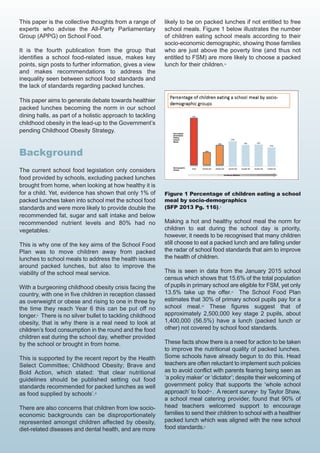
Photographs SOURCE: Gatenby, LA (2011) Children’s nutritional
intake as part of the Eat Well Do Well scheme in Kingston-upon-Hull
– a pilot study. Nutrition Bulletin. 36 87-94.


Leeds Case 
Study: 
 
In  2008,  Leeds  City  Council  led  a  city‐wide 
packed  lunch  policy  consultation  engaging 
children,  young  people  their  families, 
headteachers,  health  professionals  & 
councillors to investigate the needs for a city‐
wide  packed  lunch  policy.  The  following 
summarise key stakeholder opinions. 
Headteacher opinion 
Of the 109 Head teachers that responded 92 
(84%), said they agreed and would welcome the 
policy to support their health ethos. Concerns 
related  to  parent  reaction  and  requested 
tailored  support  for  families  on  what 
constitutes a healthy school meal. They agreed 
the  policy  should  not  be  mandatory,  and 
requested  high‐level  publicity  to  inform  and 
prepare pupils and parents for change.  
 “We anticipate a few issues to start with, but 
eventually pupils and parents will conform, 
same as the School Uniform policy.”  
Headteacher 
Pupil opinion 
Pupils agreed it was only fair that packed lunch 
pupils should eat healthily ‐ the same as those 
having  school  meals.  They  said  if  done 
inappropriately  it  could  cause  bullying  and 
discrimination of pupils and expressed the need 
for  support  for  children  from  low‐income 
families  who  are  not  entitled  to  free  school 
meals; recognising that there would be some 
resistance at first from pupils and parents, but 
felt after time that they would get used to it.  
“Its unfair students can eat chocolate in their 
packed lunch but we can’t buy from the 
school.” Secondary school pupil 
Parent opinion 
Parents agreed saying the standards for school 
food were necessary, and that it was unfair that 
packed lunch eaters were not restricted to the 
same  standards.  Their  concerns  tended  to 
focus  on  monitoring  and  affordability  and 
would welcome advice.    
“It’s one less argument” Parent 
Catering opinion 
All 9 catering providers to the 260 schools in 
Leeds welcomed the policy. Collective concerns 
focused  on  monitoring  and  importance  of 
promoting a hot school meal and monitoring. 
“Must not discourage uptake of school meals.” 
Catering Manager 
Policy outcome 
These  findings  informed  the  Leeds  Packed 
Lunch policy toolkit and guide setting out 6 key 
steps for implementation in consultation with 
pupils and families. A free copy of the original 
Packed Lunch Policy Guidance Frameworks and 
a  toolkit  on  ‘how  to’  create  a  policy  are 
available here:  
http://www.cornwallhealthyschools.org/documents/pack
ed%20lunch%20policy%20guidance%20EL.pdf 
http://www.cornwallhealthyschools.org/documents/pack
ed%20lunch%20toolkit.pdf 
Sample comments by Head teachers in 
response to the policy facilitated by a Clinical 
Programme Manager for Paediatric Dietitian 
(Childhood Obesity) in Manchester: 
 “These families often struggle to provide three 
meals a day, especially in the school holidays 
and are frequent recipients of our food bank 
vouchers.  The packed lunches are low on a 
nutritional and calorific level just due to 
affordability.  
 
“There would need to be an investment in 
skilling parents up to meet a set of guidelines 
rather than just setting rules.” 
 

Packed Lunch

  • 1.
    All-Party Parliamentary Group SchoolFood Position Paper for Packed Lunch Standards Framework June 2016
  • 2.
    This paper isthe collective thoughts from a range of experts who advise the All-Party Parliamentary Group (APPG) on School Food. It is the fourth publication from the group that identifies a school food-related issue, makes key points, sign posts to further information, gives a view and makes recommendations to address the inequality seen between school food standards and the lack of standards regarding packed lunches. This paper aims to generate debate towards healthier packed lunches becoming the norm in our school dining halls, as part of a holistic approach to tackling childhood obesity in the lead-up to the Government’s pending Childhood Obesity Strategy. Background The current school food legislation only considers food provided by schools, excluding packed lunches brought from home, when looking at how healthy it is for a child. Yet, evidence has shown that only 1% of packed lunches taken into school met the school food standards and were more likely to provide double the recommended fat, sugar and salt intake and below recommended nutrient levels and 80% had no vegetables.i This is why one of the key aims of the School Food Plan was to move children away from packed lunches to school meals to address the health issues around packed lunches, but also to improve the viability of the school meal service. With a burgeoning childhood obesity crisis facing the country, with one in five children in reception classed as overweight or obese and rising to one in three by the time they reach Year 6 this can be put off no longer.ii There is no silver bullet to tackling childhood obesity, that is why there is a real need to look at children’s food consumption in the round and the food children eat during the school day, whether provided by the school or brought in from home. This is supported by the recent report by the Health Select Committee; Childhood Obesity; Brave and Bold Action, which stated: ‘that clear nutritional guidelines should be published setting out food standards recommended for packed lunches as well as food supplied by schools’.iii There are also concerns that children from low socio- economic backgrounds can be disproportionately represented amongst children affected by obesity, diet-related diseases and dental health, and are more likely to be on packed lunches if not entitled to free school meals. Figure 1 below illustrates the number of children eating school meals according to their socio-economic demographic, showing those families who are just above the poverty line (and thus not entitled to FSM) are more likely to choose a packed lunch for their children.iv Figure 1 Percentage of children eating a school meal by socio-demographics (SFP 2013 Pg. 116).v Making a hot and healthy school meal the norm for children to eat during the school day is priority, however, it needs to be recognised that many children still choose to eat a packed lunch and are falling under the radar of school food standards that aim to improve the health of children. This is seen in data from the January 2015 school census which shows that 15.6% of the total population of pupils in primary school are eligible for FSM, yet only 13.5% take up the offer.vi The School Food Plan estimates that 30% of primary school pupils pay for a school meal.vii These figures suggest that of approximately 2,500,000 key stage 2 pupils, about 1,400,000 (56.5%) have a lunch (packed lunch or other) not covered by school food standards. These facts show there is a need for action to be taken to improve the nutritional quality of packed lunches. Some schools have already begun to do this. Head teachers are often reluctant to implement such policies as to avoid conflict with parents fearing being seen as ‘a policy maker’ or ‘dictator’; despite their welcoming of government policy that supports the ‘whole school approach’ to foodviii . A recent surveyix by Taylor Shaw, a school meal catering provider, found that 90% of head teachers welcomed support to encourage families to send their children to school with a healthier packed lunch which was aligned with the new school food standards.x
  • 3.
    However, there isa growing acceptance that parents have a role to play in improving their child’s diet, as seen in the Government’s Healthy Weight Healthy Lives report which states that families want to do what is right for their families but give in to their child’s food choices for a harmonious household.xi Evidence on tension between families was seen in a case study in Leeds in 2008, which showed pupils having a school lunch felt aggrieved by the disparity between standards.xii As one child said: “It’s unfair they can eat chocolate in their packed lunches I have to have my free school meal”. Ofsted has shown an on-going commitment to promoting the health and wellbeing of students and now have a measure (under Personal Development, Behaviour and Welfare) which looks at how schools can, and must, support pupils’ learning to keep themselves healthy – including through healthy eating. Recommendation Based on the burgeoning childhood obesity crisis facing the country, and the growing acceptance amongst head teachers and parents to introduce a clear packed lunch standard framework, the APPG recommends that the Government: - Considers the introduction of a holistic non-mandatory packed lunch standards framework, based on the current school food standards, which restricts foods high in fat, sugar and salt and promotes healthier affordable choices for all and do this by consulting with head teachers, unions, parents and children and young people. - This policy should not seek to be a direct translation of the current school food standards as this could disengage head teachers, instead it should advocate a ‘softer’ framework that aims to restrict certain foods and reflect the style of the former School Food Plan Office’s resources. - It’s not about developing a punitive policy or making head teachers and dining room supervisors or the catering sector the ‘food police’. Instead it’s about supporting public health policy that is fair, practical, accessible and affordable for everyone. TheAPPG also believes providing resources to parents and schools, or raising awareness of already existing resources, on a healthy, affordable packed lunch, such as example menus and recipes, would be beneficial to the ‘whole school approach’ to food as a way of helping address family tensions and conflicts. References i http://www.schoolfoodplan.com/wp- content/uploads/2013/10/School-Food-Plan-Evidence-Pack-July-201 3-Final.pdf Rogers, Cade, Evans (2007) et al Pg. 16 ii https://www.noo.org.uk/slide_sets iii http://www.publications.parliament.uk/pa/cm201516/cmsel ect/cmhealth/465/46511.htm#_idTextAnchor066 iv http://www.schoolfoodplan.com/wp- content/uploads/2013/07/School_Food_Plan_2013.pdf v http://www.schoolfoodplan.com/wp- content/uploads/2013/07/School_Food_Plan_2013.pdf vi https://www.gov.uk/government/statistics/schools-pupils- and-their-characteristics-january-2015 viii Cargo, M. Salsberg, J. Delormier, T. Desrosiers, S. Macaulay, A. (2005) Understanding the social context of school health promotion program implementation. Health Education. 106: (2) 85-97 ix Herbert, D. (2000) School Choice in the Local Environment: headteachers as gatekeepers on an uneven playing Journal of School Leadership & Management, 20, (1): 79-97. x Report available from rosie.molinari@taylorshaw.com or tel. 07912784496 Strategic Public Health Manager for Taylor Shaw xi http://www.nhs.uk/change4life/supporter- resources/downloads/consumer_insight.pdf xii Report available from rosie.molinari@taylorshaw.com tel. no. 07912784496 Strategic Public Health Manager for Taylor Shaw _____________________________________________________ Photographs SOURCE: Gatenby, LA (2011) Children’s nutritional intake as part of the Eat Well Do Well scheme in Kingston-upon-Hull – a pilot study. Nutrition Bulletin. 36 87-94.
  • 4.
           Leeds Case  Study:    In  2008,  Leeds City  Council  led  a  city‐wide  packed  lunch  policy  consultation  engaging  children,  young  people  their  families,  headteachers,  health  professionals  &  councillors to investigate the needs for a city‐ wide  packed  lunch  policy.  The  following  summarise key stakeholder opinions.  Headteacher opinion  Of the 109 Head teachers that responded 92  (84%), said they agreed and would welcome the  policy to support their health ethos. Concerns  related  to  parent  reaction  and  requested  tailored  support  for  families  on  what  constitutes a healthy school meal. They agreed  the  policy  should  not  be  mandatory,  and  requested  high‐level  publicity  to  inform  and  prepare pupils and parents for change.    “We anticipate a few issues to start with, but  eventually pupils and parents will conform,  same as the School Uniform policy.”   Headteacher  Pupil opinion  Pupils agreed it was only fair that packed lunch  pupils should eat healthily ‐ the same as those  having  school  meals.  They  said  if  done  inappropriately  it  could  cause  bullying  and  discrimination of pupils and expressed the need  for  support  for  children  from  low‐income  families  who  are  not  entitled  to  free  school  meals; recognising that there would be some  resistance at first from pupils and parents, but  felt after time that they would get used to it.   “Its unfair students can eat chocolate in their  packed lunch but we can’t buy from the  school.” Secondary school pupil  Parent opinion  Parents agreed saying the standards for school  food were necessary, and that it was unfair that  packed lunch eaters were not restricted to the  same  standards.  Their  concerns  tended  to  focus  on  monitoring  and  affordability  and  would welcome advice.     “It’s one less argument” Parent  Catering opinion  All 9 catering providers to the 260 schools in  Leeds welcomed the policy. Collective concerns  focused  on  monitoring  and  importance  of  promoting a hot school meal and monitoring.  “Must not discourage uptake of school meals.”  Catering Manager  Policy outcome  These  findings  informed  the  Leeds  Packed  Lunch policy toolkit and guide setting out 6 key  steps for implementation in consultation with  pupils and families. A free copy of the original  Packed Lunch Policy Guidance Frameworks and  a  toolkit  on  ‘how  to’  create  a  policy  are  available here:   http://www.cornwallhealthyschools.org/documents/pack ed%20lunch%20policy%20guidance%20EL.pdf  http://www.cornwallhealthyschools.org/documents/pack ed%20lunch%20toolkit.pdf  Sample comments by Head teachers in  response to the policy facilitated by a Clinical  Programme Manager for Paediatric Dietitian  (Childhood Obesity) in Manchester:   “These families often struggle to provide three  meals a day, especially in the school holidays  and are frequent recipients of our food bank  vouchers.  The packed lunches are low on a  nutritional and calorific level just due to  affordability.     “There would need to be an investment in  skilling parents up to meet a set of guidelines  rather than just setting rules.”