+
Feeding in Pediatric OT
ALLS
June 17th, 2015
Melanie Shea, OTI
+
Prevalence
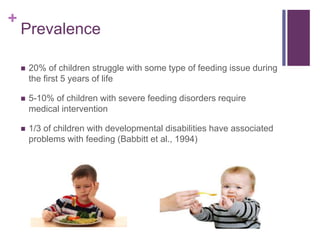
 20% of children struggle with some type of feeding issue during
the first 5 years of life
 5-10% of children with severe feeding disorders require
medical intervention
 1/3 of children with developmental disabilities have associated
problems with feeding (Babbitt et al., 1994)
+
Prevalence
 Myth: Is it a behavioral or organic problem?
 Burklow et al. (1998) – 85% mixed
 Budd et al. (1992) – 64% mixed
 Rose PFC (2001) – 93% mixed
 When normal early feeding experiences and interactions have
been disrupted, children are at risk of chronic eating difficulties
during early childhood.
 Poor appetite
 Food refusal and selectivity
 Delayed skill acquisition
 Disruptive mealtime behaviors (Babbitt et al., 1994)
+
Effect on Parents
 68% of mothers felt stressed out during
feeding time (Lewinsohn, 2005).
 78% of parents identified the quality of the foods to be the most
important issue (Cerro, 2002)
 “The more worried a mother was about her child’s weight, the
more her interactions with her child at mealtimes were
impacted” (Gueron-Sela et al., 2011).
 Caring for these children increases the physical and
psychological demands on parents because of balancing the
tasks involved in managing the child’s medical care and
nutrition, with other aspects of parenting and family life (Wolf &
Glass, 1992; Mori, 1997).
 Guilt, worry, and stress
+
Family Meal Goals
1. Volume of preferred foods
2. Exposure to non-preferred foods
3. Creating a mealtime structure and routine
+
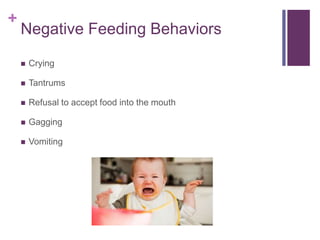
Negative Feeding Behaviors
 Crying
 Tantrums
 Refusal to accept food into the mouth
 Gagging
 Vomiting
+
Parent-based Interventions
 Have a schedule for meals & snacks
 Have a consistent seated location for mealtimes
 Avoid distractions at mealtimes
 Preparatory activities
 Use transitional activities
 Incorporate mealtime-related activities
 Positive reinforcement
* Reducing anxiety at mealtimes is critical for success
+
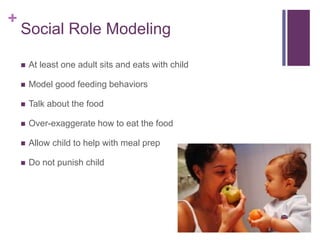
Social Role Modeling
 At least one adult sits and eats with child
 Model good feeding behaviors
 Talk about the food
 Over-exaggerate how to eat the food
 Allow child to help with meal prep
 Do not punish child
+
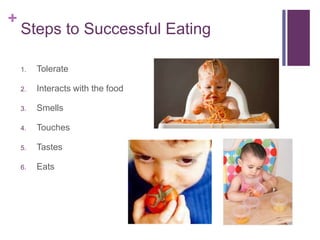
Steps to Successful Eating
1. Tolerate
2. Interacts with the food
3. Smells
4. Touches
5. Tastes
6. Eats
+
Hindrances to OT
 Feeding progress is often slow
 OTs might move to next level before it is appropriate
 Too many people working on feeding with the child
 Parents may be too busy/worried on basic needs that they
cannot add in new interventions
+
OT Considerations
 Safety *
 Work on spitting
 Work on more challenging foods in OT before having the family
work on them
 Postural stability and proper positioning
 Sensory techniques prior to feeding
 Key phrases
 Parent education and training
+ OT Considerations
 Auditory
 Volume of voices
 Complexity of modeling
 Visual
 Colors of food
 Clutter
 Tactile
 Tools to interact with
 Use baggies or gloves
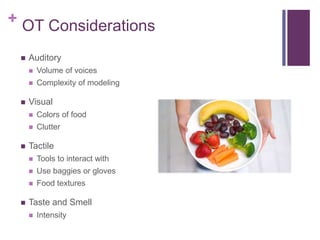
 Food textures
 Taste and Smell
 Intensity
+
+
References
Clawson, E., & Elliott, C. (2014). Integrating Evidence-Based Treatment of
Pediatric Feeding Disorders Into Clinical Practice: Challenges to Implementation.
Clinical Practice in Pediatric Psychology, 2(3), 312-321.
Franklin, L., & Rodger, S. (2003). Parents’ perspectives on feeding medically
compromised children: Implications for occupational therapy. Australian
Occupational Therapy Journal, 50, 137-147.
Howe, T.-H., & Wang, T.-N. (2013). Systematic review of interventions used in or
relevant to occupational therapy for children with feeding difficulties ages birth–5
years. American Journal of Occupational Therapy, 67, 405–412.
http://dx.doi.org/10.5014/ajot.2013.004564
Maune, N. (2007, March). Pediatric Feeding Issues: Reexamining Assessment
and Intervention Using the Sensory Integrative Frame of Reference. American
Journal of Occupational Therapy, 30(1), 1-4.
Suarez, M. A., Atchison, B. J., & Lagerwey, M. (2014). Brief Report—
Phenomenological examination of the mealtime experience for mothers of
children with autism and food selectivity. American Journal of Occupational
Therapy, 68, 102–107. http://dx.doi.org/10.5014/ajot.2014.008748
Toomey & Ross (2015). Picky Eaters vs. Problem Feeders – The SOS Approach
to Feeding.

In Service

  • 1.
    + Feeding in PediatricOT ALLS June 17th, 2015 Melanie Shea, OTI
  • 2.
    + Prevalence  20% ofchildren struggle with some type of feeding issue during the first 5 years of life  5-10% of children with severe feeding disorders require medical intervention  1/3 of children with developmental disabilities have associated problems with feeding (Babbitt et al., 1994)
  • 3.
    + Prevalence  Myth: Isit a behavioral or organic problem?  Burklow et al. (1998) – 85% mixed  Budd et al. (1992) – 64% mixed  Rose PFC (2001) – 93% mixed  When normal early feeding experiences and interactions have been disrupted, children are at risk of chronic eating difficulties during early childhood.  Poor appetite  Food refusal and selectivity  Delayed skill acquisition  Disruptive mealtime behaviors (Babbitt et al., 1994)
  • 4.
    + Effect on Parents 68% of mothers felt stressed out during feeding time (Lewinsohn, 2005).  78% of parents identified the quality of the foods to be the most important issue (Cerro, 2002)  “The more worried a mother was about her child’s weight, the more her interactions with her child at mealtimes were impacted” (Gueron-Sela et al., 2011).  Caring for these children increases the physical and psychological demands on parents because of balancing the tasks involved in managing the child’s medical care and nutrition, with other aspects of parenting and family life (Wolf & Glass, 1992; Mori, 1997).  Guilt, worry, and stress
  • 5.
    + Family Meal Goals 1.Volume of preferred foods 2. Exposure to non-preferred foods 3. Creating a mealtime structure and routine
  • 6.
    + Negative Feeding Behaviors Crying  Tantrums  Refusal to accept food into the mouth  Gagging  Vomiting
  • 7.
    + Parent-based Interventions  Havea schedule for meals & snacks  Have a consistent seated location for mealtimes  Avoid distractions at mealtimes  Preparatory activities  Use transitional activities  Incorporate mealtime-related activities  Positive reinforcement * Reducing anxiety at mealtimes is critical for success
  • 8.
    + Social Role Modeling At least one adult sits and eats with child  Model good feeding behaviors  Talk about the food  Over-exaggerate how to eat the food  Allow child to help with meal prep  Do not punish child
  • 9.
    + Steps to SuccessfulEating 1. Tolerate 2. Interacts with the food 3. Smells 4. Touches 5. Tastes 6. Eats
  • 10.
    + Hindrances to OT Feeding progress is often slow  OTs might move to next level before it is appropriate  Too many people working on feeding with the child  Parents may be too busy/worried on basic needs that they cannot add in new interventions
  • 11.
    + OT Considerations  Safety*  Work on spitting  Work on more challenging foods in OT before having the family work on them  Postural stability and proper positioning  Sensory techniques prior to feeding  Key phrases  Parent education and training
  • 12.
    + OT Considerations Auditory  Volume of voices  Complexity of modeling  Visual  Colors of food  Clutter  Tactile  Tools to interact with  Use baggies or gloves  Food textures  Taste and Smell  Intensity
  • 13.
  • 14.
    + References Clawson, E., &Elliott, C. (2014). Integrating Evidence-Based Treatment of Pediatric Feeding Disorders Into Clinical Practice: Challenges to Implementation. Clinical Practice in Pediatric Psychology, 2(3), 312-321. Franklin, L., & Rodger, S. (2003). Parents’ perspectives on feeding medically compromised children: Implications for occupational therapy. Australian Occupational Therapy Journal, 50, 137-147. Howe, T.-H., & Wang, T.-N. (2013). Systematic review of interventions used in or relevant to occupational therapy for children with feeding difficulties ages birth–5 years. American Journal of Occupational Therapy, 67, 405–412. http://dx.doi.org/10.5014/ajot.2013.004564 Maune, N. (2007, March). Pediatric Feeding Issues: Reexamining Assessment and Intervention Using the Sensory Integrative Frame of Reference. American Journal of Occupational Therapy, 30(1), 1-4. Suarez, M. A., Atchison, B. J., & Lagerwey, M. (2014). Brief Report— Phenomenological examination of the mealtime experience for mothers of children with autism and food selectivity. American Journal of Occupational Therapy, 68, 102–107. http://dx.doi.org/10.5014/ajot.2014.008748 Toomey & Ross (2015). Picky Eaters vs. Problem Feeders – The SOS Approach to Feeding.

Editor's Notes

  • #5 Stressed about: Managing the child’s feeding and medical care Disruption to family routines The family relationships Perceptions of parenting responsibilities Guilt and worry for their child’s future as a result of not being successful at creating and enjoying quality family meals
  • #8 1. Schedule - Helps to regulate hunger, the child can anticipate eating; beginning (wash hands..), middle (eat), end (clean up) 2. Distractions - Helps the child focus, set the expectation that mealtimes are for eating, they can understand the cues better 3. Prep – Blowing games that don’t touch the mouth (blowing bubbles) 4.Transitional - singing a certain song & washing hands before mealtime 5. Mealtime-related – to engage the mind & intention – reading books or watching videos about food & eating, singing songs about it, playing pretend with kitchen and foods 6. Positive reinforcement – staying at the table, looking at new foods, serving oneself, & touching food with one finger
  • #9 1. Talk about the food – color, shape, size, texture 2. Over-exaggerate – big chews or bites, move food from tongue to back molars 3. Food prep – younger kids can be playing near food, older kids can help with meal prep 4. Punishing – Unpleasant association with food
  • #10 Interacts with – child pours food from one container to another, smashes it with napkin… Touch – hands (poke with one fingertip), body (drive food up arm), face to lips (drive down nose, kisses), lips (tap on teeth with whole piece) Taste – lick off the plate like a puppy
  • #11 Slow – discouraging Moving too fast – because it is so slow you might run out of ideas to engage the child; the child might get too bored and start having avoiding behaviors Too many people – you need to decipher who is in charge of what part of feeding; if they saw someone that week, what did they do with the child and what did they say about it?; and sometimes parents are too overwhelmed with all the therapy, appointments, etc. that their ability to comply with recommendations is more limited New interventions – make the interventions go along with what the family already does
  • #12 Spitting – so that they don’t choke Postural stability is important because: stability will allow them to breathe easier, allows for better hand-to-mouth coordination and fine motor control; Positioning – 90-90-90 Sensory techniques – children need to be in an organized state to start with in order to engage in a difficult task Joint compressions/brushing (Wilbarger) Pushing/pulling Weights/vests Swinging “you can” – you believe in them, different word than “eat” “we stay in our chairs until clean up time” - We tell them what to do versus NOT to do “food stays on the table” - Make a scraps plate; if you leave it on the floor it’s reinforcing – got away from the food or table, learning plate “good job…!” - Encourage the EXACT action being taught/reinforced
  • #13 Complexity of modeling Use picture schedules Use songs with known actions Be patient and wait! (delays in auditory processing) Be aware of office noises, doors shutting, etc. Colors of food – bright colors are more exciting Clutter – cut food into fun shapes Always make sure the immediate space is clear Place food in a cup or bowl Tools – goes back to hierarchy Present mixed texture foods separate first, and then combine (preferred with non preferred) Intensity – may have to water it down initially Present it on a washcloth first
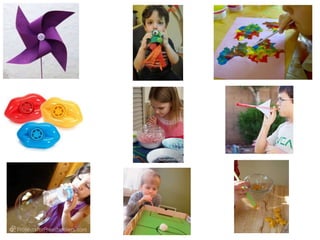
  • #14 A lot of these combine fine motor skills with oral motor. Pinwheel Fire breathing dragon – toilet paper roll Blow paint – put paint on paper first Whistle lips Bubble volcano Airplane? Recycled bubble blower Cotton ball soccer Sucking/blowing – snack