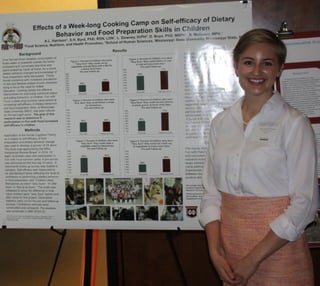
Anna Laurin Harrison
College of Agriculture and Life Sciences Undergraduate Research Scholars Program
GA 4000
DIS in Agriculture
Dr. Sylvia Byrd1, Faculty Mentor
Collaborators: L. Downey, DrPH2
, D. Buys, PhD, MSPH1
, R. Mathews, MPH.1
Spring 2015
Effects of a Week-long Cooking Camp on Self-efficacy of Dietary Behavior and Food
Preparation Skills in Children
ABSTRACT
Over the last three decades consumption of foods eaten or prepared outside the home
increased and conversely less time was spent preparing meals at home. These trends
combined with increased prevalence of diet and lifestyle-related chronic diseases focus
the need for edible education, meal planning, purchasing ingredients, food preparation
skills, and nutritional meals. Cooking camps are effective interventions for improving
nutritional status and eating behaviors of children.
Fun with Food, a weeklong summer camp aimed at increasing self-efficacy in food
preparation skills, at Mississippi State University has been offered for the last eight
years. Twenty 8-13 year olds in 2014 Fun with Food summer camp participated in a
pre-survey administered the first day of camp, as well as a 9-month follow up survey.
IRB approval was obtained. Application of Social Cognitive Theory as it relates to self-
efficacy of food preparation and dietary behavior change was utilized. Self-efficacy was
measured by standardized questions reflecting the level of confidence in performing a
food- or kitchen-related task.
The pre- and follow up surveys were analyzed for changes in self-efficacy of food
preparation and dietary behaviors resulting from participation in Fun with Food Camp.
Sixty percent of camp participants were females. Prior to attending camp, only thirty-five
percent of participants were confident in their ability to follow a recipe without help. Sixty
percent of participants were not sure they could eat a half cup of vegetables or one
serving of whole grains at home most days. Data revealed that involving children in food
preparation can positively affect self-efficacy and dietary behaviors.
Additional research is needed to determine if food-preparation skills translate to
sustainable and healthier food choices.
1
Food Science, Nutrition, and Health Promotion, 2
School of Human Sciences, Mississippi State University, Mississippi State, MS.
LITERATURE REVIEW
Childhood obesity and overweight are issues that have gained global attention in
the 21st century. The problem has been attributed to an excess of caloric availability and
intake. However, diet quality overall, including fruit and vegetable consumption, is of
concern. The diet quality of the population is measured by United States Department of
Agriculture’s Healthy Eating Index. The Healthy Eating Index-2010 results found that the
categories of Greens and Beans and Whole Grains had the lowest scores when held to
national standards (14-18% and 16-18%, respectively). Though significant improvement
was seen in adequacy of Total Fruit and Whole Fruit and reduced empty calorie intake,
the total score (47-50%) remained far lower than the recommendations set forth by
USDA. Children consuming more vegetables and whole grains in place of empty
calories like solid fat and sugar could accomplish further improvement in total score
(Diet Quality of Children Age 2-17 Years as Measured by the Healthy Eating Index-
2010, 2013).
Fast food has been found to be the greatest contributor to this excess in energy
intake and calories consumed away from home. Researchers at the University of North
Carolina at Chapel Hill conducted a study which analyzed the impact of location of food
consumption and preparation upon the diets of children using data from the 1977-1978
Nationwide Food Consumption Survey, 1989-1991 and 1994-1998 Continuing Survey of
Food Intake by Individuals, and 2003-2006 NHANES. It was determined that the
increased energy intake by children over the last thirty years was associated with the
increase of calories consumed outside of the home. These results further justify the
need for food preparation instruction with children in order to improve diet quality (Poti &
Popkin, 2011).
Parenting and feeding trends have shown to be influential in a child’s eating
habits and development of food preferences. Modeling eating behaviors is evidence to
be beneficial in creating dietary behaviors that will last in to adulthood. These studies
have focused primarily on pre-school age children. One study found in a preschools and
daycare convenience sample (n=465) that parents and children eating the same home-
cooked meals at the same time resulted in greater vegetable consumption among the
children (Sweetman, McGowan, Croker, & Cooke, 2011). It has also been suggested
that young children are more likely to try new foods after observing their caregiver eat
the same food. This collection of research suggests that parenting styles and child-
feeding practices may be indicative of risk for overweight or obesity, and will be used in
the future as an intervention strategy (Stang & Loth, 2011). Family-based behavioral
intervention is considered to be a non-diet approach and has resulted in improved
weight status among adolescent participants (Hoelscher, Kirk, Ritchie, & Cunningham-
Sabo, 2013).
Children and adolescents may benefit indirectly from adults’ food preparation
abilities. Clemson University’s Cooking with a Chef trained food service professionals in
creative food preparation techniques that could make school meals containing heathy
ingredients more appealing to children. Participants completed five sessions and a
questionnaire used as a pre and post-survey. The theoretical approach to this program
was Social Cognitive Theory (SCT) and resulted in increase in confidence with a variety
of food preparation techniques as well as improved attitudes towards trying new recipes
(Condrasky, Sharp, & Carter, 2014).
Intervention strategies for children are heavily evaluated for effectiveness and
validity. Theory-driven interventions usually measure psychosocial variables such as
self-efficacy. In the case of cooking camps, knowledge gained and behavior change
may also be assessed. There are limited, published evaluations and descriptive studies
for camps such as these. However, a handful of programs such as the 4-H Healthy
Living Project at the University of California Cooperative Extension have been
thoroughly evaluated based on theory, food preparation instruction, behavior change,
and self-efficacy. This was a pilot study for youth participants (n=82) which included two
quantitative evaluation methods (pre and post-tests), a food photo journal, and a
qualitative method as well. A four item survey evaluating nutrition behaviors was
completed by participants before and after the six-week program which consisted of six
sessions of hands-on cooking, a nutrition activity, a physical activity, congregate
mealtime, and reflective writing. Youth also compiled a food photo journal at home for
one week during the first and fifth week of the program. This was found to be an
ineffective way to log behaviors due to poor documentation by the participants. The pre-
and post-surveys, however, proved to be effective in documenting outcomes with this
pilot study. The authors stated that the six-week time period of intervention and
evaluation could not measure sustainable behavior change. Additional outcomes that
were not captured included how much the children enjoy or dislike cooking, self-efficacy
in food preparation, interest in trying new foods, and if behaviors changed as a result of
activities done in class. The study reflected the need to tailor instruments for the target
population and curriculum in order to yield useful data that will measure the desired
knowledge and behavior outcomes (Matthiessen et al, 2011).
Another cooking camp intervention was Oregon State University’s Culinary
Camp. Beets, Swanger, Wilcox, & Cardinal (2007) stated that the purpose of this
Culinary Camp was to “increase the number of times young adolescents prepared
meals at home and to improve their attitudes, self-efficacy, behavioral expectancies,
knowledge, perceived cooking ability, and perceptions of parents’ worry regarding
cooking.” Culinary Camp used experiential learning as its theoretical framework which
involved development of food preparation skills. The pilot program was conducted in the
summer of 2006. Baseline and one-week post-assessments were collected using a
survey that focused on cooking behaviors as well as psychosocial modality such as
attitudes towards cooking, self-efficacy, knowledge, and perceptions about personal
cooking ability. The primary goal of Culinary Camp was to see increased meal
preparation, however, this was not accomplished. Overall, though, the participants
gained useful cooking skills in an innovative fashion. The authors suggest that future
studies incorporate a parent component in order to encourage them to allow children to
be active in food preparation at home (Beets, Swanger, Wilcox, & Cardinal, 2007).
Pennsylvania State University’s program Cooking like a Chef is a week-long
camp for pre-adolescent children which involves hands-on culinary nutrition sessions
with the aim to increase cooking confidence that will translate in to healthy eating habits.
Pre- and post-questionnaires were completed by participants (n=97) which quantified
children’s cooking confidence, nutritional knowledge, and food preparation skills. The
study revealed that the camp was influential in children making healthier food choices
and having positive attitudes towards food due to their new-found knowledge of food
and cooking (Condrasky, Dixon, Corr, & Sharp, 2012).
A systematic review of eight cooking education program frameworks and
outcomes evaluated influence on children’s report food preparation skills, dietary intake,
cooking confidence, fruit and vegetable preferences, attitudes towards food and
cooking, and food-related knowledge (Hersch, Perdue, Ambroz, & Boucher, 2014). The
findings concluded that such cooking programs may have positive impact on children’s
nutrition behaviors, knowledge, and attitudes. Though the evidence demonstrates the
benefits of such programs, literature describing ideal program length and the sustained
effects is lacking.
Through perusing the literature, it is evident that child nutrition interventions
focusing on food preparation skills, nutrition knowledge, and self-efficacy of dietary
behaviors are increasingly prevalent and in continuous development. The major goals in
the United States of reducing excessive energy intake, especially from junk foods and
added sugars, and increasing fruit and vegetable consumption have potential to be met
through cooking instruction as well as modeling behaviors.
Fun with Food at Mississippi State University
The purpose of this study was to compare the reporting of self-efficacy and
dietary behaviors of 2014 campers prior to camp and what they report after camp.
Specifically, in this camp, participants learned how to cut and measure ingredients,
follow a recipe and basic kitchen skills. Understanding the impact of a camp such as
Fun with Food provides evidence that children need this type of training to be self-
sufficient and to make choices as adults.
Increasing self-efficacy in food-preparation is a goal of Fun with Food camp. Dr.
Pajares (2002) states that, “ researchers have established that self-efficacy beliefs
and behavior changes and outcomes are highly correlated and that self-efficacy is an
excellent predictor of behavior self-efficacy has proven to be a more consistent
predictor of behavior outcomes than have any other motivational constructs.” In
addition, modeling behaviors are a component of this, in that one can relate to and learn
from another performing a task. This proves to increase self-efficacy of the observer as
well as increase the likelihood that he or she will attempt to perform that behavior or
task. This theory has been applied to children as they observe food preparation and
dietary behaviors while participating in Fun with Food camp at Mississippi State
University.
SUMMARY OF FINDINGS
Application of the Social Cognitive Theory as it relates to self-efficacy of food
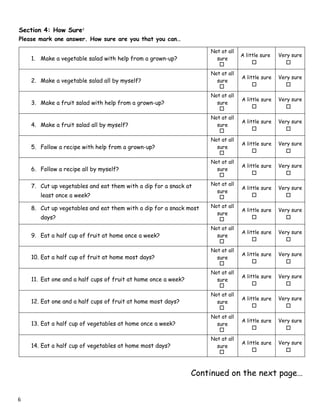
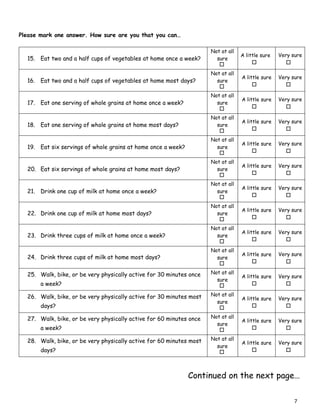
preparation and dietary behavior change was used to develop a survey1 of 28 items.
The study was approved by the MSU Institutional Review Board. In 2014, 20 eight- to
thirteen-year-olds participated in Fun with Food summer camp. A pre-survey was
administered the first day of camp. A nine-month follow-up survey was mailed to
campers. Self-efficacy was measured by six standardized items reflecting the level of
confidence in performing a dietary behavior or food preparation skill. Children rated
themselves as either “Very Sure”, “A Little Sure” or “Not at all Sure.” The scale was
collapsed to show the difference in how many children were “Very Sure” before and
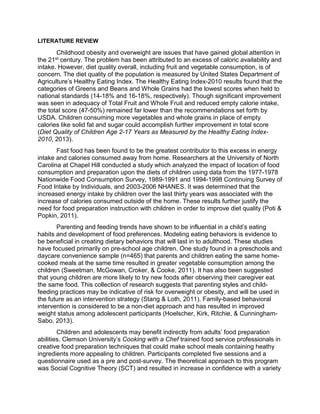
30%
43%
0%
20%
40%
60%
80%
Pre (n=20) Follow-up (n=14)
Figure 1. Percent of children who were
"Very Sure" they could cut up vegetables and
eat them with a dip for a snack most days,
Pre and Follow-up
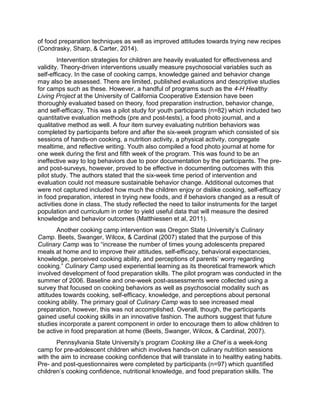
35% 36%
0%
20%
40%
60%
80%
Pre (n=20) Follow-up (n=14)
Figure 2. Percent of children who were
"Very Sure" they could follow a recipe by
themselves,
Pre and Follow-up
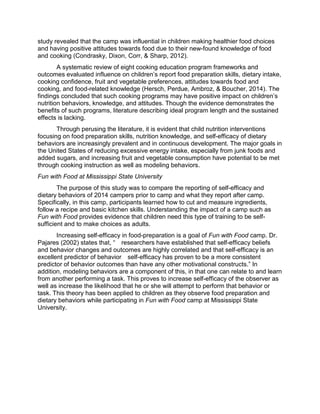
55% 57%
0%
20%
40%
60%
80%
Pre (n=20) Follow-up (n=14)
Figure 3. Percent of children who were
"Very Sure" they could make a vegetable
salad by themselves,
Pre and Follow-up
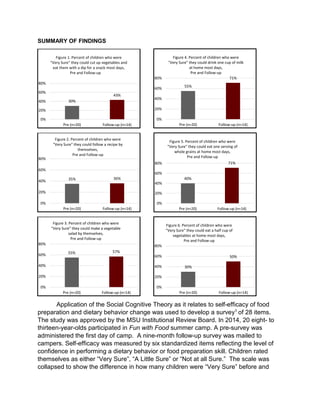
55%
71%
0%
20%
40%
60%
80%
Pre (n=20) Follow-up (n=14)
Figure 4. Percent of children who were
"Very Sure" they could drink one cup of milk
at home most days,
Pre and Follow-up
40%
71%
0%
20%
40%
60%
80%
Pre (n=20) Follow-up (n=14)
Figure 5. Percent of children who were
"Very Sure" they could eat one serving of
whole grains at home most days,
Pre and Follow-up
30%
50%
0%
20%
40%
60%
80%
Pre (n=20) Follow-up (n=14)
Figure 6. Percent of children who were
"Very Sure" they could eat a half cup of
vegetables at home most days,
Pre and Follow-up
after camp for this project. Descriptive statistics were run for the pre and follow-up
surveys. Confidence intervals were constructed and compared. The analysis was
conducted in IBM SPSS 22.
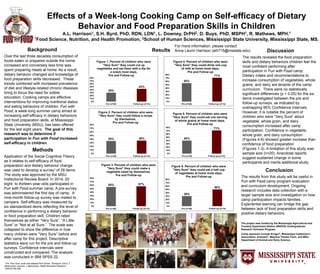
The results revealed the food preparation skills and dietary behaviors children
feel the most confident performing after participation in Fun with Food camp. Dietary
intake and recommendations to increase consumption of vegetables, whole grains, and
dairy are tenants of the camp curriculum. There were no statistically significant
differences (p < 0.05) for the six items investigated between the pre and follow-up
surveys, as indicated by overlapping 95% Confidence Intervals. However, it is notable
the percent of children who were “Very Sure” about vegetable, whole grain, and dairy
consumption increased after camp participation. Confidence in vegetable, whole grain,
and dairy consumption (Figures 4-6) showed greater increase than confidence of food
preparation (Figures 1-3). A limitation of this study was sample size (n=20). Anecdotal
reports suggest sustained change in some participants and merits additional study.
STUDENT EXPERIENCES
As an undergraduate student in Food Science, Nutrition, and Health Promotion, I
have taken classes that focus on the research process and research methods. Since
becoming an undergraduate research scholar in the College of Agriculture and Life
Sciences, this information has come alive and increased my confidence in conducting
research. Dietetics is a research-based, evidence-based practice. By participating in the
CALS Undergraduate Research Scholars program, I gained experience that would not
be plausible in the classroom and maximized the effectiveness I can have as a future
health professional. Acting as principal investigator in this project gave me the
opportunity to learn about research in my field from the ground up.
Before the project was received as a MAFES-funded student research project, I
met with my collaborators (with the exception of Ms. Mathews who had not yet started
her doctoral studies) and faculty mentor to discuss the prospect of developing a project
related to 2014 Fun with Food camp at Mississippi State University. At this time, I was
acting as Fun with Food camp coordinator. Thus, I became extremely familiar with camp
goals, objectives, curriculum, and planning. This was beneficial in writing the research
proposal and in the development of the evaluation instrument. Camp was held on June
16-20. I saw first-hand how cooking instruction and basic nutrition lessons were
reinforced with the children and the impact on their confidence in the kitchen. Naturally,
my interest in a research project about Fun with Food increased after camp. A proposal
was written and I applied for the CALS Undergraduate Research Scholars Program.
Upon acceptance, I got to work on a review of literature and a timeline for my
project. This was my first, practical experience in development of a true research
project. One of my favorite parts of undergraduate research was exploring the literature
and finding myself fascinated by the trails that led from one study to another. The
literature review was a critical part of this project as I was better able to discuss and
explain the rationale of Fun with Food camp, the importance of conducting the study,
and compare it to similar programs.
Most of the fall semester was centered on development of the survey. Though it
seemed at first to be an uncomplicated task, I soon discovered the great amount of
thought and analysis required. The benefit of my collaborators’ input in that process is
immeasurable. My personal experience in Fun with Food camp proved to be valuable in
writing the survey because I was familiar with the objectives and had witnessed the
subtle, yet notable, increase in confidence level of the campers in the kitchen and their
willingness to try new foods.
In the spring semester, the focus was survey printing and administration. In
contrast to the previous semester, this process was much more detailed. Due to the
nature of the research (children as subjects) IRB approval had to be obtained for the
project. I worked with my faculty mentor and collaborators to ensure appropriate
methods would be utilized in the administration of the survey and maintenance of the
results after analysis. I learned a great deal by going through the IRB application, which
involved multiple revisions and consultation with IRB compliance officers. I used the
registration database from 2014 Fun with Food camp to develop the mailing list and
print labels, as well as individualize the surveys in hopes of increasing the response
rate. In addition, we included a parent survey for non-research purposes to gain insight
for an after-school Fun with Food program and future Fun with Food summer camps. I
obtained IRB approval for a procedure modification in order to follow-up with reminders
to the parents about the survey via email. During this time, I also submitted abstracts for
poster presentation at the Undergraduate Research Symposium and the Food and
Nutrition Conference & Expo in Nashville (October 3-6, 2015).
Analysis was an area in which I definitely lacked experience, but desired to learn
more as it will be a critical skill in graduate studies and dietetic practice. With assistance
from Ms. Mathews, a doctoral student and research collaborator, I developed a much
better understanding of statistical analysis. I was able to contribute to the analysis by
doing some data entry. When data entry was completed, we ran descriptive statistics
and reviewed the results together. It was a good experience to hear the input of each of
my collaborators in a round-table discussion of the results.
After thorough analysis, I drafted a poster for the Undergraduate Research
Symposium. It took many hours to finalize the design and text for the poster. I practiced
my presentation before the C.H.A.N.G.E. (Community Health and Applied Nutrition
Group Exchange), a research-oriented group in the Department of Food Science,
Nutrition, and Health Promotion consisting of undergraduate researchers and research
assistants, graduate students, and professors. Receiving their feed-back, though tough,
provided thought-provoking questions to consider before presenting at the symposium.
On the day of the symposium, my aptitude for speaking in front of others has
never been higher. Because my direct involvement with the research, I was able to
explain and discuss my project with enthusiasm and without hesitation. The
presentation experience was the most rewarding moment of my undergraduate career.
In conclusion, my experience as a CALS Undergraduate Research Scholar
proved to be substantially beneficial and has impacted my future academic endeavors
as well as career aspirations. I will continue be involved with and support research in my
field, and be grateful for the opportunity provided by Mississippi State University and the
College of Agriculture and Life Sciences to enrich my educational experience.
LEARNING OUTCOMES
• As a result of completing the Undergraduate Research Scholars Program, the student is
able to write a research proposal.
• As a result of completing the Undergraduate Research Scholars Program, the student
can conduct a research project.
• As a result of completing the Undergraduate Research Scholars Program, the student
can design an instrument for program evaluation.
• As a result of completing the Undergraduate Research Scholars Program, the student
can compile a review of literature.
• As a result of completing the Undergraduate Research Scholars Program, the student
learned and applied ethical research methods.
• As a result of completing the Undergraduate Research Scholars Program, the student
gained experience in data entry, management, and analysis.
• As a result of completing the Undergraduate Research Scholars Program, the student
can prepare and present results of a research project at a research symposium.
DELIVERABLES
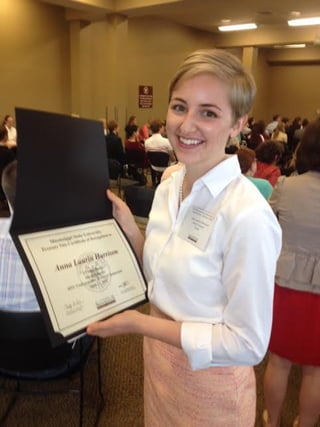
• 3rd
Place Poster, Social Sciences category, MSU Undergraduate Research Symposium
• Appended:
o Instrument for measurement of self-efficacy of dietary behavior and food
preparation skills in participants of Fun with Food camp 2014
o Abstracts submissions
o Poster presentation
*Appended documents are in chronological order.
WORKS CITED
Beets, Michael W., Swanger, Karen, Wilcox, Douglas R., & Cardinal, Bradley J. (2007). Using
Hands-on Demonstrations to Promote Cooking Behaviors with Young Adolescents: The
Culinary Camp Summer Cooking Program. Journal of Nutrition Education and Behavior,
39(5), 288-289. doi: http://dx.doi.org/10.1016/j.jneb.2007.05.002
Condrasky, M. D., Dixon, E., Corr, A., & Sharp, J. (2012). Culinary Nutrition Skill Development
of Pre-Adolescent Cooking Camp Participants. Journal of the Academy of Nutrition and
Dietetics, 112(9, Supplement), A50. doi: http://dx.doi.org/10.1016/j.jand.2012.06.178
Condrasky, M. D., Sharp, J. L., & Carter, C. (2014). Cooking with a Chef Training with School
Food Service Professionals. Journal of the Academy of Nutrition and Dietetics, 114(9,
Supplement), A60. doi: http://dx.doi.org/10.1016/j.jand.2014.06.196
Diet Quality of Children Age 2-17 Years as Measured by the Healthy Eating Index-2010. (2013).
Hersch, Derek, Perdue, Laura, Ambroz, Teresa, & Boucher, Jackie L. (2014). The Impact of
Cooking Classes on Food-Related Preferences, Attitudes, and Behaviors of School-
Aged Children: A Systematic Review of the Evidence, 2003-2014. Preventing Chronic
Disease, 11, E193. doi: 10.5888/pcd11.140267
Hoelscher, Deanna M., Kirk, Shelley, Ritchie, Lorrene, & Cunningham-Sabo, Leslie. (2013).
Position of the Academy of Nutrition and Dietetics: Interventions for the Prevention and
Treatment of Pediatric Overweight and Obesity. Journal of the Academy of Nutrition and
Dietetics, 113(10), 1375-1394. doi: http://dx.doi.org/10.1016/j.jand.2013.08.004
Matthiessen, T., Horowitz, M., Neelon, M., Smith, D., & Kaiser, L. (2011). Insights from an
Evaluation of a Healthy Living Project. Advances in youth development: Research and
evaluation from the University of California Cooperative Extension (2001 - 2010).
Subramaniam, A., Heck, K., Carlos, R. & Junge, S. (Eds.). University of California
Agriculture and Natural Resource. 58-69.
Pajares, Frank (2002). Overview of social cognitive theory and of self-efficacy.
Retrieved October 1, 2014. http://www.emory.edu/EDUCATION/mfp/eff.html
Poti, Jennifer M., & Popkin, Barry M. (2011). Trends in Energy Intake among US Children by
Eating Location and Food Source, 1977-2006. Journal of the American Dietetic
Association, 111(8), 1156-1164. doi: http://dx.doi.org/10.1016/j.jada.2011.05.007
Stang, Jamie, & Loth, Katie A. (2011). Parenting Style and Child Feeding Practices: Potential
Mitigating Factors in the Etiology of Childhood Obesity. Journal of the American Dietetic
Association, 111(9), 1301-1305. doi: http://dx.doi.org/10.1016/j.jada.2011.06.010
Sweetman, Claire, McGowan, Laura, Croker, Helen, & Cooke, Lucy. (2011). Characteristics of
Family Mealtimes Affecting Children's Vegetable Consumption and Liking. Journal of the
American Dietetic Association, 111(2), 269-273. doi:
http://dx.doi.org/10.1016/j.jada.2010.10.050
5 | P a g e
CALS / MAFES Undergraduate Research Program
Faculty Application
PROJECT TITLE: Effects of a week-long cooking camp on self-efficacy of dietary
behavior and food preparation skills in children
UNDERGRADUATE MENTOR: Sylvia H. Byrd
Departmental/Unit Affiliation: Food Science, Nutrition and Health Promotion
Email: shb5@msstate.edu
PROJECT ABSTRACT
Anticipated Outcomes/Impacts: The undergraduate student will have the opportunity to
collaborate with Research, Extension and Teaching faculty, conduct a literature review, assist
with development of program evaluation surveys, collect and analysis data and present findings
at a professional meeting. In addition, results from the project will be utilized to obtain additional
funding to conduct a “Train the Trainer” for Extension Agents and Science teachers in MS.
Proposals should be emailed to wburger@cfr.msstate.edu no later than August 15, 201 4.
The increasing prevalence of diet and lifestyle related chronic diseases in the United
States has led many interested in prevention to diverse solutions. The most practical, but
capital intensive solution involves teaching individuals about food: how to plan meals, purchase
ingredients and prepare nutritional meals for themselves and their families. The growing
number of adult and child-focused programs nationwide indicate the need for effective and
innovative programs to be validated and standardized for dissemination. The goal of this
undergraduate research project is to assess changes in children’s behavior and self-efficacy
resulting from participation in week-long farm to table cooking camp.
In 2007, the inaugural Fun with Food summer cooking camp was conducted at
Mississippi State University for children entering third through sixth grade. For almost a
decade, the camp has empowered over 200 children to practice food preparation skills and
food safety as well as given them the farm to table experiences to want to embrace their new
knowledge. In order to assess the effectiveness of Fun with Food camp, program evaluation
tools must be developed for current and future camp participants. The purpose of the larger
study is to develop tools and assess prior cohorts’ change in self-efficacy of nutrition behavior
and food preparation skills and overall program quality and effectiveness.
Research and Extension faculty are collaborating to develop program evaluation tools
including surveys for previous camp participants and their parents to complete. The participant
survey will be used to measure changes in self-efficacy of dietary behaviors and food
preparation skills using multiple methodologies. The parent survey will be used to assess
perceived behavior changes of their child after camp. Because there are eight years of
campers, long-term measures will be meaningful in measuring program effectiveness.
Results of this study will be integral in providing data for proposals in conjunction with
the MSU Foundation and Infinite Impact Campaign to receive funding from the Kroger
Foundation and other stakeholders. Additionally, results will be utilized to guide the
development of an after school curriculum for integration into 4-H Healthy Living curricula.
CALS / MAFES Undergraduate Research Program
Student Application
STUDENT NAME: Anna Laurin Harrison
MSU STUDENT ID: alh715
EMAIL: alh715@msstate.edu
DEPARTMENT: Food Science, Nutrition, Health Promotion
DEGREE PROGRAM: Nutrition
CLASS STATUS (sophomore, junior, senior): Senior
GPA: 3.48
Are you a previous CALS/MAFES URSP participant? (Yes/No): No
Email this application and resume to Dr. Carolyn Huntington (chuntington@ads.msstate.edu ) no later than September 15, 2013
After completing a Bachelor of Science in Food Science, Nutrition, and Health Promotion at Mississippi
State, I plan to continue my education through a combined dietetic internship (DI) and Masters of Science degree in
Nutrition or a related field, which will prepare me for the requirements to become a Registered Dietitian. The
education I have received at Mississippi State University will be beneficial toward being a graduate student,
dietitian, and representative of Mississippi State.
Professionally, I would like to gain a minimum of five years of experience in research-oriented clinical
care. This type of dietetic practice would broaden my knowledge and practice for my career. My long-term goal is
to develop resources for and work with families who wish to tailor their lifestyle to become more healthful and
balanced through individualized meal-planning. Of special interest is promoting healthy eating among children
through hands-on cooking instruction and educating about food using all of our senses.
“Fun with Food Camp” was launched by Dr. Sylvia Byrd in 2007 and over three-hundred children have
participated over the last eight years. The mission of this camp is to provide an opportunity for children to be
involved with food from the farm to the table. The week is action-packed with the children cooking, taking field
trips to local food producers, and learning from professionals including chefs and farmers. As camp Coordinator of
"Fun with Food Camp” this summer, I observed the effectiveness of cooking instruction and "farm-to-table"
approach with children. By getting a glimpse at where food comes from and the multitude of ways it can be
enjoyed, they are encouraged to be mindful of what they consume. I believe that such programs encourage children
to try more foods, increase whole fruit and vegetable intake, and can yield overall healthful eating habits for them
and their families. By participating in a program such as “Fun with Food Camp”, children are motivated and
empowered to prepare healthful food and share their knowledge with others. The assumption is that as the
children’s cooking skills develop, so will their self-efficacy. Therefore, they will be more resolved to practice what
they have learned. I plan to complete a literature review, collect, and analyze data to support the value of cooking
instruction for children.
Participating in the Undergraduate Research Scholars Program will strengthen my research abilities and
provide experience in instrument development for program evaluation. In addition, this opportunity will increase
my competitiveness in the dietetic internship application process. Research and evidence-based practice is key in
the field of Dietetics, thus, this undergraduate research experience will greatly enhance my aptitude as a student and
future dietitian.
Faculty Mentor: Dr. Sylvia Byrd
Undergraduate Research Scholar Program
Meeting 9.29.14 (Brainstorm)
Rahel & Anna Laurin
“Effects of a Week-long Cooking Camp on Self-Efficacy of Dietary Behavior and Food Preparation Skills in
Children”
My Research Goals:
• Evaluate the curriculum by comparing/contrasting the Learning Objectives and outcomes.
• Determine the effectiveness of a week-long camp as evidenced by behavior modification &
increased self-efficacy in food preparation, and/or positive dietary habits.
• Develop an instrument that will provide a comprehensive & replicable analysis of the
effectiveness of Fun with Food Camp, and can be utilized in similar programs.
• ______________________________________________________________________________
______________________________________________________________________________
• ______________________________________________________________________________
______________________________________________________________________________
Data Collection:
• We are working on consolidating (moving in to one document) the registration information
(name, age, gender, etc) from 2007-2014.
• 2010’s registration information is inaccessible.
Research Questions:
• Based on the Learning Objectives in the Fun with Food Camp curriculum, have campers’ dietary
behaviors changed? And/or are they exhibiting positive dietary habits?
• Does the curriculum and the Fun with Food Camp experience influence children’s dietary
habits?
• Does the curriculum and the Fun with Food Camp experience increase children’s’ self-efficacy in
food preparation and food choices?
• Are long-term (2007-2008 campers) behavior changes a result or attributed to Fun with Food
Camp? Or another medium such as public education, other camps, familial influence, etc.?
• ______________________________________________________________________________
______________________________________________________________________________
• ______________________________________________________________________________
______________________________________________________________________________
• ______________________________________________________________________________
______________________________________________________________________________
• ______________________________________________________________________________
______________________________________________________________________________
Potential Methods for Survey Administration & Data Analysis:
1. Administer a post-survey to only the older age group (i.e. those who attended Food Camp in
2007-2008)
a. Pros:
i. Long-term evaluation. Does Food Camp continue to influence behaviors and has
it improved self-efficacy?
ii. The survey could be tailored to older age group, rather than writing two surveys
for young & old.
b. Cons:
i. We lose further potential research by leaving out data from younger age group
ii. Will these young adults be able to link their current dietary behaviors and self-
efficacy to the Fun with Food Camp Experience after a 7 year period?
2. Pre-/post- survey design, administered to all former campers
a. Pros:
i. More data to analyze
b. Cons:
i. Survey development for wide range of age groups
ii. Do we have pre-surveys from all years of camp?
3. Post- only survey/data analysis design
a. Pros:
i. The survey could be tailored to reflect our research questions and goals.
b. Cons:
i. Chance of missing a comparative analysis between the pre- and post- survey.
But would there be time?
4. 2013-2014 repeated post
a. Pros:
i. Evaluate changes over a shorter period of time
b. Cons:
i. Not a lot of time for survey development, administration, and analysis
MAFES Undergraduate Research Scholar Program
Effects of a week-long cooking camp on self-efficacy of dietary behavior and food preparation skills in children
Timeline
Anna Laurin Harrison
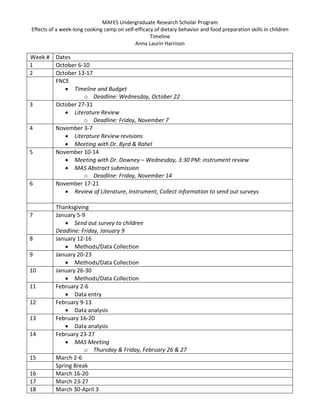
Week # Dates
1 October 6-10
2 October 13-17
FNCE
• Timeline and Budget
o Deadline: Wednesday, October 22
3 October 27-31
• Literature Review
o Deadline: Friday, November 7
4 November 3-7
• Literature Review revisions
• Meeting with Dr. Byrd & Rahel
5 November 10-14
• Meeting with Dr. Downey – Wednesday, 3:30 PM: instrument review
• MAS Abstract submission
o Deadline: Friday, November 14
6 November 17-21
• Review of Literature, Instrument, Collect information to send out surveys
Thanksgiving
7 January 5-9
• Send out survey to children
Deadline: Friday, January 9
8 January 12-16
• Methods/Data Collection
9 January 20-23
• Methods/Data Collection
10 January 26-30
• Methods/Data Collection
11 February 2-6
• Data entry
12 February 9-13
• Data analysis
13 February 16-20
• Data analysis
14 February 23-27
• MAS Meeting
o Thursday & Friday, February 26 & 27
15 March 2-6
Spring Break
16 March 16-20
17 March 23-27
18 March 30-April 3
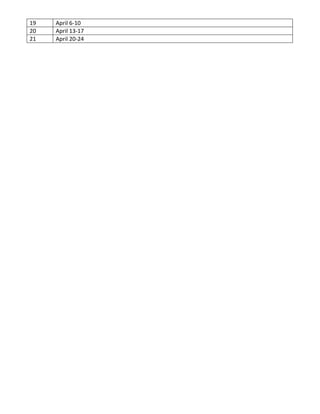
19 April 6-10
20 April 13-17
21 April 20-24
MAFES Undergraduate Research Scholar Program
Effect of a week-long cooking camp on self-efficacy of dietary behaviors and food preparation skills in children
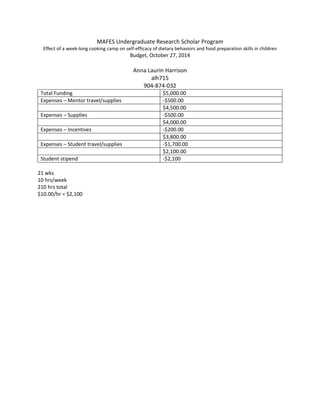
Budget, October 27, 2014
Anna Laurin Harrison
alh715
904-874-032
Total Funding $5,000.00
Expenses – Mentor travel/supplies -$500.00
$4,500.00
Expenses – Supplies -$500.00
$4,000.00
Expenses – Incentives -$200.00
$3,800.00
Expenses – Student travel/supplies -$1,700.00
$2,100.00
Student stipend -$2,100
21 wks
10 hrs/week
210 hrs total
$10.00/hr = $2,100
DDeeppaarrttmmeenntt ooff FFoooodd SScciieennccee,, NNuuttrriittiioonn,, aanndd HHeeaalltthh PPrroommoottiioonn
<Date>
<Address>
Dear <Name of Parents>,
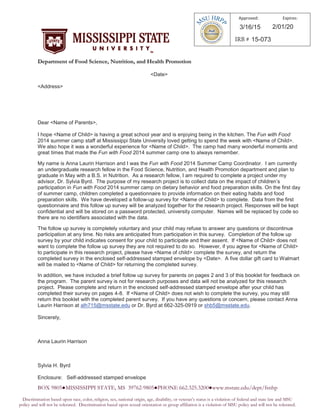
I hope <Name of Child> is having a great school year and is enjoying being in the kitchen. The Fun with Food
2014 summer camp staff at Mississippi State University loved getting to spend the week with <Name of Child>.
We also hope it was a wonderful experience for <Name of Child>. The camp had many wonderful moments and
great times that made the Fun with Food 2014 summer camp one to always remember.
My name is Anna Laurin Harrison and I was the Fun with Food 2014 Summer Camp Coordinator. I am currently
an undergraduate research fellow in the Food Science, Nutrition, and Health Promotion department and plan to
graduate in May with a B.S. in Nutrition. As a research fellow, I am required to complete a project under my
advisor, Dr. Sylvia Byrd. The purpose of my research project is to collect data on the impact of children’s
participation in Fun with Food 2014 summer camp on dietary behavior and food preparation skills. On the first day
of summer camp, children completed a questionnaire to provide information on their eating habits and food
preparation skills. We have developed a follow-up survey for <Name of Child> to complete. Data from the first
questionnaire and this follow up survey will be analyzed together for the research project. Responses will be kept
confidential and will be stored on a password protected, university computer. Names will be replaced by code so
there are no identifiers associated with the data.
The follow up survey is completely voluntary and your child may refuse to answer any questions or discontinue
participation at any time. No risks are anticipated from participation in this survey. Completion of the follow up
survey by your child indicates consent for your child to participate and their assent. If <Name of Child> does not
want to complete the follow up survey they are not required to do so. However, if you agree for <Name of Child>
to participate in this research project, please have <Name of child> complete the survey, and return the
completed survey in the enclosed self-addressed stamped envelope by <Date>. A five dollar gift card to Walmart
will be mailed to <Name of Child> for returning the completed survey.
In addition, we have included a brief follow up survey for parents on pages 2 and 3 of this booklet for feedback on
the program. The parent survey is not for research purposes and data will not be analyzed for this research
project. Please complete and return in the enclosed self-addressed stamped envelope after your child has
completed their survey on pages 4-8. If <Name of Child> does not wish to complete the survey, you may still
return this booklet with the completed parent survey. If you have any questions or concern, please contact Anna
Laurin Harrison at alh715@msstate.edu or Dr. Byrd at 662-325-0919 or shb5@msstate.edu.
Sincerely,
Anna Laurin Harrison
Sylvia H. Byrd
Enclosure: Self-addressed stamped envelope
-
Approved: Expires:
3/16/15 2/01/20
15-073
Fun with Food 2014 Parent Follow up Survey
Dear Parent:
Because your child participated in the Fun with Food summer camp program in June 2014, we would like to learn your
perspective on the program. If you had more than one child participate in 2014, please fill out a survey for each child.
This survey is voluntary. If you do not want to fill out the survey, you do not need to. However, we hope you will take a
few minutes to fill it out because your feedback is important to us and will help us make improvements to the program.
This survey is confidential. Your answers will be summarized into reports to help improve Fun with Food. Please answer all
of the questions as honestly as you can. If you are uncomfortable answering a question, you may leave it blank.
This is not a test. There are no right or wrong answers, and your answers will not affect your child’s future participation in
any way.
Thank you for your help! If you have any questions, you may contact Ms. Rahel Mathews, PhD student
rm933@msstate.edu or Dr. Sylvia Byrd at shb5@msstate.edu, Professor in Food Science, Nutrition and Health Promotion
and Director of Fun with Food.
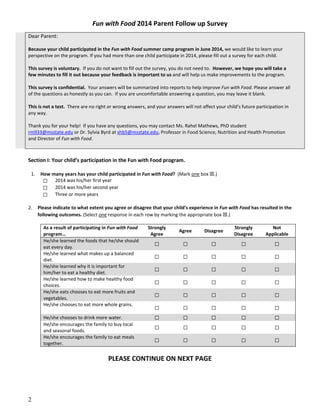
Section I: Your child’s participation in the Fun with Food program.
1. How many years has your child participated in Fun with Food? (Mark one box ☒.)
☐ 2014 was his/her first year
☐ 2014 was his/her second year
☐ Three or more years
2. Please indicate to what extent you agree or disagree that your child’s experience in Fun with Food has resulted in the
following outcomes. (Select one response in each row by marking the appropriate box ☒.)
As a result of participating in Fun with Food
program…
Strongly
Agree
Agree Disagree
Strongly
Disagree
Not
Applicable
He/she learned the foods that he/she should
eat every day.
☐ ☐ ☐ ☐ ☐
He/she learned what makes up a balanced
diet.
☐ ☐ ☐ ☐ ☐
He/she learned why it is important for
him/her to eat a healthy diet.
☐ ☐ ☐ ☐ ☐
He/she learned how to make healthy food
choices.
☐ ☐ ☐ ☐ ☐
He/she eats chooses to eat more fruits and
vegetables.
☐ ☐ ☐ ☐ ☐
He/she chooses to eat more whole grains.
☐ ☐ ☐ ☐ ☐
He/she chooses to drink more water. ☐ ☐ ☐ ☐ ☐
He/she encourages the family to buy local
and seasonal foods.
☐ ☐ ☐ ☐ ☐
He/she encourages the family to eat meals
together.
☐ ☐ ☐ ☐ ☐
PLEASE CONTINUE ON NEXT PAGE
2
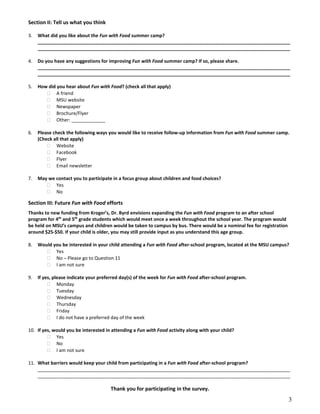
Section II: Tell us what you think
3. What did you like about the Fun with Food summer camp?
_________________________________________________________________________________________________
_________________________________________________________________________________________________
4. Do you have any suggestions for improving Fun with Food summer camp? If so, please share.
_________________________________________________________________________________________________
_________________________________________________________________________________________________
5. How did you hear about Fun with Food? (check all that apply)
A friend
MSU website
Newspaper
Brochure/Flyer
Other: _____________
6. Please check the following ways you would like to receive follow-up information from Fun with Food summer camp.
(Check all that apply)
Website
Facebook
Flyer
Email newsletter
7. May we contact you to participate in a focus group about children and food choices?
Yes
No
Section III: Future Fun with Food efforts
Thanks to new funding from Kroger’s, Dr. Byrd envisions expanding the Fun with Food program to an after school
program for 4th
and 5th
grade students which would meet once a week throughout the school year. The program would
be held on MSU’s campus and children would be taken to campus by bus. There would be a nominal fee for registration
around $25-$50. If your child is older, you may still provide input as you understand this age group.
8. Would you be interested in your child attending a Fun with Food after-school program, located at the MSU campus?
Yes
No – Please go to Question 11
I am not sure
9. If yes, please indicate your preferred day(s) of the week for Fun with Food after-school program.
Monday
Tuesday
Wednesday
Thursday
Friday
I do not have a preferred day of the week
10. If yes, would you be interested in attending a Fun with Food activity along with your child?
Yes
No
I am not sure
11. What barriers would keep your child from participating in a Fun with Food after-school program?
_________________________________________________________________________________________________
_________________________________________________________________________________________________
Thank you for participating in the survey.
3
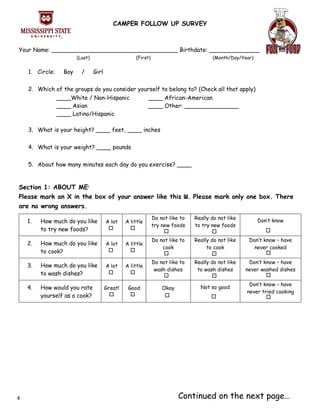
CAMPER FOLLOW UP SURVEY
Your Name: ___________________________________ Birthdate: ______________
(Last) (First) (Month/Day/Year)
1. Circle: Boy / Girl
2. Which of the groups do you consider yourself to belong to? (Check all that apply)
____White / Non-Hispanic
____ Asian
____ Latino/Hispanic
____ African-American
____ Other: _______________
3. What is your height? ____ feet, ____ inches
4. What is your weight? ____ pounds
5. About how many minutes each day do you exercise? ____
Section 1: ABOUT ME1
Please mark an X in the box of your answer like this x. Please mark only one box. There
are no wrong answers.
1. How much do you like
to try new foods?
A lot A little
Do not like to
try new foods
Really do not like
to try new foods
Don’t know
2. How much do you like
to cook?
A lot A little
Do not like to
cook
Really do not like
to cook
Don’t know – have
never cooked
3. How much do you like
to wash dishes?
A lot A little
Do not like to
wash dishes
Really do not like
to wash dishes
Don’t know – have
never washed dishes
4. How would you rate
yourself as a cook?
Great! Good Okay Not so good
Don’t know – have
never tried cooking
Continued on the next page…4
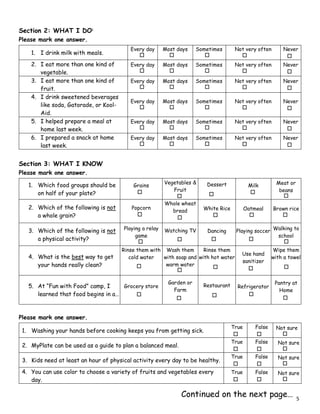
Section 2: WHAT I DO1
Please mark one answer.
Section 3: WHAT I KNOW
Please mark one answer.
1. I drink milk with meals.
Every day Most days Sometimes Not very often Never
2. I eat more than one kind of
vegetable.
Every day Most days Sometimes Not very often Never
3. I eat more than one kind of
fruit.
Every day Most days Sometimes Not very often Never
4. I drink sweetened beverages
like soda, Gatorade, or Kool-
Aid.
Every day Most days Sometimes Not very often Never
5. I helped prepare a meal at
home last week.
Every day Most days Sometimes Not very often Never
6. I prepared a snack at home
last week.
Every day Most days Sometimes Not very often Never
1. Which food groups should be
on half of your plate?
Grains
Vegetables &
Fruit
Dessert Milk Meat or
beans
2. Which of the following is not
a whole grain?
Popcorn
Whole wheat
bread White Rice Oatmeal Brown rice
3. Which of the following is not
a physical activity?
Playing a relay
game
Watching TV Dancing Playing soccer Walking to
school
4. What is the best way to get
your hands really clean?
Rinse them with
cold water
Wash them
with soap and
warm water
Rinse them
with hot water
Use hand
sanitizer
Wipe them
with a towel
5. At “Fun with Food” camp, I
learned that food begins in a…
Grocery store
Garden or
Farm
Restaurant Refrigerator
Pantry at
Home
1. Washing your hands before cooking keeps you from getting sick.
True False Not sure
2. MyPlate can be used as a guide to plan a balanced meal.
True False Not sure
3. Kids need at least an hour of physical activity every day to be healthy.
True False Not sure
4. You can use color to choose a variety of fruits and vegetables every
day.
True False Not sure
Continued on the next page… 5
Section 4: How Sure2
Please mark one answer. How sure are you that you can…
1. Make a vegetable salad with help from a grown-up?
Not at all
sure
A little sure Very sure
2. Make a vegetable salad all by myself?
Not at all
sure
A little sure Very sure
3. Make a fruit salad with help from a grown-up?
Not at all
sure
A little sure Very sure
4. Make a fruit salad all by myself?
Not at all
sure
A little sure Very sure
5. Follow a recipe with help from a grown-up?
Not at all
sure
A little sure Very sure
6. Follow a recipe all by myself?
Not at all
sure
A little sure Very sure
7. Cut up vegetables and eat them with a dip for a snack at
least once a week?
Not at all
sure
A little sure Very sure
8. Cut up vegetables and eat them with a dip for a snack most
days?
Not at all
sure
A little sure Very sure
9. Eat a half cup of fruit at home once a week?
Not at all
sure
A little sure Very sure
10. Eat a half cup of fruit at home most days?
Not at all
sure
A little sure Very sure
11. Eat one and a half cups of fruit at home once a week?
Not at all
sure
A little sure Very sure
12. Eat one and a half cups of fruit at home most days?
Not at all
sure
A little sure Very sure
13. Eat a half cup of vegetables at home once a week?
Not at all
sure
A little sure Very sure
14. Eat a half cup of vegetables at home most days?
Not at all
sure
A little sure Very sure
Continued on the next page…
6
Continued on the next page…
Please mark one answer. How sure are you that you can…
you can…
15. Eat two and a half cups of vegetables at home once a week?
Not at all
sure
A little sure Very sure
16. Eat two and a half cups of vegetables at home most days?
Not at all
sure
A little sure Very sure
17. Eat one serving of whole grains at home once a week?
Not at all
sure
A little sure Very sure
18. Eat one serving of whole grains at home most days?
Not at all
sure
A little sure Very sure
19. Eat six servings of whole grains at home once a week?
Not at all
sure
A little sure Very sure
20. Eat six servings of whole grains at home most days?
Not at all
sure
A little sure Very sure
21. Drink one cup of milk at home once a week?
Not at all
sure
A little sure Very sure
22. Drink one cup of milk at home most days?
Not at all
sure
A little sure Very sure
23. Drink three cups of milk at home once a week?
Not at all
sure
A little sure Very sure
24. Drink three cups of milk at home most days?
Not at all
sure
A little sure Very sure
25. Walk, bike, or be very physically active for 30 minutes once
a week?
Not at all
sure
A little sure Very sure
26. Walk, bike, or be very physically active for 30 minutes most
days?
Not at all
sure
A little sure Very sure
27. Walk, bike, or be very physically active for 60 minutes once
a week?
Not at all
sure
A little sure Very sure
28. Walk, bike, or be very physically active for 60 minutes most
days?
Not at all
sure
A little sure Very sure
7
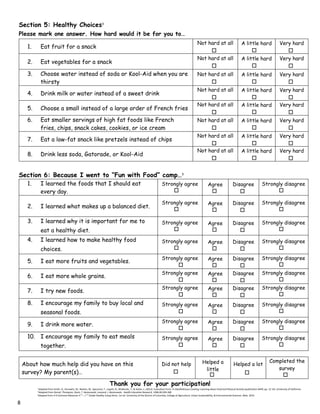
Section 5: Healthy Choices3
Please mark one answer. How hard would it be for you to…
Section 6: Because I went to “Fun with Food” camp…3
1. I learned the foods that I should eat
every day.
Strongly agree Agree Disagree Strongly disagree
2. I learned what makes up a balanced diet.
Strongly agree Agree Disagree Strongly disagree
3. I learned why it is important for me to
eat a healthy diet.
Strongly agree Agree Disagree Strongly disagree
4. I learned how to make healthy food
choices.
Strongly agree Agree Disagree Strongly disagree
5. I eat more fruits and vegetables.
Strongly agree Agree Disagree Strongly disagree
6. I eat more whole grains.
Strongly agree Agree Disagree Strongly disagree
7. I try new foods.
Strongly agree Agree Disagree Strongly disagree
8. I encourage my family to buy local and
seasonal foods.
Strongly agree Agree Disagree Strongly disagree
9. I drink more water.
Strongly agree Agree Disagree Strongly disagree
10. I encourage my family to eat meals
together.
Strongly agree Agree Disagree Strongly disagree
Thank you for your participation!
1
Adapted from Smith, D., Horowitz, M., Neelon, M., Spezzano, T., Lippitt, N., McMurdo, T., & Kaiser, L. (2012). Evaluation Form. In Healthalicious Cooking: Learning about Food and Physical Activity (publication 8449, pp. 12-14). University of California.
2
Adapted from Domel, Thompson, Davis, T. Baranowski, Leonard, J. Baranowski. Health Education Research, 1996:00:299-308
3
Adapted from 4-H Common Measures 4 Th
– 7 Th
Grade Healthy Living Items. 1st ed. University of the District of Columbia, College of Agriculture, Urban Sustainability, & Environmental Sciences. Web. 2014.
1. Eat fruit for a snack
Not hard at all A little hard Very hard
2. Eat vegetables for a snack
Not hard at all A little hard Very hard
3. Choose water instead of soda or Kool-Aid when you are
thirsty
Not hard at all A little hard Very hard
4. Drink milk or water instead of a sweet drink
Not hard at all A little hard Very hard
5. Choose a small instead of a large order of French fries
Not hard at all A little hard Very hard
6. Eat smaller servings of high fat foods like French
fries, chips, snack cakes, cookies, or ice cream
Not hard at all A little hard Very hard
7. Eat a low-fat snack like pretzels instead of chips
Not hard at all A little hard Very hard
8. Drink less soda, Gatorade, or Kool-Aid
Not hard at all A little hard Very hard
About how much help did you have on this
survey? My parent(s)…
Did not help Helped a
little
Helped a lot
Completed the
survey
8
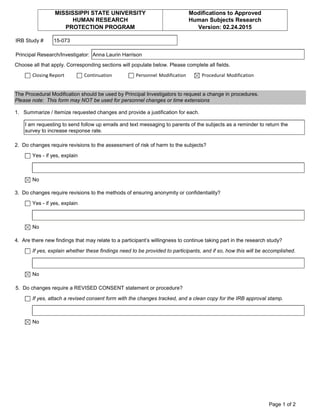
IRB Study #
Principal Research/Investigator:
Choose all that apply. Corresponding sections will populate below. Please complete all fields.
Closing Report Continuation Personnel Modification Procedural Modification
1. Summarize / Itemize requested changes and provide a justification for each.
2. Do changes require revisions to the assessment of risk of harm to the subjects?
Yes - if yes, explain
No
3. Do changes require revisions to the methods of ensuring anonymity or confidentiality?
Yes - if yes, explain
No
4. Are there new findings that may relate to a participant’s willingness to continue taking part in the research study?
If yes, explain whether these findings need to be provided to participants, and if so, how this will be accomplished.
No
5. Do changes require a REVISED CONSENT statement or procedure?
If yes, attach a revised consent form with the changes tracked, and a clean copy for the IRB approval stamp.
No
I am requesting to send follow up emails and text messaging to parents of the subjects as a reminder to return the
survey to increase response rate.
The Procedural Modification should be used by Principal Investigators to request a change in procedures.
Please note: This form may NOT be used for personnel changes or time extensions
MISSISSIPPI STATE UNIVERSITY
HUMAN RESEARCH
PROTECTION PROGRAM
Modifications to Approved
Human Subjects Research
Version: 02.24.2015
15-073
Anna Laurin Harrison
Page 1 of 2
Name of Principal Investigator / Researcher:
Signature Date
Name of Advisor (if applicable):
Signature Date
*Note: You must receive written notification of approval from the IRB before implementing any changes (except
when necessary to eliminate apparent immediate hazards to the subject).
March 25, 2015
March 25, 2015
Page 2 of 2
Academy of Nutrition and Dietetics
120 South Riverside Plaza, Suite 2000
 Print this Page for Your Records Close Window
Control/Tracking Number: 15­RA­1634­ADA
Activity: Research Abstracts
Current Date/Time: 2/27/2015 8:51:45 PM
Effect of a Week­long Camp on Self­efficacy of Dietary Behavior and Food Preparation Skills in Children 
Author Block: A. L. Harrison1, S. H. Byrd, PhD, RDN, LDN1, L. Downey, PhD2, D. Buys, PhD1, R. Mathews, M.S.1;
1Food Science, Nutrition, and Health Promotion, Mississippi State Univ., Mississippi State, MS, 2School of Human
Sciences, Mississippi State Univ., Mississippi State, MS. 
Abstract:
Over the last three decades consumption of foods eaten or prepared outside the home increased and conversely less
time was spent preparing meals at home. These trends combined with increased prevalence of diet­ and lifestyle­
related chronic diseases focus the need for edible education or teaching about food, meal planning, purchasing
ingredients, food preparation skills, and nutritional meals. Cooking camps are an effective intervention for improving
nutritional status and eating behaviors of children. Twenty participants, 8­13 year olds in 2014 Fun with Food summer
camp, a week­long program aimed at increasing self­efficacy in food preparation skills, were evaluated. Application of
Social Cognitive Theory as it relates to self­efficacy of food preparation and dietary behavior change was utilized. IRB
approval was obtained. Participants were given a pre­survey and follow up survey. Self­efficacy was measured by
standardized questions reflecting the level of confidence in performing a food­ or kitchen­related task. The pre­ and
follow up surveys were analyzed for changes in self­efficacy of food preparation and dietary behaviors resulting from
participation in Fun with Food Camp. Sixty percent of camp participants were females. Initial data reveals involving
children in food preparation can positively affect self­efficacy and dietary behaviors. Additional research is needed to
determine if food­preparation skills translate to sustainable and healthier food choices. 
:
Author Disclosure Information:  A.L. Harrison: None. 
Learning Needs Codes (Complete):  6040 Education theories and techniques for children and adolescents ;  6010
Behavior change theories, techniques 
Additional Information (Complete): 
     Learning Outcome : To recognize the importance of edible education and teaching of food preparation skills to
bring about positive dietary behavior change and increasing self­efficacy
 Funding Source : Mississippi Agricultural and Forestry Experiment Station.
 Faculty advisor Name: : Sylvia H. Byrd, PhD, RDN, LDN
 Email: : shb5@msstate.edu
 Phone: : (662)325­0919
Status: Complete
Name: Haley, Bryant 
Major: Wildlife & Fisheries Science/Aquaculture & Fisheries Science 
Faculty Advisor Name:  Wes Neal 
Faculty Advisor Affiliation: Wildlife, Fisheries, and Aquaculture 
Faculty Advisor Email: jneal@cfr.msstate.edu  
Project Type: Poster 
Project Category: Biological Sciences and Engineering 
Community Engagement Track: No 
Project Title:  Spatio‐temporal distributions of the zooplankton comunity in a Puerto 
Rico reservoir 
Abstract: Zooplankton provide an essential forage base for the development and 
maintenance of a balanced recreational fishery. As the second tier in the aquatic 
food web, their importance cannot be overlooked. Little scrutiny has been given to 
zooplankton dynamics in tropical reservoirs in general and particularly those in 
Puerto Rico. This study attempts to assess the movements of the zooplankton 
community within Carite reservoir, Puerto Rico. Data collection began in June 2011 
and was conducted for a period of one year. Comparisons evaluated within the 
study include habitat preference, by comparing littoral and limnetic zones; diel 
movement, by sampling at 12‐hour intervals; and seasonal trends within the 
system. All zooplankton studied revealed their highest abundances in the fall, 
though the number of rotifers dwarfed copepods and cladocerans and consistently 
represented the largest abundances throughout the study. Diel period showed no 
effect on rotifers, however they were found in greatest abundance in limnetic 
habitats. Copepods, the next most abundant order, also showed a slight bias toward 
limnetic sites and were found in higher densities at dusk. Cladocera represented the 
least captured group and like the others were found in highest abundance during 
dusk samples. They showed no significant difference between habitat types. 
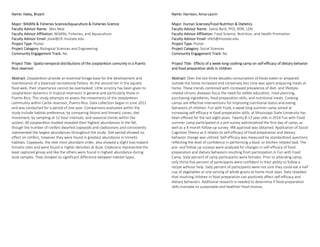
Name: Harrison, Anna Laurin 
Major: Human Sciences/Food Nutrition & Dietetics 
Faculty Advisor Name:  Sylvia Byrd, PhD, RDN, LDN 
Faculty Advisor Affiliation: Food Science, Nutrition, and Health Promotion 
Faculty Advisor Email: shb5@msstate.edu  
Project Type: Poster 
Project Category: Social Sciences 
Community Engagement Track: No 
Project Title:  Effects of a week‐long cooking camp on self‐efficacy of dietary behavior 
and food preparation skills in children 
Abstract: Over the last three decades consumption of foods eaten or prepared 
outside the home increased and conversely less time was spent preparing meals at 
home. These trends combined with increased prevalence of diet‐ and lifestyle‐
related chronic diseases focus the need for edible education, meal planning, 
purchasing ingredients, food preparation skills, and nutritional meals. Cooking 
camps are effective interventions for improving nutritional status and eating 
behaviors of children. Fun with Food, a week‐long summer camp aimed at 
increasing self‐efficacy in food preparation skills, at Mississippi State University has 
been offered for the last eight years. Twenty 8‐13 year olds in 2014 Fun with Food 
summer camp participated in a pre‐survey administered the first day of camp, as 
well as a 9‐month follow‐up survey. IRB approval was obtained. Application of Social 
Cognitive Theory as it relates to self‐efficacy of food preparation and dietary 
behavior change was utilized. Self‐efficacy was measured by standardized questions 
reflecting the level of confidence in performing a food‐ or kitchen‐related task. The 
pre‐ and follow up surveys were analyzed for changes in self‐efficacy of food 
preparation and dietary behaviors resulting from participation in Fun with Food 
Camp. Sixty percent of camp participants were females. Prior to attending camp, 
only thirty‐five percent of participants were confident in their ability to follow a 
recipe without help. Sixty percent of participants were not sure they could eat a half 
cup of vegetables or one serving of whole grains at home most days. Data revealed 
that involving children in food preparation can positively affect self‐efficacy and 
dietary behaviors. Additional research is needed to determine if food‐preparation 
skills translate to sustainable and healthier food choices. 
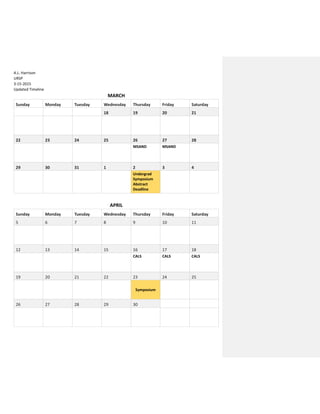
A.L. Harrison
URSP
3-15-2015
Updated Timeline
MARCH
Sunday Monday Tuesday Wednesday Thursday Friday Saturday
18 19 20 21
22 23 24 25 26 27 28
MSAND MSAND
29 30 31 1 2 3 4
Undergrad
Symposium
Abstract
Deadline
APRIL
Sunday Monday Tuesday Wednesday Thursday Friday Saturday
5 6 7 8 9 10 11
12 13 14 15 16 17 18
CALS CALS CALS
19 20 21 22 23 24 25
Symposium
26 27 28 29 30
IRB Study #: 15-073
Email to Parents of Participants in Fun with Food 2014 Summer Camp - Draft
Dear <Name of Parent(s)>,
My name is Anna Laurin Harrison and I was the 2014 Fun with Food Summer Camp Coordinator. As part
of an undergraduate research project, I mailed you a survey to be completed by you and your child. This
is a reminder to return the survey booklet by <Date> or before in order for your child to receive the gift
card. If you did not receive a survey in the mail please contact me.
If you have any questions or concern, please contact Anna Laurin Harrison at alh715@msstate.edu or
Dr. Byrd at 662-325-0919 or shb5@msstate.edu.
Thank you!
Anna Laurin Harrison
Effects of a Week-long Cooking Camp on Self-efficacy of Dietary
Behavior and Food Preparation Skills in Children
A.L. Harrison1, S.H. Byrd, PhD, RDN, LDN1, L. Downey, DrPH2, D. Buys, PhD, MSPH1, R. Mathews, MPH.1
1Food Science, Nutrition, and Health Promotion, 2School of Human Sciences, Mississippi State University, Mississippi State, MS.
ResultsBackground
Over the last three decades consumption of
foods eaten or prepared outside the home
increased and conversely less time was
spent preparing meals at home. As a result,
dietary behavior changed and knowledge of
food preparation skills decreased. These
trends combined with increased prevalence
of diet and lifestyle-related chronic diseases
bring to focus the need for edible
education. Cooking camps are effective
interventions for improving nutritional status
and eating behaviors of children. Fun with
Food, a week-long summer camp aimed at
increasing self-efficacy in dietary behaviors
and food preparation skills, at Mississippi
State University (MSU), has been offered
for the last eight years. The goal of this
research was to determine if
participation in Fun with Food increased
self-efficacy in children.
Methods
Application of the Social Cognitive Theory
as it relates to self-efficacy of food
preparation and dietary behavior change
was used to develop a survey1 of 28 items.
The study was approved by the MSU
Institutional Review Board. In 2014, 20
eight- to thirteen-year-olds participated in
Fun with Food summer camp. A pre-survey
was administered the first day of camp. A
nine-month follow-up survey was mailed to
campers. Self-efficacy was measured by
six standardized items reflecting the level of
confidence in performing a dietary behavior
or food preparation skill. Children rated
themselves as either “Very Sure”, “A Little
Sure” or “Not at all Sure.” The scale was
collapsed to show the difference in how
many children were “Very Sure” before and
after camp for this project. Descriptive
statistics were run for the pre and follow-up
surveys. Confidence intervals were
constructed and compared. The analysis
was conducted in IBM SPSS 22.
1The “How Sure” scale was adapted from Domel, Thompson, Davis, T.
Baranowski, Leonard, J. Baranowski. Health Education Research,
1996:00:299-308.
35% 36%
0%
10%
20%
30%
40%
50%
60%
70%
80%
Pre (n=20) Follow-up (n=14)
Figure 2. Percent of children who were
"Very Sure" they could follow a recipe
by themselves,
Pre and Follow-up
40%
71%
0%
10%
20%
30%
40%
50%
60%
70%
80%
Pre (n=20) Follow-up (n=14)
Figure 5. Percent of children who were
"Very Sure" they could eat one serving
of whole grains at home most days,
Pre and Follow-up
55%
71%
0%
10%
20%
30%
40%
50%
60%
70%
80%
Pre (n=20) Follow-up (n=14)
Figure 4. Percent of children who were
"Very Sure" they could drink one cup
of milk at home most days,
Pre and Follow-up
55% 57%
0%
10%
20%
30%
40%
50%
60%
70%
80%
Pre (n=20) Follow-up (n=14)
Figure 3. Percent of children who were
"Very Sure" they could make a
vegetable salad by themselves,
Pre and Follow-up
30%
50%
0%
10%
20%
30%
40%
50%
60%
70%
80%
Pre (n=20) Follow-up (n=14)
Figure 6. Percent of children who were
"Very Sure" they could eat a half cup
of vegetables at home most days,
Pre and Follow-up
Discussion
The results revealed the food preparation
skills and dietary behaviors children feel the
most confident performing after
participation in Fun with Food camp.
Dietary intake and recommendations to
increase consumption of vegetables, whole
grains, and dairy are tenants of the camp
curriculum. There were no statistically
significant differences (p < 0.05) for the six
items investigated between the pre and
follow-up surveys, as indicated by
overlapping 95% Confidence Intervals.
However, it is notable the percent of
children who were “Very Sure” about
vegetable, whole grain, and dairy
consumption increased after camp
participation. Confidence in vegetable,
whole grain, and dairy consumption
(Figures 4-6) showed greater increase than
confidence of food preparation
(Figures 1-3). A limitation of this study was
sample size (n=20). Anecdotal reports
suggest sustained change in some
participants and merits additional study.
Conclusion
The results from this study will be useful in
Fun with Food camp program evaluation
and curriculum development. Ongoing
research includes data collection with a
larger sample size and investigation on how
camp participation impacts families.
Experiential learning can bridge the gap
between lack of food preparation skills and
positive dietary behaviors.
30%
43%
0%
10%
20%
30%
40%
50%
60%
70%
80%
Pre (n=20) Follow-up (n=14)
Figure 1. Percent of children who were
"Very Sure" they could cut up
vegetables and eat them with a dip for
a snack most days,
Pre and Follow-up
The project was funded by the Mississippi Agricultural and
Forestry Experiment Station (MAFES) Undergraduate
Research Scholars Program.
Camp sponsors include Kroger®, Mississippi Cattleman’s
Association, Aramark®, Mayhew Tomato Farm, and MSU
Department of Animal and Dairy Science.
For more information, please contact
Anna Laurin Harrison (alh715@msstate.edu)
To Whom It May Concern
From: Anna Laurin Harrison
Faculty Supervisor: Sylvia Byrd
The attached receipt reflects the purchase of 14 gift cards for $5 each to be mailed as incentive
to participants in a research study. The recipients are listed below. Please contact Anna Laurin
(alh715) or Dr. Byrd with questions (shb5).
1.
2.
3.
4.
5.
6.
7.
8.
9.
10.
11.
12.
13.
14.
Undergraduate Research

Undergraduate Research

  • 1.
    Anna Laurin Harrison Collegeof Agriculture and Life Sciences Undergraduate Research Scholars Program GA 4000 DIS in Agriculture Dr. Sylvia Byrd1, Faculty Mentor Collaborators: L. Downey, DrPH2 , D. Buys, PhD, MSPH1 , R. Mathews, MPH.1 Spring 2015 Effects of a Week-long Cooking Camp on Self-efficacy of Dietary Behavior and Food Preparation Skills in Children ABSTRACT Over the last three decades consumption of foods eaten or prepared outside the home increased and conversely less time was spent preparing meals at home. These trends combined with increased prevalence of diet and lifestyle-related chronic diseases focus the need for edible education, meal planning, purchasing ingredients, food preparation skills, and nutritional meals. Cooking camps are effective interventions for improving nutritional status and eating behaviors of children. Fun with Food, a weeklong summer camp aimed at increasing self-efficacy in food preparation skills, at Mississippi State University has been offered for the last eight years. Twenty 8-13 year olds in 2014 Fun with Food summer camp participated in a pre-survey administered the first day of camp, as well as a 9-month follow up survey. IRB approval was obtained. Application of Social Cognitive Theory as it relates to self- efficacy of food preparation and dietary behavior change was utilized. Self-efficacy was measured by standardized questions reflecting the level of confidence in performing a food- or kitchen-related task. The pre- and follow up surveys were analyzed for changes in self-efficacy of food preparation and dietary behaviors resulting from participation in Fun with Food Camp. Sixty percent of camp participants were females. Prior to attending camp, only thirty-five percent of participants were confident in their ability to follow a recipe without help. Sixty percent of participants were not sure they could eat a half cup of vegetables or one serving of whole grains at home most days. Data revealed that involving children in food preparation can positively affect self-efficacy and dietary behaviors. Additional research is needed to determine if food-preparation skills translate to sustainable and healthier food choices. 1 Food Science, Nutrition, and Health Promotion, 2 School of Human Sciences, Mississippi State University, Mississippi State, MS.
  • 2.
    LITERATURE REVIEW Childhood obesityand overweight are issues that have gained global attention in the 21st century. The problem has been attributed to an excess of caloric availability and intake. However, diet quality overall, including fruit and vegetable consumption, is of concern. The diet quality of the population is measured by United States Department of Agriculture’s Healthy Eating Index. The Healthy Eating Index-2010 results found that the categories of Greens and Beans and Whole Grains had the lowest scores when held to national standards (14-18% and 16-18%, respectively). Though significant improvement was seen in adequacy of Total Fruit and Whole Fruit and reduced empty calorie intake, the total score (47-50%) remained far lower than the recommendations set forth by USDA. Children consuming more vegetables and whole grains in place of empty calories like solid fat and sugar could accomplish further improvement in total score (Diet Quality of Children Age 2-17 Years as Measured by the Healthy Eating Index- 2010, 2013). Fast food has been found to be the greatest contributor to this excess in energy intake and calories consumed away from home. Researchers at the University of North Carolina at Chapel Hill conducted a study which analyzed the impact of location of food consumption and preparation upon the diets of children using data from the 1977-1978 Nationwide Food Consumption Survey, 1989-1991 and 1994-1998 Continuing Survey of Food Intake by Individuals, and 2003-2006 NHANES. It was determined that the increased energy intake by children over the last thirty years was associated with the increase of calories consumed outside of the home. These results further justify the need for food preparation instruction with children in order to improve diet quality (Poti & Popkin, 2011). Parenting and feeding trends have shown to be influential in a child’s eating habits and development of food preferences. Modeling eating behaviors is evidence to be beneficial in creating dietary behaviors that will last in to adulthood. These studies have focused primarily on pre-school age children. One study found in a preschools and daycare convenience sample (n=465) that parents and children eating the same home- cooked meals at the same time resulted in greater vegetable consumption among the children (Sweetman, McGowan, Croker, & Cooke, 2011). It has also been suggested that young children are more likely to try new foods after observing their caregiver eat the same food. This collection of research suggests that parenting styles and child- feeding practices may be indicative of risk for overweight or obesity, and will be used in the future as an intervention strategy (Stang & Loth, 2011). Family-based behavioral intervention is considered to be a non-diet approach and has resulted in improved weight status among adolescent participants (Hoelscher, Kirk, Ritchie, & Cunningham- Sabo, 2013). Children and adolescents may benefit indirectly from adults’ food preparation abilities. Clemson University’s Cooking with a Chef trained food service professionals in creative food preparation techniques that could make school meals containing heathy ingredients more appealing to children. Participants completed five sessions and a questionnaire used as a pre and post-survey. The theoretical approach to this program was Social Cognitive Theory (SCT) and resulted in increase in confidence with a variety
  • 3.
    of food preparationtechniques as well as improved attitudes towards trying new recipes (Condrasky, Sharp, & Carter, 2014). Intervention strategies for children are heavily evaluated for effectiveness and validity. Theory-driven interventions usually measure psychosocial variables such as self-efficacy. In the case of cooking camps, knowledge gained and behavior change may also be assessed. There are limited, published evaluations and descriptive studies for camps such as these. However, a handful of programs such as the 4-H Healthy Living Project at the University of California Cooperative Extension have been thoroughly evaluated based on theory, food preparation instruction, behavior change, and self-efficacy. This was a pilot study for youth participants (n=82) which included two quantitative evaluation methods (pre and post-tests), a food photo journal, and a qualitative method as well. A four item survey evaluating nutrition behaviors was completed by participants before and after the six-week program which consisted of six sessions of hands-on cooking, a nutrition activity, a physical activity, congregate mealtime, and reflective writing. Youth also compiled a food photo journal at home for one week during the first and fifth week of the program. This was found to be an ineffective way to log behaviors due to poor documentation by the participants. The pre- and post-surveys, however, proved to be effective in documenting outcomes with this pilot study. The authors stated that the six-week time period of intervention and evaluation could not measure sustainable behavior change. Additional outcomes that were not captured included how much the children enjoy or dislike cooking, self-efficacy in food preparation, interest in trying new foods, and if behaviors changed as a result of activities done in class. The study reflected the need to tailor instruments for the target population and curriculum in order to yield useful data that will measure the desired knowledge and behavior outcomes (Matthiessen et al, 2011). Another cooking camp intervention was Oregon State University’s Culinary Camp. Beets, Swanger, Wilcox, & Cardinal (2007) stated that the purpose of this Culinary Camp was to “increase the number of times young adolescents prepared meals at home and to improve their attitudes, self-efficacy, behavioral expectancies, knowledge, perceived cooking ability, and perceptions of parents’ worry regarding cooking.” Culinary Camp used experiential learning as its theoretical framework which involved development of food preparation skills. The pilot program was conducted in the summer of 2006. Baseline and one-week post-assessments were collected using a survey that focused on cooking behaviors as well as psychosocial modality such as attitudes towards cooking, self-efficacy, knowledge, and perceptions about personal cooking ability. The primary goal of Culinary Camp was to see increased meal preparation, however, this was not accomplished. Overall, though, the participants gained useful cooking skills in an innovative fashion. The authors suggest that future studies incorporate a parent component in order to encourage them to allow children to be active in food preparation at home (Beets, Swanger, Wilcox, & Cardinal, 2007). Pennsylvania State University’s program Cooking like a Chef is a week-long camp for pre-adolescent children which involves hands-on culinary nutrition sessions with the aim to increase cooking confidence that will translate in to healthy eating habits. Pre- and post-questionnaires were completed by participants (n=97) which quantified children’s cooking confidence, nutritional knowledge, and food preparation skills. The
  • 4.
    study revealed thatthe camp was influential in children making healthier food choices and having positive attitudes towards food due to their new-found knowledge of food and cooking (Condrasky, Dixon, Corr, & Sharp, 2012). A systematic review of eight cooking education program frameworks and outcomes evaluated influence on children’s report food preparation skills, dietary intake, cooking confidence, fruit and vegetable preferences, attitudes towards food and cooking, and food-related knowledge (Hersch, Perdue, Ambroz, & Boucher, 2014). The findings concluded that such cooking programs may have positive impact on children’s nutrition behaviors, knowledge, and attitudes. Though the evidence demonstrates the benefits of such programs, literature describing ideal program length and the sustained effects is lacking. Through perusing the literature, it is evident that child nutrition interventions focusing on food preparation skills, nutrition knowledge, and self-efficacy of dietary behaviors are increasingly prevalent and in continuous development. The major goals in the United States of reducing excessive energy intake, especially from junk foods and added sugars, and increasing fruit and vegetable consumption have potential to be met through cooking instruction as well as modeling behaviors. Fun with Food at Mississippi State University The purpose of this study was to compare the reporting of self-efficacy and dietary behaviors of 2014 campers prior to camp and what they report after camp. Specifically, in this camp, participants learned how to cut and measure ingredients, follow a recipe and basic kitchen skills. Understanding the impact of a camp such as Fun with Food provides evidence that children need this type of training to be self- sufficient and to make choices as adults. Increasing self-efficacy in food-preparation is a goal of Fun with Food camp. Dr. Pajares (2002) states that, “ researchers have established that self-efficacy beliefs and behavior changes and outcomes are highly correlated and that self-efficacy is an excellent predictor of behavior self-efficacy has proven to be a more consistent predictor of behavior outcomes than have any other motivational constructs.” In addition, modeling behaviors are a component of this, in that one can relate to and learn from another performing a task. This proves to increase self-efficacy of the observer as well as increase the likelihood that he or she will attempt to perform that behavior or task. This theory has been applied to children as they observe food preparation and dietary behaviors while participating in Fun with Food camp at Mississippi State University.
  • 5.
    SUMMARY OF FINDINGS Applicationof the Social Cognitive Theory as it relates to self-efficacy of food preparation and dietary behavior change was used to develop a survey1 of 28 items. The study was approved by the MSU Institutional Review Board. In 2014, 20 eight- to thirteen-year-olds participated in Fun with Food summer camp. A pre-survey was administered the first day of camp. A nine-month follow-up survey was mailed to campers. Self-efficacy was measured by six standardized items reflecting the level of confidence in performing a dietary behavior or food preparation skill. Children rated themselves as either “Very Sure”, “A Little Sure” or “Not at all Sure.” The scale was collapsed to show the difference in how many children were “Very Sure” before and 30% 43% 0% 20% 40% 60% 80% Pre (n=20) Follow-up (n=14) Figure 1. Percent of children who were "Very Sure" they could cut up vegetables and eat them with a dip for a snack most days, Pre and Follow-up 35% 36% 0% 20% 40% 60% 80% Pre (n=20) Follow-up (n=14) Figure 2. Percent of children who were "Very Sure" they could follow a recipe by themselves, Pre and Follow-up 55% 57% 0% 20% 40% 60% 80% Pre (n=20) Follow-up (n=14) Figure 3. Percent of children who were "Very Sure" they could make a vegetable salad by themselves, Pre and Follow-up 55% 71% 0% 20% 40% 60% 80% Pre (n=20) Follow-up (n=14) Figure 4. Percent of children who were "Very Sure" they could drink one cup of milk at home most days, Pre and Follow-up 40% 71% 0% 20% 40% 60% 80% Pre (n=20) Follow-up (n=14) Figure 5. Percent of children who were "Very Sure" they could eat one serving of whole grains at home most days, Pre and Follow-up 30% 50% 0% 20% 40% 60% 80% Pre (n=20) Follow-up (n=14) Figure 6. Percent of children who were "Very Sure" they could eat a half cup of vegetables at home most days, Pre and Follow-up
  • 6.
    after camp forthis project. Descriptive statistics were run for the pre and follow-up surveys. Confidence intervals were constructed and compared. The analysis was conducted in IBM SPSS 22. The results revealed the food preparation skills and dietary behaviors children feel the most confident performing after participation in Fun with Food camp. Dietary intake and recommendations to increase consumption of vegetables, whole grains, and dairy are tenants of the camp curriculum. There were no statistically significant differences (p < 0.05) for the six items investigated between the pre and follow-up surveys, as indicated by overlapping 95% Confidence Intervals. However, it is notable the percent of children who were “Very Sure” about vegetable, whole grain, and dairy consumption increased after camp participation. Confidence in vegetable, whole grain, and dairy consumption (Figures 4-6) showed greater increase than confidence of food preparation (Figures 1-3). A limitation of this study was sample size (n=20). Anecdotal reports suggest sustained change in some participants and merits additional study. STUDENT EXPERIENCES As an undergraduate student in Food Science, Nutrition, and Health Promotion, I have taken classes that focus on the research process and research methods. Since becoming an undergraduate research scholar in the College of Agriculture and Life Sciences, this information has come alive and increased my confidence in conducting research. Dietetics is a research-based, evidence-based practice. By participating in the CALS Undergraduate Research Scholars program, I gained experience that would not be plausible in the classroom and maximized the effectiveness I can have as a future health professional. Acting as principal investigator in this project gave me the opportunity to learn about research in my field from the ground up. Before the project was received as a MAFES-funded student research project, I met with my collaborators (with the exception of Ms. Mathews who had not yet started her doctoral studies) and faculty mentor to discuss the prospect of developing a project related to 2014 Fun with Food camp at Mississippi State University. At this time, I was acting as Fun with Food camp coordinator. Thus, I became extremely familiar with camp goals, objectives, curriculum, and planning. This was beneficial in writing the research proposal and in the development of the evaluation instrument. Camp was held on June 16-20. I saw first-hand how cooking instruction and basic nutrition lessons were reinforced with the children and the impact on their confidence in the kitchen. Naturally, my interest in a research project about Fun with Food increased after camp. A proposal was written and I applied for the CALS Undergraduate Research Scholars Program. Upon acceptance, I got to work on a review of literature and a timeline for my project. This was my first, practical experience in development of a true research project. One of my favorite parts of undergraduate research was exploring the literature and finding myself fascinated by the trails that led from one study to another. The literature review was a critical part of this project as I was better able to discuss and
  • 7.
    explain the rationaleof Fun with Food camp, the importance of conducting the study, and compare it to similar programs. Most of the fall semester was centered on development of the survey. Though it seemed at first to be an uncomplicated task, I soon discovered the great amount of thought and analysis required. The benefit of my collaborators’ input in that process is immeasurable. My personal experience in Fun with Food camp proved to be valuable in writing the survey because I was familiar with the objectives and had witnessed the subtle, yet notable, increase in confidence level of the campers in the kitchen and their willingness to try new foods. In the spring semester, the focus was survey printing and administration. In contrast to the previous semester, this process was much more detailed. Due to the nature of the research (children as subjects) IRB approval had to be obtained for the project. I worked with my faculty mentor and collaborators to ensure appropriate methods would be utilized in the administration of the survey and maintenance of the results after analysis. I learned a great deal by going through the IRB application, which involved multiple revisions and consultation with IRB compliance officers. I used the registration database from 2014 Fun with Food camp to develop the mailing list and print labels, as well as individualize the surveys in hopes of increasing the response rate. In addition, we included a parent survey for non-research purposes to gain insight for an after-school Fun with Food program and future Fun with Food summer camps. I obtained IRB approval for a procedure modification in order to follow-up with reminders to the parents about the survey via email. During this time, I also submitted abstracts for poster presentation at the Undergraduate Research Symposium and the Food and Nutrition Conference & Expo in Nashville (October 3-6, 2015). Analysis was an area in which I definitely lacked experience, but desired to learn more as it will be a critical skill in graduate studies and dietetic practice. With assistance from Ms. Mathews, a doctoral student and research collaborator, I developed a much better understanding of statistical analysis. I was able to contribute to the analysis by doing some data entry. When data entry was completed, we ran descriptive statistics and reviewed the results together. It was a good experience to hear the input of each of my collaborators in a round-table discussion of the results. After thorough analysis, I drafted a poster for the Undergraduate Research Symposium. It took many hours to finalize the design and text for the poster. I practiced my presentation before the C.H.A.N.G.E. (Community Health and Applied Nutrition Group Exchange), a research-oriented group in the Department of Food Science, Nutrition, and Health Promotion consisting of undergraduate researchers and research assistants, graduate students, and professors. Receiving their feed-back, though tough, provided thought-provoking questions to consider before presenting at the symposium. On the day of the symposium, my aptitude for speaking in front of others has never been higher. Because my direct involvement with the research, I was able to
  • 8.
    explain and discussmy project with enthusiasm and without hesitation. The presentation experience was the most rewarding moment of my undergraduate career. In conclusion, my experience as a CALS Undergraduate Research Scholar proved to be substantially beneficial and has impacted my future academic endeavors as well as career aspirations. I will continue be involved with and support research in my field, and be grateful for the opportunity provided by Mississippi State University and the College of Agriculture and Life Sciences to enrich my educational experience. LEARNING OUTCOMES • As a result of completing the Undergraduate Research Scholars Program, the student is able to write a research proposal. • As a result of completing the Undergraduate Research Scholars Program, the student can conduct a research project. • As a result of completing the Undergraduate Research Scholars Program, the student can design an instrument for program evaluation. • As a result of completing the Undergraduate Research Scholars Program, the student can compile a review of literature. • As a result of completing the Undergraduate Research Scholars Program, the student learned and applied ethical research methods. • As a result of completing the Undergraduate Research Scholars Program, the student gained experience in data entry, management, and analysis. • As a result of completing the Undergraduate Research Scholars Program, the student can prepare and present results of a research project at a research symposium. DELIVERABLES • 3rd Place Poster, Social Sciences category, MSU Undergraduate Research Symposium • Appended: o Instrument for measurement of self-efficacy of dietary behavior and food preparation skills in participants of Fun with Food camp 2014 o Abstracts submissions o Poster presentation *Appended documents are in chronological order.
  • 9.
    WORKS CITED Beets, MichaelW., Swanger, Karen, Wilcox, Douglas R., & Cardinal, Bradley J. (2007). Using Hands-on Demonstrations to Promote Cooking Behaviors with Young Adolescents: The Culinary Camp Summer Cooking Program. Journal of Nutrition Education and Behavior, 39(5), 288-289. doi: http://dx.doi.org/10.1016/j.jneb.2007.05.002 Condrasky, M. D., Dixon, E., Corr, A., & Sharp, J. (2012). Culinary Nutrition Skill Development of Pre-Adolescent Cooking Camp Participants. Journal of the Academy of Nutrition and Dietetics, 112(9, Supplement), A50. doi: http://dx.doi.org/10.1016/j.jand.2012.06.178 Condrasky, M. D., Sharp, J. L., & Carter, C. (2014). Cooking with a Chef Training with School Food Service Professionals. Journal of the Academy of Nutrition and Dietetics, 114(9, Supplement), A60. doi: http://dx.doi.org/10.1016/j.jand.2014.06.196 Diet Quality of Children Age 2-17 Years as Measured by the Healthy Eating Index-2010. (2013). Hersch, Derek, Perdue, Laura, Ambroz, Teresa, & Boucher, Jackie L. (2014). The Impact of Cooking Classes on Food-Related Preferences, Attitudes, and Behaviors of School- Aged Children: A Systematic Review of the Evidence, 2003-2014. Preventing Chronic Disease, 11, E193. doi: 10.5888/pcd11.140267 Hoelscher, Deanna M., Kirk, Shelley, Ritchie, Lorrene, & Cunningham-Sabo, Leslie. (2013). Position of the Academy of Nutrition and Dietetics: Interventions for the Prevention and Treatment of Pediatric Overweight and Obesity. Journal of the Academy of Nutrition and Dietetics, 113(10), 1375-1394. doi: http://dx.doi.org/10.1016/j.jand.2013.08.004 Matthiessen, T., Horowitz, M., Neelon, M., Smith, D., & Kaiser, L. (2011). Insights from an Evaluation of a Healthy Living Project. Advances in youth development: Research and evaluation from the University of California Cooperative Extension (2001 - 2010). Subramaniam, A., Heck, K., Carlos, R. & Junge, S. (Eds.). University of California Agriculture and Natural Resource. 58-69. Pajares, Frank (2002). Overview of social cognitive theory and of self-efficacy. Retrieved October 1, 2014. http://www.emory.edu/EDUCATION/mfp/eff.html Poti, Jennifer M., & Popkin, Barry M. (2011). Trends in Energy Intake among US Children by Eating Location and Food Source, 1977-2006. Journal of the American Dietetic Association, 111(8), 1156-1164. doi: http://dx.doi.org/10.1016/j.jada.2011.05.007 Stang, Jamie, & Loth, Katie A. (2011). Parenting Style and Child Feeding Practices: Potential Mitigating Factors in the Etiology of Childhood Obesity. Journal of the American Dietetic Association, 111(9), 1301-1305. doi: http://dx.doi.org/10.1016/j.jada.2011.06.010 Sweetman, Claire, McGowan, Laura, Croker, Helen, & Cooke, Lucy. (2011). Characteristics of Family Mealtimes Affecting Children's Vegetable Consumption and Liking. Journal of the American Dietetic Association, 111(2), 269-273. doi: http://dx.doi.org/10.1016/j.jada.2010.10.050
  • 10.
    5 | P a ge CALS / MAFES Undergraduate Research Program Faculty Application PROJECT TITLE: Effects of a week-long cooking camp on self-efficacy of dietary behavior and food preparation skills in children UNDERGRADUATE MENTOR: Sylvia H. Byrd Departmental/Unit Affiliation: Food Science, Nutrition and Health Promotion Email: shb5@msstate.edu PROJECT ABSTRACT Anticipated Outcomes/Impacts: The undergraduate student will have the opportunity to collaborate with Research, Extension and Teaching faculty, conduct a literature review, assist with development of program evaluation surveys, collect and analysis data and present findings at a professional meeting. In addition, results from the project will be utilized to obtain additional funding to conduct a “Train the Trainer” for Extension Agents and Science teachers in MS. Proposals should be emailed to wburger@cfr.msstate.edu no later than August 15, 201 4. The increasing prevalence of diet and lifestyle related chronic diseases in the United States has led many interested in prevention to diverse solutions. The most practical, but capital intensive solution involves teaching individuals about food: how to plan meals, purchase ingredients and prepare nutritional meals for themselves and their families. The growing number of adult and child-focused programs nationwide indicate the need for effective and innovative programs to be validated and standardized for dissemination. The goal of this undergraduate research project is to assess changes in children’s behavior and self-efficacy resulting from participation in week-long farm to table cooking camp. In 2007, the inaugural Fun with Food summer cooking camp was conducted at Mississippi State University for children entering third through sixth grade. For almost a decade, the camp has empowered over 200 children to practice food preparation skills and food safety as well as given them the farm to table experiences to want to embrace their new knowledge. In order to assess the effectiveness of Fun with Food camp, program evaluation tools must be developed for current and future camp participants. The purpose of the larger study is to develop tools and assess prior cohorts’ change in self-efficacy of nutrition behavior and food preparation skills and overall program quality and effectiveness. Research and Extension faculty are collaborating to develop program evaluation tools including surveys for previous camp participants and their parents to complete. The participant survey will be used to measure changes in self-efficacy of dietary behaviors and food preparation skills using multiple methodologies. The parent survey will be used to assess perceived behavior changes of their child after camp. Because there are eight years of campers, long-term measures will be meaningful in measuring program effectiveness. Results of this study will be integral in providing data for proposals in conjunction with the MSU Foundation and Infinite Impact Campaign to receive funding from the Kroger Foundation and other stakeholders. Additionally, results will be utilized to guide the development of an after school curriculum for integration into 4-H Healthy Living curricula.
  • 11.
    CALS / MAFESUndergraduate Research Program Student Application STUDENT NAME: Anna Laurin Harrison MSU STUDENT ID: alh715 EMAIL: alh715@msstate.edu DEPARTMENT: Food Science, Nutrition, Health Promotion DEGREE PROGRAM: Nutrition CLASS STATUS (sophomore, junior, senior): Senior GPA: 3.48 Are you a previous CALS/MAFES URSP participant? (Yes/No): No Email this application and resume to Dr. Carolyn Huntington (chuntington@ads.msstate.edu ) no later than September 15, 2013 After completing a Bachelor of Science in Food Science, Nutrition, and Health Promotion at Mississippi State, I plan to continue my education through a combined dietetic internship (DI) and Masters of Science degree in Nutrition or a related field, which will prepare me for the requirements to become a Registered Dietitian. The education I have received at Mississippi State University will be beneficial toward being a graduate student, dietitian, and representative of Mississippi State. Professionally, I would like to gain a minimum of five years of experience in research-oriented clinical care. This type of dietetic practice would broaden my knowledge and practice for my career. My long-term goal is to develop resources for and work with families who wish to tailor their lifestyle to become more healthful and balanced through individualized meal-planning. Of special interest is promoting healthy eating among children through hands-on cooking instruction and educating about food using all of our senses. “Fun with Food Camp” was launched by Dr. Sylvia Byrd in 2007 and over three-hundred children have participated over the last eight years. The mission of this camp is to provide an opportunity for children to be involved with food from the farm to the table. The week is action-packed with the children cooking, taking field trips to local food producers, and learning from professionals including chefs and farmers. As camp Coordinator of "Fun with Food Camp” this summer, I observed the effectiveness of cooking instruction and "farm-to-table" approach with children. By getting a glimpse at where food comes from and the multitude of ways it can be enjoyed, they are encouraged to be mindful of what they consume. I believe that such programs encourage children to try more foods, increase whole fruit and vegetable intake, and can yield overall healthful eating habits for them and their families. By participating in a program such as “Fun with Food Camp”, children are motivated and empowered to prepare healthful food and share their knowledge with others. The assumption is that as the children’s cooking skills develop, so will their self-efficacy. Therefore, they will be more resolved to practice what they have learned. I plan to complete a literature review, collect, and analyze data to support the value of cooking instruction for children. Participating in the Undergraduate Research Scholars Program will strengthen my research abilities and provide experience in instrument development for program evaluation. In addition, this opportunity will increase my competitiveness in the dietetic internship application process. Research and evidence-based practice is key in the field of Dietetics, thus, this undergraduate research experience will greatly enhance my aptitude as a student and future dietitian. Faculty Mentor: Dr. Sylvia Byrd
  • 12.
    Undergraduate Research ScholarProgram Meeting 9.29.14 (Brainstorm) Rahel & Anna Laurin “Effects of a Week-long Cooking Camp on Self-Efficacy of Dietary Behavior and Food Preparation Skills in Children” My Research Goals: • Evaluate the curriculum by comparing/contrasting the Learning Objectives and outcomes. • Determine the effectiveness of a week-long camp as evidenced by behavior modification & increased self-efficacy in food preparation, and/or positive dietary habits. • Develop an instrument that will provide a comprehensive & replicable analysis of the effectiveness of Fun with Food Camp, and can be utilized in similar programs. • ______________________________________________________________________________ ______________________________________________________________________________ • ______________________________________________________________________________ ______________________________________________________________________________ Data Collection: • We are working on consolidating (moving in to one document) the registration information (name, age, gender, etc) from 2007-2014. • 2010’s registration information is inaccessible. Research Questions: • Based on the Learning Objectives in the Fun with Food Camp curriculum, have campers’ dietary behaviors changed? And/or are they exhibiting positive dietary habits? • Does the curriculum and the Fun with Food Camp experience influence children’s dietary habits? • Does the curriculum and the Fun with Food Camp experience increase children’s’ self-efficacy in food preparation and food choices? • Are long-term (2007-2008 campers) behavior changes a result or attributed to Fun with Food Camp? Or another medium such as public education, other camps, familial influence, etc.? • ______________________________________________________________________________ ______________________________________________________________________________ • ______________________________________________________________________________ ______________________________________________________________________________ • ______________________________________________________________________________ ______________________________________________________________________________ • ______________________________________________________________________________ ______________________________________________________________________________
  • 13.
    Potential Methods forSurvey Administration & Data Analysis: 1. Administer a post-survey to only the older age group (i.e. those who attended Food Camp in 2007-2008) a. Pros: i. Long-term evaluation. Does Food Camp continue to influence behaviors and has it improved self-efficacy? ii. The survey could be tailored to older age group, rather than writing two surveys for young & old. b. Cons: i. We lose further potential research by leaving out data from younger age group ii. Will these young adults be able to link their current dietary behaviors and self- efficacy to the Fun with Food Camp Experience after a 7 year period? 2. Pre-/post- survey design, administered to all former campers a. Pros: i. More data to analyze b. Cons: i. Survey development for wide range of age groups ii. Do we have pre-surveys from all years of camp? 3. Post- only survey/data analysis design a. Pros: i. The survey could be tailored to reflect our research questions and goals. b. Cons: i. Chance of missing a comparative analysis between the pre- and post- survey. But would there be time? 4. 2013-2014 repeated post a. Pros: i. Evaluate changes over a shorter period of time b. Cons: i. Not a lot of time for survey development, administration, and analysis
  • 14.
    MAFES Undergraduate ResearchScholar Program Effects of a week-long cooking camp on self-efficacy of dietary behavior and food preparation skills in children Timeline Anna Laurin Harrison Week # Dates 1 October 6-10 2 October 13-17 FNCE • Timeline and Budget o Deadline: Wednesday, October 22 3 October 27-31 • Literature Review o Deadline: Friday, November 7 4 November 3-7 • Literature Review revisions • Meeting with Dr. Byrd & Rahel 5 November 10-14 • Meeting with Dr. Downey – Wednesday, 3:30 PM: instrument review • MAS Abstract submission o Deadline: Friday, November 14 6 November 17-21 • Review of Literature, Instrument, Collect information to send out surveys Thanksgiving 7 January 5-9 • Send out survey to children Deadline: Friday, January 9 8 January 12-16 • Methods/Data Collection 9 January 20-23 • Methods/Data Collection 10 January 26-30 • Methods/Data Collection 11 February 2-6 • Data entry 12 February 9-13 • Data analysis 13 February 16-20 • Data analysis 14 February 23-27 • MAS Meeting o Thursday & Friday, February 26 & 27 15 March 2-6 Spring Break 16 March 16-20 17 March 23-27 18 March 30-April 3
  • 15.
    19 April 6-10 20April 13-17 21 April 20-24
  • 16.
    MAFES Undergraduate ResearchScholar Program Effect of a week-long cooking camp on self-efficacy of dietary behaviors and food preparation skills in children Budget, October 27, 2014 Anna Laurin Harrison alh715 904-874-032 Total Funding $5,000.00 Expenses – Mentor travel/supplies -$500.00 $4,500.00 Expenses – Supplies -$500.00 $4,000.00 Expenses – Incentives -$200.00 $3,800.00 Expenses – Student travel/supplies -$1,700.00 $2,100.00 Student stipend -$2,100 21 wks 10 hrs/week 210 hrs total $10.00/hr = $2,100
  • 17.
    DDeeppaarrttmmeenntt ooff FFooooddSScciieennccee,, NNuuttrriittiioonn,, aanndd HHeeaalltthh PPrroommoottiioonn <Date> <Address> Dear <Name of Parents>, I hope <Name of Child> is having a great school year and is enjoying being in the kitchen. The Fun with Food 2014 summer camp staff at Mississippi State University loved getting to spend the week with <Name of Child>. We also hope it was a wonderful experience for <Name of Child>. The camp had many wonderful moments and great times that made the Fun with Food 2014 summer camp one to always remember. My name is Anna Laurin Harrison and I was the Fun with Food 2014 Summer Camp Coordinator. I am currently an undergraduate research fellow in the Food Science, Nutrition, and Health Promotion department and plan to graduate in May with a B.S. in Nutrition. As a research fellow, I am required to complete a project under my advisor, Dr. Sylvia Byrd. The purpose of my research project is to collect data on the impact of children’s participation in Fun with Food 2014 summer camp on dietary behavior and food preparation skills. On the first day of summer camp, children completed a questionnaire to provide information on their eating habits and food preparation skills. We have developed a follow-up survey for <Name of Child> to complete. Data from the first questionnaire and this follow up survey will be analyzed together for the research project. Responses will be kept confidential and will be stored on a password protected, university computer. Names will be replaced by code so there are no identifiers associated with the data. The follow up survey is completely voluntary and your child may refuse to answer any questions or discontinue participation at any time. No risks are anticipated from participation in this survey. Completion of the follow up survey by your child indicates consent for your child to participate and their assent. If <Name of Child> does not want to complete the follow up survey they are not required to do so. However, if you agree for <Name of Child> to participate in this research project, please have <Name of child> complete the survey, and return the completed survey in the enclosed self-addressed stamped envelope by <Date>. A five dollar gift card to Walmart will be mailed to <Name of Child> for returning the completed survey. In addition, we have included a brief follow up survey for parents on pages 2 and 3 of this booklet for feedback on the program. The parent survey is not for research purposes and data will not be analyzed for this research project. Please complete and return in the enclosed self-addressed stamped envelope after your child has completed their survey on pages 4-8. If <Name of Child> does not wish to complete the survey, you may still return this booklet with the completed parent survey. If you have any questions or concern, please contact Anna Laurin Harrison at alh715@msstate.edu or Dr. Byrd at 662-325-0919 or shb5@msstate.edu. Sincerely, Anna Laurin Harrison Sylvia H. Byrd Enclosure: Self-addressed stamped envelope - Approved: Expires: 3/16/15 2/01/20 15-073
  • 18.
    Fun with Food2014 Parent Follow up Survey Dear Parent: Because your child participated in the Fun with Food summer camp program in June 2014, we would like to learn your perspective on the program. If you had more than one child participate in 2014, please fill out a survey for each child. This survey is voluntary. If you do not want to fill out the survey, you do not need to. However, we hope you will take a few minutes to fill it out because your feedback is important to us and will help us make improvements to the program. This survey is confidential. Your answers will be summarized into reports to help improve Fun with Food. Please answer all of the questions as honestly as you can. If you are uncomfortable answering a question, you may leave it blank. This is not a test. There are no right or wrong answers, and your answers will not affect your child’s future participation in any way. Thank you for your help! If you have any questions, you may contact Ms. Rahel Mathews, PhD student rm933@msstate.edu or Dr. Sylvia Byrd at shb5@msstate.edu, Professor in Food Science, Nutrition and Health Promotion and Director of Fun with Food. Section I: Your child’s participation in the Fun with Food program. 1. How many years has your child participated in Fun with Food? (Mark one box ☒.) ☐ 2014 was his/her first year ☐ 2014 was his/her second year ☐ Three or more years 2. Please indicate to what extent you agree or disagree that your child’s experience in Fun with Food has resulted in the following outcomes. (Select one response in each row by marking the appropriate box ☒.) As a result of participating in Fun with Food program… Strongly Agree Agree Disagree Strongly Disagree Not Applicable He/she learned the foods that he/she should eat every day. ☐ ☐ ☐ ☐ ☐ He/she learned what makes up a balanced diet. ☐ ☐ ☐ ☐ ☐ He/she learned why it is important for him/her to eat a healthy diet. ☐ ☐ ☐ ☐ ☐ He/she learned how to make healthy food choices. ☐ ☐ ☐ ☐ ☐ He/she eats chooses to eat more fruits and vegetables. ☐ ☐ ☐ ☐ ☐ He/she chooses to eat more whole grains. ☐ ☐ ☐ ☐ ☐ He/she chooses to drink more water. ☐ ☐ ☐ ☐ ☐ He/she encourages the family to buy local and seasonal foods. ☐ ☐ ☐ ☐ ☐ He/she encourages the family to eat meals together. ☐ ☐ ☐ ☐ ☐ PLEASE CONTINUE ON NEXT PAGE 2
  • 19.
    Section II: Tellus what you think 3. What did you like about the Fun with Food summer camp? _________________________________________________________________________________________________ _________________________________________________________________________________________________ 4. Do you have any suggestions for improving Fun with Food summer camp? If so, please share. _________________________________________________________________________________________________ _________________________________________________________________________________________________ 5. How did you hear about Fun with Food? (check all that apply) A friend MSU website Newspaper Brochure/Flyer Other: _____________ 6. Please check the following ways you would like to receive follow-up information from Fun with Food summer camp. (Check all that apply) Website Facebook Flyer Email newsletter 7. May we contact you to participate in a focus group about children and food choices? Yes No Section III: Future Fun with Food efforts Thanks to new funding from Kroger’s, Dr. Byrd envisions expanding the Fun with Food program to an after school program for 4th and 5th grade students which would meet once a week throughout the school year. The program would be held on MSU’s campus and children would be taken to campus by bus. There would be a nominal fee for registration around $25-$50. If your child is older, you may still provide input as you understand this age group. 8. Would you be interested in your child attending a Fun with Food after-school program, located at the MSU campus? Yes No – Please go to Question 11 I am not sure 9. If yes, please indicate your preferred day(s) of the week for Fun with Food after-school program. Monday Tuesday Wednesday Thursday Friday I do not have a preferred day of the week 10. If yes, would you be interested in attending a Fun with Food activity along with your child? Yes No I am not sure 11. What barriers would keep your child from participating in a Fun with Food after-school program? _________________________________________________________________________________________________ _________________________________________________________________________________________________ Thank you for participating in the survey. 3
  • 20.
    CAMPER FOLLOW UPSURVEY Your Name: ___________________________________ Birthdate: ______________ (Last) (First) (Month/Day/Year) 1. Circle: Boy / Girl 2. Which of the groups do you consider yourself to belong to? (Check all that apply) ____White / Non-Hispanic ____ Asian ____ Latino/Hispanic ____ African-American ____ Other: _______________ 3. What is your height? ____ feet, ____ inches 4. What is your weight? ____ pounds 5. About how many minutes each day do you exercise? ____ Section 1: ABOUT ME1 Please mark an X in the box of your answer like this x. Please mark only one box. There are no wrong answers. 1. How much do you like to try new foods? A lot A little Do not like to try new foods Really do not like to try new foods Don’t know 2. How much do you like to cook? A lot A little Do not like to cook Really do not like to cook Don’t know – have never cooked 3. How much do you like to wash dishes? A lot A little Do not like to wash dishes Really do not like to wash dishes Don’t know – have never washed dishes 4. How would you rate yourself as a cook? Great! Good Okay Not so good Don’t know – have never tried cooking Continued on the next page…4
  • 21.
    Section 2: WHATI DO1 Please mark one answer. Section 3: WHAT I KNOW Please mark one answer. Please mark one answer. 1. I drink milk with meals. Every day Most days Sometimes Not very often Never 2. I eat more than one kind of vegetable. Every day Most days Sometimes Not very often Never 3. I eat more than one kind of fruit. Every day Most days Sometimes Not very often Never 4. I drink sweetened beverages like soda, Gatorade, or Kool- Aid. Every day Most days Sometimes Not very often Never 5. I helped prepare a meal at home last week. Every day Most days Sometimes Not very often Never 6. I prepared a snack at home last week. Every day Most days Sometimes Not very often Never 1. Which food groups should be on half of your plate? Grains Vegetables & Fruit Dessert Milk Meat or beans 2. Which of the following is not a whole grain? Popcorn Whole wheat bread White Rice Oatmeal Brown rice 3. Which of the following is not a physical activity? Playing a relay game Watching TV Dancing Playing soccer Walking to school 4. What is the best way to get your hands really clean? Rinse them with cold water Wash them with soap and warm water Rinse them with hot water Use hand sanitizer Wipe them with a towel 5. At “Fun with Food” camp, I learned that food begins in a… Grocery store Garden or Farm Restaurant Refrigerator Pantry at Home 1. Washing your hands before cooking keeps you from getting sick. True False Not sure 2. MyPlate can be used as a guide to plan a balanced meal. True False Not sure 3. Kids need at least an hour of physical activity every day to be healthy. True False Not sure 4. You can use color to choose a variety of fruits and vegetables every day. True False Not sure Continued on the next page… 5
  • 22.
    Section 4: HowSure2 Please mark one answer. How sure are you that you can… 1. Make a vegetable salad with help from a grown-up? Not at all sure A little sure Very sure 2. Make a vegetable salad all by myself? Not at all sure A little sure Very sure 3. Make a fruit salad with help from a grown-up? Not at all sure A little sure Very sure 4. Make a fruit salad all by myself? Not at all sure A little sure Very sure 5. Follow a recipe with help from a grown-up? Not at all sure A little sure Very sure 6. Follow a recipe all by myself? Not at all sure A little sure Very sure 7. Cut up vegetables and eat them with a dip for a snack at least once a week? Not at all sure A little sure Very sure 8. Cut up vegetables and eat them with a dip for a snack most days? Not at all sure A little sure Very sure 9. Eat a half cup of fruit at home once a week? Not at all sure A little sure Very sure 10. Eat a half cup of fruit at home most days? Not at all sure A little sure Very sure 11. Eat one and a half cups of fruit at home once a week? Not at all sure A little sure Very sure 12. Eat one and a half cups of fruit at home most days? Not at all sure A little sure Very sure 13. Eat a half cup of vegetables at home once a week? Not at all sure A little sure Very sure 14. Eat a half cup of vegetables at home most days? Not at all sure A little sure Very sure Continued on the next page… 6
  • 23.
    Continued on thenext page… Please mark one answer. How sure are you that you can… you can… 15. Eat two and a half cups of vegetables at home once a week? Not at all sure A little sure Very sure 16. Eat two and a half cups of vegetables at home most days? Not at all sure A little sure Very sure 17. Eat one serving of whole grains at home once a week? Not at all sure A little sure Very sure 18. Eat one serving of whole grains at home most days? Not at all sure A little sure Very sure 19. Eat six servings of whole grains at home once a week? Not at all sure A little sure Very sure 20. Eat six servings of whole grains at home most days? Not at all sure A little sure Very sure 21. Drink one cup of milk at home once a week? Not at all sure A little sure Very sure 22. Drink one cup of milk at home most days? Not at all sure A little sure Very sure 23. Drink three cups of milk at home once a week? Not at all sure A little sure Very sure 24. Drink three cups of milk at home most days? Not at all sure A little sure Very sure 25. Walk, bike, or be very physically active for 30 minutes once a week? Not at all sure A little sure Very sure 26. Walk, bike, or be very physically active for 30 minutes most days? Not at all sure A little sure Very sure 27. Walk, bike, or be very physically active for 60 minutes once a week? Not at all sure A little sure Very sure 28. Walk, bike, or be very physically active for 60 minutes most days? Not at all sure A little sure Very sure 7
  • 24.
    Section 5: HealthyChoices3 Please mark one answer. How hard would it be for you to… Section 6: Because I went to “Fun with Food” camp…3 1. I learned the foods that I should eat every day. Strongly agree Agree Disagree Strongly disagree 2. I learned what makes up a balanced diet. Strongly agree Agree Disagree Strongly disagree 3. I learned why it is important for me to eat a healthy diet. Strongly agree Agree Disagree Strongly disagree 4. I learned how to make healthy food choices. Strongly agree Agree Disagree Strongly disagree 5. I eat more fruits and vegetables. Strongly agree Agree Disagree Strongly disagree 6. I eat more whole grains. Strongly agree Agree Disagree Strongly disagree 7. I try new foods. Strongly agree Agree Disagree Strongly disagree 8. I encourage my family to buy local and seasonal foods. Strongly agree Agree Disagree Strongly disagree 9. I drink more water. Strongly agree Agree Disagree Strongly disagree 10. I encourage my family to eat meals together. Strongly agree Agree Disagree Strongly disagree Thank you for your participation! 1 Adapted from Smith, D., Horowitz, M., Neelon, M., Spezzano, T., Lippitt, N., McMurdo, T., & Kaiser, L. (2012). Evaluation Form. In Healthalicious Cooking: Learning about Food and Physical Activity (publication 8449, pp. 12-14). University of California. 2 Adapted from Domel, Thompson, Davis, T. Baranowski, Leonard, J. Baranowski. Health Education Research, 1996:00:299-308 3 Adapted from 4-H Common Measures 4 Th – 7 Th Grade Healthy Living Items. 1st ed. University of the District of Columbia, College of Agriculture, Urban Sustainability, & Environmental Sciences. Web. 2014. 1. Eat fruit for a snack Not hard at all A little hard Very hard 2. Eat vegetables for a snack Not hard at all A little hard Very hard 3. Choose water instead of soda or Kool-Aid when you are thirsty Not hard at all A little hard Very hard 4. Drink milk or water instead of a sweet drink Not hard at all A little hard Very hard 5. Choose a small instead of a large order of French fries Not hard at all A little hard Very hard 6. Eat smaller servings of high fat foods like French fries, chips, snack cakes, cookies, or ice cream Not hard at all A little hard Very hard 7. Eat a low-fat snack like pretzels instead of chips Not hard at all A little hard Very hard 8. Drink less soda, Gatorade, or Kool-Aid Not hard at all A little hard Very hard About how much help did you have on this survey? My parent(s)… Did not help Helped a little Helped a lot Completed the survey 8
  • 25.
    IRB Study # PrincipalResearch/Investigator: Choose all that apply. Corresponding sections will populate below. Please complete all fields. Closing Report Continuation Personnel Modification Procedural Modification 1. Summarize / Itemize requested changes and provide a justification for each. 2. Do changes require revisions to the assessment of risk of harm to the subjects? Yes - if yes, explain No 3. Do changes require revisions to the methods of ensuring anonymity or confidentiality? Yes - if yes, explain No 4. Are there new findings that may relate to a participant’s willingness to continue taking part in the research study? If yes, explain whether these findings need to be provided to participants, and if so, how this will be accomplished. No 5. Do changes require a REVISED CONSENT statement or procedure? If yes, attach a revised consent form with the changes tracked, and a clean copy for the IRB approval stamp. No I am requesting to send follow up emails and text messaging to parents of the subjects as a reminder to return the survey to increase response rate. The Procedural Modification should be used by Principal Investigators to request a change in procedures. Please note: This form may NOT be used for personnel changes or time extensions MISSISSIPPI STATE UNIVERSITY HUMAN RESEARCH PROTECTION PROGRAM Modifications to Approved Human Subjects Research Version: 02.24.2015 15-073 Anna Laurin Harrison Page 1 of 2
  • 26.
    Name of PrincipalInvestigator / Researcher: Signature Date Name of Advisor (if applicable): Signature Date *Note: You must receive written notification of approval from the IRB before implementing any changes (except when necessary to eliminate apparent immediate hazards to the subject). March 25, 2015 March 25, 2015 Page 2 of 2
  • 27.
    Academy of Nutrition and Dietetics 120 South Riverside Plaza, Suite 2000  Print this Page for Your Records Close Window Control/Tracking Number: 15­RA­1634­ADA Activity: Research Abstracts Current Date/Time: 2/27/2015 8:51:45 PM Effect of a Week­long Camp on Self­efficacy of Dietary Behavior and Food Preparation Skills in Children  Author Block: A. L. Harrison1, S. H. Byrd, PhD, RDN, LDN1, L. Downey, PhD2, D. Buys, PhD1, R. Mathews, M.S.1; 1Food Science, Nutrition, and Health Promotion, Mississippi State Univ., Mississippi State, MS, 2School of Human Sciences, Mississippi State Univ., Mississippi State, MS.  Abstract: Over the last three decades consumption of foods eaten or prepared outside the home increased and conversely less time was spent preparing meals at home. These trends combined with increased prevalence of diet­ and lifestyle­ related chronic diseases focus the need for edible education or teaching about food, meal planning, purchasing ingredients, food preparation skills, and nutritional meals. Cooking camps are an effective intervention for improving nutritional status and eating behaviors of children. Twenty participants, 8­13 year olds in 2014 Fun with Food summer camp, a week­long program aimed at increasing self­efficacy in food preparation skills, were evaluated. Application of Social Cognitive Theory as it relates to self­efficacy of food preparation and dietary behavior change was utilized. IRB approval was obtained. Participants were given a pre­survey and follow up survey. Self­efficacy was measured by standardized questions reflecting the level of confidence in performing a food­ or kitchen­related task. The pre­ and follow up surveys were analyzed for changes in self­efficacy of food preparation and dietary behaviors resulting from participation in Fun with Food Camp. Sixty percent of camp participants were females. Initial data reveals involving children in food preparation can positively affect self­efficacy and dietary behaviors. Additional research is needed to determine if food­preparation skills translate to sustainable and healthier food choices.  : Author Disclosure Information:  A.L. Harrison: None.  Learning Needs Codes (Complete):  6040 Education theories and techniques for children and adolescents ;  6010 Behavior change theories, techniques  Additional Information (Complete):       Learning Outcome : To recognize the importance of edible education and teaching of food preparation skills to bring about positive dietary behavior change and increasing self­efficacy  Funding Source : Mississippi Agricultural and Forestry Experiment Station.  Faculty advisor Name: : Sylvia H. Byrd, PhD, RDN, LDN  Email: : shb5@msstate.edu  Phone: : (662)325­0919 Status: Complete
  • 28.
    Name: Haley, Bryant  Major: Wildlife & Fisheries Science/Aquaculture & Fisheries Science  Faculty Advisor Name:  Wes Neal  Faculty Advisor Affiliation: Wildlife, Fisheries, and Aquaculture  Faculty Advisor Email: jneal@cfr.msstate.edu   Project Type: Poster  Project Category: Biological Sciences and Engineering  Community Engagement Track: No  Project Title:  Spatio‐temporal distributions of the zooplankton comunity in a Puerto  Rico reservoir  Abstract: Zooplankton provide an essential forage base for the development and  maintenance of a balanced recreational fishery. As the second tier in the aquatic  food web, their importance cannot be overlooked. Little scrutiny has been given to  zooplankton dynamics in tropical reservoirs in general and particularly those in  Puerto Rico. This study attempts to assess the movements of the zooplankton  community within Carite reservoir, Puerto Rico. Data collection began in June 2011  and was conducted for a period of one year. Comparisons evaluated within the  study include habitat preference, by comparing littoral and limnetic zones; diel  movement, by sampling at 12‐hour intervals; and seasonal trends within the  system. All zooplankton studied revealed their highest abundances in the fall,  though the number of rotifers dwarfed copepods and cladocerans and consistently  represented the largest abundances throughout the study. Diel period showed no  effect on rotifers, however they were found in greatest abundance in limnetic  habitats. Copepods, the next most abundant order, also showed a slight bias toward  limnetic sites and were found in higher densities at dusk. Cladocera represented the  least captured group and like the others were found in highest abundance during  dusk samples. They showed no significant difference between habitat types.  Name: Harrison, Anna Laurin  Major: Human Sciences/Food Nutrition & Dietetics  Faculty Advisor Name:  Sylvia Byrd, PhD, RDN, LDN  Faculty Advisor Affiliation: Food Science, Nutrition, and Health Promotion  Faculty Advisor Email: shb5@msstate.edu   Project Type: Poster  Project Category: Social Sciences  Community Engagement Track: No  Project Title:  Effects of a week‐long cooking camp on self‐efficacy of dietary behavior  and food preparation skills in children  Abstract: Over the last three decades consumption of foods eaten or prepared  outside the home increased and conversely less time was spent preparing meals at  home. These trends combined with increased prevalence of diet‐ and lifestyle‐ related chronic diseases focus the need for edible education, meal planning,  purchasing ingredients, food preparation skills, and nutritional meals. Cooking  camps are effective interventions for improving nutritional status and eating  behaviors of children. Fun with Food, a week‐long summer camp aimed at  increasing self‐efficacy in food preparation skills, at Mississippi State University has  been offered for the last eight years. Twenty 8‐13 year olds in 2014 Fun with Food  summer camp participated in a pre‐survey administered the first day of camp, as  well as a 9‐month follow‐up survey. IRB approval was obtained. Application of Social  Cognitive Theory as it relates to self‐efficacy of food preparation and dietary  behavior change was utilized. Self‐efficacy was measured by standardized questions  reflecting the level of confidence in performing a food‐ or kitchen‐related task. The  pre‐ and follow up surveys were analyzed for changes in self‐efficacy of food  preparation and dietary behaviors resulting from participation in Fun with Food  Camp. Sixty percent of camp participants were females. Prior to attending camp,  only thirty‐five percent of participants were confident in their ability to follow a  recipe without help. Sixty percent of participants were not sure they could eat a half  cup of vegetables or one serving of whole grains at home most days. Data revealed  that involving children in food preparation can positively affect self‐efficacy and  dietary behaviors. Additional research is needed to determine if food‐preparation  skills translate to sustainable and healthier food choices. 
  • 29.
    A.L. Harrison URSP 3-15-2015 Updated Timeline MARCH SundayMonday Tuesday Wednesday Thursday Friday Saturday 18 19 20 21 22 23 24 25 26 27 28 MSAND MSAND 29 30 31 1 2 3 4 Undergrad Symposium Abstract Deadline APRIL Sunday Monday Tuesday Wednesday Thursday Friday Saturday 5 6 7 8 9 10 11 12 13 14 15 16 17 18 CALS CALS CALS 19 20 21 22 23 24 25 Symposium 26 27 28 29 30
  • 30.
    IRB Study #:15-073 Email to Parents of Participants in Fun with Food 2014 Summer Camp - Draft Dear <Name of Parent(s)>, My name is Anna Laurin Harrison and I was the 2014 Fun with Food Summer Camp Coordinator. As part of an undergraduate research project, I mailed you a survey to be completed by you and your child. This is a reminder to return the survey booklet by <Date> or before in order for your child to receive the gift card. If you did not receive a survey in the mail please contact me. If you have any questions or concern, please contact Anna Laurin Harrison at alh715@msstate.edu or Dr. Byrd at 662-325-0919 or shb5@msstate.edu. Thank you! Anna Laurin Harrison
  • 31.
    Effects of aWeek-long Cooking Camp on Self-efficacy of Dietary Behavior and Food Preparation Skills in Children A.L. Harrison1, S.H. Byrd, PhD, RDN, LDN1, L. Downey, DrPH2, D. Buys, PhD, MSPH1, R. Mathews, MPH.1 1Food Science, Nutrition, and Health Promotion, 2School of Human Sciences, Mississippi State University, Mississippi State, MS. ResultsBackground Over the last three decades consumption of foods eaten or prepared outside the home increased and conversely less time was spent preparing meals at home. As a result, dietary behavior changed and knowledge of food preparation skills decreased. These trends combined with increased prevalence of diet and lifestyle-related chronic diseases bring to focus the need for edible education. Cooking camps are effective interventions for improving nutritional status and eating behaviors of children. Fun with Food, a week-long summer camp aimed at increasing self-efficacy in dietary behaviors and food preparation skills, at Mississippi State University (MSU), has been offered for the last eight years. The goal of this research was to determine if participation in Fun with Food increased self-efficacy in children. Methods Application of the Social Cognitive Theory as it relates to self-efficacy of food preparation and dietary behavior change was used to develop a survey1 of 28 items. The study was approved by the MSU Institutional Review Board. In 2014, 20 eight- to thirteen-year-olds participated in Fun with Food summer camp. A pre-survey was administered the first day of camp. A nine-month follow-up survey was mailed to campers. Self-efficacy was measured by six standardized items reflecting the level of confidence in performing a dietary behavior or food preparation skill. Children rated themselves as either “Very Sure”, “A Little Sure” or “Not at all Sure.” The scale was collapsed to show the difference in how many children were “Very Sure” before and after camp for this project. Descriptive statistics were run for the pre and follow-up surveys. Confidence intervals were constructed and compared. The analysis was conducted in IBM SPSS 22. 1The “How Sure” scale was adapted from Domel, Thompson, Davis, T. Baranowski, Leonard, J. Baranowski. Health Education Research, 1996:00:299-308. 35% 36% 0% 10% 20% 30% 40% 50% 60% 70% 80% Pre (n=20) Follow-up (n=14) Figure 2. Percent of children who were "Very Sure" they could follow a recipe by themselves, Pre and Follow-up 40% 71% 0% 10% 20% 30% 40% 50% 60% 70% 80% Pre (n=20) Follow-up (n=14) Figure 5. Percent of children who were "Very Sure" they could eat one serving of whole grains at home most days, Pre and Follow-up 55% 71% 0% 10% 20% 30% 40% 50% 60% 70% 80% Pre (n=20) Follow-up (n=14) Figure 4. Percent of children who were "Very Sure" they could drink one cup of milk at home most days, Pre and Follow-up 55% 57% 0% 10% 20% 30% 40% 50% 60% 70% 80% Pre (n=20) Follow-up (n=14) Figure 3. Percent of children who were "Very Sure" they could make a vegetable salad by themselves, Pre and Follow-up 30% 50% 0% 10% 20% 30% 40% 50% 60% 70% 80% Pre (n=20) Follow-up (n=14) Figure 6. Percent of children who were "Very Sure" they could eat a half cup of vegetables at home most days, Pre and Follow-up Discussion The results revealed the food preparation skills and dietary behaviors children feel the most confident performing after participation in Fun with Food camp. Dietary intake and recommendations to increase consumption of vegetables, whole grains, and dairy are tenants of the camp curriculum. There were no statistically significant differences (p < 0.05) for the six items investigated between the pre and follow-up surveys, as indicated by overlapping 95% Confidence Intervals. However, it is notable the percent of children who were “Very Sure” about vegetable, whole grain, and dairy consumption increased after camp participation. Confidence in vegetable, whole grain, and dairy consumption (Figures 4-6) showed greater increase than confidence of food preparation (Figures 1-3). A limitation of this study was sample size (n=20). Anecdotal reports suggest sustained change in some participants and merits additional study. Conclusion The results from this study will be useful in Fun with Food camp program evaluation and curriculum development. Ongoing research includes data collection with a larger sample size and investigation on how camp participation impacts families. Experiential learning can bridge the gap between lack of food preparation skills and positive dietary behaviors. 30% 43% 0% 10% 20% 30% 40% 50% 60% 70% 80% Pre (n=20) Follow-up (n=14) Figure 1. Percent of children who were "Very Sure" they could cut up vegetables and eat them with a dip for a snack most days, Pre and Follow-up The project was funded by the Mississippi Agricultural and Forestry Experiment Station (MAFES) Undergraduate Research Scholars Program. Camp sponsors include Kroger®, Mississippi Cattleman’s Association, Aramark®, Mayhew Tomato Farm, and MSU Department of Animal and Dairy Science. For more information, please contact Anna Laurin Harrison (alh715@msstate.edu)
  • 32.
    To Whom ItMay Concern From: Anna Laurin Harrison Faculty Supervisor: Sylvia Byrd The attached receipt reflects the purchase of 14 gift cards for $5 each to be mailed as incentive to participants in a research study. The recipients are listed below. Please contact Anna Laurin (alh715) or Dr. Byrd with questions (shb5). 1. 2. 3. 4. 5. 6. 7. 8. 9. 10. 11. 12. 13. 14.