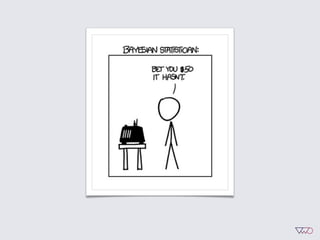
BAYESIAN STATISTICS
Chris Stucchio
@stucchio
https://chrisstucchio.com
| https://github.com/stucchio
09 Oct 2015
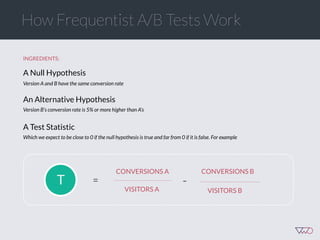
INGREDIENTS:
A Null Hypothesis
Version A and B have the same conversion rate
An Alternative Hypothesis
Version B’s conversion rate is 5% or more higher than A’s
A Test Statistic
Which we expect to be close to 0 if the null hypothesis is true and far from 0 if it is false. For example
T =
CONVERSIONS A
VISITORS A
CONVERSIONS B
VISITORS B
-
How Frequentist A/B Tests Work
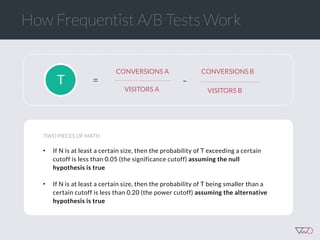
• If N is at least a certain size, then the probability of T exceeding a certain
cutoff is less than 0.05 (the significance cutoff) assuming the null
hypothesis is true
• If N is at least a certain size, then the probability of T being smaller than a
certain cutoff is less than 0.20 (the power cutoff) assuming the alternative
hypothesis is true
TWO PIECES OF MATH
T =
CONVERSIONS A
VISITORS A
CONVERSIONS B
VISITORS B
-
How Frequentist A/B Tests Work
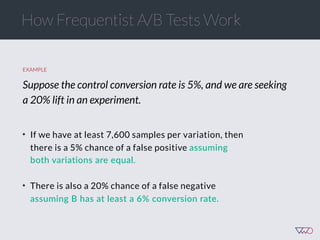
Suppose the control conversion rate is 5%, and we are seeking
a 20% lift in an experiment.
EXAMPLE
• If we have at least 7,600 samples per variation, then
there is a 5% chance of a false positive assuming  
both  variations  are  equal.    
• There is also a 20% chance of a false negative
assuming  B  has  at  least  a  6%  conversion  rate.  
How Frequentist A/B Tests Work
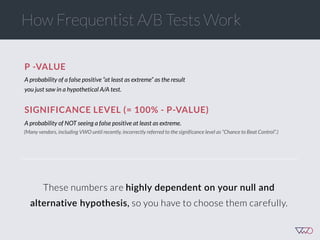
P -VALUE
A probability of a false positive “at least as extreme” as the result
you just saw in a hypothetical A/A test.
SIGNIFICANCE LEVEL (= 100% - P-VALUE)
A probability of NOT seeing a false positive at least as extreme.
These numbers are highly  dependent  on  your  null  and  
alternative  hypothesis, so you have to choose them carefully.
How Frequentist A/B Tests Work
(Many vendors, including VWO until recently, incorrectly referred to the significance level as “Chance to Beat Control”.)
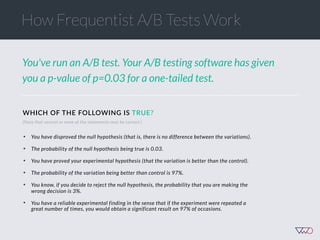
You've run an A/B test. Your A/B testing software has given
you a p-value of p=0.03 for a one-tailed test.
(Note that several or none of the statements may be correct.)
• You have disproved the null hypothesis (that is, there is no difference between the variations).
• The probability of the null hypothesis being true is 0.03.
• You have proved your experimental hypothesis (that the variation is better than the control).
• The probability of the variation being better than control is 97%.
• You know, if you decide to reject the null hypothesis, the probability that you are making the
wrong decision is 3%.
• You have a reliable experimental finding in the sense that if the experiment were repeated a
great number of times, you would obtain a significant result on 97% of occasions.
WHICH  OF  THE  FOLLOWING  IS  TRUE?
How Frequentist A/B Tests Work
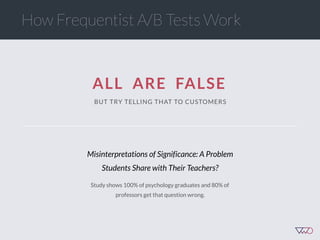
ALL ARE FALSE
BUT TRY TELLING THAT TO CUSTOMERS
Study shows 100% of psychology graduates and 80% of
professors get that question wrong.
Misinterpretations of Significance: A Problem
Students Share with Their Teachers?
How Frequentist A/B Tests Work
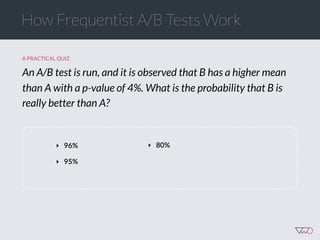
A PRACTICAL QUIZ
An A/B test is run, and it is observed that B has a higher mean
than A with a p-value of 4%. What is the probability that B is
really better than A?
‣ 96%  
‣ 95%
‣ 80%
How Frequentist A/B Tests Work
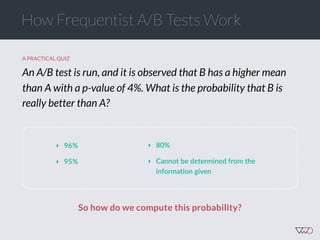
So how do we compute this probability?
A PRACTICAL QUIZ
An A/B test is run, and it is observed that B has a higher mean
than A with a p-value of 4%. What is the probability that B is
really better than A?
How Frequentist A/B Tests Work
‣ 96%  
‣ 95%
‣ 80%  
‣ Cannot  be  determined  from  the  
information  given
OUR FIRST BAYESIAN
CALCULATION
Make unrealistic  assumptions to simplify  the  math.
(This is a pedagogical exercise.)
ASSUME THERE ARE ONLY TWO POSSIBILITIES IN THE WORLD
• Null Hypothesis (Control and Variation are Equal)
• Alternate Hypothesis (Variation beats control by at least 20%)
WE  WILL  ASSUME  EACH  OF  THESE  OCCURS  WITH  FIXED  PROBABILITY
How Frequentist A/B Tests Work
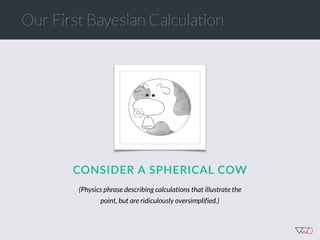
CONSIDER  A  SPHERICAL  COW
(Physics phrase describing calculations that illustrate the
point, but are ridiculously oversimplified.)
Our First Bayesian Calculation
Need to know base rate - fraction of A/B tests which actually
have true result.
Suppose base rate is 5% - i.e., 95%  of  ideas  suck.    
This means exactly 5%  of  tests have a variation which is
20%  better  than  control, and 95%  of  tests  have  a  
variation  identical  to  control.
Our First Bayesian Calculation
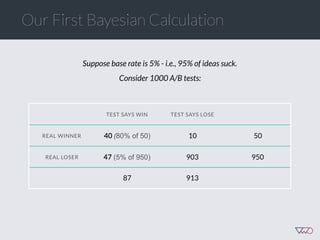
TEST SAYS WIN TEST SAYS LOSE
REAL WINNER 40 (80% of 50) 10 50
REAL LOSER 47  (5% of 950) 903 950
87 913
Suppose base rate is 5% - i.e., 95% of ideas suck.
Consider 1000 A/B tests:
Our First Bayesian Calculation
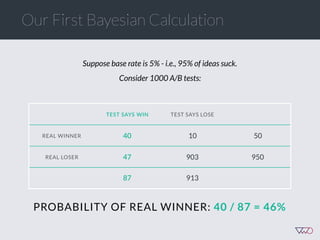
PROBABILITY OF REAL WINNER: 40 / 87 = 46%
TEST  SAYS  WIN TEST SAYS LOSE
REAL WINNER 40 10 50
REAL LOSER 47 903 950
87 913
Suppose base rate is 5% - i.e., 95% of ideas suck.
Consider 1000 A/B tests:
Our First Bayesian Calculation
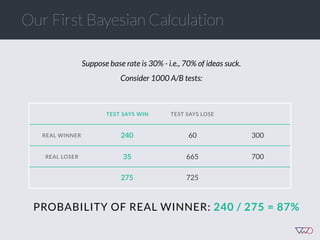
PROBABILITY OF REAL WINNER: 240 / 275 = 87%
TEST  SAYS  WIN TEST SAYS LOSE
REAL WINNER 240 60 300
REAL LOSER 35 665 700
275 725
Suppose base rate is 30% - i.e., 70% of ideas suck.
Consider 1000 A/B tests:
Our First Bayesian Calculation
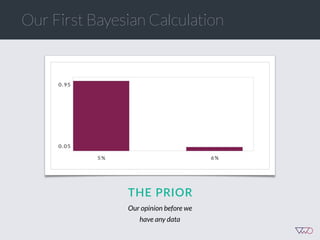
THE  PRIOR
Our opinion before we
have any data
- PAUL SAMUELSON
When events change,I change my mind.
What  do  you  do?
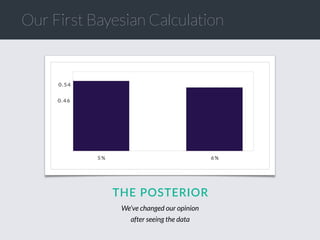
Our First Bayesian Calculation
THE  POSTERIOR
We’ve changed our opinion
after seeing the data
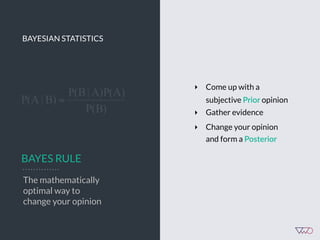
BAYESIAN STATISTICS
‣ Come up with a
subjective Prior opinion
‣ Gather evidence
‣ Change your opinion
and form a Posterior
BAYES RULE
The mathematically
optimal way to
change your opinion
IMPROVING  THE  ACCURACY  OF  OUR  MODEL
Unrealistic Assumptions
• Only possible conversion rates are 5% and 6% - why not
4.3% or 5.5%?
• Ignores cost/benefit. If B has a 3% conversion rate,
choosing it is very bad. If B has a 4.99% conversion rate,
choosing it is almost harmless.
• Results in previous test based on looking at results only
once, then making decision. Our  users  check  test  
results  every  day.  
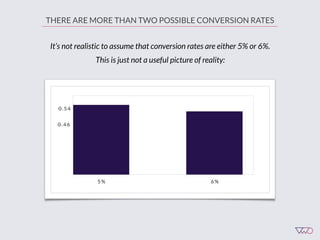
THERE ARE MORE THAN TWO POSSIBLE CONVERSION RATES
It’s not realistic to assume that conversion rates are either 5% or 6%.
This is just not a useful picture of reality:
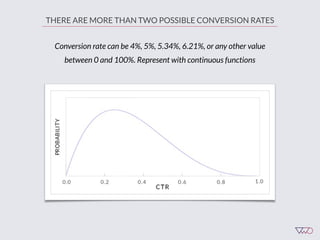
THERE ARE MORE THAN TWO POSSIBLE CONVERSION RATES
Conversion rate can be 4%, 5%, 5.34%, 6.21%, or any other value
between 0 and 100%. Represent with continuous functions
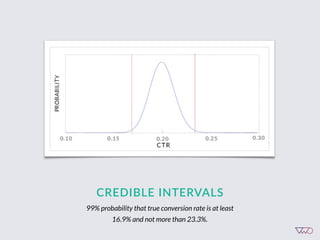
CREDIBLE  INTERVALS
99% probability that true conversion rate is at least
16.9% and not more than 23.3%.
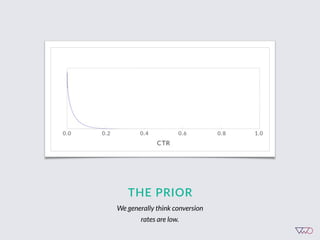
THE  PRIOR
We generally think conversion
rates are low.
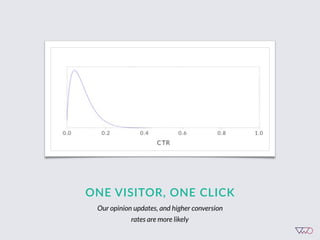
ONE  VISITOR,  ONE  CLICK
Our opinion updates, and higher conversion
rates are more likely
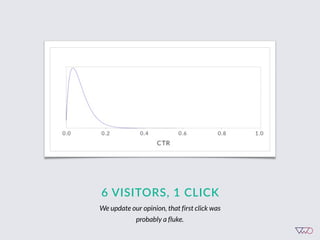
6  VISITORS,  1  CLICK
We update our opinion, that first click was
probably a fluke.
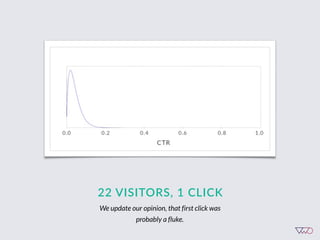
22  VISITORS,  1  CLICK
We update our opinion, that first click was
probably a fluke.
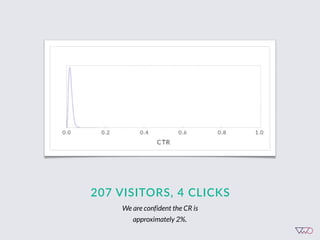
207  VISITORS,  4  CLICKS
We are confident the CR is
approximately 2%.
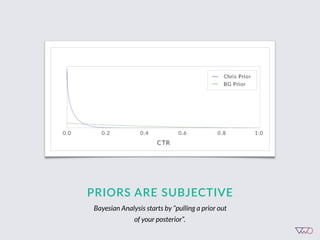
PRIORS  ARE  SUBJECTIVE
Bayesian Analysis starts by “pulling a prior out
of your posterior”.
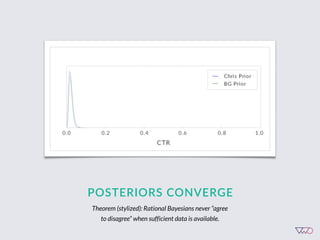
POSTERIORS  CONVERGE
Theorem (stylized): Rational Bayesians never “agree
to disagree” when sufficient data is available.
JOINT POSTERIORS - REPRESENTING ALL VARIATIONS
So far we only form opinions about conversion
rate of one variation.
Need to represent probability of things like “conversion
rate of A is 4.5% and conversion rate of B is 6.3%”.
SOLUTION IS CALLED
JOINT POSTERIOR
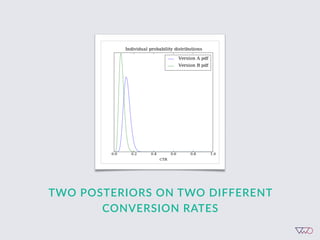
TWO  POSTERIORS  ON  TWO  DIFFERENT  
CONVERSION  RATES
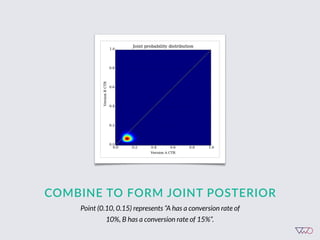
COMBINE  TO  FORM  JOINT  POSTERIOR
Point (0.10, 0.15) represents “A has a conversion rate of
10%, B has a conversion rate of 15%”.
Opinions About the World
• Start with an uneducated opinion, the  prior.  
• Gather data.
• Change your opinion and end up educated
with a posterior.  
MAKING DECISIONS
Maximize Revenue, don’t Test for Truth
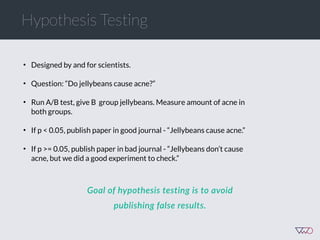
• Designed by and for scientists.
• Question: “Do jellybeans cause acne?”
• Run A/B test, give B group jellybeans. Measure amount of acne in
both groups.
• If p < 0.05, publish paper in good journal - “Jellybeans cause acne.”
• If p >= 0.05, publish paper in bad journal - “Jellybeans don’t cause
acne, but we did a good experiment to check.”
Hypothesis Testing
Goal  of  hypothesis  testing  is  to  avoid  
publishing  false  results.
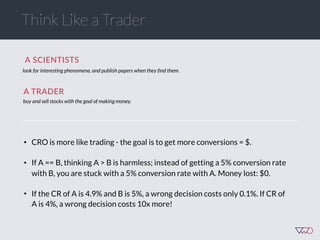
Think Like a Trader
look for interesting phenomena, and publish papers when they find them.
• CRO is more like trading - the goal is to get more conversions = $.
• If A == B, thinking A > B is harmless; instead of getting a 5% conversion rate
with B, you are stuck with a 5% conversion rate with A. Money lost: $0.
• If the CR of A is 4.9% and B is 5%, a wrong decision costs only 0.1%. If CR of
A is 4%, a wrong decision costs 10x more!
buy and sell stocks with the goal of making money.
A  SCIENTISTS  
A  TRADER  
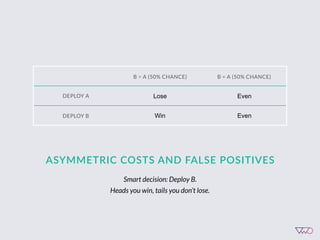
B > A (50% CHANCE) B = A (50% CHANCE)
DEPLOY A Lose Even
DEPLOY B Win Even
ASYMMETRIC  COSTS  AND  FALSE  POSITIVES
Smart decision: Deploy B.
Heads you win, tails you don’t lose.
Cost of a Mistake
Suppose we choose variation x. The cost of this choice is:
Loss[x] = Max (CR[i] - CR[x])
This is simple opportunity cost - it’s the difference
between the best choice and our choice.
Key point: bigger mistakes cost us more money.
Cost of a Mistake
EXAMPLE
A. 5%
‣ Loss[A] = Max(5% - 5%, 6% - 5%, 4.5% - 5%) = 1%
‣ Loss[B] = Max(5% - 6%, 6% - 6%, 4.5% - 6%) = 0%
‣ Loss[C] = Max(5% - 4.5%, 6% - 4.5%, 4.5% - 4.5%) = 1.5%
B. 6% C. 4.5%
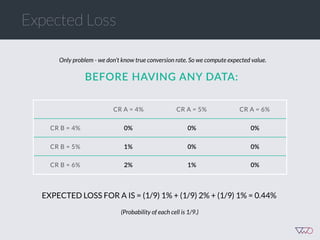
Expected Loss
CR A = 4% CR A = 5% CR A = 6%
CR B = 4% 0% 0% 0%
CR B = 5% 1% 0% 0%
CR B = 6% 2% 1% 0%
BEFORE  HAVING  ANY  DATA:  
Only problem - we don’t know true conversion rate. So we compute expected value.
EXPECTED LOSS FOR A IS = (1/9) 1% + (1/9) 2% + (1/9) 1% = 0.44%
(Probability of each cell is 1/9.)
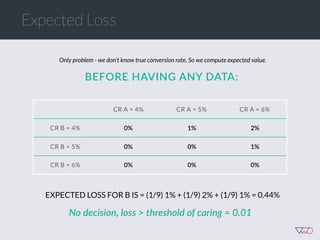
Expected Loss
CR A = 4% CR A = 5% CR A = 6%
CR B = 4% 0% 1% 2%
CR B = 5% 0% 0% 1%
CR B = 6% 0% 0% 0%
BEFORE  HAVING  ANY  DATA:  
Only problem - we don’t know true conversion rate. So we compute expected value.
EXPECTED LOSS FOR B IS = (1/9) 1% + (1/9) 2% + (1/9) 1% = 0.44%
No  decision,  loss  >  threshold  of  caring  =  0.01
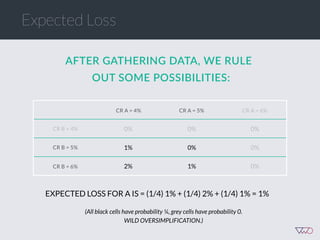
Expected Loss
EXPECTED LOSS FOR A IS = (1/4) 1% + (1/4) 2% + (1/4) 1% = 1%
AFTER  GATHERING  DATA,  WE  RULE  
OUT  SOME  POSSIBILITIES:  
(All black cells have probability ¼, grey cells have probability 0.
WILD OVERSIMPLIFICATION.)
CR A = 4% CR A = 5% CR A = 6%
CR B = 4% 0% 0% 0%
CR B = 5% 1% 0% 0%
CR B = 6% 2% 1% 0%
Expected Loss
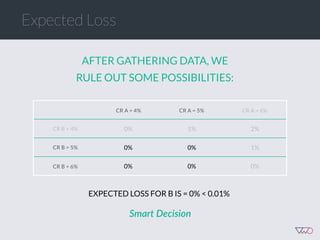
EXPECTED LOSS FOR B IS = 0% < 0.01%
AFTER GATHERING DATA, WE
RULE OUT SOME POSSIBILITIES:
CR A = 4% CR A = 5% CR A = 6%
CR B = 4% 0% 1% 2%
CR B = 5% 0% 0% 1%
CR B = 6% 0% 0% 0%
Smart  Decision
How to run a Bayesian A/B test
• Identify a threshold  of  caring - a value so small that if your conversion rate
drops by less than this, you don’t care.
• Example: I sell $10,000 of product/week on a 2% conversion rate. A 0.05%
threshold of caring corresponds to a $250/week change in revenue.
• Run A/B test.
• Periodically (not more than once a week!) compute the expected loss for
each variation. If the expected loss for some variation drops below the
threshold of caring, deploy  that  variation.
NOT  NECESSARILY  A  WINNER,  BUT  IT  WON’T  LOSE.  
Advantages
• Bayesian tests are insensitive to peeking - it’s fine to stop a test early.
• “Chance to beat control” is really the chance that a variation is better than
the control
• Get additional numbers, e.g. chance  to  beat  all  - what is the probability that
B is better than A, C and D?
• Credible intervals bound uncertainty - when a winner is deployed, you’ll be
told “variation B is between 0.01% and 25% better than A”. (Confidence
intervals do NOT provide this information.)
• Easy to understand and extend. Is there a cost of switching? Want to account
for other factors? Just include it in the loss function. (Question asked by
Denis @ booking.com, and in Bayesian framework answer was obvious.)
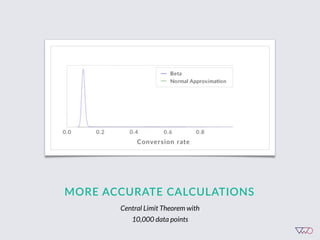
MORE  ACCURATE  CALCULATIONS  
Central Limit Theorem with
10,000 data points
MORE  ACCURATE  CALCULATIONS  
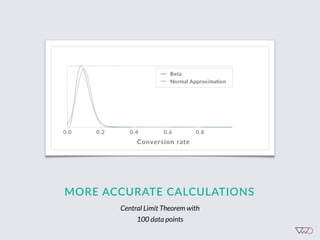
Central Limit Theorem with
100 data points
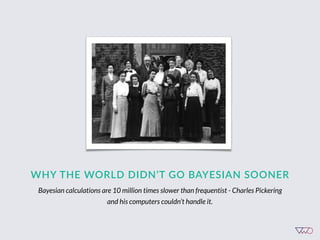
WHY  THE  WORLD  DIDN’T  GO  BAYESIAN  SOONER
Bayesian calculations are 10 million times slower than frequentist - Charles Pickering
and his computers couldn’t handle it.
Thank You !
For any questions, you can talk to us at
chris@wingify.com
@stucchio

Chris Stuccio - Data science - Conversion Hotel 2015

  • 1.
  • 2.
    INGREDIENTS: A Null Hypothesis VersionA and B have the same conversion rate An Alternative Hypothesis Version B’s conversion rate is 5% or more higher than A’s A Test Statistic Which we expect to be close to 0 if the null hypothesis is true and far from 0 if it is false. For example T = CONVERSIONS A VISITORS A CONVERSIONS B VISITORS B - How Frequentist A/B Tests Work
  • 3.
    • If Nis at least a certain size, then the probability of T exceeding a certain cutoff is less than 0.05 (the significance cutoff) assuming the null hypothesis is true • If N is at least a certain size, then the probability of T being smaller than a certain cutoff is less than 0.20 (the power cutoff) assuming the alternative hypothesis is true TWO PIECES OF MATH T = CONVERSIONS A VISITORS A CONVERSIONS B VISITORS B - How Frequentist A/B Tests Work
  • 4.
    Suppose the controlconversion rate is 5%, and we are seeking a 20% lift in an experiment. EXAMPLE • If we have at least 7,600 samples per variation, then there is a 5% chance of a false positive assuming   both  variations  are  equal.     • There is also a 20% chance of a false negative assuming  B  has  at  least  a  6%  conversion  rate.   How Frequentist A/B Tests Work
  • 5.
    P -VALUE A probabilityof a false positive “at least as extreme” as the result you just saw in a hypothetical A/A test. SIGNIFICANCE LEVEL (= 100% - P-VALUE) A probability of NOT seeing a false positive at least as extreme. These numbers are highly  dependent  on  your  null  and   alternative  hypothesis, so you have to choose them carefully. How Frequentist A/B Tests Work (Many vendors, including VWO until recently, incorrectly referred to the significance level as “Chance to Beat Control”.)
  • 6.
    You've run anA/B test. Your A/B testing software has given you a p-value of p=0.03 for a one-tailed test. (Note that several or none of the statements may be correct.) • You have disproved the null hypothesis (that is, there is no difference between the variations). • The probability of the null hypothesis being true is 0.03. • You have proved your experimental hypothesis (that the variation is better than the control). • The probability of the variation being better than control is 97%. • You know, if you decide to reject the null hypothesis, the probability that you are making the wrong decision is 3%. • You have a reliable experimental finding in the sense that if the experiment were repeated a great number of times, you would obtain a significant result on 97% of occasions. WHICH  OF  THE  FOLLOWING  IS  TRUE? How Frequentist A/B Tests Work
  • 7.
    ALL ARE FALSE BUTTRY TELLING THAT TO CUSTOMERS Study shows 100% of psychology graduates and 80% of professors get that question wrong. Misinterpretations of Significance: A Problem Students Share with Their Teachers? How Frequentist A/B Tests Work
  • 8.
    A PRACTICAL QUIZ AnA/B test is run, and it is observed that B has a higher mean than A with a p-value of 4%. What is the probability that B is really better than A? ‣ 96%   ‣ 95% ‣ 80% How Frequentist A/B Tests Work
  • 9.
    So how dowe compute this probability? A PRACTICAL QUIZ An A/B test is run, and it is observed that B has a higher mean than A with a p-value of 4%. What is the probability that B is really better than A? How Frequentist A/B Tests Work ‣ 96%   ‣ 95% ‣ 80%   ‣ Cannot  be  determined  from  the   information  given
  • 10.
  • 11.
    Make unrealistic  assumptionsto simplify  the  math. (This is a pedagogical exercise.) ASSUME THERE ARE ONLY TWO POSSIBILITIES IN THE WORLD • Null Hypothesis (Control and Variation are Equal) • Alternate Hypothesis (Variation beats control by at least 20%) WE  WILL  ASSUME  EACH  OF  THESE  OCCURS  WITH  FIXED  PROBABILITY How Frequentist A/B Tests Work
  • 12.
    CONSIDER  A  SPHERICAL COW (Physics phrase describing calculations that illustrate the point, but are ridiculously oversimplified.) Our First Bayesian Calculation
  • 13.
    Need to knowbase rate - fraction of A/B tests which actually have true result. Suppose base rate is 5% - i.e., 95%  of  ideas  suck.     This means exactly 5%  of  tests have a variation which is 20%  better  than  control, and 95%  of  tests  have  a   variation  identical  to  control. Our First Bayesian Calculation
  • 14.
    TEST SAYS WINTEST SAYS LOSE REAL WINNER 40 (80% of 50) 10 50 REAL LOSER 47  (5% of 950) 903 950 87 913 Suppose base rate is 5% - i.e., 95% of ideas suck. Consider 1000 A/B tests: Our First Bayesian Calculation
  • 15.
    PROBABILITY OF REALWINNER: 40 / 87 = 46% TEST  SAYS  WIN TEST SAYS LOSE REAL WINNER 40 10 50 REAL LOSER 47 903 950 87 913 Suppose base rate is 5% - i.e., 95% of ideas suck. Consider 1000 A/B tests: Our First Bayesian Calculation
  • 16.
    PROBABILITY OF REALWINNER: 240 / 275 = 87% TEST  SAYS  WIN TEST SAYS LOSE REAL WINNER 240 60 300 REAL LOSER 35 665 700 275 725 Suppose base rate is 30% - i.e., 70% of ideas suck. Consider 1000 A/B tests: Our First Bayesian Calculation
  • 17.
    Our First BayesianCalculation THE  PRIOR Our opinion before we have any data
  • 18.
    - PAUL SAMUELSON Whenevents change,I change my mind. What  do  you  do?
  • 19.
    Our First BayesianCalculation THE  POSTERIOR We’ve changed our opinion after seeing the data
  • 20.
    BAYESIAN STATISTICS ‣ Comeup with a subjective Prior opinion ‣ Gather evidence ‣ Change your opinion and form a Posterior BAYES RULE The mathematically optimal way to change your opinion
  • 21.
    IMPROVING  THE  ACCURACY OF  OUR  MODEL
  • 22.
    Unrealistic Assumptions • Onlypossible conversion rates are 5% and 6% - why not 4.3% or 5.5%? • Ignores cost/benefit. If B has a 3% conversion rate, choosing it is very bad. If B has a 4.99% conversion rate, choosing it is almost harmless. • Results in previous test based on looking at results only once, then making decision. Our  users  check  test   results  every  day.  
  • 23.
    THERE ARE MORETHAN TWO POSSIBLE CONVERSION RATES It’s not realistic to assume that conversion rates are either 5% or 6%. This is just not a useful picture of reality:
  • 24.
    THERE ARE MORETHAN TWO POSSIBLE CONVERSION RATES Conversion rate can be 4%, 5%, 5.34%, 6.21%, or any other value between 0 and 100%. Represent with continuous functions
  • 25.
    CREDIBLE  INTERVALS 99% probabilitythat true conversion rate is at least 16.9% and not more than 23.3%.
  • 26.
    THE  PRIOR We generallythink conversion rates are low.
  • 27.
    ONE  VISITOR,  ONE CLICK Our opinion updates, and higher conversion rates are more likely
  • 28.
    6  VISITORS,  1 CLICK We update our opinion, that first click was probably a fluke.
  • 29.
    22  VISITORS,  1 CLICK We update our opinion, that first click was probably a fluke.
  • 30.
    207  VISITORS,  4 CLICKS We are confident the CR is approximately 2%.
  • 31.
    PRIORS  ARE  SUBJECTIVE BayesianAnalysis starts by “pulling a prior out of your posterior”.
  • 32.
    POSTERIORS  CONVERGE Theorem (stylized):Rational Bayesians never “agree to disagree” when sufficient data is available.
  • 33.
    JOINT POSTERIORS -REPRESENTING ALL VARIATIONS So far we only form opinions about conversion rate of one variation. Need to represent probability of things like “conversion rate of A is 4.5% and conversion rate of B is 6.3%”. SOLUTION IS CALLED JOINT POSTERIOR
  • 34.
    TWO  POSTERIORS  ON TWO  DIFFERENT   CONVERSION  RATES
  • 35.
    COMBINE  TO  FORM JOINT  POSTERIOR Point (0.10, 0.15) represents “A has a conversion rate of 10%, B has a conversion rate of 15%”.
  • 36.
    Opinions About theWorld • Start with an uneducated opinion, the  prior.   • Gather data. • Change your opinion and end up educated with a posterior.  
  • 37.
    MAKING DECISIONS Maximize Revenue,don’t Test for Truth
  • 38.
    • Designed byand for scientists. • Question: “Do jellybeans cause acne?” • Run A/B test, give B group jellybeans. Measure amount of acne in both groups. • If p < 0.05, publish paper in good journal - “Jellybeans cause acne.” • If p >= 0.05, publish paper in bad journal - “Jellybeans don’t cause acne, but we did a good experiment to check.” Hypothesis Testing Goal  of  hypothesis  testing  is  to  avoid   publishing  false  results.
  • 39.
    Think Like aTrader look for interesting phenomena, and publish papers when they find them. • CRO is more like trading - the goal is to get more conversions = $. • If A == B, thinking A > B is harmless; instead of getting a 5% conversion rate with B, you are stuck with a 5% conversion rate with A. Money lost: $0. • If the CR of A is 4.9% and B is 5%, a wrong decision costs only 0.1%. If CR of A is 4%, a wrong decision costs 10x more! buy and sell stocks with the goal of making money. A  SCIENTISTS   A  TRADER  
  • 40.
    B > A(50% CHANCE) B = A (50% CHANCE) DEPLOY A Lose Even DEPLOY B Win Even ASYMMETRIC  COSTS  AND  FALSE  POSITIVES Smart decision: Deploy B. Heads you win, tails you don’t lose.
  • 41.
    Cost of aMistake Suppose we choose variation x. The cost of this choice is: Loss[x] = Max (CR[i] - CR[x]) This is simple opportunity cost - it’s the difference between the best choice and our choice. Key point: bigger mistakes cost us more money.
  • 42.
    Cost of aMistake EXAMPLE A. 5% ‣ Loss[A] = Max(5% - 5%, 6% - 5%, 4.5% - 5%) = 1% ‣ Loss[B] = Max(5% - 6%, 6% - 6%, 4.5% - 6%) = 0% ‣ Loss[C] = Max(5% - 4.5%, 6% - 4.5%, 4.5% - 4.5%) = 1.5% B. 6% C. 4.5%
  • 43.
    Expected Loss CR A= 4% CR A = 5% CR A = 6% CR B = 4% 0% 0% 0% CR B = 5% 1% 0% 0% CR B = 6% 2% 1% 0% BEFORE  HAVING  ANY  DATA:   Only problem - we don’t know true conversion rate. So we compute expected value. EXPECTED LOSS FOR A IS = (1/9) 1% + (1/9) 2% + (1/9) 1% = 0.44% (Probability of each cell is 1/9.)
  • 44.
    Expected Loss CR A= 4% CR A = 5% CR A = 6% CR B = 4% 0% 1% 2% CR B = 5% 0% 0% 1% CR B = 6% 0% 0% 0% BEFORE  HAVING  ANY  DATA:   Only problem - we don’t know true conversion rate. So we compute expected value. EXPECTED LOSS FOR B IS = (1/9) 1% + (1/9) 2% + (1/9) 1% = 0.44% No  decision,  loss  >  threshold  of  caring  =  0.01
  • 45.
    Expected Loss EXPECTED LOSSFOR A IS = (1/4) 1% + (1/4) 2% + (1/4) 1% = 1% AFTER  GATHERING  DATA,  WE  RULE   OUT  SOME  POSSIBILITIES:   (All black cells have probability ¼, grey cells have probability 0. WILD OVERSIMPLIFICATION.) CR A = 4% CR A = 5% CR A = 6% CR B = 4% 0% 0% 0% CR B = 5% 1% 0% 0% CR B = 6% 2% 1% 0%
  • 46.
    Expected Loss EXPECTED LOSSFOR B IS = 0% < 0.01% AFTER GATHERING DATA, WE RULE OUT SOME POSSIBILITIES: CR A = 4% CR A = 5% CR A = 6% CR B = 4% 0% 1% 2% CR B = 5% 0% 0% 1% CR B = 6% 0% 0% 0% Smart  Decision
  • 47.
    How to runa Bayesian A/B test • Identify a threshold  of  caring - a value so small that if your conversion rate drops by less than this, you don’t care. • Example: I sell $10,000 of product/week on a 2% conversion rate. A 0.05% threshold of caring corresponds to a $250/week change in revenue. • Run A/B test. • Periodically (not more than once a week!) compute the expected loss for each variation. If the expected loss for some variation drops below the threshold of caring, deploy  that  variation. NOT  NECESSARILY  A  WINNER,  BUT  IT  WON’T  LOSE.  
  • 48.
    Advantages • Bayesian testsare insensitive to peeking - it’s fine to stop a test early. • “Chance to beat control” is really the chance that a variation is better than the control • Get additional numbers, e.g. chance  to  beat  all  - what is the probability that B is better than A, C and D? • Credible intervals bound uncertainty - when a winner is deployed, you’ll be told “variation B is between 0.01% and 25% better than A”. (Confidence intervals do NOT provide this information.) • Easy to understand and extend. Is there a cost of switching? Want to account for other factors? Just include it in the loss function. (Question asked by Denis @ booking.com, and in Bayesian framework answer was obvious.)
  • 49.
    MORE  ACCURATE  CALCULATIONS  Central Limit Theorem with 10,000 data points
  • 50.
    MORE  ACCURATE  CALCULATIONS  Central Limit Theorem with 100 data points
  • 51.
    WHY  THE  WORLD DIDN’T  GO  BAYESIAN  SOONER Bayesian calculations are 10 million times slower than frequentist - Charles Pickering and his computers couldn’t handle it.
  • 55.
    Thank You ! Forany questions, you can talk to us at chris@wingify.com @stucchio