Children’s Interstitial Lung
Disease (ChILD):
Clinical Overview
Leland L. Fan, MD
2/7/15
Disclosures
• I receive royalties for writing
topics for UpToDate
Interstitial Lung Disease (ILD),
also known as diffuse lung disease, includes
large, heterogeneous group of rare pulmonary
disorders that cause derangements of the
alveolar wall and disordered gas exchange
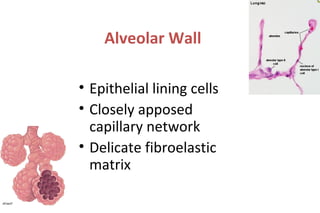
Alveolar Wall
• Epithelial lining cells
• Closely apposed
capillary network
• Delicate fibroelastic
matrix
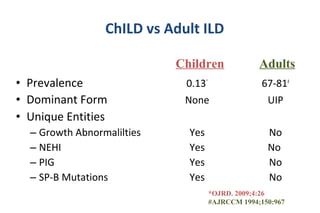
• Prevalence 0.13*
67-81#
• Dominant Form None UIP
• Unique Entities
– Growth Abnormalilties Yes No
– NEHI Yes No
– PIG Yes No
– SP-B Mutations Yes No
ChILD vs Adult ILD
Children Adults
*OJRD. 2009;4:26
#AJRCCM 1994;150:967
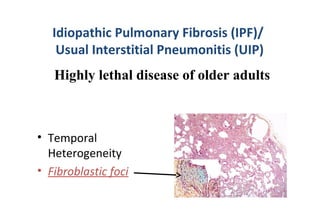
Idiopathic Pulmonary Fibrosis (IPF)/
Usual Interstitial Pneumonitis (UIP)
• Temporal
Heterogeneity
• Fibroblastic foci
Highly lethal disease of older adults
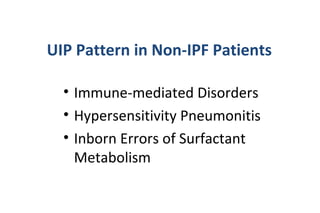
UIP Pattern in Non-IPF Patients
• Immune-mediated Disorders
• Hypersensitivity Pneumonitis
• Inborn Errors of Surfactant
Metabolism
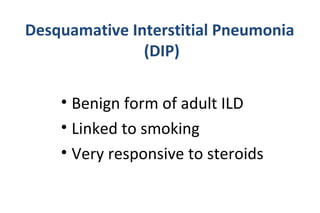
Desquamative Interstitial Pneumonia
(DIP)
• Benign form of adult ILD
• Linked to smoking
• Very responsive to steroids
• Nothing known at the time
• Pediatricians assumed these were
pediatric examples of ILD types
described in adults
• Numerous cases reported as DIP, UIP,
IPF, and CFA
Early Cases of ChILD
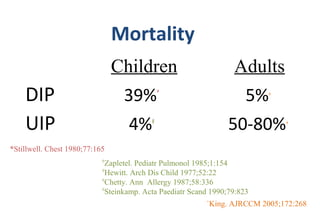
Mortality
DIP 39%*
5%+
UIP 4%#
50-80%+
Children Adults
#
Zapletel. Pediatr Pulmonol 1985;1:154
#
Hewitt. Arch Dis Child 1977;52:22
#
Chetty. Ann Allergy 1987;58:336
#
Steinkamp. Acta Paediatr Scand 1990;79:823
*Stillwell. Chest 1980;77:165
+
King. AJRCCM 2005;172:268
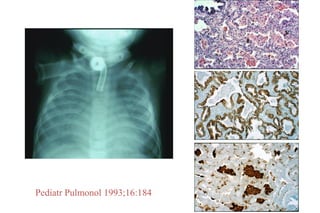
Pediatr Pulmonol 1993;16:184
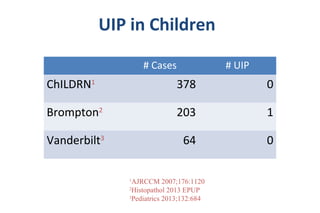
UIP in Children
1
AJRCCM 2007;176:1120
2
Histopathol 2013 EPUP
3
Pediatrics 2013;132:684
# Cases # UIP
ChILDRN1
378 0
Brompton2
203 1
Vanderbilt3
64 0
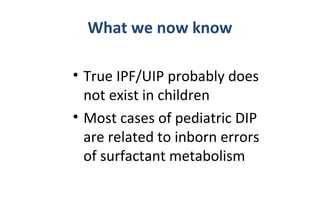
What we now know
• True IPF/UIP probably does
not exist in children
• Most cases of pediatric DIP
are related to inborn errors
of surfactant metabolism
ChILD
can be very difficult to diagnose
and treat, and is associated
with significant morbidity and
mortality.
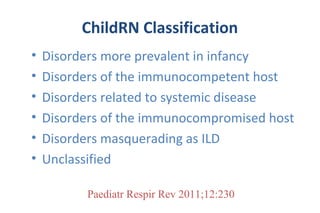
ChildRN Classification
• Disorders more prevalent in infancy
• Disorders of the immunocompetent host
• Disorders related to systemic disease
• Disorders of the immunocompromised host
• Disorders masquerading as ILD
• Unclassified
Paediatr Respir Rev 2011;12:230
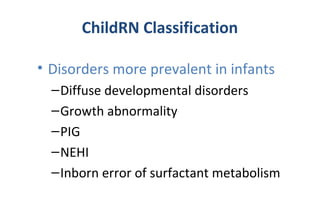
ChildRN Classification
• Disorders more prevalent in infants
–Diffuse developmental disorders
–Growth abnormality
–PIG
–NEHI
–Inborn error of surfactant metabolism
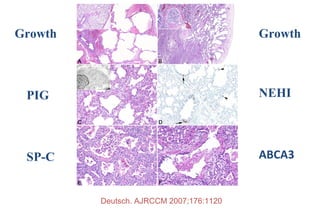
Growth
PIG
SP-C
NEHI
Growth
ABCA3
Deutsch. AJRCCM 2007;176:1120
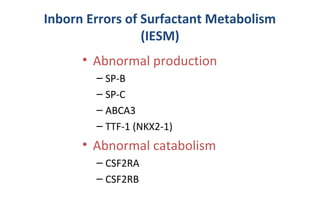
Inborn Errors of Surfactant Metabolism
(IESM)
• Abnormal production
– SP-B
– SP-C
– ABCA3
– TTF-1 (NKX2-1)
• Abnormal catabolism
– CSF2RA
– CSF2RB
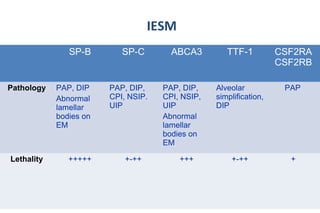
SP-B SP-C ABCA3 TTF-1 CSF2RA
CSF2RB
Pathology PAP, DIP
Abnormal
lamellar
bodies on
EM
PAP, DIP,
CPI, NSIP.
UIP
PAP, DIP,
CPI, NSIP,
UIP
Abnormal
lamellar
bodies on
EM
Alveolar
simplification,
DIP
PAP
Lethality +++++ +-++ +++ +-++ +
IESM
An Official American Thoracic Society Clinical Practice
Guideline: Classification, Evaluation, and Management of
Childhood Interstitial Lung Disease in Infancy
Geoffrey Kurland, Robin R. Deterding, James S. Hagood, Lisa R. Young, Alan S. Brody, Robert G.
Castile, Sharon Dell, Leland L. Fan, Aaron Hamvas, Bettina C. Hilman, Claire Langston, Lawrence
M. Nogee, and Gregory J. Redding; on behalf of the American Thoracic Society Committee on
Childhood Interstitial Lung Disease (chILD) and the chILD Research Network
Am J Respir Crit Care Med 2013;188:376
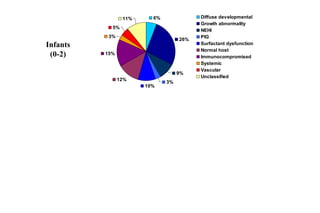
6%
26%
9%
3%
10%
12%
15%
3%
5%
11% Diffuse developmental
Growth abnormality
NEHI
PIG
Surfactant dysfunction
Normal host
Immunocompromised
Systemic
Vascular
Unclassified
Infants
(0-2)
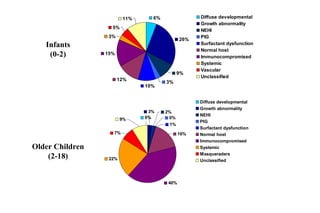
6%
26%
9%
3%
10%
12%
15%
3%
5%
11% Diffuse developmental
Growth abnormality
NEHI
PIG
Surfactant dysfunction
Normal host
Immunocompromised
Systemic
Vascular
Unclassified
40%
22%
16%
1%
0%
2%
0%
7%
9%
3%
Diffuse developmental
Growth abnormality
NEHI
PIG
Surfactant dysfunction
Normal host
Immunocompromised
Systemic
Masqueraders
Unclassified
Infants
(0-2)
Older Children
(2-18)
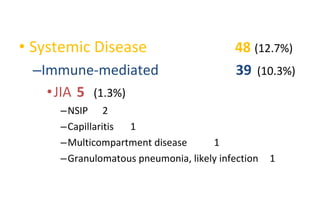
• Systemic Disease 48 (12.7%)
–Immune-mediated 39 (10.3%)
•JIA 5 (1.3%)
–NSIP 2
–Capillaritis 1
–Multicompartment disease 1
–Granulomatous pneumonia, likely infection 1
a systematic approach is essential
to the evaluation of ChILD.
With such a huge
differential diagnosis,
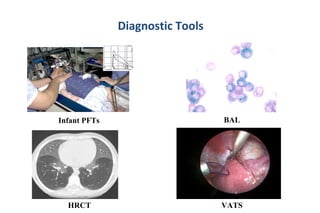
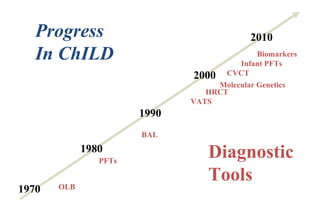
Diagnostic Tools
Infant PFTs
HRCT VATS
BAL
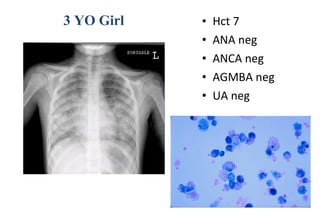
• Hct 7
• ANA neg
• ANCA neg
• AGMBA neg
• UA neg
3 YO Girl
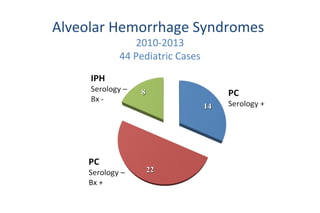
Alveolar Hemorrhage Syndromes

2010-2013
44 Pediatric Cases
2222
1414
88
1970
1990
2000
1980
BAL
VATS
HRCT
Molecular Genetics
PFTs
Infant PFTs
CVCT
OLB
Progress
In ChILD Biomarkers
2010
Diagnostic
Tools
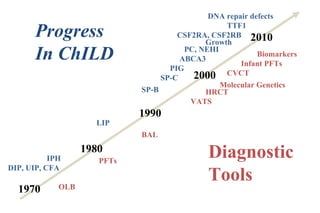
1970
1990
2000
DIP, UIP, CFA
1980
BAL
VATS
HRCTSP-B
Molecular Genetics
PFTs
Infant PFTs
PIG
ABCA3
SP-C
LIP
CVCT
OLB
Progress
In ChILD Biomarkers
2010Growth
CSF2RA, CSF2RB
DNA repair defects
TTF1
Diagnostic
Tools
PC, NEHI
IPH
1970
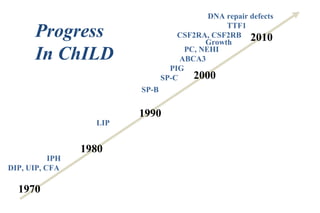
1990
2000
DIP, UIP, CFA
1980
SP-B
PIG
ABCA3
PC, NEHI
SP-C
LIP
2010Growth
CSF2RA, CSF2RB
DNA repair defects
TTF1
Progress
In ChILD
IPH
1970
1990
2000
DIP, UIP, CFA
1980
SP-B
PIG
ABCA3
PC, NEHI
SP-C
LIP
2010Growth
CSF2RA, CSF2RB
DNA repair defects
TTF1
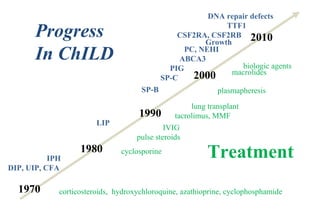
pulse steroids
corticosteroids, hydroxychloroquine, azathioprine, cyclophosphamide
IVIG
cyclosporine
lung transplant
biologic agents
tacrolimus, MMF
macrolides
Progress
In ChILD
Treatment
plasmapheresis
IPH
1970
1990
2000
DIP, UIP, CFA
1980
SP-B
PIG
ABCA3
SP-C
LIP
2010Growth
CSF2RA, CSF2RB
DNA repair defects
TTF1
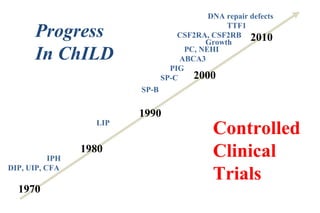
Progress
In ChILD
Controlled
Clinical
Trials
PC, NEHI
IPH
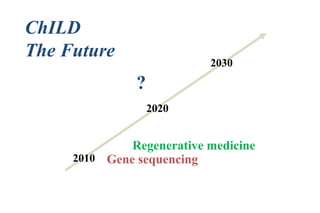
2020
ChILD
The Future
?
2030
2010
Regenerative medicine
Gene sequencing
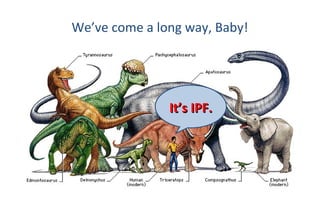
We’ve come a long way, Baby!
It’s IPF.It’s IPF.
Childrens Interstitial Lung Disease Clinical Overview

Childrens Interstitial Lung Disease Clinical Overview