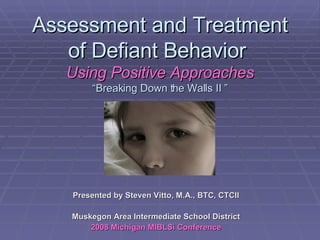
Assessment and Treatment of Defiant Behavior  Using Positive Approaches “Breaking Down the Walls II ” Presented by Steven Vitto, M.A., BTC, CTCII Muskegon Area Intermediate School District 2008 Michigan MIBLSi Conference
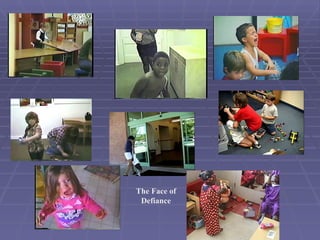
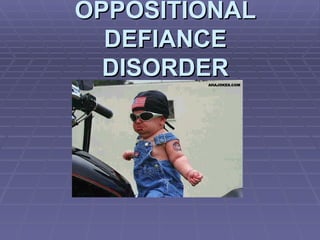
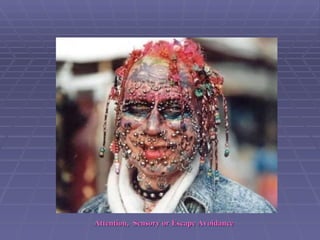
The Face of Defiance
The Evolution of Adversarial Relationships and Subversion  As aberrant behaviors begin to surface an unhealthy communication paradigm emerges A phone call home, a detention slip, a suspension THE STAGE IS SET
The Reaction Continuum “ My son wouldn’t do that!! “ I will punish him.” “  What do you expect me to do?” “ You guys are always kicking him out!! At this point a shift begins and the parent and school are at risk for developing an adversarial relationship. THE FIRST SIGNS “  He says other kids were doing the same thing  and nothing happened to them”
The Downward Spiral Without evidenced based decision making the school continues to respond in the only way they know how-punishment and exclusion. Without proper supports, the parent becomes trapped in a dilemma. Do I blame myself, my child, or the school? And a day comes when the parent begins to blame the school, and the real damage begins…
What Johnny Learns Johnny is becoming increasingly dis-enfranchised with school Johnny figures out that he if he tells his parents he was picked on, singled out, overly  or repeatedly punished, then his parents will begin to focus on the school rather than his behaviors. It becomes increasing probable for Johnny to misrepresent the school. He escapes punishment and takes the focus off of him. By blaming the school, the parents avoid blame, and are relieved of the feeling of helplessness, The end result:  a parent who rescues, defends, accuses a child who has a escape card-any time he wants to use it.
When Co morbidity Sets In The child with Social Maladjustment receives a diagnosis of ADHD The parent looking for something to explain all of the child’s behaviors focuses on the ADHD diagnosis The parents use the ADHD diagnosis to defend the child’s behavior at school Once again the child makes a connection. If I get in trouble, I can use my disability How do you know when this is happening? The child will say my disability caused the behavior! The challenge: to separate ADHD behavior and learned behavior.
THE SOLUTION 1 .  DON’T RELY ON A PUNISHMENT AT HOME FOR A BEHAVIOR THAT OCCURS AT SCHOOL-THE PHONE CALL. 2. WHEN YOU MEET, HAVE ALL THE PLAYERS IN THE ROOM TOGETHER. 3. DESIGNATE ONE COMMUNICATION POINT PERSON. 4. HAVE THE PLAN CLEARLY STATED. 5. DOCUMENT, DOCUMENT, DOCUMENT!! 6. AGREE TO ADVOCATE, AGREE TO DISAGREE BUT NEVER NEVER IN FRONT OF THE CHILD!!!! 7. FOR THE PARENT “WHO DOESN’T FOLLOW THROUGH,” FOCUS ON THE POSITIVES!!!!
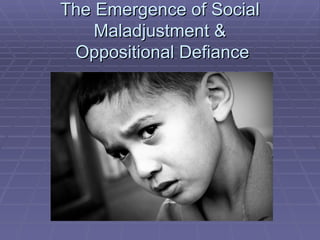
The Emergence of Social Maladjustment &  Oppositional Defiance
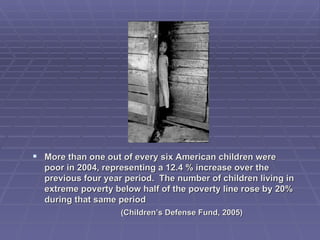
More than one out of every six American children were poor in 2004, representing a 12.4 % increase over the previous four year period.  The number of children living in extreme poverty below half of the poverty line rose by 20% during that same period  (Children’s Defense Fund, 2005)
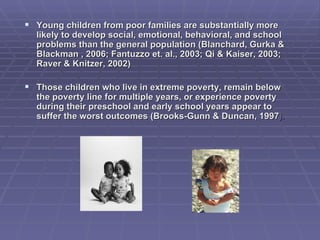
Young children from poor families are substantially more likely to develop social, emotional, behavioral, and school problems than the general population (Blanchard, Gurka & Blackman , 2006; Fantuzzo et. al., 2003; Qi & Kaiser, 2003; Raver & Knitzer, 2002)  Those children who live in extreme poverty, remain below the poverty line for multiple years, or experience poverty during their preschool and early school years appear to suffer the worst outcomes (Brooks-Gunn & Duncan, 1997 ).
Campbell (1995)  estimated  that approximately 10-15% of all typically developing preschool children have  chronic mild to moderate  levels of  behavior problems.   Children who are poor are much more likely to develop behavior problems with prevalence rates that approach 30% (Qi & Kaiser, 2003). Center for Evidence Based Practice: Young Children with Challenging Behavior  www.challengingbehavior.org
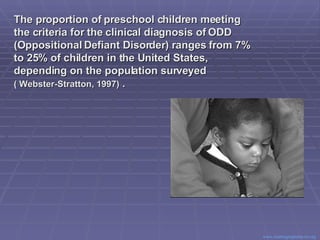
The proportion of preschool children meeting the criteria for the clinical diagnosis of ODD (Oppositional Defiant Disorder) ranges from 7% to 25% of children in the United States, depending on the population surveyed  ( Webster-Stratton, 1997)  . Center for Evidence Based Practice: Young Children with Challenging Behavior  www.challengingbehavior.org
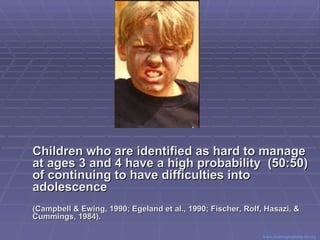
Children who are identified as hard to manage at ages 3 and 4 have a high probability  (50:50) of continuing to have difficulties into adolescence  (Campbell & Ewing, 1990; Egeland et al., 1990; Fischer, Rolf, Hasazi, & Cummings, 1984). Center for Evidence Based Practice: Young Children with Challenging Behavior  www.challengingbehavior.org
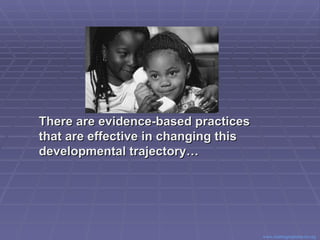
There are evidence-based practices that are effective in changing this developmental trajectory…  Center for Evidence Based Practice: Young Children with Challenging Behavior  www.challengingbehavior.org
THE NATURE OF ATTACHMENT
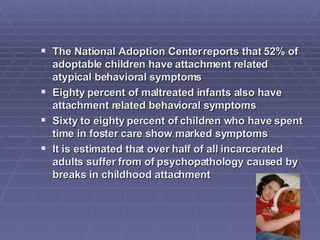
The National Adoption Center reports that 52% of adoptable children have attachment related atypical behavioral symptoms Eighty percent of maltreated infants also have attachment related behavioral symptoms Sixty to eighty percent of children who have spent time in foster care show marked symptoms It is estimated that over half of all incarcerated adults suffer from of psychopathology caused by breaks in childhood attachment
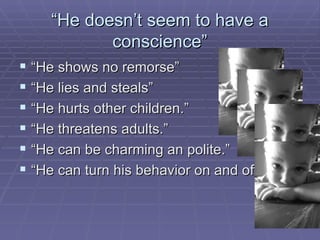
“ He doesn’t seem to have a conscience” “He shows no remorse” “He lies and steals” “He hurts other children.” “He threatens adults.” “He can be charming an polite.” “He can turn his behavior on and off.”
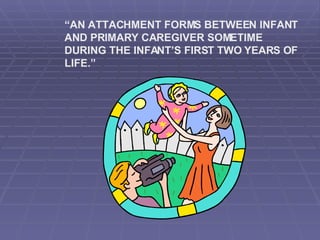
“ AN ATTACHMENT FORMS BETWEEN INFANT AND PRIMARY CAREGIVER SOMETIME DURING THE INFANT’S FIRST TWO YEARS OF LIFE.”
Attachment is the “lasting psychological connectedness between human beings.”
“ The quality of our attachment acts as a foundation for our future.”
Secure Attachments   This  secure-base script  includes the following if-then propositions:  “ If I encounter an obstacle and/or become distressed,  I can approach a significant other for help;  he or she is likely to be available and supportive; I will experience relief and comfort as a result of proximity to this person;  I can then return to other activities.”   John Bowlby and Mary Aimsworth
The Basic Function of Secure Attachment Learn basic trust and reciprocity. Explore the environment with feelings of safety and security which leads to healthy cognitive and social development. Develop the ability to self-regulate, which results in effective management of impulses and emotions. Create a foundation for the formation of identity. Establish a prosocial moral framework, which involves empathy. Generate the core belief system. Provides a defense against stress and trauma. But, when trauma occurs…. John Bowlby and Mary Aimsworth
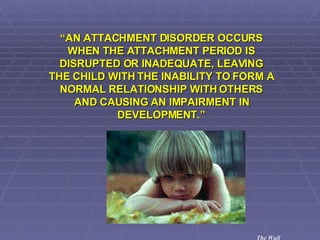
“ AN ATTACHMENT DISORDER OCCURS WHEN THE ATTACHMENT PERIOD IS DISRUPTED OR INADEQUATE, LEAVING THE CHILD WITH THE INABILITY TO FORM A NORMAL RELATIONSHIP WITH OTHERS AND CAUSING AN IMPAIRMENT IN DEVELOPMENT.” The Wall
Risk Factors for Developing   Attachment Disorders. Maternal ambivalence towards pregnancy. Sudden separation from the primary caregiver (death of mother, hospitalization). Abuse (physical, emotional, sexual ). Frequent moves and placements (foster care, failed adoptions).
Risk Factors  (Continued…) Traumatic prenatal experience (in-utero exposure to alcohol/drugs).  neglect or parental ambivalence. Genetic predisposition. Birth trauma. Undiagnosed and/or painful illness or injury.  Inconsistent or inadequate day care. Unprepared mothers with poor parenting skills.
Characteristics or Symptoms of Attachment Disorder and Social Maladjustment: Superficially charming: uses cuteness to get her or his way. Cruel to animals or people. Fascinated by fire/death/blood/gore. Severe need for control over adults even over minute situations.  Manipulative-plays adults against each other. Difficulty in making eye-contact. Lack of affection on parental terms yet overly affectionate to strangers. Bossy. Shows no remorse---seems to have no conscience. Lies and steals. Low impulse control. Lack of cause/effect thinking. Destructiveness to self, others and material things. Ainsworth
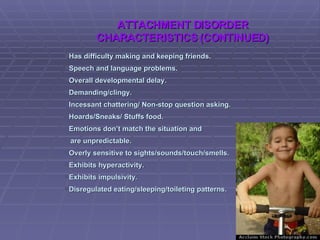
Has difficulty making and keeping friends. Speech and language problems. Overall developmental delay. Demanding/clingy. Incessant chattering/ Non-stop question asking. Hoards/Sneaks/ Stuffs food. Emotions don’t match the situation and  are unpredictable. Overly sensitive to sights/sounds/touch/smells. Exhibits hyperactivity. Exhibits impulsivity. Disregulated eating/sleeping/toileting patterns. ATTACHMENT DISORDER CHARACTERISTICS (CONTINUED)
What the research says about overcoming the effects of insecure or interrupted attachment. Prognosis is Tenuous High Risk for Interpersonal Problems High Risk for Not Responding to Traditional Behavioral Treatment Approaches High Risk for Oppositional Defiance Disorder High Risk for Conduct Disorder Age of Intervention is a significant variable Most Frequently Identified Protective Factors include: Intelligence, Proximity, and Constancy
Maladjusted/Conduct Disorder students: perceive themselves as normal are capable of behaving appropriately choose to break rules and violate norms. view rule breaking as normal and acceptable. are motivated by self-gain and strong survival skills lack age appropriate concern for their behavior displayed behavior which may be highly valued in a small  subgroup display socialized or unsocialized forms of aggression due not display anxiety unless they fear being caught intensity and duration of behavior differs markedly  from peer group
Prognosis: Eighty percent of children with Oppositional Defiance Disorder showed insecure attachment. Insecurely attached children often grow up to become insecurely attached parents, and the cycle continues
OPPOSITIONAL DEFIANCE DISORDER
All children are oppositional from time to time, particularly when tired, hungry, stressed or upset. They may argue, talk back, disobey, and defy parents, teachers, and other adults. Oppositional behavior is often a normal part of development for two to three year olds and early adolescents. However, openly uncooperative and hostile behavior becomes a serious concern when it is so frequent and consistent that it stands out when compared with other children of the same age and developmental level and when it affects the child’s social, family, and academic life.
What is Oppositional Defiance Disorder? ODD is a persistent pattern (lasting for at least six months) of negativistic, hostile, disobedient, and defiant behavior in a child or teen without serious violation of the basic rights of others.
What are the Symptoms of Oppositional Defiance Disorder? Frequent loss of  temper;  Arguing with adults Defying adults  Refusing adult requests or rules Deliberately annoying others Blaming others for mistakes and misbehavior
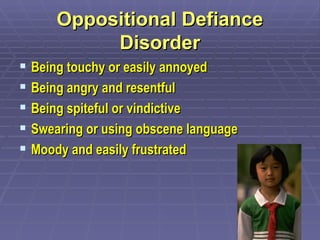
Oppositional Defiance Disorder Being touchy or easily annoyed Being angry and resentful Being spiteful or vindictive Swearing or using obscene language Moody and easily frustrated
What Causes Oppositional Defiance Disorder? The cause of Oppositional Defiant Disorder is unknown at  this time. The following are some of the theories being  investigated:  It may be related to the child's temperament and the family's response to that temperament.  A predisposition to ODD is inherited in some families.  There may be problems in the brain that cause ODD.  It may be caused by a chemical imbalance in the brain.  Children with ODD have often experienced a break in  attachment or bonding during the first 2 years of life Ross Green, Russell Barkley, Mel Levine
It is important to distinguish between a won’t problem and a can’t problem Can be difficult to assess Treating a can’t problem with punishment can cause distrust and alienation Treating a won’t problem with punishment and reward programs can result in deceit and manipulation
OTHER DISORDERS THAT MAY MANIFEST IN DEFIANCE ODD/CD ADHD Childhood Bipolar Disorder Emotional Impairment Down’s Syndrome Fragile X Prader-Willi Syndrome TBI ASD/Aspergers Syndrome
Motivation of Behavior Functional Behavioral Assessment Methods FACTS A & B ABC Analysis Inquiry Method Competing Pathways Descriptive Analysis Direct Observation and Video Taping Talking to Parents, Teachers, and Students Social Work History Wrap Around and Agency Support Emotionally Tasking
MOTIVATION of  DEFIANCE Escape/Avoidance> Adults or Adult Demands,  Limits,Boundaries,etc. Obtain Sensory > Distress when sense of order  is challenged or sensory  reinforcement during  conflict Obtain Attention  “ POWER AND CONTROL”
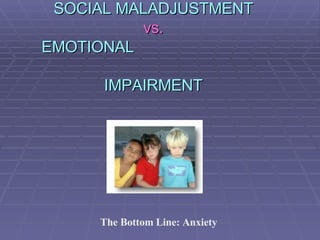
SOCIAL MALADJUSTMENT vs.   EMOTIONAL      IMPAIRMENT The Bottom Line: Anxiety


Attention,  Sensory or Escape Avoidance
DSM IV Conduct Disorder Criteria For 12 months or more has repeatedly violated rules, age-appropriate societal norms or the rights of others. Shown by 3 or more of the following, with at least one of the following occurring in the past 6 months: Aggression against people or animals Frequent bullying or threatening Often starts fights Used a weapon that could cause serious injury Physical cruelty to people Physical cruelty to animals Theft with confrontation   Forced sex upon someone
Contra-Indicated Behavioral Strategies for the ODD Child Ultimatums Strict Boundaries: Drawing the Line in the Sand Counts, Warnings, Threats Prolonged Eye-Contact Infringing on Personal Space Social Disapproval Judgmental Responses Response Cost and Punishment Strict Boundaries or Contracts Suspension and Detention, Progressive Discipline Marion
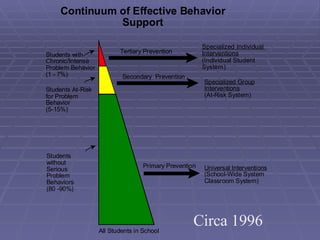
Circa 1996
Underlying Systems of Control in School The use of reinforcement Response Cost-loss of privileges, loss of points, loss of access to reinforcing events, etc. Restrictive classroom rules and boundaries-e.g.,  “ No going in my desk.” “  No going into this area.” “  No talking while in line.” “  Sitting with both both feet on the floor.” “  Raising your hand before talking.” Expecting immediate compliance Suspension, Detention, and other forms of punishment
Evidence Based Classroom Environment ARE WE USING THEM IN OUR CLASSROOM? Environmental Supports Relationship Based? Positives Outweigh the Negatives? Teaching Social Skills? Clear Expectations taught and reviewed? Procedures for transitions? Positive Home School Partnerships Consistent Brief Consequences that promote the development of replacement behaviors?
RTI- Are classroom response cost systems contributing to defiance?  Response to Intervention Are we using evidenced based classroom behavior management systems at the universal level? Are classroom response cost systems evidenced based? Is there a balance, better yet, an overbalance of Positive Incentives and Feedback for Desired Behavior? When universal consequences (e.g., Classroom Response Cost System) are not effective, or when they trigger an escalation of behavior, do we differentiate our approach? Are we over-relying on classroom response cost systems to manage student behaviors?
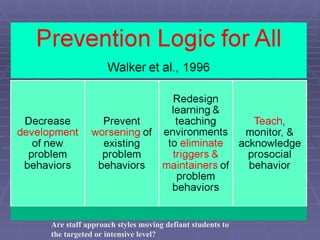
Are staff approach styles moving defiant students to the targeted or intensive level?
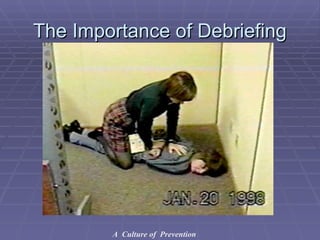
The Importance of Debriefing A  Culture of  Prevention
In 1946, Anderson and Brewer reported that teachers using dominating behaviors of force, threat, shame, and blame had classrooms in which children displayed nonconforming behavior at rates higher than in classrooms in which teachers were more positive and supportive.  How far have we come in over 60 years?
The greatest problem with punishment is that it does not provide an appropriate model of acceptable behavior. Furthermore, in many classrooms, punishment is accompanied by an emotional response from the teacher.  Don’t do that! I don’t like that!
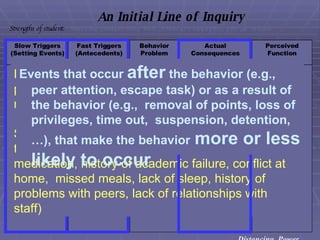
An Initial Line of Inquiry Strengths of student:  What the student does well.  Student’s strengths, gifts, &  talents . ? ? Events that may occur before and/or during the problem behavior, that cause the student to respond to a “typical” situation in an “atypical” way. Specific conditions, events, or activities that make the problem behavior worse  (i.e., missed medication, history of academic failure, conflict at home,  missed meals, lack of sleep, history of problems with peers, lack of relationships with staff) Events that occur immediately before the behavior (e.g., task demand, teacher direction, social interaction, presentation of worksheet etc.) Events that occur  after  the behavior (e.g., peer attention, escape task) or as a result of the behavior (e.g.,  removal of points, loss of privileges, time out,  suspension, detention, …), that make the behavior   more or less likely to occur Distancing, Power Perceived Function Actual Consequences Behavior Problem Fast Triggers (Antecedents) Slow Triggers (Setting Events)
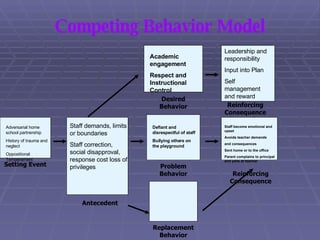
Competing Behavior Model Setting Event Antecedent Desired Behavior Problem Behavior Replacement Behavior Reinforcing Consequence Reinforcing Consequence Academic engagement Respect and Instructional Control Defiant and disrespectful of staff Bullying others on the playground Adversarial home school partnership History of trauma and neglect Oppositional Temperament Staff demands, limits or boundaries Staff correction, social disapproval, response cost loss of privileges Staff become emotional and upset Avoids teacher demands and consequences Sent home or to the office Parent complains to principal and yells at teacher Leadership and responsibility Input into Plan Self management and reward
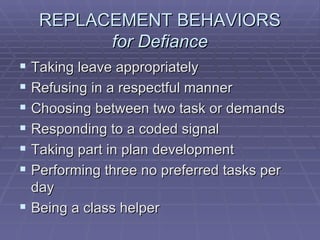
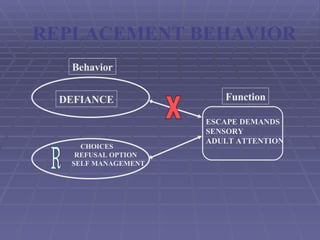
REPLACEMENT BEHAVIORS for Defiance Taking leave appropriately Refusing in a respectful manner Choosing between two task or demands Responding to a coded signal Taking part in plan development Performing three no preferred tasks per day Being a class helper
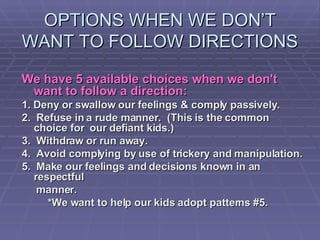
OPTIONS WHEN WE DON’T WANT TO FOLLOW DIRECTIONS We have 5 available choices when we don't want to follow a direction:   1. Deny or swallow our feelings & comply passively.  2.  Refuse in a rude manner.  (This is the common choice for  our defiant kids.)  3.  Withdraw or run away.  4.  Avoid complying by use of trickery and manipulation.  5.  Make our feelings and decisions known in an respectful  manner.  *We want to help our kids adopt patterns #5.
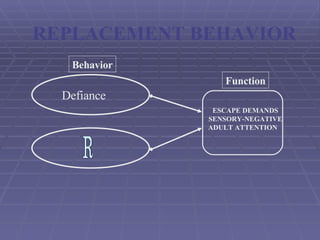
REPLACEMENT BEHAVIOR Defiance ESCAPE DEMANDS SENSORY-NEGATIVE ADULT ATTENTION Function Behavior R
REPLACEMENT BEHAVIOR DEFIANCE CHOICES REFUSAL OPTION SELF MANAGEMENT X Behavior Function R ESCAPE DEMANDS SENSORY ADULT ATTENTION
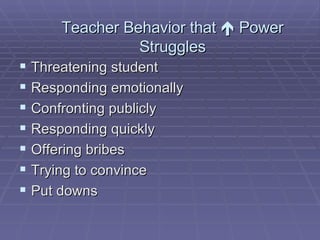
Teacher Behavior that    Power Struggles Threatening student Responding emotionally Confronting publicly Responding quickly Offering bribes Trying to convince Put downs
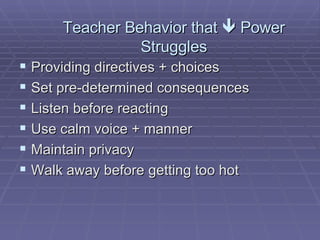
Teacher Behavior that    Power Struggles Providing directives + choices Set pre-determined consequences Listen before reacting Use calm voice + manner Maintain privacy Walk away before getting too hot
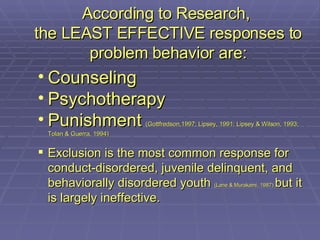
According to Research,  the LEAST EFFECTIVE responses to problem behavior are: Counseling Psychotherapy Punishment   (Gottfredson,1997; Lipsey, 1991; Lipsey & Wilson, 1993; Tolan & Guerra, 1994) Exclusion is the most common response for conduct-disordered, juvenile delinquent, and behaviorally disordered youth  (Lane & Murakami, 1987)  but it is largely ineffective.
Why Then, Do We Educators, Resource Officers, and Counselors Employ These Procedures? When WE experience aversive situations, we select interventions that produce immediate (rather than sustained) relief.  We tend to focus on our concerns, not the student’s. Remove the student. Remove ourselves. Modify the physical environment. Assign responsibility for change to student and/or others.
Social skills training Academic and curricular restructuring Behavioral interventions (Gottfredson, 1997; Lipsey, 1991, 1992; Lipsey & Wilson, 1993; Tolan & Guerra, 1994) According to Research, the MOST EFFECTIVE responses to problem behavior are:
Ross Greene’s  Three Basket Method Three goals with this method: 1. To maintain adults as authority figures. 2. Teach skills of flexibility and frustration tolerance. 3. Awareness of the child’s limitations.
Three basket method: How it works Behaviors are divided into three baskets. Basket A -are non-negotiable behaviors- usually fall into the safety and rights of others category. These behaviors are those that are important enough to endure a “meltdown” over. Child must be capable of successfully exhibiting this behavior on a fairly consistent basis. Basket B - These behaviors are important but can be worked on over time.  They are not behaviors worth inducing a “meltdown” over. Basket C - These behaviors are those that could be ignored without any significant repercussions.
Advantages of this Treatment Approach Breaks behaviors down into three approachable categories. Emphasizes communication and problem solving techniques over rewards and punishments. Teaches frustration tolerance. Absolves blame while keeping the child’s self-esteem in tact.
Limitations of the 3-basket method It is ideal to make this work that all parties; teachers, parents, support staff be able to work together. Dr. Greene is careful to point out that even though there are some issues that the non-medical approach addresses more effectively than the medical approach there are indeed some factors medicine addresses better than the non-medical approach.  For those children who need medication it will make it more difficult to teach frustration tolerance when there is also an organic matter.
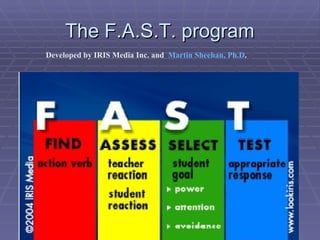
The F.A.S.T. program Developed by  IRIS Media Inc . and   Martin Sheehan, Ph.D .
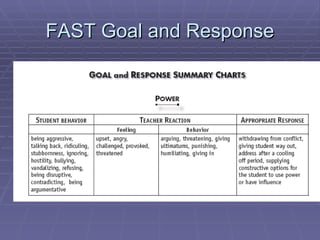
FAST Goal and Response
Therapeutic  Crisis Intervention
Crisis Cycle TCI TRAINING [30]
Recovery Phase TCI TRAINING [6]
When Young People Will Not Comply Actively listen and problem-solve Remove the others from the area Give choices and time to decide Let program consequences stand Redirect young person to a more attractive activity Appeal to the young person’s self-interest Use your relationship with the young person TCI TRAINING [33]
I ASSIST I  - Isolate the young person A  - Actively listen S  – Speak calmly, assertively, respectfully S  – Statements of understanding precede  requests I  – Invite the young people to consider positive  outcomes and behaviors S  – Space reduces pressure T  – Time helps   young people respond to requests TCI TRAINING [43]
How to avoid physical contact Remove triggering stimulus Calmly explain limits Select a staff (or peer) who has a calming influence Select a novel or neutral party Bait to open area Remove other students Call home or police
Strategies That Work Access referral services Communicate and collaborate with the child’s family Collect assessment data and perform a  functional behavior assessment Address the student’s learning and motivational needs Provide social skills instruction
Offer attribution training (teaching students how their behavior affects their successes and failures) Build relationships with students Develop student’s self-esteem Give student’s choices (this gives them responsibility for their actions and appropriate outlet for control)
Be aware of verbal and non-verbal communication Teach students to use self management interventions Follow routines and foster transitions Establish and teach rules (let the students help create these rules) Learn as much as you can about ODD
Labeling Students Terms such as “oppositional defiance disorder” locate problems within students rather than within the educational system Labels can limit the way that others perceive and interact with students thereby disabling the students academically and hindering the development of their self-esteem
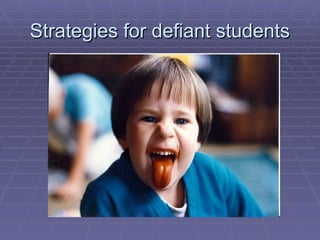
Strategies for defiant students
Let’s Make a Deal “You need to finish your math before recess.”  . . . Ask rather than tell - “What do you need to do before recess?” Need to feel in control It’s your choice - you control if you do your math before recess or . . .
Public, Blatant Violation of Rules “ Remember to raise your hand before speaking.”  . . . Planned ignoring for the moment Avoid power struggle Address violation later, privately Teach students about planned ignoring
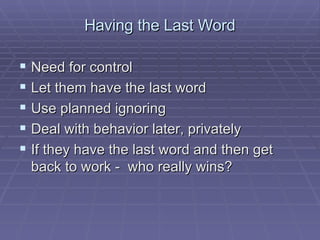
Having the Last Word Need for control Let them have the last word Use planned ignoring Deal with behavior later, privately If they have the last word and then get back to work -  who really wins?
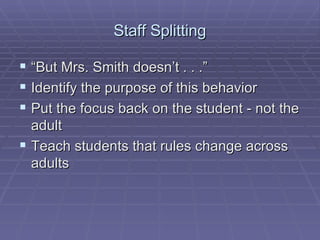
Staff Splitting “But Mrs. Smith doesn’t . . .” Identify the purpose of this behavior Put the focus back on the student - not the adult Teach students that rules change across adults
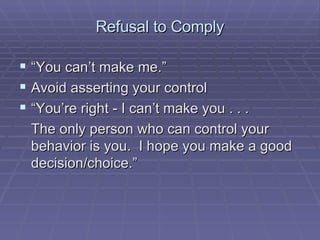
Refusal to Comply “You can’t make me.” Avoid asserting your control “You’re right - I can’t make you . . . The only person who can control your behavior is you.  I hope you make a good decision/choice.”
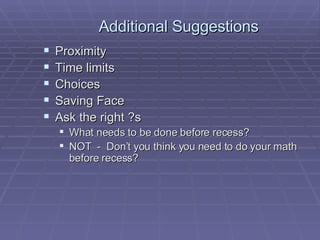
Additional Suggestions Proximity Time limits Choices Saving Face Ask the right ?s What needs to be done before recess? NOT  -  Don’t you think you need to do your math before recess?
What he/she does in our absence The importance of self control over punishment. The importance of teaching them to care!!!! The Importance of channeling their need for control. Bullycide
[email_address] Slideshare.com

Steve Vittos Assessing And Treating Defiant Behavior

  • 1.
    Assessment and Treatmentof Defiant Behavior Using Positive Approaches “Breaking Down the Walls II ” Presented by Steven Vitto, M.A., BTC, CTCII Muskegon Area Intermediate School District 2008 Michigan MIBLSi Conference
  • 2.
    The Face ofDefiance
  • 3.
    The Evolution ofAdversarial Relationships and Subversion As aberrant behaviors begin to surface an unhealthy communication paradigm emerges A phone call home, a detention slip, a suspension THE STAGE IS SET
  • 4.
    The Reaction Continuum“ My son wouldn’t do that!! “ I will punish him.” “ What do you expect me to do?” “ You guys are always kicking him out!! At this point a shift begins and the parent and school are at risk for developing an adversarial relationship. THE FIRST SIGNS “ He says other kids were doing the same thing and nothing happened to them”
  • 5.
    The Downward SpiralWithout evidenced based decision making the school continues to respond in the only way they know how-punishment and exclusion. Without proper supports, the parent becomes trapped in a dilemma. Do I blame myself, my child, or the school? And a day comes when the parent begins to blame the school, and the real damage begins…
  • 6.
    What Johnny LearnsJohnny is becoming increasingly dis-enfranchised with school Johnny figures out that he if he tells his parents he was picked on, singled out, overly or repeatedly punished, then his parents will begin to focus on the school rather than his behaviors. It becomes increasing probable for Johnny to misrepresent the school. He escapes punishment and takes the focus off of him. By blaming the school, the parents avoid blame, and are relieved of the feeling of helplessness, The end result: a parent who rescues, defends, accuses a child who has a escape card-any time he wants to use it.
  • 7.
    When Co morbiditySets In The child with Social Maladjustment receives a diagnosis of ADHD The parent looking for something to explain all of the child’s behaviors focuses on the ADHD diagnosis The parents use the ADHD diagnosis to defend the child’s behavior at school Once again the child makes a connection. If I get in trouble, I can use my disability How do you know when this is happening? The child will say my disability caused the behavior! The challenge: to separate ADHD behavior and learned behavior.
  • 8.
    THE SOLUTION 1. DON’T RELY ON A PUNISHMENT AT HOME FOR A BEHAVIOR THAT OCCURS AT SCHOOL-THE PHONE CALL. 2. WHEN YOU MEET, HAVE ALL THE PLAYERS IN THE ROOM TOGETHER. 3. DESIGNATE ONE COMMUNICATION POINT PERSON. 4. HAVE THE PLAN CLEARLY STATED. 5. DOCUMENT, DOCUMENT, DOCUMENT!! 6. AGREE TO ADVOCATE, AGREE TO DISAGREE BUT NEVER NEVER IN FRONT OF THE CHILD!!!! 7. FOR THE PARENT “WHO DOESN’T FOLLOW THROUGH,” FOCUS ON THE POSITIVES!!!!
  • 9.
    The Emergence ofSocial Maladjustment & Oppositional Defiance
  • 10.
    More than oneout of every six American children were poor in 2004, representing a 12.4 % increase over the previous four year period. The number of children living in extreme poverty below half of the poverty line rose by 20% during that same period (Children’s Defense Fund, 2005)
  • 11.
    Young children frompoor families are substantially more likely to develop social, emotional, behavioral, and school problems than the general population (Blanchard, Gurka & Blackman , 2006; Fantuzzo et. al., 2003; Qi & Kaiser, 2003; Raver & Knitzer, 2002) Those children who live in extreme poverty, remain below the poverty line for multiple years, or experience poverty during their preschool and early school years appear to suffer the worst outcomes (Brooks-Gunn & Duncan, 1997 ).
  • 12.
    Campbell (1995) estimated that approximately 10-15% of all typically developing preschool children have chronic mild to moderate levels of behavior problems. Children who are poor are much more likely to develop behavior problems with prevalence rates that approach 30% (Qi & Kaiser, 2003). Center for Evidence Based Practice: Young Children with Challenging Behavior www.challengingbehavior.org
  • 13.
    The proportion ofpreschool children meeting the criteria for the clinical diagnosis of ODD (Oppositional Defiant Disorder) ranges from 7% to 25% of children in the United States, depending on the population surveyed ( Webster-Stratton, 1997) . Center for Evidence Based Practice: Young Children with Challenging Behavior www.challengingbehavior.org
  • 14.
    Children who areidentified as hard to manage at ages 3 and 4 have a high probability (50:50) of continuing to have difficulties into adolescence (Campbell & Ewing, 1990; Egeland et al., 1990; Fischer, Rolf, Hasazi, & Cummings, 1984). Center for Evidence Based Practice: Young Children with Challenging Behavior www.challengingbehavior.org
  • 15.
    There are evidence-basedpractices that are effective in changing this developmental trajectory… Center for Evidence Based Practice: Young Children with Challenging Behavior www.challengingbehavior.org
  • 16.
    THE NATURE OFATTACHMENT
  • 17.
    The National AdoptionCenter reports that 52% of adoptable children have attachment related atypical behavioral symptoms Eighty percent of maltreated infants also have attachment related behavioral symptoms Sixty to eighty percent of children who have spent time in foster care show marked symptoms It is estimated that over half of all incarcerated adults suffer from of psychopathology caused by breaks in childhood attachment
  • 18.
    “ He doesn’tseem to have a conscience” “He shows no remorse” “He lies and steals” “He hurts other children.” “He threatens adults.” “He can be charming an polite.” “He can turn his behavior on and off.”
  • 19.
    “ AN ATTACHMENTFORMS BETWEEN INFANT AND PRIMARY CAREGIVER SOMETIME DURING THE INFANT’S FIRST TWO YEARS OF LIFE.”
  • 20.
    Attachment is the“lasting psychological connectedness between human beings.”
  • 21.
    “ The qualityof our attachment acts as a foundation for our future.”
  • 22.
    Secure Attachments This secure-base script includes the following if-then propositions: “ If I encounter an obstacle and/or become distressed, I can approach a significant other for help; he or she is likely to be available and supportive; I will experience relief and comfort as a result of proximity to this person; I can then return to other activities.” John Bowlby and Mary Aimsworth
  • 23.
    The Basic Functionof Secure Attachment Learn basic trust and reciprocity. Explore the environment with feelings of safety and security which leads to healthy cognitive and social development. Develop the ability to self-regulate, which results in effective management of impulses and emotions. Create a foundation for the formation of identity. Establish a prosocial moral framework, which involves empathy. Generate the core belief system. Provides a defense against stress and trauma. But, when trauma occurs…. John Bowlby and Mary Aimsworth
  • 24.
    “ AN ATTACHMENTDISORDER OCCURS WHEN THE ATTACHMENT PERIOD IS DISRUPTED OR INADEQUATE, LEAVING THE CHILD WITH THE INABILITY TO FORM A NORMAL RELATIONSHIP WITH OTHERS AND CAUSING AN IMPAIRMENT IN DEVELOPMENT.” The Wall
  • 25.
    Risk Factors forDeveloping Attachment Disorders. Maternal ambivalence towards pregnancy. Sudden separation from the primary caregiver (death of mother, hospitalization). Abuse (physical, emotional, sexual ). Frequent moves and placements (foster care, failed adoptions).
  • 26.
    Risk Factors (Continued…) Traumatic prenatal experience (in-utero exposure to alcohol/drugs). neglect or parental ambivalence. Genetic predisposition. Birth trauma. Undiagnosed and/or painful illness or injury. Inconsistent or inadequate day care. Unprepared mothers with poor parenting skills.
  • 27.
    Characteristics or Symptomsof Attachment Disorder and Social Maladjustment: Superficially charming: uses cuteness to get her or his way. Cruel to animals or people. Fascinated by fire/death/blood/gore. Severe need for control over adults even over minute situations. Manipulative-plays adults against each other. Difficulty in making eye-contact. Lack of affection on parental terms yet overly affectionate to strangers. Bossy. Shows no remorse---seems to have no conscience. Lies and steals. Low impulse control. Lack of cause/effect thinking. Destructiveness to self, others and material things. Ainsworth
  • 28.
    Has difficulty makingand keeping friends. Speech and language problems. Overall developmental delay. Demanding/clingy. Incessant chattering/ Non-stop question asking. Hoards/Sneaks/ Stuffs food. Emotions don’t match the situation and are unpredictable. Overly sensitive to sights/sounds/touch/smells. Exhibits hyperactivity. Exhibits impulsivity. Disregulated eating/sleeping/toileting patterns. ATTACHMENT DISORDER CHARACTERISTICS (CONTINUED)
  • 29.
    What the researchsays about overcoming the effects of insecure or interrupted attachment. Prognosis is Tenuous High Risk for Interpersonal Problems High Risk for Not Responding to Traditional Behavioral Treatment Approaches High Risk for Oppositional Defiance Disorder High Risk for Conduct Disorder Age of Intervention is a significant variable Most Frequently Identified Protective Factors include: Intelligence, Proximity, and Constancy
  • 30.
    Maladjusted/Conduct Disorder students:perceive themselves as normal are capable of behaving appropriately choose to break rules and violate norms. view rule breaking as normal and acceptable. are motivated by self-gain and strong survival skills lack age appropriate concern for their behavior displayed behavior which may be highly valued in a small subgroup display socialized or unsocialized forms of aggression due not display anxiety unless they fear being caught intensity and duration of behavior differs markedly from peer group
  • 31.
    Prognosis: Eighty percentof children with Oppositional Defiance Disorder showed insecure attachment. Insecurely attached children often grow up to become insecurely attached parents, and the cycle continues
  • 32.
  • 33.
    All children areoppositional from time to time, particularly when tired, hungry, stressed or upset. They may argue, talk back, disobey, and defy parents, teachers, and other adults. Oppositional behavior is often a normal part of development for two to three year olds and early adolescents. However, openly uncooperative and hostile behavior becomes a serious concern when it is so frequent and consistent that it stands out when compared with other children of the same age and developmental level and when it affects the child’s social, family, and academic life.
  • 34.
    What is OppositionalDefiance Disorder? ODD is a persistent pattern (lasting for at least six months) of negativistic, hostile, disobedient, and defiant behavior in a child or teen without serious violation of the basic rights of others.
  • 35.
    What are theSymptoms of Oppositional Defiance Disorder? Frequent loss of temper; Arguing with adults Defying adults Refusing adult requests or rules Deliberately annoying others Blaming others for mistakes and misbehavior
  • 36.
    Oppositional Defiance DisorderBeing touchy or easily annoyed Being angry and resentful Being spiteful or vindictive Swearing or using obscene language Moody and easily frustrated
  • 37.
    What Causes OppositionalDefiance Disorder? The cause of Oppositional Defiant Disorder is unknown at this time. The following are some of the theories being investigated: It may be related to the child's temperament and the family's response to that temperament. A predisposition to ODD is inherited in some families. There may be problems in the brain that cause ODD. It may be caused by a chemical imbalance in the brain. Children with ODD have often experienced a break in attachment or bonding during the first 2 years of life Ross Green, Russell Barkley, Mel Levine
  • 38.
    It is importantto distinguish between a won’t problem and a can’t problem Can be difficult to assess Treating a can’t problem with punishment can cause distrust and alienation Treating a won’t problem with punishment and reward programs can result in deceit and manipulation
  • 39.
    OTHER DISORDERS THATMAY MANIFEST IN DEFIANCE ODD/CD ADHD Childhood Bipolar Disorder Emotional Impairment Down’s Syndrome Fragile X Prader-Willi Syndrome TBI ASD/Aspergers Syndrome
  • 40.
    Motivation of BehaviorFunctional Behavioral Assessment Methods FACTS A & B ABC Analysis Inquiry Method Competing Pathways Descriptive Analysis Direct Observation and Video Taping Talking to Parents, Teachers, and Students Social Work History Wrap Around and Agency Support Emotionally Tasking
  • 41.
    MOTIVATION of DEFIANCE Escape/Avoidance> Adults or Adult Demands, Limits,Boundaries,etc. Obtain Sensory > Distress when sense of order is challenged or sensory reinforcement during conflict Obtain Attention “ POWER AND CONTROL”
  • 42.
    SOCIAL MALADJUSTMENT vs. EMOTIONAL IMPAIRMENT The Bottom Line: Anxiety
  • 43.
  • 44.
  • 45.
  • 46.
    Attention, Sensoryor Escape Avoidance
  • 47.
    DSM IV ConductDisorder Criteria For 12 months or more has repeatedly violated rules, age-appropriate societal norms or the rights of others. Shown by 3 or more of the following, with at least one of the following occurring in the past 6 months: Aggression against people or animals Frequent bullying or threatening Often starts fights Used a weapon that could cause serious injury Physical cruelty to people Physical cruelty to animals Theft with confrontation Forced sex upon someone
  • 48.
    Contra-Indicated Behavioral Strategiesfor the ODD Child Ultimatums Strict Boundaries: Drawing the Line in the Sand Counts, Warnings, Threats Prolonged Eye-Contact Infringing on Personal Space Social Disapproval Judgmental Responses Response Cost and Punishment Strict Boundaries or Contracts Suspension and Detention, Progressive Discipline Marion
  • 49.
  • 50.
    Underlying Systems ofControl in School The use of reinforcement Response Cost-loss of privileges, loss of points, loss of access to reinforcing events, etc. Restrictive classroom rules and boundaries-e.g., “ No going in my desk.” “ No going into this area.” “ No talking while in line.” “ Sitting with both both feet on the floor.” “ Raising your hand before talking.” Expecting immediate compliance Suspension, Detention, and other forms of punishment
  • 51.
    Evidence Based ClassroomEnvironment ARE WE USING THEM IN OUR CLASSROOM? Environmental Supports Relationship Based? Positives Outweigh the Negatives? Teaching Social Skills? Clear Expectations taught and reviewed? Procedures for transitions? Positive Home School Partnerships Consistent Brief Consequences that promote the development of replacement behaviors?
  • 52.
    RTI- Are classroomresponse cost systems contributing to defiance? Response to Intervention Are we using evidenced based classroom behavior management systems at the universal level? Are classroom response cost systems evidenced based? Is there a balance, better yet, an overbalance of Positive Incentives and Feedback for Desired Behavior? When universal consequences (e.g., Classroom Response Cost System) are not effective, or when they trigger an escalation of behavior, do we differentiate our approach? Are we over-relying on classroom response cost systems to manage student behaviors?
  • 53.
    Are staff approachstyles moving defiant students to the targeted or intensive level?
  • 54.
    The Importance ofDebriefing A Culture of Prevention
  • 55.
    In 1946, Andersonand Brewer reported that teachers using dominating behaviors of force, threat, shame, and blame had classrooms in which children displayed nonconforming behavior at rates higher than in classrooms in which teachers were more positive and supportive. How far have we come in over 60 years?
  • 56.
    The greatest problemwith punishment is that it does not provide an appropriate model of acceptable behavior. Furthermore, in many classrooms, punishment is accompanied by an emotional response from the teacher. Don’t do that! I don’t like that!
  • 57.
    An Initial Lineof Inquiry Strengths of student: What the student does well. Student’s strengths, gifts, & talents . ? ? Events that may occur before and/or during the problem behavior, that cause the student to respond to a “typical” situation in an “atypical” way. Specific conditions, events, or activities that make the problem behavior worse (i.e., missed medication, history of academic failure, conflict at home, missed meals, lack of sleep, history of problems with peers, lack of relationships with staff) Events that occur immediately before the behavior (e.g., task demand, teacher direction, social interaction, presentation of worksheet etc.) Events that occur after the behavior (e.g., peer attention, escape task) or as a result of the behavior (e.g., removal of points, loss of privileges, time out, suspension, detention, …), that make the behavior more or less likely to occur Distancing, Power Perceived Function Actual Consequences Behavior Problem Fast Triggers (Antecedents) Slow Triggers (Setting Events)
  • 58.
    Competing Behavior ModelSetting Event Antecedent Desired Behavior Problem Behavior Replacement Behavior Reinforcing Consequence Reinforcing Consequence Academic engagement Respect and Instructional Control Defiant and disrespectful of staff Bullying others on the playground Adversarial home school partnership History of trauma and neglect Oppositional Temperament Staff demands, limits or boundaries Staff correction, social disapproval, response cost loss of privileges Staff become emotional and upset Avoids teacher demands and consequences Sent home or to the office Parent complains to principal and yells at teacher Leadership and responsibility Input into Plan Self management and reward
  • 59.
    REPLACEMENT BEHAVIORS forDefiance Taking leave appropriately Refusing in a respectful manner Choosing between two task or demands Responding to a coded signal Taking part in plan development Performing three no preferred tasks per day Being a class helper
  • 60.
    OPTIONS WHEN WEDON’T WANT TO FOLLOW DIRECTIONS We have 5 available choices when we don't want to follow a direction: 1. Deny or swallow our feelings & comply passively. 2. Refuse in a rude manner.  (This is the common choice for our defiant kids.) 3.  Withdraw or run away. 4. Avoid complying by use of trickery and manipulation. 5. Make our feelings and decisions known in an respectful manner. *We want to help our kids adopt patterns #5.
  • 61.
    REPLACEMENT BEHAVIOR DefianceESCAPE DEMANDS SENSORY-NEGATIVE ADULT ATTENTION Function Behavior R
  • 62.
    REPLACEMENT BEHAVIOR DEFIANCECHOICES REFUSAL OPTION SELF MANAGEMENT X Behavior Function R ESCAPE DEMANDS SENSORY ADULT ATTENTION
  • 63.
    Teacher Behavior that  Power Struggles Threatening student Responding emotionally Confronting publicly Responding quickly Offering bribes Trying to convince Put downs
  • 64.
    Teacher Behavior that  Power Struggles Providing directives + choices Set pre-determined consequences Listen before reacting Use calm voice + manner Maintain privacy Walk away before getting too hot
  • 65.
    According to Research, the LEAST EFFECTIVE responses to problem behavior are: Counseling Psychotherapy Punishment (Gottfredson,1997; Lipsey, 1991; Lipsey & Wilson, 1993; Tolan & Guerra, 1994) Exclusion is the most common response for conduct-disordered, juvenile delinquent, and behaviorally disordered youth (Lane & Murakami, 1987) but it is largely ineffective.
  • 66.
    Why Then, DoWe Educators, Resource Officers, and Counselors Employ These Procedures? When WE experience aversive situations, we select interventions that produce immediate (rather than sustained) relief. We tend to focus on our concerns, not the student’s. Remove the student. Remove ourselves. Modify the physical environment. Assign responsibility for change to student and/or others.
  • 67.
    Social skills trainingAcademic and curricular restructuring Behavioral interventions (Gottfredson, 1997; Lipsey, 1991, 1992; Lipsey & Wilson, 1993; Tolan & Guerra, 1994) According to Research, the MOST EFFECTIVE responses to problem behavior are:
  • 68.
    Ross Greene’s Three Basket Method Three goals with this method: 1. To maintain adults as authority figures. 2. Teach skills of flexibility and frustration tolerance. 3. Awareness of the child’s limitations.
  • 69.
    Three basket method:How it works Behaviors are divided into three baskets. Basket A -are non-negotiable behaviors- usually fall into the safety and rights of others category. These behaviors are those that are important enough to endure a “meltdown” over. Child must be capable of successfully exhibiting this behavior on a fairly consistent basis. Basket B - These behaviors are important but can be worked on over time. They are not behaviors worth inducing a “meltdown” over. Basket C - These behaviors are those that could be ignored without any significant repercussions.
  • 70.
    Advantages of thisTreatment Approach Breaks behaviors down into three approachable categories. Emphasizes communication and problem solving techniques over rewards and punishments. Teaches frustration tolerance. Absolves blame while keeping the child’s self-esteem in tact.
  • 71.
    Limitations of the3-basket method It is ideal to make this work that all parties; teachers, parents, support staff be able to work together. Dr. Greene is careful to point out that even though there are some issues that the non-medical approach addresses more effectively than the medical approach there are indeed some factors medicine addresses better than the non-medical approach. For those children who need medication it will make it more difficult to teach frustration tolerance when there is also an organic matter.
  • 72.
    The F.A.S.T. programDeveloped by IRIS Media Inc . and   Martin Sheehan, Ph.D .
  • 73.
    FAST Goal andResponse
  • 74.
    Therapeutic CrisisIntervention
  • 75.
    Crisis Cycle TCITRAINING [30]
  • 76.
    Recovery Phase TCITRAINING [6]
  • 77.
    When Young PeopleWill Not Comply Actively listen and problem-solve Remove the others from the area Give choices and time to decide Let program consequences stand Redirect young person to a more attractive activity Appeal to the young person’s self-interest Use your relationship with the young person TCI TRAINING [33]
  • 78.
    I ASSIST I - Isolate the young person A - Actively listen S – Speak calmly, assertively, respectfully S – Statements of understanding precede requests I – Invite the young people to consider positive outcomes and behaviors S – Space reduces pressure T – Time helps young people respond to requests TCI TRAINING [43]
  • 79.
    How to avoidphysical contact Remove triggering stimulus Calmly explain limits Select a staff (or peer) who has a calming influence Select a novel or neutral party Bait to open area Remove other students Call home or police
  • 80.
    Strategies That WorkAccess referral services Communicate and collaborate with the child’s family Collect assessment data and perform a functional behavior assessment Address the student’s learning and motivational needs Provide social skills instruction
  • 81.
    Offer attribution training(teaching students how their behavior affects their successes and failures) Build relationships with students Develop student’s self-esteem Give student’s choices (this gives them responsibility for their actions and appropriate outlet for control)
  • 82.
    Be aware ofverbal and non-verbal communication Teach students to use self management interventions Follow routines and foster transitions Establish and teach rules (let the students help create these rules) Learn as much as you can about ODD
  • 83.
    Labeling Students Termssuch as “oppositional defiance disorder” locate problems within students rather than within the educational system Labels can limit the way that others perceive and interact with students thereby disabling the students academically and hindering the development of their self-esteem
  • 84.
  • 85.
    Let’s Make aDeal “You need to finish your math before recess.” . . . Ask rather than tell - “What do you need to do before recess?” Need to feel in control It’s your choice - you control if you do your math before recess or . . .
  • 86.
    Public, Blatant Violationof Rules “ Remember to raise your hand before speaking.” . . . Planned ignoring for the moment Avoid power struggle Address violation later, privately Teach students about planned ignoring
  • 87.
    Having the LastWord Need for control Let them have the last word Use planned ignoring Deal with behavior later, privately If they have the last word and then get back to work - who really wins?
  • 88.
    Staff Splitting “ButMrs. Smith doesn’t . . .” Identify the purpose of this behavior Put the focus back on the student - not the adult Teach students that rules change across adults
  • 89.
    Refusal to Comply“You can’t make me.” Avoid asserting your control “You’re right - I can’t make you . . . The only person who can control your behavior is you. I hope you make a good decision/choice.”
  • 90.
    Additional Suggestions ProximityTime limits Choices Saving Face Ask the right ?s What needs to be done before recess? NOT - Don’t you think you need to do your math before recess?
  • 91.
    What he/she doesin our absence The importance of self control over punishment. The importance of teaching them to care!!!! The Importance of channeling their need for control. Bullycide
  • 92.