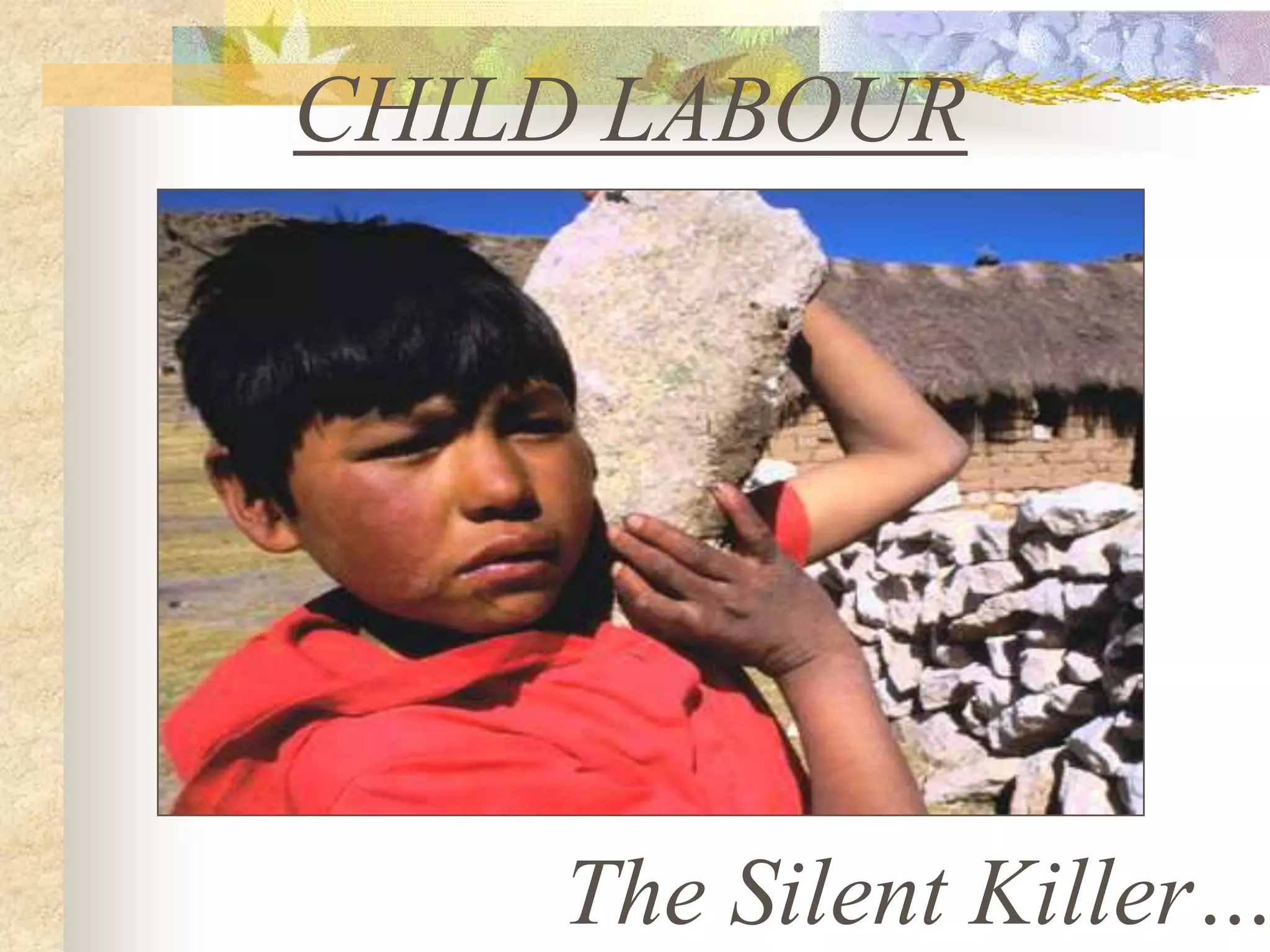
CHILD LABOURSHRIRAM SARDA        70    VINAY THAKKAR        71SANIL JADHAV               73NILESH SHIDGANE        111AATISH RAUT                   132UMESH GAWDA                133
Some Sweet Ones
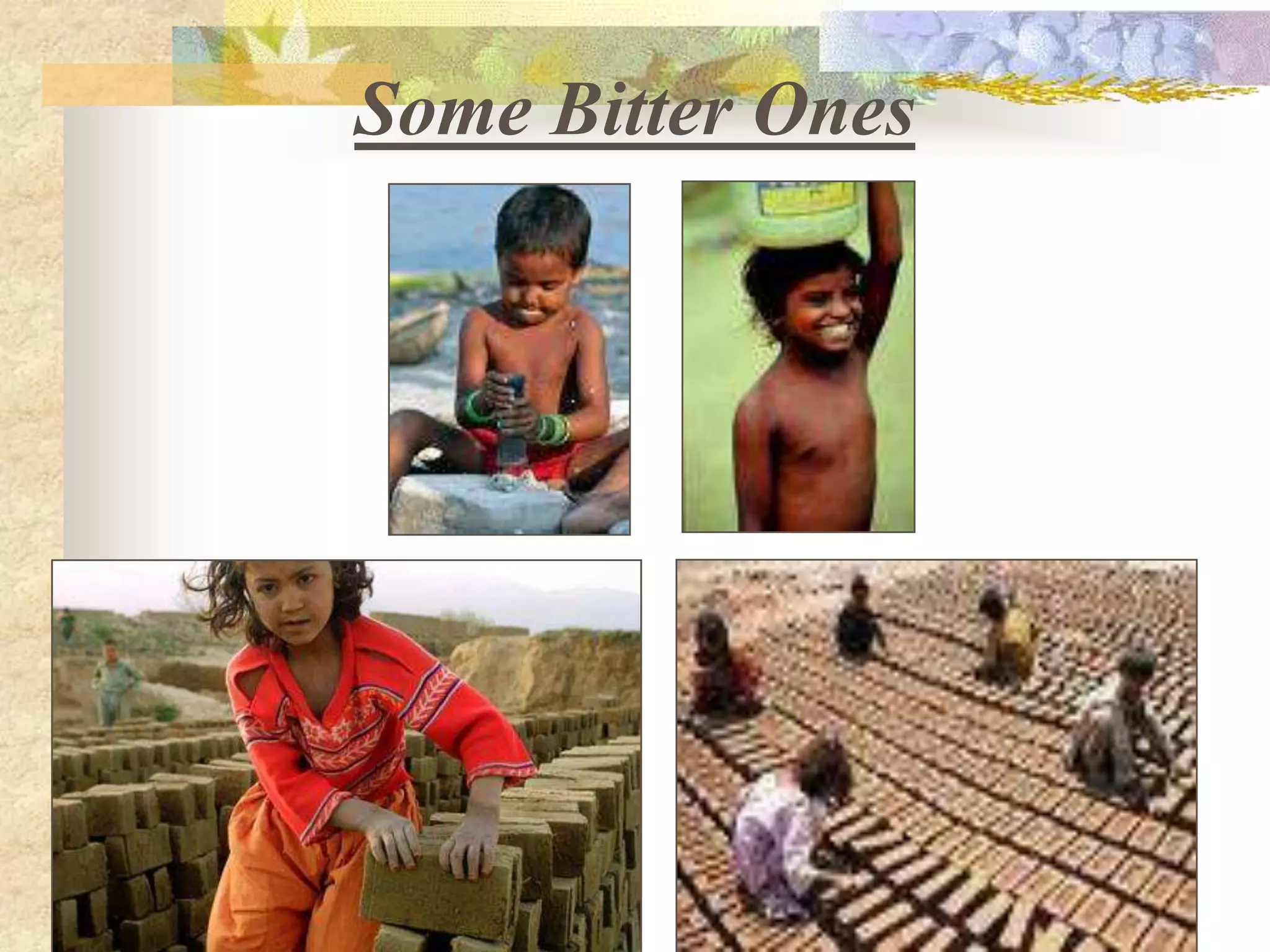
Some Bitter Ones
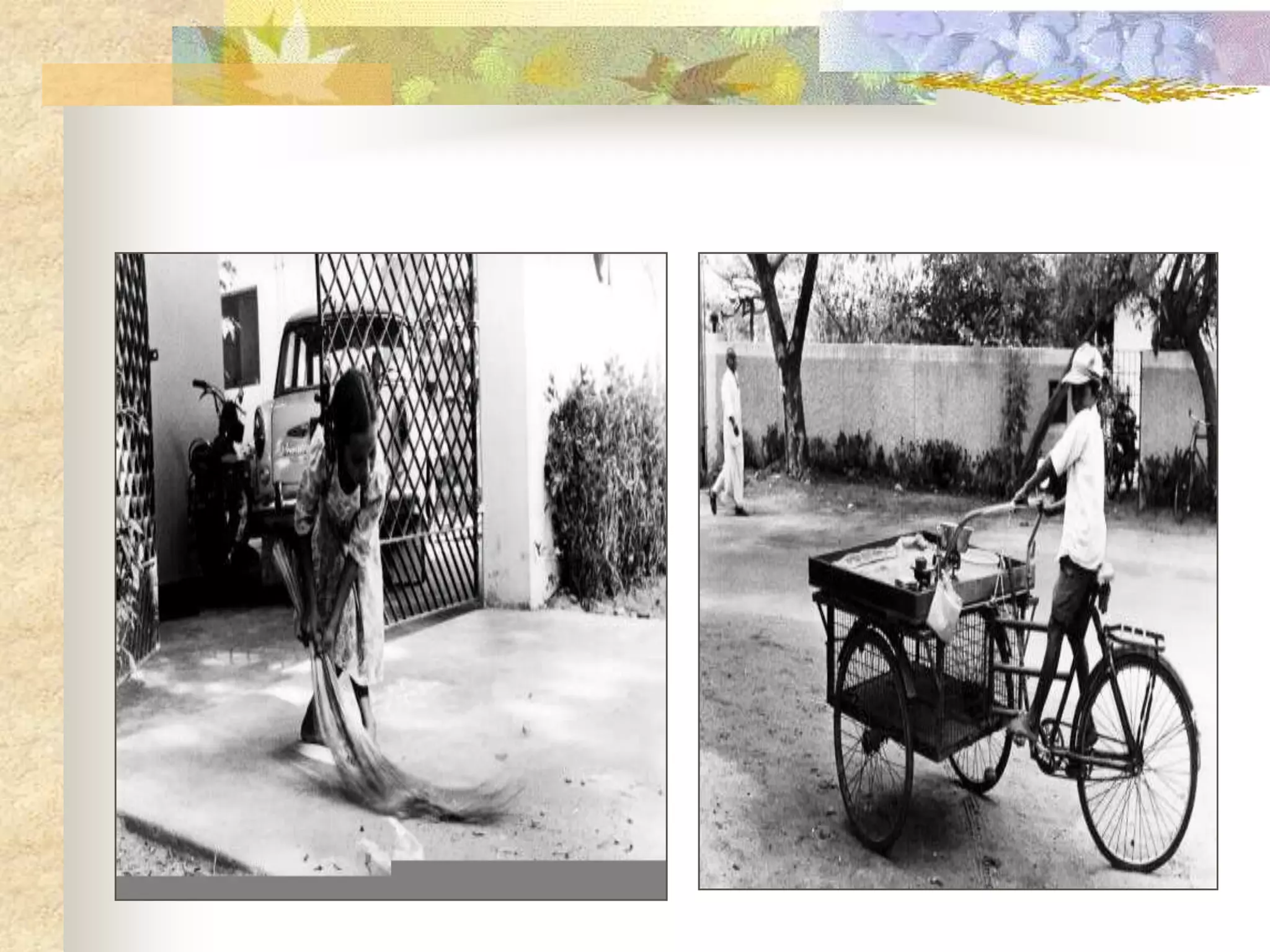
CHILD LABOURChild labour is not only a social problem but also an economic one Watching a young child work for fourteen hours a-day is what is termed as child labor.Child labour has a predominant feature in Indian societycarpet industry requires the fine little fingers to weave the finest and tiniest of knots to create the most expensive of carpets firecracker industry probably prefers kids to men because they are cost effective and more efficientEven household labor – children last longer and are more honest than adults; is a claim made by most homemakers
Child Labour Fact Sheet73 million working children are less than 10 years old. While buffaloes may cost up to 15,000 rupees , children are sold at prices between 500 and 2,000 rupees. 47 out of 100 children in India enrolled in class I reach class VIII, putting the dropout rate at 52.79%. Approximately 16.64% of villages in the country do not have facilities for primary schooling. (UNICEF) 42 million children in the age-group 6-14 years do not attend school in India.
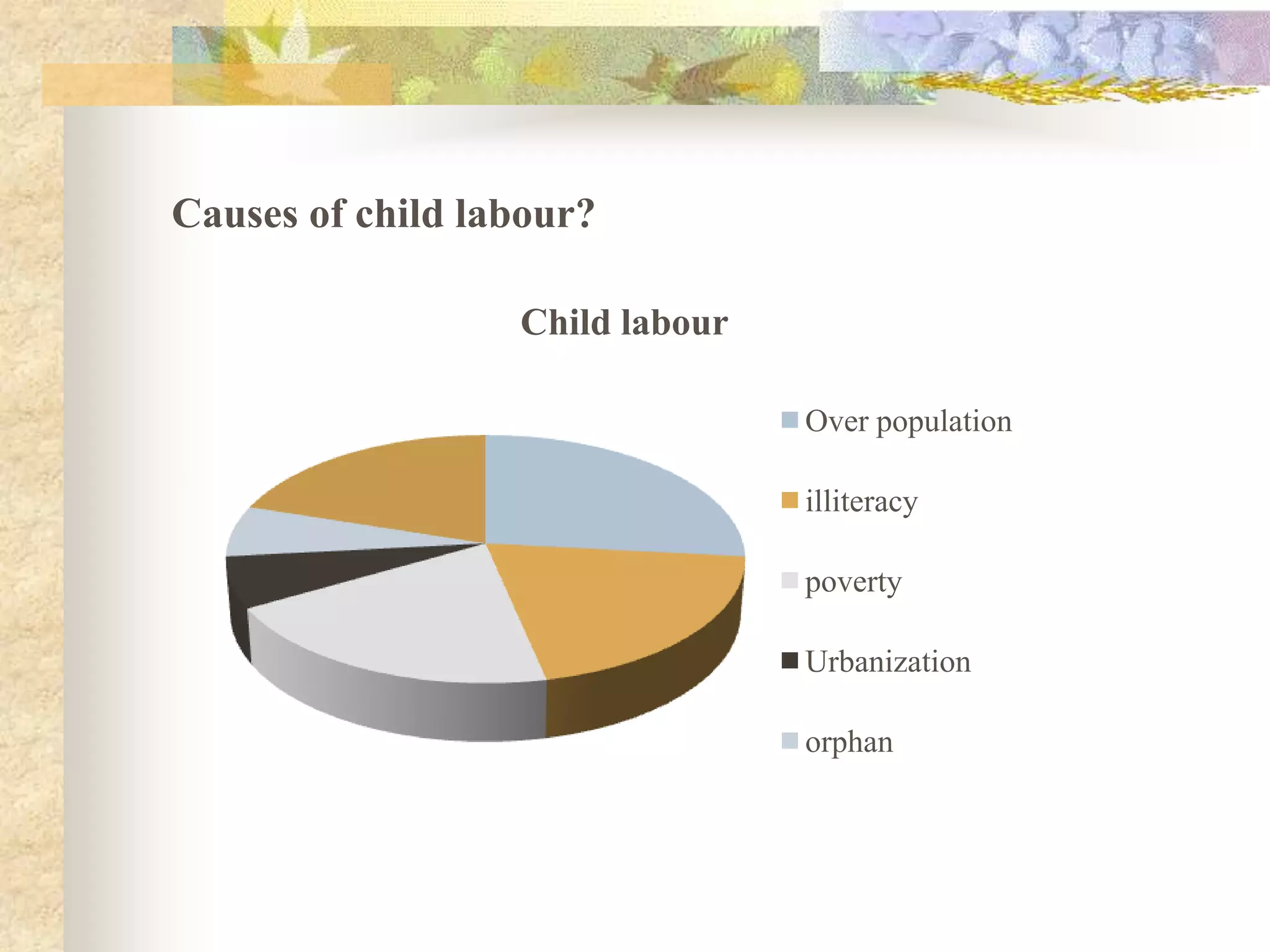
Causes of Child LabourOVER POPULATION: limited resources and more mouths to feed, Children are employed in various forms of work. ILLITERACY :Illiterate parents do not realize the need for a proper physical,emotional and cognitive development of a child. POVERTY: Many a time poverty forces parents to send their children to hazardous jobs. URBANIZATION: MNC's and export industries in the developing world employ child workers, particularly in the garment industry.
ORPHANS: Children born out of wedlock, children with no parents and relatives, often do not find anyone to support them. Thus they are forced to work for their own living.WILLINGNESS TO EXPLOIT CHILDREN: This is at the root of the problem Even if a family is very poor, the incidence of child labour will be very low unless there are people willing to exploit these children. UNEMPLOYMENT OF ELDERS: Elders often find it difficult to get jobs. The industrialists and factory owners find it profitable to employ children. This is so because they can pay less and extract more work. They will also not create union problem. Causes of Child Labour
Consequences For Children..Physical injuries and mutilations are caused by badly maintained machinery on farms and in factories, machete accidents in plantations, and any number of hazards encountered in industries such as mining, ceramics and fireworks manufacture Pesticide poisoning is one of the biggest killers of child laborers. In Sri Lanka, pesticides kill more children than diphtheria, malaria, polio and tetanus combined. The global death toll each year from pesticides is supposed to be approximately 40'000 Growth deficiency is prevalent among working children, who tend to be shorter and lighter than other children; these deficiencies also impact on their adult life
Consequences For Children..Long-term health problems, such as respiratory disease, asbestosis and a variety of cancers, are common in countries where children are forced to work with dangerous chemicals HIV/AIDS and other sexually transmitted diseases are rife among the one million children forced into prostitution every year; pregnancy, drug addiction and mental illness are also common among child prostitutes Exhaustion and malnutrition are a result of underdeveloped children performing heavy manual labour, working long hours in unbearable conditions and not earning enough to feed themselves adequately
LAWSNational Policy on Child Labour was formulated in 1987.prohibition of children being employed in hazardous occupations and processes.Poverty being the main root cause the govt has decided to generate the employment supplementary nutrition and regular health check ups so as to prepare them to join regular mainstream schools
Initiatives towards Elimination of Child LabourThe government has made efforts to prohibit child labor by enacting Child labor laws in India including the 1986 Child Labor (Prohibition and Regulation)Government has accordingly been taking proactive steps to tackle this problem through strict enforcement of legislative provisions along with simultaneous rehabilitative measuresState Governments, which are the appropriate implementing authorities, have been conducting regular inspections and raids to detect cases of violationsGovernment has been laying a lot of emphasis on the rehabilitation of these children and on improving the economic conditions of their families
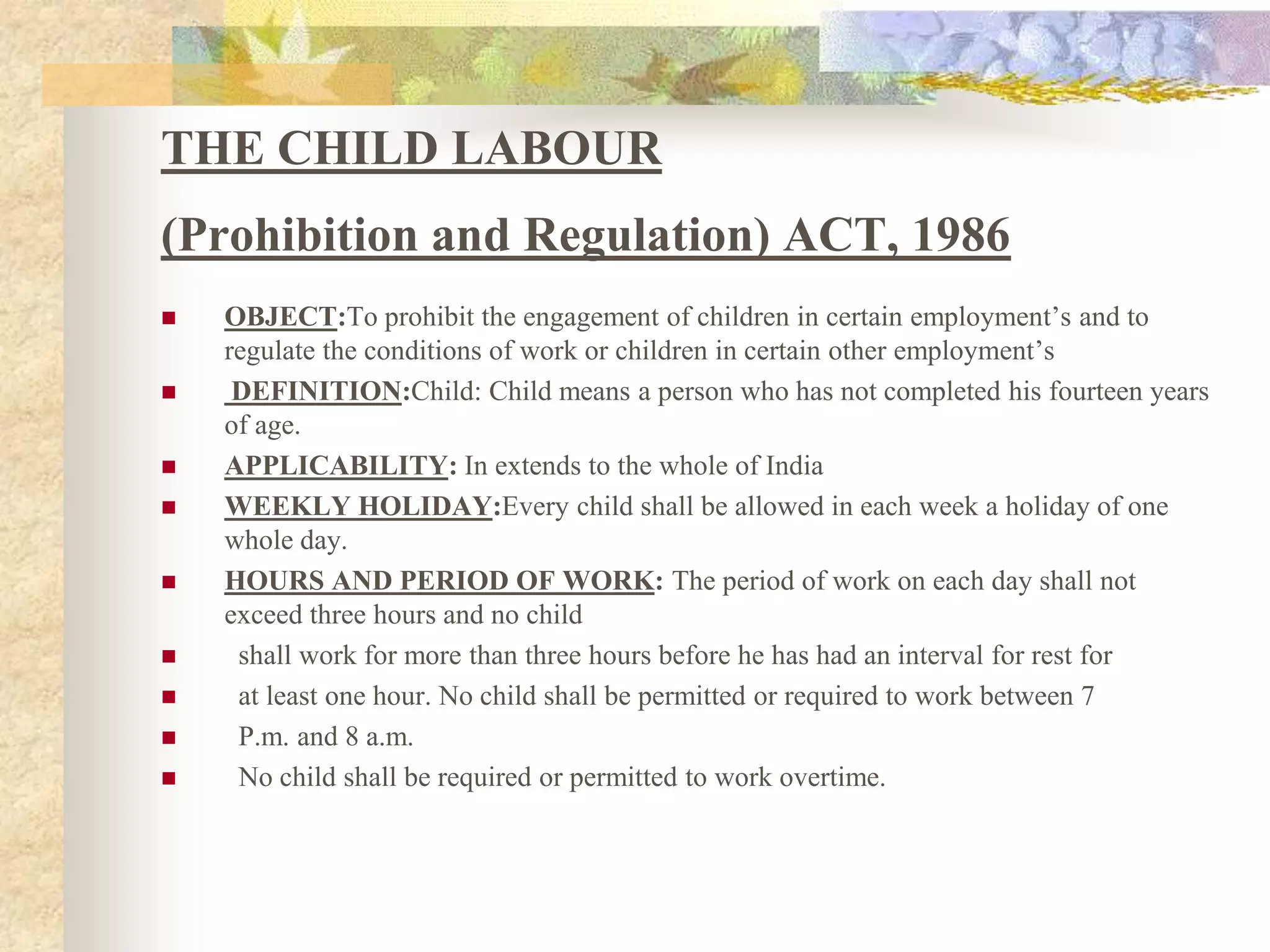
THE CHILD LABOUR(Prohibition and Regulation) ACT, 1986OBJECT:To prohibit the engagement of children in certain employment’s and to regulate the conditions of work or children in certain other employment’s DEFINITION:Child: Child means a person who has not completed his fourteen years of age.APPLICABILITY: In extends to the whole of India WEEKLY HOLIDAY:Every child shall be allowed in each week a holiday of one whole day.HOURS AND PERIOD OF WORK: The period of work on each day shall not exceed three hours and no child  shall work for more than three hours before he has had an interval for rest for  at least one hour. No child shall be permitted or required to work between 7  P.m. and 8 a.m.  No child shall be required or permitted to work overtime.
PROHIBITION OF EMPLOYMENT OF CHILDREN IN CERTAINOCCUPATIONS AND PROCESSES1. Transport of passengers, goods; or mails by railway2. Cinder picking, clearing of an ash pit or building operation in the railwaypremise.3. Work in a catering establishment at a railway station, involving the movementof vendor or any other employee of the establishment from one platform toanother or into or out of a moving train.4. Work relating to the construction of railway station or with any other workwhere such work is done in close proximity to or between the railway lines.5. The port authority within the limits of any port.1076. Work relating to selling of crackers and fireworks in shops with temporarylicenses7. Abattoirs/slaughter Houses8. Automobile workshops and garages.9. Founderies10. Handling of taxies or inflammable substance or explosives11. Handlom and powerloom industry12. Mines (Under ground and under water) and collieries13. Plastic units and Fiber glass workship
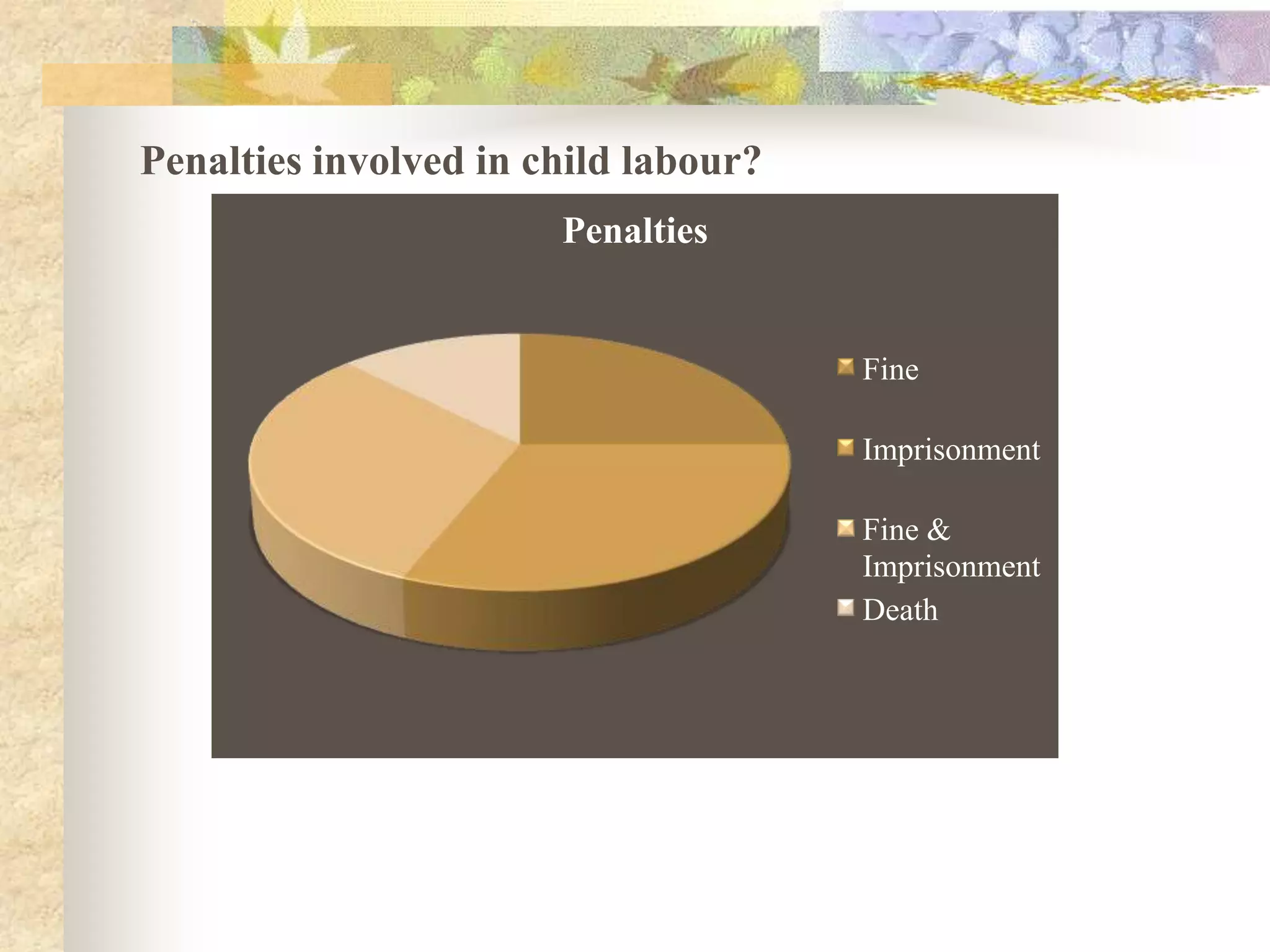
THE CHILD LABOUR(Prohibition and Regulation) ACT, 1986PENALITIES:Section-3 shall be punishable with imprisonment which shallnot be less than three months which may extend to one year or with finewhich shall not be less than ten thousand rupees but which may Extend totwenty thousand rupees or with both. section (3)     shall be punishable with imprisonment for a term which shall not be less thansix months but which may extend to two years.Any other violations under the Act shall be punishable with simple imprisonment,which may extend to one month or with fine, which may extend to ten thousandrupees or with both.
Questions conducted in survey1.Do u aware that child labour  is a crime?
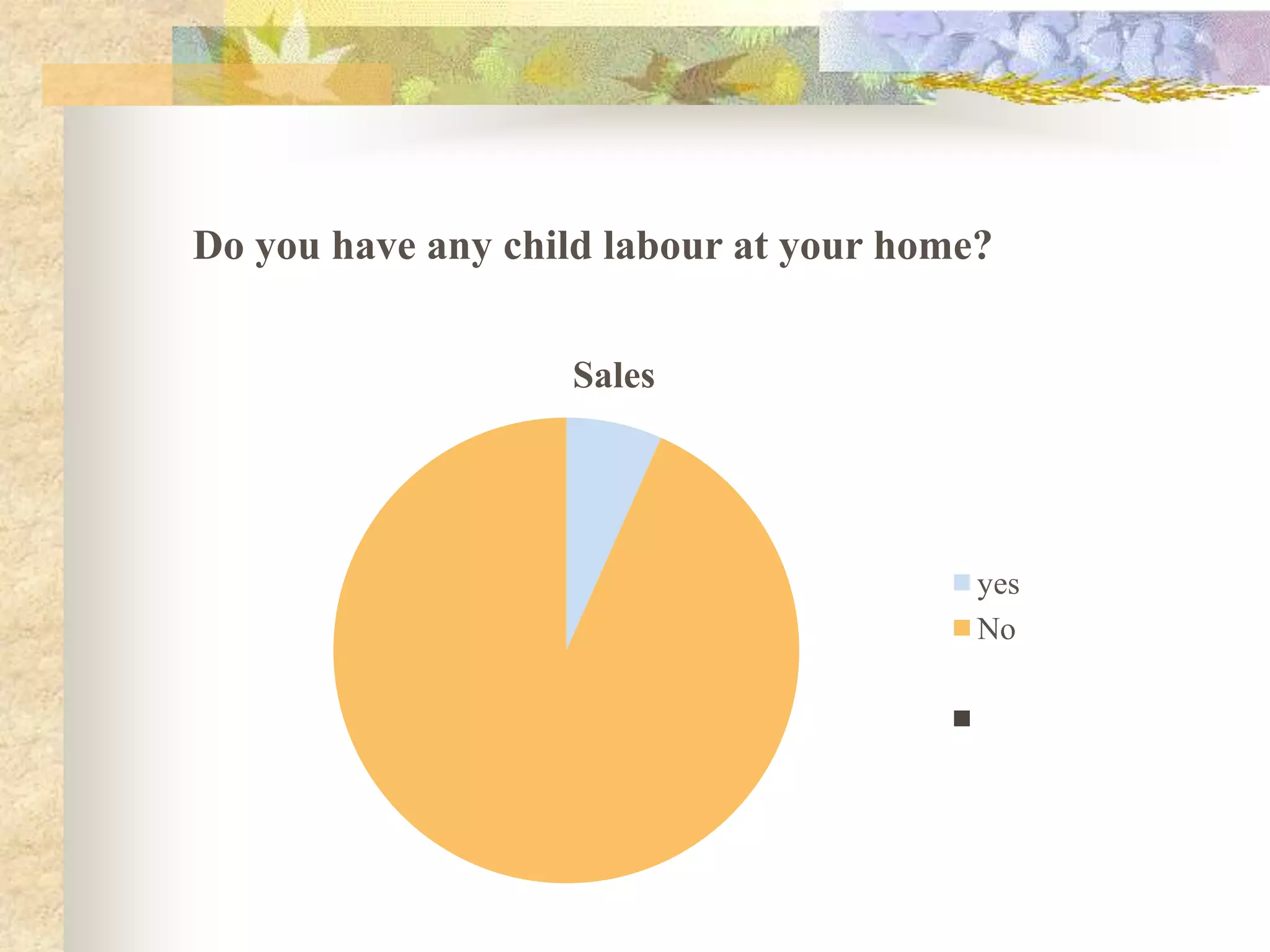
Do you have any child labour at your home?
Have you ever seen a child labour?
What is the age limit for child labour to be considered as a crime?
Causes of child labour?
Places where child labour found?
Major states contributing to child labour?
Penalties involved in child labour?
CHILD LABOURThe Silent Killer…
Children are remarkably imaginative and resilient - but also heartbreakingly fragile and vulnerable.“ So let us share their dreamsAnd shape their future” .
          THANK YOU

Child labour rm

  • 1.
    CHILD LABOURSHRIRAM SARDA 70 VINAY THAKKAR 71SANIL JADHAV 73NILESH SHIDGANE 111AATISH RAUT 132UMESH GAWDA 133
  • 2.
  • 3.
  • 5.
    CHILD LABOURChild labouris not only a social problem but also an economic one Watching a young child work for fourteen hours a-day is what is termed as child labor.Child labour has a predominant feature in Indian societycarpet industry requires the fine little fingers to weave the finest and tiniest of knots to create the most expensive of carpets firecracker industry probably prefers kids to men because they are cost effective and more efficientEven household labor – children last longer and are more honest than adults; is a claim made by most homemakers
  • 6.
    Child Labour FactSheet73 million working children are less than 10 years old. While buffaloes may cost up to 15,000 rupees , children are sold at prices between 500 and 2,000 rupees. 47 out of 100 children in India enrolled in class I reach class VIII, putting the dropout rate at 52.79%. Approximately 16.64% of villages in the country do not have facilities for primary schooling. (UNICEF) 42 million children in the age-group 6-14 years do not attend school in India.
  • 7.
    Causes of ChildLabourOVER POPULATION: limited resources and more mouths to feed, Children are employed in various forms of work. ILLITERACY :Illiterate parents do not realize the need for a proper physical,emotional and cognitive development of a child. POVERTY: Many a time poverty forces parents to send their children to hazardous jobs. URBANIZATION: MNC's and export industries in the developing world employ child workers, particularly in the garment industry.
  • 8.
    ORPHANS: Children bornout of wedlock, children with no parents and relatives, often do not find anyone to support them. Thus they are forced to work for their own living.WILLINGNESS TO EXPLOIT CHILDREN: This is at the root of the problem Even if a family is very poor, the incidence of child labour will be very low unless there are people willing to exploit these children. UNEMPLOYMENT OF ELDERS: Elders often find it difficult to get jobs. The industrialists and factory owners find it profitable to employ children. This is so because they can pay less and extract more work. They will also not create union problem. Causes of Child Labour
  • 9.
    Consequences For Children..Physicalinjuries and mutilations are caused by badly maintained machinery on farms and in factories, machete accidents in plantations, and any number of hazards encountered in industries such as mining, ceramics and fireworks manufacture Pesticide poisoning is one of the biggest killers of child laborers. In Sri Lanka, pesticides kill more children than diphtheria, malaria, polio and tetanus combined. The global death toll each year from pesticides is supposed to be approximately 40'000 Growth deficiency is prevalent among working children, who tend to be shorter and lighter than other children; these deficiencies also impact on their adult life
  • 10.
    Consequences For Children..Long-termhealth problems, such as respiratory disease, asbestosis and a variety of cancers, are common in countries where children are forced to work with dangerous chemicals HIV/AIDS and other sexually transmitted diseases are rife among the one million children forced into prostitution every year; pregnancy, drug addiction and mental illness are also common among child prostitutes Exhaustion and malnutrition are a result of underdeveloped children performing heavy manual labour, working long hours in unbearable conditions and not earning enough to feed themselves adequately
  • 11.
    LAWSNational Policy onChild Labour was formulated in 1987.prohibition of children being employed in hazardous occupations and processes.Poverty being the main root cause the govt has decided to generate the employment supplementary nutrition and regular health check ups so as to prepare them to join regular mainstream schools
  • 12.
    Initiatives towards Eliminationof Child LabourThe government has made efforts to prohibit child labor by enacting Child labor laws in India including the 1986 Child Labor (Prohibition and Regulation)Government has accordingly been taking proactive steps to tackle this problem through strict enforcement of legislative provisions along with simultaneous rehabilitative measuresState Governments, which are the appropriate implementing authorities, have been conducting regular inspections and raids to detect cases of violationsGovernment has been laying a lot of emphasis on the rehabilitation of these children and on improving the economic conditions of their families
  • 13.
    THE CHILD LABOUR(Prohibitionand Regulation) ACT, 1986OBJECT:To prohibit the engagement of children in certain employment’s and to regulate the conditions of work or children in certain other employment’s DEFINITION:Child: Child means a person who has not completed his fourteen years of age.APPLICABILITY: In extends to the whole of India WEEKLY HOLIDAY:Every child shall be allowed in each week a holiday of one whole day.HOURS AND PERIOD OF WORK: The period of work on each day shall not exceed three hours and no child shall work for more than three hours before he has had an interval for rest for at least one hour. No child shall be permitted or required to work between 7 P.m. and 8 a.m. No child shall be required or permitted to work overtime.
  • 14.
    PROHIBITION OF EMPLOYMENTOF CHILDREN IN CERTAINOCCUPATIONS AND PROCESSES1. Transport of passengers, goods; or mails by railway2. Cinder picking, clearing of an ash pit or building operation in the railwaypremise.3. Work in a catering establishment at a railway station, involving the movementof vendor or any other employee of the establishment from one platform toanother or into or out of a moving train.4. Work relating to the construction of railway station or with any other workwhere such work is done in close proximity to or between the railway lines.5. The port authority within the limits of any port.1076. Work relating to selling of crackers and fireworks in shops with temporarylicenses7. Abattoirs/slaughter Houses8. Automobile workshops and garages.9. Founderies10. Handling of taxies or inflammable substance or explosives11. Handlom and powerloom industry12. Mines (Under ground and under water) and collieries13. Plastic units and Fiber glass workship
  • 15.
    THE CHILD LABOUR(Prohibitionand Regulation) ACT, 1986PENALITIES:Section-3 shall be punishable with imprisonment which shallnot be less than three months which may extend to one year or with finewhich shall not be less than ten thousand rupees but which may Extend totwenty thousand rupees or with both. section (3) shall be punishable with imprisonment for a term which shall not be less thansix months but which may extend to two years.Any other violations under the Act shall be punishable with simple imprisonment,which may extend to one month or with fine, which may extend to ten thousandrupees or with both.
  • 16.
    Questions conducted insurvey1.Do u aware that child labour is a crime?
  • 17.
    Do you haveany child labour at your home?
  • 18.
    Have you everseen a child labour?
  • 19.
    What is theage limit for child labour to be considered as a crime?
  • 20.
  • 21.
    Places where childlabour found?
  • 22.
  • 24.
  • 26.
  • 27.
    Children are remarkablyimaginative and resilient - but also heartbreakingly fragile and vulnerable.“ So let us share their dreamsAnd shape their future” .
  • 28.
    THANK YOU