Personal Learning Environments
(PLE) in The Teaching Ecosystem:
A proposal in development
ï€Ș "A set of tools, data sources, connections and activities (experiences) that
each person uses usually to learn" Adell&Castañeda
ï€Ș The PLE is a new approach to learning. Neither is it an application, nor is it
a software.
ï€Ș It's a different way of learning with technology, it is an autonomous
personal informal learning on the net. The student sets its objectives,
content and environment, requires a trained learner.
What is a PLE?
✓ Everybody has a Personal Learnig Enviroment.
✓ PLEs give oportunities of learning that help the student to take
control of his own learning, objectives, etc. in different contexts.
✓ Ples promote learning in multiple contexts ( complex and
changing) .These ones act on formal+informal+personal+social
fields .
✓ PLEs is learning, learning in the digital age.
ï€Ș Currently most students use tools and web 2.0 services. It should be
emphasized, that its use is rather limited (reduced to games, emails, social
networks, video, websites, office programs, etc.) and students do not
become aware of learning that can be achieved, because they are not using
technologies as tools for learning.
ï€Ș In this context, this research emerges as a new way of understanding
learning, which requires knowledge, reflection, and Know-How to generate
the PLE that we can use as a mediator instrument of learning throughout
our training.
Why this research?
ï€Ș PLEs are particularly important because they consist of different tools we
use in our daily lives. We not only absorb information but we also learn
both inside the classroom and from our surroundings
ï€Ș The proposal is to analyze and understand students ́ PLEs via a pedagogical
approach, on how people learn in a technological environment. The focus
is on how we relate to, and interact with the tools, resources and the
social and personal networks we establish in a formal and informal open
ecosystem.
Why this research?
This research presents a study on Personal Learning Environments PLE, it
aims to describe and analyze the PLE with students who have studied the
course ICTÂŽs in Education first academic year 2014/2015 of the degree of
teacher of Primary in the Faculty of Education at the University of
Salamanca.
The research is quasi-experimental which aims to investigate
these environments, describe
1. Digital skills
2. Strategies and tools used by students to manage their own
learning.
3. Establish relations of these environments with their learning
styles, academic performance, multidisciplinary areas, etc.
4. It also seeks to find out whether this new approach enrich
students in their personal and academic dimension, and its use is
maintained over time.
Additionally, it is about providing students with a new approach to the use
of Learning Technology, by giving them the necessary skills for developing,
designing and enriching their own PLE, according to their needs. This
allows them to make use of different tools and use these as a learning
strategy. Including the three essential components:
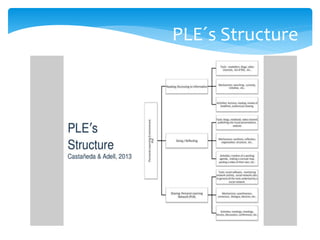
Tools and strategies READING: where to read and access information
(blogs, youtube, lists, email lists etc RSS.)
Tools and strategies REFLECTION: Where to modify information
"transforms" to develop knowledge production sites: wikis, blog, mind
maps, youtube, etc.
PLN Tools SHARE: where we interact with other 1.-objects through which
we share (publish and publishing) 2.-experiences and activities and 3.-
personal relationships in the net.
PLEÂŽs Structure
 The research is quasi-experimental, it has been applied to students who
have completed the course the ICT ́s in Education first academic year
2014/2015 of the degree of teacher of Primary Education in the Faculty of
Education of Salamanca.
 The group is composed by 120 students.
 This research has established two focus groups (experimental and
control) in both of them the PLE will be studied in each student, at the
beginning and the end of the academic course (pretest-postest). The
experimental group will be composed by 60 students and the control
group will be composed by about the same number. The most age of
students varies between 18 and 21 years old.
Research Methods
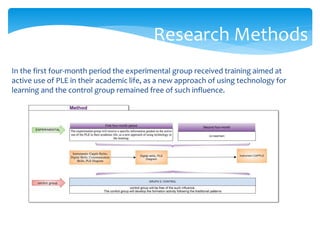
In the first four-month period the experimental group received training aimed at
active use of PLE in their academic life, as a new approach of using technology for
learning and the control group remained free of such influence.
Research Methods
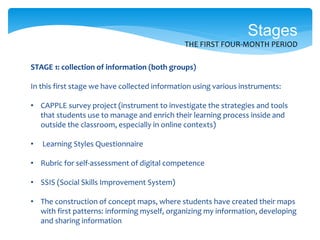
STAGE 1: collection of information (both groups)
In this first stage we have collected information using various instruments:
‱ CAPPLE survey project (instrument to investigate the strategies and tools
that students use to manage and enrich their learning process inside and
outside the classroom, especially in online contexts)
‱ Learning Styles Questionnaire
‱ Rubric for self-assessment of digital competence
‱ SSIS (Social Skills Improvement System)
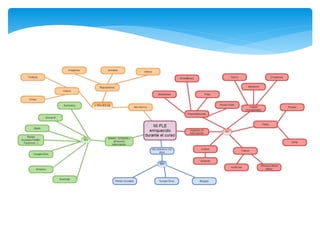
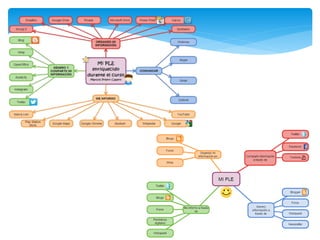
‱ The construction of concept maps, where students have created their maps
with first patterns: informing myself, organizing my information, developing
and sharing information
Stages
THE FIRST FOUR-MONTH PERIOD
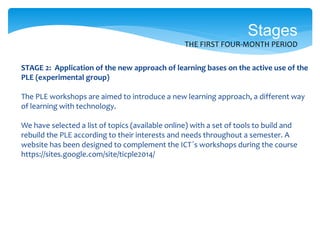
STAGE 2: Application of the new approach of learning bases on the active use of the
PLE (experimental group)
The PLE workshops are aimed to introduce a new learning approach, a different way
of learning with technology.
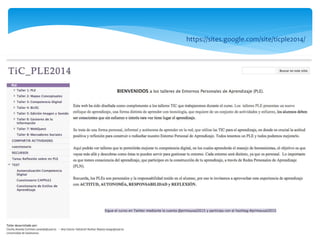
We have selected a list of topics (available online) with a set of tools to build and
rebuild the PLE according to their interests and needs throughout a semester. A
website has been designed to complement the ICTÂŽs workshops during the course
https://sites.google.com/site/ticple2014/
Stages
THE FIRST FOUR-MONTH PERIOD
https://sites.google.com/site/ticple2014/
STAGE 3: Analysis and interpretation
At this moment we are in this phase of research. We have just implemented the
instruments and collected the information.
We are analyzing and describing the information, as well as, establishing relation
between variables and groups.
Does the new approach of the use of technology to learn improve the PLE students’
and is their use kept in their lifelong learning?
Is the PLE improved through the obtaining of new digital competences
independently?
Do students find usefulness to the PLE to study the academic subjects?
Stages
There will be no a direct intervention but we checked both groups to
examine the evolution of the PLE along the course and to determine if
students, on their own, continue cultivating and improving PLES.
If it were positive, we would analyse in which way they are doing, we
would establish conclusions and relations with the carried out analysis
in the first four-month period. By the opposite, the hypothesis will be
invalid
Stages
THE SECOND FOUR-MONTH PERIOD
The research work does not have results yet. It is important to point out what we are
expecting:
1.- To know the processes of creation, management and enrichment of PLE along the course.
And highlight strategies needed to enhance their empowerment from formal education, in
order to improve these and academic performance.
2. -Analyse the influence of the use of the PLE in the academic learning of students, to
establish relations with the use of the PLE with different variation: performance, learning
style, personal network of learning and to investigate whether there is relationship between
the PLE.
3.- The application of new learning approach based on active use of PLE (experimental
group) evidencing changes.
EXPECTED RESULTS
GRACIAS!!!

Personal Learning Environments (PLE) in The Teaching Ecosystem: A proposal in development

  • 1.
    Personal Learning Environments (PLE)in The Teaching Ecosystem: A proposal in development
  • 2.
    ï€Ș "A setof tools, data sources, connections and activities (experiences) that each person uses usually to learn" Adell&Castañeda ï€Ș The PLE is a new approach to learning. Neither is it an application, nor is it a software. ï€Ș It's a different way of learning with technology, it is an autonomous personal informal learning on the net. The student sets its objectives, content and environment, requires a trained learner. What is a PLE?
  • 3.
    ✓ Everybody hasa Personal Learnig Enviroment. ✓ PLEs give oportunities of learning that help the student to take control of his own learning, objectives, etc. in different contexts. ✓ Ples promote learning in multiple contexts ( complex and changing) .These ones act on formal+informal+personal+social fields . ✓ PLEs is learning, learning in the digital age.
  • 4.
    ï€Ș Currently moststudents use tools and web 2.0 services. It should be emphasized, that its use is rather limited (reduced to games, emails, social networks, video, websites, office programs, etc.) and students do not become aware of learning that can be achieved, because they are not using technologies as tools for learning. ï€Ș In this context, this research emerges as a new way of understanding learning, which requires knowledge, reflection, and Know-How to generate the PLE that we can use as a mediator instrument of learning throughout our training. Why this research?
  • 5.
    ï€Ș PLEs areparticularly important because they consist of different tools we use in our daily lives. We not only absorb information but we also learn both inside the classroom and from our surroundings ï€Ș The proposal is to analyze and understand students ́ PLEs via a pedagogical approach, on how people learn in a technological environment. The focus is on how we relate to, and interact with the tools, resources and the social and personal networks we establish in a formal and informal open ecosystem. Why this research?
  • 6.
    This research presentsa study on Personal Learning Environments PLE, it aims to describe and analyze the PLE with students who have studied the course ICTÂŽs in Education first academic year 2014/2015 of the degree of teacher of Primary in the Faculty of Education at the University of Salamanca.
  • 7.
    The research isquasi-experimental which aims to investigate these environments, describe 1. Digital skills 2. Strategies and tools used by students to manage their own learning. 3. Establish relations of these environments with their learning styles, academic performance, multidisciplinary areas, etc. 4. It also seeks to find out whether this new approach enrich students in their personal and academic dimension, and its use is maintained over time.
  • 8.
    Additionally, it isabout providing students with a new approach to the use of Learning Technology, by giving them the necessary skills for developing, designing and enriching their own PLE, according to their needs. This allows them to make use of different tools and use these as a learning strategy. Including the three essential components: Tools and strategies READING: where to read and access information (blogs, youtube, lists, email lists etc RSS.) Tools and strategies REFLECTION: Where to modify information "transforms" to develop knowledge production sites: wikis, blog, mind maps, youtube, etc. PLN Tools SHARE: where we interact with other 1.-objects through which we share (publish and publishing) 2.-experiences and activities and 3.- personal relationships in the net.
  • 9.
  • 12.
     The researchis quasi-experimental, it has been applied to students who have completed the course the ICT ́s in Education first academic year 2014/2015 of the degree of teacher of Primary Education in the Faculty of Education of Salamanca.  The group is composed by 120 students.  This research has established two focus groups (experimental and control) in both of them the PLE will be studied in each student, at the beginning and the end of the academic course (pretest-postest). The experimental group will be composed by 60 students and the control group will be composed by about the same number. The most age of students varies between 18 and 21 years old. Research Methods
  • 13.
    In the firstfour-month period the experimental group received training aimed at active use of PLE in their academic life, as a new approach of using technology for learning and the control group remained free of such influence. Research Methods
  • 14.
    STAGE 1: collectionof information (both groups) In this first stage we have collected information using various instruments: ‱ CAPPLE survey project (instrument to investigate the strategies and tools that students use to manage and enrich their learning process inside and outside the classroom, especially in online contexts) ‱ Learning Styles Questionnaire ‱ Rubric for self-assessment of digital competence ‱ SSIS (Social Skills Improvement System) ‱ The construction of concept maps, where students have created their maps with first patterns: informing myself, organizing my information, developing and sharing information Stages THE FIRST FOUR-MONTH PERIOD
  • 15.
    STAGE 2: Applicationof the new approach of learning bases on the active use of the PLE (experimental group) The PLE workshops are aimed to introduce a new learning approach, a different way of learning with technology. We have selected a list of topics (available online) with a set of tools to build and rebuild the PLE according to their interests and needs throughout a semester. A website has been designed to complement the ICTÂŽs workshops during the course https://sites.google.com/site/ticple2014/ Stages THE FIRST FOUR-MONTH PERIOD
  • 16.
  • 17.
    STAGE 3: Analysisand interpretation At this moment we are in this phase of research. We have just implemented the instruments and collected the information. We are analyzing and describing the information, as well as, establishing relation between variables and groups. Does the new approach of the use of technology to learn improve the PLE students’ and is their use kept in their lifelong learning? Is the PLE improved through the obtaining of new digital competences independently? Do students find usefulness to the PLE to study the academic subjects? Stages
  • 18.
    There will beno a direct intervention but we checked both groups to examine the evolution of the PLE along the course and to determine if students, on their own, continue cultivating and improving PLES. If it were positive, we would analyse in which way they are doing, we would establish conclusions and relations with the carried out analysis in the first four-month period. By the opposite, the hypothesis will be invalid Stages THE SECOND FOUR-MONTH PERIOD
  • 19.
    The research workdoes not have results yet. It is important to point out what we are expecting: 1.- To know the processes of creation, management and enrichment of PLE along the course. And highlight strategies needed to enhance their empowerment from formal education, in order to improve these and academic performance. 2. -Analyse the influence of the use of the PLE in the academic learning of students, to establish relations with the use of the PLE with different variation: performance, learning style, personal network of learning and to investigate whether there is relationship between the PLE. 3.- The application of new learning approach based on active use of PLE (experimental group) evidencing changes. EXPECTED RESULTS
  • 20.

Editor's Notes

  • #3 This research is about Personal Learning Environments (it is the same as PLE), but what is a PLE?
  • #14 In the experimental group, we had worked on the process of personal learning and building a PLE will address integrating resources they already have with new ones, so that they autonomously acquire new skills and reflect on their learning to optimize depending on their personal and academic necessities. The control group will developed the training activity following the traditional patterns and at the end of the four-month period a first comparative analysis will be carried out. In this first analysis both groups will be studied in function of their PLE, and we will establish relations between the PLE and different variation: performance, learning style, kinds of networks that establish (social- learning), academic area, etc.