Grey water treatment by constructed
wetland
Chethan B J
2016-18-012
,
Types of waste water
• Greywater is defined as all wastewaters generated in the household, excluding toilet wastes.
It can come from the sinks, showers, tubs, or washing machine of a home.
• Brown water -Wastewater containing faeces
• Yellow water -Wastewater containing urine
• Black water -Wastewater containing both, faeces and urine
• Green water- Wastewater from kitchen sinks containing mainly food particles
• Storm water- Collected on roofs and driveways containing dust, hydrocarbons, abraded
materials from rubber and break, and heavy metals from metallic roofs
Grey water
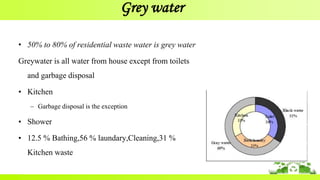
• 50% to 80% of residential waste water is grey water
Greywater is all water from house except from toilets
and garbage disposal
• Kitchen
– Garbage disposal is the exception
• Shower
• 12.5 % Bathing,56 % laundary,Cleaning,31 %
Kitchen waste
Classification of Grey Water
Depending on Source, Grey Water is Classified
o Domestic
o Institutional
o Commercial Laundry
o Commercial Kitchens
What Grey Water Contains??
• Grey water generation is dependent on living standard of people & it’s a result of personal
hygiene, detergents used, cosmetics used as well as dirty cloths,.
• Grey water contain Soap, Shampoo, Toothpaste, Food scraps, Cooking oils, Detergents
and Hairs, Kitchen waste, water from Floor Cleaning.
• Dishwashing & Floor cleaning mainly contain phosphorous , Sodium Bicarbonate.
• Kitchen waste contribute to Organic loading so increase in BOD Load.
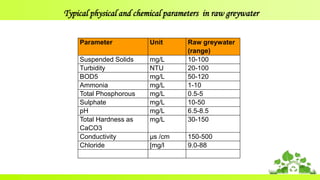
Parameter Unit Raw greywater
(range)
Suspended Solids mg/L 10-100
Turbidity NTU 20-100
BOD5 mg/L 50-120
Ammonia mg/L 1-10
Total Phosphorous mg/L 0.5-5
Sulphate mg/L 10-50
pH mg/L 6.5-8.5
Total Hardness as
CaCO3
mg/L 30-150
Conductivity μs /cm 150-500
Chloride [mg/l 9.0-88
Typical physical and chemical parameters in raw greywater
Why reuse GW?
• The excess concentration of phosphate from washing activities leads to eutrophication, which
leads to increase increasing domination of aquatic plants, breeding of mosquitos and snails,
generation of foul smell, death of aquatic animals, plants and ground water pollution.
• GW Recycling can save up to 35-40% of water consumption within a residential building by
reusing shower & basin water for the use of toilet flushing, irrigation, car washing, cleaning,
etc.
• Conventional plumbing systems dispose of greywater via septic tanks or sewers. The many
drawbacks of this practice include overloading treatment systems, contaminating natural
waters with poorly treated effluent and high ecological/economic cost
Why Grey Water Recycling??
• Treated grey water will act as a substitute to those application which do not require
drinking water quality so directly it will reduce & save fresh water requirement.
• Grey water recycling is not dependent on season or variability of rainfall and as such is a
continuous and a reliable water resource.
• As the treated water is high in nutrient Content(N,P)
• Grey water recycling will reduce load on Sewage treatment plant therefore tangential
benefit is there.
• Infiltration of treated Grey water will help to increase ground water table level
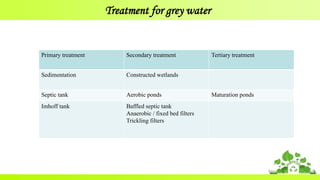
Treatment for grey water
Primary treatment Secondary treatment Tertiary treatment
Sedimentation Constructed wetlands
Septic tank Aerobic ponds Maturation ponds
Imhoff tank Baffled septic tank
Anaerobic / fixed bed filters
Trickling filters
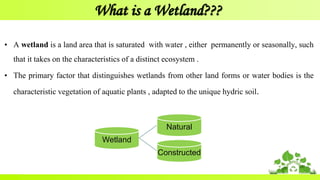
What is a Wetland???
• A wetland is a land area that is saturated with water , either permanently or seasonally, such
that it takes on the characteristics of a distinct ecosystem .
• The primary factor that distinguishes wetlands from other land forms or water bodies is the
characteristic vegetation of aquatic plants , adapted to the unique hydric soil.
Wetland
Natural
Constructed
.
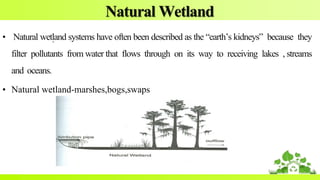
Natural Wetland
• Natural wetland systems have often been described as the “earth’s kidneys” because they
filter pollutants from water that flows through on its way to receiving lakes , streams
and oceans.
• Natural wetland-marshes,bogs,swaps
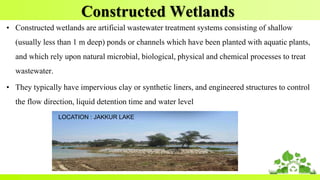
Constructed Wetlands
• Constructed wetlands are artificial wastewater treatment systems consisting of shallow
(usually less than 1 m deep) ponds or channels which have been planted with aquatic plants,
and which rely upon natural microbial, biological, physical and chemical processes to treat
wastewater.
• They typically have impervious clay or synthetic liners, and engineered structures to control
the flow direction, liquid detention time and water level
LOCATION : JAKKUR LAKE
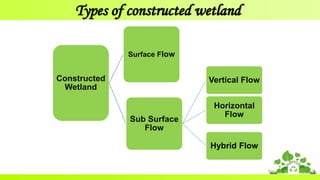
Types of constructed wetland
Constructed
Wetland
Surface Flow
Sub Surface
Flow
Vertical Flow
Horizontal
Flow
Hybrid Flow
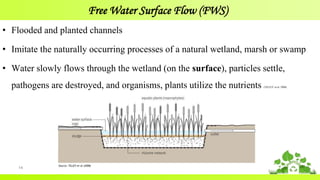
Free Water Surface Flow (FWS)
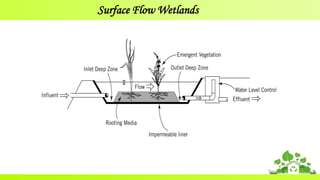
• Flooded and planted channels
• Imitate the naturally occurring processes of a natural wetland, marsh or swamp
• Water slowly flows through the wetland (on the surface), particles settle,
pathogens are destroyed, and organisms, plants utilize the nutrients (TILLEY et al. 2008)
14
Source: TILLEY et al (2008)
Surface Flow Wetlands
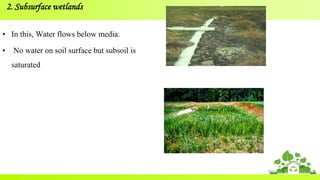
• In this, Water flows below media.
• No water on soil surface but subsoil is
saturated
2. Subsurface wetlands
*Photo courtesy of USGS
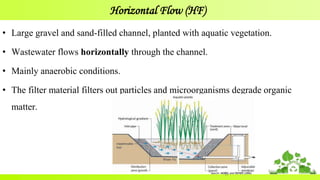
Horizontal Flow (HF)
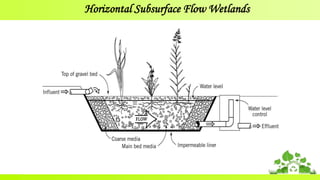
• Large gravel and sand-filled channel, planted with aquatic vegetation.
• Wastewater flows horizontally through the channel.
• Mainly anaerobic conditions.
• The filter material filters out particles and microorganisms degrade organic
matter.
17Source: MOREL and DIENER (2006)
Horizontal Subsurface Flow Wetlands
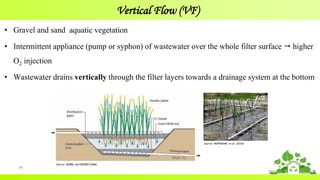
Vertical Flow (VF)
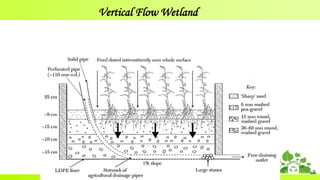
• Gravel and sand aquatic vegetation
• Intermittent appliance (pump or syphon) of wastewater over the whole filter surface  higher
O2 injection
• Wastewater drains vertically through the filter layers towards a drainage system at the bottom
19
Source: MOREL and DIENER (2006)
Source: HOFFMANN et al. (2010)
Vertical Flow Wetland
Hybrid Flow
21
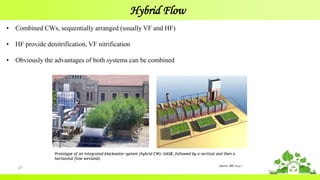
• Combined CWs, sequentially arranged (usually VF and HF)
• HF provide denitrification, VF nitrification
• Obviously the advantages of both systems can be combined
Source: UPC (n.y.)
Prototype of an integrated blackwater system (hybrid CW): UASB, followed by a vertical and then a
horizontal flow wetland).
Typical Subsurface Wetland System consists of :
• Liner
• Inlet structure
• Bed (including media and plants)
• Outlet structure
Slope
• Systems have been designed with bed slopes of as much 8 percent to achieve the hydraulic gradient. Newer
systems have used a flat bottom or slight slope and have employed an adjustable outlet to achieve the hydraulic
gradient.
Aspect Ratio
• The aspect ratio (length/width) is also important. Ratios of around 4:1 are preferable. Longer beds have an
inadequate hydraulic gradient and tend to result in water above the bed surface.
COMPONENTS OF WETLAND
• Waterproof basin
– To avoid groundwater and soil contamination
– To prevent infiltration of groundwater into the wetland bed
– Layer of compacted clay
– Plastic liners
23
COMPONENTS OF WETLAND
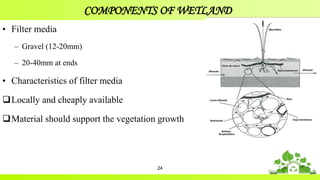
• Filter media
– Gravel (12-20mm)
– 20-40mm at ends
• Characteristics of filter media
Locally and cheaply available
Material should support the vegetation growth
24
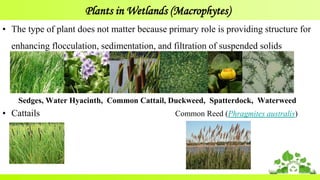
Plants in Wetlands (Macrophytes)
• The type of plant does not matter because primary role is providing structure for
enhancing flocculation, sedimentation, and filtration of suspended solids
Sedges, Water Hyacinth, Common Cattail, Duckweed, Spatterdock, Waterweed
• Cattails Common Reed (Phragmites australis)
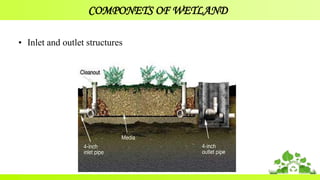
COMPONETS OF WETLAND
• Inlet and outlet structures
26
Filtration and sedimentation – Larger particles are trapped in the media or settle to the bottom of the bed as
water flows through. Because these systems are normally used with a pretreatment system, such as a septic tank
or detention pond, this is a small part of the treatment.
The main treatment processes are,
• The breakdown and transformation by the microbial population clinging to the surface of the media
and plant roots
• The adsorption of materials and ion exchange at the media and plant surfaces.
The plants in the bed also provide oxygen and nutrients to promote microbial growth. The rest of the bed is
assumed to be anaerobic.
Wetlands treat water in the following ways
WORKING MECHANISM
• Organic matter
– Aerobic microbial degradation
– Anaerobic microbial degradation
• Suspended solids
– Sedimentation
– filtration
• Pathogens
– Sedimentation
– Filtration
– Predation 28
WORKING MECHANISM
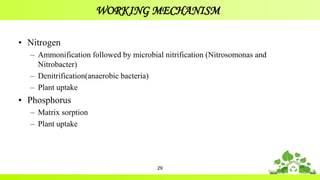
• Nitrogen
– Ammonification followed by microbial nitrification (Nitrosomonas and
Nitrobacter)
– Denitrification(anaerobic bacteria)
– Plant uptake
• Phosphorus
– Matrix sorption
– Plant uptake
29
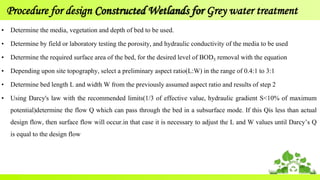
Procedure for design Constructed Wetlands for Grey water treatment
• Determine the media, vegetation and depth of bed to be used.
• Determine by field or laboratory testing the porosity, and hydraulic conductivity of the media to be used
• Determine the required surface area of the bed, for the desired level of BOD5 removal with the equation
• Depending upon site topography, select a preliminary aspect ratio(L:W) in the range of 0.4:1 to 3:1
• Determine bed length L and width W from the previously assumed aspect ratio and results of step 2
• Using Darcy's law with the recommended limits(1/3 of effective value, hydraulic gradient S<10% of maximum
potential)determine the flow Q which can pass through the bed in a subsurface mode. If this Qis less than actual
design flow, then surface flow will occur.in that case it is necessary to adjust the L and W values until Darcy’s Q
is equal to the design flow
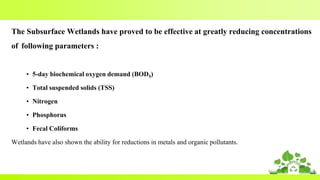
The Subsurface Wetlands have proved to be effective at greatly reducing concentrations
of following parameters :
• 5-day biochemical oxygen demand (BOD5)
• Total suspended solids (TSS)
• Nitrogen
• Phosphorus
• Fecal Coliforms
Wetlands have also shown the ability for reductions in metals and organic pollutants.
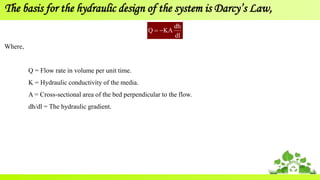
dl
dh
KAQ 
The basis for the hydraulic design of the system is Darcy’s Law,
Where,
Q = Flow rate in volume per unit time.
K = Hydraulic conductivity of the media.
A = Cross-sectional area of the bed perpendicular to the flow.
dh/dl = The hydraulic gradient.
Biochemical oxygen demand
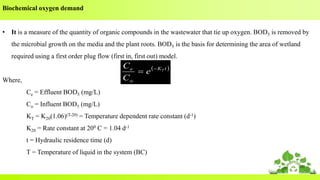
• It is a measure of the quantity of organic compounds in the wastewater that tie up oxygen. BOD5 is removed by
the microbial growth on the media and the plant roots. BOD5 is the basis for determining the area of wetland
required using a first order plug flow (first in, first out) model.
Where,
Ce = Effluent BOD5 (mg/L)
Co = Influent BOD5 (mg/L)
KT = K20(1.06)(T-20) = Temperature dependent rate constant (d-1)
K20 = Rate constant at 200 C = 1.04 d-1
t = Hydraulic residence time (d)
T = Temperature of liquid in the system (BC)
 tK
o
e T
e
C
C 

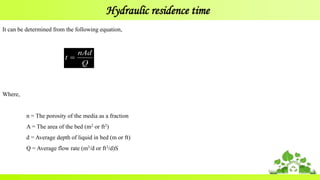
Hydraulic residence time
Q
nAd
t 
It can be determined from the following equation,
Where,
n = The porosity of the media as a fraction
A = The area of the bed (m2 or ft2)
d = Average depth of liquid in bed (m or ft)
Q = Average flow rate (m3/d or ft3/d)S
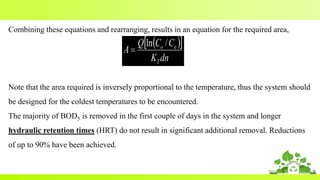
Combining these equations and rearranging, results in an equation for the required area,
Note that the area required is inversely proportional to the temperature, thus the system should
be designed for the coldest temperatures to be encountered.
The majority of BOD5 is removed in the first couple of days in the system and longer
hydraulic retention times (HRT) do not result in significant additional removal. Reductions
of up to 90% have been achieved.
  
dnK
CCQ
A
T
eo /ln

TSS
The results for TSS removal have been similar to BOD5 in that the majority is removed in the first few feet
of the bed (or first couple of days) and a system properly sized for BOD5 removal would be properly sized
for TSS removal.
Nitrogen
The removal of nitrogen in the form of ammonia and organic nitrogen requires a supply of oxygen for
nitrification. This oxygen usually comes from the plant roots. Nitrate removal in a wetland takes place by
plant uptake, de-nitrification and microbial processes.
Phosphorus
For significant phosphorus removal, sand or fine river gravel with iron or aluminum oxides is needed. These
finer materials with their lower hydraulic conductivity require larger areas and may not be feasible if that is
not a major goal.
Fecal Coliforms
This is usually not enough to satisfy local regulations, however, so some sort of after treatment is needed.
The reduction is enough to significantly reduce the scope of the after treatment process.
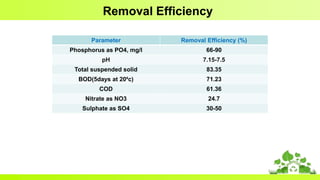
Removal Efficiency
Parameter Removal Efficiency (%)
Phosphorus as PO4, mg/l 66-90
pH 7.15-7.5
Total suspended solid 83.35
BOD(5days at 20⁰c) 71.23
COD 61.36
Nitrate as NO3 24.7
Sulphate as SO4 30-50
• Secondary or tertiary treatment process for black, brown and greywater
• Adequate strategy if land is no limiting factor (space and costs)
• Constructed wetlands are natural systems and do not require electrical energy
(unless for pumps) or chemicals
• Best suited for warm climates, but can be designed to tolerate freezing periods
• CW’s can be combined with many other techniques such as aquaculture,
irrigation and several pre-treatment options.
40
Applicability
Uses of treated grey water
• Urinal and toilet flushing
• Irrigation of lawns (college campuses, athletic fields, cemeteries, parks and golf, Courses,
domestic gardens)
• Washing of vehicles and windows
• Fire protection
• Boiler feed water
• Concrete production
• Develop and preserve wetlands
• Infiltrate into the ground
• Agriculture and viticulture reuse
42
•Advantages:
– Simple O&M due to high process stability
– No chemicals required
– Can be built and repaired with locally available
materials
– Utilisation of natural processes
– Efficient removal of suspended and dissolved
organic matter, nutrients and pathogens
•Disadvantages:
– Permanent land required
– Requires expert design and supervision
– Moderate capital cost depending on land, liner,
fill, etc.; low operating costs
– Pre-treatment is required to prevent clogging
– Low tolerance to durable cold climates
– Electricity may be required
THANK YOU

Grey water treatment by constructed wetland

  • 1.
    Grey water treatmentby constructed wetland Chethan B J 2016-18-012 ,
  • 2.
    Types of wastewater • Greywater is defined as all wastewaters generated in the household, excluding toilet wastes. It can come from the sinks, showers, tubs, or washing machine of a home. • Brown water -Wastewater containing faeces • Yellow water -Wastewater containing urine • Black water -Wastewater containing both, faeces and urine • Green water- Wastewater from kitchen sinks containing mainly food particles • Storm water- Collected on roofs and driveways containing dust, hydrocarbons, abraded materials from rubber and break, and heavy metals from metallic roofs
  • 3.
    Grey water • 50%to 80% of residential waste water is grey water Greywater is all water from house except from toilets and garbage disposal • Kitchen – Garbage disposal is the exception • Shower • 12.5 % Bathing,56 % laundary,Cleaning,31 % Kitchen waste
  • 4.
    Classification of GreyWater Depending on Source, Grey Water is Classified o Domestic o Institutional o Commercial Laundry o Commercial Kitchens
  • 5.
    What Grey WaterContains?? • Grey water generation is dependent on living standard of people & it’s a result of personal hygiene, detergents used, cosmetics used as well as dirty cloths,. • Grey water contain Soap, Shampoo, Toothpaste, Food scraps, Cooking oils, Detergents and Hairs, Kitchen waste, water from Floor Cleaning. • Dishwashing & Floor cleaning mainly contain phosphorous , Sodium Bicarbonate. • Kitchen waste contribute to Organic loading so increase in BOD Load.
  • 6.
    Parameter Unit Rawgreywater (range) Suspended Solids mg/L 10-100 Turbidity NTU 20-100 BOD5 mg/L 50-120 Ammonia mg/L 1-10 Total Phosphorous mg/L 0.5-5 Sulphate mg/L 10-50 pH mg/L 6.5-8.5 Total Hardness as CaCO3 mg/L 30-150 Conductivity μs /cm 150-500 Chloride [mg/l 9.0-88 Typical physical and chemical parameters in raw greywater
  • 7.
    Why reuse GW? •The excess concentration of phosphate from washing activities leads to eutrophication, which leads to increase increasing domination of aquatic plants, breeding of mosquitos and snails, generation of foul smell, death of aquatic animals, plants and ground water pollution. • GW Recycling can save up to 35-40% of water consumption within a residential building by reusing shower & basin water for the use of toilet flushing, irrigation, car washing, cleaning, etc. • Conventional plumbing systems dispose of greywater via septic tanks or sewers. The many drawbacks of this practice include overloading treatment systems, contaminating natural waters with poorly treated effluent and high ecological/economic cost
  • 8.
    Why Grey WaterRecycling?? • Treated grey water will act as a substitute to those application which do not require drinking water quality so directly it will reduce & save fresh water requirement. • Grey water recycling is not dependent on season or variability of rainfall and as such is a continuous and a reliable water resource. • As the treated water is high in nutrient Content(N,P) • Grey water recycling will reduce load on Sewage treatment plant therefore tangential benefit is there. • Infiltration of treated Grey water will help to increase ground water table level
  • 9.
    Treatment for greywater Primary treatment Secondary treatment Tertiary treatment Sedimentation Constructed wetlands Septic tank Aerobic ponds Maturation ponds Imhoff tank Baffled septic tank Anaerobic / fixed bed filters Trickling filters
  • 10.
    What is aWetland??? • A wetland is a land area that is saturated with water , either permanently or seasonally, such that it takes on the characteristics of a distinct ecosystem . • The primary factor that distinguishes wetlands from other land forms or water bodies is the characteristic vegetation of aquatic plants , adapted to the unique hydric soil. Wetland Natural Constructed
  • 11.
    . Natural Wetland • Naturalwetland systems have often been described as the “earth’s kidneys” because they filter pollutants from water that flows through on its way to receiving lakes , streams and oceans. • Natural wetland-marshes,bogs,swaps
  • 12.
    Constructed Wetlands • Constructedwetlands are artificial wastewater treatment systems consisting of shallow (usually less than 1 m deep) ponds or channels which have been planted with aquatic plants, and which rely upon natural microbial, biological, physical and chemical processes to treat wastewater. • They typically have impervious clay or synthetic liners, and engineered structures to control the flow direction, liquid detention time and water level LOCATION : JAKKUR LAKE
  • 13.
    Types of constructedwetland Constructed Wetland Surface Flow Sub Surface Flow Vertical Flow Horizontal Flow Hybrid Flow
  • 14.
    Free Water SurfaceFlow (FWS) • Flooded and planted channels • Imitate the naturally occurring processes of a natural wetland, marsh or swamp • Water slowly flows through the wetland (on the surface), particles settle, pathogens are destroyed, and organisms, plants utilize the nutrients (TILLEY et al. 2008) 14 Source: TILLEY et al (2008)
  • 15.
  • 16.
    • In this,Water flows below media. • No water on soil surface but subsoil is saturated 2. Subsurface wetlands *Photo courtesy of USGS
  • 17.
    Horizontal Flow (HF) •Large gravel and sand-filled channel, planted with aquatic vegetation. • Wastewater flows horizontally through the channel. • Mainly anaerobic conditions. • The filter material filters out particles and microorganisms degrade organic matter. 17Source: MOREL and DIENER (2006)
  • 18.
  • 19.
    Vertical Flow (VF) •Gravel and sand aquatic vegetation • Intermittent appliance (pump or syphon) of wastewater over the whole filter surface  higher O2 injection • Wastewater drains vertically through the filter layers towards a drainage system at the bottom 19 Source: MOREL and DIENER (2006) Source: HOFFMANN et al. (2010)
  • 20.
  • 21.
    Hybrid Flow 21 • CombinedCWs, sequentially arranged (usually VF and HF) • HF provide denitrification, VF nitrification • Obviously the advantages of both systems can be combined Source: UPC (n.y.) Prototype of an integrated blackwater system (hybrid CW): UASB, followed by a vertical and then a horizontal flow wetland).
  • 22.
    Typical Subsurface WetlandSystem consists of : • Liner • Inlet structure • Bed (including media and plants) • Outlet structure Slope • Systems have been designed with bed slopes of as much 8 percent to achieve the hydraulic gradient. Newer systems have used a flat bottom or slight slope and have employed an adjustable outlet to achieve the hydraulic gradient. Aspect Ratio • The aspect ratio (length/width) is also important. Ratios of around 4:1 are preferable. Longer beds have an inadequate hydraulic gradient and tend to result in water above the bed surface.
  • 23.
    COMPONENTS OF WETLAND •Waterproof basin – To avoid groundwater and soil contamination – To prevent infiltration of groundwater into the wetland bed – Layer of compacted clay – Plastic liners 23
  • 24.
    COMPONENTS OF WETLAND •Filter media – Gravel (12-20mm) – 20-40mm at ends • Characteristics of filter media Locally and cheaply available Material should support the vegetation growth 24
  • 25.
    Plants in Wetlands(Macrophytes) • The type of plant does not matter because primary role is providing structure for enhancing flocculation, sedimentation, and filtration of suspended solids Sedges, Water Hyacinth, Common Cattail, Duckweed, Spatterdock, Waterweed • Cattails Common Reed (Phragmites australis)
  • 26.
    COMPONETS OF WETLAND •Inlet and outlet structures 26
  • 27.
    Filtration and sedimentation– Larger particles are trapped in the media or settle to the bottom of the bed as water flows through. Because these systems are normally used with a pretreatment system, such as a septic tank or detention pond, this is a small part of the treatment. The main treatment processes are, • The breakdown and transformation by the microbial population clinging to the surface of the media and plant roots • The adsorption of materials and ion exchange at the media and plant surfaces. The plants in the bed also provide oxygen and nutrients to promote microbial growth. The rest of the bed is assumed to be anaerobic. Wetlands treat water in the following ways
  • 28.
    WORKING MECHANISM • Organicmatter – Aerobic microbial degradation – Anaerobic microbial degradation • Suspended solids – Sedimentation – filtration • Pathogens – Sedimentation – Filtration – Predation 28
  • 29.
    WORKING MECHANISM • Nitrogen –Ammonification followed by microbial nitrification (Nitrosomonas and Nitrobacter) – Denitrification(anaerobic bacteria) – Plant uptake • Phosphorus – Matrix sorption – Plant uptake 29
  • 30.
    Procedure for designConstructed Wetlands for Grey water treatment • Determine the media, vegetation and depth of bed to be used. • Determine by field or laboratory testing the porosity, and hydraulic conductivity of the media to be used • Determine the required surface area of the bed, for the desired level of BOD5 removal with the equation • Depending upon site topography, select a preliminary aspect ratio(L:W) in the range of 0.4:1 to 3:1 • Determine bed length L and width W from the previously assumed aspect ratio and results of step 2 • Using Darcy's law with the recommended limits(1/3 of effective value, hydraulic gradient S<10% of maximum potential)determine the flow Q which can pass through the bed in a subsurface mode. If this Qis less than actual design flow, then surface flow will occur.in that case it is necessary to adjust the L and W values until Darcy’s Q is equal to the design flow
  • 31.
    The Subsurface Wetlandshave proved to be effective at greatly reducing concentrations of following parameters : • 5-day biochemical oxygen demand (BOD5) • Total suspended solids (TSS) • Nitrogen • Phosphorus • Fecal Coliforms Wetlands have also shown the ability for reductions in metals and organic pollutants.
  • 32.
    dl dh KAQ  The basisfor the hydraulic design of the system is Darcy’s Law, Where, Q = Flow rate in volume per unit time. K = Hydraulic conductivity of the media. A = Cross-sectional area of the bed perpendicular to the flow. dh/dl = The hydraulic gradient.
  • 33.
    Biochemical oxygen demand •It is a measure of the quantity of organic compounds in the wastewater that tie up oxygen. BOD5 is removed by the microbial growth on the media and the plant roots. BOD5 is the basis for determining the area of wetland required using a first order plug flow (first in, first out) model. Where, Ce = Effluent BOD5 (mg/L) Co = Influent BOD5 (mg/L) KT = K20(1.06)(T-20) = Temperature dependent rate constant (d-1) K20 = Rate constant at 200 C = 1.04 d-1 t = Hydraulic residence time (d) T = Temperature of liquid in the system (BC)  tK o e T e C C  
  • 34.
    Hydraulic residence time Q nAd t It can be determined from the following equation, Where, n = The porosity of the media as a fraction A = The area of the bed (m2 or ft2) d = Average depth of liquid in bed (m or ft) Q = Average flow rate (m3/d or ft3/d)S
  • 35.
    Combining these equationsand rearranging, results in an equation for the required area, Note that the area required is inversely proportional to the temperature, thus the system should be designed for the coldest temperatures to be encountered. The majority of BOD5 is removed in the first couple of days in the system and longer hydraulic retention times (HRT) do not result in significant additional removal. Reductions of up to 90% have been achieved.    dnK CCQ A T eo /ln 
  • 36.
    TSS The results forTSS removal have been similar to BOD5 in that the majority is removed in the first few feet of the bed (or first couple of days) and a system properly sized for BOD5 removal would be properly sized for TSS removal. Nitrogen The removal of nitrogen in the form of ammonia and organic nitrogen requires a supply of oxygen for nitrification. This oxygen usually comes from the plant roots. Nitrate removal in a wetland takes place by plant uptake, de-nitrification and microbial processes.
  • 37.
    Phosphorus For significant phosphorusremoval, sand or fine river gravel with iron or aluminum oxides is needed. These finer materials with their lower hydraulic conductivity require larger areas and may not be feasible if that is not a major goal. Fecal Coliforms This is usually not enough to satisfy local regulations, however, so some sort of after treatment is needed. The reduction is enough to significantly reduce the scope of the after treatment process.
  • 39.
    Removal Efficiency Parameter RemovalEfficiency (%) Phosphorus as PO4, mg/l 66-90 pH 7.15-7.5 Total suspended solid 83.35 BOD(5days at 20⁰c) 71.23 COD 61.36 Nitrate as NO3 24.7 Sulphate as SO4 30-50
  • 40.
    • Secondary ortertiary treatment process for black, brown and greywater • Adequate strategy if land is no limiting factor (space and costs) • Constructed wetlands are natural systems and do not require electrical energy (unless for pumps) or chemicals • Best suited for warm climates, but can be designed to tolerate freezing periods • CW’s can be combined with many other techniques such as aquaculture, irrigation and several pre-treatment options. 40 Applicability
  • 41.
    Uses of treatedgrey water • Urinal and toilet flushing • Irrigation of lawns (college campuses, athletic fields, cemeteries, parks and golf, Courses, domestic gardens) • Washing of vehicles and windows • Fire protection • Boiler feed water • Concrete production • Develop and preserve wetlands • Infiltrate into the ground • Agriculture and viticulture reuse
  • 42.
    42 •Advantages: – Simple O&Mdue to high process stability – No chemicals required – Can be built and repaired with locally available materials – Utilisation of natural processes – Efficient removal of suspended and dissolved organic matter, nutrients and pathogens •Disadvantages: – Permanent land required – Requires expert design and supervision – Moderate capital cost depending on land, liner, fill, etc.; low operating costs – Pre-treatment is required to prevent clogging – Low tolerance to durable cold climates – Electricity may be required
  • 43.