Chemotherapy
Prepared by:
Abeer Abed Al-Majeed & Fidaa
Dirbas
Supervisor:
Abeer Mansour
Specific Objective
1) Define Chemotherapy
2) Explain the indications of Chemotherapy
3) Describe the side effects in chemotherapy
4) Goals of chemotherapy
5) Type of Chemotherapy
6) Rout Of Administration
7) Therapeutic Strategies
8) Prevention of Chemotherapy related Problems & Instruction
9) Complication
Definition
• Chemotherapy is an aggressive from of chemical drug therapy
meant to destroy rapidly growing cells in the body.
• It’s usually used to treat cancer, as cancer cells grow and
dividing faster than other cells.
• It includes the use of various chemotherapeutic agents and
hormones
Indications of Chemotherapy
• Chemotherapy is primarily used to:
• Lower the total number of cancer cells in the body.
• Reduce the likelihood of cancer spreading.
• Shrink tumour size.
• Reduce current symptoms.
Why does Chemotherapy cause side
effects?
• Chemotherapy works on active cells (cells that are growing
and dividing into more of the same type of cells).
• Cancer cells are active, but so are some healthy cells.
• Side effects happen when chemotherapy damages these
healthy cells.
Side effects in chemotherapy
• Chemotherapy drugs as most drugs do have side effects which
are unwanted things that happen.
• Some chemotherapy drugs can cause: pain, weakness,
numbness, pale skin, tingling in the hands and feet (peripheral
neuropathy), minor skin irritation like itchiness or rash.
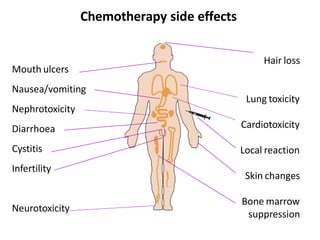
Mouth ulcers
Nausea/vomiting
Nephrotoxicity
Diarrhoea
Cystitis
Infertility
Neurotoxicity
Hair loss
Lung toxicity
Cardiotoxicity
Local reaction
Skin changes
Bone marrow
suppression
Chemotherapy side effects
Goals of chemotherapy
• Eliminate the cancer
• Shrink the tumor
• Prevent cancer from spreading
• Relieve symptoms from cancer, such as pain
Type of Chemotherapy
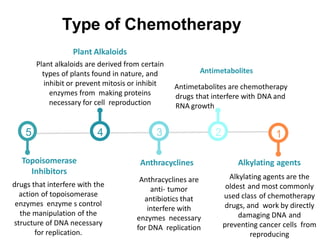
5 4 3 2 1
Alkylating agents
Alkylating agents are the
oldest and most commonly
used class of chemotherapy
drugs, and work by directly
damaging DNA and
preventing cancer cells from
reproducing
Anthracyclines
Anthracyclines are
anti- tumor
antibiotics that
interfere with
enzymes necessary
for DNA replication
Topoisomerase
Inhibitors
drugs that interfere with the
action of topoisomerase
enzymes enzyme s control
the manipulation of the
structure of DNA necessary
for replication.
Plant Alkaloids
Plant alkaloids are derived from certain
types of plants found in nature, and
inhibit or prevent mitosis or inhibit
enzymes from making proteins
necessary for cell reproduction
Antimetabolites
Antimetabolites are chemotherapy
drugs that interfere with DNA and
RNA growth
Rout Of Administration
–Oral—capsule, tablet, or liquid
–I.V.—push (bolus) or infusion over a specified time period
–Intramuscular
–Intrathecal/intraventricular—given by injection via an Ommaya reservoir or by
lumbar puncture
–Intra-arterial
–Intracavitary—such as peritoneal cavity
–Intravesical—into uterus or bladder
–Topical
Adjuvant therapy
Given to patients who have no evidence of residual disease
but who are at high risk for relapse
The justifications for adjuvant chemotherapy are the high
recurrence rate after surgery for apparently localized tumors,
the inability to identify cured patients at the time of surgery,
and the failure of therapy to cure these patients after
recurrence of disease
Neoadjuvant therapy
Preoperative chemotherapy:
– Administered prior to surgery in an attempt to downstage
the primary tumor so that less invasive surgery can be
performed
For example, patients with large breast tumors can preserve
the breast and undergo lumpectomy instead of mastectomy
– The goal of therapy is to decrease the amount of tissue
that needs to be removed as well as to attempt to maximize
cure potential
High dose/intensive therapy
– Administration of high doses of chemotherapy, usually in
association with growth factor support or before bone
marrow transplant/stem cell rescue
Dose intensification
– Has received increasing emphasis in recent years as a strategy for
overcoming resistance to chemotherapy
– Malignant cells may be resistant to certain drugs from the start of therapy
(natural resistance) or become resistant after therapy has begun (acquired
resistance)
– Dose intensification suggests that chemotherapy should be given in the
highest tolerated dose over the briefest interval, with the growth factor
support
–This has been tested in breast cancer, and results show that it is more
effective than standard treatment schedules and is equally tolerated
– It continues to be tested with other malignancies with unknown results.
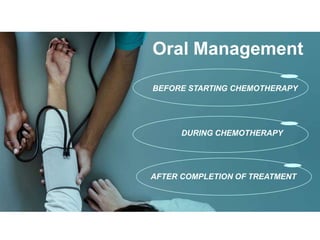
Oral Management
BEFORE STARTING CHEMOTHERAPY
DURING CHEMOTHERAPY
AFTER COMPLETION OF TREATMENT
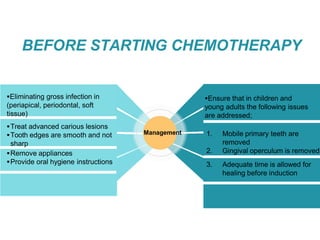
BEFORE STARTING CHEMOTHERAPY
Eliminating gross infection in
(periapical, periodontal, soft
tissue)
Treat advanced carious lesions
Tooth edges are smooth and not
sharp
Remove appliances
Provide oral hygiene instructions
Management
Ensure that in children and
young adults the following issues
are addressed;
1. Mobile primary teeth are
removed
2. Gingival operculum is removed
3. Adequate time is allowed for
healing before induction
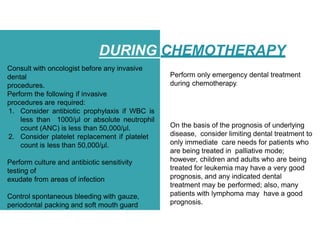
DURING CHEMOTHERAPY
Consult with oncologist before any invasive
dental
procedures.
Perform the following if invasive
procedures are required:
1. Consider antibiotic prophylaxis if WBC is
less than 1000/µl or absolute neutrophil
count (ANC) is less than 50,000/µl.
2. Consider platelet replacement if platelet
count is less than 50,000/µl.
Perform culture and antibiotic sensitivity
testing of
exudate from areas of infection
Control spontaneous bleeding with gauze,
periodontal packing and soft mouth guard
Perform only emergency dental treatment
during chemotherapy.
On the basis of the prognosis of underlying
disease, consider limiting dental treatment to
only immediate care needs for patients who
are being treated in palliative mode;
however, children and adults who are being
treated for leukemia may have a very good
prognosis, and any indicated dental
treatment may be performed; also, many
patients with lymphoma may have a good
prognosis.
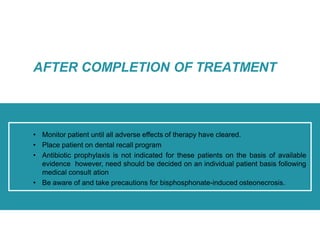
• Monitor patient until all adverse effects of therapy have cleared.
• Place patient on dental recall program
• Antibiotic prophylaxis is not indicated for these patients on the basis of available
evidence however, need should be decided on an individual patient basis following
medical consult ation
• Be aware of and take precautions for bisphosphonate-induced osteonecrosis.
AFTER COMPLETION OF TREATMENT
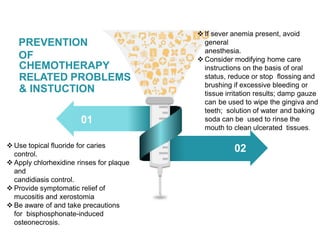
PREVENTION
OF
CHEMOTHERAPY
RELATED PROBLEMS
& INSTUCTION
01
02
 Use topical fluoride for caries
control.
 Apply chlorhexidine rinses for plaque
and
candidiasis control.
 Provide symptomatic relief of
mucositis and xerostomia
 Be aware of and take precautions
for bisphosphonate-induced
osteonecrosis.
 If sever anemia present, avoid
general
anesthesia.
 Consider modifying home care
instructions on the basis of oral
status, reduce or stop flossing and
brushing if excessive bleeding or
tissue irritation results; damp gauze
can be used to wipe the gingiva and
teeth; solution of water and baking
soda can be used to rinse the
mouth to clean ulcerated tissues.
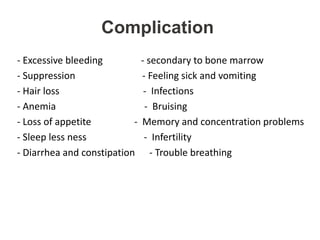
Complication
- Excessive bleeding - secondary to bone marrow
- Suppression - Feeling sick and vomiting
- Hair loss - Infections
- Anemia - Bruising
- Loss of appetite - Memory and concentration problems
- Sleep less ness - Infertility
- Diarrhea and constipation - Trouble breathing
Thank You
Any question

Chemotherapy.pptx

  • 1.
    Chemotherapy Prepared by: Abeer AbedAl-Majeed & Fidaa Dirbas Supervisor: Abeer Mansour
  • 2.
    Specific Objective 1) DefineChemotherapy 2) Explain the indications of Chemotherapy 3) Describe the side effects in chemotherapy 4) Goals of chemotherapy 5) Type of Chemotherapy 6) Rout Of Administration 7) Therapeutic Strategies 8) Prevention of Chemotherapy related Problems & Instruction 9) Complication
  • 3.
    Definition • Chemotherapy isan aggressive from of chemical drug therapy meant to destroy rapidly growing cells in the body. • It’s usually used to treat cancer, as cancer cells grow and dividing faster than other cells. • It includes the use of various chemotherapeutic agents and hormones
  • 4.
    Indications of Chemotherapy •Chemotherapy is primarily used to: • Lower the total number of cancer cells in the body. • Reduce the likelihood of cancer spreading. • Shrink tumour size. • Reduce current symptoms.
  • 5.
    Why does Chemotherapycause side effects? • Chemotherapy works on active cells (cells that are growing and dividing into more of the same type of cells). • Cancer cells are active, but so are some healthy cells. • Side effects happen when chemotherapy damages these healthy cells.
  • 6.
    Side effects inchemotherapy • Chemotherapy drugs as most drugs do have side effects which are unwanted things that happen. • Some chemotherapy drugs can cause: pain, weakness, numbness, pale skin, tingling in the hands and feet (peripheral neuropathy), minor skin irritation like itchiness or rash.
  • 7.
    Mouth ulcers Nausea/vomiting Nephrotoxicity Diarrhoea Cystitis Infertility Neurotoxicity Hair loss Lungtoxicity Cardiotoxicity Local reaction Skin changes Bone marrow suppression Chemotherapy side effects
  • 8.
    Goals of chemotherapy •Eliminate the cancer • Shrink the tumor • Prevent cancer from spreading • Relieve symptoms from cancer, such as pain
  • 9.
    Type of Chemotherapy 54 3 2 1 Alkylating agents Alkylating agents are the oldest and most commonly used class of chemotherapy drugs, and work by directly damaging DNA and preventing cancer cells from reproducing Anthracyclines Anthracyclines are anti- tumor antibiotics that interfere with enzymes necessary for DNA replication Topoisomerase Inhibitors drugs that interfere with the action of topoisomerase enzymes enzyme s control the manipulation of the structure of DNA necessary for replication. Plant Alkaloids Plant alkaloids are derived from certain types of plants found in nature, and inhibit or prevent mitosis or inhibit enzymes from making proteins necessary for cell reproduction Antimetabolites Antimetabolites are chemotherapy drugs that interfere with DNA and RNA growth
  • 10.
    Rout Of Administration –Oral—capsule,tablet, or liquid –I.V.—push (bolus) or infusion over a specified time period –Intramuscular –Intrathecal/intraventricular—given by injection via an Ommaya reservoir or by lumbar puncture –Intra-arterial –Intracavitary—such as peritoneal cavity –Intravesical—into uterus or bladder –Topical
  • 12.
    Adjuvant therapy Given topatients who have no evidence of residual disease but who are at high risk for relapse The justifications for adjuvant chemotherapy are the high recurrence rate after surgery for apparently localized tumors, the inability to identify cured patients at the time of surgery, and the failure of therapy to cure these patients after recurrence of disease
  • 13.
    Neoadjuvant therapy Preoperative chemotherapy: –Administered prior to surgery in an attempt to downstage the primary tumor so that less invasive surgery can be performed For example, patients with large breast tumors can preserve the breast and undergo lumpectomy instead of mastectomy – The goal of therapy is to decrease the amount of tissue that needs to be removed as well as to attempt to maximize cure potential
  • 14.
    High dose/intensive therapy –Administration of high doses of chemotherapy, usually in association with growth factor support or before bone marrow transplant/stem cell rescue
  • 15.
    Dose intensification – Hasreceived increasing emphasis in recent years as a strategy for overcoming resistance to chemotherapy – Malignant cells may be resistant to certain drugs from the start of therapy (natural resistance) or become resistant after therapy has begun (acquired resistance) – Dose intensification suggests that chemotherapy should be given in the highest tolerated dose over the briefest interval, with the growth factor support –This has been tested in breast cancer, and results show that it is more effective than standard treatment schedules and is equally tolerated – It continues to be tested with other malignancies with unknown results.
  • 16.
    Oral Management BEFORE STARTINGCHEMOTHERAPY DURING CHEMOTHERAPY AFTER COMPLETION OF TREATMENT
  • 17.
    BEFORE STARTING CHEMOTHERAPY Eliminatinggross infection in (periapical, periodontal, soft tissue) Treat advanced carious lesions Tooth edges are smooth and not sharp Remove appliances Provide oral hygiene instructions Management Ensure that in children and young adults the following issues are addressed; 1. Mobile primary teeth are removed 2. Gingival operculum is removed 3. Adequate time is allowed for healing before induction
  • 18.
    DURING CHEMOTHERAPY Consult withoncologist before any invasive dental procedures. Perform the following if invasive procedures are required: 1. Consider antibiotic prophylaxis if WBC is less than 1000/µl or absolute neutrophil count (ANC) is less than 50,000/µl. 2. Consider platelet replacement if platelet count is less than 50,000/µl. Perform culture and antibiotic sensitivity testing of exudate from areas of infection Control spontaneous bleeding with gauze, periodontal packing and soft mouth guard Perform only emergency dental treatment during chemotherapy. On the basis of the prognosis of underlying disease, consider limiting dental treatment to only immediate care needs for patients who are being treated in palliative mode; however, children and adults who are being treated for leukemia may have a very good prognosis, and any indicated dental treatment may be performed; also, many patients with lymphoma may have a good prognosis.
  • 19.
    • Monitor patientuntil all adverse effects of therapy have cleared. • Place patient on dental recall program • Antibiotic prophylaxis is not indicated for these patients on the basis of available evidence however, need should be decided on an individual patient basis following medical consult ation • Be aware of and take precautions for bisphosphonate-induced osteonecrosis. AFTER COMPLETION OF TREATMENT
  • 20.
    PREVENTION OF CHEMOTHERAPY RELATED PROBLEMS & INSTUCTION 01 02 Use topical fluoride for caries control.  Apply chlorhexidine rinses for plaque and candidiasis control.  Provide symptomatic relief of mucositis and xerostomia  Be aware of and take precautions for bisphosphonate-induced osteonecrosis.  If sever anemia present, avoid general anesthesia.  Consider modifying home care instructions on the basis of oral status, reduce or stop flossing and brushing if excessive bleeding or tissue irritation results; damp gauze can be used to wipe the gingiva and teeth; solution of water and baking soda can be used to rinse the mouth to clean ulcerated tissues.
  • 21.
    Complication - Excessive bleeding- secondary to bone marrow - Suppression - Feeling sick and vomiting - Hair loss - Infections - Anemia - Bruising - Loss of appetite - Memory and concentration problems - Sleep less ness - Infertility - Diarrhea and constipation - Trouble breathing
  • 22.