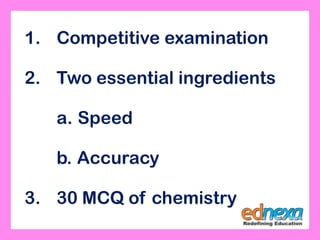

1. Competitive examination
2. Two essential ingredients
a. Speed
b. Accuracy
3. 30 MCQ of chemistry
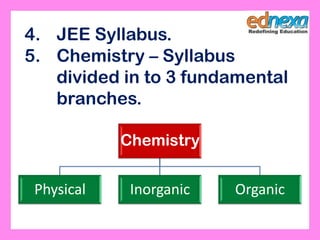
4. JEE Syllabus.
5. Chemistry – Syllabus
divided in to 3 fundamental
branches.
Chemistry
Physical Inorganic Organic
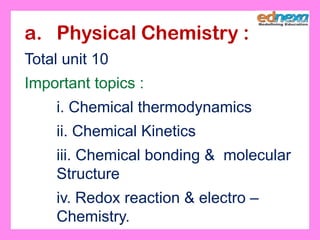
a. Physical Chemistry :
Total unit 10
Important topics :
i. Chemical thermodynamics
ii. Chemical Kinetics
iii. Chemical bonding & molecular
Structure
iv. Redox reaction & electro –
Chemistry.
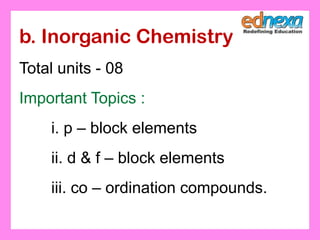
b. Inorganic Chemistry
Total units - 08
Important Topics :
i. p – block elements
ii. d & f – block elements
iii. co – ordination compounds.
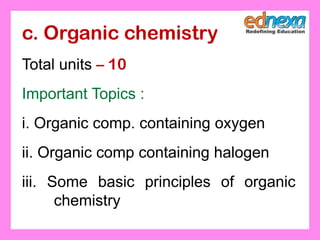
c. Organic chemistry
Total units – 10
Important Topics :
i. Organic comp. containing oxygen
ii. Organic comp containing halogen
iii. Some basic principles of organic
chemistry
Last but not the least
“ Do not try to find out the
correct answer
but
try to find out the
CORRECT OPTION”.
1. The complex used as an
anti-cancer agent is
(a) cis[PtCI2(NH3)2]
(b) cis-K2[PtCI2Br2]
(c) trans-[Co(NH3)3CI3]
(d) Na2CO3
Ans : a
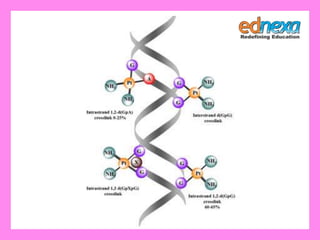
Solution : Cis-isomer of [Pt (NH3)2 CI2]
is used as an anticancer drugs for
treating several type of malignant
tumours when it is inject into the blood
stream the more reactive CI groups are
lost so, the Pt atom bonds to a N-atom
in guanosine (a part of DNA). This
molecule can bond to two different
guanosine units and by bridging
between them it upsets the normal
reproduction of DNA.
( )2
3 2
3
2
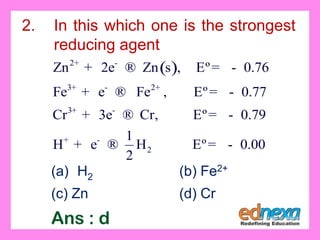
Zn 2e Zn s , Eº 0.76
Fe e Fe , Eº 0.77
Cr 3e Cr, Eº 0.79
1
H e H Eº 0.00
2
+ -
+ - +
+ -
+ -
+ ® = -
+ ® = -
+ ® = -
+ ® = -
2. In this which one is the strongest
reducing agent
(a) H2 (b) Fe2+
(c) Zn (d) Cr
Ans : d
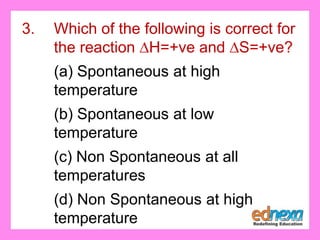
3. Which of the following is correct for
the reaction ∆H=+ve and ∆S=+ve?
(a) Spontaneous at high
temperature
(b) Spontaneous at low
temperature
(c) Non Spontaneous at all
temperatures
(d) Non Spontaneous at high
temperature
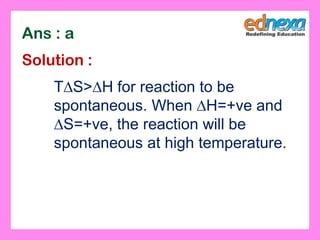
Ans : a
Solution :
T∆S>∆H for reaction to be
spontaneous. When ∆H=+ve and
∆S=+ve, the reaction will be
spontaneous at high temperature.
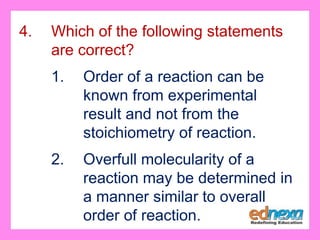
4. Which of the following statements
are correct?
1. Order of a reaction can be
known from experimental
result and not from the
stoichiometry of reaction.
2. Overfull molecularity of a
reaction may be determined in
a manner similar to overall
order of reaction.
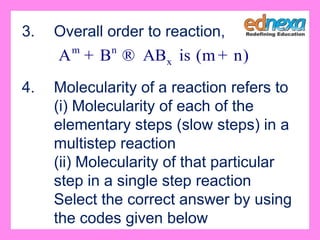
3. Overall order to reaction,
4. Molecularity of a reaction refers to
(i) Molecularity of each of the
elementary steps (slow steps) in a
multistep reaction
(ii) Molecularity of that particular
step in a single step reaction
Select the correct answer by using
the codes given below
m n
xA B AB is (m n)+ ® +
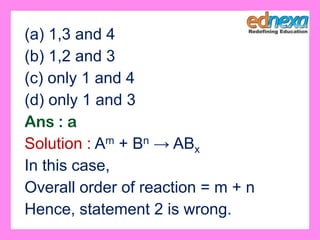
(a) 1,3 and 4
(b) 1,2 and 3
(c) only 1 and 4
(d) only 1 and 3
Ans : a
Solution : Am + Bn → ABx
In this case,
Overall order of reaction = m + n
Hence, statement 2 is wrong.
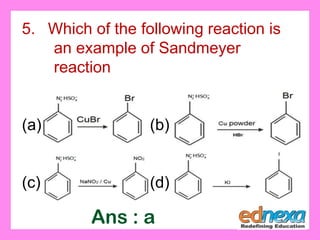
5. Which of the following reaction is
an example of Sandmeyer
reaction
(a) (b)
(c) (d)
Ans : a
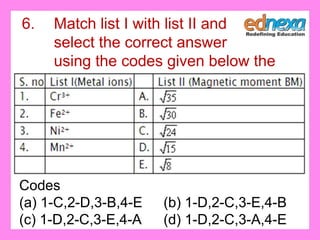
6. Match list I with list II and
select the correct answer
using the codes given below the
Codes
(a) 1-C,2-D,3-B,4-E (b) 1-D,2-C,3-E,4-B
(c) 1-D,2-C,3-E,4-A (d) 1-D,2-C,3-A,4-E
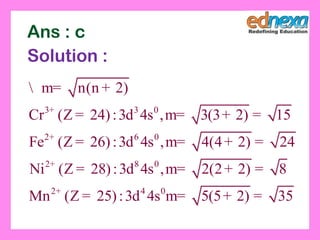
3 3 0
2 6 0
2 8 0
2 4 0
n(n 2)
Cr (Z 24):3d 4s , 3(3 2) 15
Fe (Z 26):3d 4s , 4(4 2) 24
Ni (Z 28):3d 4s , 2(2 2) 8
Mn (Z 25):3d 4s 5(5 2) 35
+
+
+
+
 m= +
= m= + =
= m= + =
= m= + =
= m= + =
Ans : c
Solution :
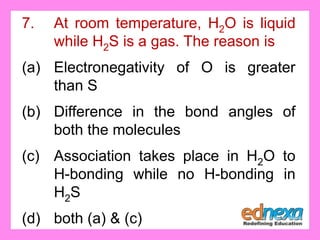
7. At room temperature, H2O is liquid
while H2S is a gas. The reason is
(a) Electronegativity of O is greater
than S
(b) Difference in the bond angles of
both the molecules
(c) Association takes place in H2O to
H-bonding while no H-bonding in
H2S
(d) both (a) & (c)
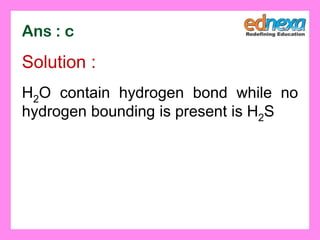
Ans : c
Solution :
H2O contain hydrogen bond while no
hydrogen bounding is present is H2S
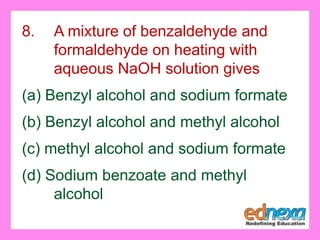
8. A mixture of benzaldehyde and
formaldehyde on heating with
aqueous NaOH solution gives
(a) Benzyl alcohol and sodium formate
(b) Benzyl alcohol and methyl alcohol
(c) methyl alcohol and sodium formate
(d) Sodium benzoate and methyl
alcohol
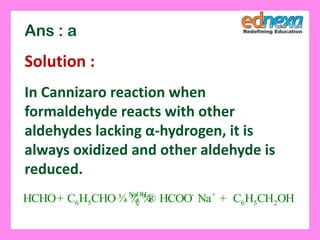
Ans : a
Solution :
In Cannizaro reaction when
formaldehyde reacts with other
aldehydes lacking α-hydrogen, it is
always oxidized and other aldehyde is
reduced.
NaOH
6 5 6 5 2HCHO C H CHO HCOO Na C H CH OH- +
+ ¾ ¾ ¾® +V
Thank You…

Chemistry tips for JEE Main / MH-CET 2014

  • 2.
    1. Competitive examination 2.Two essential ingredients a. Speed b. Accuracy 3. 30 MCQ of chemistry
  • 3.
    4. JEE Syllabus. 5.Chemistry – Syllabus divided in to 3 fundamental branches. Chemistry Physical Inorganic Organic
  • 4.
    a. Physical Chemistry: Total unit 10 Important topics : i. Chemical thermodynamics ii. Chemical Kinetics iii. Chemical bonding & molecular Structure iv. Redox reaction & electro – Chemistry.
  • 5.
    b. Inorganic Chemistry Totalunits - 08 Important Topics : i. p – block elements ii. d & f – block elements iii. co – ordination compounds.
  • 6.
    c. Organic chemistry Totalunits – 10 Important Topics : i. Organic comp. containing oxygen ii. Organic comp containing halogen iii. Some basic principles of organic chemistry
  • 7.
    Last but notthe least “ Do not try to find out the correct answer but try to find out the CORRECT OPTION”.
  • 8.
    1. The complexused as an anti-cancer agent is (a) cis[PtCI2(NH3)2] (b) cis-K2[PtCI2Br2] (c) trans-[Co(NH3)3CI3] (d) Na2CO3 Ans : a
  • 9.
    Solution : Cis-isomerof [Pt (NH3)2 CI2] is used as an anticancer drugs for treating several type of malignant tumours when it is inject into the blood stream the more reactive CI groups are lost so, the Pt atom bonds to a N-atom in guanosine (a part of DNA). This molecule can bond to two different guanosine units and by bridging between them it upsets the normal reproduction of DNA.
  • 11.
    ( )2 3 2 3 2 Zn2e Zn s , Eº 0.76 Fe e Fe , Eº 0.77 Cr 3e Cr, Eº 0.79 1 H e H Eº 0.00 2 + - + - + + - + - + ® = - + ® = - + ® = - + ® = - 2. In this which one is the strongest reducing agent (a) H2 (b) Fe2+ (c) Zn (d) Cr Ans : d
  • 12.
    3. Which ofthe following is correct for the reaction ∆H=+ve and ∆S=+ve? (a) Spontaneous at high temperature (b) Spontaneous at low temperature (c) Non Spontaneous at all temperatures (d) Non Spontaneous at high temperature
  • 13.
    Ans : a Solution: T∆S>∆H for reaction to be spontaneous. When ∆H=+ve and ∆S=+ve, the reaction will be spontaneous at high temperature.
  • 14.
    4. Which ofthe following statements are correct? 1. Order of a reaction can be known from experimental result and not from the stoichiometry of reaction. 2. Overfull molecularity of a reaction may be determined in a manner similar to overall order of reaction.
  • 15.
    3. Overall orderto reaction, 4. Molecularity of a reaction refers to (i) Molecularity of each of the elementary steps (slow steps) in a multistep reaction (ii) Molecularity of that particular step in a single step reaction Select the correct answer by using the codes given below m n xA B AB is (m n)+ ® +
  • 16.
    (a) 1,3 and4 (b) 1,2 and 3 (c) only 1 and 4 (d) only 1 and 3 Ans : a Solution : Am + Bn → ABx In this case, Overall order of reaction = m + n Hence, statement 2 is wrong.
  • 17.
    5. Which ofthe following reaction is an example of Sandmeyer reaction (a) (b) (c) (d) Ans : a
  • 18.
    6. Match listI with list II and select the correct answer using the codes given below the Codes (a) 1-C,2-D,3-B,4-E (b) 1-D,2-C,3-E,4-B (c) 1-D,2-C,3-E,4-A (d) 1-D,2-C,3-A,4-E
  • 19.
    3 3 0 26 0 2 8 0 2 4 0 n(n 2) Cr (Z 24):3d 4s , 3(3 2) 15 Fe (Z 26):3d 4s , 4(4 2) 24 Ni (Z 28):3d 4s , 2(2 2) 8 Mn (Z 25):3d 4s 5(5 2) 35 + + + + m= + = m= + = = m= + = = m= + = = m= + = Ans : c Solution :
  • 20.
    7. At roomtemperature, H2O is liquid while H2S is a gas. The reason is (a) Electronegativity of O is greater than S (b) Difference in the bond angles of both the molecules (c) Association takes place in H2O to H-bonding while no H-bonding in H2S (d) both (a) & (c)
  • 21.
    Ans : c Solution: H2O contain hydrogen bond while no hydrogen bounding is present is H2S
  • 22.
    8. A mixtureof benzaldehyde and formaldehyde on heating with aqueous NaOH solution gives (a) Benzyl alcohol and sodium formate (b) Benzyl alcohol and methyl alcohol (c) methyl alcohol and sodium formate (d) Sodium benzoate and methyl alcohol
  • 23.
    Ans : a Solution: In Cannizaro reaction when formaldehyde reacts with other aldehydes lacking α-hydrogen, it is always oxidized and other aldehyde is reduced. NaOH 6 5 6 5 2HCHO C H CHO HCOO Na C H CH OH- + + ¾ ¾ ¾® +V
  • 24.