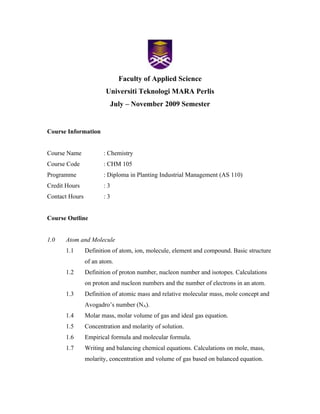
Faculty of Applied Science
                        Universiti Teknologi MARA Perlis
                            July – November 2009 Semester


Course Information


Course Name            : Chemistry
Course Code            : CHM 105
Programme              : Diploma in Planting Industrial Management (AS 110)
Credit Hours           :3
Contact Hours          :3


Course Outline


1.0   Atom and Molecule
      1.1       Definition of atom, ion, molecule, element and compound. Basic structure
                of an atom.
      1.2       Definition of proton number, nucleon number and isotopes. Calculations
                on proton and nucleon numbers and the number of electrons in an atom.
      1.3       Definition of atomic mass and relative molecular mass, mole concept and
                Avogadro’s number (NA).
      1.4       Molar mass, molar volume of gas and ideal gas equation.
      1.5       Concentration and molarity of solution.
      1.6       Empirical formula and molecular formula.
      1.7       Writing and balancing chemical equations. Calculations on mole, mass,
                molarity, concentration and volume of gas based on balanced equation.
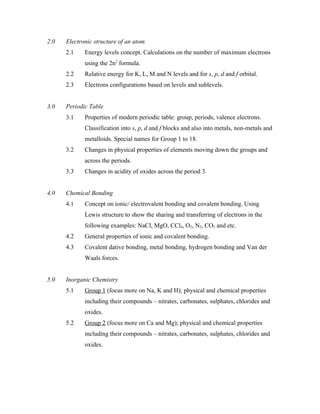
2.0   Electronic structure of an atom
      2.1    Energy levels concept. Calculations on the number of maximum electrons
             using the 2n2 formula.
      2.2    Relative energy for K, L, M and N levels and for s, p, d and f orbital.
      2.3    Electrons configurations based on levels and sublevels.


3.0   Periodic Table
      3.1    Properties of modern periodic table: group, periods, valence electrons.
             Classification into s, p, d and f blocks and also into metals, non-metals and
             metalloids. Special names for Group 1 to 18.
      3.2    Changes in physical properties of elements moving down the groups and
             across the periods.
      3.3    Changes in acidity of oxides across the period 3.


4.0   Chemical Bonding
      4.1    Concept on ionic/ electrovalent bonding and covalent bonding. Using
             Lewis structure to show the sharing and transferring of electrons in the
             following examples: NaCl, MgO, CCl4, O2, N2, CO2 and etc.
      4.2    General properties of ionic and covalent bonding.
      4.3    Covalent dative bonding, metal bonding, hydrogen bonding and Van der
             Waals forces.


5.0   Inorganic Chemistry
      5.1    Group 1 (focus more on Na, K and H); physical and chemical properties
             including their compounds – nitrates, carbonates, sulphates, chlorides and
             oxides.
      5.2    Group 2 (focus more on Ca and Mg); physical and chemical properties
             including their compounds – nitrates, carbonates, sulphates, chlorides and
             oxides.
5.3   Group 15 (focus more on N and P); physical and chemical properties
            including their compounds (especially fertilizer) – ammonium sulphate,
            ammonium nitrate, urea and phosphoric acid.
      5.4   Group 16 (concentrate more on O and S); physical and chemical
            properties including their compounds – SO2, SO3, H2SO4 and H2O2.


6.0   Oxidation and Reduction
      6.1   Definition of oxidation, reduction, oxidizing agent and reducing agent in
            terms of hydrogen, oxygen, electron transfer and oxidation number.
      6.2   Determination of oxidation number.
      6.3   Balancing redox equation using ion-electron method.
      6.4   Balancing redox equation using oxidation number method.


7.0   Acids and Bases
      7.1   Definition based on Arrhenius, Brønsted-Lowry and Lewis with simple
            examples. General properties of acid and base. Definitions and examples
            of strong acid, strong base, weak acid and weak base.
      7.2   pH scale: definition and examples on calculation of pH for strong base and
            strong acid only (using the pH = - log [H+] and [H+][OH-] = 1.0 X 10⁻¹⁴
            formula).
      7.3   Calculations on volumetric analysis, neutralization and titration involving
            acid and base; oxidizing and reducing agents.


8.0   Organic Chemistry
      8.1   Tetravalence organic compound structure for carbon (3 dimensional
            structural formula using ball and stick model).
      8.2   Classification of organic compound, homologous series and functional
            groups for alkanes, alkenes, alcohols, aldehydes and ketones. Molecular
            and structural formulas. Examples of each homologous series.
      8.3   IUPAC nomenclature for alkanes, alkenes, alcohols, aldehydes and
            ketones with examples.
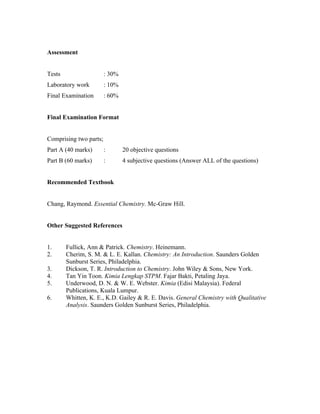
Assessment


Tests                   : 30%
Laboratory work         : 10%
Final Examination       : 60%


Final Examination Format


Comprising two parts;
Part A (40 marks)       :       20 objective questions
Part B (60 marks)       :       4 subjective questions (Answer ALL of the questions)


Recommended Textbook


Chang, Raymond. Essential Chemistry. Mc-Graw Hill.


Other Suggested References


1.      Fullick, Ann & Patrick. Chemistry. Heinemann.
2.      Cherim, S. M. & L. E. Kallan. Chemistry: An Introduction. Saunders Golden
        Sunburst Series, Philadelphia.
3.      Dickson, T. R. Introduction to Chemistry. John Wiley & Sons, New York.
4.      Tan Yin Toon. Kimia Lengkap STPM. Fajar Bakti, Petaling Jaya.
5.      Underwood, D. N. & W. E. Webster. Kimia (Edisi Malaysia). Federal
        Publications, Kuala Lumpur.
6.      Whitten, K. E., K.D. Gailey & R. E. Davis. General Chemistry with Qualitative
        Analysis. Saunders Golden Sunburst Series, Philadelphia.

Chemistry syllabus UiTM

  • 1.
    Faculty of AppliedScience Universiti Teknologi MARA Perlis July – November 2009 Semester Course Information Course Name : Chemistry Course Code : CHM 105 Programme : Diploma in Planting Industrial Management (AS 110) Credit Hours :3 Contact Hours :3 Course Outline 1.0 Atom and Molecule 1.1 Definition of atom, ion, molecule, element and compound. Basic structure of an atom. 1.2 Definition of proton number, nucleon number and isotopes. Calculations on proton and nucleon numbers and the number of electrons in an atom. 1.3 Definition of atomic mass and relative molecular mass, mole concept and Avogadro’s number (NA). 1.4 Molar mass, molar volume of gas and ideal gas equation. 1.5 Concentration and molarity of solution. 1.6 Empirical formula and molecular formula. 1.7 Writing and balancing chemical equations. Calculations on mole, mass, molarity, concentration and volume of gas based on balanced equation.
  • 2.
    2.0 Electronic structure of an atom 2.1 Energy levels concept. Calculations on the number of maximum electrons using the 2n2 formula. 2.2 Relative energy for K, L, M and N levels and for s, p, d and f orbital. 2.3 Electrons configurations based on levels and sublevels. 3.0 Periodic Table 3.1 Properties of modern periodic table: group, periods, valence electrons. Classification into s, p, d and f blocks and also into metals, non-metals and metalloids. Special names for Group 1 to 18. 3.2 Changes in physical properties of elements moving down the groups and across the periods. 3.3 Changes in acidity of oxides across the period 3. 4.0 Chemical Bonding 4.1 Concept on ionic/ electrovalent bonding and covalent bonding. Using Lewis structure to show the sharing and transferring of electrons in the following examples: NaCl, MgO, CCl4, O2, N2, CO2 and etc. 4.2 General properties of ionic and covalent bonding. 4.3 Covalent dative bonding, metal bonding, hydrogen bonding and Van der Waals forces. 5.0 Inorganic Chemistry 5.1 Group 1 (focus more on Na, K and H); physical and chemical properties including their compounds – nitrates, carbonates, sulphates, chlorides and oxides. 5.2 Group 2 (focus more on Ca and Mg); physical and chemical properties including their compounds – nitrates, carbonates, sulphates, chlorides and oxides.
  • 3.
    5.3 Group 15 (focus more on N and P); physical and chemical properties including their compounds (especially fertilizer) – ammonium sulphate, ammonium nitrate, urea and phosphoric acid. 5.4 Group 16 (concentrate more on O and S); physical and chemical properties including their compounds – SO2, SO3, H2SO4 and H2O2. 6.0 Oxidation and Reduction 6.1 Definition of oxidation, reduction, oxidizing agent and reducing agent in terms of hydrogen, oxygen, electron transfer and oxidation number. 6.2 Determination of oxidation number. 6.3 Balancing redox equation using ion-electron method. 6.4 Balancing redox equation using oxidation number method. 7.0 Acids and Bases 7.1 Definition based on Arrhenius, Brønsted-Lowry and Lewis with simple examples. General properties of acid and base. Definitions and examples of strong acid, strong base, weak acid and weak base. 7.2 pH scale: definition and examples on calculation of pH for strong base and strong acid only (using the pH = - log [H+] and [H+][OH-] = 1.0 X 10⁻¹⁴ formula). 7.3 Calculations on volumetric analysis, neutralization and titration involving acid and base; oxidizing and reducing agents. 8.0 Organic Chemistry 8.1 Tetravalence organic compound structure for carbon (3 dimensional structural formula using ball and stick model). 8.2 Classification of organic compound, homologous series and functional groups for alkanes, alkenes, alcohols, aldehydes and ketones. Molecular and structural formulas. Examples of each homologous series. 8.3 IUPAC nomenclature for alkanes, alkenes, alcohols, aldehydes and ketones with examples.
  • 4.
    Assessment Tests : 30% Laboratory work : 10% Final Examination : 60% Final Examination Format Comprising two parts; Part A (40 marks) : 20 objective questions Part B (60 marks) : 4 subjective questions (Answer ALL of the questions) Recommended Textbook Chang, Raymond. Essential Chemistry. Mc-Graw Hill. Other Suggested References 1. Fullick, Ann & Patrick. Chemistry. Heinemann. 2. Cherim, S. M. & L. E. Kallan. Chemistry: An Introduction. Saunders Golden Sunburst Series, Philadelphia. 3. Dickson, T. R. Introduction to Chemistry. John Wiley & Sons, New York. 4. Tan Yin Toon. Kimia Lengkap STPM. Fajar Bakti, Petaling Jaya. 5. Underwood, D. N. & W. E. Webster. Kimia (Edisi Malaysia). Federal Publications, Kuala Lumpur. 6. Whitten, K. E., K.D. Gailey & R. E. Davis. General Chemistry with Qualitative Analysis. Saunders Golden Sunburst Series, Philadelphia.