1
CHEMISTRY
Subject Code: 043
ClassesXI-XII (2025-26)
Rationale
The second phase of Secondary stage is the most crucial stage of school
education because at this juncture specialized discipline based, content -
oriented courses are introduced. Students reach this stage after 10 years of
general education and opt for Chemistry with a purpose of pursuing their career
in basic sciences or professional courses like medicine, engineering, technology
and study courses in applied areas of science and technology at tertiary level.
Therefore, there is a need to provide the learners with a sufficient conceptual
background of Chemistry, which will make them competent to meet the
challenges of academic and professional courses after this stage.
The new and updated curriculum is based on a disciplinary approach with rigor
and depth taking care that the syllabus is not heavy and at the same time it is
comparable to that at the international level. The pedagogy of Chemistry has
undergone tremendous changes in recent times. Many new areas like green
chemistry, material science, biomolecules, and industrial chemistry deserve to
be an integral part of the chemistry syllabus at this stage. Globally,
nomenclature of elements and compounds, symbols and units of physical
quantities recommended by scientific bodies like IUPAC and CGPM are of
immense importance and also need to be incorporated in the updated syllabus.
The proposed syllabus adequately addresses these issues.
Objectives
The curriculum of Chemistry at the second phase of Secondary stage has been
designed to:
● equip the learners with tools to understand the working of Chemistry rather
than mere facts of it;
● develop the necessary conceptual foundations of chemistry and ability to
apply them to real life situations;
● enable the learners to represent chemical phenomena at macroscopic,
molecular, and symbolic levels;
● make the learners identify patterns and form connections that underlie various
chemical phenomena;
● prepare the learners to contribute to frontier research areas related to climate
change, environmental issues, materials science, biology and medicine etc.:
● inculcate problem solving skills in the learners and integrate life skills and
values in the context of chemistry; and
● apprise learners of the interface of chemistry with other disciplines of science
such as physics, biology, geology, engineering etc.
2.
2
COURSE STRUCTURE
CLASS XI
THEORY
Time:3 Hours Total Marks: 70
S. No UNIT Marks
1 Some Basic Concepts of Chemistry 7
2 Structure of Atom 9
3 Classification of Elements and Periodicity in Properties 6
4 Chemical Bonding and Molecular Structure 7
5 Chemical Thermodynamics 9
6 Equilibrium 7
7 Redox Reactions 4
8 Organic Chemistry: Some basic Principles and
Techniques
11
9 Hydrocarbons 10
TOTAL 70
Unit 1: Some Basic Concepts of Chemistry
General Introduction: Importance and scope of Chemistry, Nature of matter, laws of
chemical combination, Dalton's atomic theory: concept of elements, atoms and
molecules, atomic and molecular masses, mole concept and molar mass, percentage
composition, empirical and molecular formula, chemical reactions, stoichiometry and
calculations based on stoichiometry.
Unit 2: Structure of Atom
Discovery of Electron, Proton and Neutron, atomic number, isotopes and isobars.
Thomson's model and its limitations. Rutherford's model and its limitations, Bohr's model
and its limitations, concept of shells and subshells, dual nature of matter and light, de
Broglie's relationship, Heisenberg uncertainty principle, concept of orbitals, quantum
numbers, shapes of s, p and d orbitals, rules for filling electrons in orbitals - Aufbau
principle, Pauli's exclusion principle and Hund's rule, electronic configuration of atoms,
stability of half-filled and completely filled orbitals.
Unit 3: Classification of Elements and Periodicity in Properties
Significance of classification, brief history of the development of periodic table, modern
periodic law and the present form of periodic table, periodic trends in properties of
elements -atomic radii, ionic radii, inert gas radii, Ionization enthalpy, electron gain
enthalpy, electronegativity, valiancy, Nomenclature of elements with atomic number
greater than 100.
3.
3
Unit 4: ChemicalBonding and Molecular Structure
Valence electrons, ionic bond, covalent bond, bond parameters, Lewis structure, polar
character of covalent bond, covalent character of ionic bond, valence bond theory,
resonance, geometry of covalent molecules, VSEPR theory, concept of hybridization,
involving s, p and d orbitals and shapes of some simple molecules, molecular orbital
theory of homonuclear diatomic molecules (qualitative idea only), Hydrogen bond.
Unit 5: Chemical Thermodynamics
Concepts of System and types of systems, surroundings, work, heat, energy, extensive
and intensive properties, state functions.
First law of thermodynamics -internal energy and enthalpy, heat capacity and specific
heat, measurement of ∆U and ∆H, Hess's law of constant heat summation, enthalpy of
bond dissociation, combustion, formation, atomization, sublimation, phase transition,
ionization, solution and dilution. Second law of Thermodynamics (brief introduction),
Introduction of entropy as a state function, Gibb's energy change for spontaneous and
non- spontaneous processes, criteria for equilibrium, Third law of thermodynamics (brief
introduction).
Unit 6: Equilibrium
Equilibrium in physical and chemical processes, dynamic nature of equilibrium, law of
mass action, equilibrium constant, factors affecting equilibrium – Le Chatelier's principle,
ionic equilibrium- ionization of acids and bases, strong and weak electrolytes, degree of
ionization, ionization of poly basic acids, acid strength, concept of pH, hydrolysis of salts
(elementary idea), buffer solution, Henderson Equation, solubility product, common ion
effect (with illustrative examples).
Unit 7: Redox Reactions
Concept of oxidation and reduction, redox reactions, oxidation number, balancing redox
reactions, in terms of loss and gain of electrons and change in oxidation number,
applications of redox reactions.
Unit 8: Organic Chemistry – Some Basic Principles and Techniques
General introduction, methods of purification, qualitative and quantitative analysis,
classification and IUPAC nomenclature of organic compounds. Electronic displacements
in a covalent bond: inductive effect, electrometric effect, resonance and hyper
conjugation. Homolytic and heterolytic fission of a covalent bond: free radicals,
carbocations, carbanions, electrophiles and nucleophiles, types of organic reactions.
4.
4
Unit 9: Hydrocarbons
AliphaticHydrocarbons
Alkanes - Nomenclature, isomerism, conformation (ethane only), physical properties,
chemical reactions including free radical mechanism of halogenation, combustion and
pyrolysis.
Alkenes - Nomenclature, structure of double bond (ethene), geometrical isomerism,
physical properties, methods of preparation, chemical reactions: addition of hydrogen,
halogen, water, hydrogen halides (Markovnikov's addition and peroxide effect),
ozonolysis, oxidation, mechanism of electrophilic addition.
Alkynes - Nomenclature, structure of triple bond (ethyne), physical properties, methods
of preparation, chemical reactions: acidic character of alkynes, addition reaction of -
hydrogen, halogens, hydrogen halides and water.
Aromatic Hydrocarbons
Introduction, IUPAC nomenclature, benzene: resonance, aromaticity, chemical
properties: mechanism of electrophilic substitution. Nitration, sulphonation, halogenation,
Friedel Craft's alkylation and acylation, directive influence of functional group in mono
substituted benzene, carcinogenicity and toxicity
Note: The following topics are included in the syllabus but will be assessed only
formatively to reinforce understanding without adding to summative assessments. This
reduces academic stress while ensuring meaningful learning. Schools can integrate
these with existing chapters as they align well. Relevant NCERT textual material is
enclosed for reference.
1. s & p Block Elements
Electronic configuration, atomic & Ionic radii, Ionization Enthalpy, Hydration
Enthalpy and general trends in physical and chemical properties of s and p
block elements across the periods and down the groups; unique behavior of the
first element in each group.
2. The Gaseous State
Qualitative treatment of Gas laws, Ideal gas equation and deviations from it.
5.
5
PRACTICAL
PRACTICAL SYLLABUS
Micro-chemical methodsare available for several of the practical experiments,
wherever possible such techniques should be used.
A.Basic Laboratory Techniques
1. Cutting glass tube and glass rod
2. Bending a glass tube
3. Drawing out a glass jet
4. Boring a cork
B.Characterization and Purification of Chemical Substances
1. Determination of melting point of an organic compound.
2. Determination of boiling point of an organic compound.
3. Crystallization of impure sample of any one of the following: Alum, Copper
Sulphate, Benzoic Acid.
C.Experiments based on pH
1. Any one of the following experiments:
Determination of pH of some solutions obtained from fruit juices,
solution of known and varied concentrations of acids, bases and salts
using pH paper or universal indicator.
Comparing the pH of solutions of strong and weak acids of same
concentration.
Study the pH change in the titration of a strong base using a universal
indicator.
2. Study the pH change by common-ion in case of weak acids and weak bases.
Evaluation Scheme for Examination Marks
Volumetric Analysis 08
Salt Analysis 08
Content Based Experiment 06
Project Work 04
Class record and viva 04
Total 30
6.
6
D.Chemical Equilibrium
Any oneof the following experiments:
Study the shift in equilibrium between ferric ions and thiocyanate ions by
increasing/decreasing the concentration of either of the ions.
Study the shift in equilibrium between [Co(H2O)6]2+
and chloride ions by
changing the concentration of either of the ions.
E.Quantitative Estimation
1. Using a mechanical balance/electronic balance.
2. Preparation of standard solution of Oxalic acid.
3. Determination of strength of a given solution of Sodium hydroxide by titrating it
against standard solution of Oxalic acid.
4. Preparation of standard solution of Sodium carbonate.
5. Determination of strength of a given solution of hydrochloric acid by titrating it
against standard Sodium Carbonate solution.
F.Qualitative Analysis
1. Determination of one anion and one cation in a given salt
Cations: 𝑷𝒃𝟐+
,𝑪𝒖𝟐+
, 𝑨𝒍𝟑+
, 𝑭𝒆𝟑+
,𝑴𝒏𝟐+
, 𝑵𝒊𝟐+
, 𝒁𝒏𝟐+
, 𝑪𝒐𝟐+
, 𝑪𝒂𝟐+
, 𝑺𝒓𝟐+
, 𝑩𝒂𝟐+
, 𝑴𝒈𝟐+
,
𝑵𝑯𝟒
+
Anions: 𝑪𝑶𝟑
𝟐−
,𝐒𝟐−
, 𝐒𝐎𝟑
𝟐−
, 𝑵𝑶𝟑
−
, 𝑵𝑶𝟐
−
, 𝐂𝐥−
, 𝐁𝐫−
, 𝐈−
,𝑺𝑶𝟒
𝟐−
, 𝑷𝑶𝟒
𝟑−
, 𝐂𝐇𝟑𝐂𝐎𝐎−
(Note: Insoluble salts excluded)
2. Detection of -Nitrogen, Sulphur, Chlorine in organic compounds.
PROJECTS
Scientific investigations involving laboratory testing and collecting information from other
sources.
A few suggested Projects
a) Checking the bacterial contamination in drinking water by testing sulphide ion
b) Study of the methods of purification of water
c) Testing the hardness, presence of Iron, Fluoride, Chloride, etc., depending upon
the regional variation in drinking water and study of causes of presence of these
ions above permissible limit (if any).
7.
7
d) Investigation ofthe foaming capacity of different washing soaps and the effect of
addition of Sodium carbonate on it
e) Study the acidity of different samples of tea leaves.
f) Determination of the rate of evaporation of different liquids
g) Study the effect of acids and bases on the tensile strength of fibers.
h) Study of acidity of fruit and vegetable juices.
Note: Any other investigatory project, which involves about 10 periods of work, can be
chosen with the approval of the teacher.
Practical Examination for Visually Challenged Students Class XI
Note: Same Evaluation scheme and general guidelines for visually challenged students
as given for Class XII may be followed.
List of apparatus for identification for assessment in practicals (All experiments)
Beaker, tripod stand, wire gauze, glass rod, funnel, filter paper, Bunsen burner,
test tube, test tube stands, dropper, test tube holder, ignition tube, china dish,
tongs, standard flask, pipette, burette, conical flask, clamp stand, dropper, wash
bottle
• Odor detection in qualitative analysis.
• Procedure/Setup of the apparatus.
List of Experiments
A. Characterization and Purification of Chemical Substances
Crystallization of an impure sample of any one of the following:
copper sulphate, benzoic acid.
B. Experiments based on pH
1. Determination of pH of some solutions obtained from fruit juices, solutions of
known and varied concentrations of acids, bases and salts using pH paper.
2. Comparing the pH of solutions of strong and weak acids of same concentration.
C. Chemical Equilibrium
1. Study the shift in equilibrium between ferric ions and thiocyanate ions by
increasing/decreasing the concentration of either ions.
2. Study the shift in equilibrium between [Co(H2O)6]2+
and chloride ions by changing
the concentration of either of the ions.
D. Quantitative estimation
1. Preparation of standard solution of oxalic acid.
8.
8
2. Determination ofmolarity of a given solution of sodium hydroxide by titrating it
against standard solution of oxalic acid.
E. Qualitative Analysis
1. Determination of one anion and one cation in a given salt
Cations - 𝑵𝑯𝟒
+
Anions: 𝑪𝑶𝟑
𝟐−
,𝐒𝟐−
, 𝐒𝐎𝟑
𝟐−
, , 𝐂𝐥−
, 𝐂𝐇𝟑𝐂𝐎𝐎−
(Note: insoluble salts excluded)
2. Detection of Nitrogen in the given organic compound.
3. Detection of Halogen in the given organic compound.
Note: The above practical may be carried out in an experiential manner rather than
recording observations.
Prescribed Books:
1. Chemistry Part – I, Class-XI, Published by NCERT.
2. Chemistry Part – II, Class-XI, Published by NCERT.
3. Manual of Microscale Chemistry laboratory kit.
Links for NCERT textbooks:
1. https://ncert.nic.in/textbook.php?kech1=0-6
2. https://ncert.nic.in/textbook.php?kech2=0-3
3. https://ncert.nic.in/division/dek/pdf/Manual_01.pdf
9.
9
COURSE STRUCTURE
CLASS XII
THEORY
Time:3 Hours Total Marks: 70
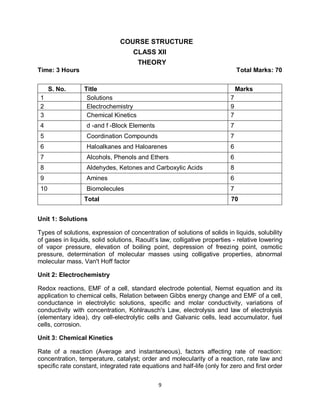
S. No. Title Marks
1 Solutions 7
2 Electrochemistry 9
3 Chemical Kinetics 7
4 d -and f -Block Elements 7
5 Coordination Compounds 7
6 Haloalkanes and Haloarenes 6
7 Alcohols, Phenols and Ethers 6
8 Aldehydes, Ketones and Carboxylic Acids 8
9 Amines 6
10 Biomolecules 7
Total 70
Unit 1: Solutions
Types of solutions, expression of concentration of solutions of solids in liquids, solubility
of gases in liquids, solid solutions, Raoult’s law, colligative properties - relative lowering
of vapor pressure, elevation of boiling point, depression of freezing point, osmotic
pressure, determination of molecular masses using colligative properties, abnormal
molecular mass, Van't Hoff factor
Unit 2: Electrochemistry
Redox reactions, EMF of a cell, standard electrode potential, Nernst equation and its
application to chemical cells, Relation between Gibbs energy change and EMF of a cell,
conductance in electrolytic solutions, specific and molar conductivity, variations of
conductivity with concentration, Kohlrausch's Law, electrolysis and law of electrolysis
(elementary idea), dry cell-electrolytic cells and Galvanic cells, lead accumulator, fuel
cells, corrosion.
Unit 3: Chemical Kinetics
Rate of a reaction (Average and instantaneous), factors affecting rate of reaction:
concentration, temperature, catalyst; order and molecularity of a reaction, rate law and
specific rate constant, integrated rate equations and half-life (only for zero and first order
10.
10
reactions), concept ofcollision theory (elementary idea, no mathematical treatment),
activation energy, Arrhenius equation.
Unit 4: d and f Block Elements
General introduction, electronic configuration, occurrence and characteristics of
transition metals, general trends in properties of the first row transition metals – metallic
character, ionization enthalpy, oxidation states, ionic radii, colour, catalytic property,
magnetic properties, interstitial compounds, alloy formation, preparation and properties
of K2Cr2O7 and KMnO4.
Lanthanides - Electronic configuration, oxidation states, chemical reactivity and
lanthanide contraction and its consequences.
Actinides - Electronic configuration, oxidation states and comparison with lanthanides
Unit 5: Coordination Compounds
Coordination compounds - Introduction, ligands, coordination number, colour, magnetic
properties and shapes, IUPAC nomenclature of mononuclear coordination compounds.
Bonding, Werner's theory, VBT, and CFT; structure and stereoisomerism, importance
of coordination compounds (in qualitative analysis, extraction of metals and biological
system).
Unit 6: Haloalkanes and Haloarenes
Haloalkanes: Nomenclature, nature of C–X bond, physical and chemical properties,
optical rotation mechanism of substitution reactions.
Haloarenes: Nature of C–X bond, substitution reactions (Directive influence of halogen
in monosubstituted compounds only).
Uses and environmental effects of - dichloromethane, trichloromethane,
tetrachloromethane, iodoform, freons, DDT.
Unit 7: Alcohols, Phenols and Ethers
Alcohols: Nomenclature, methods of preparation, physical and chemical properties (of
primary alcohols only), identification of primary, secondary and tertiary alcohols,
mechanism of dehydration, uses with special reference to methanol and ethanol.
Phenols: Nomenclature, methods of preparation, physical and chemical properties,
acidic nature of phenol, electrophilic substitution reactions, uses of phenols.
Ethers: Nomenclature, methods of preparation, physical and chemical properties, uses
Unit 8: Aldehydes, Ketones and Carboxylic Acids
Aldehydes and Ketones: Nomenclature, nature of carbonyl group, methods of
preparation, physical and chemical properties, mechanism of nucleophilic addition,
reactivity of alpha hydrogen in aldehydes, uses.
11.
11
Carboxylic Acids: Nomenclature,acidic nature, methods of preparation, physical and
chemical properties; uses.
Unit 9: Amines
Amines: Nomenclature, classification, structure, methods of preparation, physical and
chemical properties, uses, identification of primary, secondary and tertiary amines.
Diazonium salts: Preparation, chemical reactions and importance in synthetic organic
chemistry.
Unit 10: Biomolecules
Carbohydrates - Classification (aldoses and ketoses), monosaccahrides (glucose and
fructose), D-L configuration oligosaccharides (sucrose, lactose, maltose),
polysaccharides (starch, cellulose, glycogen); Importance of carbohydrates.
Proteins -Elementary idea of - amino acids, peptide bond, polypeptides, proteins,
structure of proteins - primary, secondary, tertiary structure and quaternary structures
(qualitative idea only), denaturation of proteins; enzymes. Hormones - Elementary idea
excluding structure.
Vitamins - Classification and functions.
Nucleic Acids: DNA and RNA.
PRACTICAL
Evaluation Scheme for Examination Marks
Volumetric Analysis 08
Salt Analysis 08
Content Based Experiment 06
Project Work 04
Class record and viva 04
Total 30
PRACTICAL SYLLABUS
Micro-chemical methods are available for several of the practical experiments,
wherever possible such techniques should be used.
A. Surface Chemistry
1. Preparation of one lyophilic and one lyophobic sol
12.
12
Lyophilic sol -starch, egg albumin and gum
Lyophobic sol – aluminum hydroxide, ferric hydroxide, arsenous sulphide.
2. Dialysis of sol-prepared in (a) above.
3. Study of the role of emulsifying agents in stabilizing the emulsion of different oils.
B.Chemical Kinetics
1. Effect of concentration and temperature on the rate of reaction between Sodium
Thiosulphate and Hydrochloric acid.
2. Study of reaction rates of any one of the following:
Reaction of Iodide ion with Hydrogen Peroxide at room temperature
using different concentration of Iodide ions.
Reaction between Potassium Iodate, (KIO3) and Sodium Sulphate:
(Na2SO3) using starch solution as indicator (clock reaction).
C.Thermochemistry
Any one of the following experiments
Enthalpy of dissolution of Copper Sulphate or Potassium Nitrate.
Enthalpy of neutralization of strong acid (HCI) and strong base (NaOH).
Determination of enthalpy change during interaction (Hydrogen bond
formation) between Acetone and Chloroform.
D.Electrochemistry
Variation of cell potential in Zn/Zn2+
|| Cu2+
/Cu with change in concentration of electrolytes
(CuSO4 or ZnSO4) at room temperature.
E. Chromatography
1. Separation of pigments from extracts of leaves and flowers by paper
chromatography and determination of Rf values.
2. Separation of constituents present in an inorganic mixture containing two cations
only (constituents having large difference in Rf values to be provided).
F. Preparation of Inorganic Compounds
1. Preparation of double salt of Ferrous Ammonium Sulphate or Potash Alum.
2. Preparation of Potassium Ferric Oxalate.
G.Preparation of Organic Compounds
Preparation of any one of the following compounds
1. Acetanilide
13.
13
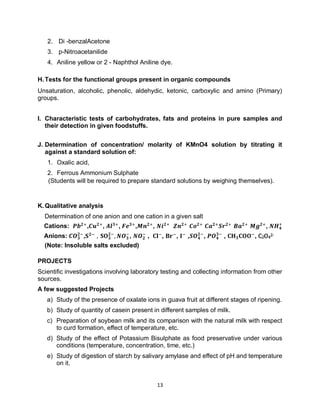
2. Di -benzalAcetone
3.p-Nitroacetanilide
4. Aniline yellow or 2 - Naphthol Aniline dye.
H.Tests for the functional groups present in organic compounds
Unsaturation, alcoholic, phenolic, aldehydic, ketonic, carboxylic and amino (Primary)
groups.
I. Characteristic tests of carbohydrates, fats and proteins in pure samples and
their detection in given foodstuffs.
J. Determination of concentration/ molarity of KMnO4 solution by titrating it
against a standard solution of:
1. Oxalic acid,
2. Ferrous Ammonium Sulphate
(Students will be required to prepare standard solutions by weighing themselves).
K.Qualitative analysis
Determination of one anion and one cation in a given salt
Cations: 𝑷𝒃𝟐+
,𝑪𝒖𝟐+
, 𝑨𝒍𝟑+
, 𝑭𝒆𝟑+
,𝑴𝒏𝟐+
, 𝑵𝒊𝟐+
𝒁𝒏𝟐+
𝑪𝒐𝟐+
𝑪𝒂𝟐+
𝑺𝒓𝟐+
𝑩𝒂𝟐+
𝑴𝒈𝟐+
, 𝑵𝑯𝟒
+
Anions: 𝑪𝑶𝟑
𝟐−
,𝐒𝟐−
, 𝐒𝐎𝟑
𝟐−
, 𝑵𝑶𝟑
−
, 𝑵𝑶𝟐
−
, 𝐂𝐥−
, 𝐁𝐫−
, 𝐈−
,𝑺𝑶𝟒
𝟐−
, 𝑷𝑶𝟒
𝟑−
, 𝐂𝐇𝟑𝐂𝐎𝐎−
, C2O4
2-
(Note: Insoluble salts excluded)
PROJECTS
Scientific investigations involving laboratory testing and collecting information from other
sources.
A few suggested Projects
a) Study of the presence of oxalate ions in guava fruit at different stages of ripening.
b) Study of quantity of casein present in different samples of milk.
c) Preparation of soybean milk and its comparison with the natural milk with respect
to curd formation, effect of temperature, etc.
d) Study of the effect of Potassium Bisulphate as food preservative under various
conditions (temperature, concentration, time, etc.)
e) Study of digestion of starch by salivary amylase and effect of pH and temperature
on it.
14.
14
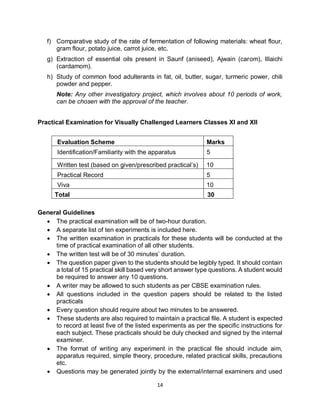
f) Comparative studyof the rate of fermentation of following materials: wheat flour,
gram flour, potato juice, carrot juice, etc.
g) Extraction of essential oils present in Saunf (aniseed), Ajwain (carom), Illaichi
(cardamom).
h) Study of common food adulterants in fat, oil, butter, sugar, turmeric power, chili
powder and pepper.
Note: Any other investigatory project, which involves about 10 periods of work,
can be chosen with the approval of the teacher.
Practical Examination for Visually Challenged Learners Classes XI and XII
General Guidelines
The practical examination will be of two-hour duration.
A separate list of ten experiments is included here.
The written examination in practicals for these students will be conducted at the
time of practical examination of all other students.
The written test will be of 30 minutes’ duration.
The question paper given to the students should be legibly typed. It should contain
a total of 15 practical skill based very short answer type questions. A student would
be required to answer any 10 questions.
A writer may be allowed to such students as per CBSE examination rules.
All questions included in the question papers should be related to the listed
practicals
Every question should require about two minutes to be answered.
These students are also required to maintain a practical file. A student is expected
to record at least five of the listed experiments as per the specific instructions for
each subject. These practicals should be duly checked and signed by the internal
examiner.
The format of writing any experiment in the practical file should include aim,
apparatus required, simple theory, procedure, related practical skills, precautions
etc.
Questions may be generated jointly by the external/internal examiners and used
Evaluation Scheme Marks
Identification/Familiarity with the apparatus 5
Written test (based on given/prescribed practical’s) 10
Practical Record 5
Viva 10
Total 30
15.
15
for assessment.
Theviva questions may include questions based on basic
theory/principle/concept, apparatus/materials/ chemicals required, procedure,
precautions, sources of error etc.
List of apparatus for identification/familiarity for assessment in practical (All
experiments)
Beaker, glass rod, tripod stand, wire gauze, Bunsen burner, Whatman filter paper, gas
jar, capillary tube, pestle and mortar, test tubes, tongs, test tube holder, test tube stand,
burette, pipette, conical flask, standard flask, clamp stand, funnel, filter paper
Hands-on Assessment
Identification/familiarity with the apparatus
Odour detection in qualitative analysis
List of Experiments
The experiments have been divided into two sections: Section A and Section B.
The experiments mentioned in Section B are mandatory.
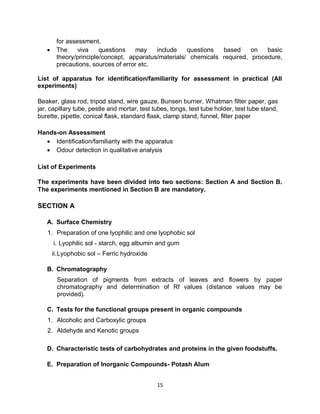
SECTION A
A. Surface Chemistry
1. Preparation of one lyophilic and one lyophobic sol
i. Lyophilic sol - starch, egg albumin and gum
ii.Lyophobic sol – Ferric hydroxide
B. Chromatography
Separation of pigments from extracts of leaves and flowers by paper
chromatography and determination of Rf values (distance values may be
provided).
C. Tests for the functional groups present in organic compounds
1. Alcoholic and Carboxylic groups
2. Aldehyde and Kenotic groups
D. Characteristic tests of carbohydrates and proteins in the given foodstuffs.
E. Preparation of Inorganic Compounds- Potash Alum
16.
16
SECTION B (Mandatory)
F.Quantitative analysis
1. (a) Preparation of a given volume of the standard solution of Oxalic acid.
(b) Determination of molarity of KMnO4 solution by titrating it against a standard
solution of Oxalic acid.
2. The above exercise [F 1 (a) and (b)] to be conducted using Ferrous ammonium
sulphate (Mohr's salt)
G. Qualitative Analysis
Determination of one anion and one cation in a given salt
Cation - 𝑵𝑯𝟒
+
Anions: 𝑪𝑶𝟑
𝟐−
,𝐒𝟐−
, 𝐒𝐎𝟑
𝟐−
, , 𝐂𝐥−
, 𝐂𝐇𝟑𝐂𝐎𝐎−
(Note: insoluble salts excluded)
Note: The above practical may be carried out in an experiential manner rather than
recording observations.
Prescribed Books:
1. Chemistry Part – I, Class-XII, Published by NCERT.
2. Chemistry Part – II, Class-XII, Published by NCERT.
3. Manual of Microscale Chemistry laboratory kit.
Links for NCERT textbooks:
1. https://ncert.nic.in/textbook.php?lech1=0-5
2. https://ncert.nic.in/textbook.php?lech2=0-5
3. https://ncert.nic.in/division/dek/pdf/Manual_01.pdf
17.
17
QUESTION PAPER DESIGNCLASSES XI & XII
1. No chapter wise weightage is provided, however, care to be taken to cover
all the chapters.
2. Suitable internal variations may be made for generating various templates.
3. There will be no overall choice in the question paper.
4. However, 33% internal choices will be given in all the sections.
S.No Domains Total
Marks
%
1 Remembering and Understanding:
Exhibit memory of previously learned material by recalling
facts, terms, basic concepts and answers. Demonstrate
understanding of facts and ideas by organizing,
comparing, translating, interpreting, giving descriptions
and stating main ideas.
28 40
2 Applying:
Solve problems to new situations by applying acquired
knowledge, facts, techniques and rules in a different way.
21 30
3 Analysing, Evaluating and Creating:
Examine and break information into parts by identifying
motives or causes. Make inferences and find evidence to
support generalizations. Present and defend opinions by
making judgments about information, validity of ideas or
quality of work based on a set of criteria.
Compile information together in a different way by
combining elements in a new pattern or proposing
alternative solutions.
21 30
![6
D.Chemical Equilibrium
Any one of the following experiments:
Study the shift in equilibrium between ferric ions and thiocyanate ions by
increasing/decreasing the concentration of either of the ions.
Study the shift in equilibrium between [Co(H2O)6]2+
and chloride ions by
changing the concentration of either of the ions.
E.Quantitative Estimation
1. Using a mechanical balance/electronic balance.
2. Preparation of standard solution of Oxalic acid.
3. Determination of strength of a given solution of Sodium hydroxide by titrating it
against standard solution of Oxalic acid.
4. Preparation of standard solution of Sodium carbonate.
5. Determination of strength of a given solution of hydrochloric acid by titrating it
against standard Sodium Carbonate solution.
F.Qualitative Analysis
1. Determination of one anion and one cation in a given salt
Cations: 𝑷𝒃𝟐+
,𝑪𝒖𝟐+
, 𝑨𝒍𝟑+
, 𝑭𝒆𝟑+
,𝑴𝒏𝟐+
, 𝑵𝒊𝟐+
, 𝒁𝒏𝟐+
, 𝑪𝒐𝟐+
, 𝑪𝒂𝟐+
, 𝑺𝒓𝟐+
, 𝑩𝒂𝟐+
, 𝑴𝒈𝟐+
,
𝑵𝑯𝟒
+
Anions: 𝑪𝑶𝟑
𝟐−
,𝐒𝟐−
, 𝐒𝐎𝟑
𝟐−
, 𝑵𝑶𝟑
−
, 𝑵𝑶𝟐
−
, 𝐂𝐥−
, 𝐁𝐫−
, 𝐈−
,𝑺𝑶𝟒
𝟐−
, 𝑷𝑶𝟒
𝟑−
, 𝐂𝐇𝟑𝐂𝐎𝐎−
(Note: Insoluble salts excluded)
2. Detection of -Nitrogen, Sulphur, Chlorine in organic compounds.
PROJECTS
Scientific investigations involving laboratory testing and collecting information from other
sources.
A few suggested Projects
a) Checking the bacterial contamination in drinking water by testing sulphide ion
b) Study of the methods of purification of water
c) Testing the hardness, presence of Iron, Fluoride, Chloride, etc., depending upon
the regional variation in drinking water and study of causes of presence of these
ions above permissible limit (if any).](https://image.slidesharecdn.com/chemistrysrsec2025-26-250521021221-a506e32c/85/Chemistry_SrSec_2025-26-pdfbugvuvtvinlmln-6-320.jpg)
![7
d) Investigation of the foaming capacity of different washing soaps and the effect of
addition of Sodium carbonate on it
e) Study the acidity of different samples of tea leaves.
f) Determination of the rate of evaporation of different liquids
g) Study the effect of acids and bases on the tensile strength of fibers.
h) Study of acidity of fruit and vegetable juices.
Note: Any other investigatory project, which involves about 10 periods of work, can be
chosen with the approval of the teacher.
Practical Examination for Visually Challenged Students Class XI
Note: Same Evaluation scheme and general guidelines for visually challenged students
as given for Class XII may be followed.
List of apparatus for identification for assessment in practicals (All experiments)
Beaker, tripod stand, wire gauze, glass rod, funnel, filter paper, Bunsen burner,
test tube, test tube stands, dropper, test tube holder, ignition tube, china dish,
tongs, standard flask, pipette, burette, conical flask, clamp stand, dropper, wash
bottle
• Odor detection in qualitative analysis.
• Procedure/Setup of the apparatus.
List of Experiments
A. Characterization and Purification of Chemical Substances
Crystallization of an impure sample of any one of the following:
copper sulphate, benzoic acid.
B. Experiments based on pH
1. Determination of pH of some solutions obtained from fruit juices, solutions of
known and varied concentrations of acids, bases and salts using pH paper.
2. Comparing the pH of solutions of strong and weak acids of same concentration.
C. Chemical Equilibrium
1. Study the shift in equilibrium between ferric ions and thiocyanate ions by
increasing/decreasing the concentration of either ions.
2. Study the shift in equilibrium between [Co(H2O)6]2+
and chloride ions by changing
the concentration of either of the ions.
D. Quantitative estimation
1. Preparation of standard solution of oxalic acid.](https://image.slidesharecdn.com/chemistrysrsec2025-26-250521021221-a506e32c/85/Chemistry_SrSec_2025-26-pdfbugvuvtvinlmln-7-320.jpg)
![16
SECTION B (Mandatory)
F. Quantitative analysis
1. (a) Preparation of a given volume of the standard solution of Oxalic acid.
(b) Determination of molarity of KMnO4 solution by titrating it against a standard
solution of Oxalic acid.
2. The above exercise [F 1 (a) and (b)] to be conducted using Ferrous ammonium
sulphate (Mohr's salt)
G. Qualitative Analysis
Determination of one anion and one cation in a given salt
Cation - 𝑵𝑯𝟒
+
Anions: 𝑪𝑶𝟑
𝟐−
,𝐒𝟐−
, 𝐒𝐎𝟑
𝟐−
, , 𝐂𝐥−
, 𝐂𝐇𝟑𝐂𝐎𝐎−
(Note: insoluble salts excluded)
Note: The above practical may be carried out in an experiential manner rather than
recording observations.
Prescribed Books:
1. Chemistry Part – I, Class-XII, Published by NCERT.
2. Chemistry Part – II, Class-XII, Published by NCERT.
3. Manual of Microscale Chemistry laboratory kit.
Links for NCERT textbooks:
1. https://ncert.nic.in/textbook.php?lech1=0-5
2. https://ncert.nic.in/textbook.php?lech2=0-5
3. https://ncert.nic.in/division/dek/pdf/Manual_01.pdf](https://image.slidesharecdn.com/chemistrysrsec2025-26-250521021221-a506e32c/85/Chemistry_SrSec_2025-26-pdfbugvuvtvinlmln-16-320.jpg)