Abstract
• Coffee, Tea,and soft drinks are very commonly used beverages in which
caffeine is the main stimulant occurred.
• It stimulates the central nervous system, provide energy, decrease fatigue,
and enhance performance.
• Additionally, caffeine has medicinal value and can be used along with other
drugs for headache, stimulation, muscle relaxant and so on.
• However, overdose of caffeine have side effects on the human body.
• different extraction techniques and various instrumental methods employed
for determination of caffeine in plants such as, coffee, tea, soft drinks and
pharmaceutical formulation in presence of other drugs were reviewed in this
work.
• HPLC as most commonly methods for the determination caffeine in
complex sample were discussed.
• Furthermore, the merits and demerits of some extraction methods and
various determination techniques were elaborated with different reference
3.
1.1. Background
Caffeineis mainly the content of many beverages and foods (Aresta A. et al.,
2005).
Chemicals such as caffeine, theobromine, and theophylline are present in tea
leave, coffee, and cacao seeds (Patil., 2012).
Caffeine was initially obtained by Germany chemist friedrich Ferdinand runge
in 1819. Word “caffeine” was derived from the term “kaffein” by him
(Pradeep et al., 2018).
Caffeine is alkaloid compounds of plant origin which is basic in nature since
they contain one or more nitrogen in heterocyclic ring on the structural unit.
Which can be contribute electron pairs on the nitrogen the make it base
(Hagos et al., 2018).
4.
They occur largelyas salt of malic, tartaric, citric and aromatic acid.
Additionally, they may occur in the form of their glycoside, ester or as acid
amide (Bhattarai et al., 2019).
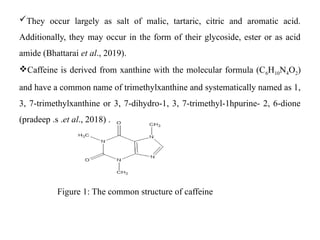
Caffeine is derived from xanthine with the molecular formula (C6H10N4O2)
and have a common name of trimethylxanthine and systematically named as 1,
3, 7-trimethylxanthine or 3, 7-dihydro-1, 3, 7-trimethyl-1hpurine- 2, 6-dione
(pradeep .s .et al., 2018) .
Figure 1: The common structure of caffeine
5.
•Caffeine is commonorganic molecule found in beverages that used to reduce
physical fatigue and restore mental alertness when unusual weakness happens
(Desai, 2020).
•Caffeine act as a CNS stimulant, mild diuretic, it increases the heart rate and
blood pressure and stimulate gastric secretion (pradhan.D.et al.,2017).
When it was taken (consumption) above recommended amounts needed for
body, it may produce toxicities such as nervousness, irritability, anxiety,
muscle twitching, insomnia, headache, respiratory alkalosis and heart
palpitations (Hillary.m. et al., 2013).
• Therefore, controlling amounts of caffeine in foods and drinks is important
for food and beverages quality control (shishov.A.et al.2018).
• Different energy drinks having different amount of caffeine range from 50-
300 mg/L (Sereshti.H.& Samadi.S. et al 2020
6.
Caffeine also usedas natural pesticides that paralyses and kill
microorganisms and insects feeding on the plants. For example, caffeine with
UV light can kill some algae (Dulanlebit, Y.et al.,2020) .
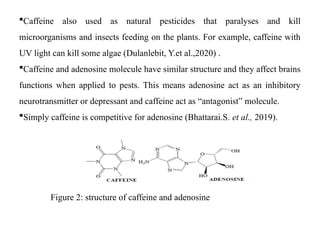
Caffeine and adenosine molecule have similar structure and they affect brains
functions when applied to pests. This means adenosine act as an inhibitory
neurotransmitter or depressant and caffeine act as “antagonist” molecule.
Simply caffeine is competitive for adenosine (Bhattarai.S. et al., 2019).
Figure 2: structure of caffeine and adenosine
7.
Caffeine was usedas indicator for contamination of domestic water because it is
anthropogenic origin and it is detected in both waste and surface water (Bailey.A et
al., 2015).
The use of caffeine as indicator of sewage contamination is a relatively new
analytical tool, especially when other indicators cannot reflect the source and
magnitude of the observed contamination.
Caffeine has a half-life of 30 days in natural environments, allowing its
measurement in environmental samples even some time after initial contamination.
Its behavior is more stable and conservative than that presented by others
indicators, such as nitrogen, favoring the use of caffeine as a contamination
indicator for domestic wastewater into surface waters(Gonçalves et al 2017).
8.
•
Therefore, to beused properly extraction and knowing the amount is decisive.
•
There are different extraction techniques and instruments for quantifications of
caffeine in the sample should be considered. So, in this review different extraction
techniques with some merits and analytical techniques for quantification of the
compound after extraction was considered.
The objective ;
The main objective of this review
to study physical and chemical properties of caffeine;
to determine which extractions methods is appropriate for extractions of
caffeine and
to elaborate different instrumental method used for quantifications of caffeine
in the sample.
9.
2 .LITERATURE REVIEW
2.1.PHYSICALAND CHEMICAL PROPERTIES
2.1.1. Physical a properties
•Caffeine is highly soluble in non-polar solvents and sparingly soluble in most
polar solvents.
•Its melting points 234 0
c -239o
c and boiling point is 178 o
c
•. Pure caffeine occurs as odorless and its density is 1.2g/cm3.
It has molecular
mass 194.19 g/mol (Bojago et al.,2020).
• It has bitter taste in its pure state and it is white crystalline xanthine.
Caffeine is included in achiral molecule because it contains no stereo genic
centers (Bhusnure et al.,2015).
10.
2.1.2., Chemical properties
•The compound caffeine comprises carbon, nitrogen, hydrogen, and oxygen
atoms.
• It is made up of eight carbons, ten hydrogen, four nitrogen, and two
oxygen atoms (Bispom , m.et al.,2012).
• Caffeine is weakly basic having a pka value of 0.6; and a strong acid is
required to protonate it.
• PH of a 1% solution of caffeine in water is 6.9 (Ali.m.,2012)
11.
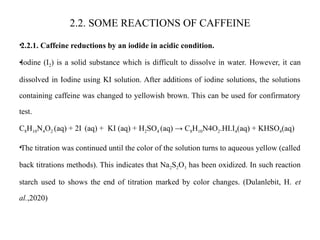
2.2. SOME REACTIONSOF CAFFEINE
•2.2.1. Caffeine reductions by an iodide in acidic condition.
•Iodine (I2) is a solid substance which is difficult to dissolve in water. However, it can
dissolved in Iodine using KI solution. After additions of iodine solutions, the solutions
containing caffeine was changed to yellowish brown. This can be used for confirmatory
test.
C8H10N4O2 (aq) + 2I (aq) + KI (aq) + H2SO4 (aq) → C8H10N4O2.HI.I4(aq) + KHSO4(aq)
•The titration was continued until the color of the solution turns to aqueous yellow (called
back titrations methods). This indicates that Na2S2O3 has been oxidized. In such reaction
starch used to shows the end of titration marked by color changes. (Dulanlebit, H. et
al.,2020)
12.
I2(aq) + 2S2O32
-
(aq)→ 2I-
(aq) + (aq)
• This reaction is very important for determinations of caffeine using
iodometric methods
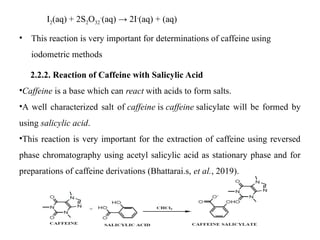
2.2.2. Reaction of Caffeine with Salicylic Acid
•Caffeine is a base which can react with acids to form salts.
•A well characterized salt of caffeine is caffeine salicylate will be formed by
using salicylic acid.
•This reaction is very important for the extraction of caffeine using reversed
phase chromatography using acetyl salicylic acid as stationary phase and for
preparations of caffeine derivations (Bhattarai.s, et al., 2019).
13.
2.2.3. Degradation ofcaffeine
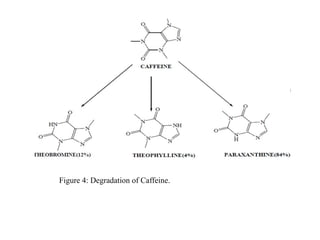
Caffeine is broken down into para xanthine, theo bromine, and theophylline
when caffeine gets to the liver.
These three molecules are structural isomers of each other, which mean that
they have the same chemical formula.
Most of the caffeine is metabolized into para xanthine, which is also a CNS
stimulant. The next most-produced metabolic product of caffeine is Theo
bromine, which can increase the flow of oxygen and nutrients to the brain.
Finally, about 4% of the caffeine is metabolized into theophylline, which
increases heart rate and the force of heart contraction (bhattarai.s,et al.,
2019). So, upon degradation different stimulating compounds will be formed
from caffeine.
2.3 CHEMICAL TESTSFOR CAFFEINE
2.3.1. Potassium hexacyanoferrate(III) (K4 [Fe (CN) 6 ]) test
When few milligram of caffeine were warmed with K4 [Fe (CN) 6] and
HNO3, a Prussian blue colour was observed. By using this method possible to
determine presences of caffeine in certain sample. (Bhattarai.S.et al.,2019).
•2.3.2., Murexide Test: (caffeine, Theo bromine and theophylline).
•The murexide test is an analytical technique to identify the presence of
caffeine and other purine derivatives in a sample. When a substance such as
caffeine is treated with an oxidizing agent and evaporated to dryness on water
bath, red color was produced which turns to violet on exposure to ammonia
vapors(Bailey,M.et al,2012).
16.
caffeine + concHCl and traces of KClO3 →evaporated on water bath →
red color is produced which turns to violet on exposure to ammonia vapor
(Alkamaisah .S .et al,2015).
2.3.3., Tannic acid solution test(caffeine and theophylline):
To a saturated solution of caffeine, few drops of tannic acid solution was
added; a white precipitate was produced which would be soluble in excess
of the reagent.
•A concentrated solution of the alkaloid + tannic acid → white precipitate is
obtained that dissolves in excess of the reagent (Bhattarai.S.et al , 2019).
17.
2.4 . EXTRACTIONSOF CAFFEINE
•They are different methods of extractions of caffeine from the sample as natural products.
2.4.1. Solvent Extractions ( liquid–liquid extraction)
Solvent extraction is the process in which a compound transferred from one solvent to
another owing difference in solubility or distribution coefficient between these two
immiscible (or slightly soluble) solvents.
The extraction will be carried out by simply adding a portion of solvent to the sample.
The caffeine is more soluble in the solvent than in the sample matrix, so it moves out
of” the sample into the solvent.
The solvent now containing dissolved caffeine, is then separated from the sample by
extractions ( Komes.D et al.,2009).
The organic solvents used for the extraction of caffeine from aqueous phase were
chloroform, dichloromethane, toluene, and n-octane at room temperature.
18.
Chloroform was foundto be the most suitable solvent to extract caffeine from
aqueous solution because of high solubility of caffeine in chloroform.
As stated many literature the solubility of caffeine in chloroform is nine times
more than water at room temperature. Thus, chloroform was chosen for many
experimental works ( Desai,S., 2020, Alkamaisah .S .et al,2015,Yazid, E et
al.,2021,).
2.4.2., Dispersive Liquid–Liquid Micro extraction (DLLME) Methods.
The dispersive liquid-liquid micro extraction method was applied for extraction
of caffeine in some popular beverages.
• It is an extraction technique developed within the last decade, which
involves the dispersion of fine droplets of extraction solvent in an aqueous
and then Partitioning of analytes into the extraction phase.
• it is instantaneous due to the very high collective surface area of the droplets.
19.
. This leadsto very high enrichment factors and very low solvent
consumption, relative to other liquid or solid phase extraction methods
( Sereshti,H & Samadi,S., 2014).
•Recently, a fully-automated dispersive liquid-liquid micro extraction
procedure has been developed for the fast and efficient separation and pre
concentration of caffeine from beverages.
• The procedure was automated based on lab-in-syringe approach. The
developed automated technique has advantages such as quickness, low cost,
simplicity, high sensitivity and selectivity ( Shishov, A et al., 2018)
20.
2.4.3., Adsorption techniqueextractions
•Caffeine is selectively adsorbed from aqueous solutions of sample by contact with a
particular form of zeolites created by high temperature rigorous steaming ( Pradeep S,et
al ., 2018).
• In many experiments absorbents used to absorb caffeine was activated carbon (Alonso-
Salces et al., 2001). Since the surface of activated carbon is nonpolar, easier to absorb
color, adsorbs certain gases and chemical compounds which are selective, depending on
the size or volume of the pores and their surface area.
•Activated carbon also known as solid sponge.
• It has a specific surface area, a high adsorption capacity, a higher level of surface
reactivity and a micro pore structure sufficient to remove various types of dyes. Activated
carbon has a very large absorption power, namely 25-100 % by weight of activated carbon.
•When compared with organic solvents, the use of adsorbents is cheaper, easier to obtain,
and more efficient (Yazid. E. et al.,2021).
21.
2.4.4., Solid PhaseExtraction (SPE)
Solid phase extractions are a technique designed for rapid, selective sample
preparation and purification prior to the chromatographic analysis.
In SPE, one or more analytes from a liquid sample are isolated by extracting,
partitioning, and adsorbing onto a solid stationary phase.
•Solid phase extraction uses the difference of affinity between an analyte and
interferents, present in a liquid matrix, for a solid phase (sorbent). This affinity
allows the separation of the target analyte from the interferents ( Pradeep .S,et al .,
2018).
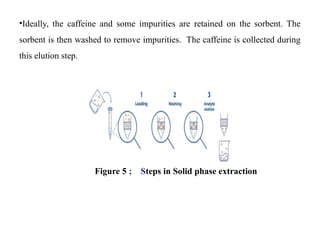
•Solid phase extraction involves four steps:
First, the cartridge(container) is equilibrated or conditioned with
a solvent to wet the sorbent Then the loading solution containing
caffeine tis percolated through the solid phase.
22.
•Ideally, the caffeineand some impurities are retained on the sorbent. The
sorbent is then washed to remove impurities. The caffeine is collected during
this elution step.
Figure 5 ; Steps in Solid phase extraction
23.
2.4.5. Pressurized LiquidExtraction (PLE)
•Pressurized liquid extraction (PLE) is a sample preparation technique where
temperature and pressure are used to accelerate extraction of compounds from
solid and semi-solid samples.
•Pressure is used to increase the contact between the extracting fluid and
sample.
•Temperature is used to break the caffeine-matrix bonds.
•Since PLE is conducted at elevated pressures it allows liquid extraction at
temperatures above the boiling points of the solvent at atmospheric pressure,
thereby improving caffeine solubility and its desorption from the matrix.
•Moreover, temperature can dramatically modify the relative permittivity of the
extracting fluid, increasing selectivity (Huie., 2002).
24.
• This techniqueallows the required volume of extraction solvent to be
reduced, the analysis time to be shortened and the handling necessary to
produce more precise results to be decreased (Alonso-Salces et al., 2001).
• Also, PLE offers the possibility of performing the extractions under an
inert atmosphere and protected from light, which represents an attractive
advantage since many compounds, are sensitive to these two factors
(Palma et al., 2001).
• Pressurized liquid extraction (PLE) has also been described as accelerated
solvent extraction, enhanced solvent extraction, pressurized fluid
extraction, accelerated fluid extraction, and high pressure solvent
extraction by different research groups.
• PLE applies high pressure in extraction. High pressure keeps solvents in a
liquid state above their boiling point resulting in a high solubility and high
diffusion rate of solutes in the solvent, and a high penetration of the solvent
in the matrix.
25.
2.4.6. Ultrasound-Assisted Extraction(UAE)
•Ultrasonic-assisted extraction (UAE), also called ultrasonic extraction or
sonication, uses ultrasonic wave energy in the extraction.
• Ultrasound in the solvent producing cavitation accelerates the dissolution and
diffusion of the solute as well as the heat transfer, which improves the
extraction efficiency.
• The other advantage of UAE includes low solvent and energy consumption,
and the reduction of extraction temperature and time.
•Applicable for the extraction of thermolabile and unstable compounds.
•UAE is commonly employed in the extraction of many types of natural
products such as caffeine (Barba et al. 2016).
26.
2.4.7. Supercritical FluidExtraction (SFE)
Supercritical fluid extraction (SFE) uses supercritical fluid (SF) as the extraction
solvent.
SF has similar solubility to liquid and similar diffusivity to gas, and can dissolve a
wide variety of natural products. Their solvating properties dramatically changed
near their critical points due to small pressure and temperature changes.
Supercritical carbon dioxide (S-CO2) was widely used in SFE because of its
attractive merits such as low critical temperature (31 °C), selectivity, inertness, low
cost, non-toxicity, and capability to extract thermally labile compounds.
The low polarity of S-CO2 makes it ideal for the extraction of non-polar natural
products such as lipid and volatile oil. A modifer may be added to S-CO2 to enhance
its solvating properties significantly (Mumin et al.,2006).
27.
•2.5. CHARACTERIZATIONS.
•Different methodswere employed to characterize the crystalline caffeine.
Pure caffeine obtained from different samples was characterized by UV-
Visible spectrophotometer, TLC, FT-IR and HPLC.
2.5.1., Determination of melting point:
•The melting point of different extracted pure samples was carried out in a
digital melting point apparatus.
•After that melting points of extracted sample (crystalline caffeine) was
matched with melting points of standard sample used (Mumin,A et al ., 2006).
28.
•2.5.2., Thin LayerChromatography methods:
•TLC is an important analytical tool for the separation, identification and estimation
of different classes of compound.
•This method is based on the principle of adsorption. When a mixture of compound
dissolved in a mobile phase move through a column of stationary phase compound
which has more affinity towards the stationary phase travels slower and the
compound with lower affinity travels faster (Bhattarai et al.,2019).
•By the purified product (crystalline caffeine) TLC plate was developed using
chloroform as mobile phase. The plate was examined under UV light. The sample
components quench the fluorescence of the material so that all of the plate
fluoresces except where the non-fluorescing sample components are located. Next to
this RF of unknown sample was matched with RF value of standard caffeine used in
developing plate of TLC (Hillary,M et al., 2013).
29.
• In anotherway the identity of separated species can also be
confirmed by a scraping-and-dissolution technique. The area
containing the analyte is scraped from the plate with a razor blade or
spatula and the contents collected on a piece of glazed paper.
• After transferring to a suitable container, the caffeine is dissolved in
an appropriate solvent and separated from the stationary phase by
centrifugation or filtration.
• Spectroscopic techniques, such as fluorescence, UV-visible
absorption, nuclear magnetic resonance (NMR), or FTIR, are then
used to identify the species ( Demissie.E et al., 2016)
30.
2.5.4., UV Spectrometrymethod:
•An UV- absorption spectrum of extracted purified crystalline caffeine was prepared at
different absorbance against different wavelength using a UV absorption
spectrophotometer.
•If the wave length was found to be similar to that found in literature or standard
sample we can conclude that the sample was pure caffeine (Dulanlebit.H et al .,2020,).
2.5.5., HPLC method
•By using HPLC method, the retention time and the relative peak area of extracted
purified caffeine was determined. The retention time of the purified caffeine and that
of the standard caffeine was matched together, this confirms the sample was totally
pure caffeine if they have same retention time (Dulanlebit.H et al .,2020, Mumin.A et
al.,2006).
•In general Characterization of caffeine was achieved by determining melting
temperature, Rf value, IR spectrum and UV spectrophotometry
31.
2.6., PREPARATION OFSAMPLE FOR ANALYSIS
•After extractions to prepare caffeine for analysis it must be purified. The best
methods for purification of caffeine are recrystallization.
•Caffeine dissolved in another solvent such as toluene and a small amount of
petroleum ether was added for recrystallization.
•Caffeine is highly dissolved in temperature between 50° to 100°C and
preferably from 60° to 80° C.
•Recrystallization takes place by cooling, conveniently to a temperature below
30° C. and preferably to a temperature from15° to 25° C (Mumin.A et al.,2006)
•During preparations of sample for analysis two solutions must be prepared.
One is sample solutions and another one standard solution which used to
compare result of sample solutions (Bhattarai.S et al., 2019).
32.
2.7., METHODS ANALYSISOF CAFFEINE
Caffeine is very commonly occurred and used various soft drinks, hot
drinks, beverages, medicines and available in various plant verities.
There are various methods reported since long time for the determination
of caffeine (Patil.P., 2012).
Now a day’s various sophisticated instruments are available for estimation
of caffeine such as chromatographic techniques, chromatographic
techniques coupled with mass spectrometer, UV spectrophotometer,
Infrared spectrophotometry, capillary electrophoresis, nuclear magnetic
resonance spectrometry (NMR), Iodometry etc(Patil.P.,2012, Zerihun.A&
Dekebo.A.,2019, Weldegebreal et al.,2017, Dulanlebit.H , et al.,2020).
33.
•
In chromatographic analysis,sample was purified before being injected into HPLC.
•Reverse phase HPLC column (non-polar stationary phase and polar mobile phase is
used) was used to determine the concentration of caffeine in beverage drinks. Using
the high performance liquid chromatography system made a fast and easy separation
of caffeine from any other substances in the extracted caffeine sample.
•
Standard solution of caffeine was prepared and injected into the HPLC. From the
resulting chromatograms, measurements of retention time (tR) and peak areas were
performed. In this chromatographic determination, retention time (tR) was used as a
qualitative measure, whereas the peak area was used as quantitative measure. A
calibration curve for peak area against the concentration of the caffeine standards was
employed to determine the concentration of caffeine in the beverages (Zerihun.A&
Dekebo.A.,2019).
34.
•HPLC methods arethe most common methods, especially when the samples
are complex such as food and pharmaceutical preparation while UV-Vis
spectrophotometer method cannot be used directly for determination of
Caffeine in complex samples such as coffee due to the matrix effect.
•However, UV-Vis spectrophotometry method which is available in most
laboratories is easy, fast and cheap for the determination of the caffeine
contents (Zerihun.A& Dekebo.A.,2019)
•As different article indicated spectrophotometric determination of caffeine is
also reported as preferred method of determination such as UV–Vis
spectrophotometry because of its relatively low cost, rapidity, high accuracy
and reproducibility.
35.
•But UV–Vis spectrophotometricmethod cannot be used directly for
determination of caffeine in coffee beans extracted with water owing to the
matrix effect of UV–Vis absorbing substances in the sample matrix. In
aqueous solution of coffee beans it was observed that there is spectral
interference from caffeine and chromogenic acid (Weldegebreal et al.,2017).
•Some of the above stated methods such as FT-IR, and NIR spectroscopy do
not require rigorous sample preparation process, but to resolve the analyte
signal from potential interferences the application of sophisticated chemo
metrics techniques is necessary.
•This makes the method complex and difficult to implement in practical
applications. However, most of the methods, due to insufficient sensitivity and
matrix interferences, direct analysis of the caffeine in food and beverage
samples is limited.
36.
•Therefore, in orderto isolate caffeine, a separation a or a pre-concentration
step prior to the analysis are necessary (Desai.S,2020& Pradeep. S.et
al.,2015).
•Iodometry is a practical, simple and efficient analytical method. This method
is a redox titration based on the sample color changing after titration
( Dulanlebit.H , et al.,2020).
•The standard caffeine dissolved in water and the aqueous solutions of sample
showed an emission and excitation spectrum.
•However, there is difficulty for quantification of caffeine in aqueous solution
of solute using the emission property due to strong overlapping. Therefore, to
overcome this difficulty it is necessary to quantify the amount of caffeine
using the excitation intensity.
37.
•Hence, fluorescent compoundscan be identified or quantified on the basis of their
excitation or emission properties. The fluorescence excitation intensity versus
wavelength spectrum of standard caffeine (weldegebreal et al.,2017).
•A method of caffeine determination in beverages using calibration technique was
developed in the present study which can overcome the difficulty of NIR region for
direct determination of caffeine in beverages.
•Regarding caffeine content determination a fast, simple and cost effective procedure
was developed using NIR spectrophotometry in green coffee bean samples with
reduced amount of organic solvent used.
•The sensitivity of spectrometric measurements relies on band intensities, even the
spectra obtained for the NIR measurement of caffeine was very intense band relative
with other less intense bands in which spectral information is repeated throughout the
successive overtones and combination regions((Zerihun.A& Dekebo.A.,2019).
38.
NIR spectrophotometric methodcannot be used directly for the
determination of caffeine in aqueous solution of beverages. In the NIR
region water absorbs strongly, the free spectral range is not wide and
on the free spectral range available the absorption of aqueous solution
of caffeine is not significant.
Therefore, it is necessarily to use other solvents which are available
for the NIR determination of caffeine in beverages.
•For this method, DMF was selected as a solvent which is less
carcinogenic than chlorinated solvents, its ability to dissolve caffeine
very well and having free spectral range on the studied region
(Gebeyehu and Bikila, 2015).
39.
•The standard caffeinedissolved in water and the extracted solution showed
similar FT-IR absorption spectra over the wavenumber range (2825–2982)cm−
which showed a maximum absorption at around 2855 and 2924 cm−1.
•The two spectra must be similar to each other both in peaks and shapes.
•The similarity in peak and shape of the two spectra show there is no overlap
band from other components of sample in these regions, and this shows the
specificity of the method.
•The use ATR accessories in conjunction with FT-IR spectrometers provides for
the non-destructive measurement of sample and the ATR accessory also allows
for easy and reproducible as well as fast analysis of liquid samples with just a
few drops required.
40.
•FT-IR-ATR determination ofcaffeine in beverages was characterized
with two sharp peaks at around 2855 and 2924 cm−1; these bands are
correlated with the symmetrical and asymmetrical stretching of C–H
bonds of methyl (–CH3) group in the caffeine molecule and the
absorption region over the wavenumber range of 2982–2825 cm−1
was successfully used for quantitative determination of caffeine in
beverages.
•Hence this stretching vibration may play an important role in the
qualitative and quantitative analysis of caffeine in
beverages(Patil.P.,2012).
41.
conclusions
•Caffeine, a componentof coffee, soft drinks, and chocolate, is widely consumed
and considered harmless, although it has powerful effects on a number of organs,
systems, and behavior. Caffeine, in typical concentration ranges of human
consumption, acts as a nonspecific blocker of the adenosine receptor.
•
Dichloromethane or chloroform is used as solvent in extraction because caffeine
has higher solubility in Dichloromethane as compared to other solvents.
•
Crude caffeine was obtained by solid phase extraction (SPE) method. This means
solid phase extractions method best method of extractions of caffeine than
other .because it can take small amounts of sample for extractions and also during
extractions very pure caffeine obtained that does not need purifications process.
42.
•On the otherhand extractions process such as liquid-liquid extractions is
somewhat it needs high amounts of solvents and sample during the extractions
process.it also need needs another purifications process such as
recrystallizations.
• As a general HPLC is the method of choice by many researchers in
determining the caffeine contents in beverages. Because its reliable
methods for the determination caffeine in complex sample. Very low
concentration of caffeine can be determined with high accuracy and
precision
![2.3 CHEMICAL TESTS FOR CAFFEINE
2.3.1. Potassium hexacyanoferrate(III) (K4 [Fe (CN) 6 ]) test
When few milligram of caffeine were warmed with K4 [Fe (CN) 6] and
HNO3, a Prussian blue colour was observed. By using this method possible to
determine presences of caffeine in certain sample. (Bhattarai.S.et al.,2019).
•2.3.2., Murexide Test: (caffeine, Theo bromine and theophylline).
•The murexide test is an analytical technique to identify the presence of
caffeine and other purine derivatives in a sample. When a substance such as
caffeine is treated with an oxidizing agent and evaporated to dryness on water
bath, red color was produced which turns to violet on exposure to ammonia
vapors(Bailey,M.et al,2012).](https://image.slidesharecdn.com/presentation2-250421073941-be98a25a/85/Presentation2-pptxfor-extration-of-beverages-15-320.jpg)



![APPROACH TO FEVER IN PEDIATRICS[1].pptTT](https://cdn.slidesharecdn.com/ss_thumbnails/approachtofeverinpediatrics1-260125081456-d559e079-thumbnail.jpg?width=640&height=640&fit=bounds)


