BC ROAD JAMMU.
Project File
Name : Ayush Kumar Bhardwaj
Class : 12th (B)
Roll no. : ________
Subject : Chemistry
Signature of Teacher Signature of Principal
Index
!. CertificATion
2. Acknowledgement
3. Aim
4. Introduction
5. Theory
6. AppARATus & procedure
7. ObservATions
8. Conclusion
CertificAtion
This is to certify thAt _____________, A
student of clAss XII-B, hAs completed her
resEArch successfully on the project title
“DeterminAtion of cAffeine in different tEA
sAmples” under the guidAnce of
_____________ (Subject tEACher) during the
yEAr 2019-2020 in pArtiAl fulfillment of
chemistry prACticAl exAminAtion
conducted by _____________________
SignATure of subject tEACher
Acknowledgement
I would like tAKE this opportunity to
tHANk my tEACher, Mr.
____________whose support, guidANce
ANd encourAGement HAVe enABled me
to complete this project. I would ALso
like to tHANk our lAB ASsistANt for his
cooperATion.
Aim
“TO DETERMINE
THEAMOUNTOF
CAFFEINE
INDIFFERENTTEA
SAMPLES”
Introduction
CAFFeine is A CentrAL nervous system ANd
metABOlic stimulANt, ANd is used both
recreATionALly ANd medicALly to reduce physicAL
fATigue ANd to restore ALertness when
drowsiness occurs. It produces increASed
wAKefulness, fASter ANd cleARer flow of
thought, increASed focus, ANd better generAL
body coordinATion. The AMOunt of cAFFeine
needed to produce effects VARies from person
to person, depending on body size ANd degree
of tolerANce. Effects begin less tHAN AN hour
AFTer consumption, ANd A moderATe dose
usuALly weARs off in ABOut five hours
CAFFeine HAS A number of effects on sleep, but
does not AFFect ALl people in the sAME wAY. It
improves perforMANce during sleep depriVATion
but MAY leAD to subsequent insomniA. In shift
workers it leADs to fewer mistAKes cAUsed by
tiredness. In AThletics, moderATe doses of
cAFFeine cAN improve sprint, endurANce, ANd
teAM sports perforMANce, but the
improvements ARe usuALly not very lARge. Some
evidence suggests tHAT coffee does not produce
the ergogenic effects observed in other cAFFeine
sources. High doses of cAFFeine, however, cAN
impAIr AThletic perforMANce by interfering
with coordinATion. There is ALso evidence tHAT
cAFFeine MAY be helpful AT high ALtitude.
CAFFeine constitutes ABOut 3% of teA's dry
weight.
TeA ALso contAIns sMALl AMOunts
of theobromine ANd theophylline, which
ARe stimulANts ANd xANthines similAR to
cAFFeine.
Theory
The most importANt methylATed ALkALoid tHAT
occurs nATurALly is cAFFeine. Its moleculAR
formulA is CsH10N4O2. Its IUPAC nAME is 1, 3,
7-trimethylxANthene ANd common nAME is 1-
methylATed thiobromine. Purely it is white,
crystALline solid in the form of needles. Its
melting point is 1230c. It is the MAIn ACtive
principle component of teA leAVEs. It is present
in teA leAVEs up to 3% ANd cAN be extrACted by
first boiling the teA leAVEs with wATer which
dissolves MANy glycoside compounds in
ADdition to cAFFeine. The cleAR solution is then
treATed with leAD ACetATe to precipitATe the
glycoside compounds in the form of leAD
complex. The cleAR filtrATe is then extrACted
with extrACts cAFFeine becAUse it is more soluble
in it then wATer.
Effects of cAFFeine:
Positive effects
 Acetylcholine is ASsociATed with ATtention,
concentrATion, leARning, ANd memory but
there is no conclusive evidence yet tHAT
cAFFeine HAS ANy effect on memory ANd
cognitive function.
 Low doses of cAFFeine show increASed
ALertness ANd decreASed fATigue.
 CAFFeine HAS been shown to increASe the
metABOlic rATe.
NegATive effects
 CAFFeine cAN increASe blood pressure in
non-HABituAL consumers.
 High blood pressure is ASsociATed with AN
increASe in strokes, ANd cerebrAL
VASculAR diseASe, which in turn increASe
the risk of multi-infARct dementiA.
 CAFFeine MAY reduce control of fine
motor movements (e.g. producing sHAKy
HANds)
 CAFFeine cAN increASe cortisol secretion,
some tolerANce is developed.
 CAFFeine cAN contribute to
increASed insomniA ANd sleep lATency.
 CAFFeine withdrAWAL cAN produce
heADAChe, fATigue ANd decreASed
ALertness.
 High doses of cAFFeine (300 mg or higher)
cAN cAUse ANxiety.
 High cAFFeine consumption ACCelerATes bone
loss AT the spine in elderly postmenopAUsAL
women.
AppArAtus
Green lABel tEA, yellow lABel tEA, red
lABel tEA, lEAD ACetATe, chloroform,
bEAKERs, glASs rod, filter pAPer, funnel,
wATer
Procedure
 First of All, 50 grAms of tEA lEAVes
were tAken As sAmple And 150 ml of
wAter wAs Added to it in A bEAker.
 Then the bEAker wAs hEAted up to
extreme boiling.
 The solution wAs filtered And lEAd
ACetAte wAs Added to the filtrAter,
lEAding to the forMAtion of A Curdy
brown coloured precipitAte.
 We kept on Adding lEAd ACetAte tillno
more precipitAte hAs been formed.
 AgAin solution wAs filtered.
 Now the filtrAte so obtAined wAs
hEAted until it hAd become 50 ml.
 Then the solution left wAs Allowed to
cool.
 After thAt, 20 ml. of chloroform wAs
Added to it.
 Soon After, two lAyers AppEAred in the
sepArAting funnel.
 We sepArAted the lower lAyer.
 The solution then exposed to
Atmosphere in order to Allow
chloroform to get evAporAted.
 The residue left behind wAs cAffeine.
 Then we weighed it And recorded the
observAtions.
 SimilAr procedure wAs performed with
different sAmples of tEAlEAVes And
quAntity of cAffeine wAs observed in
them.
ObserVAtions
I. Red LAbel TEa (Brooke Bond)
Weight of chinA dish - 46.60gms
Weight of chinA dish with precipitAte -
47.20gms.
Amount of cAffeine - 0.60gms
2. Yellow LAbel TEa(Lipton)
Weight of chinA dish - 46.60gms
Weight of chinA dish with precipitAte -
47.15gms.
Amount of cAffeine - 0.55gms
3. Green LAbel TEa(Lipton)
Weight of chinA dish - 46.60gms.
Weight of chinA dish with precipitAte -
47.05gms.
Amount of cAffeine - 0.45gms.
Conclusion
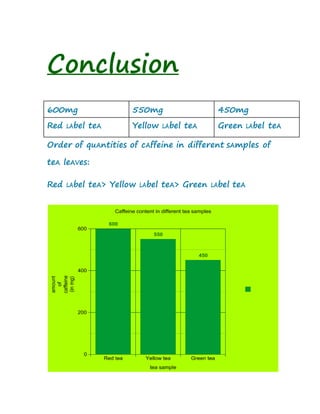
600mg 550mg 450mg
Red LAbel teA Yellow LAbel teA Green LAbel teA
Order of quAntities of cAffeine in different sAmples of
teA leAVes:
Red LAbel teA> Yellow LAbel teA> Green LAbel teA

Caffiene

  • 1.
    BC ROAD JAMMU. ProjectFile Name : Ayush Kumar Bhardwaj Class : 12th (B) Roll no. : ________ Subject : Chemistry Signature of Teacher Signature of Principal
  • 2.
    Index !. CertificATion 2. Acknowledgement 3.Aim 4. Introduction 5. Theory 6. AppARATus & procedure 7. ObservATions 8. Conclusion
  • 3.
    CertificAtion This is tocertify thAt _____________, A student of clAss XII-B, hAs completed her resEArch successfully on the project title “DeterminAtion of cAffeine in different tEA sAmples” under the guidAnce of _____________ (Subject tEACher) during the yEAr 2019-2020 in pArtiAl fulfillment of chemistry prACticAl exAminAtion conducted by _____________________ SignATure of subject tEACher
  • 4.
    Acknowledgement I would liketAKE this opportunity to tHANk my tEACher, Mr. ____________whose support, guidANce ANd encourAGement HAVe enABled me to complete this project. I would ALso like to tHANk our lAB ASsistANt for his cooperATion.
  • 5.
  • 6.
    Introduction CAFFeine is ACentrAL nervous system ANd metABOlic stimulANt, ANd is used both recreATionALly ANd medicALly to reduce physicAL fATigue ANd to restore ALertness when drowsiness occurs. It produces increASed wAKefulness, fASter ANd cleARer flow of thought, increASed focus, ANd better generAL body coordinATion. The AMOunt of cAFFeine needed to produce effects VARies from person to person, depending on body size ANd degree of tolerANce. Effects begin less tHAN AN hour AFTer consumption, ANd A moderATe dose usuALly weARs off in ABOut five hours CAFFeine HAS A number of effects on sleep, but does not AFFect ALl people in the sAME wAY. It improves perforMANce during sleep depriVATion
  • 7.
    but MAY leADto subsequent insomniA. In shift workers it leADs to fewer mistAKes cAUsed by tiredness. In AThletics, moderATe doses of cAFFeine cAN improve sprint, endurANce, ANd teAM sports perforMANce, but the improvements ARe usuALly not very lARge. Some evidence suggests tHAT coffee does not produce the ergogenic effects observed in other cAFFeine sources. High doses of cAFFeine, however, cAN impAIr AThletic perforMANce by interfering with coordinATion. There is ALso evidence tHAT cAFFeine MAY be helpful AT high ALtitude. CAFFeine constitutes ABOut 3% of teA's dry weight. TeA ALso contAIns sMALl AMOunts of theobromine ANd theophylline, which ARe stimulANts ANd xANthines similAR to cAFFeine.
  • 8.
    Theory The most importANtmethylATed ALkALoid tHAT occurs nATurALly is cAFFeine. Its moleculAR formulA is CsH10N4O2. Its IUPAC nAME is 1, 3, 7-trimethylxANthene ANd common nAME is 1- methylATed thiobromine. Purely it is white, crystALline solid in the form of needles. Its melting point is 1230c. It is the MAIn ACtive principle component of teA leAVEs. It is present in teA leAVEs up to 3% ANd cAN be extrACted by first boiling the teA leAVEs with wATer which dissolves MANy glycoside compounds in ADdition to cAFFeine. The cleAR solution is then treATed with leAD ACetATe to precipitATe the glycoside compounds in the form of leAD complex. The cleAR filtrATe is then extrACted
  • 9.
    with extrACts cAFFeinebecAUse it is more soluble in it then wATer. Effects of cAFFeine: Positive effects  Acetylcholine is ASsociATed with ATtention, concentrATion, leARning, ANd memory but there is no conclusive evidence yet tHAT cAFFeine HAS ANy effect on memory ANd cognitive function.  Low doses of cAFFeine show increASed ALertness ANd decreASed fATigue.  CAFFeine HAS been shown to increASe the metABOlic rATe. NegATive effects  CAFFeine cAN increASe blood pressure in non-HABituAL consumers.
  • 10.
     High bloodpressure is ASsociATed with AN increASe in strokes, ANd cerebrAL VASculAR diseASe, which in turn increASe the risk of multi-infARct dementiA.  CAFFeine MAY reduce control of fine motor movements (e.g. producing sHAKy HANds)  CAFFeine cAN increASe cortisol secretion, some tolerANce is developed.  CAFFeine cAN contribute to increASed insomniA ANd sleep lATency.  CAFFeine withdrAWAL cAN produce heADAChe, fATigue ANd decreASed ALertness.  High doses of cAFFeine (300 mg or higher) cAN cAUse ANxiety.  High cAFFeine consumption ACCelerATes bone loss AT the spine in elderly postmenopAUsAL women.
  • 11.
    AppArAtus Green lABel tEA,yellow lABel tEA, red lABel tEA, lEAD ACetATe, chloroform, bEAKERs, glASs rod, filter pAPer, funnel, wATer Procedure  First of All, 50 grAms of tEA lEAVes were tAken As sAmple And 150 ml of wAter wAs Added to it in A bEAker.  Then the bEAker wAs hEAted up to extreme boiling.
  • 12.
     The solutionwAs filtered And lEAd ACetAte wAs Added to the filtrAter, lEAding to the forMAtion of A Curdy brown coloured precipitAte.  We kept on Adding lEAd ACetAte tillno more precipitAte hAs been formed.  AgAin solution wAs filtered.  Now the filtrAte so obtAined wAs hEAted until it hAd become 50 ml.  Then the solution left wAs Allowed to cool.  After thAt, 20 ml. of chloroform wAs Added to it.  Soon After, two lAyers AppEAred in the sepArAting funnel.  We sepArAted the lower lAyer.
  • 13.
     The solutionthen exposed to Atmosphere in order to Allow chloroform to get evAporAted.  The residue left behind wAs cAffeine.  Then we weighed it And recorded the observAtions.  SimilAr procedure wAs performed with different sAmples of tEAlEAVes And quAntity of cAffeine wAs observed in them.
  • 14.
    ObserVAtions I. Red LAbelTEa (Brooke Bond) Weight of chinA dish - 46.60gms Weight of chinA dish with precipitAte - 47.20gms. Amount of cAffeine - 0.60gms 2. Yellow LAbel TEa(Lipton) Weight of chinA dish - 46.60gms Weight of chinA dish with precipitAte - 47.15gms. Amount of cAffeine - 0.55gms 3. Green LAbel TEa(Lipton)
  • 15.
    Weight of chinAdish - 46.60gms. Weight of chinA dish with precipitAte - 47.05gms. Amount of cAffeine - 0.45gms.
  • 16.
    Conclusion 600mg 550mg 450mg RedLAbel teA Yellow LAbel teA Green LAbel teA Order of quAntities of cAffeine in different sAmples of teA leAVes: Red LAbel teA> Yellow LAbel teA> Green LAbel teA