Ionic Compound Formulas
www.lab-initio.com
Ions
Cation: A positive ion
Mg2+, NH4
+
Anion: A negative ion
Cl-, SO4
2-
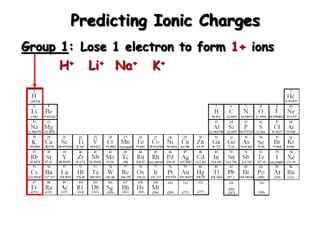
Predicting Ionic Charges
Group 1: Lose 1 electron to form 1+ ions
H+ Li+ Na+ K+
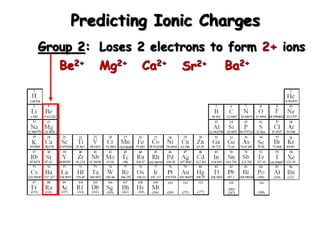
Predicting Ionic Charges
Group 2: Loses 2 electrons to form 2+ ions
Be2+ Mg2+ Ca2+
Sr2+ Ba2+
Predicting Ionic Charges
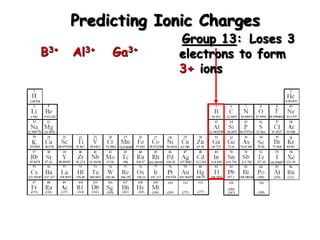
Group 13: Loses 3
electrons to form
3+ ions
B3+ Al3+ Ga3+
Predicting Ionic Charges
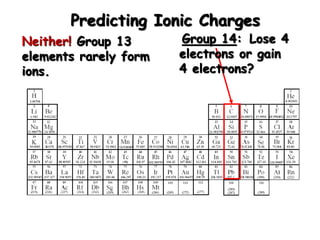
Group 14: Lose 4
electrons or gain
4 electrons?
Neither! Group 13
elements rarely form
ions.
Predicting Ionic Charges
Group 15: Gains 3
electrons to form
3- ions
N3-
P3-
As3-
Nitride
Phosphide
Arsenide
Predicting Ionic Charges
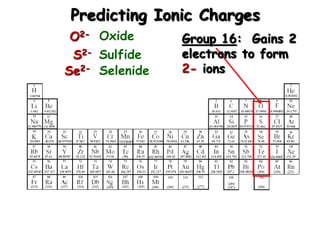
Group 16: Gains 2
electrons to form
2- ions
O2-
S2-
Se2-
Oxide
Sulfide
Selenide
Predicting Ionic Charges
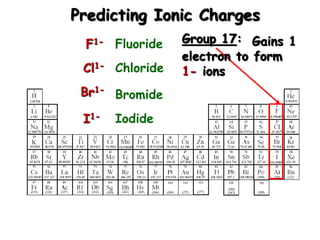
Group 17: Gains 1
electron to form
1- ions
F1-
Cl1-
Br1-
Fluoride
Chloride
Bromide
I1- Iodide
Predicting Ionic Charges
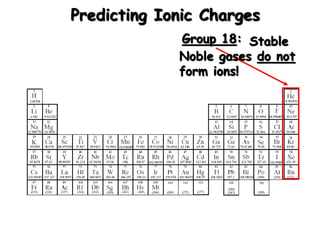
Group 18: Stable
Noble gases do not
form ions!
Predicting Ionic Charges
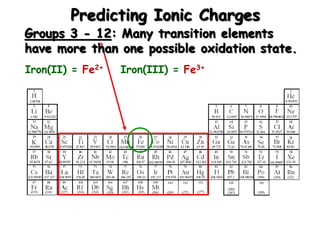
Groups 3 - 12: Many transition elements
have more than one possible oxidation state.
Iron(II) = Fe2+ Iron(III) = Fe3+
Predicting Ionic Charges
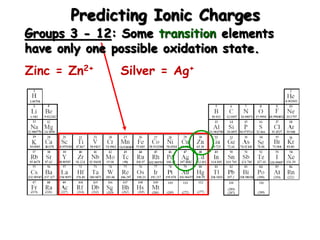
Groups 3 - 12: Some transition elements
have only one possible oxidation state.
Zinc = Zn2+ Silver = Ag+
Writing Ionic Compound Formulas
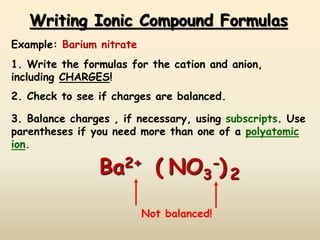
Example: Barium nitrate
1. Write the formulas for the cation and anion,
including CHARGES!
Ba2+ NO3
-
2. Check to see if charges are balanced.
3. Balance charges , if necessary, using subscripts. Use
parentheses if you need more than one of a polyatomic
ion.
Not balanced!
( ) 2
Writing Ionic Compound Formulas
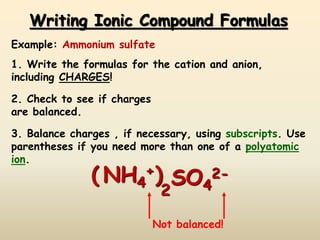
Example: Ammonium sulfate
1. Write the formulas for the cation and anion,
including CHARGES!
NH4
+
SO4
2-
2. Check to see if charges
are balanced.
3. Balance charges , if necessary, using subscripts. Use
parentheses if you need more than one of a polyatomic
ion.
Not balanced!
( )
2
Writing Ionic Compound Formulas
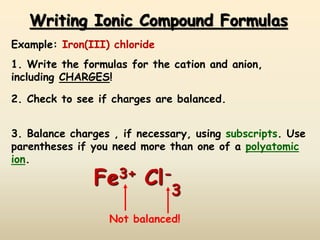
Example: Iron(III) chloride
1. Write the formulas for the cation and anion,
including CHARGES!
Fe3+ Cl-
2. Check to see if charges are balanced.
3. Balance charges , if necessary, using subscripts. Use
parentheses if you need more than one of a polyatomic
ion.
Not balanced!
3
Writing Ionic Compound Formulas
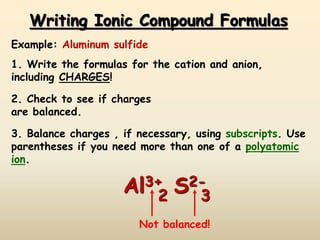
Example: Aluminum sulfide
1. Write the formulas for the cation and anion,
including CHARGES!
Al3+ S2-
2. Check to see if charges
are balanced.
3. Balance charges , if necessary, using subscripts. Use
parentheses if you need more than one of a polyatomic
ion.
Not balanced!
2 3
Writing Ionic Compound Formulas
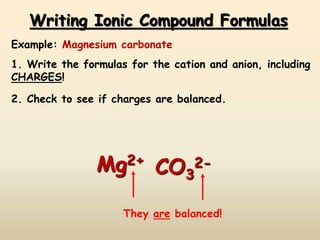
Example: Magnesium carbonate
1. Write the formulas for the cation and anion, including
CHARGES!
Mg2+
CO3
2-
2. Check to see if charges are balanced.
They are balanced!
Writing Ionic Compound Formulas
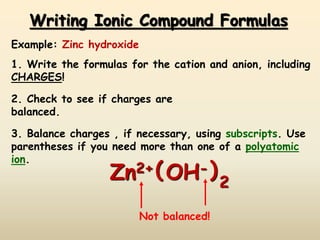
Example: Zinc hydroxide
1. Write the formulas for the cation and anion, including
CHARGES!
Zn2+ OH-
2. Check to see if charges are
balanced.
3. Balance charges , if necessary, using subscripts. Use
parentheses if you need more than one of a polyatomic
ion.
Not balanced!
( )
2
Writing Ionic Compound Formulas
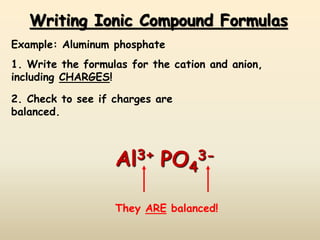
Example: Aluminum phosphate
1. Write the formulas for the cation and anion,
including CHARGES!
Al3+ PO4
3-
2. Check to see if charges are
balanced.
They ARE balanced!
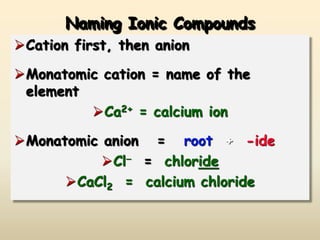
Naming Ionic Compounds
Cation first, then anion
Monatomic cation = name of the
element
Ca2+ = calcium ion
Monatomic anion = root + -ide
Cl- = chloride
CaCl2 = calcium chloride
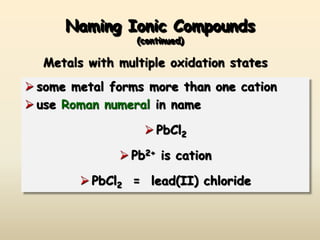
Naming Ionic Compounds
(continued)
 some metal forms more than one cation
 use Roman numeral in name
 PbCl2
 Pb2+ is cation
 PbCl2 = lead(II) chloride
Metals with multiple oxidation states

IonicFormulas.ppsx

  • 1.
  • 2.
    Ions Cation: A positiveion Mg2+, NH4 + Anion: A negative ion Cl-, SO4 2-
  • 3.
    Predicting Ionic Charges Group1: Lose 1 electron to form 1+ ions H+ Li+ Na+ K+
  • 4.
    Predicting Ionic Charges Group2: Loses 2 electrons to form 2+ ions Be2+ Mg2+ Ca2+ Sr2+ Ba2+
  • 5.
    Predicting Ionic Charges Group13: Loses 3 electrons to form 3+ ions B3+ Al3+ Ga3+
  • 6.
    Predicting Ionic Charges Group14: Lose 4 electrons or gain 4 electrons? Neither! Group 13 elements rarely form ions.
  • 7.
    Predicting Ionic Charges Group15: Gains 3 electrons to form 3- ions N3- P3- As3- Nitride Phosphide Arsenide
  • 8.
    Predicting Ionic Charges Group16: Gains 2 electrons to form 2- ions O2- S2- Se2- Oxide Sulfide Selenide
  • 9.
    Predicting Ionic Charges Group17: Gains 1 electron to form 1- ions F1- Cl1- Br1- Fluoride Chloride Bromide I1- Iodide
  • 10.
    Predicting Ionic Charges Group18: Stable Noble gases do not form ions!
  • 11.
    Predicting Ionic Charges Groups3 - 12: Many transition elements have more than one possible oxidation state. Iron(II) = Fe2+ Iron(III) = Fe3+
  • 12.
    Predicting Ionic Charges Groups3 - 12: Some transition elements have only one possible oxidation state. Zinc = Zn2+ Silver = Ag+
  • 13.
    Writing Ionic CompoundFormulas Example: Barium nitrate 1. Write the formulas for the cation and anion, including CHARGES! Ba2+ NO3 - 2. Check to see if charges are balanced. 3. Balance charges , if necessary, using subscripts. Use parentheses if you need more than one of a polyatomic ion. Not balanced! ( ) 2
  • 14.
    Writing Ionic CompoundFormulas Example: Ammonium sulfate 1. Write the formulas for the cation and anion, including CHARGES! NH4 + SO4 2- 2. Check to see if charges are balanced. 3. Balance charges , if necessary, using subscripts. Use parentheses if you need more than one of a polyatomic ion. Not balanced! ( ) 2
  • 15.
    Writing Ionic CompoundFormulas Example: Iron(III) chloride 1. Write the formulas for the cation and anion, including CHARGES! Fe3+ Cl- 2. Check to see if charges are balanced. 3. Balance charges , if necessary, using subscripts. Use parentheses if you need more than one of a polyatomic ion. Not balanced! 3
  • 16.
    Writing Ionic CompoundFormulas Example: Aluminum sulfide 1. Write the formulas for the cation and anion, including CHARGES! Al3+ S2- 2. Check to see if charges are balanced. 3. Balance charges , if necessary, using subscripts. Use parentheses if you need more than one of a polyatomic ion. Not balanced! 2 3
  • 17.
    Writing Ionic CompoundFormulas Example: Magnesium carbonate 1. Write the formulas for the cation and anion, including CHARGES! Mg2+ CO3 2- 2. Check to see if charges are balanced. They are balanced!
  • 18.
    Writing Ionic CompoundFormulas Example: Zinc hydroxide 1. Write the formulas for the cation and anion, including CHARGES! Zn2+ OH- 2. Check to see if charges are balanced. 3. Balance charges , if necessary, using subscripts. Use parentheses if you need more than one of a polyatomic ion. Not balanced! ( ) 2
  • 19.
    Writing Ionic CompoundFormulas Example: Aluminum phosphate 1. Write the formulas for the cation and anion, including CHARGES! Al3+ PO4 3- 2. Check to see if charges are balanced. They ARE balanced!
  • 20.
    Naming Ionic Compounds Cationfirst, then anion Monatomic cation = name of the element Ca2+ = calcium ion Monatomic anion = root + -ide Cl- = chloride CaCl2 = calcium chloride
  • 21.
    Naming Ionic Compounds (continued) some metal forms more than one cation  use Roman numeral in name  PbCl2  Pb2+ is cation  PbCl2 = lead(II) chloride Metals with multiple oxidation states