PRESENTATION SEMINAR
ON
THE CHEMISTRY OF BREWERY
BY GROUP F
WHAT IS BREWING?
 Definition: Brewing is the production of beer by
steeping a starch source in water and fermenting the
liquid with yeast.
 Historical Context: Brewing has taken place since
around the 6th millennium BC. Emerging civilizations in
ancient Egypt, China, and Mesopotamia all brewed
beer.
 Modern Industry: Today, the brewing industry is a
global business, moving from artisanal to industrial
production since the Industrial Revolution.
THE FOUR MAIN
INGREDIENTS
 Water: Beer is composed mostly of water, and its mineral components
(hardness) can significantly affect the taste.
 Starch Source (Malted Grains): This provides the fermentable material
for the beer. Malted barley is the most common starch source due to
its fibrous husk and rich source of the enzyme amylase.
 Hops: Hops are the female flower clusters of the hop vine used as a
flavoring and preservative agent. They contribute bitterness, aroma,
and aid in "head retention". The distinct bitterness comes from
chemical compounds called alpha-acids and beta-acids.
 Yeast: This microorganism is responsible for fermentation, metabolizing
sugars from the grains to produce alcohol and carbon dioxide.
The Brewing Process: Initial
Steps
 Malting: Barley grain is soaked in water and allowed to
germinate, then dried in a kiln. This process produces
enzymes, like amylases, that convert starches into
fermentable sugars during the next step.
 Mashing: Milled grain is mixed with hot water in a
vessel called a mash tun. This activates the amylase
enzymes, which break down long carbohydrates
(polymers like amylopectin and amylose) into simpler
sugars that the yeast can use.
The Brewing Process: Lautering
and Boiling
 : Lautering: This is the separation of the wort (the sugar-
rich liquid) from the spent grains. This is typically done
in a lauter tun with a false bottom that acts as a filter.
 Boiling: The wort is transferred to a kettle and boiled
with hops. The boiling process serves to terminate
enzymatic processes, precipitate proteins, and
isomerize hop resins to add bitterness and flavor.
The Brewing Process:
Fermentation
 The Role of Yeast: Yeast is added to the cooled wort in a
fermentation tank. Under anaerobic conditions, yeast
relies on fermentation to convert pyruvate into ethanol.
 Fermentation Methods:
 Warm Fermentation: Used for ales, typically at
temperatures of 18°C (64°F).
 Cool Fermentation: Used for lagers, brewed at around
10°C (50°F) and then stored (lagered) for several weeks
at temperatures near freezing.
 Spontaneous Fermentation: A traditional method where
wild, airborne yeasts are allowed to ferment the wort in
open vessels.
The Brewing Process:
Finishing Steps
 Conditioning: The beer is aged to smooth its flavor and
dissipate unwanted flavors.
 Filtering: Filtering stabilizes the beer's flavor and
removes haze, giving it a clear appearance.
 Packaging: The finished beer is either force
carbonated and bottled or canned, or it can be
naturally carbonated in the bottle or cask.
The Chemistry of Beer
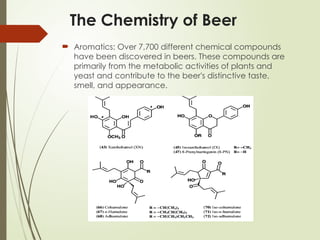
 Aromatics: Over 7,700 different chemical compounds
have been discovered in beers. These compounds are
primarily from the metabolic activities of plants and
yeast and contribute to the beer's distinctive taste,
smell, and appearance.
Conclusion
 Summary: The brewing process is a complex series of
steps, from preparing the raw materials to
fermentation and finishing. In commercial brewing,
beer is carbonated with pressurized carbon dioxide.
Inert gases like nitrogen can also be used, which
creates smaller bubbles and a smoother, creamier
head. .
 Final Thought: It is a fusion of tradition, precise control,
and biochemistry that transforms simple ingredients
into the vast variety of beers enjoyed worldwide.

SEMINAR_brewing chemistry including steps

  • 1.
  • 2.
    WHAT IS BREWING? Definition: Brewing is the production of beer by steeping a starch source in water and fermenting the liquid with yeast.  Historical Context: Brewing has taken place since around the 6th millennium BC. Emerging civilizations in ancient Egypt, China, and Mesopotamia all brewed beer.  Modern Industry: Today, the brewing industry is a global business, moving from artisanal to industrial production since the Industrial Revolution.
  • 3.
    THE FOUR MAIN INGREDIENTS Water: Beer is composed mostly of water, and its mineral components (hardness) can significantly affect the taste.  Starch Source (Malted Grains): This provides the fermentable material for the beer. Malted barley is the most common starch source due to its fibrous husk and rich source of the enzyme amylase.  Hops: Hops are the female flower clusters of the hop vine used as a flavoring and preservative agent. They contribute bitterness, aroma, and aid in "head retention". The distinct bitterness comes from chemical compounds called alpha-acids and beta-acids.  Yeast: This microorganism is responsible for fermentation, metabolizing sugars from the grains to produce alcohol and carbon dioxide.
  • 4.
    The Brewing Process:Initial Steps  Malting: Barley grain is soaked in water and allowed to germinate, then dried in a kiln. This process produces enzymes, like amylases, that convert starches into fermentable sugars during the next step.  Mashing: Milled grain is mixed with hot water in a vessel called a mash tun. This activates the amylase enzymes, which break down long carbohydrates (polymers like amylopectin and amylose) into simpler sugars that the yeast can use.
  • 5.
    The Brewing Process:Lautering and Boiling  : Lautering: This is the separation of the wort (the sugar- rich liquid) from the spent grains. This is typically done in a lauter tun with a false bottom that acts as a filter.  Boiling: The wort is transferred to a kettle and boiled with hops. The boiling process serves to terminate enzymatic processes, precipitate proteins, and isomerize hop resins to add bitterness and flavor.
  • 6.
    The Brewing Process: Fermentation The Role of Yeast: Yeast is added to the cooled wort in a fermentation tank. Under anaerobic conditions, yeast relies on fermentation to convert pyruvate into ethanol.  Fermentation Methods:  Warm Fermentation: Used for ales, typically at temperatures of 18°C (64°F).  Cool Fermentation: Used for lagers, brewed at around 10°C (50°F) and then stored (lagered) for several weeks at temperatures near freezing.  Spontaneous Fermentation: A traditional method where wild, airborne yeasts are allowed to ferment the wort in open vessels.
  • 7.
    The Brewing Process: FinishingSteps  Conditioning: The beer is aged to smooth its flavor and dissipate unwanted flavors.  Filtering: Filtering stabilizes the beer's flavor and removes haze, giving it a clear appearance.  Packaging: The finished beer is either force carbonated and bottled or canned, or it can be naturally carbonated in the bottle or cask.
  • 8.
    The Chemistry ofBeer  Aromatics: Over 7,700 different chemical compounds have been discovered in beers. These compounds are primarily from the metabolic activities of plants and yeast and contribute to the beer's distinctive taste, smell, and appearance.
  • 9.
    Conclusion  Summary: Thebrewing process is a complex series of steps, from preparing the raw materials to fermentation and finishing. In commercial brewing, beer is carbonated with pressurized carbon dioxide. Inert gases like nitrogen can also be used, which creates smaller bubbles and a smoother, creamier head. .  Final Thought: It is a fusion of tradition, precise control, and biochemistry that transforms simple ingredients into the vast variety of beers enjoyed worldwide.