
CHEMICAL WEAPONS
Presented by:
Hafsa Abdul Ghuffar
Roll # 13-329
CONTENTS
• Why This Topic?
• Categories of Chemical Weapons
• Nerve Agents
a. Names
b. Synthesis of Sarin
c. Mode of Action
d. First Aid and treatment
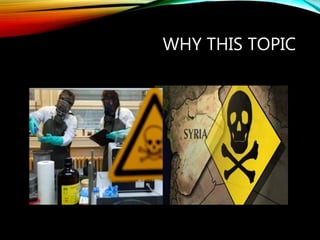
WHY THIS TOPIC
CHEMICAL WEAPONS
• A toxic chemical contained in a delivery system, such as a bomb or
shell.
• According to Chemical Weapons Convention CWC, the term
chemical weapon is applied to any toxic chemical or its precursor that
can cause death, injury, temporary incapacitation or sensory irritation
through its chemical action.
• Munitions or other delivery devices designed to deliver chemical
weapons, whether filled or unfilled, are also considered weapons
themselves.
CATEGORIES
Military planners generally organize chemical into four groups:
• 1- nerve agents (such as sarin and VX)
• 2 -blister agents (such as mustard gas)
• 3-choking agents (such as chlorine and phosgene)
• 4- blood agents (such as hydrogen cyanide).
BLOOD AGENTS
• Volatile, flammable, usually colorless gasses attack by being
absorbed in blood
• Are cyanide or arsenic based
• act through inhalation
• Inhibit cells’ ability to transfer or utilize oxygen
Arsine
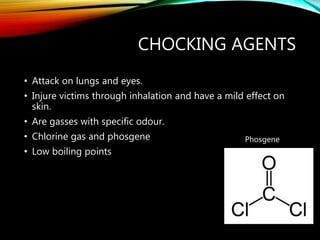
CHOCKING AGENTS
• Attack on lungs and eyes.
• Injure victims through inhalation and have a mild effect on
skin.
• Are gasses with specific odour.
• Chlorine gas and phosgene
• Low boiling points
Phosgene
BLISTERING AGENTS
• A blister agent, or vesicant, is a chemical compound that
causes severe skin, eye and mucosal pain and irritation.
• Chemically belong to these categories:
1. Sulfur mustards – A family of sulfur-based agents,
including mustard gas.
2. Nitrogen mustards – A family of agents similar to the sulfur
mustards, but based on nitrogen instead of sulfur.
BLISTERING AGENT
Sulfur Mustard
C4H8Cl2S
NERVE AGENTS
• phosphorus-containing organic chemicals
(organophosphates) that disrupt the mechanisms by which
nerves transfer messages to organs.
TABUN
• Tabun, O-ethyl dimethylamidophosphorylcyanide, with the
American denomination GA.
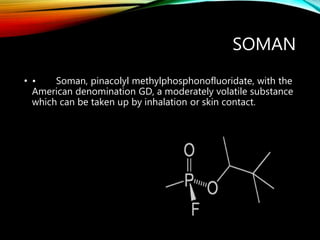
SOMAN
• • Soman, pinacolyl methylphosphonofluoridate, with the
American denomination GD, a moderately volatile substance
which can be taken up by inhalation or skin contact.
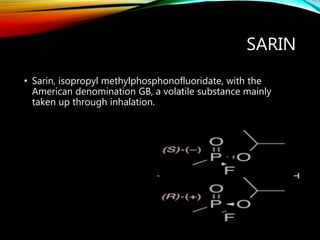
SARIN
• Sarin, isopropyl methylphosphonofluoridate, with the
American denomination GB, a volatile substance mainly
taken up through inhalation.
SYNTHESIS
• Reaction of methylphosphonyl difluoride with
isopropyl alcohol, which produces hydrofluoric
acid as a byproduct:
SYNTHESIS
• By reaction of equal quantities of methylphosphonyl
difluoride and methylphosphonic dichloride
NERVE AGENTS
SLUDGE Syndrome
• Salivation
• Lacrimation (tears flow)
• Urination
• Diaphoresis (sweating)
• Gastrointestinal motility
• Emesis (vomiting)
MODE OF ACTION
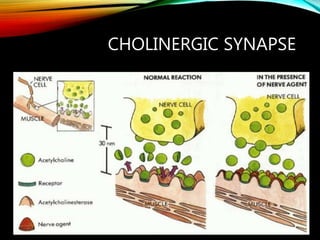
• irreversibly inhibit enzyme acetylcholinesterase.
• If nerve agent is inhaled poisoning effects start immediately
• If nerve agent gets into body via skin it might take 20-30
minutes for the symptoms to appear.
CHOLINERGIC SYNAPSE
MODE OF ACTION
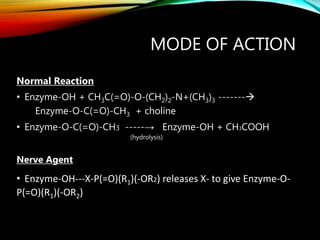
Normal Reaction
• Enzyme-OH + CH3C(=O)-O-(CH2)2-N+(CH3)3 -------
Enzyme-O-C(=O)-CH3 + choline
• Enzyme-O-C(=O)-CH3 -----→ Enzyme-OH + CH3COOH
(hydrolysis)
Nerve Agent
• Enzyme-OH---X-P(=O)(R1)(-OR2) releases X- to give Enzyme-O-
P(=O)(R1)(-OR2)
TREATMENT
Reactivation Using Oxime
• The oxime (Pralidoxime in given example) attacks the P-O
bond
• operational enzyme and a phosphorylated oxime, which is
rapidly hydrolyzed to non-toxic products, are formed
TREATMENT
• Ageing
• In the "ageing" reaction, the phosphorylated enzyme is
dealkylated
• Enzyme-O-P(=O)(R1)(-OR2) reacts to give Enzyme-O-
P(=O)(R1)-OH
• The reaction is catalyzed by the enzyme itself
• Reaction may be extremely fast.
• Soman-inhibited acetylcholinesterase becomes "aged" within
a few minutes.
Chemical weapons

Chemical weapons

  • 1.
    CHEMICAL WEAPONS Presented by: HafsaAbdul Ghuffar Roll # 13-329
  • 2.
    CONTENTS • Why ThisTopic? • Categories of Chemical Weapons • Nerve Agents a. Names b. Synthesis of Sarin c. Mode of Action d. First Aid and treatment
  • 3.
  • 4.
    CHEMICAL WEAPONS • Atoxic chemical contained in a delivery system, such as a bomb or shell. • According to Chemical Weapons Convention CWC, the term chemical weapon is applied to any toxic chemical or its precursor that can cause death, injury, temporary incapacitation or sensory irritation through its chemical action. • Munitions or other delivery devices designed to deliver chemical weapons, whether filled or unfilled, are also considered weapons themselves.
  • 5.
    CATEGORIES Military planners generallyorganize chemical into four groups: • 1- nerve agents (such as sarin and VX) • 2 -blister agents (such as mustard gas) • 3-choking agents (such as chlorine and phosgene) • 4- blood agents (such as hydrogen cyanide).
  • 6.
    BLOOD AGENTS • Volatile,flammable, usually colorless gasses attack by being absorbed in blood • Are cyanide or arsenic based • act through inhalation • Inhibit cells’ ability to transfer or utilize oxygen Arsine
  • 7.
    CHOCKING AGENTS • Attackon lungs and eyes. • Injure victims through inhalation and have a mild effect on skin. • Are gasses with specific odour. • Chlorine gas and phosgene • Low boiling points Phosgene
  • 8.
    BLISTERING AGENTS • Ablister agent, or vesicant, is a chemical compound that causes severe skin, eye and mucosal pain and irritation. • Chemically belong to these categories: 1. Sulfur mustards – A family of sulfur-based agents, including mustard gas. 2. Nitrogen mustards – A family of agents similar to the sulfur mustards, but based on nitrogen instead of sulfur.
  • 9.
  • 10.
    NERVE AGENTS • phosphorus-containingorganic chemicals (organophosphates) that disrupt the mechanisms by which nerves transfer messages to organs.
  • 11.
    TABUN • Tabun, O-ethyldimethylamidophosphorylcyanide, with the American denomination GA.
  • 12.
    SOMAN • • Soman,pinacolyl methylphosphonofluoridate, with the American denomination GD, a moderately volatile substance which can be taken up by inhalation or skin contact.
  • 13.
    SARIN • Sarin, isopropylmethylphosphonofluoridate, with the American denomination GB, a volatile substance mainly taken up through inhalation.
  • 14.
    SYNTHESIS • Reaction ofmethylphosphonyl difluoride with isopropyl alcohol, which produces hydrofluoric acid as a byproduct:
  • 15.
    SYNTHESIS • By reactionof equal quantities of methylphosphonyl difluoride and methylphosphonic dichloride
  • 16.
    NERVE AGENTS SLUDGE Syndrome •Salivation • Lacrimation (tears flow) • Urination • Diaphoresis (sweating) • Gastrointestinal motility • Emesis (vomiting)
  • 18.
    MODE OF ACTION •irreversibly inhibit enzyme acetylcholinesterase. • If nerve agent is inhaled poisoning effects start immediately • If nerve agent gets into body via skin it might take 20-30 minutes for the symptoms to appear.
  • 19.
  • 20.
    MODE OF ACTION NormalReaction • Enzyme-OH + CH3C(=O)-O-(CH2)2-N+(CH3)3 ------- Enzyme-O-C(=O)-CH3 + choline • Enzyme-O-C(=O)-CH3 -----→ Enzyme-OH + CH3COOH (hydrolysis) Nerve Agent • Enzyme-OH---X-P(=O)(R1)(-OR2) releases X- to give Enzyme-O- P(=O)(R1)(-OR2)
  • 21.
    TREATMENT Reactivation Using Oxime •The oxime (Pralidoxime in given example) attacks the P-O bond • operational enzyme and a phosphorylated oxime, which is rapidly hydrolyzed to non-toxic products, are formed
  • 22.
    TREATMENT • Ageing • Inthe "ageing" reaction, the phosphorylated enzyme is dealkylated • Enzyme-O-P(=O)(R1)(-OR2) reacts to give Enzyme-O- P(=O)(R1)-OH • The reaction is catalyzed by the enzyme itself • Reaction may be extremely fast. • Soman-inhibited acetylcholinesterase becomes "aged" within a few minutes.

Editor's Notes

  • #4 Related to our Subject Current Syria War and Attitude of Science Students towards Current Social and Global Issues Unique and Interesting
  • #16 -Tetra-n-butylammonium bromide. -N,N-Diisopropylethylamine