THREAT FROM CWA&
IDENTIFICATION OF
HAZARDOUS CHEMICAL/
CWA
Presented By
CT- K J REDDY
06 BN NDRF
2.
OBJECTIVES
Upon completion ofthis lesson, you will able to:-
Definition of CWA
Describe the types of CWA
Classification of CWA
Identify Threats from CWA and hazardous Chemical/CWA
Sign and Symptoms of CWA.
3.
CWA
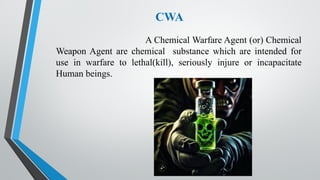
A Chemical WarfareAgent (or) Chemical
Weapon Agent are chemical substance which are intended for
use in warfare to lethal(kill), seriously injure or incapacitate
Human beings.
4.
WHY USE OFCWA
Poor man’s Nuclear Bomb
Easy to manufacture
Required in small quantity in enclosed spaces
Impact in Area
Difficult to recognize
Psychological Trauma
5.
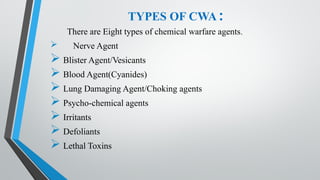
TYPES OF CWA:
There are Eight types of chemical warfare agents.
Nerve Agent
Blister Agent/Vesicants
Blood Agent(Cyanides)
Lung Damaging Agent/Choking agents
Psycho-chemical agents
Irritants
Defoliants
Lethal Toxins
6.
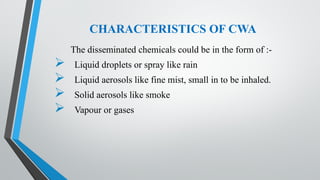
CHARACTERISTICS OF CWA
Thedisseminated chemicals could be in the form of :-
Liquid droplets or spray like rain
Liquid aerosols like fine mist, small in to be inhaled.
Solid aerosols like smoke
Vapour or gases
7.
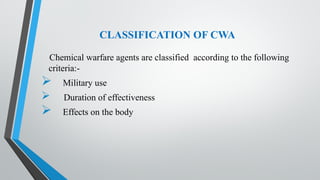
CLASSIFICATION OF CWA
Chemicalwarfare agents are classified according to the following
criteria:-
Military use
Duration of effectiveness
Effects on the body
8.
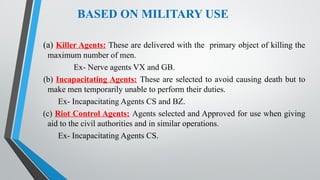
BASED ON MILITARYUSE
(a) Killer Agents: These are delivered with the primary object of killing the
maximum number of men.
Ex- Nerve agents VX and GB.
(b) Incapacitating Agents: These are selected to avoid causing death but to
make men temporarily unable to perform their duties.
Ex- Incapacitating Agents CS and BZ.
(c) Riot Control Agents: Agents selected and Approved for use when giving
aid to the civil authorities and in similar operations.
Ex- Incapacitating Agents CS.
9.
BASED ON DURATIONOF EFFECTIVENESS
1. Non Persistent Agents:- These substances are highly
volatile and which contaminate the air.
Ex. HCN(Blood agent), Sarin(GB), Soman(GD), Tabun(GA)
(Nerve agent), Tear Gases and H Agents.
2. Persistent Agents:-These substances are non-volatile and
persist for a period used to contaminate ground surface.
Ex-VX(Nerve agents), thickened Soman, Sulphur
Mustard(Blister agents) gas.
10.
BASED ON EFFECTSON THE BODY
The third method of classification is to group agents
by their action and effect on the body. Such groups are as
follows:
(i) Nerve Agent: These interfere with the nervous system and
thus disrupt essential body functions like breathing, muscular
control and vision.
Ex- Tabun (GA), Sarin (GB), Soman (GD) and V agents.
11.
Cont.....
(ii) Blister Agents:These agents cause inflammation, blistering of
the skin and superficial destruction of contaminated internal tissue.
Ex: Mustard Gas(HD), Nitrogen, Mustard (HN 1 to HN 3) and
Lewisite (L).
iii) Blood Agents: These prevent body tissue from using the
oxygen in the blood.
Ex- Hydrogen Cyanide (HCN), Cyanogen Chloride (CNCL) and
Arsine(AS).
12.
Cont...
(iv) Choking/Lungs Agents:These attack the breathing passage
and lungs.
Ex- Phosgene(CG), Di-phosgene (DP) and Chloropicrin (PS).
(v) Vomiting Agents: These cause irritation in the nose and throat,
which can lead to vomiting.
(vi) Mental Incapacitates: These cause temporary mental
disturbances, usually preceded or accompanied by physical effects.
13.
CWA (Chemical WarfareAgents) and hazardous
chemicals pose significant threats to human health,
safety, and the environment.
14.
HERE ARE SOMEPOTENTIAL THREATS
CWA Threats:
Toxicity: CWA can cause severe harm or death through
inhalation, skin contact, or ingestion.
Contamination: CWA can contaminate soil, water, and air,
leading to long-term environmental damage.
Exposure: CWA can be released through various means,
including attacks, accidents, or improper handling.
Latency: Some CWA can have delayed effects, making it
difficult to immediately identify exposure.
15.
Hazardous chemicals threats:
1.Toxicity:Hazardous chemicals can cause acute or chronic health
effects, including cancer, organ damage, and neurological problems.
2. Flammability: Many hazardous chemicals are flammable, posing
fire and explosion risks.
3. Reactivity: Hazardous chemicals can react with other substances,
leading to dangerous situations.
4. Environmental Harm: Hazardous chemicals can contaminate the
environment, harming wildlife and ecosystems.
5. Accidental Release: Hazardous chemicals can be released through
accidents, such as spills or leaks.
16.
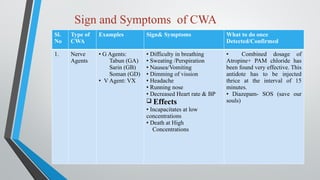
Sign and Symptomsof CWA
Sl.
No
Type of
CWA
Examples Sign& Symptoms What to do once
Detected/Confirmed
1. Nerve
Agents
• G Agents:
Tabun (GA)
Sarin (GB)
Soman (GD)
• V Agent: VX
• Difficulty in breathing
• Sweating /Perspiration
• Nausea/Vomiting
• Dimming of vission
• Headache
• Running nose
• Decreased Heart rate & BP
Effects
• Incapacitates at low
concentrations
• Death at High
Concentrations
• Combined dosage of
Atropine+ PAM chloride has
been found very effective. This
antidote has to be injected
thrice at the interval of 15
minutes.
• Diazepam- SOS (save our
souls)
17.
Cont….
Sl.
No
Type of
CWA
Examples Sign&Symptoms What to do once Detected/
Confirmed
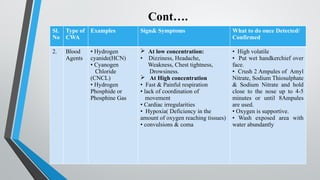
2. Blood
Agents
• Hydrogen
cyanide(HCN)
• Cyanogen
Chloride
(CNCL)
• Hydrogen
Phosphide or
Phosphine Gas
At low concentration:
• Dizziness, Headache,
Weakness, Chest tightness,
Drowsiness.
At High concentration
• Fast & Painful respiration
• lack of coordination of
movement
• Cardiac irregularities
• Hypoxia( Deficiency in the
amount of oxygen reaching tissues)
• convulsions & coma
• High volatile
• Put wet handkerchief over
face.
• Crush 2 Ampules of Amyl
Nitrate, Sodium Thiosulphate
& Sodium Nitrate and hold
close to the nose up to 4-5
minutes or until 8Ampules
are used.
• Oxygen is supportive.
• Wash exposed area with
water abundantly
18.
Cont….
Sl.
No
Type of
CWA
Examples Sign&Symptoms What to do once Detected/
Confirmed
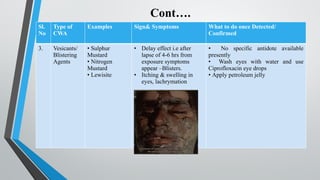
3. Vesicants/
Blistering
Agents
• Sulphur
Mustard
• Nitrogen
Mustard
• Lewisite
• Delay effect i.e after
lapse of 4-6 hrs from
exposure symptoms
appear –Blisters.
• Itching & swelling in
eyes, lachrymation
• No specific antidote available
presently
• Wash eyes with water and use
Ciprofloxacin eye drops
• Apply petroleum jelly
19.
Cont….
Sl.
No
Type of CWAExamples Sign& Symptoms What to do once Detected/
Confirmed
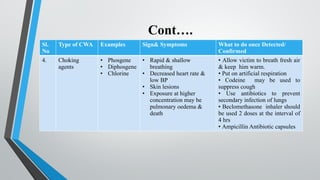
4. Choking
agents
• Phosgene
• Diphosgene
• Chlorine
• Rapid & shallow
breathing
• Decreased heart rate &
low BP
• Skin lesions
• Exposure at higher
concentration may be
pulmonary oedema &
death
• Allow victim to breath fresh air
& keep him warm.
• Put on artificial respiration
• Codeine may be used to
suppress cough
• Use antibiotics to prevent
secondary infection of lungs
• Beclomethasone inhaler should
be used 2 doses at the interval of
4 hrs
• Ampicillin Antibiotic capsules
20.
Cont…
Sl. No Typeof
CWA
Examples Sign & Symptoms What to do once Detected/
Confirmed
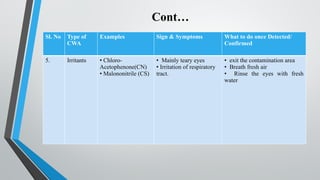
5. Irritants • Chloro-
Acetophenone(CN)
• Malononitrile (CS)
• Mainly teary eyes
• Irritation of respiratory
tract.
• exit the contamination area
• Breath fresh air
• Rinse the eyes with fresh
water
21.
REVIEW
Upon completion ofthis lesson you now able to:-
Definition of CWA
Describe the types of CWA
Classification of CWA
Identify Threats from CWA and hazardous Chemical/CWA
Sign and Symptoms of CWA.