Slide Title
Welcome to
our
presentation
Compounds used in warfare
Chemical Warfare
PREPARED BY:
Zahra Naveed (76)
Misharab Liaqat (108)
Tayaba Kausar (116)
Summer Tahir (60)
Nafessa Shoukat (112)
Abstract:
• From the axe, which originated in
1,000,000 B.C.to today’s use of weapons
has been varied and incredibly invented.
• Weapons have changed history and
aided in the rise and fall of civilization.
Introduction
• Weapons
• Types
• Biological warfare
• Surface warfare
• Chemical Warfare
• History
Weapons:
• Such substances or elements
used to attack on enemy or
to protect yourself in the
defense manner.
• That may rise the civilization
or might harm them.
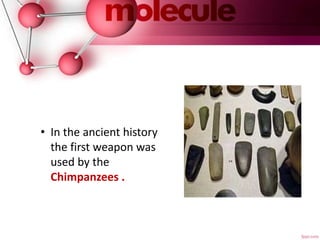
• In the ancient history
the first weapon was
used by the
Chimpanzees .
Types
Biological warfare :
• Biological warfare also termed as Germ Warfare .
• any of a number of disease-producing agents—such
as bacteria, viruses, fungi, toxins, or other biological
agents—that may be utilized as weapons against
humans, animals, or plants.
• It later termed as Bio-agents.
• The reason is that the viruses are not self
reproductive or required a proper host to
reproduce.
• Biological weapons are commonly referred
to as weapons of mass destruction .
Bio-agents
Biological Warfare Agents
• Biological warfare agents differ greatly in the type of
organism or toxin used in a weapons system. Such as:
• lethality
• length of incubation
• infectiousness
• stability
• ability to be treated with current vaccines and
medicines.
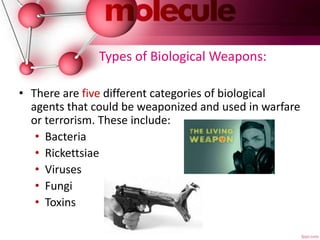
Types of Biological Weapons:
• There are five different categories of biological
agents that could be weaponized and used in warfare
or terrorism. These include:
• Bacteria
• Rickettsiae
• Viruses
• Fungi
• Toxins
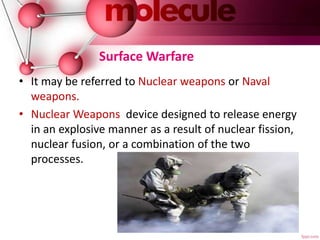
Surface Warfare
• It may be referred to Nuclear weapons or Naval
weapons.
• Nuclear Weapons device designed to release energy
in an explosive manner as a result of nuclear fission,
nuclear fusion, or a combination of the two
processes.
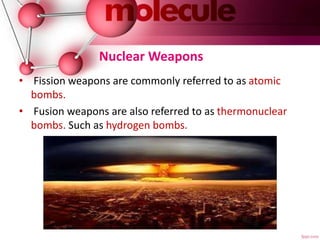
Nuclear Weapons
• Fission weapons are commonly referred to as atomic
bombs.
• Fusion weapons are also referred to as thermonuclear
bombs. Such as hydrogen bombs.
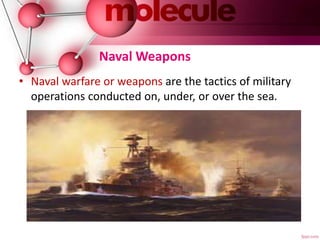
Naval Weapons
• Naval warfare or weapons are the tactics of military
operations conducted on, under, or over the sea.
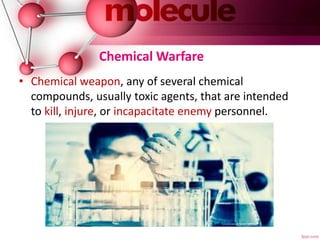
Chemical Warfare
• Chemical weapon, any of several chemical
compounds, usually toxic agents, that are intended
to kill, injure, or incapacitate enemy personnel.
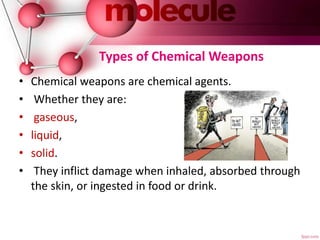
Types of Chemical Weapons
• Chemical weapons are chemical agents.
• Whether they are:
• gaseous,
• liquid,
• solid.
• They inflict damage when inhaled, absorbed through
the skin, or ingested in food or drink.
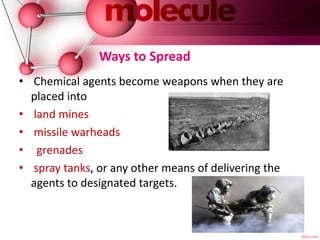
Ways to Spread
• Chemical agents become weapons when they are
placed into
• land mines
• missile warheads
• grenades
• spray tanks, or any other means of delivering the
agents to designated targets.
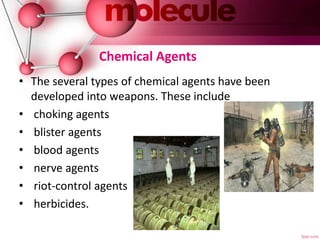
Chemical Agents
• The several types of chemical agents have been
developed into weapons. These include
• choking agents
• blister agents
• blood agents
• nerve agents
• riot-control agents
• herbicides.
History
• Chemical weapons were first used in significant
amounts in World War I.
• German troops released Chlorine Gas on
unsuspecting French soldiers, choking them and
causing panic.
• The Germans also used Phosgene Gas and
introduced Mustard Gas into war in 1917.
• By 1918, all major world powers had employed
chemical weapons.
• During World War II, Germany developed nerve
agents such as
• Toman ,
• Soman ,
• Sarin.
• After World War II, the British invented VX, a more
persistent nerve agent that eventually was
deployed by the United States.
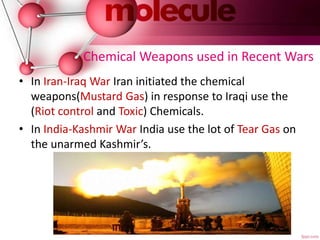
Chemical Weapons used in Recent Wars
• In Iran-Iraq War Iran initiated the chemical
weapons(Mustard Gas) in response to Iraqi use the
(Riot control and Toxic) Chemicals.
• In India-Kashmir War India use the lot of Tear Gas on
the unarmed Kashmir’s.
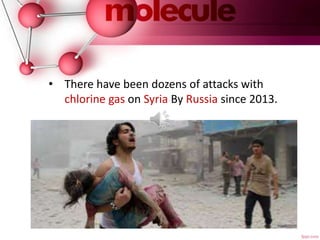
• There have been dozens of attacks with
chlorine gas on Syria By Russia since 2013.
Harassing Agents
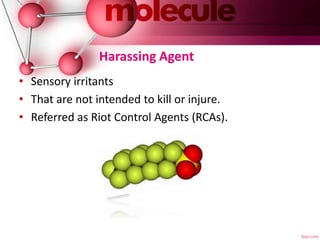
Harassing Agent
• Sensory irritants
• That are not intended to kill or injure.
• Referred as Riot Control Agents (RCAs).
Harassing agent
Types
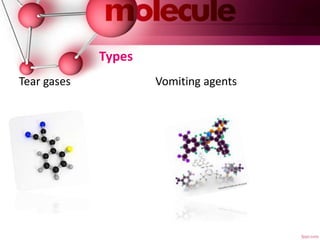
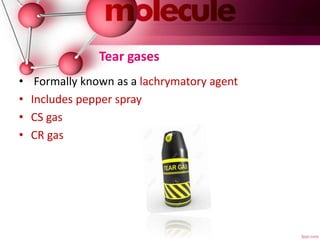
Tear gases Vomiting agents
Tear gases
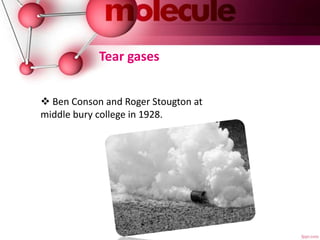
• Formally known as a lachrymatory agent
• Includes pepper spray
• CS gas
• CR gas
Tear gases
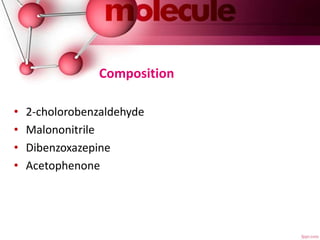
 Ben Conson and Roger Stougton at
middle bury college in 1928.
Composition
• 2-cholorobenzaldehyde
• Malononitrile
• Dibenzoxazepine
• Acetophenone
Vomiting Agent
• Sensory irritants
• Also termed sternators
• Nose irritants
Vomiting agent
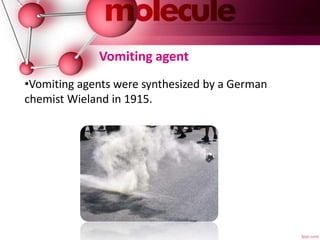
•Vomiting agents were synthesized by a German
chemist Wieland in 1915.
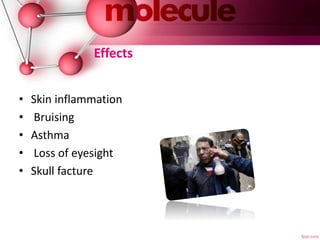
Effects
• Skin inflammation
• Bruising
• Asthma
• Loss of eyesight
• Skull facture
Incapacitating agent
Incapacitating agents
• Nonlethal agents.
• Mainly include physiological agents
• Produce debilitating effects.
• Permanent injury or loss of life.
Psychological Agents
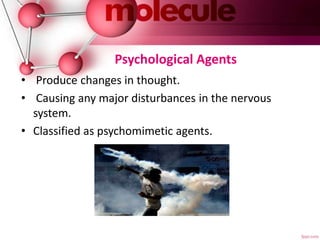
• Produce changes in thought.
• Causing any major disturbances in the nervous
system.
• Classified as psychomimetic agents.
Composition
• 3-Quinucilidinyl benzilate (BZ)
• Phencyclidine (SN)
• Lysergic acid diethylamide (K)
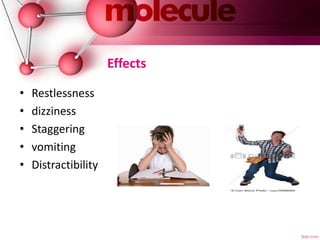
Effects
• Restlessness
• dizziness
• Staggering
• vomiting
• Distractibility
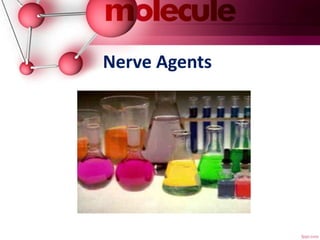
Nerve Agents
Nerve agents
A class of phosphorus-containing organic
chemicals (organophosphates).
That disrupt the mechanisms by which nerves
transfer messages to organs.
Nerve Agent
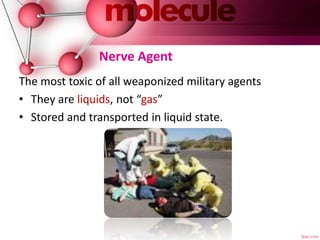
The most toxic of all weaponized military agents
• They are liquids, not “gas”
• Stored and transported in liquid state.
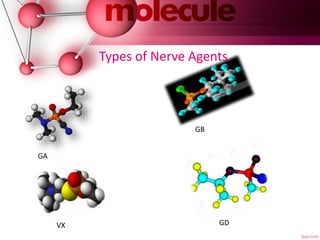
Types of Nerve Agents
GA
GB
VX GD
Composition of Nerve agent
These chemical used in formation of nerve agent
dimethylamidophosphoric dichloride
Chlorobenzene
Hydrogen cyanide
Triethylamine
Phosphorus trichloride
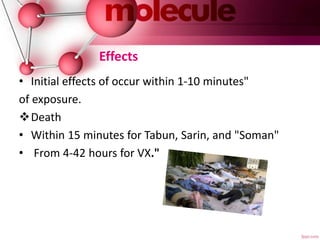
Effects
• Initial effects of occur within 1-10 minutes"
of exposure.
Death
• Within 15 minutes for Tabun, Sarin, and "Soman"
• From 4-42 hours for VX."
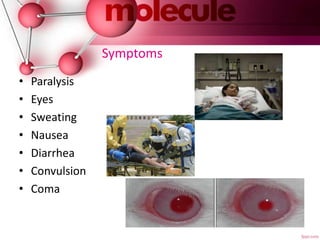
Symptoms
• Paralysis
• Eyes
• Sweating
• Nausea
• Diarrhea
• Convulsion
• Coma
Blood Agents
Blood agent
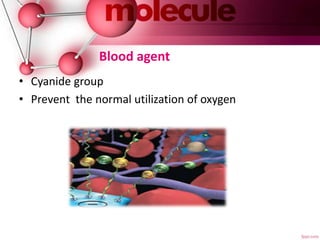
• Cyanide group
• Prevent the normal utilization of oxygen
Blood agent
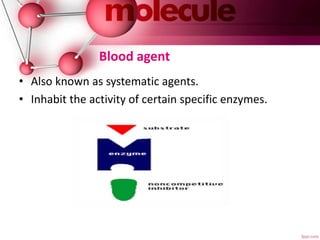
• Also known as systematic agents.
• Inhabit the activity of certain specific enzymes.
Blood agent types
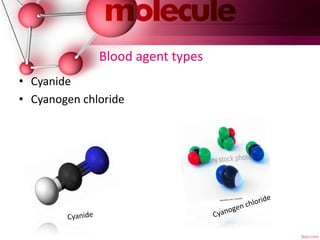
• Cyanide
• Cyanogen chloride
Composition
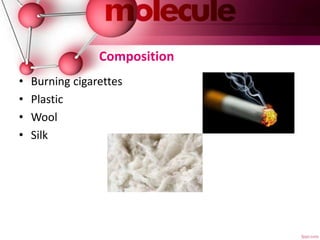
• Burning cigarettes
• Plastic
• Wool
• Silk
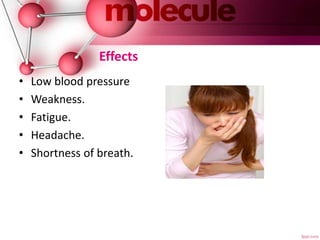
Effects
• Low blood pressure
• Weakness.
• Fatigue.
• Headache.
• Shortness of breath.
Choking Agents
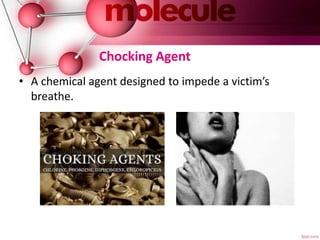
Chocking Agent
• A chemical agent designed to impede a victim’s
breathe.
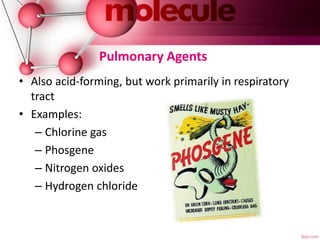
Pulmonary Agents
• Also acid-forming, but work primarily in respiratory
tract
• Examples:
– Chlorine gas
– Phosgene
– Nitrogen oxides
– Hydrogen chloride
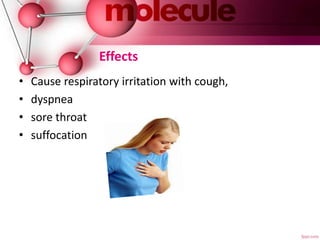
Effects
• Cause respiratory irritation with cough,
• dyspnea
• sore throat
• suffocation
Lethal agents
Lethal agents
• An agent capable of causing death
Types
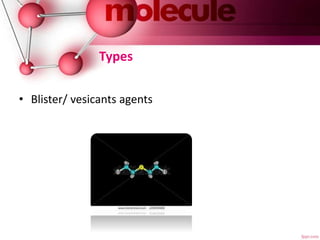
• Blister/ vesicants agents
Blisters/vesicants agents
• Acid-forming agents that affect mucous membranes
and skin; also respiratory tract
• Examples:
– Mustard gas
– Lewisite
Effects
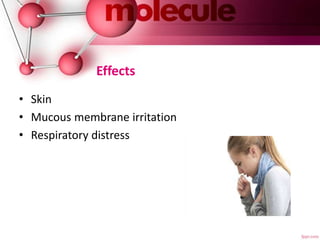
• Skin
• Mucous membrane irritation
• Respiratory distress
Protection Emergency
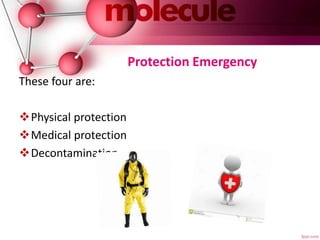
These four are:
Physical protection
Medical protection
Decontamination
Basic Initial management
Early pre-hospital decontamination
• Removal of infected cloth
• Immediately wash with water
• Shelter in place
• Focus on air patency
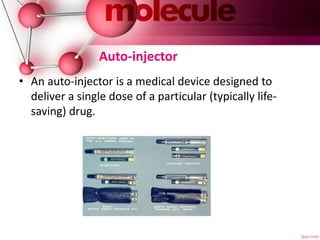
Auto-injector
• An auto-injector is a medical device designed to
deliver a single dose of a particular (typically life-
saving) drug.
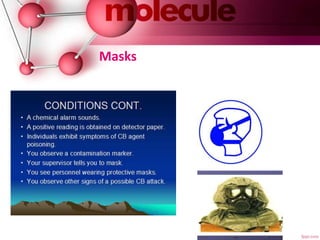
Masks
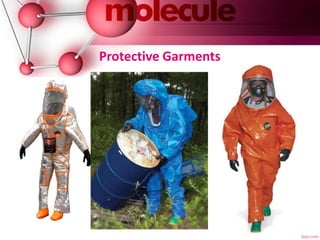
Protective Garments
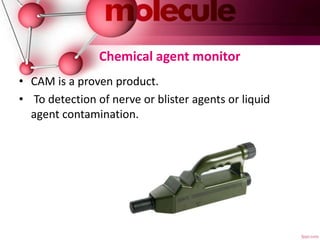
Chemical agent monitor
• CAM is a proven product.
• To detection of nerve or blister agents or liquid
agent contamination.
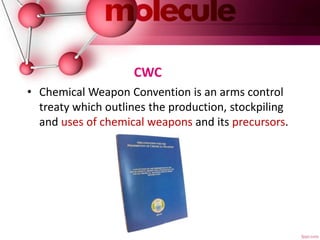
CWC
• Chemical Weapon Convention is an arms control
treaty which outlines the production, stockpiling
and uses of chemical weapons and its precursors.
References
• www.wekipidea.com
• www.linkedin.com
• www.quora.com
• www.thefreedictionary.com
• www.brtinnica.com
Compounds used in Warfare

Compounds used in Warfare