Control measures
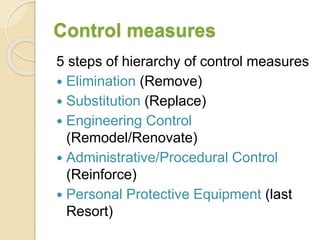
5 steps of hierarchy of control measures
 Elimination (Remove)
 Substitution (Replace)
 Engineering Control
(Remodel/Renovate)
 Administrative/Procedural Control
(Reinforce)
 Personal Protective Equipment (last
Resort)
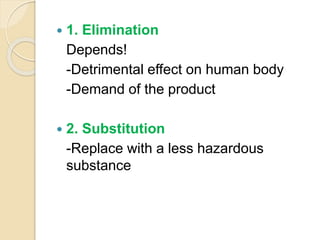
 1. Elimination
Depends!
-Detrimental effect on human body
-Demand of the product
 2. Substitution
-Replace with a less hazardous
substance
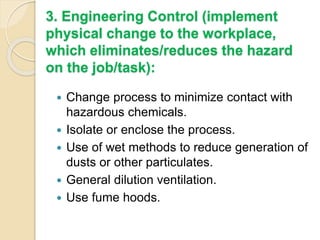
3. Engineering Control (implement
physical change to the workplace,
which eliminates/reduces the hazard
on the job/task):
 Change process to minimize contact with
hazardous chemicals.
 Isolate or enclose the process.
 Use of wet methods to reduce generation of
dusts or other particulates.
 General dilution ventilation.
 Use fume hoods.
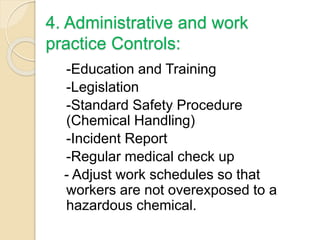
4. Administrative and work
practice Controls:
-Education and Training
-Legislation
-Standard Safety Procedure
(Chemical Handling)
-Incident Report
-Regular medical check up
- Adjust work schedules so that
workers are not overexposed to a
hazardous chemical.
 5. Personal Protective Equipment
(PPE):(use protection to reduce
exposure to risk factors)
Different types of chemical have
different use on each equipment
-Hand Gloves
-Face Guard/Mask
-Safety Apron/Safety Suit
-Rubber Boots
-Helmet ?
SCENARIO
You as an Occupational Health Nurse have been advised
to investigate an incident in the endoscopy unit. It was
reported that 10 healthcare workers have been suffering
from acute exacerbation of asthma for 3 days. It was
later identified that all affected HCWs were handling
Glutaraldehyde (Cidex) while disinfecting endoscopic
instruments.
(a) Describe how would you perform a worksite
assessment.
(b) Using the hierarchy of control measures, provide
recommendation in order to minimise the health
impact of Glutaraldehyde (Cidex)
WORKSITE ASSESSMENT
Walk through Survey
5 P’s (People, Premise, Process and
Product, Personal Protective
Equipment)
Specific Site
Specific Task
(the pattern of exposure, work
 Substitution
Replace Glutaraldehyde with a less toxic substance.
 Engineering Controls
Provide local exhaust ventilation such as laboratory
hood, large enough to contain the Glutaraldehyde
immersion system and an equipment washing and
rising sink at the source. The design should include a
face velocity at the hood with the airflow directed toward
the back of the hood away from the operator’s breathing
zone. This system will require an appropriate amount of
filtered and tempered replacement air in order to work
properly
Increase general room ventilation. This solution is
generally ineffective in controlling exposure due to
short-term tasks such as equipment cleaning or solution
changes that may generate a high concentration
contaminant quickly
Provide buckets and other containers
that are shaped to minimise the
surface area of the liquid.
Modify facility design to limit traffic or
potential exposure to individuals who
are not involved with the disinfection
process. Exposure to Glutaraldehyde
solutions in confined spaces should be
avoided
 Administrative controls
Reviewing work practices periodically in all areas
where Glutaraldehyde is used in order to prevent
overexposure. Communicate with other areas of
the hospital setting that use Glutaraldehyde such
as surgical department, emergency rooms,
intensive care unit or central sterile supply
department
Training and educating new and current healthcare
workers regarding safe work practices is
essential in reducing chemical exposure. All new
and current healthcare workers should be
instructed about the potential hazards associated
with Glutaraldehyde, proper use of protective
clothing, safe work practices, avoidance of
exposure in a confined space and personal
hygiene concerns. This would include education
regarding signs and symptoms associated with
overexposure to Glutaraldehyde
 Personal protective equipment
A written procedure detailing the type of
clothing and the proper use of protective
clothing should be provided to healthcare
workers involved in maintenance and
disinfecting medical instruments.
Proper gloves wear such as butyl rubber,
polyurethane or Viton could be use
Respirators or face mask are necessary when
the exposure to a chemical exceeds 0.1ppm.
Nevertheless, this should be known not as a
primary control since the availability of
engineering control and substitution of
chemical. Yet, this can still be use in non
routine maintenance or emergencies
(NIOSH, 2005).
Further Information
 http://www.worksafe.vic.gov.au
 http://www.westcoastdhb.org.nz
 http://www.ilo.org
 http://www.cdc.gov/niosh
 http://toxnet.nlm.nih.gov/

Chemical Hazards Control & Prevention.pptx

  • 1.
    Control measures 5 stepsof hierarchy of control measures  Elimination (Remove)  Substitution (Replace)  Engineering Control (Remodel/Renovate)  Administrative/Procedural Control (Reinforce)  Personal Protective Equipment (last Resort)
  • 2.
     1. Elimination Depends! -Detrimentaleffect on human body -Demand of the product  2. Substitution -Replace with a less hazardous substance
  • 3.
    3. Engineering Control(implement physical change to the workplace, which eliminates/reduces the hazard on the job/task):  Change process to minimize contact with hazardous chemicals.  Isolate or enclose the process.  Use of wet methods to reduce generation of dusts or other particulates.  General dilution ventilation.  Use fume hoods.
  • 4.
    4. Administrative andwork practice Controls: -Education and Training -Legislation -Standard Safety Procedure (Chemical Handling) -Incident Report -Regular medical check up - Adjust work schedules so that workers are not overexposed to a hazardous chemical.
  • 5.
     5. PersonalProtective Equipment (PPE):(use protection to reduce exposure to risk factors) Different types of chemical have different use on each equipment -Hand Gloves -Face Guard/Mask -Safety Apron/Safety Suit -Rubber Boots -Helmet ?
  • 6.
    SCENARIO You as anOccupational Health Nurse have been advised to investigate an incident in the endoscopy unit. It was reported that 10 healthcare workers have been suffering from acute exacerbation of asthma for 3 days. It was later identified that all affected HCWs were handling Glutaraldehyde (Cidex) while disinfecting endoscopic instruments. (a) Describe how would you perform a worksite assessment. (b) Using the hierarchy of control measures, provide recommendation in order to minimise the health impact of Glutaraldehyde (Cidex)
  • 7.
    WORKSITE ASSESSMENT Walk throughSurvey 5 P’s (People, Premise, Process and Product, Personal Protective Equipment) Specific Site Specific Task (the pattern of exposure, work
  • 8.
     Substitution Replace Glutaraldehydewith a less toxic substance.  Engineering Controls Provide local exhaust ventilation such as laboratory hood, large enough to contain the Glutaraldehyde immersion system and an equipment washing and rising sink at the source. The design should include a face velocity at the hood with the airflow directed toward the back of the hood away from the operator’s breathing zone. This system will require an appropriate amount of filtered and tempered replacement air in order to work properly Increase general room ventilation. This solution is generally ineffective in controlling exposure due to short-term tasks such as equipment cleaning or solution changes that may generate a high concentration contaminant quickly
  • 9.
    Provide buckets andother containers that are shaped to minimise the surface area of the liquid. Modify facility design to limit traffic or potential exposure to individuals who are not involved with the disinfection process. Exposure to Glutaraldehyde solutions in confined spaces should be avoided
  • 10.
     Administrative controls Reviewingwork practices periodically in all areas where Glutaraldehyde is used in order to prevent overexposure. Communicate with other areas of the hospital setting that use Glutaraldehyde such as surgical department, emergency rooms, intensive care unit or central sterile supply department Training and educating new and current healthcare workers regarding safe work practices is essential in reducing chemical exposure. All new and current healthcare workers should be instructed about the potential hazards associated with Glutaraldehyde, proper use of protective clothing, safe work practices, avoidance of exposure in a confined space and personal hygiene concerns. This would include education regarding signs and symptoms associated with overexposure to Glutaraldehyde
  • 11.
     Personal protectiveequipment A written procedure detailing the type of clothing and the proper use of protective clothing should be provided to healthcare workers involved in maintenance and disinfecting medical instruments. Proper gloves wear such as butyl rubber, polyurethane or Viton could be use Respirators or face mask are necessary when the exposure to a chemical exceeds 0.1ppm. Nevertheless, this should be known not as a primary control since the availability of engineering control and substitution of chemical. Yet, this can still be use in non routine maintenance or emergencies (NIOSH, 2005).
  • 12.
    Further Information  http://www.worksafe.vic.gov.au http://www.westcoastdhb.org.nz  http://www.ilo.org  http://www.cdc.gov/niosh  http://toxnet.nlm.nih.gov/