Chemical Comparison
   Of Hard Soaps
History Of Soap
• The exact moment that someone invented soap is not
  known. However, it is known that the Babylonians had
  soap in 2800 BC. We also know that soap was mentioned
  throughout history in a number of different writings.

• It is speculated that soap was discovered by washer
  women who did laundry in the Tiber River at the base of
  Sapo Hill in Rome. Sacrifices were made on Sapo Hill, so
  the rainwater running down the hill was rich in
  potassium hydroxide, derived from the potash in the
  ashes from the fires and animal fat from the sacrifices.
History Cont.
• during the 700’s soap making began to be a craft in some part
  of Europe. The benefits of soap were beginning to be
  recognized and soap spread across that continent.
• In the late 1700’s lye was produced and soap could be made
  by more people. The European settlers that came to the
  Americas brought a form of soap with them and continued to
  make soap once they arrived.
   – They took hot water and poured it over wood ashes. This
      created alkali potash which was boiled with animal fats.
      The soaps they made were often harsh and had a pungent
      odor.
History cont.
• By the 1800’s the soap industry was in full
  swing in North America. There are still some
  that choose to make their own soap as a
  hobby or to save money.
Uses
• Different people made soap for different tasks
  mainly for :
   – Washing clothes & pots
   – To form makeup
   – Bathing (Minor purpose)
• modern times, the use of soap has become
  universal in industrialized nations due to a better
  understanding of the role of hygiene in reducing
  the population size of pathogenic microorganisms
Alternatives to Soap

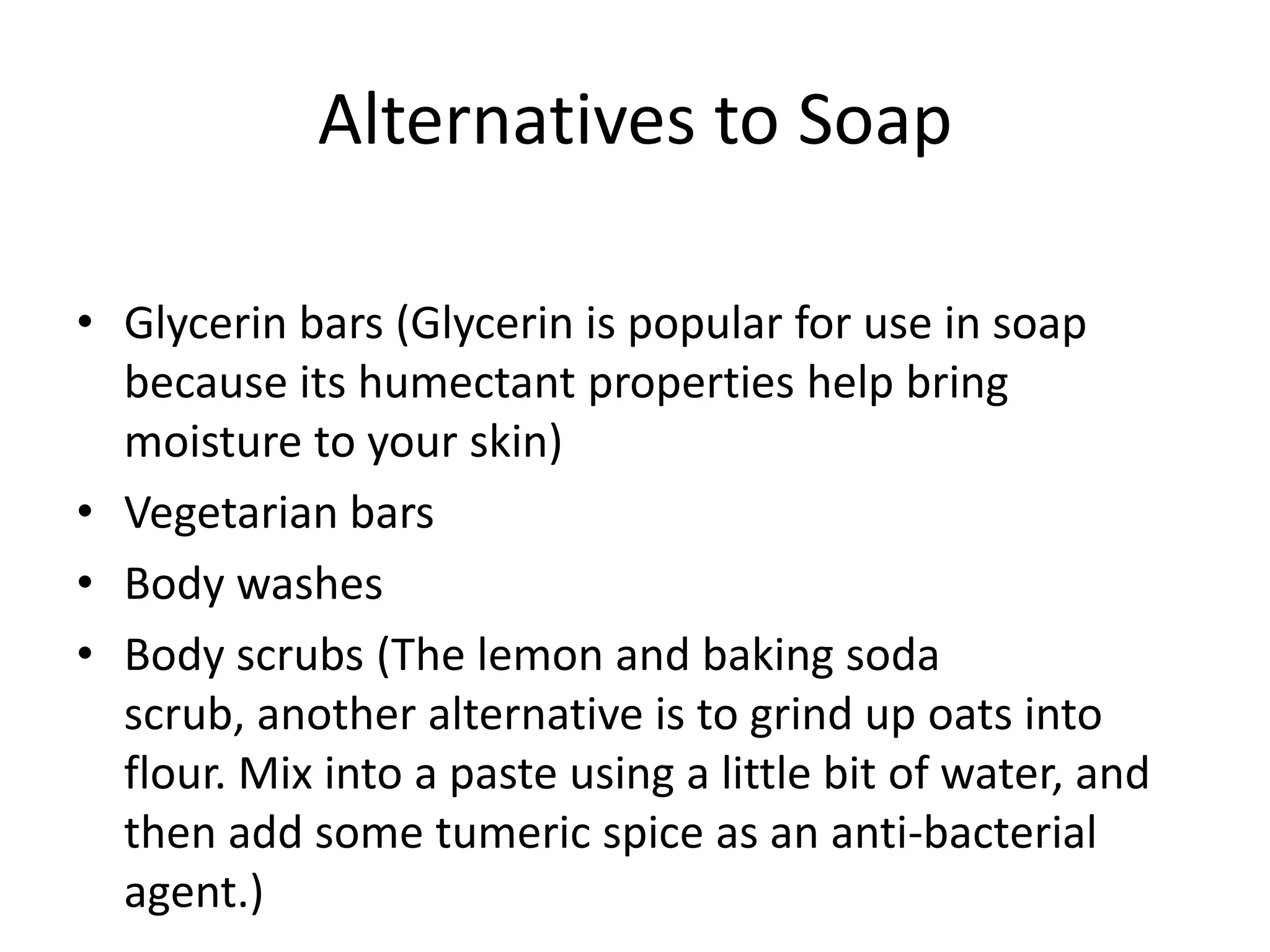
• Glycerin bars (Glycerin is popular for use in soap
  because its humectant properties help bring
  moisture to your skin)
• Vegetarian bars
• Body washes
• Body scrubs (The lemon and baking soda
  scrub, another alternative is to grind up oats into
  flour. Mix into a paste using a little bit of water, and
  then add some tumeric spice as an anti-bacterial
  agent.)
Chemical structure

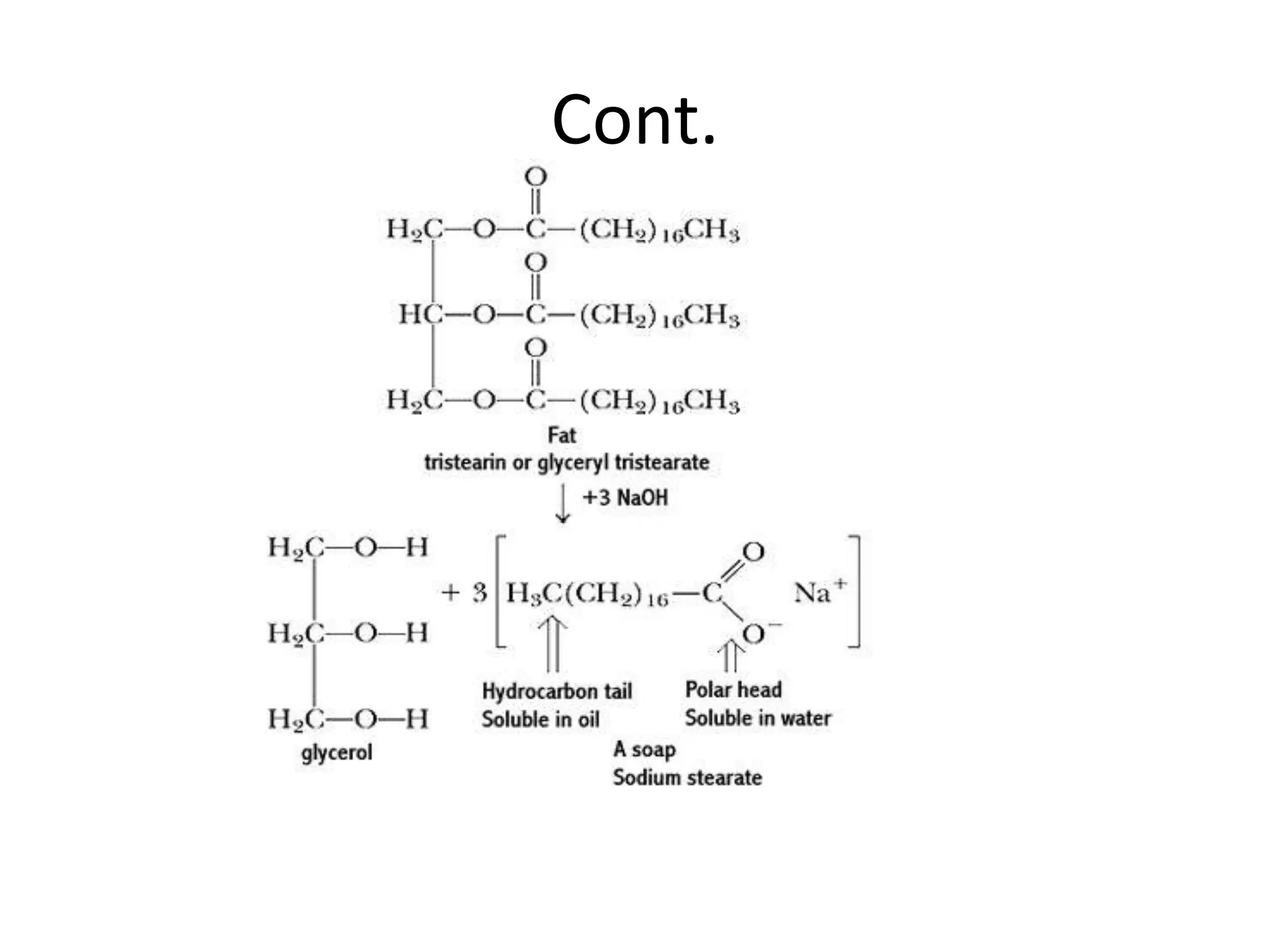
• Most soaps are soluble sodium or potassium salts of
  carboxylic acids. The most common commercial soap is
  sodium stearate, Na[C17H35CO2]. It dissolves in
  water, forming the sodium and stearate ions. Even though
  most of the stearate ion is a hydrocarbon chain, it dissolves in
  water because of the carboxylate group. The carboxylate end
  is called hydrophilic (water-loving), and the hydrocarbon tail is
  called hydrophobic (water-fearing).
Cont.
Product Comparison
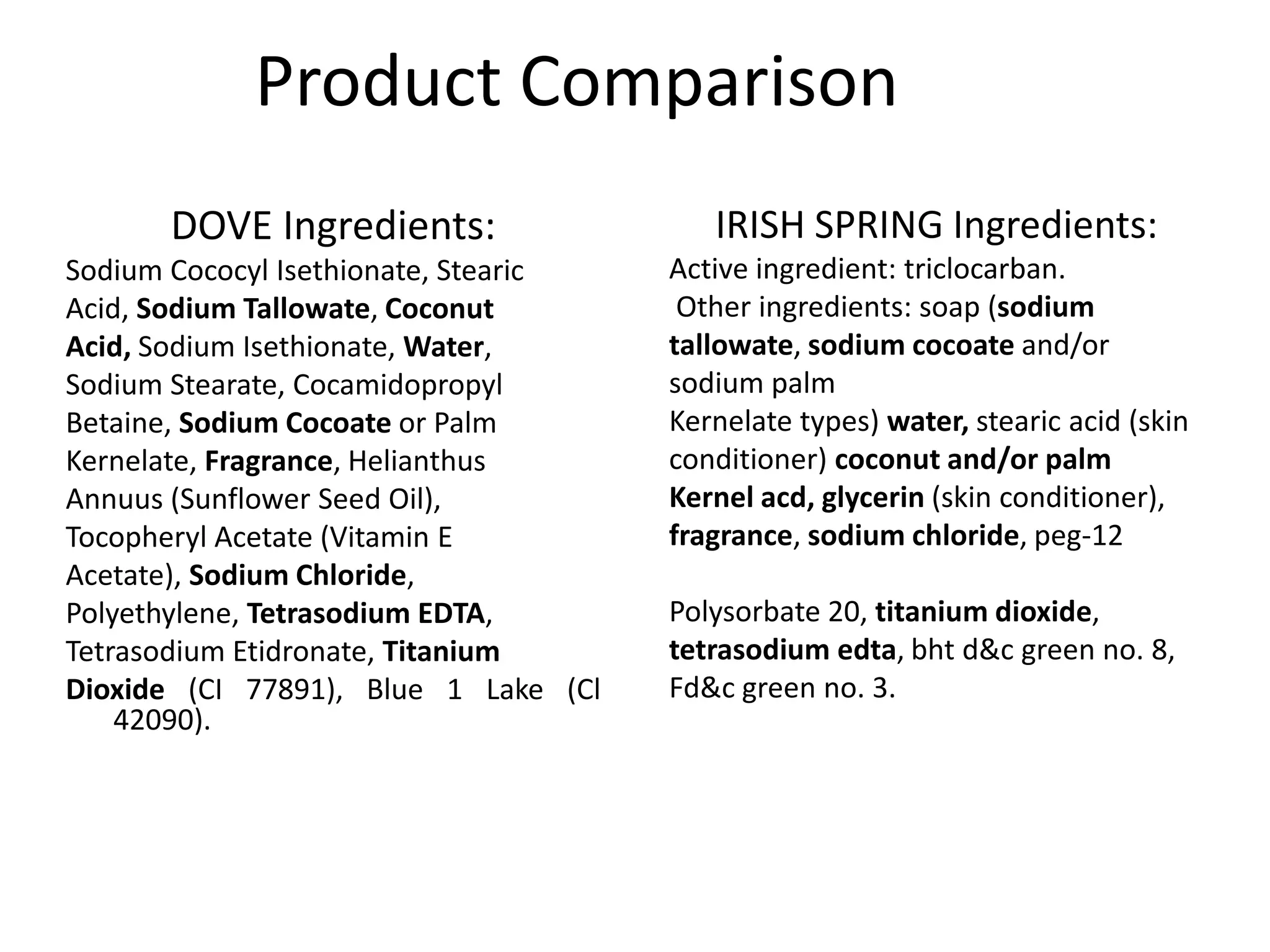
      DOVE Ingredients:                  IRISH SPRING Ingredients:
Sodium Cococyl Isethionate, Stearic   Active ingredient: triclocarban.
Acid, Sodium Tallowate, Coconut        Other ingredients: soap (sodium
Acid, Sodium Isethionate, Water,      tallowate, sodium cocoate and/or
Sodium Stearate, Cocamidopropyl       sodium palm
Betaine, Sodium Cocoate or Palm       Kernelate types) water, stearic acid (skin
Kernelate, Fragrance, Helianthus      conditioner) coconut and/or palm
Annuus (Sunflower Seed Oil),          Kernel acd, glycerin (skin conditioner),
Tocopheryl Acetate (Vitamin E         fragrance, sodium chloride, peg-12
Acetate), Sodium Chloride,
Polyethylene, Tetrasodium EDTA,       Polysorbate 20, titanium dioxide,
Tetrasodium Etidronate, Titanium      tetrasodium edta, bht d&c green no. 8,
Dioxide (CI 77891), Blue 1 Lake (Cl   Fd&c green no. 3.
    42090).
Product Comparison Cont.
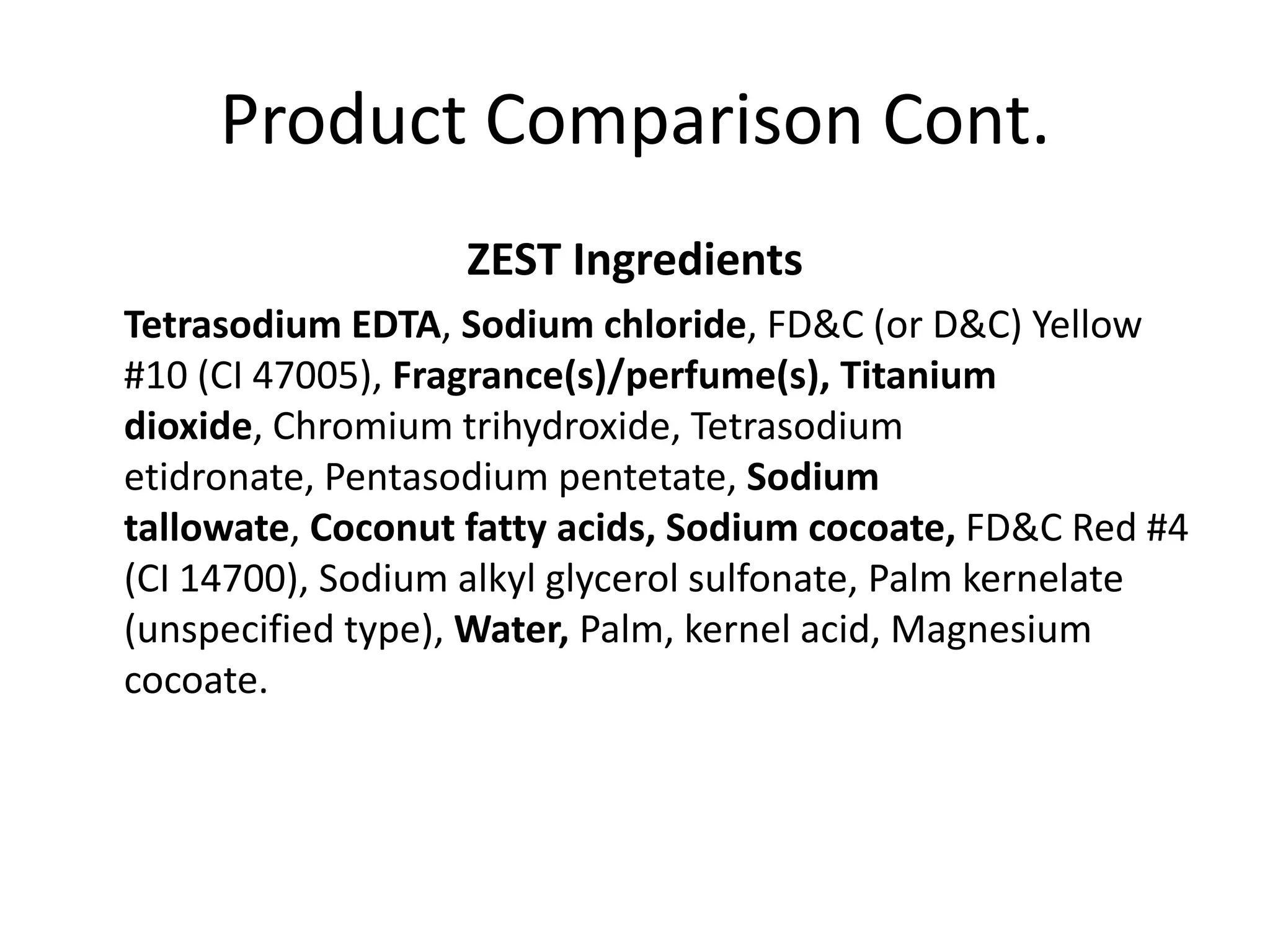
                  ZEST Ingredients
Tetrasodium EDTA, Sodium chloride, FD&C (or D&C) Yellow
#10 (CI 47005), Fragrance(s)/perfume(s), Titanium
dioxide, Chromium trihydroxide, Tetrasodium
etidronate, Pentasodium pentetate, Sodium
tallowate, Coconut fatty acids, Sodium cocoate, FD&C Red #4
(CI 14700), Sodium alkyl glycerol sulfonate, Palm kernelate
(unspecified type), Water, Palm, kernel acid, Magnesium
cocoate.
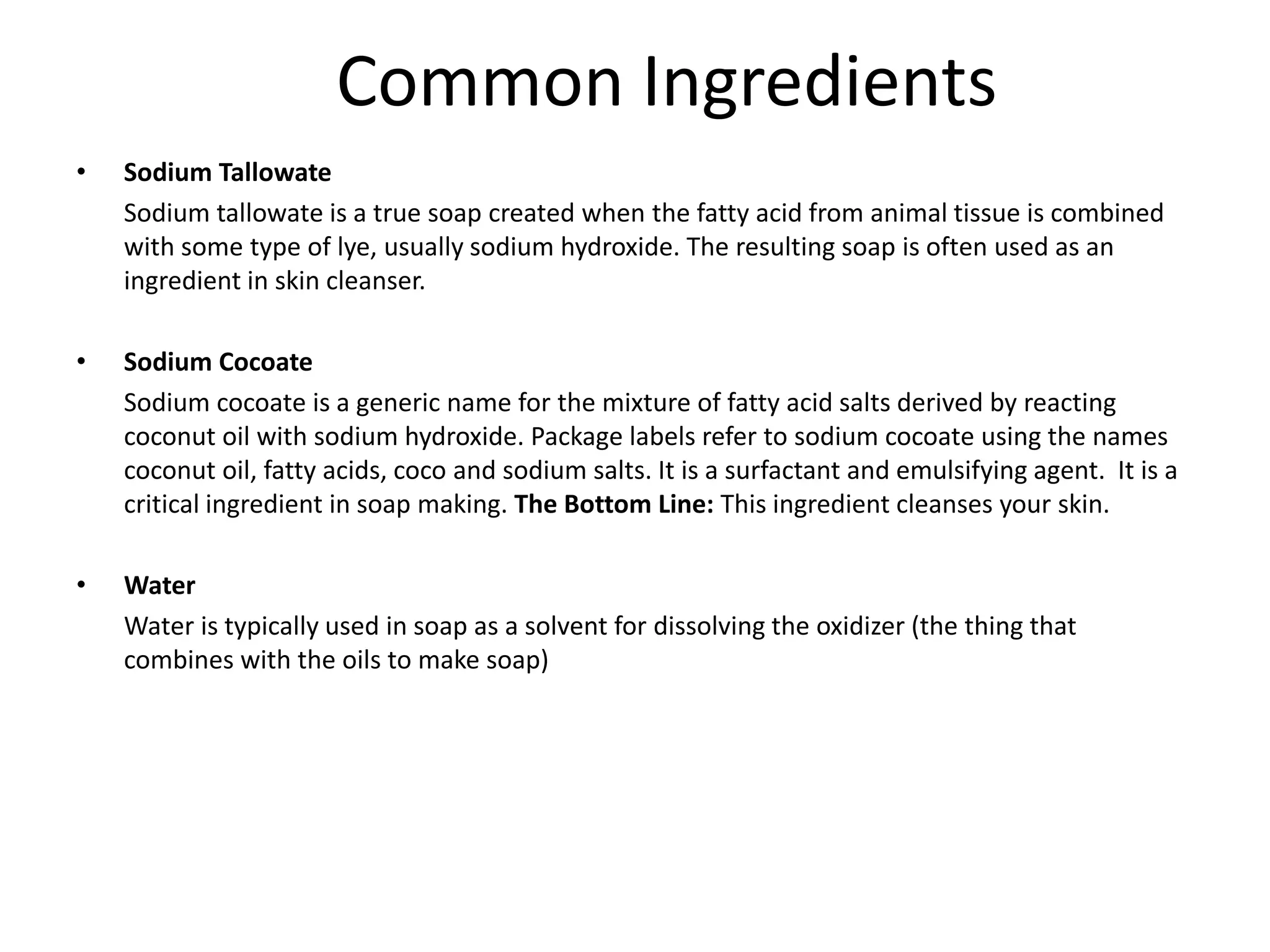
Common Ingredients
•   Sodium Tallowate
    Sodium tallowate is a true soap created when the fatty acid from animal tissue is combined
    with some type of lye, usually sodium hydroxide. The resulting soap is often used as an
    ingredient in skin cleanser.

•   Sodium Cocoate
    Sodium cocoate is a generic name for the mixture of fatty acid salts derived by reacting
    coconut oil with sodium hydroxide. Package labels refer to sodium cocoate using the names
    coconut oil, fatty acids, coco and sodium salts. It is a surfactant and emulsifying agent. It is a
    critical ingredient in soap making. The Bottom Line: This ingredient cleanses your skin.

•   Water
    Water is typically used in soap as a solvent for dissolving the oxidizer (the thing that
    combines with the oils to make soap)
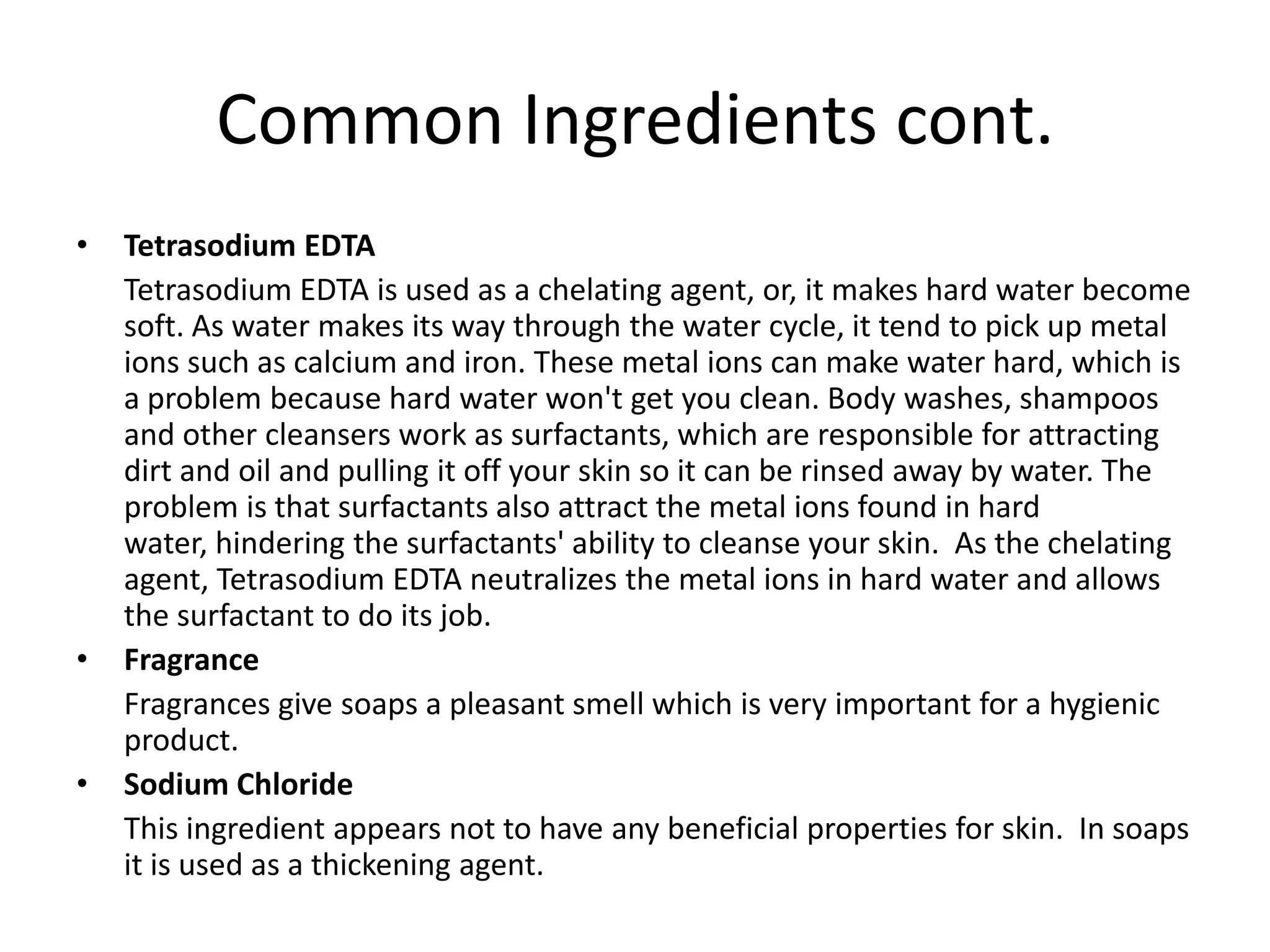
Common Ingredients cont.
•   Tetrasodium EDTA
    Tetrasodium EDTA is used as a chelating agent, or, it makes hard water become
    soft. As water makes its way through the water cycle, it tend to pick up metal
    ions such as calcium and iron. These metal ions can make water hard, which is
    a problem because hard water won't get you clean. Body washes, shampoos
    and other cleansers work as surfactants, which are responsible for attracting
    dirt and oil and pulling it off your skin so it can be rinsed away by water. The
    problem is that surfactants also attract the metal ions found in hard
    water, hindering the surfactants' ability to cleanse your skin. As the chelating
    agent, Tetrasodium EDTA neutralizes the metal ions in hard water and allows
    the surfactant to do its job.
•   Fragrance
    Fragrances give soaps a pleasant smell which is very important for a hygienic
    product.
•   Sodium Chloride
    This ingredient appears not to have any beneficial properties for skin. In soaps
    it is used as a thickening agent.
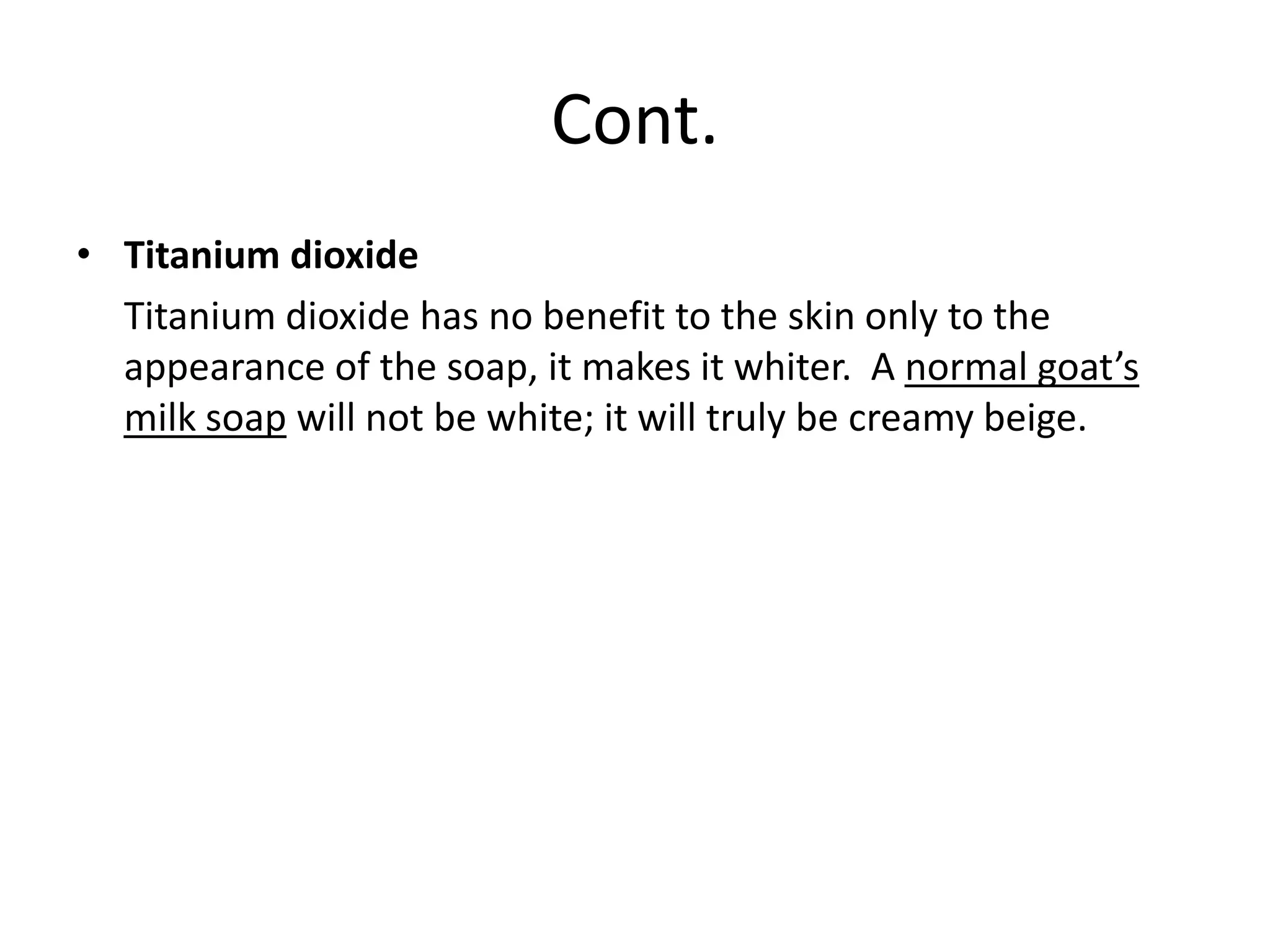
Cont.
• Titanium dioxide
  Titanium dioxide has no benefit to the skin only to the
  appearance of the soap, it makes it whiter. A normal goat’s
  milk soap will not be white; it will truly be creamy beige.
Cost Comparison
1 bar Dove - $3.25
1 bar Irish spring - $1.49
1 bar Zest - $1.59

• Research has shown that the most expensive ingredients in
  the soap bars are the essential and natural oils.
• The ingredient listing on the Dove bar shows that the bar
  contains more oils than both contenders, making it pricier.
  We can also see, that Zest has a minute, but acceptable
  amount of oils.
• Irish Spring however has no extra oils than those shared
  among the three.
Performance
• The dove white soap bar contains ¼ pure moisturizing cream.
   – This proves to be true as the bar leaves skin clean, soft and
     smooth. Dove, however is the most costly of the three.

• The motto for the Irish Spring Original soap bar is “Fresh
  without the frills, for a classic clean”.
   – This bar is all clean and no moisture.
   – It contains drying ingredients that strip skin of its natural
     moisture, leaving it feeling dry and tight. This may
     contribute significantly to its low price.
Performance

• Zest bar soap has a few cons that we noticed when using the product.
   – The bar dissolves very quickly under water and finishes quicker than
      its contenders.
   – The bar has nothing special about it. It does not have moisturizing
      properties like the Dove bar and it does not have a fresh scent like the
      Irish Spring bar
Environmental & Health Concerns
• It is surprising that the product we use to wash our bodies
  and keep it clean could actually cause much damage to not
  only the environment and aquatic systems, but also to our
  own skin.
• Most commercial soaps contain harsh chemical additives to
  make them lather properly.
   – They contain perfumes and fragrances that are known to cause
     irritation in some people.
   – These sweet smelling fragrances are not extracted from natural
     sources like flowers; they are produced chemically using cancer-
     causing chemicals.
   – Studies have also shown that some of the chemicals used in soap
     fragrances can cause skin diseases, birth defects and even liver
     damage in animal testing.
Cont.
• Soaps hold their bar-like shape because of
  ingredients like animal tallow, paraffin wax
  and other crude oil derivatives.
• Other problem: is that those same chemicals
  run down our drains and into our water
  systems. Disrupting the marine eco system
  and the bacterial breakdown required for a
  functional sewage system.
Conclusion & Findings
• Based on our research we can conclude that the best soap is determined
  by one’s preference. You may have a preference for a high quality
  moisturizing soap bar and unconcerned about its price, then the Dove
  soap bar would be an ideal choice. If you have a preference for highly
  fragrant soap bars and is unconcerned about moisture, then the Irish
  Spring soap bar is for you.

•    If you are simply in search of a low cost, light smelling soap, then Zest bar
    soap is ideal for you. If you are an environmental and health conscious
    individual, I would say that no form of hard soap is ideal for you as most of
    them have trace amounts of toxic chemicals. You may want to know why
    hard soaps are still so popular despite their many flaws.
Cont.
• The answer is simple; tradition. Hard soaps have been
  around for centuries and they are all some people come to
  know. They are usually cheaper than their alternatives and
  information about their health and environmental concerns
  are not accessible to individuals from all walks of life.
Thanks for Your Attention!!

Chemical comparison ppt

  • 1.
    Chemical Comparison Of Hard Soaps
  • 2.
    History Of Soap •The exact moment that someone invented soap is not known. However, it is known that the Babylonians had soap in 2800 BC. We also know that soap was mentioned throughout history in a number of different writings. • It is speculated that soap was discovered by washer women who did laundry in the Tiber River at the base of Sapo Hill in Rome. Sacrifices were made on Sapo Hill, so the rainwater running down the hill was rich in potassium hydroxide, derived from the potash in the ashes from the fires and animal fat from the sacrifices.
  • 3.
    History Cont. • duringthe 700’s soap making began to be a craft in some part of Europe. The benefits of soap were beginning to be recognized and soap spread across that continent. • In the late 1700’s lye was produced and soap could be made by more people. The European settlers that came to the Americas brought a form of soap with them and continued to make soap once they arrived. – They took hot water and poured it over wood ashes. This created alkali potash which was boiled with animal fats. The soaps they made were often harsh and had a pungent odor.
  • 4.
    History cont. • Bythe 1800’s the soap industry was in full swing in North America. There are still some that choose to make their own soap as a hobby or to save money.
  • 5.
    Uses • Different peoplemade soap for different tasks mainly for : – Washing clothes & pots – To form makeup – Bathing (Minor purpose) • modern times, the use of soap has become universal in industrialized nations due to a better understanding of the role of hygiene in reducing the population size of pathogenic microorganisms
  • 6.
    Alternatives to Soap •Glycerin bars (Glycerin is popular for use in soap because its humectant properties help bring moisture to your skin) • Vegetarian bars • Body washes • Body scrubs (The lemon and baking soda scrub, another alternative is to grind up oats into flour. Mix into a paste using a little bit of water, and then add some tumeric spice as an anti-bacterial agent.)
  • 7.
    Chemical structure • Mostsoaps are soluble sodium or potassium salts of carboxylic acids. The most common commercial soap is sodium stearate, Na[C17H35CO2]. It dissolves in water, forming the sodium and stearate ions. Even though most of the stearate ion is a hydrocarbon chain, it dissolves in water because of the carboxylate group. The carboxylate end is called hydrophilic (water-loving), and the hydrocarbon tail is called hydrophobic (water-fearing).
  • 8.
  • 9.
    Product Comparison DOVE Ingredients: IRISH SPRING Ingredients: Sodium Cococyl Isethionate, Stearic Active ingredient: triclocarban. Acid, Sodium Tallowate, Coconut Other ingredients: soap (sodium Acid, Sodium Isethionate, Water, tallowate, sodium cocoate and/or Sodium Stearate, Cocamidopropyl sodium palm Betaine, Sodium Cocoate or Palm Kernelate types) water, stearic acid (skin Kernelate, Fragrance, Helianthus conditioner) coconut and/or palm Annuus (Sunflower Seed Oil), Kernel acd, glycerin (skin conditioner), Tocopheryl Acetate (Vitamin E fragrance, sodium chloride, peg-12 Acetate), Sodium Chloride, Polyethylene, Tetrasodium EDTA, Polysorbate 20, titanium dioxide, Tetrasodium Etidronate, Titanium tetrasodium edta, bht d&c green no. 8, Dioxide (CI 77891), Blue 1 Lake (Cl Fd&c green no. 3. 42090).
  • 10.
    Product Comparison Cont. ZEST Ingredients Tetrasodium EDTA, Sodium chloride, FD&C (or D&C) Yellow #10 (CI 47005), Fragrance(s)/perfume(s), Titanium dioxide, Chromium trihydroxide, Tetrasodium etidronate, Pentasodium pentetate, Sodium tallowate, Coconut fatty acids, Sodium cocoate, FD&C Red #4 (CI 14700), Sodium alkyl glycerol sulfonate, Palm kernelate (unspecified type), Water, Palm, kernel acid, Magnesium cocoate.
  • 11.
    Common Ingredients • Sodium Tallowate Sodium tallowate is a true soap created when the fatty acid from animal tissue is combined with some type of lye, usually sodium hydroxide. The resulting soap is often used as an ingredient in skin cleanser. • Sodium Cocoate Sodium cocoate is a generic name for the mixture of fatty acid salts derived by reacting coconut oil with sodium hydroxide. Package labels refer to sodium cocoate using the names coconut oil, fatty acids, coco and sodium salts. It is a surfactant and emulsifying agent. It is a critical ingredient in soap making. The Bottom Line: This ingredient cleanses your skin. • Water Water is typically used in soap as a solvent for dissolving the oxidizer (the thing that combines with the oils to make soap)
  • 12.
    Common Ingredients cont. • Tetrasodium EDTA Tetrasodium EDTA is used as a chelating agent, or, it makes hard water become soft. As water makes its way through the water cycle, it tend to pick up metal ions such as calcium and iron. These metal ions can make water hard, which is a problem because hard water won't get you clean. Body washes, shampoos and other cleansers work as surfactants, which are responsible for attracting dirt and oil and pulling it off your skin so it can be rinsed away by water. The problem is that surfactants also attract the metal ions found in hard water, hindering the surfactants' ability to cleanse your skin. As the chelating agent, Tetrasodium EDTA neutralizes the metal ions in hard water and allows the surfactant to do its job. • Fragrance Fragrances give soaps a pleasant smell which is very important for a hygienic product. • Sodium Chloride This ingredient appears not to have any beneficial properties for skin. In soaps it is used as a thickening agent.
  • 13.
    Cont. • Titanium dioxide Titanium dioxide has no benefit to the skin only to the appearance of the soap, it makes it whiter. A normal goat’s milk soap will not be white; it will truly be creamy beige.
  • 14.
    Cost Comparison 1 barDove - $3.25 1 bar Irish spring - $1.49 1 bar Zest - $1.59 • Research has shown that the most expensive ingredients in the soap bars are the essential and natural oils. • The ingredient listing on the Dove bar shows that the bar contains more oils than both contenders, making it pricier. We can also see, that Zest has a minute, but acceptable amount of oils. • Irish Spring however has no extra oils than those shared among the three.
  • 15.
    Performance • The dovewhite soap bar contains ¼ pure moisturizing cream. – This proves to be true as the bar leaves skin clean, soft and smooth. Dove, however is the most costly of the three. • The motto for the Irish Spring Original soap bar is “Fresh without the frills, for a classic clean”. – This bar is all clean and no moisture. – It contains drying ingredients that strip skin of its natural moisture, leaving it feeling dry and tight. This may contribute significantly to its low price.
  • 16.
    Performance • Zest barsoap has a few cons that we noticed when using the product. – The bar dissolves very quickly under water and finishes quicker than its contenders. – The bar has nothing special about it. It does not have moisturizing properties like the Dove bar and it does not have a fresh scent like the Irish Spring bar
  • 17.
    Environmental & HealthConcerns • It is surprising that the product we use to wash our bodies and keep it clean could actually cause much damage to not only the environment and aquatic systems, but also to our own skin. • Most commercial soaps contain harsh chemical additives to make them lather properly. – They contain perfumes and fragrances that are known to cause irritation in some people. – These sweet smelling fragrances are not extracted from natural sources like flowers; they are produced chemically using cancer- causing chemicals. – Studies have also shown that some of the chemicals used in soap fragrances can cause skin diseases, birth defects and even liver damage in animal testing.
  • 18.
    Cont. • Soaps holdtheir bar-like shape because of ingredients like animal tallow, paraffin wax and other crude oil derivatives. • Other problem: is that those same chemicals run down our drains and into our water systems. Disrupting the marine eco system and the bacterial breakdown required for a functional sewage system.
  • 19.
    Conclusion & Findings •Based on our research we can conclude that the best soap is determined by one’s preference. You may have a preference for a high quality moisturizing soap bar and unconcerned about its price, then the Dove soap bar would be an ideal choice. If you have a preference for highly fragrant soap bars and is unconcerned about moisture, then the Irish Spring soap bar is for you. • If you are simply in search of a low cost, light smelling soap, then Zest bar soap is ideal for you. If you are an environmental and health conscious individual, I would say that no form of hard soap is ideal for you as most of them have trace amounts of toxic chemicals. You may want to know why hard soaps are still so popular despite their many flaws.
  • 20.
    Cont. • The answeris simple; tradition. Hard soaps have been around for centuries and they are all some people come to know. They are usually cheaper than their alternatives and information about their health and environmental concerns are not accessible to individuals from all walks of life.
  • 21.
    Thanks for YourAttention!!