Charting And Technical
Analysis
FINDING FUTURE IN THE PAST
What is Technical analysis?
 The technical analysis concentrates on the

movement of share prices.
 Also the analysis believes by examine past price
movements future share prices can be can be
accurately predicted.
 The basic premise of technical analysis is that price
moves in trends or waves which may be upward or
downward.
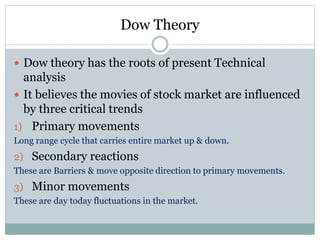
Dow Theory
 Dow theory has the roots of present Technical

analysis
 It believes the movies of stock market are influenced
by three critical trends
1) Primary movements
Long range cycle that carries entire market up & down.

2) Secondary reactions
These are Barriers & move opposite direction to primary movements.

3) Minor movements
These are day today fluctuations in the market.
Dow theory
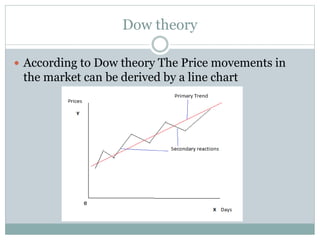
 According to Dow theory The Price movements in

the market can be derived by a line chart
Basic principles of Technical Analysis
 The market value of a security is related to demand

and supply factors in the market.
 Security prices move same direction for some length
of time.
 Stock prices have been seen to change when there is
a change in demand and supply factors.
 Shifts of demand and supply can be detected through
charts
Types of charts using in Technical analysis
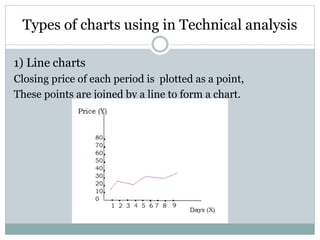
1) Line charts
Closing price of each period is plotted as a point,
These points are joined by a line to form a chart.
Types of charts using in Technical analysis
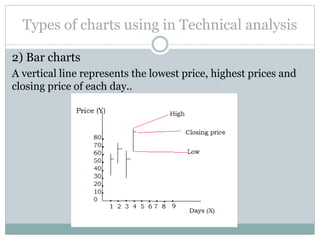
2) Bar charts
A vertical line represents the lowest price, highest prices and
closing price of each day..
Types of charts using in Technical analysis
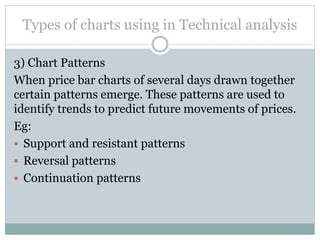
3) Chart Patterns
When price bar charts of several days drawn together
certain patterns emerge. These patterns are used to
identify trends to predict future movements of prices.
Eg:
 Support and resistant patterns
 Reversal patterns
 Continuation patterns
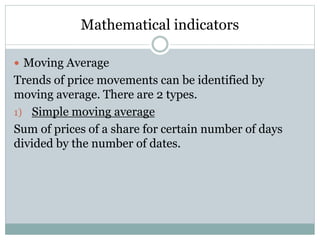
Mathematical indicators
 Moving Average

Trends of price movements can be identified by
moving average. There are 2 types.
1) Simple moving average
Sum of prices of a share for certain number of days
divided by the number of dates.
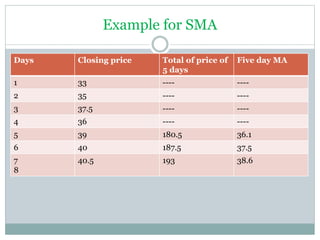
Example for SMA
Days

Closing price

Total of price of
5 days

Five day MA

1

33

----

----

2

35

----

----

3

37.5

----

----

4

36

----

----

5

39

180.5

36.1

6

40

187.5

37.5

7
8

40.5

193

38.6
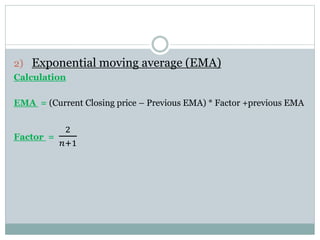
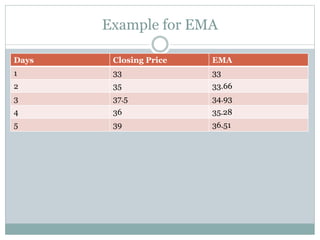
2) Exponential moving average (EMA)
Calculation
EMA = (Current Closing price – Previous EMA) * Factor +previous EMA

2
Factor =
𝑛+1
Example for EMA
Days

Closing Price

EMA

1

33

33

2

35

33.66

3

37.5

34.93

4

36

35.28

5

39

36.51

Charting and technical analysis

  • 1.
  • 2.
    What is Technicalanalysis?  The technical analysis concentrates on the movement of share prices.  Also the analysis believes by examine past price movements future share prices can be can be accurately predicted.  The basic premise of technical analysis is that price moves in trends or waves which may be upward or downward.
  • 3.
    Dow Theory  Dowtheory has the roots of present Technical analysis  It believes the movies of stock market are influenced by three critical trends 1) Primary movements Long range cycle that carries entire market up & down. 2) Secondary reactions These are Barriers & move opposite direction to primary movements. 3) Minor movements These are day today fluctuations in the market.
  • 4.
    Dow theory  Accordingto Dow theory The Price movements in the market can be derived by a line chart
  • 5.
    Basic principles ofTechnical Analysis  The market value of a security is related to demand and supply factors in the market.  Security prices move same direction for some length of time.  Stock prices have been seen to change when there is a change in demand and supply factors.  Shifts of demand and supply can be detected through charts
  • 6.
    Types of chartsusing in Technical analysis 1) Line charts Closing price of each period is plotted as a point, These points are joined by a line to form a chart.
  • 7.
    Types of chartsusing in Technical analysis 2) Bar charts A vertical line represents the lowest price, highest prices and closing price of each day..
  • 8.
    Types of chartsusing in Technical analysis 3) Chart Patterns When price bar charts of several days drawn together certain patterns emerge. These patterns are used to identify trends to predict future movements of prices. Eg:  Support and resistant patterns  Reversal patterns  Continuation patterns
  • 9.
    Mathematical indicators  MovingAverage Trends of price movements can be identified by moving average. There are 2 types. 1) Simple moving average Sum of prices of a share for certain number of days divided by the number of dates.
  • 10.
    Example for SMA Days Closingprice Total of price of 5 days Five day MA 1 33 ---- ---- 2 35 ---- ---- 3 37.5 ---- ---- 4 36 ---- ---- 5 39 180.5 36.1 6 40 187.5 37.5 7 8 40.5 193 38.6
  • 11.
    2) Exponential movingaverage (EMA) Calculation EMA = (Current Closing price – Previous EMA) * Factor +previous EMA 2 Factor = 𝑛+1
  • 12.
    Example for EMA Days ClosingPrice EMA 1 33 33 2 35 33.66 3 37.5 34.93 4 36 35.28 5 39 36.51