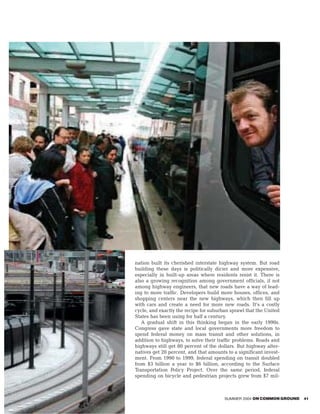
he type of planning and community development

                                   T      described by the term Smart Growth continues to evolve.
                                          When the term was first introduced in the mid-1990s,
                                   Smart Growth’s focus was on reducing or mitigating the envi-
                                   ronmental degradation brought by development—consumption
                                   of land and the accompanying negative effects of degraded
                                   water and air quality and loss of natural lands, wildlife, and
                                   farmland. The term’s early use also encompassed the need to
                                   provide adequate infrastructure to handle growth’s demands
                                   and address concerns such as traffic congestion.
                                      Subsequently, Smart Growth’s vision has expanded to con-
                                   sider new models of how to rebuild (or build) communities to
                                   be better places. This refined vision now includes alternative
                                   transportation options (including transit and walking), the cre-
                                   ation of “walkable,” mixed-use communities, and the revital-
                                   ization of older neighborhoods and cities. From the beginning,
                                   the NATIONAL ASSOCIATION OF REALTORS®’ definition of
                                   Smart Growth included the provision of a wide range of hous-
                                   ing options and prices, and this element has been embraced by
                                   Smart Growth advocates.


                    MEASURING
                    Today’s Smart Growth


2
                    SUCCESS
    ON COMMON GROUND SUMMER 2004
Now there is an increasing recognition that Smart
Growth must address the need for social equity in our
communities. This means creating safer, healthier,
more livable communities for all members of our com-
munities, and embracing the full range of our diverse
population in the benefits of Smart Growth, including
homeownership.
    Are these expanding goals for Smart Growth being
achieved? The scorecard is mixed. There has been
significant achievement since the late 1990s in the
preservation of natural lands and agricultural lands
through a variety of mechanisms, including public
purchase, land trust stewardship, and the use of pur-
chase or transfer of development rights. Transit rider-                                               Mithun Design
ship is increasing, and many communities are invest-                                            photo: Michael Seidl
ing in new transit systems. The downtowns of many
major cities have been revived, and growth in these
cities has included significant residential develop-      For more information on NAR and Smart Growth,
ment. Some jurisdictions are rewriting their zoning       go to www.realtor.org/smartgrowth.
codes to permit and encourage more compact, mixed-
use development, and these projects are doing very        On Common Ground is published twice a year by
well in the marketplace.                                  the Government Affairs office of the
    But in most places, zoning still makes Smart          NATIONAL ASSOCIATION OF REALTORS®, and
Growth development illegal, and the amount of             is distributed free of charge. The publication pres-
development that could be called Smart Growth is a        ents a wide range of views on Smart Growth
small portion of what is being built. Low-density sub-    issues, with the goal of encouraging a dialogue
urbs that require the use of a car to go everywhere are   among REALTORS®, elected officials, and other
still the norm (and still required by most zoning         interested citizens. The opinions expressed in On
codes), and attempts to integrate different housing
                                                          Common Ground are those of the authors and do
types and prices are usually opposed. While home-
                                                          not necessarily reflect the opinions or policy of the
ownership rates are at an all-time high, housing
opportunities for low-income households are dwin-         NATIONAL ASSOCIATION OF REALTORS®, its
dling, especially in revitalized high-cost cities. And    members, or affiliate organizations.
while some older cities flourish, others—especially
those whose economies were based on manufactur-           Editor
ing—are stagnating or declining.                          Joseph R. Molinaro
    In this issue of On Common Ground, we take a          Manager, Smart Growth Programs
wide-view scan of the State of Smart Growth—what’s        NATIONAL ASSOCIATION OF REALTORS®
working and what challenges remain. We report on          700 Eleventh Street, NW
efforts to measure and promote Smart Growth, zoning       Washington, DC 20001
codes that encourage Smart Growth, and some of the        jmolinaro@realtors.org
REALTORS® who have embraced Smart Growth in
their business plans and in their associations’ public    Distribution
policy efforts.                                           For more copies of this issue or to be placed on our
                                                          mailing list for future issues of
                                                          On Common Ground, please contact
                                                          Ted Wright, NAR Government Affairs, at
                                                          (202) 383-1206 or twright@realtors.org.


                                                                       SUMMER 2004 ON COMMON GROUND           3
Communities are learning
                                   to build compactly by mixing
                                   housing, stores, and offices …
                                   but outmoded zoning and other
                                   obstacles must be overcome.


The LongRoad to


4   ON COMMON GROUND SUMMER 2004
n the Internet, the

   O       Census Bureau operates
           a “population clock” that
   gives an up-to-the-minute esti-
   mate of how people are living in
   the United States (www.census.
   gov/cgi-bin/popclock). On April
   15, the clock counted 293,026,388
   people on U.S. soil—140 million
   more than in 1950. Every 13 sec-
   onds another person is added.
      This near-doubling of the
   nation’s population in a little
   more than half a century—
   compounded by the tendency of
   Americans to demand more liv-
   ing space per person, drive more
   miles per person, and consume
   more goods per person than they
   did in 1950—is forcing policy
   makers to face an important
   question: How should our com-
   munities grow?


Smart Growth                                                        By Philip Langdon
      In the 1,000-square-mile Highlands region that stretches from eastern
   Pennsylvania across northern New Jersey to New York’s lower Hudson Valley and
   northwestern Connecticut, nearly 100 square miles have undergone development
   during the past two decades. The spread of houses, roads, offices, and shopping
   centers has exerted a mostly harmful impact on agriculture, wildlife, and sources
   of fresh drinking water. Meanwhile, in the Rocky Mountains and the Far West,
   development is penetrating areas that used to be far off the beaten path. In much
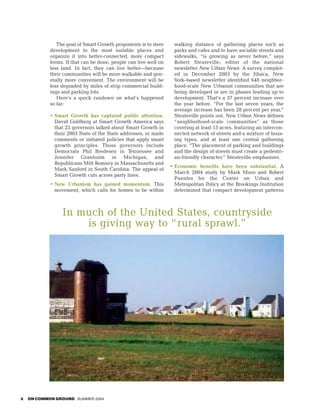
   of the United States, countryside is giving way to “rural sprawl.”
      What’s the answer? Part of it can be summed up in two words: Smart Growth.
   “Smart Growth first and foremost is plain old good planning,” says Don Chen,
   executive director of the national advocacy group Smart Growth America. “It
   means improving on what we’ve already built, rather than throwing away old
   neighborhoods and leaving scars in the landscape so that we go chew up the next
   field or forest.”


                                                            SUMMER 2004 ON COMMON GROUND   5
The goal of Smart Growth proponents is to steer     walking distance of gathering places such as
            development to the most suitable places and            parks and cafes and to have sociable streets and
            organize it into better-connected, more compact        sidewalks, “is growing as never before,” says
            forms. If that can be done, people can live well on    Robert Steuteville, editor of the national
            less land. In fact, they can live better—because       newsletter New Urban News. A survey complet-
            their communities will be more walkable and gen-       ed in December 2003 by the Ithaca, New
            erally more convenient. The environment will be        York–based newsletter identified 648 neighbor-
            less degraded by miles of strip commercial build-      hood-scale New Urbanist communities that are
            ings and parking lots.                                 being developed or are in phases leading up to
               Here’s a quick rundown on what’s happened           development. That’s a 37 percent increase over
            so far:                                                the year before. “For the last seven years, the
                                                                   average increase has been 28 percent per year,”
            • Smart Growth has captured public attention.          Steuteville points out. New Urban News defines
              David Goldberg at Smart Growth America says          “neighborhood-scale communities” as those
              that 23 governors talked about Smart Growth in       covering at least 15 acres, featuring an intercon-
              their 2003 State of the State addresses, or made     nected network of streets and a mixture of hous-
              comments or initiated policies that apply smart      ing types, and at least one central gathering
              growth principles. Those governors include           place. “The placement of parking and buildings
              Democrats Phil Bredesen in Tennessee and             and the design of streets must create a pedestri-
              Jennifer Granholm in Michigan, and                   an-friendly character,” Steuteville emphasizes.
              Republicans Mitt Romney in Massachusetts and
                                                                  • Economic benefits have been substantial. A
              Mark Sanford in South Carolina. The appeal of
                                                                    March 2004 study by Mark Muro and Robert
              Smart Growth cuts across party lines.
                                                                    Puentes for the Center on Urban and
            • New Urbanism has gained momentum. This                Metropolitan Policy at the Brookings Institution
              movement, which calls for homes to be within          determined that compact development patterns


                 In much of the United States, countryside
                     is giving way to “ rural sprawl.”


6   ON COMMON GROUND SUMMER 2004
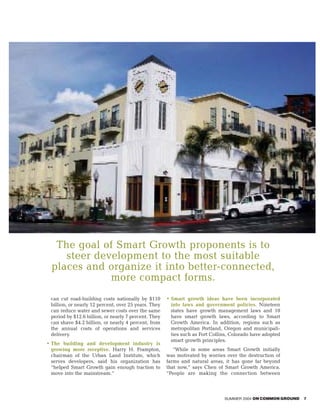
The goal of Smart Growth proponents is to
     steer development to the most suitable
  places and organize it into better-connected,
              more compact forms.
 can cut road-building costs nationally by $110       • Smart growth ideas have been incorporated
 billion, or nearly 12 percent, over 25 years. They     into laws and government policies. Nineteen
 can reduce water and sewer costs over the same         states have growth management laws and 10
 period by $12.6 billion, or nearly 7 percent. They     have smart growth laws, according to Smart
 can shave $4.2 billion, or nearly 4 percent, from      Growth America. In addition, regions such as
 the annual costs of operations and services            metropolitan Portland, Oregon and municipali-
 delivery.                                              ties such as Fort Collins, Colorado have adopted
                                                        smart growth principles.
• The building and development industry is
  growing more receptive. Harry H. Frampton,             “While in some areas Smart Growth initially
  chairman of the Urban Land Institute, which         was motivated by worries over the destruction of
  serves developers, said his organization has        farms and natural areas, it has gone far beyond
  “helped Smart Growth gain enough traction to        that now,” says Chen of Smart Growth America.
  move into the mainstream.”                          “People are making the connection between


                                                                               SUMMER 2004 ON COMMON GROUND   7
spread-out, disconnected development and the            minimum density of 3.5 dwelling units per acre in
            need to spend so much of our lives in traffic. One-     new residential projects. If a county designated a
            size-fits-all subdivisions just aren’t working for a    Priority Funding Area, it also had to be consistent
            population that is aging, deferring children and        with the county’s 20-year growth projections.
            having fewer of them, and forming single-person            Since construction of schools in outlying areas
            households faster than any other type.”                 often entices families to move to the suburban
                                                                    fringe, Glendening increased state school spend-
            How communities respond                                 ing and focused more of its construction and ren-
            A number of governments have decided to chan-           ovation budget on older, more built-up communi-
            nel development into existing towns and cities and      ties. In 1996–97, 43 percent of Maryland’s school
            other areas where new construction makes the            construction and renovation funds went to older
            most sense from a regional perspective. Under           communities. When Glendening left office in
            Democratic Governor Parris Glendening,                  January 2003, schools in older communities
            Maryland established “Priority Funding Areas”—          received 80 percent of those funds.
            areas designated for growth. Land outside those            Glendening’s Republican successor, Robert L.
            areas is ineligible for state financial support,        Ehrlich Jr., has since backed off on some elements
            including road-building and other projects intend-      of Smart Growth, such as using state funds to
            ed to accommodate growth. (One exception is             acquire open space, but he too is focusing on bol-
            schools. To forestall opposition from rural legisla-    stering older communities. “The idea is to spend
            tors, schools were omitted from the Smart Growth        money renovating and fixing up these existing
            law, but Glendening took other actions to concen-       town centers and historic Main Streets,” says
            trate school construction dollars in built-up areas.)   Chuck Gates, spokesperson for the Maryland
               Maryland’s program designated the state’s 157        Department of Planning.
            municipalities and all the communities inside the          “It has made a significant difference,” Gates
            Washington and Baltimore beltways as Priority           says of Maryland’s effort over the past eight years.
            Funding Areas. Many counties are beyond the             On Baltimore’s west side, large condominium tow-
            beltways and have no municipalities. Every coun-        ers have been springing up. “Throughout older
            ty was allowed to designate additional Priority         parts of our communities, we see new life and
            Funding Areas, but those areas were required to         increasing property values,” says Dru Schmidt-
            have water and sewer lines, and had to achieve a        Perkins, executive director of 1000 Friends of


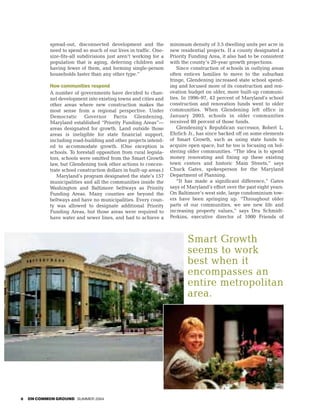
                                                                            Smart Growth
                                                                            seems to work
                                                                            best when it
                                                                            encompasses an
                                                                            entire metropolitan
                                                                            area.


8   ON COMMON GROUND SUMMER 2004
Maryland. On the other hand, Gates notes that if
homebuyers want to live in more remote areas and
are willing to pay a premium for that privilege,
developers will heed the market and continue
building at the fringe. Smart Growth, as practiced
in Maryland and many other places, does not pre-
clude outward development; it does, however,         across the Columbia River in Washington State is
eliminate many of what effectively were govern-      exempt from Metro’s growth controls. Motivated
ment subsidies for sprawl.                           by the disappearance of prime farmland, Portland
   Smart Growth seems to work best when it           has been thinking regionally since the 1970s,
encompasses an entire metropolitan area. Before      when Governor Tom McCall and the state legisla-
Maryland embarked on its smart growth efforts,       ture took steps to control outward development.
some counties acted on their own, with mixed            Oregon law requires Metro to keep a 20-year
results. Baltimore County, which surrounds           supply of land available for development within
Baltimore City, restricted development in some       the growth boundary. Since the late 1970s, the
rural areas, such as the horse country north of      boundary has moved about three dozen times,
Baltimore, where the landed gentry live. That        usually not far. The most recent expansion, in
inadvertently encouraged residential develop-        December 2002, added a substantial territory—
ment to leapfrog to Harford County to the north-     18,638 acres, enough for 38,657 housing units and
east and Carroll County to the northwest. “Both      thousands of jobs. Rather than expanding around
those counties have experienced enormous sprawl      the fringe, Metro concentrated two thirds of the
problems,” says Gates. The lesson is that restric-   growth in one area: Damascus/Boring. “The
tions in one area sometimes shift development        intent,” says Metro principal planner Raymond
into more distant places.                            Valone, “is that it be all planned together as a com-
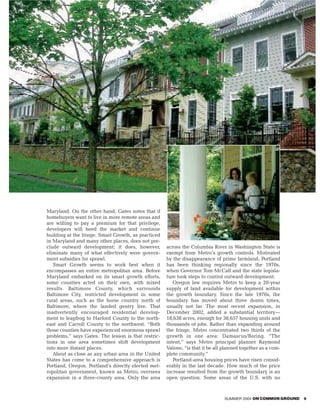
   About as close as any urban area in the United    plete community.”
States has come to a comprehensive approach is          Portland-area housing prices have risen consid-
Portland, Oregon. Portland’s directly elected met-   erably in the last decade. How much of the price
ropolitan government, known as Metro, oversees       increase resulted from the growth boundary is an
expansion in a three-county area. Only the area      open question. Some areas of the U.S. with no


                                                                                SUMMER 2004 ON COMMON GROUND   9
ensure that housing of various kinds can be pro-
                                                                  duced in a range of locations. “Any corner lot in a
             If Smart Growth is to                                single-family residential zone in Portland is enti-
                                                                  tled to be converted to a duplex,” notes Robert
              achieve substantial                                 Liberty, former executive director of 1000 Friends
                                                                  of Oregon. “All local governments [in the region]
            results, efforts must be                              must authorize accessory apartments.” While sub-
                                                                  urbs in many sections of the United States have
            made at both regional                                 become less dense over the years, Portland’s sub-
                and local levels.                                 urbs have become denser.
                                                                      The 2000 Census found that greater Portland,
                                                                  unlike most American metropolitan areas, does
                                                                  not concentrate poor families in the city. People
                                                                  with modest incomes were able to disperse
                                                                  throughout nearly all of the Portland suburbs
                                                                  because every municipality and county is required
                                                                  to zone for a sizable number of apartments. In
                                                                  2000, for the first time, more poor people in the
                                                                  three-county area lived in the suburbs than in
                                                                  Portland itself, Betsy Hammond reported in The
                                                                  Oregonian. The result, in the view of Bruce Katz,
                                                                  director of the Brookings’ Center on Urban and
                                                                  Metropolitan Policy, is that social problems are not
                                                                  compounded by concentration. Nor are the central
                                                                  city and the older suburbs emptying out, dragging
                                                                  down the metro area.
                                                                      The center, with its MAX light-rail line and a
                                                                  new streetcar line, is thriving. The light-rail line
                                                                  connects towns on the east side to those on the
                                                                  west. Mixed-use development has clustered close
                                                                  to MAX stops like Orenco Station—a popular cen-
                                                                  ter where residents can walk from home to coffee
                                                                  shops, restaurants, and commuter rail.
                                                                      If Smart Growth is to achieve substantial
                                                                  results, efforts must be made at both regional and
                                                                  local levels. In metropolitan Washington, D.C., the
                                                                  best development over the past 25 years owes its
            growth boundaries have experienced sharply            existence to the regional Metro rail system and to
            escalating house prices. “In Portland, the housing    local initiatives. A prime example is the profusion
            supply is expanding in a fashion that corresponds     of housing, offices, stores, restaurants, and ser-
            very well with the population,” says Gerrit Knaap,    vices within walking distance of five Metro sta-
            executive director of the National Center for Smart   tions in the Rosslyn-Ballston corridor of Arlington
            Growth Research and Education at the University       County, Virginia. What had been an aging, low-
            of Maryland. In part because of restrictions on       density commercial road corridor in the 1960s has
            outward expansion, plenty of private redevelop-       become “the economic engine of Arlington
            ment is occurring in the city. The population with-   County,” according to James Snyder, supervisor of
            in the city’s boundaries has grown to 539,000 from    the county’s Planning Section. Since 1979, when
            366,000 in 1980, partly through annexation but        Metro opened its Orange Line in the corridor,
            also through an embrace of apartments, town-          18,000 houses and apartments, 14 million square
            houses, and other, denser forms of housing.           feet of offices, and 21.5 million square feet of retail
            Housing has been built on former parking lots,        have appeared. “Things are compact and dense,”
            above stores, even atop a public library. Haggard-    Snyder says. The corridor, containing 7.6 percent
            looking neighborhoods have improved. “There’s         of the county’s land area, generates 33 percent of
            no blight in Portland,” Knaap says. “That’s really    its property tax revenue. It allows Arlington to set
            stunning.”                                            its property tax rate lower than other major juris-
               As Smart Growth has become the norm, gov-          dictions in northern Virginia.
            ernments in the Portland area have taken steps to         Greater Atlanta, the biggest metropolis in the


10   ON COMMON GROUND SUMMER 2004
Southeast, is now trying to combine regional and            ing; and developers tend to specialize in only one
local action, both of which are badly needed after          or two kinds of projects. “Compared with the chal-
decades of uncontrolled sprawl made commuting               lenge at hand—fundamentally transforming how
on the region’s clogged highways maddeningly                our communities grow—the strides that have been
slow. In 1999, the 10-county Atlanta Regional               made are quite modest,” says Smart Growth
Commission launched the Livable Centers                     America’s Don Chen.
Initiative, providing $5 million over five years for           There is no doubt that compact, mixed-use
communities to devise ways to build mixed-use               development with extensively interconnected
and residential construction with access to transit.        streets, pedestrian convenience, and access to
The resulting community plans are eligible for a            transit is increasing. The question is whether it
share of $350 million in transportation improve-            will become widespread enough, fast enough. “In
ments. One such plan calls for turning Perimeter            my perspective, the ‘smart growth movement’ has
Center—a suburban mall and office center with               been most successful at sparking a national con-
three MARTA rail stations—into a transit village.           versation about why places matter,” says John
Another calls for building mixed-income housing             Shepard, a long-range planner with Larimer
on what had been parking, near an underused                 County (Fort Collins), Colorado. That’s an impor-
MARTA station in Decatur. In Midtown Atlanta                tant beginning. But much more will have to be
near the Georgia Tech campus, extensive develop-            done, as Hank Dittmar, president of the advocacy
ment integrating offices and housing is taking              group Reconnecting America, acknowledges.
place. Dan Reuter, chief of the Commission’s Land           “Our challenge,” Dittmar says, “is to scale up, and
Use Division, calls Midtown “a national success             to take down the regulations, codes, standards,
story.”                                                     and habits that shackle the marketplace.”
    In most of the United States, Smart Growth is
still the exception to the rule. Impediments are            Philip Langdon is senior editor of New Urban News, a
many: zoning codes discourage mixed uses; finan-            national newsletter on New Urbanism and community
                                                            design.
ciers resist integration of offices, retail, and hous-


     B
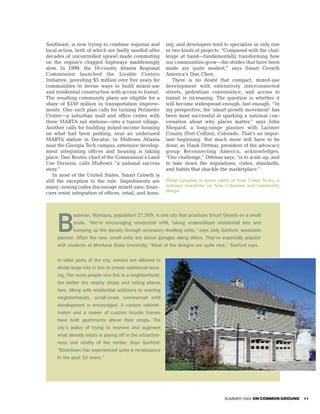
            ozeman, Montana, population 27,509, is one city that practices Smart Growth on a small
            scale. “We’re encouraging residential infill, taking underutilized residential lots and
            bumping up the density through accessory dwelling units,” says Jody Sanford, associate
     planner. Often the new, small units are above garages along alleys. They’re especially popular
     with students at Montana State University. “Most of the designs are quite nice,” Sanford says.


     In older parts of the city, owners are allowed to
     divide large lots in two to create additional hous-
     ing. The more people who live in a neighborhood,
     the better the nearby shops and eating places
     fare. Along with residential additions to existing
     neighborhoods, small-scale commercial infill
     development is encouraged. A custom cabinet-
     maker and a maker of custom bicycle frames
     have built apartments above their shops. The
     city’s policy of trying to improve and augment
     what already exists is paying off in the attractive-
     ness and vitality of the center. Says Sanford:
     “Downtown has experienced quite a renaissance
     in the past 10 years.”


                                                                                      SUMMER 2004 ON COMMON GROUND   11
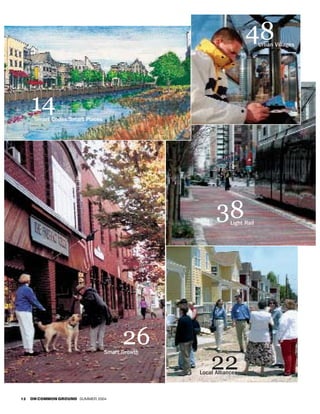
48     Urban Villages


     14
      Smart Codes Smart Places


                                                      38    Light Rail


                                       26
                                                    22
                                 Smart Growth


                                                Local Alliances


12   ON COMMON GROUND SUMMER 2004
On Common Ground
summer 2004   2    Introduction

              4    The Long Road to Smart Growth
                   Communities are learning to build compactly
                   by mixing housing, stores, and offices … but
                   outmoded zoning and other obstacles must
                   be overcome
                   By Philip Langdon

              14   Smart Codes Smart Places By Jason Miller

              22   Local Alliances Helping to Determine
                   Smart Growth Criteria
                   By John Van Gieson

              26   How Do You Know If It’s Smart Growth?
                   By David Goldberg

              32   Coast to Coast
                   REALTORS® take an active role in shaping
                   sustainable, Smart Growth communities
                   By Steve Wright and Heidi Johnson-Wright

              38   Light Rail
                   A solid option in the transportation debate
                   By Chris Swope

              44   Housing versus Transportation
                   Two sides of the affordability coin
                   By Joanne M. Haas

              48   Smart Growth Fuels Vibrant Urban Villages
                   By Brad Broberg


    54
              54   And the Winner Is …
                   EPA’s 2003 National Awards for Smart Growth
                   Achievement

 EPA Awards   60   Smart Growth in the States

              On Common Ground thanks the following contribu-
              tors and organizations for photographs, illustrations,
              and artist renderings reproduced in this issue: Haley
              Fleming of Atlanta Regional Commission; David
              Goldstein of Natural Resources Defense Council;
              Jody Sanford of the City of Bozeman; Christine
              Shenot of the Maryland Department of Planning;
              Howard Katz, Director of Strategic Planning,
              Cuyahoga County Treasurer’s Office; Tom Myer of
              Condo 1; Rob Steuteville of New Urban News; Janet
              Stone of Greenbelt Alliance; Urban Advantage;
              Emmaus Main Street Program; Craig Lewis, The
              Lawrence Group; Fisher & Hall Urban Design; Peter
              J. Musty, Charette Center.


                                            SUMMER 2004 ON COMMON GROUND   13
What do you do when your
                        development codes won’t let
                        you build or maintain the kind
                        of town you want?

                        You make new rules.


Smart           Codes
                                                  Places
                                                         By Jason Miller


14   ON COMMON GROUND SUMMER 2004
ention zoning codes to the average person and the reaction is pre-

M          dictable: a stone-faced stare, glazed eyes, a yawn. But communi-
           ties across the United States are discovering that the very fabric of
their neighborhoods and towns is built on those codes—or, more accurately,
because of them. And communities are doing something about these codes.
   Conventional zoning codes are fundamentally flawed, says Geoffrey
Ferrell, a principal with Geoffrey Ferrell Associates in Washington, D.C.
“Ever since the industrial years, the conventional separation-of-uses
approach has been the wrong approach to control”—to keeping unpleasant
uses away from the residential areas. “It has devolved to micromanagement
of use and density. The [built environment] that has resulted is very, very
poor about 99 percent of the time. No one’s happy with what they’ve been
given.”
   Ferrell’s co-principal, Mary Madden, agrees. “That micromanagement of
uses has resulted in a huge number of unintended consequences, namely,
suburban sprawl. Everybody hates sprawl, but the builders aren’t violating
rules; they’re building exactly what the codes call for. Those codes are a
blueprint for sprawl. Under the existing conventional codes, you can’t help
but build it.”
   Community frustration with conventional codes and the type of develop-
ment they spawn has driven new urbanist- and smart growth–minded plan-
ners to create new zoning codes. While these new codes go by many
names—form-based codes, new urbanist codes, TND (traditional neighbor-
hood development) ordinances, smart zoning, the SmartCode© from Miami-
based town planners Duany Plater-Zyberk & Company—they are all
designed to create places that emulate the urbanism of older, well-loved
places, while preserving rural areas and historic sites threatened by conven-
tional development.
   Communities that have replaced their conventional codes with new ordi-
nances have generally reported success in the process leading up to the new
codes’ implementation, as well as favorable upturns in their real estate mar-
kets. Here are a few of the notable success stories.
nIn the 1960s, Columbia Pike was considered Arlington, Virginia’s main
street. A 3.5-mile stretch of road that runs from the Pentagon to the Arlington
County/Fairfax County border, Columbia Pike was intended to be a Metro
rail corridor. When this didn’t happen, development along the Pike stagnat-
ed and the corridor languished for 40 years. Growth occurred along the Pike,
but it was of a singular variety, says Timothy Lynch, executive director of the


                                               SUMMER 2004 ON COMMON GROUND        15
Columbia Pike Revitalization Organization, whose     enhance the richness of their community, while
                office is located on the Pike. “We saw bank          ensuring none of the long-time local businesses
                branches with drive-through lanes, fast food fran-   would be replaced.
                chises with drive-through lanes—and that’s been         To tap the potential of this diamond in the
                about it. We also saw long-time businesses either    rough, the Columbia Pike community developed a
                close or move to other parts of the county. There    comprehensive Columbia Pike Revitalization
                are pizza stores, check-cashing stores, laundro-     Plan, which included adoption of a form-based (as
                mats, dry cleaners, dollar stores—these are all      opposed to a conventional use-based) zoning
                services people use, but you can’t buy a men’s       code. The code is a legal document that regulates
                suit, women’s clothing, a pair of shoes, or even a   land development by setting careful and clear con-
                book on Columbia Pike.”                              trols on building form to create good streets,
                   In January 1998, Arlington County Board chair     neighborhoods, and parks, with a healthy mix of
                Chris Zimmerman recognized the Pike’s need for       uses. Components of the code include clear defini-
                revitalization. A challenge came from the long-      tions of terms, a regulating plan, building enve-
                time property owners on Columbia Pike, however.      lope standards to determine each building’s form,
                Many of the existing buildings were owned out-       standards for siting and streetscapes and for archi-
                right by second- and third-generation owners who     tecture, and administrative guidelines for expedit-
                were making money and weren’t interested in          ing the approvals process.
                inviting hard-hitting capital gains taxes if they       By most accounts, the Columbia Pike venture is
                sold their buildings. Others, anticipating a boom    an ongoing success. Since implementation of the
                from the arrival of the Metro line, had developed    form-based codes in 2002, more than $30 million
                buildings that ended up being “ white elephants”     in development has been approved along the cor-
                after Metro declined to advance along the            ridor. Within the corridor itself, more than
                Columbia Pike corridor.                              $300 million in development projects are in vari-
                   Columbia Pike citizens wanted to preserve and     ous stages of negotiation and planning.


                         Everybody hates sprawl, but the builders
                          aren’t violating rules; they’re building
                              exactly what the codes call for.

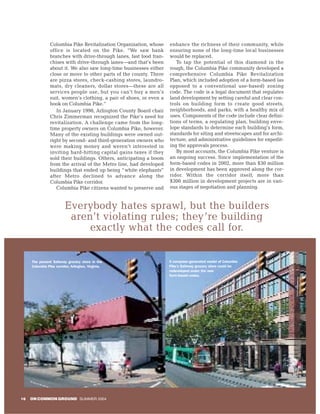
     The present Safeway grocery store in the                        A computer-generated model of Columbia
     Columbia Pike corridor, Arlington, Virginia.                    Pike’s Safeway grocery store could be
                                                                     redeveloped under the new
                                                                     form-based codes.


16   ON COMMON GROUND SUMMER 2004
BEFORE CODES          AFTER


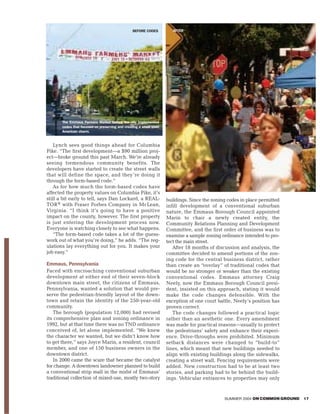
       The Emmaus Farmers Market before the city implemented
       codes that focused on preserving and creating a small town
       American charm.


    Lynch sees good things ahead for Columbia
Pike. “The first development—a $90 million proj-
ect—broke ground this past March. We’re already
seeing tremendous community benefits. The
developers have started to create the street walls
that will define the space, and they ’re doing it
through the form-based code.”
    As for how much the form-based codes have
affected the property values on Columbia Pike, it’s
still a bit early to tell, says Dan Lockard, a REAL-                buildings. Since the zoning codes in place permitted
TOR® with Fraser Forbes Company in McLean,                          infill development of a conventional suburban
Virginia. “I think it’s going to have a positive                    nature, the Emmaus Borough Council appointed
impact on the county, however. The first property                   Marin to chair a newly created entity, the
is just entering the development process now.                       Community Relations Planning and Development
Everyone is watching closely to see what happens.                   Committee, and the first order of business was to
    “The form-based code takes a lot of the guess-                  examine a sample zoning ordinance intended to pro-
work out of what you’re doing,” he adds. “The reg-                  tect the main street.
ulations lay everything out for you. It makes your                     After 18 months of discussion and analysis, the
job easy.”                                                          committee decided to amend portions of the zon-
                                                                    ing code for the central business district, rather
Emmaus, Pennsylvania                                                than create an “overlay” of traditional codes that
Faced with encroaching conventional suburban                        would be no stronger or weaker than the existing
development at either end of their seven-block                      conventional codes. Emmaus attorney Craig
downtown main street, the citizens of Emmaus,                       Neely, now the Emmaus Borough Council presi-
Pennsylvania, wanted a solution that would pre-                     dent, insisted on this approach, stating it would
serve the pedestrian-friendly layout of the down-                   make the code changes defensible. With the
town and retain the identity of the 250-year-old                    exception of one court battle, Neely’s position has
community.                                                          proven correct.
   The borough (population 12,000) had revised                         The code changes followed a practical logic
its comprehensive plan and zoning ordinance in                      rather than an aesthetic one. Every amendment
1992, but at that time there was no TND ordinance                   was made for practical reasons—usually to protect
conceived of, let alone implemented. “We knew                       the pedestrians’ safety and enhance their experi-
the character we wanted, but we didn’t know how                     ence. Drive-throughs were prohibited. Minimum
to get there,” says Joyce Marin, a resident, council                setback distances were changed to “build-to”
member, and one of 150 business owners in the                       lines, which meant that new buildings needed to
downtown district.                                                  align with existing buildings along the sidewalks,
   In 2000 came the scare that became the catalyst                  creating a street wall. Fencing requirements were
for change. A downtown landowner planned to build                   added. New construction had to be at least two
a conventional strip mall in the midst of Emmaus’                   stories, and parking had to be behind the build-
traditional collection of mixed-use, mostly two-story               ings. Vehicular entrances to properties may only


                                                                                              SUMMER 2004 ON COMMON GROUND   17
be that—entrances; the exits have to be behind                          tle place on earth,” says Marin. “We are becoming.”
                the properties.
                    Interestingly, even though the codes don’t man-                     Petaluma, California
                date aesthetics, that’s exactly what the citizens are                   A 24-member citizens advisory committee spent
                getting more of, says Marin. “Emmaus is a much                          an amazing seven years coming up with a vision
                more desirable place to live today than it was even                     for a 400-acre piece of land adjacent to the old
                three years ago.”                                                       downtown of Petaluma (the first town in America
                    Neely agrees. “Once spring arrives and the                          to adopt a limited-growth plan, in 1972).
                flowers start blooming, and the trees leaf out, I get                   Passionate about the property, the citizens knew
                comments from visitors—they think they’re com-                          they had a jewel of an opportunity, and they want-
                ing into Mayberry.”                                                     ed to make the most of it. They wanted the
                    Emmaus’ ordinances ensure that future devel-                        Petaluma River—which runs through the city—to
                opment will conform to the existing pattern, says                       become the centerpiece. They wanted the new
                Neely. “The provisions are designed to preserve                         development to blend and connect with the his-
                what’s already here, since 85 percent of what’s                         toric downtown, but with an edgier look.
                here conforms to the ordinance already. The ordi-                          After several fits and starts, an aggressive City
                nance has never really become an issue for peo-                         Council pushed the committee to act, and invited
                ple. … You don’t hear about it because it’s doing                       Fisher & Hall Urban Design of Santa Rosa,
                its job, quietly.”                                                      California, to assist the committee in its decision
                    David Fretz knows what a good job it’s doing.                       making. When principals Lois Fisher and Laura
                The Emmaus-based REALTOR® with Prudential                               Hall assembled a team, presented the
                Fretz Realty sees the results every day. “The                           SmartCode© option, and framed the discussion as
                Emmaus real estate market is very strong because                        an effort to create “smart zoning,” the committee
                of low interest rates, but people also love Emmaus                      decided to move ahead with the new approach.
                because they are tired of the fast-food, strip-mall                     Nine months later, the Petaluma SmartCode was
                look in every American town. When towns pre-                            adopted to a standing ovation from political adver-
                serve a traditional look through traditional codes,                     saries and citizens, alike.
                when they restore themselves and their character,                          The Petaluma SmartCode differed from its pre-
                that creates value. Not every community is sensi-                       ceding conventional code in its simplicity. The
                tive to that, but Emmaus is one that is.”                               “hybrid” SmartCode used ordinary language and
                    “We’re on the cusp of being the hottest, hippest lit-               simple graphics, coding precisely the aspects of


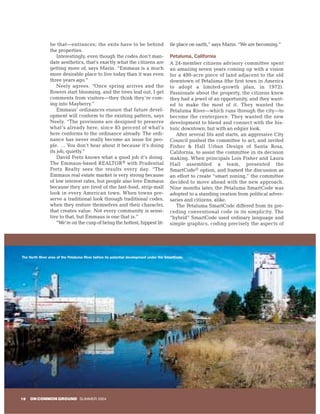
The North River area of the Petaluma River before its potential development under the SmartCode.


18   ON COMMON GROUND SUMMER 2004
The [Emmaus] code changes followed a
practical logic rather than an aesthetic one …
  usually to protect the pedestrians’ safety
        and enhance their experience.
the built environment that the community cared                          only the design review step to take if the develop-
about most: the building heights, the building                          er follows the SmartCode.
fronts, and the civic spaces. The code showed new                          “The SmartCode also eliminated mandatory
streets, new green spaces, roads, and buildings                         on-site parking. From a real estate perspective, a
facing the river. Different areas were coded for dif-                   building can now move from use to use more
ferent densities, minimum and maximum building                          quickly, and can change hands more quickly
heights, finished heights, parking areas, and per-                      because there isn’t the constraint of how much park-
centages of frontage types.                                             ing must be included with each use.”
    After the codes went into effect in June 2003, “it                     Mike Moore, community development director
was like a dam breaking,” says Hall. “A four-                           for the City of Petaluma, admits it’s a little early to
square-block theater district has been approved. A                      determine exactly how SmartCode is faring, but
10-acre condo project has been approved. In the                         likes what he sees thus far. “We had a large project
pipeline is another 10 acres of mixed-use build-                        in the initial stages, and in terms of the
ings: shops or workplaces on the main floor, con-                       SmartCode’s application, I think it has worked for
dos on top. Six downtown blocks of redevelop-                           that project, which is several blocks in the down-
ment are scheduled—in an area that had had very                         town area and includes the renovation of an exist-
little development in the last 20 years!”                               ing historic building and the construction of a
    Fisher points to the roadblocks the Petaluma                        movie theater, a parking garage, some apartment
SmartCode has removed. “Two-thirds of the                               buildings, a mixed-use building, and a small office
approval process is gone, now,” she says. With the                      building.”
SmartCode—which has been approved by the                                   Skip Sommer, a commercial REALTOR® with
Planning Commission and City Council—there’s                            Petaluma-based Creative Property Services/


An artist’s rendering of the North River area of the Petaluma River after potential development under the Petaluma SmartCode.


                                                                                                            SUMMER 2004 ON COMMON GROUND   19
Golden Land Realty, represents some of the devel-                    Hammond and the town’s officials gathered
                opers who are transforming downtown Petaluma                      community representatives and began the vision-
                under the new SmartCode. “My clientele loves the                  ing process with comparative surveys of different
                new code because it minimizes the planning                        neighborhood images. “Virtually 99.8 percent of
                process,” he says. “And the city loves it because it              the people said they preferred the traditional
                streamlines their ability to respond to developers.”              development form,” says Hammond.
                                                                                     On the strength of that visioning process,
                Huntersville, North Carolina                                      Hammond and her team developed a strategic
                A bedroom community, Huntersville lies immedi-                    plan with input from a Citizens Advisory
                ately north of Charlotte, North Carolina. In the                  Committee and the Huntersville Public Works
                ’80s and early ’90s, Huntersville and the neighbor-               Department. With help from consultants from the
                ing towns of Cornelius and Davidson began to                      College of Architecture at the University of North
                grow—fast. The rate of change Huntersville experi-                Carolina Charlotte and input from the Real Estate
                enced was disconcerting for residents who had lived               Building Industry Coalition, they totally rewrote
                there for some time. Even newcomers were uncom-                   the zoning ordinance, and made significant
                fortable with the unchecked growth, since they had                changes to the subdivision ordinance.
                wanted the small-town quality of life and character.                 The result? A draft ordinance that mandated
                Waves of suburbanization were moving out from                     traditional development form in terms of building
                Charlotte, threatening to diminish the town’s char-               placement. Build-to lines replaced minimum set-
                acter in such a way that it would not be recognizable             back requirements. Frontage requirements were
                as the place that people had chosen or had grown                  included, as well as parking requirements. Front
                accustomed to over the years.                                     doors had to be on the side of the building fronting
                   The movement to look at change in the regula-                  the street. These and other changes encouraged a
                tions was spurred by a typical urge to maintain the               pedestrian-friendly orientation of all buildings to
                community’s identity and not be “absorbed” into                   the street.
                Charlotte. Ann Hammond, then the planning                            With the help (“and open-mindedness,” says
                director for the Town of Huntersville, began to                   Hammond) of the Mecklenberg County
                expose the town’s officials to the new urbanist                   Engineering Department, they added a section on
                principles that were showing up in the planning                   narrower, more pedestrian-oriented streets. The
                and popular press. “They reacted as I had,” she                   code required connectivity, narrow lots with alley
                says. “They said, ‘This makes sense, and it makes                 access, and some vertical mixing of uses based on
                sense for us.’”                                                   locational standards—meaning that some mixed-


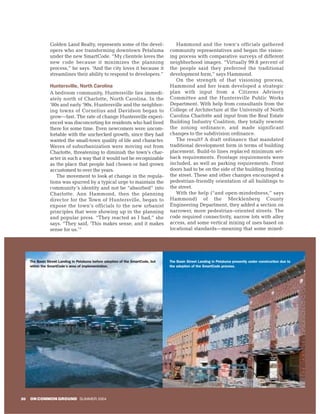
     The Basin Street Landing in Petaluma before adoption of the SmartCode, but   The Basin Street Landing in Petaluma presently under construction due to
     within the SmartCode’s area of implementation.                               the adoption of the SmartCode process.


20   ON COMMON GROUND SUMMER 2004
“The code requires
more traditional forms
   of town and city
development. It does
 not require TNDs; it
   permits TNDs.”
    Ann Hammond, former planning
      director, Town of Huntersville

use buildings were allowed closer in to town and       in creating better places within Huntersville, says
at certain key intersections.                          Craig Lewis, managing principal and director of
   The planners’ goals were simple:                    town planning with The Lawrence Group in neigh-
   • Allow neighborhoods in the more urban sec-        boring Davidson, North Carolina. As a consultant for
     tions of town to fill out properly over time.     Huntersville, Lewis has seen the outcomes of the
   • Allow for more TND greenfield developments.       ordinances—both good and not so good.
   Hammond never misses the chance to correct a           Political maneuverings blunted the edge of
misperception of the Huntersville code: “The code      some of the ordinance’s requirements, says Lewis.
requires more traditional forms of town and city       “The result was a proliferation of hybrid tradition-
development. It does not require TNDs; it permits      al neighborhoods. There were a lot of small lots in
TNDs.”                                                 seemingly discontinuous areas over a 50-square-
   The ordinance continues to allow single-family,     mile area within the Huntersville, Cornelius, and
single-use subdivisions, but they must adhere to       Davidson municipalities. Spots of sprawl were all
the new code:                                          over the place. The production builders are all
   • Narrow lots must have alley access.               there, all building semblances of traditional
   • Homes on wider lots may include a front-          neighborhoods, but many are hybrids.”
     loaded garage, but the garage must be                Fortunately, the Huntersville success stories
     recessed from the front plane of the house.       outnumber the hybrids. “Vermillion is a pure tra-
   • Every building must be on a public street.        ditional neighborhood that’s doing it right,” says
   The public street stipulation proved to be an       Lewis, “and they still have another 200 to 300
interesting aspect, because conventional subur-        acres that they can develop.”
ban shopping centers were effectively outlawed by
this point; they needed to be configured as pedes-     Jason Miller is a freelance writer, editor, photographer,
trian-oriented shopping streets.                       and publishing consultant based in St. Paul, Minnesota.
   But these and other constraints proved successful


                                                                                    SUMMER 2004 ON COMMON GROUND   21
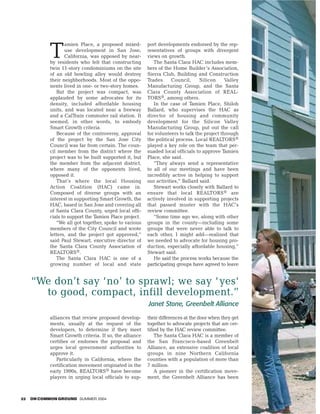
amien Place, a proposed mixed-       port developments endorsed by the rep-

            T       use development in San Jose,
                    California, was opposed by near-
            by residents who felt that constructing
                                                         resentatives of groups with divergent
                                                         views on growth.
                                                            The Santa Clara HAC includes mem-
            twin 11-story condominiums on the site       bers of the Home Builder’s Association,
            of an old bowling alley would destroy        Sierra Club, Building and Construction
            their neighborhoods. Most of the oppo-       Trades      Council,     Silicon     Valley
            nents lived in one- or two-story homes.      Manufacturing Group, and the Santa
               But the project was compact, was          Clara County Association of REAL-
            applauded by some advocates for its          TORS®, among others.
            density, included affordable housing            In the case of Tamien Place, Shiloh
            units, and was located near a freeway        Ballard, who supervises the HAC as
            and a CalTrain commuter rail station. It     director of housing and community
            seemed, in other words, to embody            development for the Silicon Valley
            Smart Growth criteria.                       Manufacturing Group, put out the call
               Because of the controversy, approval      for volunteers to talk the project through
            of the project by the San Jose City          the political process. Local REALTORS®
            Council was far from certain. The coun-      played a key role on the team that per-
            cil member from the district where the       suaded local officials to approve Tamien
            project was to be built supported it, but    Place, she said.
            the member from the adjacent district,          ”They always send a representative
            where many of the opponents lived,           to all of our meetings and have been
            opposed it.                                  incredibly active in helping to support
               That’s where the local Housing            our activities,” Ballard said.
            Action Coalition (HAC) came in.                 Stewart works closely with Ballard to
            Composed of diverse groups with an           ensure that local REALTORS® are
            interest in supporting Smart Growth, the     actively involved in supporting projects
            HAC, based in San Jose and covering all      that passed muster with the HAC’s
            of Santa Clara County, urged local offi-     review committee.
            cials to support the Tamien Place project.      “Some time ago we, along with other
               “We all got together, spoke to various    groups in the county—including some
            members of the City Council and wrote        groups that were never able to talk to
            letters, and the project got approved,”      each other, I might add—realized that
            said Paul Stewart, executive director of     we needed to advocate for housing pro-
            the Santa Clara County Association of        duction, especially affordable housing,”
            REALTORS®.                                   Stewart said.
               The Santa Clara HAC is one of a              He said the process works because the
            growing number of local and state            participating groups have agreed to leave


     “We don’t say ‘no’ to sprawl; we say ‘ yes‘
       to good, compact, infill development.”
                                                         Janet Stone, Greenbelt Alliance
            alliances that review proposed develop-      their differences at the door when they get
            ments, usually at the request of the         together to advocate projects that are cer-
            developers, to determine if they meet        tified by the HAC review committee.
            Smart Growth criteria. If so, the alliance       The Santa Clara HAC is a member of
            certifies or endorses the proposal and       the San Francisco–based Greenbelt
            urges local government authorities to        Alliance, an extensive coalition of local
            approve it.                                  groups in nine Northern California
               Particularly in California, where the     counties with a population of more than
            certification movement originated in the     7 million.
            early 1990s, REALTORS® have become               A pioneer in the certification move-
            players in urging local officials to sup-    ment, the Greenbelt Alliance has been


22   ON COMMON GROUND SUMMER 2004
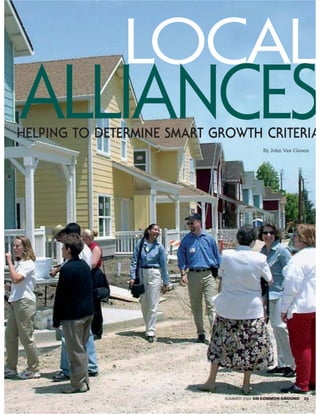
LOCAL
ALLIANCES
HELPING TO DETERMINE SMART GROWTH CRITERIA
                                          By John Van Gieson


                            SUMMER 2004 ON COMMON GROUND   23
reviewing and certifying development         TORS® is actively involved in the
                             projects since 1990, before the term         Housing Action Coalition in the Alameda
                             Smart Growth gained the currency it has      and Contra Costa counties’ suburbs east
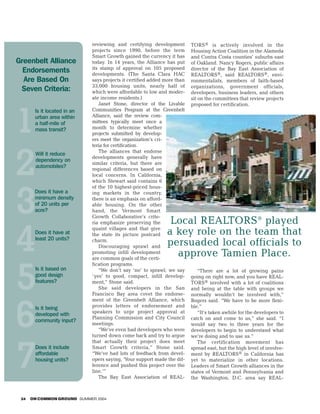
Greenbelt Alliance           today. In 14 years, the Alliance has put     of Oakland. Nancy Rogers, public affairs
                             its stamp of approval on 105 proposed
  Endorsements               developments. (The Santa Clara HAC
                                                                          director of the Bay East Association of
                                                                          REALTORS®, said REALTORS®, envi-
  Are Based On               says projects it certified added more than   ronmentalists, members of faith-based
                             33,000 housing units, nearly half of         organizations, government officials,
 Seven Criteria:             which were affordable to low and moder-      developers, business leaders, and others
                             ate income residents.)                       sit on the committees that review projects


1
                                Janet Stone, director of the Livable      proposed for certification.
       Is it located in an   Communities Program at the Greenbelt
       urban area within     Alliance, said the review com-
       a half-mile of        mittees typically meet once a
       mass transit?         month to determine whether
                             projects submitted by develop-
                             ers meet the organization’s cri-


2
                             teria for certification.
                                The alliances that endorse
       Will it reduce
                             developments generally have
       dependency on
                             similar criteria, but there are
       automobiles?          regional differences based on
                             local concerns. In California,


3
                             which Stewart said contains 6
                             of the 10 highest-priced hous-
       Does it have a        ing markets in the country,
       minimum density       there is an emphasis on afford-
       of 20 units per       able housing. On the other
       acre?                 hand, the Vermont Smart
                             Growth Collaborative’s crite-


4
                             ria emphasize preserving the       Local REALTORS® played
                             quaint villages and that give
       Does it have at       the state its picture postcard    a key role on the team that
       least 20 units?       charm.
                                Discouraging sprawl and        persuaded local officials to
                             promoting infill development        approve Tamien Place.


5
                             are common goals of the certi-
                             fication programs.
       Is it based on           “We don’t say ‘no’ to sprawl; we say         “There are a lot of growing pains
       good design           ‘yes’ to good, compact, infill develop-      going on right now, and you have REAL-
       features?             ment,” Stone said.                           TORS® involved with a lot of coalitions
                                She said developers in the San            and being at the table with groups we


6
                             Francisco Bay area covet the endorse-        normally wouldn’t be involved with,”
                             ment of the Greenbelt Alliance, which        Rogers said. “We have to be more flexi-
       Is it being           provides letters of endorsement and          ble.”
                             speakers to urge project approval at            “It’s taken awhile for the developers to
       developed with
                             Planning Commission and City Council         catch on and come to us,” she said. “I
       community input?
                             meetings.                                    would say two to three years for the
                                “We’ve even had developers who were       developers to begin to understand what


7
                             turned down come back and try to argue       we’re doing and to use us.”
                             that actually their project does meet           The certification movement has
       Does it include       Smart Growth criteria,” Stone said.          spread east, but the high level of involve-
       affordable            “We’ve had lots of feedback from devel-      ment by REALTORS® in California has
       housing units?        opers saying, ‘Your support made the dif-    yet to materialize in other locations.
                             ference and pushed this project over the     Leaders of Smart Growth alliances in the
                             line.’”                                      states of Vermont and Pennsylvania and
                                The Bay East Association of REAL-         the Washington, D.C. area say REAL-


 24   ON COMMON GROUND SUMMER 2004
TORS® are not actively involved in their efforts.                     her organization contained only four affordable
   One of the most promising new certification                        single-family homes.
programs is the Washington Smart Growth                                  Those homes were proposed, however, in the
Alliance based in Washington, D.C., which covers                      center of the Village of Hancock, population 382.
the city and its Virginia and Maryland suburbs.                       Hancock residents were fiercely insistent on pro-
Formed by the Urban Land Institute and four part-                     tecting their 216-year-old village, Humstone said,
ner organizations, the Washington program is a                        and it took a great deal of negotiating to reach
prototype for programs being considered by other                      agreement with them.
regional affiliates of the Urban Land Institute.                         Resistance by neighbors is a constant problem
   The partners in the Smart Growth Alliance                          that must be overcome by Smart Growth develop-
(SGA) are the Chesapeake Bay Foundation,                              ers and their advocates in the certification move-
Greater Washington Board of Trade, Coalition for                      ment. Stewart said opponents of growth twist the
Smarter Growth, and the Metropolitan Wash-                            meaning of Smart Growth to use it as a no-growth
ington Builders’ Council. The review committees,                      club to beat up on projects they don’t like.
which meet quarterly, have endorsed 15 projects                          “Often the neighbors will call us up and say,
in the SGA’s three-year history.                                      ‘Could you help me fight this project?’ when it is a
   John Bailey, director of the Smart Growth                          Smart Growth project,” Humstone said. She said her
Alliance, said the organization believes in work-                     group’s endorsement may help to overcome opposi-
ing with developers to correct problems that may                      tion to Smart Growth projects, “but it’s too soon to
prevent them from being recognized for meeting                        say since it’s the Nimbys we’re dealing with.”
Smart Growth criteria. “We’re sort of like the                           Nimbys—short for Not in My Backyard—are a
teacher who says, ‘Hey, I don’t want to fail you. I                   potentially potent political force.
want to pass you,’” he said.                                             “If you’re a city council member and you’re fac-
   In Vermont, REALTORS® helped to develop the                        ing a crowd of 50 people who are opposing a vote
Smart Growth criteria used by the Vermont Smart                       you’re going to take, why would you vote that
Growth Collaborative, but they have not been                          way?” Ballard said. “You can’t go out on a limb.”
active in the review process.                                            What the endorsements do is give local officials
   Development in Vermont typically occurs on a                       cover in supporting controversial developments.
far smaller scale than condominium towers like                        And they’ve been known to strengthen a back-
Tamien Place in San Jose, or the massive mixed-                       bone or two.
use projects springing up in the Washington sub-
urbs. Beth Humstone, director of the Vermont col-                     John Van Gieson is a freelance writer based in
laborative, said one of the projects approved by                      Tallahassee, Florida. He owns and runs Van Gieson
                                                                      Media Relations.


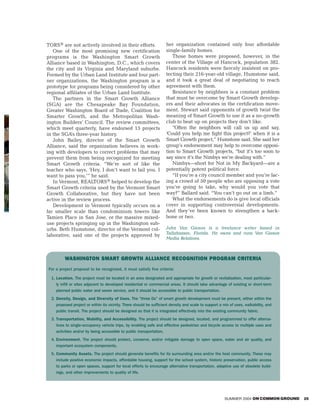
         WASHINGTON SMART GROWTH ALLIANCE RECOGNITION PROGRAM CRITERIA
For a project proposal to be recognized, it must satisfy five criteria:

  1. Location. The project must be located in an area designated and appropriate for growth or revitalization, most particular-
    ly infill or sites adjacent to developed residential or commercial areas. It should take advantage of existing or short-term
    planned public water and sewer service, and it should be accessible to public transportation.
  2. Density, Design, and Diversity of Uses. The “three Ds” of smart growth development must be present, either within the
    proposed project or within its vicinity. There should be sufficient density and scale to support a mix of uses, walkability, and
    public transit. The project should be designed so that it is integrated effectively into the existing community fabric.
  3. Transportation, Mobility, and Accessibility. The project should be designed, located, and programmed to offer alterna-
     tives to single-occupancy vehicle trips, by enabling safe and effective pedestrian and bicycle access to multiple uses and
    activities and/or by being accessible to public transportation.
  4. Environment. The project should protect, conserve, and/or mitigate damage to open space, water and air quality, and
    important ecosystem components.
  5. Community Assets. The project should generate benefits for its surrounding area and/or the host community. These may
    include positive economic impacts, affordable housing, support for the school system, historic preservation, public access
    to parks or open spaces, support for local efforts to encourage alternative transportation, adaptive use of obsolete build-
    ings, and other improvements to quality of life.


                                                                                                        SUMMER 2004 ON COMMON GROUND   25
HOW DO YOU KNOW IF IT’S
SMART GROWTH?


                                    By David Goldberg


26   ON COMMON GROUND SUMMER 2004
magine yourself in Pam Sessions’ shoes. You’re a

I    profit-oriented developer with a social conscience.
     Through market and demographic research,
you’ve detected an unmet demand in metro Atlanta for
well-designed, urban scale neighborhoods, with a mix
of housing types and prices, in a village-like setting.
You’ve absorbed the literature on green design and
Smart Growth. The principles make sense and you’re
determined to put them into practice. You’ve hired a
design firm credited with landmark projects from
Seaside, Florida to Maryland’s Kentlands. You’re con-
fident you’ve got a to-die-for winner, but when you
present it to the local government the reception is a
tad chilly—something akin to being doused with ice
water, then clonked on the head with the bucket.
    “It’s always a challenge to do something new,”
Sessions says in her characteristically understated
manner. The truth is, almost every aspect of her
“smart,” “green” project was either illegal or otherwise
unacceptable at the time. Narrow, tree-lined, pedestri-
an-oriented streets? Sorry, code violation. Mix town-
homes, big and little houses and apartments at differ-
ent price points? It’s just not done.
    Eventually, though, Sessions did get her Vickery
project approved—once the rental apartments were
jettisoned. The whole process might have been a bit
easier, she says, if there had been some respected third
party to evaluate her plans and certify them as “smart”
and “green,” or to tell her how to make them more so.
Such a certification also could have helped the local
community understand how certain changes to plans
might be counterproductive to goals such as reducing
traffic or water runoff or encouraging people to walk.
    Sessions might be getting her wish. Concerns like hers, along with several
other considerations, are behind a growing effort to create tools, through
research and standard-setting, to help answer the question, “How do you know
if it’s Smart Growth?” The question applies not only to individual projects, but
also to the broader policies being put into place to preserve rural land, revital-
ize already-developed areas, and accommodate future growth in high-quality
urban settings. Over the next few pages we’ll take a look at three promising
efforts to measure Smart Growth in order to certify that it is, in fact, happening.
One is an expansion of the Leadership in Energy and Environmental Design
(LEED) certification for green buildings to neighborhood developments; anoth-
er is an effort in Atlanta to create a market-ready, branded certification of smart-
growth communities; and the third is an attempt to create a scorecard for
Maryland’s statewide Smart Growth program.

Taking the LEED in greening the neighborhood
Since its introduction a few years ago, the LEED rating system developed by the
U.S. Green Building Council (USGBC) has gained wide acceptance as a way
both to teach best practices in resource-efficient building design, and to recog-
nize the builders and buildings that use them. Under LEED, projects can earn
Certified, Silver, Gold, or Platinum status by meeting rigorous criteria in sever-
al categories: sustainable sites, water efficiency, energy and atmosphere, indoor
environmental quality, materials and resources, and innovation in design.
   Its shortcoming, according to some advocates of Smart Growth, is that it gives
too little weight to the building’s context. For example, a brand-new office build-


                                                                                  SUMMER 2004 ON COMMON GROUND   27
ing in a cornfield reachable only by car could rate       there too much or too little low-income housing
            higher for energy savings than a renovated in-            nearby? What are local needs?—is likely to vary so
            town building accessible by subway, foot, bike,           widely that standard-setting could be very diffi-
            and car. At the same time, acknowledges urban             cult, Benfield said.
            designer Doug Farr, the USGBC could criticize                Another challenge will be to set clear standards
            new urbanist and smart growth advocates for               but avoid being overly rigid. “Whatever system we
            neighborhood designs that fall short on minimiz-          come up with will have to be flexible enough to
            ing storm-water runoff, night-sky lighting, or the        recognize regional variations,” Benfield said. “I
            heat-island effect.                                       personally think creativity is really important in
               “We wanted to see if we could work together to         the smart growth world. It’s an incredibly creative
            come up with a rating system for green, smart-            field, one in which new answers are being found
            growth neighborhoods,” said Farr, a Chicago new           almost on a daily basis. I think we need to encour-
            urbanist and green architect responsible for sever-       age that and whatever we do shouldn’t standard-
            al LEED-rated buildings himself. Farr has been            ize too much.”
            representing the Congress for the New Urbanism
            (CNU) in a three-way planning effort among                Marketing Smart Growth in Metro Atlanta
            CNU, the USGBC, and the Natural Resources                    As the LEED-ND panel begins to craft the new
            Defense Council (NRDC), which has expertise in            program, members will no doubt want to watch
            both smart growth and environmental design. The           developments in metro Atlanta where Sessions
            collaboration has produced a 15-member panel of           and three other developers are guinea pigs in a
            experts that will establish rating criteria for what is   LEED-like effort, with some twists. There, a col-
            being called LEED-ND, for neighborhood devel-             laboration between the Greater Atlanta Home
            opment.                                                   Builders Association (HBA) and the Southface
               “One reason to do this is to foster a positive side    Energy Institute, a nonprofit
            of environmentalism and reward good actors—
            business people, architects, designers, REAL-
            TORS® who are pursuing a path with good envi-
            ronmental values,” said Kaid Benfield, NRDC’s
            smart-growth guru and representative on LEED-
            ND. Another is the hope that projects able to meet
            the high standards will face less opposition
            from neighborhood groups, or at a mini-
            mum, prevent opponents from making false
            claims of environmental harm. As it has
            with individual buildings, a LEED standard
            might also convince more developers to try
            a greener approach. “Developers like pre-
            dictability,” Farr said. “If you’re telling me
            to do Smart Growth, give me a clear idea
            what’s expected.”
               Farr sees the ND designation as adding
            at least two new rating categories: location
            and linkage. “For location you would ask: Is
            it leapfrog development or in a preferred
            growth area? Is there a plan for transit or
            other infrastructure? The other [linkage]
            addresses       neighborhood        patterns—
            pedestrian linkages, having something to
            walk to.”
               Less clear is how, or whether, to incorporate
            social goals associated with Smart Growth, such
            as the provision of affordable and mixed-income
            housing. Those goals have an environmental com-
            ponent, in that housing close to jobs and public
            transportation can reduce the air and energy
            impacts of long car commutes. But the context—Is


28   ON COMMON GROUND SUMMER 2004
EarthCraft homes – Clark’s Grove, Georgia


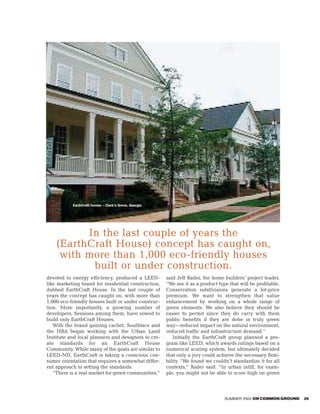
          In the last couple of years the
    (EarthCraft House) concept has caught on,
     with more than 1,000 eco-friendly houses
           built or under construction.
devoted to energy efficiency, produced a LEED-         said Jeff Rader, the home builders’ project leader.
like marketing brand for residential construction,     “We see it as a product type that will be profitable.
dubbed EarthCraft House. In the last couple of         Conservation subdivisions generate a lot-price
years the concept has caught on, with more than        premium. We want to strengthen that value
1,000 eco-friendly houses built or under construc-     enhancement by working on a whole range of
tion. More importantly, a growing number of            green elements. We also believe they should be
developers, Sessions among them, have vowed to         easier to permit since they do carry with them
build only EarthCraft Houses.                          public benefits if they are done in truly green
   With the brand gaining cachet, Southface and        way—reduced impact on the natural environment,
the HBA began working with the Urban Land              reduced traffic and infrastructure demand.”
Institute and local planners and designers to cre-        Initially the EarthCraft group planned a pro-
ate standards for an EarthCraft House                  gram like LEED, which awards ratings based on a
Community. While many of the goals are similar to      numerical scoring system, but ultimately decided
LEED-ND, EarthCraft is taking a conscious con-         that only a jury could achieve the necessary flexi-
sumer orientation that requires a somewhat differ-     bility. “We found we couldn’t standardize it for all
ent approach to setting the standards.                 contexts,” Rader said. “In urban infill, for exam-
   “There is a real market for green communities,”     ple, you might not be able to score high on green


                                                                                  SUMMER 2004 ON COMMON GROUND   29
“Any effort to measure
                                     Smart Growth should
                                     somehow capture the
                                    most important goal of
                                    all, a population that is
                                    living happily and has
                                     hopes for an equally
                                          bright future.”
                                    Harriet Tregoning, former secretary for
                                      Smart Growth, State of Maryland


30   ON COMMON GROUND SUMMER 2004
coast to coast                       REALTORS Take an Active Role
                                              ®


 32   ON COMMON GROUND SUMMER 2004
to coast to co
in Shaping Sustainable, Smart Growth Communities
         By Steve Wright & Heidi Johnson-Wright


                                                                                 hen Linda Goodwin-

                                                                     W           Nichols set up shop as
                                                                                 a    REALTOR®       in
                                                                        Florida’s Osceola County three
                                                                        decades ago, Smart Growth
                                                                        wasn’t an issue.
                                                                           In fact, growth of any kind
                                                                        wasn’t an issue. Back then, the
                                                                         quaint but sleepy Central
                                                                        Florida county didn’t even have
                                                                      50,000 residents. On a holiday
                                                                 weekend, a population greater than
                                                                that visited nearby Disney World.
                                                                    Today Goodwin-Nichols, who acts
                                                         as vice mayor of the fast-growing city of
                                                         Kissimmee, cannot think of fully serving a
                                                      client without keeping abreast of issues such as
                                                      higher density, smaller lots, better roads,
                                                     improved infrastructure, conserved land, and—
                                                      most important of all—school capacity.
                                                         “Trying to balance extreme growth while pro-
                                                    tecting private property rights has always been a
                                                   major challenge,” said Goodwin-Nichols, presi-
                                                   dent of Goodwin Realty & Associates. “Now it’s
                                                   extremely crucial that we, as REALTORS®, get
                                                  involved with planning organizations, the
                                                  Chamber of Commerce, the school board, and our
                                                government to be proactive in looking at what our
                                          community will look like in 20 years.”
                                            Whether REALTORS® are trying to preserve rural char-
                                     acter in the East, small town charm in the Midwest, affordable
                                  housing in California, economic vitality in the Pacific Northwest, or
                                good public education in Florida, they are finding that Smart Growth
                               is key to the future.
                                 Goodwin-Nichols lives in Osceola County, which has more than
                              tripled its population in less than two decades. She identified educa-
                                 tional funding as the crucial issue in an area that is popular with
                                   young and growing families.


                                                                             SUMMER 2004 ON COMMON GROUND   33
“We’re building so fast that we’re adding near-         The Ventura Coastal County Association has
            ly a classroom’s worth of children per day,” she        responded by joining a coalition called Housing
            said. “But we’re one of the worst-funded school         Opportunities Made Easier, or HOME. The
            districts in the state. So we have to look at taxes,    HOME coalition advocates for such things as
            impact fees, and other ways of making sure our          affordable housing and higher-density develop-
            children get a good education.”                         ment in Ventura County, where voters have placed
               Goodwin-Nichols said that, years ago, she            growth restrictions on much of the county land.
            could not have pictured herself becoming politi-        Consequently, less land is available for develop-
            cally active, but now she has served eight years on     ment, so it must be used more wisely.
            a city commission. In addition, three agents in her        “We have to take a hard look at single family
            medium-sized office serve on either a planning or       housing. Is it a 6,000-square-foot lot with a picket
            code enforcement board.                                 fence or a 1,200-square-foot, third-story condo
               The      Osceola     County     Association     of
            REALTORS® has become so concerned about
            development eating up land for parks, recreation,
            and open space that it committed preliminary sup-
            port to the idea of raising taxes to buy undevel-
            oped land in the Central Florida county.
               A group called Save Osceola has been working
            to place a sales tax issue on the county ballot to
            raise funds for buying undeveloped land and per-
            manently setting it aside for parks, recreation, and
            open space. Board members from the Osceola
            REALTORS® association committed their support
            for the effort. Save Osceola is a grassroots organi-
            zation dedicated to land preservation and man-
            agement for the purposes of water resources,
            wildlife areas, and for nature-based recreational
            opportunities.
               However, the movement for a sales tax may be
            on hold. A separate referendum for a sales tax that
            would have helped pay for education in the coun-
            ty failed at the ballot during the March 2004 pri-
            mary. After seeing that voters would not support a
            sales tax hike to pay for education, Save Osceola
            hasn’t taken steps to raise funds to back an open
            space ballot issue.
               “If you as a REALTOR® are going to represent
            your clients and customers, you need to know
            what’s going on in your community,” Goodwin-
            Nichols said. “If we as REALTORS® can’t get
            involved in solving the problems in our communi-
                                                                     The American dream
            ties, then nobody can. We have the manpower to
            make a huge influence in our community.”
                                                                    has to be redefined as
               In Ventura County, California, one of the most
            expensive housing markets in the country, the
                                                                      we go into the next
            challenges are different. The lack of developable       decade. Let’s see if we
            land and affordable housing are what motivate
            REALTORS® to get involved in Smart Growth               can plan our cities so
            matters.
               “With a housing crisis in California, we need to      we can walk to get a
            retain rural land while supporting jobs and hous-
            ing needs,” said Kay Wilson-Bolton, past president
                                                                       quart of milk. It’s
            of the Ventura County Coastal Association of
            REALTORS® and broker/owner of Century 21
                                                                     going to take awhile,
            Buena Vista.                                             but we can get there.

34   ON COMMON GROUND SUMMER 2004
space, but very high on transportation access and        Smart Growth under Glendening. “About 75 per-
walking destinations, etc.” A jury can also              cent was within PFAs [Priority Funding Areas].
better evaluate the place-making details that will       But that’s not to say that everything inside was
make plans worthy of brand distinction.                  Smart Growth. However, on average, development
   To calibrate their standards, the initial jury will   outside used 10 times more land.” And State fig-
evaluate four local projects that have been praised      ures show that the rate of growth in miles-driven-
as smart growth developments and that incorpo-           per-person each day is slowing, she said.
rate EarthCraft houses. One of those is Sessions’           While some evidence is visible in the form of
Vickery, a suburban greenfield project in proximi-       revitalized town centers and renovated neighbor-
ty to already-developed areas; another is Clark’s        hood schools—and it’s clear that the land con-
Grove, a new district in the exurban city of             sumption rate is slowing compared with the trend
Covington. The third is Glenwood Park, a brown-          of the 1990s—better measures of progress are
field redevelopment in Atlanta, and the fourth is        needed, said Frece, who left his state government
Serenbe (see map on page 28), a new village with-        job to become communications director for the
in a huge swath of undeveloped Fulton County             National Center for Smart Growth Research and
that is being master-planned for sustainability by a     Education at the University of Maryland. Through
collaborative of land owners. “We want to test our       a grant from the Lincoln Institute for Land Policy,
program against those very high-performance              the center is working with the Maryland
projects to make sure we don’t miss innovation, or       Department of Planning to set and measure a
that we don’t have a flaw in methodology that            number of critical benchmarks.
would prevent them from qualifying,” Rader said.            While the scorecard is still being formulated,
“Toward the end of summer, after we’ve made the          several measures have suggested themselves,
evaluations, we’ll open it up for business.”             such as: open space preserved; trends in farm
                                                         acreage; pollution in Chesapeake Bay; transit rid-
Rating Maryland’s Smart Growth Program                   ership; rates of biking and walking; land zoned for
Programs such as LEED and EarthCraft should              mixed use; and housing supply and affordability.
make it possible to evaluate individual projects for     “Unfortunately, we’re limited by what is measura-
their contribution to a metro area’s long-term           ble based on what statistics are kept,” Frece said.
quality of life, and that in turn will make it easier       Tregoning said she hopes any effort to measure
to build neighborhoods that mix uses and housing         Smart Growth would somehow capture the most
types. Meanwhile, however, single-use sprawl             important goal of all, a population that is living
development continues to be the dominant prac-           happily and has hopes for an equally bright future.
tice. An increasing number of states and localities      “You would want to know: Do people feel their
are adopting policies to change that. One of the         access to jobs and amenities is adequate or getting
best-known states is Maryland, whose adoption of         better? Do they have good choices in housing and
a Smart Growth program under Governor Parris             neighborhoods at all stages of life? How do they
Glendening in the mid-1990s helped popularize            feel about their quality of life?”
the term.
   The Maryland program requires local govern-           Conclusion
ments to designate “priority funding areas” where        However we measure it, the best way to assess
most development should occur, and then limits           whether neighborhoods and regions we’re build-
state funds for infrastructure and services to those     ing are “smart” may be to look through the eyes of
areas. Maryland encourages redevelopment of              someone living several decades hence. Will the
existing places through policies including tax           neighborhoods built in the early part of this centu-
credits and a shift of school funds toward rehab-        ry be as beloved and functional as those built in
bing old schools and away from new construction.         the early part of the 20th century are now? Will
The state also took aggressive steps to set aside        there be working farms and open vistas? Will older
open space and preserve agricultural land. “In ret-      suburbs be vibrant and vital, or will they be slums?
rospect,” said John Frece, who was Glendening’s          Perhaps when we can answer those and similar
special aide for Smart Growth, “one of the things        questions positively we’ll at last know we’re prac-
we didn’t do, but should have, was to set specific       ticing Smart Growth.
targets for what we wanted to achieve. We say we
want more walkable, livable communities, but we          David A. Goldberg is the communications director for
don’t say how we’ll know we’re making progress.”         Smart Growth America, a nationwide coalition based in
                                                         Washington D.C. that advocates for land-use policy
   The state did measure the proportion of devel-
                                                         reform. In 2002 Goldberg was awarded a Loeb
opment occurring within priority funding areas,          Fellowship at Harvard University where he studied urban
said Harriet Tregoning, who was secretary for            policy.


                                                                                     SUMMER 2004 ON COMMON GROUND   31
Mithun Design
                                                                                                         photo: Michael Seidl


                                                          REALTORS® met with more than two dozen groups,
                                                          including local builders, the Chamber of
                                                          Commerce, economic development groups, and his-
                                                          toric preservationists to come up with recommenda-
                                                          tions for zoning at the municipal level,” said Frank
                                                          Christoffel IV, director of governmental affairs for
                                                          the Building Industry Association of Lancaster
                                                          County, which also provides governmental affairs
                                                          services to the Lancaster County Association of
                                                          REALTORS®.
                                                             The Lancaster County Board of Commissioners
                                                          endorsed the plan’s recommendations and appro-
                                                          priated $60,000 for outreach and education, plus
                                                          $30,000 per year line item funding, with the goal of
                                                          defining Smart Growth.
                                                             “It means one thing to one person, another thing
with a balcony? The answer is: It’s both,” said           to another person. We wanted to find some common
Wilson-Bolton.                                            ground,” explained Christoffel.
   “The American dream has to be redefined as we             “We’re working with municipal supervisors to
go into the next decade. We have to have a real good      build on smaller lot sizes and to consolidate the
dialogue on this. If we believe in that dream, we         growth where sewer, water, and public infrastruc-
have to see if people are willing to take less to get     ture already exist,” he said.
more. Let’s see if we can plan our cities so we can          “The county has a population of 480,000, and is
walk to get a quart of milk. It’s going to take awhile,   adding about 5,000 per year. We have to build on
but we can get there,” Wilson-Bolton said.                smaller lots. The real estate market shows these
   In the rolling hills of Pennsylvania’s Lancaster       smaller lots do very well, they don’t hurt REAL-
County, REALTORS® have joined forces with politi-         TORS®. It’s easier for municipalities to provide
cians, preservationists, regulators, and developers       services,” said Christoffel.
to define Smart Growth and use it to preserve the            “It’s a great challenge with 60 separate munici-
county’s resources.                                       palities. Zoning is the real devil in the details. If
   “In 2002, the Lancaster County Association of          you’re a developer and you want to build a Smart


                                                                                      SUMMER 2004 ON COMMON GROUND              35
Growth community, you have to get a variance or          one can read and understand—you shouldn’t have
            a conditional exception, as opposed to current           to be a Ph.D. to understand them.”
            zoning that encourages sprawl. It’s easy to build           Larson said the Wisconsin REALTORS®
            sprawl. It’s harder to build Smart Growth.”              Association has launched a Quality of Life pro-
               “It’s very difficult to sit on land for three years   gram featuring statewide real estate and living
            to go through a lengthy local permitting process.        conditions surveys that will help the organization
            We focused on smaller lot size, expediting the per-      with its comprehensive planning efforts “by get-
            mitting process within growth areas in the coun-         ting into the psyche of buyers.
            ty,” said Christoffel.                                      “Rather than representing 15,000 REALTORS®,
               “[The Smart Growth coalition] is the first of its     we want to become the voice for over 3 million
            kind in the state,” he said. “We won the 2003 State      homeowners in the state,” he said.
            and Local Government Affairs Award for the Best             In the Pacific Northwest, the Washington
            Smart Growth Program in the U.S. from the                Association of REALTORS® has also created a
            National Association of Home Builders.                   Quality of Life program focused on protecting
               “We support Lancaster County’s agricultural           property rights, ensuring economic vitality, pro-
            history. We have permanently preserved over              viding housing opportunities, preserving the envi-
            50,000 acres of farmland out of about 600,000 total      ronment, and building better communities.
            acres,” said Christoffel.                                   “We’ve become some of the lead players on the
               Tom Larson, director of regulatory and legisla-       state and local level,” said Bryan Wahl, director of
            tive affairs for the Wisconsin REALTORS®                 government affairs for the Washington Association
            Association, said their member REALTORS® got             of REALTORS®. “We have really been ramping up
            very proactive in Smart
            Growth because “planning
            is critical to protection of
            the quality of life and hous-
            ing market in Wisconsin.
               “We saw plans only for
            agricultural preservation,
            only for preserving natural
            resources—they were plan-
            ning for areas where they
            didn’t want development to
            occur, but they didn’t plan
            for areas where they did
            want development to occur.
            They didn’t look at what
            the strengths and weak-
            nesses were,” Larson said
            of area planners. “They
            didn’t plan proactively for
            growth and development.”
               Larson        said      the
            Wisconsin       REALTORS®
            Association tells munici-
            palities not to hire big,           It’s easy to build sprawl. It’s
            expensive planners from
            far away.                          harder to build Smart Growth.
               “Planning is about get-
            ting the people to buy into
            the plan. If you have a plan that nobody is going        our efforts to influence local planning efforts. Our
            to follow, it doesn’t make a lot of sense,” he said.     concern is our ability to accommodate growth,
            “Planning has to respond to local political realities    especially in Washington where we have urban
            and it has to be a living, breathing document that’s     growth area restrictions.”
            flexible. Things change. You have to allow for              Wahl said the Washington Association of REAL-
            change and have updates on a regular basis.              TORS® has scored several key victories in the state
               “Some people over-think these plans,” Larson          legislature, which has supported several measures
            continued. “But they should be plans that every-         that encourage economic vitality, improve trans-


36   ON COMMON GROUND SUMMER 2004
portation and infrastructure financing, and
provide housing opportunities.
   Wahl said Washington REALTORS® and
developers face a number of problems with
permitting processes that are difficult and
time-consuming, development regulations
that often are conflicting, and overly restric-
tive limits on use of a property.
   “When you draw lines in the sand, you
have to find ways to provide for the land
capacity to accommodate that growth,” he
said. “We’ve been able to reach out and
work with organizations that typically we
weren’t on the same page with, such as
environmental [groups]. They’ve come to
see the only way we can manage land is
to provide housing of different types: mixed
use, cottage housing, planned unit develop-
ments.”

Wright and Johnson-Wright are award-winning
journalists who frequently write about Smart
Growth and sustainable communities. They live
in a restored historic home in the heart of Miami’s
Little Havana. Contact them at stevewright64
@yahoo.com.


                      SUMMER 2004 ON COMMON GROUND    37
rail
                         light
38   ON COMMON GROUND SUMMER 2004
A Solid Option in the
Transportation Debate
                   By Chris Swope


      t was a smart growth triumph in the unlikeliest of

 I    places: Houston, the traffic-choked city of freeways,
      finally has its own light-rail system. Sleek, new rail-
 cars began carrying passengers in January, rolling in and
 out of the downtown on 7.5 miles of track laid into the city
 streets. City officials called it the dawn of a new era. But
 there has been one nagging problem: automobile drivers
 keep crashing into the new railcars, at the alarming rate
 of five times a month.
    Some people joke that awe-struck Houston drivers are
 distracted because they have never seen public transit
 before. Actually, there’s a bit of truth to that theory: it
 turns out the car drivers were at fault in nearly every
 crash. Houston transit officials are working out a few
 safety kinks on their end. In the meantime, the auto-rail
 crashes have become something of a metaphor for trans-
 portation policy in an era of sustainable growth: cars and
 public transit have to learn to get along, even in car-crazy
 places like Houston.
    Crash problem aside, Houston’s light rail demon-
 strates a remarkable turn in thinking that’s occurring all
 across the country. Cities and states are coming to realize
 that they cannot solve their traffic congestion problems
 simply by building more highways further into the coun-
 tryside. So ambitious efforts to build up public transit are


                                                  SUMMER 2004 ON COMMON GROUND   39
underway even in places where it once seemed                Houston’s are an expensive boondoggle, carrying
            impossible to persuade people to leave their cars           too few passengers to justify the $43-million-per-
            at home. Houston, Phoenix, Salt Lake City, and              mile price tag. However, not even the staunchest
            San Diego—all cities that grew up around the                rail advocates expect Houstonians to abandon
            automobile—are building extensive light-rail sys-           driving altogether. As they see it, what light rail is
            tems. Meanwhile, on the highway side, many                  doing in Houston and other sprawling cities is giv-
            states are shifting investments away from building          ing people an alternative transportation choice—if
            sprawl-spawning roads in favor of fixing up the             they want it—as well as an alternative to rambling
            infrastructure they already have.                           subdivisions, parking lots, and strip malls. “We
               The nationwide boom in public transit is taking          always want to see people get out of their cars
            millions of cars off the roads, easing the conges-          whenever it’s possible,” says Ken Connaughton,
            tion in U.S. cities somewhat. Trains, buses, and            spokesperson for Houston’s transit system. “But
            other forms of public transit carried riders on 9.5         the goal here is to give people transportation
            billion trips in 2001, the highest number in 40             options. People will always need to drive. But we
            years. In the past 5 years, according to the                need a combination of choices—buses, rail, and
            Washington, D.C.–based Surface Transportation               the roadway—and unless we have all three in a
            Policy Project, transit ridership has grown by 21           viable combination we’ll be in gridlock forever.”
            percent. In the same time the number of miles
            Americans drove grew by only 12 percent.                    Traffic congestion is costly
               As communities increase investments in transit,          One thing about the nation’s transportation sys-
            the biggest payoff is not in removing cars from the         tem is painfully clear to nearly anyone who lives in
            roads. It’s in transit’s ability, particularly with rail,   a metropolitan area: traffic congestion has never
            to shape compact, pedestrian-friendly develop-              been worse. According to a report by the Texas
            ment patterns—the opposite of suburban sprawl.              Transportation Institute (TTI), the average
            Already a Houston developer is planning a 30-               American wasted 26 hours stuck in traffic in 2001,
            story condominium tower adjacent to the new                 up from just 7 hours in 1982. All the bumper-to-
            light-rail system. Units are expected to sell at            bumper delays weren’t just aggravating for driv-
            prices up to $1 million, in part because buyers see         ers, they were also expensive to the U.S. economy.
            rail access as an important amenity. Houston’s              TTI puts the cost of congestion at $70 billion,
            light-rail line is expected to stimulate as much as         including lost time and fuel.
            $1 billion worth of housing, offices, and retail               The country’s traditional response to traffic
            space along its route.                                      congestion has been to build more roads. That
               Critics argue that light-rail systems like               wasn’t so hard to do back in the 1950s when the


                      The biggest payoff
                 is not in removing cars
                   from the roads, it’s in
               transit’s ability, to shape
                    compact, pedestrian-
                   friendly development
                                 patterns.


40   ON COMMON GROUND SUMMER 2004
nation built its cherished interstate highway system. But road
building these days is politically dicier and more expensive,
especially in built-up areas where residents resist it. There is
also a growing recognition among government officials, if not
among highway engineers, that new roads have a way of lead-
ing to more traffic. Developers build more houses, offices, and
shopping centers near the new highways, which then fill up
with cars and create a need for more new roads. It’s a costly
cycle, and exactly the recipe for suburban sprawl that the United
States has been using for half a century.
   A gradual shift in this thinking began in the early 1990s.
Congress gave state and local governments more freedom to
spend federal money on mass transit and other solutions, in
addition to highways, to solve their traffic problems. Roads and
highways still get 80 percent of the dollars. But highway alter-
natives get 20 percent, and that amounts to a significant invest-
ment. From 1990 to 1999, federal spending on transit doubled
from $3 billion a year to $6 billion, according to the Surface
Transportation Policy Project. Over the same period, federal
spending on bicycle and pedestrian projects grew from $7 mil-


                                        SUMMER 2004 ON COMMON GROUND   41
lion to $222 million.                                    highway projects in other states have become
                The new funds and flexibility sparked a flurry of    political footballs. An 18-mile highway project in
            transit experimentation at the local level.              Maryland, known as the Intercounty Connector,
            Hundreds of miles of light-rail track were laid in       killed five years ago by then-Governor Parris
            cities around the country. Commuter rail is enjoy-       Glendening, has been revived by the new
            ing a renaissance, with new systems planned in           Republican Governor Robert Ehrlich (plans call for
            Atlanta, Minneapolis, and Portland, Oregon, as           limiting the number of interchanges on the road
            well as a unique rail line planned for the Chicago       to limit the amount of sprawl it creates). In
            suburbs that will make it possible to travel from        Tennessee, Democratic Governor Phil Bredesen
            one suburb to another without riding downtown            put a hold on the northern half of a beltway pro-
            first. And numerous cities, including Boston,            posed around Nashville (the southern half is near-
            Charlotte, and Miami, are using a cheaper alter-         ly complete). And last year in Georgia, Republican
            native to rail known as “bus rapid transit.” That        Governor Sonny Perdue killed a controversial 59-
            strategy speeds up pokey city buses by giving            mile highway, known as the Northern Arc, that
            them a dedicated lane on the roadway.                    was proposed to run through Atlanta’s northern
                As local transit undertakings increase, highway      suburbs.
            funding is shifting away from building highways             Residents who live in the Northern Arc’s path
            in favor of fixing and expanding the existing net-       called Perdue’s move a victory for Smart Growth.
            work. Several governors, including Democrats Jim         But Susan Laccetti Meyers, vice president of a
            McGreevey of New Jersey and Jennifer Granholm            pro-highway group called Georgians for Better
            of Michigan, as well as Massachusetts Republican         Transportation, says Perdue made a huge mistake.
            Mitt Romney, are among those advocating a “fix it        “The Atlanta lifestyle is conducive to the automo-
            first” strategy with highways. It’s a smart growth       bile,” Meyers says. “And only in very limited
            philosophy that reflects how constrained many            instances will you see that change. Projections are
            state budgets are. For example, in March                 that in 2025, 97 percent of people here will still
            Pennsylvania erased 26 road and bridge projects          use automobiles as their primary means of getting
            worth $5 billion from its 12-year plan. State trans-     around.”
            portation secretary Allen Biehler said the move
            reflected “a tightening financial picture and ongo-      The voters speak
            ing concerns about the impact transportation deci-       At the local level, mass transit is enjoying a surge
            sions have on Pennsylvania’s landscape.”                 of political support. Much of that backing comes
                In the new environment, several high-profile


                                                                    “We need a
                                                                    combination of
                                                                    choices—buses, rail,
                                                                    and the roadway—
                                                                    and unless we have
                                                                    all three in a viable
                                                                    combination we’ll be
                                                                    in gridlock forever.”
                                                                    Ken Connaughton, Houston’s transit
                                                                    system spokesperson


42   ON COMMON GROUND SUMMER 2004
straight from the voters, who are passing growing       given the timing; no one had yet taken a spin on
numbers of transit ballot initiatives. Three-quar-      the new system to see how it worked.
ters of local transit initiatives won last year, and        In the end, 52 percent of Houston voters
more are on the ballot this November. Last year’s       approved the light-rail bonding. They’d already
wins included Kansas City, where voters raised          seen the kind of traffic that 50 years of road build-
taxes in order to expand bus service; San               ing had brought about. Why not try something
Francisco, where voters kept a tax to fund bus,         new? Now that the light rail is running—the rail-
subway, and some roadway projects; and Lone             cars carried more than 550,000 passengers in the
Tree, Colorado, a Denver suburb that agreed to tax      first month alone—most Houstonians seem satis-
itself to join the regional transit district.           fied that their city is on the right track. (Except, of
    The biggest ballot victory for transit came in      course, for those few drivers who crash into the
Houston. By last November, Houston had already          trains.) “Ridership has exceeded what we expect-
spent $324 million of its own money to build the        ed,” says Ken Connaughton, the transit
first 7.5 miles of light rail, with no federal match-   spokesperson. “It’s very popular. You can go out
ing funds. (Several members of Congress from the        on the line nearly any time of day and see full
Houston area, including the powerful Republican         trains going by.”
Tom DeLay, think light rail is too expensive.) This
past November voters were asked to approve an           Chris Swope is a staff writer for Governing
additional $640 million in bonds to begin work on       Magazine.
a 64-mile light-rail expansion. It was a tough sell,


                                                                                    SUMMER 2004 ON COMMON GROUND   43
44   ON COMMON GROUND SUMMER 2004
mericans spend more from their annual household budgets coming and

                        A       going than they do on practically anything else—and that often includes
                                buying the house of their dreams in the suburbs.
                           Surprised? You’re not alone. Look in the lane next to you.
                           “I’m sure a lot of people who move into a sprawling suburb don’t realize they
                        are inflicting more transportation costs upon themselves,” says researcher
                        David Goldstein of the California-based Natural Resources Defense Council
                        (NRDC). After studying car ownership and driving patterns in three metropoli-
                        tan areas, Goldstein concluded travel-related expenses often displaced the sav-
                        ings consumers envisioned by closing on bigger, less expensive suburban
                        homes. “You’ll spend more driving to and from, than paying for the home.”
                           Goldstein says the NRDC study draws a direct link between the amount peo-
                        ple drive and whether their neighborhood design includes features such as den-


HOUSING                               V     E    R     S     U     S


TRANSPORTATION
two sides of the affordability coin
    By Joanne M. Haas   sity, transit access, and pedestrian and bicycle paths. “This study shows people
                        who live in more convenient communities are less dependent on cars.”
                            Similar findings surfaced in another recent survey where transportation
  Researchers have      costs also registered a close second in annual household expenditures,
   found that sub-      behind housing. “It’s all about location, location, and location,” says
                        researcher Robert Dunphy, senior resident fellow of Transportation and
     urban sprawl       Infrastructure with the Urban Land Institute in Washington, D.C.
                            This is why Dunphy’s study, just like Goldstein’s, stresses transportation
 means consumers        as one factor never to ignore when contemplating a move, no matter if it is
                        within a single metropolitan area or from one part of the country to another.
      are spending      Goldstein agrees, adding REALTORS® and consumers alike can tap a limit-
    more on travel      ed but growing pool of resources dedicated to helping consumers weigh
                        transportation and housing factors before signing on the dotted line.
 than their homes
                        People gotta move
     … and Smart        Dunphy approached his study confident of one factor. “There is an extraordinary
     Growth is the      amount [of money] people spend on housing. We already knew that.”
                          Using consumer expenditure data released last year by the U.S.
         real thing.    Department of Labor’s Bureau of Labor Statistics, Dunphy’s research shows


                                                                              SUMMER 2004 ON COMMON GROUND   45
he stresses, it’s imperative the housing cost calcu-
                                                                   lations also include transportation expenditures to
                                                                   get “the full burden of a location cost.” Some of
                                                                   the bigger markets have high housing costs but
                                                                   offer lower transport burdens. That combination
                                                                   doesn’t necessarily make the living easy, but it
                                                                   does make it more affordable.
                                                                       “New York and Boston both have lower trans-
                                                                   portation costs so that helps you deal with the cost
                                                                   of apartments,” he says of two cities known as
                                                                   expensive places to get a home zip code. San
                                                                   Francisco resembles that trend. But, Dunphy adds,
                                                                   weighing high housing costs with lower trans-
                                                                   portation costs makes the city by the Bay “not as
                                                                   extremely expensive.”
                                                                       The 2001 data in Dunphy’s study shows the
                                                                   average household spent $7,600 annually on
                                                                   transportation, with most of that going for costs
                                                                   related to private vehicles and a fraction for public
                                                                   transport, including air travel. That average was
               “You’ll spend more                                  lower in cities like New York, Boston, and
                                                                   Washington, D.C., which are big, densely devel-
               driving to and from,                                oped, and operate well-used mass transit systems,
                                                                   making private vehicle use unnecessary and
               than paying for the                                 almost unattractive.
                                                                       Of the 28 metropolitan areas included in his
                home.” David Goldstein,                            study, housing costs were the lowest in the
                                                                   Midwest and near the Great Lakes in places such
              Natural Resources Defense Council                    as St. Louis, the Twin Cities, Kansas City,
                                                                   Milwaukee, and the off-shore cities of Anchorage
            housing costs swallowed about a third of a single      and Honolulu. However, some savings were lost
            household’s total budget in 2001. That includes pay-   on above-average transportation costs. Dunphy
            ing the mortgage or rent, upkeep, and utilities—all    noted the biggest surprise is Honolulu, known as
            told, that’s about double what folks spent nearly 30   a high-priced market for home purchases.
            years earlier.                                         Perhaps, he said, it’s an example of households,
               According to Dunphy’s calculations, which           possibly renters, just getting by in a tough market.
            included National Association of REALTORS®                 Cities like Baltimore and Cleveland, where
            data, transportation consumed 19 percent of a          populations have dropped, are experiencing a
            household’s budget in 2001. People spent more on       return to inner neighborhoods where the best
            moving around than they did eating, seeing doc-        transit options abound. “That’s one of the favor-
            tors, or even getting new clothes. “Clearly, mobili-   able trends for transit—the resurgence in city liv-
            ty is worth a lot to people, and they do spend a lot   ing,” Dunphy says.
            on it,” Dunphy says.                                       Based in Washington, D.C., Dunphy hopes his
               The combination of housing and transportation       research is noticed by tax-averse lawmakers look-
            expenses demanded more than 50 percent of all con-     ing for insight as to what consumers are willing to
            sumer spending that year, and things aren’t much       spend and for what purposes. The Congressional
            different in 2004. In another Dunphy discovery,        debate regarding the federal transportation budg-
            lower-income people spent nearly identical percent-    et, he notes, pitted anti-tax legislators against
            ages of their budgets for housing and transportation   advocates for investment.
            as their wealthy counterparts. The differences sur-        It wouldn’t take much of a user fee increase, he
            faced when considering regions, whether Smart          says, to fund transit and road improvements that
            Growth features were available, and if homeowners      would translate into lower car repair bills and less car
            were willing to endure long commutes to own larger,    use. “The data show Smart Growth has a financial
            less expensive suburban homes.                         payoff,” he says of why he likes toll roads, especially
               Dunphy says that to reduce housing expenses a       in tight fiscal times. “There really is no other way to
            person must locate where housing is less expen-        get the money. The consequences of a pretty good
            sive—and that often means smaller markets. But,        life are starting to creep in.”


46   ON COMMON GROUND SUMMER 2004
Another idea Dunphy likes is the pay-at-the-
pump insurance proposal, which would allow                  The combination of
motorists to pay for the insurance they need for the
miles they drive.
                                                          housing and transporta-
Sprawl ife at a price
                                                         tion expenses demanded
Goldstein says NRDC research shows clearly “the           more than 50 percent of
amount you need to spend on driving depends
upon how smart the growth is in the neighborhood          all consumer spending.
you’re living.”
   The NRDC study—completed by Goldstein, the                            Impacts of Density and Transit on Auto Costs
council’s energy program director, and a few oth-                                                  San Francisco Bay Area

ers—involves the metropolitan areas of Chicago,
Los Angeles, and San Francisco, with some data                                         8000


                                                                   Annual Auto Costs
from Seattle.                                                                          7000


                                                                     ($/Household)
                                                                                       6000
   “We have empirical evidence that Smart                                              5000
Growth works,” Goldstein says. “This study shows                                       4000                                          2
                                                                                       3000
people who live in more convenient communities                                                                                     150
                                                                                       2000
are less dependent on cars. … The communities                                           1000                                 300
                                                                                           0                                       Hh/Res
are also more livable because they tend to have                                                0    300                450          Acre
                                                                                                          600    900
cleaner air and water and more protected open                                                  Zonal Transit
space.”                                                                                          Density
   Goldstein says the study should show naysay-
ers that Smart Growth is effective when it comes to      This figure displays how the cost of driving is affected by neighborhood
crafting urban designs that offer people efficient       characteristics. The height of the surface represents annual driving
and convenient places to live while simultaneous-        costs: a family in the small, light violet region at the top of the graph—
                                                         a family living in urban sprawl—would spend about $8,000/year to own
ly reducing traffic congestion and significantly         and operate their cars. Moving to the left from this area, as the com-
slashing the pollution problems that accompany           pactness of the neighborhood increases, driving cost decreases rap-
high auto use.                                           idly. Moving from the violet triangle to the right along the edge of the
   Smart Growth is a neighborhood planning style         graph shows the effect of increasing transit service levels; from no
                                                         transit service in the violet area to high levels of service (such as liv-
devoted to preventing urban sprawl by considering        ing within walking distance of a metro station) in the purple area
several key land-use issues. Those issues often          where costs drop to $6,000/year. This graph applies to a family with a
include housing, transportation, and utilities as well   typical level of income.
as agricultural, natural, and cultural resources.
   The four variables the Goldstein team used               “It’s not immediately apparent,” Goldstein
while studying the transportation costs and habits       says. “Almost every family owns a car—maybe you
of those in sprawl areas were income, household          have one or two cars and you moved out to the
size, compactness of the neighborhood, and avail-        suburban sprawl. And now you have two or three
ability of transit services. “These four explain 90      cars. That’s hard to notice but it is a real cost over
percent of the difference between zip codes,”            the years and it has contributed to feeling less eco-
Goldstein says, referring to the driving data col-       nomically secure.”
lected per zip code in the metropolitan areas. “It          For example, he says, if you are a suburban resi-
can be the difference between spending $9,000 a          dent and you lose your job, you’ll still need the cars
year on driving or only $3,000.”                         to search for new employment. An urban resident in
   A homebuyer or renter can determine how               a Smart Growth community can job hunt by using
much he or she will spend on transportation upon         public transit, cabs, or walking. “You could sell your
moving to an area and weighing those four factors.       car and keep your house,” Goldstein says. “You could
Goldstein notes there is an online service avail-        do that until you get back on your feet. You have
able to assist consumers in making that precise          more flexibility as well as lower costs in the more effi-
calculation for four metropolitan areas. It’s avail-     cient neighborhoods.”
able at www.locationefficiency.com, which also              It’s all about options aimed at helping con-
has information about Fannie Mae’s Location              sumers and the environment alike, and the
Efficient Mortgage®.                                     researchers are hoping the nation’s policy makers
   Goldstein says the program, while currently           and planners are listening.
limited, may be expanded, and remains a valuable
                                                         Joanne M. Haas is a freelance reporter covering govern-
tool in showing consumers the sometimes-hidden           ment, politics, business, agriculture, and education.
travel costs of living in the sprawling suburbs.


                                                                                                                SUMMER 2004 ON COMMON GROUND   47
Smart Growth
           Fuels Vibrant
          Urban Villages
                                    By Brad Broberg


48   ON COMMON GROUND SUMMER 2004
nspired by a variety of forces—notably the dwin-

I   dling supply of undeveloped land—successful
    Smart Growth undertakings continue to mount.
   New projects are springing up from coast to coast as
government, developers, and consumers are finding
that Smart Growth is more than a buzzword. In the
right time, place, and form, it can be the most effective
and marketable approach to development.
   REALTORS® in Pasadena, California, and Arlington
County, Virginia have found this to be especially true.
Fueled by strong support from local government, devel-
opment in those two communities reflects numerous
Smart Growth principles. And buyers are eating it up.
   “There’s a tremendous market for it,” said Dominic
DeFazio, a REALTOR® with Coldwell Banker in
Pasadena.
   REALTOR® Tom Meyer, president of Condo 1 Inc. in
Arlington, said, “There’s been a little overbuilding with
apartments in the last couple of years, but the condo
market is extremely hot. In 15 years here, I’ve never
seen it this crazy.”
   As attractive places to live within large metropolitan
areas, Pasadena and Arlington shared pressure to grow.
Yet as established communities, any vacant land had
long since disappeared. The answer was redevelop-
ment using Smart Growth principles as the building
blocks.
   Arlington, one of the first communities to embrace
Smart Growth, and Pasadena, one of the latest, both
adopted infill strategies that increased density at key
locations, encouraged a mixture of uses and, most
importantly, took advantage of the arrival of rail lines.
The result? A series of vibrant urban villages where
people can live, work, and play—all without having to
battle growing congestion in their cars.
   “There is a nice mix of retail, offices, and multi-
family residential at each Metro stop,” said Meyer.
“You can walk up out of a Metro station and find any-
thing you want.”
   Metro is the transit network that serves the
Washington, D.C., metropolitan area. Its extension of
rail service west into Arlington County 25 years ago
gave county planners the perfect tool to prepare for the
growth they knew was coming.
   “At a certain point, several decades ago, the people
in power said, ‘We know growth is coming to our area.
We know we’re going to get a Metro line here. How can
we [plan] to make sure the county doesn’t get all
clogged up with cars,’ ” explained Meyer.


                               SUMMER 2004 ON COMMON GROUND   49
Arlington is proof that you can have quality of
                  life and growth if it’s planned right.
                A compact and highly urbanized county,            lots, it targeted areas surrounding the stations for
            Arlington had gotten a taste of what might be in      high-density, mixed-use growth with plenty of
            store if it didn’t act aggressively when Rosslyn, a   public amenities, offering incentives to entice
            gritty neighborhood just across the Potomac River     developers to participate.
            from D.C., began to redevelop in the 1960s as an         “A lot of thought went into where the rail stops
            office center.                                        went,” said Meyer. “There’s a small community
                “It was occupied during the day and dead at       around each stop. Arlington is very vibrant now.
            night,” said Tom Miller, planning commission          The night life is exciting in these places” (see
            coordinator for Arlington County. “There was very     photo at right).
            little housing and not much retail. People viewed        By focusing growth within a quarter-mile radius
            Rosslyn as something they didn’t want to see          of the transit stations, Arlington not only pre-
            duplicated.”                                          served the surrounding single-family neighbor-
                Thanks to farsighted planning, that style of      hoods, it enhanced their value.
            development did not continue. As plans were              “As you get a few blocks away from the Metro
            made in the late 1960s and early 1970s to extend      stop, you see density go down from high-rise to
            MetroRail into Arlington, the county fought to        mid-rise to single-family homes, which are now
            build the Orange Line underground along the           extremely valuable because they’re near the
            aging Rosslyn-Ballston commercial corridor rather     Metro line,” said Meyer. “The prices have gone
            than along a new freeway. And instead of relegat-     out of sight a few blocks from Metro stops.”
            ing transit stations to roles as glorified parking       Kristin and Wayne Westbrook, both profession-


50   ON COMMON GROUND SPRING 2004
Arlington, VA   als in their mid-50s, live in The Atrium, a 13-story
                condo in Rosslyn. “I like the energy of the neigh-
                borhood,” said Kristin. Not only is their condo
                two blocks from a Metro rail station, but restau-
                rants, shops, and theaters are all within walking
                distance.
                    “It’s a wonderful way of getting the body mov-
                ing,” said Kristin. “When I relied more on a car, I
                walked a lot less. This is a healthy alternative.”
                    Arlington is proof that “you can have quality of
                life and growth if it’s planned right,” said Miller.
                Arlington’s success has not gone unnoticed.
                Miller said other communities are constantly ask-
                ing the county how to make Smart Growth work
                for them.
                    “It doesn’t happen overnight,” said Miller. “It’s
                difficult to create a strong sense of place and a
                place that people want to be. You can start on it
                and build the foundation ... but you can’t make
                development go where it doesn’t want to go.”
                    In Pasadena, a community known for its grace-
                ful architecture, creating a sense of place was not
                a problem for the city as it wrestled with a need to
                accommodate growth. The problem was how to
                preserve the existing sense of place while open-
                ing the door to redevelopment.
                    Mission accomplished, said Hans Hagen-
                mayer, a REALTOR® with Team Provident Realty
                in Pasadena. “Pasadena has done a good job of
                seeing that these projects keep in character with
                the city,” he said. “The new projects don’t stand
                out because they look like they’ve always been
                there.”
                    For many years, Pasadena was a sleepy city
                where change occurred slowly—if at all. “When I
                started, Pasadena was still ‘The little old lady
                from ... ’” said DeFazio, who has been selling real
                estate in that community since 1981.
                    By the 1990s, however, Southern California’s
                growing population, squeezed by a chronic hous-
                ing shortage, caught on to the charm of
                Pasadena’s leafy neighborhoods and elegant
                architecture—especially after the heart of the city,
                Old Pasadena, was revitalized and the Metro-
                politan Transportation Authority announced plans
                to build a new rail line linking Pasadena to Los
                Angeles. The little old lady has been kicking up
                her heels ever since.
                    “We had almost zero development for so many
                years and now there’s a development on every
                corner,” said Maggie Navarro, a REALTOR® with
                Coldwell Banker in Pasadena.
                    Well, maybe not every corner. Following
                Arlington’s example, Pasadena chose to channel
                growth, which had been leaking into single-
                family neighborhoods in the form of small apart-
                ment complexes, to the areas surrounding the rail


                                          SUMMER 2004 ON COMMON GROUND   51
within walking distance of
                                                                                          Mission Meridian.”
                                                                                             Sean’s mother, Janine,
                                                                                          thinks the family is making a
                                                                                          wise investment. “People in
                                                                                          California are getting tired of
                                                                                          [driving],” she said. “I think
                                                                                          this type of development will
                                                                                          be the rule for the next 10
                                                                                          years at least.”
                                                                                             Given the community’s
                                                                                          deep desire to preserve its
                                                                                          heritage, some Pasadena res-
                                                                                          idents now wonder whether
                                                                                          the city’s Smart Growth
                                                                                          approach is working too well.
                                                                                          “It’s raising people’s eye-
                                                                                          brows,”      said     League.
                                                                                          “They’re asking when is
                                                                                          enough enough.”
                                                                                             Developments in Arlington
                                                                                          and Pasadena are vivid
                                                                                          examples of the market’s
                                                                                          appetite for Smart Growth,
                                                                                          but they are not the only


            “We had almost zero development for so many
            years and now there’s a development on every
             corner.” Maggie Navarro, REALTOR with Coldwell Banker, in Pasadena
                                                                      ®


            stations for the Gold Line, which opened last year.      ones. Post Properties can point to several Smart
               The city created incentives to attract high-          Growth apartment communities it has built
            density, mixed-use developments to transit station       around the country—including Pasadena and
            sites that add urban spice to Pasadena’s predomi-        Arlington but also Denver, Dallas, and Atlanta—
            nantly suburban flavor. “They’re creating transit        that have received similar responses.
            villages ... where people can live, work, and go to         “Without question, the reception has been very
            a cool restaurant without leaving their neighbor-        positive,” said John Mears, executive vice presi-
            hood,” said Navarro.                                     dent of the Atlanta-based development company.
               The strategy has been wildly successful. “Every       “People want to be closer to where they’re working
            developer in Southern California is trying to build      and closer to the cultural amenities of the metro-
            here,” said Brian League, senior project manager         politan area and not spend inordinate time in their
            with the city of Pasadena.                               vehicles,” said Mears.
               Pasadena developers find their projects in high          Post Properties had specialized in building gar-
            demand. “People want to be able to live close to         den-style apartment homes outside the urban
            shopping, close to theaters, and keep their cars at      core. “They were gated communities, strictly resi-
            home,” said DeFazio. “People are flocking here.”         dential,” he said.
               With help from his parents, recent college grad-         That changed about six years ago. “It was a
            uate Sean Saraf is buying a unit in Mission              financial strategy as opposed to something that
            Meridian Village, a mixed-use development near           had a greater social conscience,” said Mears. “We
            a rail station in the adjacent city of South             thought if we could find well-located properties
            Pasadena. “I’m looking forward to being able to          within the city, it would be hard for our competi-
            walk out of my loft and take the train to Los            tion to find properties that would provide immedi-
            Angeles ... without having to get in my car,” said       ate competition to what we were building.”
            the 23-year-old. “Plus there are a lot of things to do      The role and scale of retail in Post Property


52   ON COMMON GROUND SUMMER 2004
developments varies from location to location. In                    ures because there’s a lack of a market. They’re
some, it is ancillary to the residential component.                  failures because they were very poorly executed.”
In others, it is an attraction in its own right.                        Perhaps the biggest mistake is trying to dupli-
   “The destination retail, as an amenity, has been                  cate a successful development at a different loca-
tremendous,” said Mears. “Where we have done                         tion without taking into account the unique needs
that, the retail is in fact a huge selling point and                 of that location. “The principles of New Urbanism
clearly distinguishes us from our competitors and                    apply everywhere, but it takes its physical form
enables us to achieve premium [rents] for that                       from the characteristics of the location,” said
convenience.”                                                        Zimmerman. “It’s not a style. It’s a complete sys-
   While Smart Growth advocates have plenty to                       tem.”
cheer about, Smart Growth remains a “woefully                           Looking ahead, Zimmerman says the New
small” percentage of overall development, said                       Urbanism expression of Smart Growth is the per-
Todd Zimmerman, co-managing director of                              fect response to a looming “demographic impera-
Zimmerman/Volk Associates, a development                             tive” in which both aging Baby Boomers and
analysis firm specializing in New Urbanism. “It’s                    Millennials—the generation that is currently
growing by leaps and bounds, but it’s growing off                    between the ages of 7 and 27—simultaneously
such a small base,” he said.                                         seek alternatives to traditional suburban living.
   Despite its many advantages, New Urbanism,                           “It is clearly the future,” said Zimmerman.
one element of Smart Growth, comes with no
guarantee of success, said Zimmerman. “Like any                      Brad Broberg is a Seattle-based freelance writer special-
other real estate development, it depends on how                     izing in business and development issues. His work
                                                                     appears regularly in the Puget Sound Business Journal
well it’s executed and positioned,” he said. “There
                                                                     and the Seattle Daily Journal of Commerce.
are several failures out there, but they’re not fail-


      T   he combination of New Urbanism and mass transit is
          a match made in Smart Growth heaven and the knot
      is being tied more and more often, said Andy Kunz.
                                                                       Mission Meridian Village features 53 courtyard condo-
                                                                     miniums and 14 lofts combined with 4,000-square feet of
                                                                     neighborhood retail and a 324-stall parking garage—all
         “Transit-oriented development (TOD) is happening in a       within a short stroll of the South Pasadena Gold Line
      lot of places to varying degrees,” said Kunz, director of      Station.
      NewUrbanism.org, a nonprofit organization that promotes          Developer Michael Dieden founded CHA in 1997 with
      urban living and mass transit—twin hallmarks of Smart          the express purpose of pursuing TOD. “Our mission is to
      Growth.                                                        build places where people can live near transit and use
        TOD uses rail and bus stations as magnets to attract         transit and leave their cars in the garage,” said Dieden,
      high-density, mixed-use, pedestrian-friendly develop-          who began planning Mission Meridian Village before it
      ment, which in turn stimulates mass-transit ridership.         was even certain the Gold Line was coming.
      Atlanta, Portland, Dallas, Los Angeles, and Washington,          Dieden’s faith did not go unrewarded. “Every unit has
      D.C. are among the metropolitan areas experiencing sig-        been pre-sold,” he said. “It just shows how much of a
      nificant transit-oriented development, said Kunz.              demand there is for this type of living.”
        “It’s just about exploding around D.C.,” said Kunz. “New       The key to successful TOD, said Dieden, is cooperation
      housing in D.C. is selling faster than they can build it and   between cities, transit agencies, and developers. That’s
      most of it is within walking distance of rail stations.”       what happened with Mission Meridian Village. “South
        What’s exciting to see, said Kunz, is that transit agen-     Pasadena is very progressive in terms of transit-oriented
      cies are taking the lead in soliciting TOD proposals from      development,” he said. On the other hand, Dieden
      developers—not just for new stations but for existing          backed away from two potential TOD projects in the Bay
      ones as well. “They are looking at their parking lots and      Area after he and the cities failed to agree on develop-
      seeing potential [commercial] gold mines as well as a way      ment strategies.
      to increase ridership,” he said.                                “Transit development is difficult because you’re dealing
        In the Los Angeles area, TOD is underway up and down         with multiple public agencies, and they often have differ-
      the rail lines of the Metropolitan Transportation Authority.   ent objectives that can conflict with the objectives a pri-
      In South Pasadena, Creative Housing Associates (CHA) is        vate developer is going to have,” said Dieden. “It’s not
      putting the finishing touches on a showcase example.           foolproof, as I have learned the hard way.”


                                                                                                      SUMMER 2004 ON COMMON GROUND   53
And theWinner Is ...
 Five Communities Receive National Award for Smart Growth Achievement


                               T     he votes have been tallied and the winners announced for
                                     EPA’s 2003 National Award for Smart Growth Achievement. In
                                     this second year of the national award program, entries were
                                     up more than 10 percent, with 112 entries from 31 states and
                                     the District of Columbia.The Award recognizes outstanding
                                     achievement in Smart Growth by state, local, or regional gov-
                                     ernments in five categories: Built Projects, Policies and
                                     Regulation, Community Outreach and Education, Public


SMART G                              Schools, and Overall Excellence in Smart Growth.
                                        The program was expanded from four to five categories in
                                     2003.The newest category highlights Smart Growth innova-
                       RO


                                     tions in a specific area that will change annually.This year’s
                                     chosen area was Public Schools, which demonstrates how
                                     K–12 schools can adopt smart growth approaches and meet
                         WTH


                                     the educational needs of students.
                                        Each award recipient has incorporated the principles of
                                     Smart Growth to create places that respect community
                                     culture and the environment, foster economic development,
                                     and enhance quality of life.The award is made by the U.S.
                                     Environmental Protection Agency Office of Policy, Economics,
                                     and Innovation, with advice provided by a range of constituen-
                                     cies with interest and expertise in the built environment and
WINN                                 Smart Growth.


                                     Read more about Smart Growth at EPA’s website: www.epa.gov/smartgrowth.


 54   ON COMMON GROUND SUMMER 2004
T GROW           LIVABLE COMMUNITIES PROGRAM                      OVERALL EXCELLENCE
               AR

         SM


                           TH
                   1
                WIN R
                   NE

                                                                 AFTER


                                                                                   BEFORE


Metropolitan Council
Minneapolis–St. Paul, Minnesota

C
      onsistently ranked among the top locations in the country to raise a
      family or establish a business, the Minneapolis-St. Paul region is experi-
      encing rapid population growth … and with that growth comes stress:
increasing traffic congestion, rising housing prices, dwindling open space.

But instead of limiting growth, the Minnesota State Legislature tried
something different. It provided the Metropolitan Council—the region-
al planning organization for the seven-county Twin Cities area—with a
voluntary, incentive-based approach to help communities grow
smarter. The Legislature passed the Livable Communities Act (LCA) in
1995 to get innovative projects off the ground. The LCA underwrites
three grant programs: Tax Base Revitalization (brownfield cleanup),
Local Housing Initiatives (lifecycle and affordable housing), and the
Livable Communities Demonstration Account (mixed-use projects).

From 1996 to May of 2003 the council awarded 292 LCA grants
totaling nearly $100 million. Metropolitan Council chair Peter Bell
says Smart Growth principles are widely supported and effect real
change. “They embrace efficient use of existing resources, economic
vibrancy, preservation of open space, choices in housing and trans-
portation, and consensus building. They are principles that promote
community, livability, and quality of life.”


                                                                                      SUMMER 2004 ON COMMON GROUND   55
BUILT PROJECTS THE VILLAGE AT NAVAL TRAINING CENTER
              T GROW
            AR
       SM


                    TH

              2
            WIN R
               NE


                                    Department of the Navy
                                    Southwest Division Naval Facilities Engineering
                                    Command, San Diego, California

                                    T
                                        he honor of the Built Projects Award was given to the Department of the
                                        Navy for creating a traditional neighborhood of military housing. The Village
                                        at the Naval Training Center adjacent to Point Loma, California (near San
                                    Diego) is the location of this award-winning community.

                                    According to Tony Megliola, public/private venture team leader, success of the
                                    undertaking can be measured in the fact that The Village enjoys 100 percent
                                    occupancy and has a waiting list. “It’s the best military housing in the U.S.,” he
                                    said. “It’s a huge increase in the quality of life for military families that enables
                                    the sailors to better focus on their jobs knowing that their families live in a good
                                    neighborhood and are well cared for.”

                                    The Village offers 500 affordable housing units, based on the principles of New
                                    Urbanism, and features well-designed public spaces, pedestrian-friendly
                                    streetscapes, and regional architectural styles. It integrates smoothly with the
                                    existing residential and commercial surroundings of historic Point Loma. The tra-
                                    ditional neighborhood design creates a place where families can live and play,
                                    and have easy access to employment and shopping.


56   ON COMMON GROUND SUMMER 2004
HOUSING ENHANCEMENT LOAN PROGRAM             POLICIES &
                                                             REGULATIONS
                                                                                  T GROW
                                                                                AR


                                                                           SM


                                                                                        TH
                                                                                  3
                                                                                WIN R
Cuyahoga County                                                                    NE

Treasurer’s Office
Cuyahoga County, Ohio


W
         orking with private banks and local municipali-
         ties, the Cuyahoga County Treasurer’s Office has
         helped finance more than 4,700 home improve-
ment loans worth in excess of $57 million. The program
has been successful in stemming out-migration, helping
residents stay in their homes, and strengthening com-
pact, diverse, and livable neighborhoods—for less than
$1 million a year. The program, named HELP—Housing
Enhancement Loan Program—has improved residents’
quality of life and encouraged thousands of families to
remain in older Cleveland neighborhoods and inner-ring
suburbs.

Under HELP participating banks make home improvement
            ,
loans at 3 percent below market rate. The County
Treasurer’s Office then purchases CDs at these banks,
accepting 3 percent less return than market rate. Homes
valued up to $250,000 and multi-family homes of three
units or more are eligible in the 33 targeted cities.

The cities have noticed a “halo effect”; that is, improved
homes encourage other homeowners to make improve-
ments, even without HELP loans. Treasurer Jim Rokakis
says that even with current low interest rates, the pro-
gram appeals to many—they make about 100 loans a
month.

The success of this program has convinced two other
Ohio counties to enact similar programs. And Rokakis
says the success of the program has spurred the County
Treasurer’s office to create a program designed especial-
ly for “heritage,” or old housing, working with the
Cleveland Restoration Society.


                                                               SUMMER 2004 ON COMMON GROUND   57
COMMUNITY OUTREACH GEORGIA QUALITY GROWTH PROGRAM
  & EDUCATION AWARD
              T GROW
            AR
       SM


                    TH


              4
            WIN R
               NE


                                    Georgia Department of
                                    Community Affairs
                                    Office of Quality Growth, State of Georgia

                                    G
                                           eorgia communities looking for better ways to plan for Smart Growth
                                           can turn to the Georgia Office of Quality Growth (OQG) for advice and
                                           planning services. Communities can request the assistance of OQG
                                    resource teams or consultants who will evaluate local ordinances, offer direct
                                    technical assistance, share success stories, and more. An OQG website lists
                                    and illustrates many ways in which Smart Growth ideas can be implemented.

                                    The OQG program, active since 2000, has two goals: (1) direct assistance
                                    efforts to those communities that are ready to implement Smart Growth and
                                    (2) educate communities about Smart Growth success stories in Georgia.

                                    The program has provided $350,000 in grants to 27 communities. With
                                    those funds, communities have, for example, created neighborhood master
                                    plans, written infill design guidelines and development regulations, conduct-
                                    ed corridor studies, and written new ordinances.

                                    Program director Jim Frederick says OQG has a field staff of four who “keep
                                    their hand on the pulse of local government so we know which [communities]
                                    are ready to go with a Smart Growth operation.” While OQG has a marketing
                                    program but limited resources, Frederick says, “We focus on the best
                                    prospects, and we rely heavily on peer-to-peer interaction to publicize the
                                    benefits of the program.”


58   ON COMMON GROUND SUMMER 2004
MOORE SQUARE MUSEUMS MAGNET MIDDLE SCHOOL                   PUBLIC SCHOOLS
                                                                    AWARD
                                                                                      T GROW
                                                                                    AR


                                                                               SM


                                                                                            TH
                                                                                      5
           Wake County
                                                                                    WIN R
                                                                                       NE

    Public School System
              City of Raleigh, North Carolina

I
   n the heart of the Raleigh, North Carolina, cultural and arts
   district is a new magnet school. This school—Moore Square
   Museums Magnet Middle School—occupies a mere four
acres near downtown Raleigh, rather than going along with the
prevailing trend of big schools on big sites. The school’s build-
ing site was assembled from disused and blighted buildings,
and has been transformed into a fully equipped school with two
playing fields.

George Chapman, city of Raleigh planning director, revels in the
project’s glow. “The school has been well received in the neigh-
borhood: it has reached out to the community, and the commu-
nity has responded in kind.”

Nearly 500 students attend the magnet school in grades 6
through 8, many who applied specifically to attend this school.
The revitalized area is attracting new residents, new businesses,
and other redevelopment, all of which has helped to stabilize
the community. The school is within walking distance of a bus
center and close to cultural attractions and several neighbor-
hoods; it is a source of pride for students and residents. It has
also set a standard for building smaller schools that students
want to attend and re-invigorating neighborhoods.


                                                                      SUMMER 2004 ON COMMON GROUND   59
smartGrowth
                                                                       in the states


       CALIFORNIA                           DELAWARE                                   FLORIDA


 Voters in the Los Angeles sub-     The state of Delaware joined The          The city of Dania Beach and Broward
 urb of Inglewood rejected a bal-   Nature Conservancy and The Conser-        County are expected to enter into an agree-
 lot measure that would have        vation Fund to announce two land          ment to fund redevelopment of the Dania
 allowed the construction of a      purchases that will lead to preserva-     Beach downtown. This agreement repre-
 new Wal-Mart store. The meas-      tion of more than 1,150 acres of forest   sents a change from how other Community
 ure would have allowed the         in Sussex County. The land, made up       Redevelopment Agency (CRA) plans in the
 construction of a new Wal-Mart     of two tracts, was purchased from a       county have been handled. For other CRAs,
 SuperCenter without the nor-       Pennsylvania lumber company for           Broward County returns the increase in the
 mal zoning, traffic, and envi-     almost $14 million dollars. Plans for     Community Redevelopment area’s growing
 ronmental reviews. Opponents       the land include reforesting with a       tax base to the district for improvements.
 of the measure, who won with       mix of hardwood and evergreen trees       The new agreement would allow Dania
 61 percent of the vote, claimed    and, eventually, limited public access    Beach to apply for up-front funding for
 the SuperCenter would hurt the     and recreational use. Governor Ruth       individual redevelopment projects in that
 community by driving out small     Ann Minner praised the purchase as        zone. Broward County has set up a pool of
 business and encouraging           an example of her proposed “Green         $10 million for several cities in need of
 urban sprawl.                      Infrastructure” program, which seeks      rejuvenation, including Dania Beach.
                                    opportunities for state government to     Improvements being considered by city
                                    work with environmental groups to         officials include adding cafés and other
                                    preserve some of the state’s most         retail establishments, better lighting, and
                                    important natural habitats.               reducing Dania Beach Boulevard by two
                                                                              lanes to create a more intimate atmosphere.


60   ON COMMON GROUND SUMMER 2004
IDAHO                                        LOUISIANA                                 MARYLAND


The Boise City Council voted unani-         Three bills approved by the              The Maryland General Assembly gave
mously to approve a transit plan            Louisiana legislature relating to        final approval to Governor Robert L.
designed to prevent traffic jams on         coastal restoration and protection       Ehrlich Jr.’s brownfields redevelop-
State Street, one of Boise’s main traf-     were signed by Governor Kathleen         ment reform bill. The program, devel-
fic corridors. The plan requires the        Babineaux Blanco. House Bill 531         oped in 1997 and praised by the envi-
Ada County Highway Commission to            authorizes use of police power to        ronmental community, has lagged in
spend upward of $57 million over the        protect the Louisiana coastline and      recent years. Only 90 polluted proper-
next 20 years, and includes a widened       specifies that compensation must be      ties, averaging about 30 each year,
State Street of seven lanes, expanded       paid “for property taken for public      have been redeveloped to date.
bike lanes, landscaped medians and          purposes related to coastal conserva-    Changes to the brownfields program
detached sidewalks and pathways to          tion, management, preservation,          include streamlining the application
make the street more pedestrian-            enhancement, creation, or restora-       process, increasing the types of eligi-
friendly. The plan calls for the affected   tion.” House Bill 766 provides that      ble properties to include sites with oil
cities—Boise, Garden City, and              state and political subdivisions shall   contamination, shortening waits for
Eagle—to make sure their compre-            be held harmless from any claims         cleanup plan review from 120 days to
hensive plans allow for development         relating to coastal restoration.         75 days, and shortening application
of mixed-use “nodes” that would per-        Finally, Senate Bill 504 establishes a   processing from 60 days to 45 days.
mit more people and better transit          fund for coastal restoration projects.   New public participation requirements
use.                                        The bills are viewed as tools to pro-    will make it easier for residents to
                                            actively manage the coast and to         comment on redevelopment proposals.
                                            take steps to repair the coast once it
                                            is harmed.

                                                                                        SUMMER 2004 ON COMMON GROUND       61
smartGrowth in the states                                                                              (continued)


       MASSACHUSETTS                                 MONTANA                              NEW JERSEY


     A $200 million redevelopment proj-       Bozeman has embraced Smart             Meadowlands planners are rolling
     ect was recently announced on the        Growth principles and will reject      out a blueprint for a mixed-use
     site of a failed mall in the city of     “cookie-cutter” housing and hous-      “transit village” that officials say
     Worcester. The plan for the site, for-   ing without parks and businesses,      will transform 145 acres of ware-
     mally known as the Worcester Com-        according to its planning director.    houses, trucking companies, and
     mon Outlets, will include razing the     Major development projects will be     old dumps into a “classy” destina-
     mall and building 900 housing            required to have a central area,       tion for residents willing to
     units, 300,000 square feet of retail     defined as some kind of commercial     embrace a mass transit–friendly
     space, a medical office building,        core or a park. City planners are      lifestyle. The Secaucus Transit
     and a connection to the city’s com-      calling for a return to “neighbor-     Village Redevelopment Plan calls
     muter rail stop. The site was devel-     hood development,” consisting of       for 1,850 residential units; a 500-
     oped as a mall in 1971, but fell on      sidewalks, trees, and safe routes to   room hotel and conference center;
     hard times in recent years due to        school, all of which are found in      and up to 750,000 square feet of
     the influx of other shopping centers     Bozeman’s oldest neighborhoods.        restaurants, boutiques, coffee
     in the area. Mall demolition is                                                 shops, professional offices, and
     expected to begin in early next year,                                           other commercial uses within a
     with occupancy projected for 2007.                                              short walk of the recently opened
                                                                                     Secaucus Junction railroad
                                                                                     station.


62   ON COMMON GROUND SUMMER 2004
NORTH DAKOTA                                    TEXAS                                  UTAH


Bismarck began implementation of a          By a slim majority, Houston resi-    Work has started on the largest develop-
“Renaissance Zone” in late 2003. The        dents approved a $7.5 billion        ment project in Utah’s history. The
purpose of the Renaissance Zone,            regional transit plan that will      Daybreak project, a 4,126-acre commu-
enacted by the State Legislature in         result in regionwide rail expan-     nity to be built on land once contaminat-
1999, is to revitalize the business com-    sion. Texas legislators are now      ed by waste from an open-pit mining
munity, building structures, or both in a   seeking federal matching funds,      operation on the east slope of the
defined area of a municipality limited      without which the project cannot     Oquirrhs Mountains, will include a town
in size, in accordance with state law.      proceed. Voters approved a $640      center, a school, 1,200 acres of parks, a
The goals for the Bismarck Renaissance      million bond issuance that will      lake, commercial space, and 13,000
Zone include establishing the Zone as       pay for 22 of the projected 73       homes to be built over 15 years. The
a center of business life, government,      miles of new light rail. The plan    project comes after years of discussion
and cultural opportunity, promoting the     also includes 44 new bus routes,     by groups like Envision Utah about the
Zone as the preferred location for com-     a doubling of HOV lanes, and         concept of “walkable communities,”
mercial uses, maximizing the accessi-       extension of the Metropolitan        where residents can work, shop, live,
bility of the Zone, and upholding           Transit Authority’s participation    and play within a reasonably close area.
Bismarck’s heritage. Those who devel-       in local road projects for another   Eventually, the community will link to a
op projects in the Zone may be eligible     five years.                          number of transportation options,
for exemptions from property and sales                                           including a proposed Light Rail Spur,
taxes.                                                                           the Mountain View Corridor, and walk-
                                                                                 ing and biking trails.

                                                                      Compiled by Gerald L. Allen, NAR Government Affairs


                                                                                     SUMMER 2004 ON COMMON GROUND           63

On Common Ground: Summer 2004

  • 1.
    he type ofplanning and community development T described by the term Smart Growth continues to evolve. When the term was first introduced in the mid-1990s, Smart Growth’s focus was on reducing or mitigating the envi- ronmental degradation brought by development—consumption of land and the accompanying negative effects of degraded water and air quality and loss of natural lands, wildlife, and farmland. The term’s early use also encompassed the need to provide adequate infrastructure to handle growth’s demands and address concerns such as traffic congestion. Subsequently, Smart Growth’s vision has expanded to con- sider new models of how to rebuild (or build) communities to be better places. This refined vision now includes alternative transportation options (including transit and walking), the cre- ation of “walkable,” mixed-use communities, and the revital- ization of older neighborhoods and cities. From the beginning, the NATIONAL ASSOCIATION OF REALTORS®’ definition of Smart Growth included the provision of a wide range of hous- ing options and prices, and this element has been embraced by Smart Growth advocates. MEASURING Today’s Smart Growth 2 SUCCESS ON COMMON GROUND SUMMER 2004
  • 2.
    Now there isan increasing recognition that Smart Growth must address the need for social equity in our communities. This means creating safer, healthier, more livable communities for all members of our com- munities, and embracing the full range of our diverse population in the benefits of Smart Growth, including homeownership. Are these expanding goals for Smart Growth being achieved? The scorecard is mixed. There has been significant achievement since the late 1990s in the preservation of natural lands and agricultural lands through a variety of mechanisms, including public purchase, land trust stewardship, and the use of pur- chase or transfer of development rights. Transit rider- Mithun Design ship is increasing, and many communities are invest- photo: Michael Seidl ing in new transit systems. The downtowns of many major cities have been revived, and growth in these cities has included significant residential develop- For more information on NAR and Smart Growth, ment. Some jurisdictions are rewriting their zoning go to www.realtor.org/smartgrowth. codes to permit and encourage more compact, mixed- use development, and these projects are doing very On Common Ground is published twice a year by well in the marketplace. the Government Affairs office of the But in most places, zoning still makes Smart NATIONAL ASSOCIATION OF REALTORS®, and Growth development illegal, and the amount of is distributed free of charge. The publication pres- development that could be called Smart Growth is a ents a wide range of views on Smart Growth small portion of what is being built. Low-density sub- issues, with the goal of encouraging a dialogue urbs that require the use of a car to go everywhere are among REALTORS®, elected officials, and other still the norm (and still required by most zoning interested citizens. The opinions expressed in On codes), and attempts to integrate different housing Common Ground are those of the authors and do types and prices are usually opposed. While home- not necessarily reflect the opinions or policy of the ownership rates are at an all-time high, housing opportunities for low-income households are dwin- NATIONAL ASSOCIATION OF REALTORS®, its dling, especially in revitalized high-cost cities. And members, or affiliate organizations. while some older cities flourish, others—especially those whose economies were based on manufactur- Editor ing—are stagnating or declining. Joseph R. Molinaro In this issue of On Common Ground, we take a Manager, Smart Growth Programs wide-view scan of the State of Smart Growth—what’s NATIONAL ASSOCIATION OF REALTORS® working and what challenges remain. We report on 700 Eleventh Street, NW efforts to measure and promote Smart Growth, zoning Washington, DC 20001 codes that encourage Smart Growth, and some of the jmolinaro@realtors.org REALTORS® who have embraced Smart Growth in their business plans and in their associations’ public Distribution policy efforts. For more copies of this issue or to be placed on our mailing list for future issues of On Common Ground, please contact Ted Wright, NAR Government Affairs, at (202) 383-1206 or twright@realtors.org. SUMMER 2004 ON COMMON GROUND 3
  • 3.
    Communities are learning to build compactly by mixing housing, stores, and offices … but outmoded zoning and other obstacles must be overcome. The LongRoad to 4 ON COMMON GROUND SUMMER 2004
  • 4.
    n the Internet,the O Census Bureau operates a “population clock” that gives an up-to-the-minute esti- mate of how people are living in the United States (www.census. gov/cgi-bin/popclock). On April 15, the clock counted 293,026,388 people on U.S. soil—140 million more than in 1950. Every 13 sec- onds another person is added. This near-doubling of the nation’s population in a little more than half a century— compounded by the tendency of Americans to demand more liv- ing space per person, drive more miles per person, and consume more goods per person than they did in 1950—is forcing policy makers to face an important question: How should our com- munities grow? Smart Growth By Philip Langdon In the 1,000-square-mile Highlands region that stretches from eastern Pennsylvania across northern New Jersey to New York’s lower Hudson Valley and northwestern Connecticut, nearly 100 square miles have undergone development during the past two decades. The spread of houses, roads, offices, and shopping centers has exerted a mostly harmful impact on agriculture, wildlife, and sources of fresh drinking water. Meanwhile, in the Rocky Mountains and the Far West, development is penetrating areas that used to be far off the beaten path. In much of the United States, countryside is giving way to “rural sprawl.” What’s the answer? Part of it can be summed up in two words: Smart Growth. “Smart Growth first and foremost is plain old good planning,” says Don Chen, executive director of the national advocacy group Smart Growth America. “It means improving on what we’ve already built, rather than throwing away old neighborhoods and leaving scars in the landscape so that we go chew up the next field or forest.” SUMMER 2004 ON COMMON GROUND 5
  • 5.
    The goal ofSmart Growth proponents is to steer walking distance of gathering places such as development to the most suitable places and parks and cafes and to have sociable streets and organize it into better-connected, more compact sidewalks, “is growing as never before,” says forms. If that can be done, people can live well on Robert Steuteville, editor of the national less land. In fact, they can live better—because newsletter New Urban News. A survey complet- their communities will be more walkable and gen- ed in December 2003 by the Ithaca, New erally more convenient. The environment will be York–based newsletter identified 648 neighbor- less degraded by miles of strip commercial build- hood-scale New Urbanist communities that are ings and parking lots. being developed or are in phases leading up to Here’s a quick rundown on what’s happened development. That’s a 37 percent increase over so far: the year before. “For the last seven years, the average increase has been 28 percent per year,” • Smart Growth has captured public attention. Steuteville points out. New Urban News defines David Goldberg at Smart Growth America says “neighborhood-scale communities” as those that 23 governors talked about Smart Growth in covering at least 15 acres, featuring an intercon- their 2003 State of the State addresses, or made nected network of streets and a mixture of hous- comments or initiated policies that apply smart ing types, and at least one central gathering growth principles. Those governors include place. “The placement of parking and buildings Democrats Phil Bredesen in Tennessee and and the design of streets must create a pedestri- Jennifer Granholm in Michigan, and an-friendly character,” Steuteville emphasizes. Republicans Mitt Romney in Massachusetts and • Economic benefits have been substantial. A Mark Sanford in South Carolina. The appeal of March 2004 study by Mark Muro and Robert Smart Growth cuts across party lines. Puentes for the Center on Urban and • New Urbanism has gained momentum. This Metropolitan Policy at the Brookings Institution movement, which calls for homes to be within determined that compact development patterns In much of the United States, countryside is giving way to “ rural sprawl.” 6 ON COMMON GROUND SUMMER 2004
  • 6.
    The goal ofSmart Growth proponents is to steer development to the most suitable places and organize it into better-connected, more compact forms. can cut road-building costs nationally by $110 • Smart growth ideas have been incorporated billion, or nearly 12 percent, over 25 years. They into laws and government policies. Nineteen can reduce water and sewer costs over the same states have growth management laws and 10 period by $12.6 billion, or nearly 7 percent. They have smart growth laws, according to Smart can shave $4.2 billion, or nearly 4 percent, from Growth America. In addition, regions such as the annual costs of operations and services metropolitan Portland, Oregon and municipali- delivery. ties such as Fort Collins, Colorado have adopted smart growth principles. • The building and development industry is growing more receptive. Harry H. Frampton, “While in some areas Smart Growth initially chairman of the Urban Land Institute, which was motivated by worries over the destruction of serves developers, said his organization has farms and natural areas, it has gone far beyond “helped Smart Growth gain enough traction to that now,” says Chen of Smart Growth America. move into the mainstream.” “People are making the connection between SUMMER 2004 ON COMMON GROUND 7
  • 7.
    spread-out, disconnected developmentand the minimum density of 3.5 dwelling units per acre in need to spend so much of our lives in traffic. One- new residential projects. If a county designated a size-fits-all subdivisions just aren’t working for a Priority Funding Area, it also had to be consistent population that is aging, deferring children and with the county’s 20-year growth projections. having fewer of them, and forming single-person Since construction of schools in outlying areas households faster than any other type.” often entices families to move to the suburban fringe, Glendening increased state school spend- How communities respond ing and focused more of its construction and ren- A number of governments have decided to chan- ovation budget on older, more built-up communi- nel development into existing towns and cities and ties. In 1996–97, 43 percent of Maryland’s school other areas where new construction makes the construction and renovation funds went to older most sense from a regional perspective. Under communities. When Glendening left office in Democratic Governor Parris Glendening, January 2003, schools in older communities Maryland established “Priority Funding Areas”— received 80 percent of those funds. areas designated for growth. Land outside those Glendening’s Republican successor, Robert L. areas is ineligible for state financial support, Ehrlich Jr., has since backed off on some elements including road-building and other projects intend- of Smart Growth, such as using state funds to ed to accommodate growth. (One exception is acquire open space, but he too is focusing on bol- schools. To forestall opposition from rural legisla- stering older communities. “The idea is to spend tors, schools were omitted from the Smart Growth money renovating and fixing up these existing law, but Glendening took other actions to concen- town centers and historic Main Streets,” says trate school construction dollars in built-up areas.) Chuck Gates, spokesperson for the Maryland Maryland’s program designated the state’s 157 Department of Planning. municipalities and all the communities inside the “It has made a significant difference,” Gates Washington and Baltimore beltways as Priority says of Maryland’s effort over the past eight years. Funding Areas. Many counties are beyond the On Baltimore’s west side, large condominium tow- beltways and have no municipalities. Every coun- ers have been springing up. “Throughout older ty was allowed to designate additional Priority parts of our communities, we see new life and Funding Areas, but those areas were required to increasing property values,” says Dru Schmidt- have water and sewer lines, and had to achieve a Perkins, executive director of 1000 Friends of Smart Growth seems to work best when it encompasses an entire metropolitan area. 8 ON COMMON GROUND SUMMER 2004
  • 8.
    Maryland. On theother hand, Gates notes that if homebuyers want to live in more remote areas and are willing to pay a premium for that privilege, developers will heed the market and continue building at the fringe. Smart Growth, as practiced in Maryland and many other places, does not pre- clude outward development; it does, however, across the Columbia River in Washington State is eliminate many of what effectively were govern- exempt from Metro’s growth controls. Motivated ment subsidies for sprawl. by the disappearance of prime farmland, Portland Smart Growth seems to work best when it has been thinking regionally since the 1970s, encompasses an entire metropolitan area. Before when Governor Tom McCall and the state legisla- Maryland embarked on its smart growth efforts, ture took steps to control outward development. some counties acted on their own, with mixed Oregon law requires Metro to keep a 20-year results. Baltimore County, which surrounds supply of land available for development within Baltimore City, restricted development in some the growth boundary. Since the late 1970s, the rural areas, such as the horse country north of boundary has moved about three dozen times, Baltimore, where the landed gentry live. That usually not far. The most recent expansion, in inadvertently encouraged residential develop- December 2002, added a substantial territory— ment to leapfrog to Harford County to the north- 18,638 acres, enough for 38,657 housing units and east and Carroll County to the northwest. “Both thousands of jobs. Rather than expanding around those counties have experienced enormous sprawl the fringe, Metro concentrated two thirds of the problems,” says Gates. The lesson is that restric- growth in one area: Damascus/Boring. “The tions in one area sometimes shift development intent,” says Metro principal planner Raymond into more distant places. Valone, “is that it be all planned together as a com- About as close as any urban area in the United plete community.” States has come to a comprehensive approach is Portland-area housing prices have risen consid- Portland, Oregon. Portland’s directly elected met- erably in the last decade. How much of the price ropolitan government, known as Metro, oversees increase resulted from the growth boundary is an expansion in a three-county area. Only the area open question. Some areas of the U.S. with no SUMMER 2004 ON COMMON GROUND 9
  • 9.
    ensure that housingof various kinds can be pro- duced in a range of locations. “Any corner lot in a If Smart Growth is to single-family residential zone in Portland is enti- tled to be converted to a duplex,” notes Robert achieve substantial Liberty, former executive director of 1000 Friends of Oregon. “All local governments [in the region] results, efforts must be must authorize accessory apartments.” While sub- urbs in many sections of the United States have made at both regional become less dense over the years, Portland’s sub- and local levels. urbs have become denser. The 2000 Census found that greater Portland, unlike most American metropolitan areas, does not concentrate poor families in the city. People with modest incomes were able to disperse throughout nearly all of the Portland suburbs because every municipality and county is required to zone for a sizable number of apartments. In 2000, for the first time, more poor people in the three-county area lived in the suburbs than in Portland itself, Betsy Hammond reported in The Oregonian. The result, in the view of Bruce Katz, director of the Brookings’ Center on Urban and Metropolitan Policy, is that social problems are not compounded by concentration. Nor are the central city and the older suburbs emptying out, dragging down the metro area. The center, with its MAX light-rail line and a new streetcar line, is thriving. The light-rail line connects towns on the east side to those on the west. Mixed-use development has clustered close to MAX stops like Orenco Station—a popular cen- ter where residents can walk from home to coffee shops, restaurants, and commuter rail. If Smart Growth is to achieve substantial results, efforts must be made at both regional and local levels. In metropolitan Washington, D.C., the best development over the past 25 years owes its growth boundaries have experienced sharply existence to the regional Metro rail system and to escalating house prices. “In Portland, the housing local initiatives. A prime example is the profusion supply is expanding in a fashion that corresponds of housing, offices, stores, restaurants, and ser- very well with the population,” says Gerrit Knaap, vices within walking distance of five Metro sta- executive director of the National Center for Smart tions in the Rosslyn-Ballston corridor of Arlington Growth Research and Education at the University County, Virginia. What had been an aging, low- of Maryland. In part because of restrictions on density commercial road corridor in the 1960s has outward expansion, plenty of private redevelop- become “the economic engine of Arlington ment is occurring in the city. The population with- County,” according to James Snyder, supervisor of in the city’s boundaries has grown to 539,000 from the county’s Planning Section. Since 1979, when 366,000 in 1980, partly through annexation but Metro opened its Orange Line in the corridor, also through an embrace of apartments, town- 18,000 houses and apartments, 14 million square houses, and other, denser forms of housing. feet of offices, and 21.5 million square feet of retail Housing has been built on former parking lots, have appeared. “Things are compact and dense,” above stores, even atop a public library. Haggard- Snyder says. The corridor, containing 7.6 percent looking neighborhoods have improved. “There’s of the county’s land area, generates 33 percent of no blight in Portland,” Knaap says. “That’s really its property tax revenue. It allows Arlington to set stunning.” its property tax rate lower than other major juris- As Smart Growth has become the norm, gov- dictions in northern Virginia. ernments in the Portland area have taken steps to Greater Atlanta, the biggest metropolis in the 10 ON COMMON GROUND SUMMER 2004
  • 10.
    Southeast, is nowtrying to combine regional and ing; and developers tend to specialize in only one local action, both of which are badly needed after or two kinds of projects. “Compared with the chal- decades of uncontrolled sprawl made commuting lenge at hand—fundamentally transforming how on the region’s clogged highways maddeningly our communities grow—the strides that have been slow. In 1999, the 10-county Atlanta Regional made are quite modest,” says Smart Growth Commission launched the Livable Centers America’s Don Chen. Initiative, providing $5 million over five years for There is no doubt that compact, mixed-use communities to devise ways to build mixed-use development with extensively interconnected and residential construction with access to transit. streets, pedestrian convenience, and access to The resulting community plans are eligible for a transit is increasing. The question is whether it share of $350 million in transportation improve- will become widespread enough, fast enough. “In ments. One such plan calls for turning Perimeter my perspective, the ‘smart growth movement’ has Center—a suburban mall and office center with been most successful at sparking a national con- three MARTA rail stations—into a transit village. versation about why places matter,” says John Another calls for building mixed-income housing Shepard, a long-range planner with Larimer on what had been parking, near an underused County (Fort Collins), Colorado. That’s an impor- MARTA station in Decatur. In Midtown Atlanta tant beginning. But much more will have to be near the Georgia Tech campus, extensive develop- done, as Hank Dittmar, president of the advocacy ment integrating offices and housing is taking group Reconnecting America, acknowledges. place. Dan Reuter, chief of the Commission’s Land “Our challenge,” Dittmar says, “is to scale up, and Use Division, calls Midtown “a national success to take down the regulations, codes, standards, story.” and habits that shackle the marketplace.” In most of the United States, Smart Growth is still the exception to the rule. Impediments are Philip Langdon is senior editor of New Urban News, a many: zoning codes discourage mixed uses; finan- national newsletter on New Urbanism and community design. ciers resist integration of offices, retail, and hous- B ozeman, Montana, population 27,509, is one city that practices Smart Growth on a small scale. “We’re encouraging residential infill, taking underutilized residential lots and bumping up the density through accessory dwelling units,” says Jody Sanford, associate planner. Often the new, small units are above garages along alleys. They’re especially popular with students at Montana State University. “Most of the designs are quite nice,” Sanford says. In older parts of the city, owners are allowed to divide large lots in two to create additional hous- ing. The more people who live in a neighborhood, the better the nearby shops and eating places fare. Along with residential additions to existing neighborhoods, small-scale commercial infill development is encouraged. A custom cabinet- maker and a maker of custom bicycle frames have built apartments above their shops. The city’s policy of trying to improve and augment what already exists is paying off in the attractive- ness and vitality of the center. Says Sanford: “Downtown has experienced quite a renaissance in the past 10 years.” SUMMER 2004 ON COMMON GROUND 11
  • 11.
    48 Urban Villages 14 Smart Codes Smart Places 38 Light Rail 26 22 Smart Growth Local Alliances 12 ON COMMON GROUND SUMMER 2004
  • 12.
    On Common Ground summer2004 2 Introduction 4 The Long Road to Smart Growth Communities are learning to build compactly by mixing housing, stores, and offices … but outmoded zoning and other obstacles must be overcome By Philip Langdon 14 Smart Codes Smart Places By Jason Miller 22 Local Alliances Helping to Determine Smart Growth Criteria By John Van Gieson 26 How Do You Know If It’s Smart Growth? By David Goldberg 32 Coast to Coast REALTORS® take an active role in shaping sustainable, Smart Growth communities By Steve Wright and Heidi Johnson-Wright 38 Light Rail A solid option in the transportation debate By Chris Swope 44 Housing versus Transportation Two sides of the affordability coin By Joanne M. Haas 48 Smart Growth Fuels Vibrant Urban Villages By Brad Broberg 54 54 And the Winner Is … EPA’s 2003 National Awards for Smart Growth Achievement EPA Awards 60 Smart Growth in the States On Common Ground thanks the following contribu- tors and organizations for photographs, illustrations, and artist renderings reproduced in this issue: Haley Fleming of Atlanta Regional Commission; David Goldstein of Natural Resources Defense Council; Jody Sanford of the City of Bozeman; Christine Shenot of the Maryland Department of Planning; Howard Katz, Director of Strategic Planning, Cuyahoga County Treasurer’s Office; Tom Myer of Condo 1; Rob Steuteville of New Urban News; Janet Stone of Greenbelt Alliance; Urban Advantage; Emmaus Main Street Program; Craig Lewis, The Lawrence Group; Fisher & Hall Urban Design; Peter J. Musty, Charette Center. SUMMER 2004 ON COMMON GROUND 13
  • 13.
    What do youdo when your development codes won’t let you build or maintain the kind of town you want? You make new rules. Smart Codes Places By Jason Miller 14 ON COMMON GROUND SUMMER 2004
  • 14.
    ention zoning codesto the average person and the reaction is pre- M dictable: a stone-faced stare, glazed eyes, a yawn. But communi- ties across the United States are discovering that the very fabric of their neighborhoods and towns is built on those codes—or, more accurately, because of them. And communities are doing something about these codes. Conventional zoning codes are fundamentally flawed, says Geoffrey Ferrell, a principal with Geoffrey Ferrell Associates in Washington, D.C. “Ever since the industrial years, the conventional separation-of-uses approach has been the wrong approach to control”—to keeping unpleasant uses away from the residential areas. “It has devolved to micromanagement of use and density. The [built environment] that has resulted is very, very poor about 99 percent of the time. No one’s happy with what they’ve been given.” Ferrell’s co-principal, Mary Madden, agrees. “That micromanagement of uses has resulted in a huge number of unintended consequences, namely, suburban sprawl. Everybody hates sprawl, but the builders aren’t violating rules; they’re building exactly what the codes call for. Those codes are a blueprint for sprawl. Under the existing conventional codes, you can’t help but build it.” Community frustration with conventional codes and the type of develop- ment they spawn has driven new urbanist- and smart growth–minded plan- ners to create new zoning codes. While these new codes go by many names—form-based codes, new urbanist codes, TND (traditional neighbor- hood development) ordinances, smart zoning, the SmartCode© from Miami- based town planners Duany Plater-Zyberk & Company—they are all designed to create places that emulate the urbanism of older, well-loved places, while preserving rural areas and historic sites threatened by conven- tional development. Communities that have replaced their conventional codes with new ordi- nances have generally reported success in the process leading up to the new codes’ implementation, as well as favorable upturns in their real estate mar- kets. Here are a few of the notable success stories. nIn the 1960s, Columbia Pike was considered Arlington, Virginia’s main street. A 3.5-mile stretch of road that runs from the Pentagon to the Arlington County/Fairfax County border, Columbia Pike was intended to be a Metro rail corridor. When this didn’t happen, development along the Pike stagnat- ed and the corridor languished for 40 years. Growth occurred along the Pike, but it was of a singular variety, says Timothy Lynch, executive director of the SUMMER 2004 ON COMMON GROUND 15
  • 15.
    Columbia Pike RevitalizationOrganization, whose enhance the richness of their community, while office is located on the Pike. “We saw bank ensuring none of the long-time local businesses branches with drive-through lanes, fast food fran- would be replaced. chises with drive-through lanes—and that’s been To tap the potential of this diamond in the about it. We also saw long-time businesses either rough, the Columbia Pike community developed a close or move to other parts of the county. There comprehensive Columbia Pike Revitalization are pizza stores, check-cashing stores, laundro- Plan, which included adoption of a form-based (as mats, dry cleaners, dollar stores—these are all opposed to a conventional use-based) zoning services people use, but you can’t buy a men’s code. The code is a legal document that regulates suit, women’s clothing, a pair of shoes, or even a land development by setting careful and clear con- book on Columbia Pike.” trols on building form to create good streets, In January 1998, Arlington County Board chair neighborhoods, and parks, with a healthy mix of Chris Zimmerman recognized the Pike’s need for uses. Components of the code include clear defini- revitalization. A challenge came from the long- tions of terms, a regulating plan, building enve- time property owners on Columbia Pike, however. lope standards to determine each building’s form, Many of the existing buildings were owned out- standards for siting and streetscapes and for archi- right by second- and third-generation owners who tecture, and administrative guidelines for expedit- were making money and weren’t interested in ing the approvals process. inviting hard-hitting capital gains taxes if they By most accounts, the Columbia Pike venture is sold their buildings. Others, anticipating a boom an ongoing success. Since implementation of the from the arrival of the Metro line, had developed form-based codes in 2002, more than $30 million buildings that ended up being “ white elephants” in development has been approved along the cor- after Metro declined to advance along the ridor. Within the corridor itself, more than Columbia Pike corridor. $300 million in development projects are in vari- Columbia Pike citizens wanted to preserve and ous stages of negotiation and planning. Everybody hates sprawl, but the builders aren’t violating rules; they’re building exactly what the codes call for. The present Safeway grocery store in the A computer-generated model of Columbia Columbia Pike corridor, Arlington, Virginia. Pike’s Safeway grocery store could be redeveloped under the new form-based codes. 16 ON COMMON GROUND SUMMER 2004
  • 16.
    BEFORE CODES AFTER The Emmaus Farmers Market before the city implemented codes that focused on preserving and creating a small town American charm. Lynch sees good things ahead for Columbia Pike. “The first development—a $90 million proj- ect—broke ground this past March. We’re already seeing tremendous community benefits. The developers have started to create the street walls that will define the space, and they ’re doing it through the form-based code.” As for how much the form-based codes have affected the property values on Columbia Pike, it’s still a bit early to tell, says Dan Lockard, a REAL- buildings. Since the zoning codes in place permitted TOR® with Fraser Forbes Company in McLean, infill development of a conventional suburban Virginia. “I think it’s going to have a positive nature, the Emmaus Borough Council appointed impact on the county, however. The first property Marin to chair a newly created entity, the is just entering the development process now. Community Relations Planning and Development Everyone is watching closely to see what happens. Committee, and the first order of business was to “The form-based code takes a lot of the guess- examine a sample zoning ordinance intended to pro- work out of what you’re doing,” he adds. “The reg- tect the main street. ulations lay everything out for you. It makes your After 18 months of discussion and analysis, the job easy.” committee decided to amend portions of the zon- ing code for the central business district, rather Emmaus, Pennsylvania than create an “overlay” of traditional codes that Faced with encroaching conventional suburban would be no stronger or weaker than the existing development at either end of their seven-block conventional codes. Emmaus attorney Craig downtown main street, the citizens of Emmaus, Neely, now the Emmaus Borough Council presi- Pennsylvania, wanted a solution that would pre- dent, insisted on this approach, stating it would serve the pedestrian-friendly layout of the down- make the code changes defensible. With the town and retain the identity of the 250-year-old exception of one court battle, Neely’s position has community. proven correct. The borough (population 12,000) had revised The code changes followed a practical logic its comprehensive plan and zoning ordinance in rather than an aesthetic one. Every amendment 1992, but at that time there was no TND ordinance was made for practical reasons—usually to protect conceived of, let alone implemented. “We knew the pedestrians’ safety and enhance their experi- the character we wanted, but we didn’t know how ence. Drive-throughs were prohibited. Minimum to get there,” says Joyce Marin, a resident, council setback distances were changed to “build-to” member, and one of 150 business owners in the lines, which meant that new buildings needed to downtown district. align with existing buildings along the sidewalks, In 2000 came the scare that became the catalyst creating a street wall. Fencing requirements were for change. A downtown landowner planned to build added. New construction had to be at least two a conventional strip mall in the midst of Emmaus’ stories, and parking had to be behind the build- traditional collection of mixed-use, mostly two-story ings. Vehicular entrances to properties may only SUMMER 2004 ON COMMON GROUND 17
  • 17.
    be that—entrances; theexits have to be behind tle place on earth,” says Marin. “We are becoming.” the properties. Interestingly, even though the codes don’t man- Petaluma, California date aesthetics, that’s exactly what the citizens are A 24-member citizens advisory committee spent getting more of, says Marin. “Emmaus is a much an amazing seven years coming up with a vision more desirable place to live today than it was even for a 400-acre piece of land adjacent to the old three years ago.” downtown of Petaluma (the first town in America Neely agrees. “Once spring arrives and the to adopt a limited-growth plan, in 1972). flowers start blooming, and the trees leaf out, I get Passionate about the property, the citizens knew comments from visitors—they think they’re com- they had a jewel of an opportunity, and they want- ing into Mayberry.” ed to make the most of it. They wanted the Emmaus’ ordinances ensure that future devel- Petaluma River—which runs through the city—to opment will conform to the existing pattern, says become the centerpiece. They wanted the new Neely. “The provisions are designed to preserve development to blend and connect with the his- what’s already here, since 85 percent of what’s toric downtown, but with an edgier look. here conforms to the ordinance already. The ordi- After several fits and starts, an aggressive City nance has never really become an issue for peo- Council pushed the committee to act, and invited ple. … You don’t hear about it because it’s doing Fisher & Hall Urban Design of Santa Rosa, its job, quietly.” California, to assist the committee in its decision David Fretz knows what a good job it’s doing. making. When principals Lois Fisher and Laura The Emmaus-based REALTOR® with Prudential Hall assembled a team, presented the Fretz Realty sees the results every day. “The SmartCode© option, and framed the discussion as Emmaus real estate market is very strong because an effort to create “smart zoning,” the committee of low interest rates, but people also love Emmaus decided to move ahead with the new approach. because they are tired of the fast-food, strip-mall Nine months later, the Petaluma SmartCode was look in every American town. When towns pre- adopted to a standing ovation from political adver- serve a traditional look through traditional codes, saries and citizens, alike. when they restore themselves and their character, The Petaluma SmartCode differed from its pre- that creates value. Not every community is sensi- ceding conventional code in its simplicity. The tive to that, but Emmaus is one that is.” “hybrid” SmartCode used ordinary language and “We’re on the cusp of being the hottest, hippest lit- simple graphics, coding precisely the aspects of The North River area of the Petaluma River before its potential development under the SmartCode. 18 ON COMMON GROUND SUMMER 2004
  • 18.
    The [Emmaus] codechanges followed a practical logic rather than an aesthetic one … usually to protect the pedestrians’ safety and enhance their experience. the built environment that the community cared only the design review step to take if the develop- about most: the building heights, the building er follows the SmartCode. fronts, and the civic spaces. The code showed new “The SmartCode also eliminated mandatory streets, new green spaces, roads, and buildings on-site parking. From a real estate perspective, a facing the river. Different areas were coded for dif- building can now move from use to use more ferent densities, minimum and maximum building quickly, and can change hands more quickly heights, finished heights, parking areas, and per- because there isn’t the constraint of how much park- centages of frontage types. ing must be included with each use.” After the codes went into effect in June 2003, “it Mike Moore, community development director was like a dam breaking,” says Hall. “A four- for the City of Petaluma, admits it’s a little early to square-block theater district has been approved. A determine exactly how SmartCode is faring, but 10-acre condo project has been approved. In the likes what he sees thus far. “We had a large project pipeline is another 10 acres of mixed-use build- in the initial stages, and in terms of the ings: shops or workplaces on the main floor, con- SmartCode’s application, I think it has worked for dos on top. Six downtown blocks of redevelop- that project, which is several blocks in the down- ment are scheduled—in an area that had had very town area and includes the renovation of an exist- little development in the last 20 years!” ing historic building and the construction of a Fisher points to the roadblocks the Petaluma movie theater, a parking garage, some apartment SmartCode has removed. “Two-thirds of the buildings, a mixed-use building, and a small office approval process is gone, now,” she says. With the building.” SmartCode—which has been approved by the Skip Sommer, a commercial REALTOR® with Planning Commission and City Council—there’s Petaluma-based Creative Property Services/ An artist’s rendering of the North River area of the Petaluma River after potential development under the Petaluma SmartCode. SUMMER 2004 ON COMMON GROUND 19
  • 19.
    Golden Land Realty,represents some of the devel- Hammond and the town’s officials gathered opers who are transforming downtown Petaluma community representatives and began the vision- under the new SmartCode. “My clientele loves the ing process with comparative surveys of different new code because it minimizes the planning neighborhood images. “Virtually 99.8 percent of process,” he says. “And the city loves it because it the people said they preferred the traditional streamlines their ability to respond to developers.” development form,” says Hammond. On the strength of that visioning process, Huntersville, North Carolina Hammond and her team developed a strategic A bedroom community, Huntersville lies immedi- plan with input from a Citizens Advisory ately north of Charlotte, North Carolina. In the Committee and the Huntersville Public Works ’80s and early ’90s, Huntersville and the neighbor- Department. With help from consultants from the ing towns of Cornelius and Davidson began to College of Architecture at the University of North grow—fast. The rate of change Huntersville experi- Carolina Charlotte and input from the Real Estate enced was disconcerting for residents who had lived Building Industry Coalition, they totally rewrote there for some time. Even newcomers were uncom- the zoning ordinance, and made significant fortable with the unchecked growth, since they had changes to the subdivision ordinance. wanted the small-town quality of life and character. The result? A draft ordinance that mandated Waves of suburbanization were moving out from traditional development form in terms of building Charlotte, threatening to diminish the town’s char- placement. Build-to lines replaced minimum set- acter in such a way that it would not be recognizable back requirements. Frontage requirements were as the place that people had chosen or had grown included, as well as parking requirements. Front accustomed to over the years. doors had to be on the side of the building fronting The movement to look at change in the regula- the street. These and other changes encouraged a tions was spurred by a typical urge to maintain the pedestrian-friendly orientation of all buildings to community’s identity and not be “absorbed” into the street. Charlotte. Ann Hammond, then the planning With the help (“and open-mindedness,” says director for the Town of Huntersville, began to Hammond) of the Mecklenberg County expose the town’s officials to the new urbanist Engineering Department, they added a section on principles that were showing up in the planning narrower, more pedestrian-oriented streets. The and popular press. “They reacted as I had,” she code required connectivity, narrow lots with alley says. “They said, ‘This makes sense, and it makes access, and some vertical mixing of uses based on sense for us.’” locational standards—meaning that some mixed- The Basin Street Landing in Petaluma before adoption of the SmartCode, but The Basin Street Landing in Petaluma presently under construction due to within the SmartCode’s area of implementation. the adoption of the SmartCode process. 20 ON COMMON GROUND SUMMER 2004
  • 20.
    “The code requires moretraditional forms of town and city development. It does not require TNDs; it permits TNDs.” Ann Hammond, former planning director, Town of Huntersville use buildings were allowed closer in to town and in creating better places within Huntersville, says at certain key intersections. Craig Lewis, managing principal and director of The planners’ goals were simple: town planning with The Lawrence Group in neigh- • Allow neighborhoods in the more urban sec- boring Davidson, North Carolina. As a consultant for tions of town to fill out properly over time. Huntersville, Lewis has seen the outcomes of the • Allow for more TND greenfield developments. ordinances—both good and not so good. Hammond never misses the chance to correct a Political maneuverings blunted the edge of misperception of the Huntersville code: “The code some of the ordinance’s requirements, says Lewis. requires more traditional forms of town and city “The result was a proliferation of hybrid tradition- development. It does not require TNDs; it permits al neighborhoods. There were a lot of small lots in TNDs.” seemingly discontinuous areas over a 50-square- The ordinance continues to allow single-family, mile area within the Huntersville, Cornelius, and single-use subdivisions, but they must adhere to Davidson municipalities. Spots of sprawl were all the new code: over the place. The production builders are all • Narrow lots must have alley access. there, all building semblances of traditional • Homes on wider lots may include a front- neighborhoods, but many are hybrids.” loaded garage, but the garage must be Fortunately, the Huntersville success stories recessed from the front plane of the house. outnumber the hybrids. “Vermillion is a pure tra- • Every building must be on a public street. ditional neighborhood that’s doing it right,” says The public street stipulation proved to be an Lewis, “and they still have another 200 to 300 interesting aspect, because conventional subur- acres that they can develop.” ban shopping centers were effectively outlawed by this point; they needed to be configured as pedes- Jason Miller is a freelance writer, editor, photographer, trian-oriented shopping streets. and publishing consultant based in St. Paul, Minnesota. But these and other constraints proved successful SUMMER 2004 ON COMMON GROUND 21
  • 21.
    amien Place, aproposed mixed- port developments endorsed by the rep- T use development in San Jose, California, was opposed by near- by residents who felt that constructing resentatives of groups with divergent views on growth. The Santa Clara HAC includes mem- twin 11-story condominiums on the site bers of the Home Builder’s Association, of an old bowling alley would destroy Sierra Club, Building and Construction their neighborhoods. Most of the oppo- Trades Council, Silicon Valley nents lived in one- or two-story homes. Manufacturing Group, and the Santa But the project was compact, was Clara County Association of REAL- applauded by some advocates for its TORS®, among others. density, included affordable housing In the case of Tamien Place, Shiloh units, and was located near a freeway Ballard, who supervises the HAC as and a CalTrain commuter rail station. It director of housing and community seemed, in other words, to embody development for the Silicon Valley Smart Growth criteria. Manufacturing Group, put out the call Because of the controversy, approval for volunteers to talk the project through of the project by the San Jose City the political process. Local REALTORS® Council was far from certain. The coun- played a key role on the team that per- cil member from the district where the suaded local officials to approve Tamien project was to be built supported it, but Place, she said. the member from the adjacent district, ”They always send a representative where many of the opponents lived, to all of our meetings and have been opposed it. incredibly active in helping to support That’s where the local Housing our activities,” Ballard said. Action Coalition (HAC) came in. Stewart works closely with Ballard to Composed of diverse groups with an ensure that local REALTORS® are interest in supporting Smart Growth, the actively involved in supporting projects HAC, based in San Jose and covering all that passed muster with the HAC’s of Santa Clara County, urged local offi- review committee. cials to support the Tamien Place project. “Some time ago we, along with other “We all got together, spoke to various groups in the county—including some members of the City Council and wrote groups that were never able to talk to letters, and the project got approved,” each other, I might add—realized that said Paul Stewart, executive director of we needed to advocate for housing pro- the Santa Clara County Association of duction, especially affordable housing,” REALTORS®. Stewart said. The Santa Clara HAC is one of a He said the process works because the growing number of local and state participating groups have agreed to leave “We don’t say ‘no’ to sprawl; we say ‘ yes‘ to good, compact, infill development.” Janet Stone, Greenbelt Alliance alliances that review proposed develop- their differences at the door when they get ments, usually at the request of the together to advocate projects that are cer- developers, to determine if they meet tified by the HAC review committee. Smart Growth criteria. If so, the alliance The Santa Clara HAC is a member of certifies or endorses the proposal and the San Francisco–based Greenbelt urges local government authorities to Alliance, an extensive coalition of local approve it. groups in nine Northern California Particularly in California, where the counties with a population of more than certification movement originated in the 7 million. early 1990s, REALTORS® have become A pioneer in the certification move- players in urging local officials to sup- ment, the Greenbelt Alliance has been 22 ON COMMON GROUND SUMMER 2004
  • 22.
    LOCAL ALLIANCES HELPING TO DETERMINESMART GROWTH CRITERIA By John Van Gieson SUMMER 2004 ON COMMON GROUND 23
  • 23.
    reviewing and certifyingdevelopment TORS® is actively involved in the projects since 1990, before the term Housing Action Coalition in the Alameda Smart Growth gained the currency it has and Contra Costa counties’ suburbs east Greenbelt Alliance today. In 14 years, the Alliance has put of Oakland. Nancy Rogers, public affairs its stamp of approval on 105 proposed Endorsements developments. (The Santa Clara HAC director of the Bay East Association of REALTORS®, said REALTORS®, envi- Are Based On says projects it certified added more than ronmentalists, members of faith-based 33,000 housing units, nearly half of organizations, government officials, Seven Criteria: which were affordable to low and moder- developers, business leaders, and others ate income residents.) sit on the committees that review projects 1 Janet Stone, director of the Livable proposed for certification. Is it located in an Communities Program at the Greenbelt urban area within Alliance, said the review com- a half-mile of mittees typically meet once a mass transit? month to determine whether projects submitted by develop- ers meet the organization’s cri- 2 teria for certification. The alliances that endorse Will it reduce developments generally have dependency on similar criteria, but there are automobiles? regional differences based on local concerns. In California, 3 which Stewart said contains 6 of the 10 highest-priced hous- Does it have a ing markets in the country, minimum density there is an emphasis on afford- of 20 units per able housing. On the other acre? hand, the Vermont Smart Growth Collaborative’s crite- 4 ria emphasize preserving the Local REALTORS® played quaint villages and that give Does it have at the state its picture postcard a key role on the team that least 20 units? charm. Discouraging sprawl and persuaded local officials to promoting infill development approve Tamien Place. 5 are common goals of the certi- fication programs. Is it based on “We don’t say ‘no’ to sprawl; we say “There are a lot of growing pains good design ‘yes’ to good, compact, infill develop- going on right now, and you have REAL- features? ment,” Stone said. TORS® involved with a lot of coalitions She said developers in the San and being at the table with groups we 6 Francisco Bay area covet the endorse- normally wouldn’t be involved with,” ment of the Greenbelt Alliance, which Rogers said. “We have to be more flexi- Is it being provides letters of endorsement and ble.” speakers to urge project approval at “It’s taken awhile for the developers to developed with Planning Commission and City Council catch on and come to us,” she said. “I community input? meetings. would say two to three years for the “We’ve even had developers who were developers to begin to understand what 7 turned down come back and try to argue we’re doing and to use us.” that actually their project does meet The certification movement has Does it include Smart Growth criteria,” Stone said. spread east, but the high level of involve- affordable “We’ve had lots of feedback from devel- ment by REALTORS® in California has housing units? opers saying, ‘Your support made the dif- yet to materialize in other locations. ference and pushed this project over the Leaders of Smart Growth alliances in the line.’” states of Vermont and Pennsylvania and The Bay East Association of REAL- the Washington, D.C. area say REAL- 24 ON COMMON GROUND SUMMER 2004
  • 24.
    TORS® are notactively involved in their efforts. her organization contained only four affordable One of the most promising new certification single-family homes. programs is the Washington Smart Growth Those homes were proposed, however, in the Alliance based in Washington, D.C., which covers center of the Village of Hancock, population 382. the city and its Virginia and Maryland suburbs. Hancock residents were fiercely insistent on pro- Formed by the Urban Land Institute and four part- tecting their 216-year-old village, Humstone said, ner organizations, the Washington program is a and it took a great deal of negotiating to reach prototype for programs being considered by other agreement with them. regional affiliates of the Urban Land Institute. Resistance by neighbors is a constant problem The partners in the Smart Growth Alliance that must be overcome by Smart Growth develop- (SGA) are the Chesapeake Bay Foundation, ers and their advocates in the certification move- Greater Washington Board of Trade, Coalition for ment. Stewart said opponents of growth twist the Smarter Growth, and the Metropolitan Wash- meaning of Smart Growth to use it as a no-growth ington Builders’ Council. The review committees, club to beat up on projects they don’t like. which meet quarterly, have endorsed 15 projects “Often the neighbors will call us up and say, in the SGA’s three-year history. ‘Could you help me fight this project?’ when it is a John Bailey, director of the Smart Growth Smart Growth project,” Humstone said. She said her Alliance, said the organization believes in work- group’s endorsement may help to overcome opposi- ing with developers to correct problems that may tion to Smart Growth projects, “but it’s too soon to prevent them from being recognized for meeting say since it’s the Nimbys we’re dealing with.” Smart Growth criteria. “We’re sort of like the Nimbys—short for Not in My Backyard—are a teacher who says, ‘Hey, I don’t want to fail you. I potentially potent political force. want to pass you,’” he said. “If you’re a city council member and you’re fac- In Vermont, REALTORS® helped to develop the ing a crowd of 50 people who are opposing a vote Smart Growth criteria used by the Vermont Smart you’re going to take, why would you vote that Growth Collaborative, but they have not been way?” Ballard said. “You can’t go out on a limb.” active in the review process. What the endorsements do is give local officials Development in Vermont typically occurs on a cover in supporting controversial developments. far smaller scale than condominium towers like And they’ve been known to strengthen a back- Tamien Place in San Jose, or the massive mixed- bone or two. use projects springing up in the Washington sub- urbs. Beth Humstone, director of the Vermont col- John Van Gieson is a freelance writer based in laborative, said one of the projects approved by Tallahassee, Florida. He owns and runs Van Gieson Media Relations. WASHINGTON SMART GROWTH ALLIANCE RECOGNITION PROGRAM CRITERIA For a project proposal to be recognized, it must satisfy five criteria: 1. Location. The project must be located in an area designated and appropriate for growth or revitalization, most particular- ly infill or sites adjacent to developed residential or commercial areas. It should take advantage of existing or short-term planned public water and sewer service, and it should be accessible to public transportation. 2. Density, Design, and Diversity of Uses. The “three Ds” of smart growth development must be present, either within the proposed project or within its vicinity. There should be sufficient density and scale to support a mix of uses, walkability, and public transit. The project should be designed so that it is integrated effectively into the existing community fabric. 3. Transportation, Mobility, and Accessibility. The project should be designed, located, and programmed to offer alterna- tives to single-occupancy vehicle trips, by enabling safe and effective pedestrian and bicycle access to multiple uses and activities and/or by being accessible to public transportation. 4. Environment. The project should protect, conserve, and/or mitigate damage to open space, water and air quality, and important ecosystem components. 5. Community Assets. The project should generate benefits for its surrounding area and/or the host community. These may include positive economic impacts, affordable housing, support for the school system, historic preservation, public access to parks or open spaces, support for local efforts to encourage alternative transportation, adaptive use of obsolete build- ings, and other improvements to quality of life. SUMMER 2004 ON COMMON GROUND 25
  • 25.
    HOW DO YOUKNOW IF IT’S SMART GROWTH? By David Goldberg 26 ON COMMON GROUND SUMMER 2004
  • 26.
    magine yourself inPam Sessions’ shoes. You’re a I profit-oriented developer with a social conscience. Through market and demographic research, you’ve detected an unmet demand in metro Atlanta for well-designed, urban scale neighborhoods, with a mix of housing types and prices, in a village-like setting. You’ve absorbed the literature on green design and Smart Growth. The principles make sense and you’re determined to put them into practice. You’ve hired a design firm credited with landmark projects from Seaside, Florida to Maryland’s Kentlands. You’re con- fident you’ve got a to-die-for winner, but when you present it to the local government the reception is a tad chilly—something akin to being doused with ice water, then clonked on the head with the bucket. “It’s always a challenge to do something new,” Sessions says in her characteristically understated manner. The truth is, almost every aspect of her “smart,” “green” project was either illegal or otherwise unacceptable at the time. Narrow, tree-lined, pedestri- an-oriented streets? Sorry, code violation. Mix town- homes, big and little houses and apartments at differ- ent price points? It’s just not done. Eventually, though, Sessions did get her Vickery project approved—once the rental apartments were jettisoned. The whole process might have been a bit easier, she says, if there had been some respected third party to evaluate her plans and certify them as “smart” and “green,” or to tell her how to make them more so. Such a certification also could have helped the local community understand how certain changes to plans might be counterproductive to goals such as reducing traffic or water runoff or encouraging people to walk. Sessions might be getting her wish. Concerns like hers, along with several other considerations, are behind a growing effort to create tools, through research and standard-setting, to help answer the question, “How do you know if it’s Smart Growth?” The question applies not only to individual projects, but also to the broader policies being put into place to preserve rural land, revital- ize already-developed areas, and accommodate future growth in high-quality urban settings. Over the next few pages we’ll take a look at three promising efforts to measure Smart Growth in order to certify that it is, in fact, happening. One is an expansion of the Leadership in Energy and Environmental Design (LEED) certification for green buildings to neighborhood developments; anoth- er is an effort in Atlanta to create a market-ready, branded certification of smart- growth communities; and the third is an attempt to create a scorecard for Maryland’s statewide Smart Growth program. Taking the LEED in greening the neighborhood Since its introduction a few years ago, the LEED rating system developed by the U.S. Green Building Council (USGBC) has gained wide acceptance as a way both to teach best practices in resource-efficient building design, and to recog- nize the builders and buildings that use them. Under LEED, projects can earn Certified, Silver, Gold, or Platinum status by meeting rigorous criteria in sever- al categories: sustainable sites, water efficiency, energy and atmosphere, indoor environmental quality, materials and resources, and innovation in design. Its shortcoming, according to some advocates of Smart Growth, is that it gives too little weight to the building’s context. For example, a brand-new office build- SUMMER 2004 ON COMMON GROUND 27
  • 27.
    ing in acornfield reachable only by car could rate there too much or too little low-income housing higher for energy savings than a renovated in- nearby? What are local needs?—is likely to vary so town building accessible by subway, foot, bike, widely that standard-setting could be very diffi- and car. At the same time, acknowledges urban cult, Benfield said. designer Doug Farr, the USGBC could criticize Another challenge will be to set clear standards new urbanist and smart growth advocates for but avoid being overly rigid. “Whatever system we neighborhood designs that fall short on minimiz- come up with will have to be flexible enough to ing storm-water runoff, night-sky lighting, or the recognize regional variations,” Benfield said. “I heat-island effect. personally think creativity is really important in “We wanted to see if we could work together to the smart growth world. It’s an incredibly creative come up with a rating system for green, smart- field, one in which new answers are being found growth neighborhoods,” said Farr, a Chicago new almost on a daily basis. I think we need to encour- urbanist and green architect responsible for sever- age that and whatever we do shouldn’t standard- al LEED-rated buildings himself. Farr has been ize too much.” representing the Congress for the New Urbanism (CNU) in a three-way planning effort among Marketing Smart Growth in Metro Atlanta CNU, the USGBC, and the Natural Resources As the LEED-ND panel begins to craft the new Defense Council (NRDC), which has expertise in program, members will no doubt want to watch both smart growth and environmental design. The developments in metro Atlanta where Sessions collaboration has produced a 15-member panel of and three other developers are guinea pigs in a experts that will establish rating criteria for what is LEED-like effort, with some twists. There, a col- being called LEED-ND, for neighborhood devel- laboration between the Greater Atlanta Home opment. Builders Association (HBA) and the Southface “One reason to do this is to foster a positive side Energy Institute, a nonprofit of environmentalism and reward good actors— business people, architects, designers, REAL- TORS® who are pursuing a path with good envi- ronmental values,” said Kaid Benfield, NRDC’s smart-growth guru and representative on LEED- ND. Another is the hope that projects able to meet the high standards will face less opposition from neighborhood groups, or at a mini- mum, prevent opponents from making false claims of environmental harm. As it has with individual buildings, a LEED standard might also convince more developers to try a greener approach. “Developers like pre- dictability,” Farr said. “If you’re telling me to do Smart Growth, give me a clear idea what’s expected.” Farr sees the ND designation as adding at least two new rating categories: location and linkage. “For location you would ask: Is it leapfrog development or in a preferred growth area? Is there a plan for transit or other infrastructure? The other [linkage] addresses neighborhood patterns— pedestrian linkages, having something to walk to.” Less clear is how, or whether, to incorporate social goals associated with Smart Growth, such as the provision of affordable and mixed-income housing. Those goals have an environmental com- ponent, in that housing close to jobs and public transportation can reduce the air and energy impacts of long car commutes. But the context—Is 28 ON COMMON GROUND SUMMER 2004
  • 28.
    EarthCraft homes –Clark’s Grove, Georgia In the last couple of years the (EarthCraft House) concept has caught on, with more than 1,000 eco-friendly houses built or under construction. devoted to energy efficiency, produced a LEED- said Jeff Rader, the home builders’ project leader. like marketing brand for residential construction, “We see it as a product type that will be profitable. dubbed EarthCraft House. In the last couple of Conservation subdivisions generate a lot-price years the concept has caught on, with more than premium. We want to strengthen that value 1,000 eco-friendly houses built or under construc- enhancement by working on a whole range of tion. More importantly, a growing number of green elements. We also believe they should be developers, Sessions among them, have vowed to easier to permit since they do carry with them build only EarthCraft Houses. public benefits if they are done in truly green With the brand gaining cachet, Southface and way—reduced impact on the natural environment, the HBA began working with the Urban Land reduced traffic and infrastructure demand.” Institute and local planners and designers to cre- Initially the EarthCraft group planned a pro- ate standards for an EarthCraft House gram like LEED, which awards ratings based on a Community. While many of the goals are similar to numerical scoring system, but ultimately decided LEED-ND, EarthCraft is taking a conscious con- that only a jury could achieve the necessary flexi- sumer orientation that requires a somewhat differ- bility. “We found we couldn’t standardize it for all ent approach to setting the standards. contexts,” Rader said. “In urban infill, for exam- “There is a real market for green communities,” ple, you might not be able to score high on green SUMMER 2004 ON COMMON GROUND 29
  • 29.
    “Any effort tomeasure Smart Growth should somehow capture the most important goal of all, a population that is living happily and has hopes for an equally bright future.” Harriet Tregoning, former secretary for Smart Growth, State of Maryland 30 ON COMMON GROUND SUMMER 2004
  • 30.
    coast to coast REALTORS Take an Active Role ® 32 ON COMMON GROUND SUMMER 2004
  • 31.
    to coast toco in Shaping Sustainable, Smart Growth Communities By Steve Wright & Heidi Johnson-Wright hen Linda Goodwin- W Nichols set up shop as a REALTOR® in Florida’s Osceola County three decades ago, Smart Growth wasn’t an issue. In fact, growth of any kind wasn’t an issue. Back then, the quaint but sleepy Central Florida county didn’t even have 50,000 residents. On a holiday weekend, a population greater than that visited nearby Disney World. Today Goodwin-Nichols, who acts as vice mayor of the fast-growing city of Kissimmee, cannot think of fully serving a client without keeping abreast of issues such as higher density, smaller lots, better roads, improved infrastructure, conserved land, and— most important of all—school capacity. “Trying to balance extreme growth while pro- tecting private property rights has always been a major challenge,” said Goodwin-Nichols, presi- dent of Goodwin Realty & Associates. “Now it’s extremely crucial that we, as REALTORS®, get involved with planning organizations, the Chamber of Commerce, the school board, and our government to be proactive in looking at what our community will look like in 20 years.” Whether REALTORS® are trying to preserve rural char- acter in the East, small town charm in the Midwest, affordable housing in California, economic vitality in the Pacific Northwest, or good public education in Florida, they are finding that Smart Growth is key to the future. Goodwin-Nichols lives in Osceola County, which has more than tripled its population in less than two decades. She identified educa- tional funding as the crucial issue in an area that is popular with young and growing families. SUMMER 2004 ON COMMON GROUND 33
  • 32.
    “We’re building sofast that we’re adding near- The Ventura Coastal County Association has ly a classroom’s worth of children per day,” she responded by joining a coalition called Housing said. “But we’re one of the worst-funded school Opportunities Made Easier, or HOME. The districts in the state. So we have to look at taxes, HOME coalition advocates for such things as impact fees, and other ways of making sure our affordable housing and higher-density develop- children get a good education.” ment in Ventura County, where voters have placed Goodwin-Nichols said that, years ago, she growth restrictions on much of the county land. could not have pictured herself becoming politi- Consequently, less land is available for develop- cally active, but now she has served eight years on ment, so it must be used more wisely. a city commission. In addition, three agents in her “We have to take a hard look at single family medium-sized office serve on either a planning or housing. Is it a 6,000-square-foot lot with a picket code enforcement board. fence or a 1,200-square-foot, third-story condo The Osceola County Association of REALTORS® has become so concerned about development eating up land for parks, recreation, and open space that it committed preliminary sup- port to the idea of raising taxes to buy undevel- oped land in the Central Florida county. A group called Save Osceola has been working to place a sales tax issue on the county ballot to raise funds for buying undeveloped land and per- manently setting it aside for parks, recreation, and open space. Board members from the Osceola REALTORS® association committed their support for the effort. Save Osceola is a grassroots organi- zation dedicated to land preservation and man- agement for the purposes of water resources, wildlife areas, and for nature-based recreational opportunities. However, the movement for a sales tax may be on hold. A separate referendum for a sales tax that would have helped pay for education in the coun- ty failed at the ballot during the March 2004 pri- mary. After seeing that voters would not support a sales tax hike to pay for education, Save Osceola hasn’t taken steps to raise funds to back an open space ballot issue. “If you as a REALTOR® are going to represent your clients and customers, you need to know what’s going on in your community,” Goodwin- Nichols said. “If we as REALTORS® can’t get involved in solving the problems in our communi- The American dream ties, then nobody can. We have the manpower to make a huge influence in our community.” has to be redefined as In Ventura County, California, one of the most expensive housing markets in the country, the we go into the next challenges are different. The lack of developable decade. Let’s see if we land and affordable housing are what motivate REALTORS® to get involved in Smart Growth can plan our cities so matters. “With a housing crisis in California, we need to we can walk to get a retain rural land while supporting jobs and hous- ing needs,” said Kay Wilson-Bolton, past president quart of milk. It’s of the Ventura County Coastal Association of REALTORS® and broker/owner of Century 21 going to take awhile, Buena Vista. but we can get there. 34 ON COMMON GROUND SUMMER 2004
  • 33.
    space, but veryhigh on transportation access and Smart Growth under Glendening. “About 75 per- walking destinations, etc.” A jury can also cent was within PFAs [Priority Funding Areas]. better evaluate the place-making details that will But that’s not to say that everything inside was make plans worthy of brand distinction. Smart Growth. However, on average, development To calibrate their standards, the initial jury will outside used 10 times more land.” And State fig- evaluate four local projects that have been praised ures show that the rate of growth in miles-driven- as smart growth developments and that incorpo- per-person each day is slowing, she said. rate EarthCraft houses. One of those is Sessions’ While some evidence is visible in the form of Vickery, a suburban greenfield project in proximi- revitalized town centers and renovated neighbor- ty to already-developed areas; another is Clark’s hood schools—and it’s clear that the land con- Grove, a new district in the exurban city of sumption rate is slowing compared with the trend Covington. The third is Glenwood Park, a brown- of the 1990s—better measures of progress are field redevelopment in Atlanta, and the fourth is needed, said Frece, who left his state government Serenbe (see map on page 28), a new village with- job to become communications director for the in a huge swath of undeveloped Fulton County National Center for Smart Growth Research and that is being master-planned for sustainability by a Education at the University of Maryland. Through collaborative of land owners. “We want to test our a grant from the Lincoln Institute for Land Policy, program against those very high-performance the center is working with the Maryland projects to make sure we don’t miss innovation, or Department of Planning to set and measure a that we don’t have a flaw in methodology that number of critical benchmarks. would prevent them from qualifying,” Rader said. While the scorecard is still being formulated, “Toward the end of summer, after we’ve made the several measures have suggested themselves, evaluations, we’ll open it up for business.” such as: open space preserved; trends in farm acreage; pollution in Chesapeake Bay; transit rid- Rating Maryland’s Smart Growth Program ership; rates of biking and walking; land zoned for Programs such as LEED and EarthCraft should mixed use; and housing supply and affordability. make it possible to evaluate individual projects for “Unfortunately, we’re limited by what is measura- their contribution to a metro area’s long-term ble based on what statistics are kept,” Frece said. quality of life, and that in turn will make it easier Tregoning said she hopes any effort to measure to build neighborhoods that mix uses and housing Smart Growth would somehow capture the most types. Meanwhile, however, single-use sprawl important goal of all, a population that is living development continues to be the dominant prac- happily and has hopes for an equally bright future. tice. An increasing number of states and localities “You would want to know: Do people feel their are adopting policies to change that. One of the access to jobs and amenities is adequate or getting best-known states is Maryland, whose adoption of better? Do they have good choices in housing and a Smart Growth program under Governor Parris neighborhoods at all stages of life? How do they Glendening in the mid-1990s helped popularize feel about their quality of life?” the term. The Maryland program requires local govern- Conclusion ments to designate “priority funding areas” where However we measure it, the best way to assess most development should occur, and then limits whether neighborhoods and regions we’re build- state funds for infrastructure and services to those ing are “smart” may be to look through the eyes of areas. Maryland encourages redevelopment of someone living several decades hence. Will the existing places through policies including tax neighborhoods built in the early part of this centu- credits and a shift of school funds toward rehab- ry be as beloved and functional as those built in bing old schools and away from new construction. the early part of the 20th century are now? Will The state also took aggressive steps to set aside there be working farms and open vistas? Will older open space and preserve agricultural land. “In ret- suburbs be vibrant and vital, or will they be slums? rospect,” said John Frece, who was Glendening’s Perhaps when we can answer those and similar special aide for Smart Growth, “one of the things questions positively we’ll at last know we’re prac- we didn’t do, but should have, was to set specific ticing Smart Growth. targets for what we wanted to achieve. We say we want more walkable, livable communities, but we David A. Goldberg is the communications director for don’t say how we’ll know we’re making progress.” Smart Growth America, a nationwide coalition based in Washington D.C. that advocates for land-use policy The state did measure the proportion of devel- reform. In 2002 Goldberg was awarded a Loeb opment occurring within priority funding areas, Fellowship at Harvard University where he studied urban said Harriet Tregoning, who was secretary for policy. SUMMER 2004 ON COMMON GROUND 31
  • 34.
    Mithun Design photo: Michael Seidl REALTORS® met with more than two dozen groups, including local builders, the Chamber of Commerce, economic development groups, and his- toric preservationists to come up with recommenda- tions for zoning at the municipal level,” said Frank Christoffel IV, director of governmental affairs for the Building Industry Association of Lancaster County, which also provides governmental affairs services to the Lancaster County Association of REALTORS®. The Lancaster County Board of Commissioners endorsed the plan’s recommendations and appro- priated $60,000 for outreach and education, plus $30,000 per year line item funding, with the goal of defining Smart Growth. “It means one thing to one person, another thing with a balcony? The answer is: It’s both,” said to another person. We wanted to find some common Wilson-Bolton. ground,” explained Christoffel. “The American dream has to be redefined as we “We’re working with municipal supervisors to go into the next decade. We have to have a real good build on smaller lot sizes and to consolidate the dialogue on this. If we believe in that dream, we growth where sewer, water, and public infrastruc- have to see if people are willing to take less to get ture already exist,” he said. more. Let’s see if we can plan our cities so we can “The county has a population of 480,000, and is walk to get a quart of milk. It’s going to take awhile, adding about 5,000 per year. We have to build on but we can get there,” Wilson-Bolton said. smaller lots. The real estate market shows these In the rolling hills of Pennsylvania’s Lancaster smaller lots do very well, they don’t hurt REAL- County, REALTORS® have joined forces with politi- TORS®. It’s easier for municipalities to provide cians, preservationists, regulators, and developers services,” said Christoffel. to define Smart Growth and use it to preserve the “It’s a great challenge with 60 separate munici- county’s resources. palities. Zoning is the real devil in the details. If “In 2002, the Lancaster County Association of you’re a developer and you want to build a Smart SUMMER 2004 ON COMMON GROUND 35
  • 35.
    Growth community, youhave to get a variance or one can read and understand—you shouldn’t have a conditional exception, as opposed to current to be a Ph.D. to understand them.” zoning that encourages sprawl. It’s easy to build Larson said the Wisconsin REALTORS® sprawl. It’s harder to build Smart Growth.” Association has launched a Quality of Life pro- “It’s very difficult to sit on land for three years gram featuring statewide real estate and living to go through a lengthy local permitting process. conditions surveys that will help the organization We focused on smaller lot size, expediting the per- with its comprehensive planning efforts “by get- mitting process within growth areas in the coun- ting into the psyche of buyers. ty,” said Christoffel. “Rather than representing 15,000 REALTORS®, “[The Smart Growth coalition] is the first of its we want to become the voice for over 3 million kind in the state,” he said. “We won the 2003 State homeowners in the state,” he said. and Local Government Affairs Award for the Best In the Pacific Northwest, the Washington Smart Growth Program in the U.S. from the Association of REALTORS® has also created a National Association of Home Builders. Quality of Life program focused on protecting “We support Lancaster County’s agricultural property rights, ensuring economic vitality, pro- history. We have permanently preserved over viding housing opportunities, preserving the envi- 50,000 acres of farmland out of about 600,000 total ronment, and building better communities. acres,” said Christoffel. “We’ve become some of the lead players on the Tom Larson, director of regulatory and legisla- state and local level,” said Bryan Wahl, director of tive affairs for the Wisconsin REALTORS® government affairs for the Washington Association Association, said their member REALTORS® got of REALTORS®. “We have really been ramping up very proactive in Smart Growth because “planning is critical to protection of the quality of life and hous- ing market in Wisconsin. “We saw plans only for agricultural preservation, only for preserving natural resources—they were plan- ning for areas where they didn’t want development to occur, but they didn’t plan for areas where they did want development to occur. They didn’t look at what the strengths and weak- nesses were,” Larson said of area planners. “They didn’t plan proactively for growth and development.” Larson said the Wisconsin REALTORS® Association tells munici- palities not to hire big, It’s easy to build sprawl. It’s expensive planners from far away. harder to build Smart Growth. “Planning is about get- ting the people to buy into the plan. If you have a plan that nobody is going our efforts to influence local planning efforts. Our to follow, it doesn’t make a lot of sense,” he said. concern is our ability to accommodate growth, “Planning has to respond to local political realities especially in Washington where we have urban and it has to be a living, breathing document that’s growth area restrictions.” flexible. Things change. You have to allow for Wahl said the Washington Association of REAL- change and have updates on a regular basis. TORS® has scored several key victories in the state “Some people over-think these plans,” Larson legislature, which has supported several measures continued. “But they should be plans that every- that encourage economic vitality, improve trans- 36 ON COMMON GROUND SUMMER 2004
  • 36.
    portation and infrastructurefinancing, and provide housing opportunities. Wahl said Washington REALTORS® and developers face a number of problems with permitting processes that are difficult and time-consuming, development regulations that often are conflicting, and overly restric- tive limits on use of a property. “When you draw lines in the sand, you have to find ways to provide for the land capacity to accommodate that growth,” he said. “We’ve been able to reach out and work with organizations that typically we weren’t on the same page with, such as environmental [groups]. They’ve come to see the only way we can manage land is to provide housing of different types: mixed use, cottage housing, planned unit develop- ments.” Wright and Johnson-Wright are award-winning journalists who frequently write about Smart Growth and sustainable communities. They live in a restored historic home in the heart of Miami’s Little Havana. Contact them at stevewright64 @yahoo.com. SUMMER 2004 ON COMMON GROUND 37
  • 37.
    rail light 38 ON COMMON GROUND SUMMER 2004
  • 38.
    A Solid Optionin the Transportation Debate By Chris Swope t was a smart growth triumph in the unlikeliest of I places: Houston, the traffic-choked city of freeways, finally has its own light-rail system. Sleek, new rail- cars began carrying passengers in January, rolling in and out of the downtown on 7.5 miles of track laid into the city streets. City officials called it the dawn of a new era. But there has been one nagging problem: automobile drivers keep crashing into the new railcars, at the alarming rate of five times a month. Some people joke that awe-struck Houston drivers are distracted because they have never seen public transit before. Actually, there’s a bit of truth to that theory: it turns out the car drivers were at fault in nearly every crash. Houston transit officials are working out a few safety kinks on their end. In the meantime, the auto-rail crashes have become something of a metaphor for trans- portation policy in an era of sustainable growth: cars and public transit have to learn to get along, even in car-crazy places like Houston. Crash problem aside, Houston’s light rail demon- strates a remarkable turn in thinking that’s occurring all across the country. Cities and states are coming to realize that they cannot solve their traffic congestion problems simply by building more highways further into the coun- tryside. So ambitious efforts to build up public transit are SUMMER 2004 ON COMMON GROUND 39
  • 39.
    underway even inplaces where it once seemed Houston’s are an expensive boondoggle, carrying impossible to persuade people to leave their cars too few passengers to justify the $43-million-per- at home. Houston, Phoenix, Salt Lake City, and mile price tag. However, not even the staunchest San Diego—all cities that grew up around the rail advocates expect Houstonians to abandon automobile—are building extensive light-rail sys- driving altogether. As they see it, what light rail is tems. Meanwhile, on the highway side, many doing in Houston and other sprawling cities is giv- states are shifting investments away from building ing people an alternative transportation choice—if sprawl-spawning roads in favor of fixing up the they want it—as well as an alternative to rambling infrastructure they already have. subdivisions, parking lots, and strip malls. “We The nationwide boom in public transit is taking always want to see people get out of their cars millions of cars off the roads, easing the conges- whenever it’s possible,” says Ken Connaughton, tion in U.S. cities somewhat. Trains, buses, and spokesperson for Houston’s transit system. “But other forms of public transit carried riders on 9.5 the goal here is to give people transportation billion trips in 2001, the highest number in 40 options. People will always need to drive. But we years. In the past 5 years, according to the need a combination of choices—buses, rail, and Washington, D.C.–based Surface Transportation the roadway—and unless we have all three in a Policy Project, transit ridership has grown by 21 viable combination we’ll be in gridlock forever.” percent. In the same time the number of miles Americans drove grew by only 12 percent. Traffic congestion is costly As communities increase investments in transit, One thing about the nation’s transportation sys- the biggest payoff is not in removing cars from the tem is painfully clear to nearly anyone who lives in roads. It’s in transit’s ability, particularly with rail, a metropolitan area: traffic congestion has never to shape compact, pedestrian-friendly develop- been worse. According to a report by the Texas ment patterns—the opposite of suburban sprawl. Transportation Institute (TTI), the average Already a Houston developer is planning a 30- American wasted 26 hours stuck in traffic in 2001, story condominium tower adjacent to the new up from just 7 hours in 1982. All the bumper-to- light-rail system. Units are expected to sell at bumper delays weren’t just aggravating for driv- prices up to $1 million, in part because buyers see ers, they were also expensive to the U.S. economy. rail access as an important amenity. Houston’s TTI puts the cost of congestion at $70 billion, light-rail line is expected to stimulate as much as including lost time and fuel. $1 billion worth of housing, offices, and retail The country’s traditional response to traffic space along its route. congestion has been to build more roads. That Critics argue that light-rail systems like wasn’t so hard to do back in the 1950s when the The biggest payoff is not in removing cars from the roads, it’s in transit’s ability, to shape compact, pedestrian- friendly development patterns. 40 ON COMMON GROUND SUMMER 2004
  • 40.
    nation built itscherished interstate highway system. But road building these days is politically dicier and more expensive, especially in built-up areas where residents resist it. There is also a growing recognition among government officials, if not among highway engineers, that new roads have a way of lead- ing to more traffic. Developers build more houses, offices, and shopping centers near the new highways, which then fill up with cars and create a need for more new roads. It’s a costly cycle, and exactly the recipe for suburban sprawl that the United States has been using for half a century. A gradual shift in this thinking began in the early 1990s. Congress gave state and local governments more freedom to spend federal money on mass transit and other solutions, in addition to highways, to solve their traffic problems. Roads and highways still get 80 percent of the dollars. But highway alter- natives get 20 percent, and that amounts to a significant invest- ment. From 1990 to 1999, federal spending on transit doubled from $3 billion a year to $6 billion, according to the Surface Transportation Policy Project. Over the same period, federal spending on bicycle and pedestrian projects grew from $7 mil- SUMMER 2004 ON COMMON GROUND 41
  • 41.
    lion to $222million. highway projects in other states have become The new funds and flexibility sparked a flurry of political footballs. An 18-mile highway project in transit experimentation at the local level. Maryland, known as the Intercounty Connector, Hundreds of miles of light-rail track were laid in killed five years ago by then-Governor Parris cities around the country. Commuter rail is enjoy- Glendening, has been revived by the new ing a renaissance, with new systems planned in Republican Governor Robert Ehrlich (plans call for Atlanta, Minneapolis, and Portland, Oregon, as limiting the number of interchanges on the road well as a unique rail line planned for the Chicago to limit the amount of sprawl it creates). In suburbs that will make it possible to travel from Tennessee, Democratic Governor Phil Bredesen one suburb to another without riding downtown put a hold on the northern half of a beltway pro- first. And numerous cities, including Boston, posed around Nashville (the southern half is near- Charlotte, and Miami, are using a cheaper alter- ly complete). And last year in Georgia, Republican native to rail known as “bus rapid transit.” That Governor Sonny Perdue killed a controversial 59- strategy speeds up pokey city buses by giving mile highway, known as the Northern Arc, that them a dedicated lane on the roadway. was proposed to run through Atlanta’s northern As local transit undertakings increase, highway suburbs. funding is shifting away from building highways Residents who live in the Northern Arc’s path in favor of fixing and expanding the existing net- called Perdue’s move a victory for Smart Growth. work. Several governors, including Democrats Jim But Susan Laccetti Meyers, vice president of a McGreevey of New Jersey and Jennifer Granholm pro-highway group called Georgians for Better of Michigan, as well as Massachusetts Republican Transportation, says Perdue made a huge mistake. Mitt Romney, are among those advocating a “fix it “The Atlanta lifestyle is conducive to the automo- first” strategy with highways. It’s a smart growth bile,” Meyers says. “And only in very limited philosophy that reflects how constrained many instances will you see that change. Projections are state budgets are. For example, in March that in 2025, 97 percent of people here will still Pennsylvania erased 26 road and bridge projects use automobiles as their primary means of getting worth $5 billion from its 12-year plan. State trans- around.” portation secretary Allen Biehler said the move reflected “a tightening financial picture and ongo- The voters speak ing concerns about the impact transportation deci- At the local level, mass transit is enjoying a surge sions have on Pennsylvania’s landscape.” of political support. Much of that backing comes In the new environment, several high-profile “We need a combination of choices—buses, rail, and the roadway— and unless we have all three in a viable combination we’ll be in gridlock forever.” Ken Connaughton, Houston’s transit system spokesperson 42 ON COMMON GROUND SUMMER 2004
  • 42.
    straight from thevoters, who are passing growing given the timing; no one had yet taken a spin on numbers of transit ballot initiatives. Three-quar- the new system to see how it worked. ters of local transit initiatives won last year, and In the end, 52 percent of Houston voters more are on the ballot this November. Last year’s approved the light-rail bonding. They’d already wins included Kansas City, where voters raised seen the kind of traffic that 50 years of road build- taxes in order to expand bus service; San ing had brought about. Why not try something Francisco, where voters kept a tax to fund bus, new? Now that the light rail is running—the rail- subway, and some roadway projects; and Lone cars carried more than 550,000 passengers in the Tree, Colorado, a Denver suburb that agreed to tax first month alone—most Houstonians seem satis- itself to join the regional transit district. fied that their city is on the right track. (Except, of The biggest ballot victory for transit came in course, for those few drivers who crash into the Houston. By last November, Houston had already trains.) “Ridership has exceeded what we expect- spent $324 million of its own money to build the ed,” says Ken Connaughton, the transit first 7.5 miles of light rail, with no federal match- spokesperson. “It’s very popular. You can go out ing funds. (Several members of Congress from the on the line nearly any time of day and see full Houston area, including the powerful Republican trains going by.” Tom DeLay, think light rail is too expensive.) This past November voters were asked to approve an Chris Swope is a staff writer for Governing additional $640 million in bonds to begin work on Magazine. a 64-mile light-rail expansion. It was a tough sell, SUMMER 2004 ON COMMON GROUND 43
  • 43.
    44 ON COMMON GROUND SUMMER 2004
  • 44.
    mericans spend morefrom their annual household budgets coming and A going than they do on practically anything else—and that often includes buying the house of their dreams in the suburbs. Surprised? You’re not alone. Look in the lane next to you. “I’m sure a lot of people who move into a sprawling suburb don’t realize they are inflicting more transportation costs upon themselves,” says researcher David Goldstein of the California-based Natural Resources Defense Council (NRDC). After studying car ownership and driving patterns in three metropoli- tan areas, Goldstein concluded travel-related expenses often displaced the sav- ings consumers envisioned by closing on bigger, less expensive suburban homes. “You’ll spend more driving to and from, than paying for the home.” Goldstein says the NRDC study draws a direct link between the amount peo- ple drive and whether their neighborhood design includes features such as den- HOUSING V E R S U S TRANSPORTATION two sides of the affordability coin By Joanne M. Haas sity, transit access, and pedestrian and bicycle paths. “This study shows people who live in more convenient communities are less dependent on cars.” Similar findings surfaced in another recent survey where transportation Researchers have costs also registered a close second in annual household expenditures, found that sub- behind housing. “It’s all about location, location, and location,” says researcher Robert Dunphy, senior resident fellow of Transportation and urban sprawl Infrastructure with the Urban Land Institute in Washington, D.C. This is why Dunphy’s study, just like Goldstein’s, stresses transportation means consumers as one factor never to ignore when contemplating a move, no matter if it is within a single metropolitan area or from one part of the country to another. are spending Goldstein agrees, adding REALTORS® and consumers alike can tap a limit- more on travel ed but growing pool of resources dedicated to helping consumers weigh transportation and housing factors before signing on the dotted line. than their homes People gotta move … and Smart Dunphy approached his study confident of one factor. “There is an extraordinary Growth is the amount [of money] people spend on housing. We already knew that.” Using consumer expenditure data released last year by the U.S. real thing. Department of Labor’s Bureau of Labor Statistics, Dunphy’s research shows SUMMER 2004 ON COMMON GROUND 45
  • 45.
    he stresses, it’simperative the housing cost calcu- lations also include transportation expenditures to get “the full burden of a location cost.” Some of the bigger markets have high housing costs but offer lower transport burdens. That combination doesn’t necessarily make the living easy, but it does make it more affordable. “New York and Boston both have lower trans- portation costs so that helps you deal with the cost of apartments,” he says of two cities known as expensive places to get a home zip code. San Francisco resembles that trend. But, Dunphy adds, weighing high housing costs with lower trans- portation costs makes the city by the Bay “not as extremely expensive.” The 2001 data in Dunphy’s study shows the average household spent $7,600 annually on transportation, with most of that going for costs related to private vehicles and a fraction for public transport, including air travel. That average was “You’ll spend more lower in cities like New York, Boston, and Washington, D.C., which are big, densely devel- driving to and from, oped, and operate well-used mass transit systems, making private vehicle use unnecessary and than paying for the almost unattractive. Of the 28 metropolitan areas included in his home.” David Goldstein, study, housing costs were the lowest in the Midwest and near the Great Lakes in places such Natural Resources Defense Council as St. Louis, the Twin Cities, Kansas City, Milwaukee, and the off-shore cities of Anchorage housing costs swallowed about a third of a single and Honolulu. However, some savings were lost household’s total budget in 2001. That includes pay- on above-average transportation costs. Dunphy ing the mortgage or rent, upkeep, and utilities—all noted the biggest surprise is Honolulu, known as told, that’s about double what folks spent nearly 30 a high-priced market for home purchases. years earlier. Perhaps, he said, it’s an example of households, According to Dunphy’s calculations, which possibly renters, just getting by in a tough market. included National Association of REALTORS® Cities like Baltimore and Cleveland, where data, transportation consumed 19 percent of a populations have dropped, are experiencing a household’s budget in 2001. People spent more on return to inner neighborhoods where the best moving around than they did eating, seeing doc- transit options abound. “That’s one of the favor- tors, or even getting new clothes. “Clearly, mobili- able trends for transit—the resurgence in city liv- ty is worth a lot to people, and they do spend a lot ing,” Dunphy says. on it,” Dunphy says. Based in Washington, D.C., Dunphy hopes his The combination of housing and transportation research is noticed by tax-averse lawmakers look- expenses demanded more than 50 percent of all con- ing for insight as to what consumers are willing to sumer spending that year, and things aren’t much spend and for what purposes. The Congressional different in 2004. In another Dunphy discovery, debate regarding the federal transportation budg- lower-income people spent nearly identical percent- et, he notes, pitted anti-tax legislators against ages of their budgets for housing and transportation advocates for investment. as their wealthy counterparts. The differences sur- It wouldn’t take much of a user fee increase, he faced when considering regions, whether Smart says, to fund transit and road improvements that Growth features were available, and if homeowners would translate into lower car repair bills and less car were willing to endure long commutes to own larger, use. “The data show Smart Growth has a financial less expensive suburban homes. payoff,” he says of why he likes toll roads, especially Dunphy says that to reduce housing expenses a in tight fiscal times. “There really is no other way to person must locate where housing is less expen- get the money. The consequences of a pretty good sive—and that often means smaller markets. But, life are starting to creep in.” 46 ON COMMON GROUND SUMMER 2004
  • 46.
    Another idea Dunphylikes is the pay-at-the- pump insurance proposal, which would allow The combination of motorists to pay for the insurance they need for the miles they drive. housing and transporta- Sprawl ife at a price tion expenses demanded Goldstein says NRDC research shows clearly “the more than 50 percent of amount you need to spend on driving depends upon how smart the growth is in the neighborhood all consumer spending. you’re living.” The NRDC study—completed by Goldstein, the Impacts of Density and Transit on Auto Costs council’s energy program director, and a few oth- San Francisco Bay Area ers—involves the metropolitan areas of Chicago, Los Angeles, and San Francisco, with some data 8000 Annual Auto Costs from Seattle. 7000 ($/Household) 6000 “We have empirical evidence that Smart 5000 Growth works,” Goldstein says. “This study shows 4000 2 3000 people who live in more convenient communities 150 2000 are less dependent on cars. … The communities 1000 300 0 Hh/Res are also more livable because they tend to have 0 300 450 Acre 600 900 cleaner air and water and more protected open Zonal Transit space.” Density Goldstein says the study should show naysay- ers that Smart Growth is effective when it comes to This figure displays how the cost of driving is affected by neighborhood crafting urban designs that offer people efficient characteristics. The height of the surface represents annual driving and convenient places to live while simultaneous- costs: a family in the small, light violet region at the top of the graph— a family living in urban sprawl—would spend about $8,000/year to own ly reducing traffic congestion and significantly and operate their cars. Moving to the left from this area, as the com- slashing the pollution problems that accompany pactness of the neighborhood increases, driving cost decreases rap- high auto use. idly. Moving from the violet triangle to the right along the edge of the Smart Growth is a neighborhood planning style graph shows the effect of increasing transit service levels; from no transit service in the violet area to high levels of service (such as liv- devoted to preventing urban sprawl by considering ing within walking distance of a metro station) in the purple area several key land-use issues. Those issues often where costs drop to $6,000/year. This graph applies to a family with a include housing, transportation, and utilities as well typical level of income. as agricultural, natural, and cultural resources. The four variables the Goldstein team used “It’s not immediately apparent,” Goldstein while studying the transportation costs and habits says. “Almost every family owns a car—maybe you of those in sprawl areas were income, household have one or two cars and you moved out to the size, compactness of the neighborhood, and avail- suburban sprawl. And now you have two or three ability of transit services. “These four explain 90 cars. That’s hard to notice but it is a real cost over percent of the difference between zip codes,” the years and it has contributed to feeling less eco- Goldstein says, referring to the driving data col- nomically secure.” lected per zip code in the metropolitan areas. “It For example, he says, if you are a suburban resi- can be the difference between spending $9,000 a dent and you lose your job, you’ll still need the cars year on driving or only $3,000.” to search for new employment. An urban resident in A homebuyer or renter can determine how a Smart Growth community can job hunt by using much he or she will spend on transportation upon public transit, cabs, or walking. “You could sell your moving to an area and weighing those four factors. car and keep your house,” Goldstein says. “You could Goldstein notes there is an online service avail- do that until you get back on your feet. You have able to assist consumers in making that precise more flexibility as well as lower costs in the more effi- calculation for four metropolitan areas. It’s avail- cient neighborhoods.” able at www.locationefficiency.com, which also It’s all about options aimed at helping con- has information about Fannie Mae’s Location sumers and the environment alike, and the Efficient Mortgage®. researchers are hoping the nation’s policy makers Goldstein says the program, while currently and planners are listening. limited, may be expanded, and remains a valuable Joanne M. Haas is a freelance reporter covering govern- tool in showing consumers the sometimes-hidden ment, politics, business, agriculture, and education. travel costs of living in the sprawling suburbs. SUMMER 2004 ON COMMON GROUND 47
  • 47.
    Smart Growth Fuels Vibrant Urban Villages By Brad Broberg 48 ON COMMON GROUND SUMMER 2004
  • 48.
    nspired by avariety of forces—notably the dwin- I dling supply of undeveloped land—successful Smart Growth undertakings continue to mount. New projects are springing up from coast to coast as government, developers, and consumers are finding that Smart Growth is more than a buzzword. In the right time, place, and form, it can be the most effective and marketable approach to development. REALTORS® in Pasadena, California, and Arlington County, Virginia have found this to be especially true. Fueled by strong support from local government, devel- opment in those two communities reflects numerous Smart Growth principles. And buyers are eating it up. “There’s a tremendous market for it,” said Dominic DeFazio, a REALTOR® with Coldwell Banker in Pasadena. REALTOR® Tom Meyer, president of Condo 1 Inc. in Arlington, said, “There’s been a little overbuilding with apartments in the last couple of years, but the condo market is extremely hot. In 15 years here, I’ve never seen it this crazy.” As attractive places to live within large metropolitan areas, Pasadena and Arlington shared pressure to grow. Yet as established communities, any vacant land had long since disappeared. The answer was redevelop- ment using Smart Growth principles as the building blocks. Arlington, one of the first communities to embrace Smart Growth, and Pasadena, one of the latest, both adopted infill strategies that increased density at key locations, encouraged a mixture of uses and, most importantly, took advantage of the arrival of rail lines. The result? A series of vibrant urban villages where people can live, work, and play—all without having to battle growing congestion in their cars. “There is a nice mix of retail, offices, and multi- family residential at each Metro stop,” said Meyer. “You can walk up out of a Metro station and find any- thing you want.” Metro is the transit network that serves the Washington, D.C., metropolitan area. Its extension of rail service west into Arlington County 25 years ago gave county planners the perfect tool to prepare for the growth they knew was coming. “At a certain point, several decades ago, the people in power said, ‘We know growth is coming to our area. We know we’re going to get a Metro line here. How can we [plan] to make sure the county doesn’t get all clogged up with cars,’ ” explained Meyer. SUMMER 2004 ON COMMON GROUND 49
  • 49.
    Arlington is proofthat you can have quality of life and growth if it’s planned right. A compact and highly urbanized county, lots, it targeted areas surrounding the stations for Arlington had gotten a taste of what might be in high-density, mixed-use growth with plenty of store if it didn’t act aggressively when Rosslyn, a public amenities, offering incentives to entice gritty neighborhood just across the Potomac River developers to participate. from D.C., began to redevelop in the 1960s as an “A lot of thought went into where the rail stops office center. went,” said Meyer. “There’s a small community “It was occupied during the day and dead at around each stop. Arlington is very vibrant now. night,” said Tom Miller, planning commission The night life is exciting in these places” (see coordinator for Arlington County. “There was very photo at right). little housing and not much retail. People viewed By focusing growth within a quarter-mile radius Rosslyn as something they didn’t want to see of the transit stations, Arlington not only pre- duplicated.” served the surrounding single-family neighbor- Thanks to farsighted planning, that style of hoods, it enhanced their value. development did not continue. As plans were “As you get a few blocks away from the Metro made in the late 1960s and early 1970s to extend stop, you see density go down from high-rise to MetroRail into Arlington, the county fought to mid-rise to single-family homes, which are now build the Orange Line underground along the extremely valuable because they’re near the aging Rosslyn-Ballston commercial corridor rather Metro line,” said Meyer. “The prices have gone than along a new freeway. And instead of relegat- out of sight a few blocks from Metro stops.” ing transit stations to roles as glorified parking Kristin and Wayne Westbrook, both profession- 50 ON COMMON GROUND SPRING 2004
  • 50.
    Arlington, VA als in their mid-50s, live in The Atrium, a 13-story condo in Rosslyn. “I like the energy of the neigh- borhood,” said Kristin. Not only is their condo two blocks from a Metro rail station, but restau- rants, shops, and theaters are all within walking distance. “It’s a wonderful way of getting the body mov- ing,” said Kristin. “When I relied more on a car, I walked a lot less. This is a healthy alternative.” Arlington is proof that “you can have quality of life and growth if it’s planned right,” said Miller. Arlington’s success has not gone unnoticed. Miller said other communities are constantly ask- ing the county how to make Smart Growth work for them. “It doesn’t happen overnight,” said Miller. “It’s difficult to create a strong sense of place and a place that people want to be. You can start on it and build the foundation ... but you can’t make development go where it doesn’t want to go.” In Pasadena, a community known for its grace- ful architecture, creating a sense of place was not a problem for the city as it wrestled with a need to accommodate growth. The problem was how to preserve the existing sense of place while open- ing the door to redevelopment. Mission accomplished, said Hans Hagen- mayer, a REALTOR® with Team Provident Realty in Pasadena. “Pasadena has done a good job of seeing that these projects keep in character with the city,” he said. “The new projects don’t stand out because they look like they’ve always been there.” For many years, Pasadena was a sleepy city where change occurred slowly—if at all. “When I started, Pasadena was still ‘The little old lady from ... ’” said DeFazio, who has been selling real estate in that community since 1981. By the 1990s, however, Southern California’s growing population, squeezed by a chronic hous- ing shortage, caught on to the charm of Pasadena’s leafy neighborhoods and elegant architecture—especially after the heart of the city, Old Pasadena, was revitalized and the Metro- politan Transportation Authority announced plans to build a new rail line linking Pasadena to Los Angeles. The little old lady has been kicking up her heels ever since. “We had almost zero development for so many years and now there’s a development on every corner,” said Maggie Navarro, a REALTOR® with Coldwell Banker in Pasadena. Well, maybe not every corner. Following Arlington’s example, Pasadena chose to channel growth, which had been leaking into single- family neighborhoods in the form of small apart- ment complexes, to the areas surrounding the rail SUMMER 2004 ON COMMON GROUND 51
  • 51.
    within walking distanceof Mission Meridian.” Sean’s mother, Janine, thinks the family is making a wise investment. “People in California are getting tired of [driving],” she said. “I think this type of development will be the rule for the next 10 years at least.” Given the community’s deep desire to preserve its heritage, some Pasadena res- idents now wonder whether the city’s Smart Growth approach is working too well. “It’s raising people’s eye- brows,” said League. “They’re asking when is enough enough.” Developments in Arlington and Pasadena are vivid examples of the market’s appetite for Smart Growth, but they are not the only “We had almost zero development for so many years and now there’s a development on every corner.” Maggie Navarro, REALTOR with Coldwell Banker, in Pasadena ® stations for the Gold Line, which opened last year. ones. Post Properties can point to several Smart The city created incentives to attract high- Growth apartment communities it has built density, mixed-use developments to transit station around the country—including Pasadena and sites that add urban spice to Pasadena’s predomi- Arlington but also Denver, Dallas, and Atlanta— nantly suburban flavor. “They’re creating transit that have received similar responses. villages ... where people can live, work, and go to “Without question, the reception has been very a cool restaurant without leaving their neighbor- positive,” said John Mears, executive vice presi- hood,” said Navarro. dent of the Atlanta-based development company. The strategy has been wildly successful. “Every “People want to be closer to where they’re working developer in Southern California is trying to build and closer to the cultural amenities of the metro- here,” said Brian League, senior project manager politan area and not spend inordinate time in their with the city of Pasadena. vehicles,” said Mears. Pasadena developers find their projects in high Post Properties had specialized in building gar- demand. “People want to be able to live close to den-style apartment homes outside the urban shopping, close to theaters, and keep their cars at core. “They were gated communities, strictly resi- home,” said DeFazio. “People are flocking here.” dential,” he said. With help from his parents, recent college grad- That changed about six years ago. “It was a uate Sean Saraf is buying a unit in Mission financial strategy as opposed to something that Meridian Village, a mixed-use development near had a greater social conscience,” said Mears. “We a rail station in the adjacent city of South thought if we could find well-located properties Pasadena. “I’m looking forward to being able to within the city, it would be hard for our competi- walk out of my loft and take the train to Los tion to find properties that would provide immedi- Angeles ... without having to get in my car,” said ate competition to what we were building.” the 23-year-old. “Plus there are a lot of things to do The role and scale of retail in Post Property 52 ON COMMON GROUND SUMMER 2004
  • 52.
    developments varies fromlocation to location. In ures because there’s a lack of a market. They’re some, it is ancillary to the residential component. failures because they were very poorly executed.” In others, it is an attraction in its own right. Perhaps the biggest mistake is trying to dupli- “The destination retail, as an amenity, has been cate a successful development at a different loca- tremendous,” said Mears. “Where we have done tion without taking into account the unique needs that, the retail is in fact a huge selling point and of that location. “The principles of New Urbanism clearly distinguishes us from our competitors and apply everywhere, but it takes its physical form enables us to achieve premium [rents] for that from the characteristics of the location,” said convenience.” Zimmerman. “It’s not a style. It’s a complete sys- While Smart Growth advocates have plenty to tem.” cheer about, Smart Growth remains a “woefully Looking ahead, Zimmerman says the New small” percentage of overall development, said Urbanism expression of Smart Growth is the per- Todd Zimmerman, co-managing director of fect response to a looming “demographic impera- Zimmerman/Volk Associates, a development tive” in which both aging Baby Boomers and analysis firm specializing in New Urbanism. “It’s Millennials—the generation that is currently growing by leaps and bounds, but it’s growing off between the ages of 7 and 27—simultaneously such a small base,” he said. seek alternatives to traditional suburban living. Despite its many advantages, New Urbanism, “It is clearly the future,” said Zimmerman. one element of Smart Growth, comes with no guarantee of success, said Zimmerman. “Like any Brad Broberg is a Seattle-based freelance writer special- other real estate development, it depends on how izing in business and development issues. His work appears regularly in the Puget Sound Business Journal well it’s executed and positioned,” he said. “There and the Seattle Daily Journal of Commerce. are several failures out there, but they’re not fail- T he combination of New Urbanism and mass transit is a match made in Smart Growth heaven and the knot is being tied more and more often, said Andy Kunz. Mission Meridian Village features 53 courtyard condo- miniums and 14 lofts combined with 4,000-square feet of neighborhood retail and a 324-stall parking garage—all “Transit-oriented development (TOD) is happening in a within a short stroll of the South Pasadena Gold Line lot of places to varying degrees,” said Kunz, director of Station. NewUrbanism.org, a nonprofit organization that promotes Developer Michael Dieden founded CHA in 1997 with urban living and mass transit—twin hallmarks of Smart the express purpose of pursuing TOD. “Our mission is to Growth. build places where people can live near transit and use TOD uses rail and bus stations as magnets to attract transit and leave their cars in the garage,” said Dieden, high-density, mixed-use, pedestrian-friendly develop- who began planning Mission Meridian Village before it ment, which in turn stimulates mass-transit ridership. was even certain the Gold Line was coming. Atlanta, Portland, Dallas, Los Angeles, and Washington, Dieden’s faith did not go unrewarded. “Every unit has D.C. are among the metropolitan areas experiencing sig- been pre-sold,” he said. “It just shows how much of a nificant transit-oriented development, said Kunz. demand there is for this type of living.” “It’s just about exploding around D.C.,” said Kunz. “New The key to successful TOD, said Dieden, is cooperation housing in D.C. is selling faster than they can build it and between cities, transit agencies, and developers. That’s most of it is within walking distance of rail stations.” what happened with Mission Meridian Village. “South What’s exciting to see, said Kunz, is that transit agen- Pasadena is very progressive in terms of transit-oriented cies are taking the lead in soliciting TOD proposals from development,” he said. On the other hand, Dieden developers—not just for new stations but for existing backed away from two potential TOD projects in the Bay ones as well. “They are looking at their parking lots and Area after he and the cities failed to agree on develop- seeing potential [commercial] gold mines as well as a way ment strategies. to increase ridership,” he said. “Transit development is difficult because you’re dealing In the Los Angeles area, TOD is underway up and down with multiple public agencies, and they often have differ- the rail lines of the Metropolitan Transportation Authority. ent objectives that can conflict with the objectives a pri- In South Pasadena, Creative Housing Associates (CHA) is vate developer is going to have,” said Dieden. “It’s not putting the finishing touches on a showcase example. foolproof, as I have learned the hard way.” SUMMER 2004 ON COMMON GROUND 53
  • 53.
    And theWinner Is... Five Communities Receive National Award for Smart Growth Achievement T he votes have been tallied and the winners announced for EPA’s 2003 National Award for Smart Growth Achievement. In this second year of the national award program, entries were up more than 10 percent, with 112 entries from 31 states and the District of Columbia.The Award recognizes outstanding achievement in Smart Growth by state, local, or regional gov- ernments in five categories: Built Projects, Policies and Regulation, Community Outreach and Education, Public SMART G Schools, and Overall Excellence in Smart Growth. The program was expanded from four to five categories in 2003.The newest category highlights Smart Growth innova- RO tions in a specific area that will change annually.This year’s chosen area was Public Schools, which demonstrates how K–12 schools can adopt smart growth approaches and meet WTH the educational needs of students. Each award recipient has incorporated the principles of Smart Growth to create places that respect community culture and the environment, foster economic development, and enhance quality of life.The award is made by the U.S. Environmental Protection Agency Office of Policy, Economics, and Innovation, with advice provided by a range of constituen- cies with interest and expertise in the built environment and WINN Smart Growth. Read more about Smart Growth at EPA’s website: www.epa.gov/smartgrowth. 54 ON COMMON GROUND SUMMER 2004
  • 54.
    T GROW LIVABLE COMMUNITIES PROGRAM OVERALL EXCELLENCE AR SM TH 1 WIN R NE AFTER BEFORE Metropolitan Council Minneapolis–St. Paul, Minnesota C onsistently ranked among the top locations in the country to raise a family or establish a business, the Minneapolis-St. Paul region is experi- encing rapid population growth … and with that growth comes stress: increasing traffic congestion, rising housing prices, dwindling open space. But instead of limiting growth, the Minnesota State Legislature tried something different. It provided the Metropolitan Council—the region- al planning organization for the seven-county Twin Cities area—with a voluntary, incentive-based approach to help communities grow smarter. The Legislature passed the Livable Communities Act (LCA) in 1995 to get innovative projects off the ground. The LCA underwrites three grant programs: Tax Base Revitalization (brownfield cleanup), Local Housing Initiatives (lifecycle and affordable housing), and the Livable Communities Demonstration Account (mixed-use projects). From 1996 to May of 2003 the council awarded 292 LCA grants totaling nearly $100 million. Metropolitan Council chair Peter Bell says Smart Growth principles are widely supported and effect real change. “They embrace efficient use of existing resources, economic vibrancy, preservation of open space, choices in housing and trans- portation, and consensus building. They are principles that promote community, livability, and quality of life.” SUMMER 2004 ON COMMON GROUND 55
  • 55.
    BUILT PROJECTS THEVILLAGE AT NAVAL TRAINING CENTER T GROW AR SM TH 2 WIN R NE Department of the Navy Southwest Division Naval Facilities Engineering Command, San Diego, California T he honor of the Built Projects Award was given to the Department of the Navy for creating a traditional neighborhood of military housing. The Village at the Naval Training Center adjacent to Point Loma, California (near San Diego) is the location of this award-winning community. According to Tony Megliola, public/private venture team leader, success of the undertaking can be measured in the fact that The Village enjoys 100 percent occupancy and has a waiting list. “It’s the best military housing in the U.S.,” he said. “It’s a huge increase in the quality of life for military families that enables the sailors to better focus on their jobs knowing that their families live in a good neighborhood and are well cared for.” The Village offers 500 affordable housing units, based on the principles of New Urbanism, and features well-designed public spaces, pedestrian-friendly streetscapes, and regional architectural styles. It integrates smoothly with the existing residential and commercial surroundings of historic Point Loma. The tra- ditional neighborhood design creates a place where families can live and play, and have easy access to employment and shopping. 56 ON COMMON GROUND SUMMER 2004
  • 56.
    HOUSING ENHANCEMENT LOANPROGRAM POLICIES & REGULATIONS T GROW AR SM TH 3 WIN R Cuyahoga County NE Treasurer’s Office Cuyahoga County, Ohio W orking with private banks and local municipali- ties, the Cuyahoga County Treasurer’s Office has helped finance more than 4,700 home improve- ment loans worth in excess of $57 million. The program has been successful in stemming out-migration, helping residents stay in their homes, and strengthening com- pact, diverse, and livable neighborhoods—for less than $1 million a year. The program, named HELP—Housing Enhancement Loan Program—has improved residents’ quality of life and encouraged thousands of families to remain in older Cleveland neighborhoods and inner-ring suburbs. Under HELP participating banks make home improvement , loans at 3 percent below market rate. The County Treasurer’s Office then purchases CDs at these banks, accepting 3 percent less return than market rate. Homes valued up to $250,000 and multi-family homes of three units or more are eligible in the 33 targeted cities. The cities have noticed a “halo effect”; that is, improved homes encourage other homeowners to make improve- ments, even without HELP loans. Treasurer Jim Rokakis says that even with current low interest rates, the pro- gram appeals to many—they make about 100 loans a month. The success of this program has convinced two other Ohio counties to enact similar programs. And Rokakis says the success of the program has spurred the County Treasurer’s office to create a program designed especial- ly for “heritage,” or old housing, working with the Cleveland Restoration Society. SUMMER 2004 ON COMMON GROUND 57
  • 57.
    COMMUNITY OUTREACH GEORGIAQUALITY GROWTH PROGRAM & EDUCATION AWARD T GROW AR SM TH 4 WIN R NE Georgia Department of Community Affairs Office of Quality Growth, State of Georgia G eorgia communities looking for better ways to plan for Smart Growth can turn to the Georgia Office of Quality Growth (OQG) for advice and planning services. Communities can request the assistance of OQG resource teams or consultants who will evaluate local ordinances, offer direct technical assistance, share success stories, and more. An OQG website lists and illustrates many ways in which Smart Growth ideas can be implemented. The OQG program, active since 2000, has two goals: (1) direct assistance efforts to those communities that are ready to implement Smart Growth and (2) educate communities about Smart Growth success stories in Georgia. The program has provided $350,000 in grants to 27 communities. With those funds, communities have, for example, created neighborhood master plans, written infill design guidelines and development regulations, conduct- ed corridor studies, and written new ordinances. Program director Jim Frederick says OQG has a field staff of four who “keep their hand on the pulse of local government so we know which [communities] are ready to go with a Smart Growth operation.” While OQG has a marketing program but limited resources, Frederick says, “We focus on the best prospects, and we rely heavily on peer-to-peer interaction to publicize the benefits of the program.” 58 ON COMMON GROUND SUMMER 2004
  • 58.
    MOORE SQUARE MUSEUMSMAGNET MIDDLE SCHOOL PUBLIC SCHOOLS AWARD T GROW AR SM TH 5 Wake County WIN R NE Public School System City of Raleigh, North Carolina I n the heart of the Raleigh, North Carolina, cultural and arts district is a new magnet school. This school—Moore Square Museums Magnet Middle School—occupies a mere four acres near downtown Raleigh, rather than going along with the prevailing trend of big schools on big sites. The school’s build- ing site was assembled from disused and blighted buildings, and has been transformed into a fully equipped school with two playing fields. George Chapman, city of Raleigh planning director, revels in the project’s glow. “The school has been well received in the neigh- borhood: it has reached out to the community, and the commu- nity has responded in kind.” Nearly 500 students attend the magnet school in grades 6 through 8, many who applied specifically to attend this school. The revitalized area is attracting new residents, new businesses, and other redevelopment, all of which has helped to stabilize the community. The school is within walking distance of a bus center and close to cultural attractions and several neighbor- hoods; it is a source of pride for students and residents. It has also set a standard for building smaller schools that students want to attend and re-invigorating neighborhoods. SUMMER 2004 ON COMMON GROUND 59
  • 59.
    smartGrowth in the states CALIFORNIA DELAWARE FLORIDA Voters in the Los Angeles sub- The state of Delaware joined The The city of Dania Beach and Broward urb of Inglewood rejected a bal- Nature Conservancy and The Conser- County are expected to enter into an agree- lot measure that would have vation Fund to announce two land ment to fund redevelopment of the Dania allowed the construction of a purchases that will lead to preserva- Beach downtown. This agreement repre- new Wal-Mart store. The meas- tion of more than 1,150 acres of forest sents a change from how other Community ure would have allowed the in Sussex County. The land, made up Redevelopment Agency (CRA) plans in the construction of a new Wal-Mart of two tracts, was purchased from a county have been handled. For other CRAs, SuperCenter without the nor- Pennsylvania lumber company for Broward County returns the increase in the mal zoning, traffic, and envi- almost $14 million dollars. Plans for Community Redevelopment area’s growing ronmental reviews. Opponents the land include reforesting with a tax base to the district for improvements. of the measure, who won with mix of hardwood and evergreen trees The new agreement would allow Dania 61 percent of the vote, claimed and, eventually, limited public access Beach to apply for up-front funding for the SuperCenter would hurt the and recreational use. Governor Ruth individual redevelopment projects in that community by driving out small Ann Minner praised the purchase as zone. Broward County has set up a pool of business and encouraging an example of her proposed “Green $10 million for several cities in need of urban sprawl. Infrastructure” program, which seeks rejuvenation, including Dania Beach. opportunities for state government to Improvements being considered by city work with environmental groups to officials include adding cafés and other preserve some of the state’s most retail establishments, better lighting, and important natural habitats. reducing Dania Beach Boulevard by two lanes to create a more intimate atmosphere. 60 ON COMMON GROUND SUMMER 2004
  • 60.
    IDAHO LOUISIANA MARYLAND The Boise City Council voted unani- Three bills approved by the The Maryland General Assembly gave mously to approve a transit plan Louisiana legislature relating to final approval to Governor Robert L. designed to prevent traffic jams on coastal restoration and protection Ehrlich Jr.’s brownfields redevelop- State Street, one of Boise’s main traf- were signed by Governor Kathleen ment reform bill. The program, devel- fic corridors. The plan requires the Babineaux Blanco. House Bill 531 oped in 1997 and praised by the envi- Ada County Highway Commission to authorizes use of police power to ronmental community, has lagged in spend upward of $57 million over the protect the Louisiana coastline and recent years. Only 90 polluted proper- next 20 years, and includes a widened specifies that compensation must be ties, averaging about 30 each year, State Street of seven lanes, expanded paid “for property taken for public have been redeveloped to date. bike lanes, landscaped medians and purposes related to coastal conserva- Changes to the brownfields program detached sidewalks and pathways to tion, management, preservation, include streamlining the application make the street more pedestrian- enhancement, creation, or restora- process, increasing the types of eligi- friendly. The plan calls for the affected tion.” House Bill 766 provides that ble properties to include sites with oil cities—Boise, Garden City, and state and political subdivisions shall contamination, shortening waits for Eagle—to make sure their compre- be held harmless from any claims cleanup plan review from 120 days to hensive plans allow for development relating to coastal restoration. 75 days, and shortening application of mixed-use “nodes” that would per- Finally, Senate Bill 504 establishes a processing from 60 days to 45 days. mit more people and better transit fund for coastal restoration projects. New public participation requirements use. The bills are viewed as tools to pro- will make it easier for residents to actively manage the coast and to comment on redevelopment proposals. take steps to repair the coast once it is harmed. SUMMER 2004 ON COMMON GROUND 61
  • 61.
    smartGrowth in thestates (continued) MASSACHUSETTS MONTANA NEW JERSEY A $200 million redevelopment proj- Bozeman has embraced Smart Meadowlands planners are rolling ect was recently announced on the Growth principles and will reject out a blueprint for a mixed-use site of a failed mall in the city of “cookie-cutter” housing and hous- “transit village” that officials say Worcester. The plan for the site, for- ing without parks and businesses, will transform 145 acres of ware- mally known as the Worcester Com- according to its planning director. houses, trucking companies, and mon Outlets, will include razing the Major development projects will be old dumps into a “classy” destina- mall and building 900 housing required to have a central area, tion for residents willing to units, 300,000 square feet of retail defined as some kind of commercial embrace a mass transit–friendly space, a medical office building, core or a park. City planners are lifestyle. The Secaucus Transit and a connection to the city’s com- calling for a return to “neighbor- Village Redevelopment Plan calls muter rail stop. The site was devel- hood development,” consisting of for 1,850 residential units; a 500- oped as a mall in 1971, but fell on sidewalks, trees, and safe routes to room hotel and conference center; hard times in recent years due to school, all of which are found in and up to 750,000 square feet of the influx of other shopping centers Bozeman’s oldest neighborhoods. restaurants, boutiques, coffee in the area. Mall demolition is shops, professional offices, and expected to begin in early next year, other commercial uses within a with occupancy projected for 2007. short walk of the recently opened Secaucus Junction railroad station. 62 ON COMMON GROUND SUMMER 2004
  • 62.
    NORTH DAKOTA TEXAS UTAH Bismarck began implementation of a By a slim majority, Houston resi- Work has started on the largest develop- “Renaissance Zone” in late 2003. The dents approved a $7.5 billion ment project in Utah’s history. The purpose of the Renaissance Zone, regional transit plan that will Daybreak project, a 4,126-acre commu- enacted by the State Legislature in result in regionwide rail expan- nity to be built on land once contaminat- 1999, is to revitalize the business com- sion. Texas legislators are now ed by waste from an open-pit mining munity, building structures, or both in a seeking federal matching funds, operation on the east slope of the defined area of a municipality limited without which the project cannot Oquirrhs Mountains, will include a town in size, in accordance with state law. proceed. Voters approved a $640 center, a school, 1,200 acres of parks, a The goals for the Bismarck Renaissance million bond issuance that will lake, commercial space, and 13,000 Zone include establishing the Zone as pay for 22 of the projected 73 homes to be built over 15 years. The a center of business life, government, miles of new light rail. The plan project comes after years of discussion and cultural opportunity, promoting the also includes 44 new bus routes, by groups like Envision Utah about the Zone as the preferred location for com- a doubling of HOV lanes, and concept of “walkable communities,” mercial uses, maximizing the accessi- extension of the Metropolitan where residents can work, shop, live, bility of the Zone, and upholding Transit Authority’s participation and play within a reasonably close area. Bismarck’s heritage. Those who devel- in local road projects for another Eventually, the community will link to a op projects in the Zone may be eligible five years. number of transportation options, for exemptions from property and sales including a proposed Light Rail Spur, taxes. the Mountain View Corridor, and walk- ing and biking trails. Compiled by Gerald L. Allen, NAR Government Affairs SUMMER 2004 ON COMMON GROUND 63