How Do Writers Introduce You 
to Their Characters? 
Feature Menu 
Characterization 
Creating Characters 
Direct Characterization 
Indirect Characterization 
Motivation 
Your Turn
Characterization 
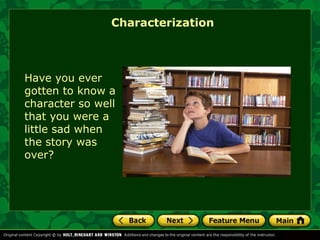
Have you ever 
gotten to know a 
character so well 
that you were a 
little sad when 
the story was 
over?
Characterization 
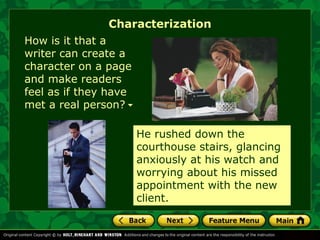
How is it that a 
writer can create a 
character on a page 
and make readers 
feel as if they have 
met a real person? 
He rushed down the 
courthouse stairs, glancing 
anxiously at his watch and 
worrying about his missed 
appointment with the new 
client.
Characterization 
The way a writer reveals character is called 
characterization. 
Poor characterization can make a 
character uninteresting, 
because that character may 
lack focus and clarity.
Characterization 
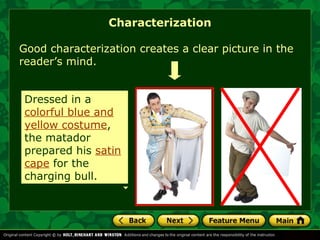
Good characterization creates a clear picture in the 
reader’s mind. 
Dressed in a 
colorful blue and 
yellow costume, 
the matador 
prepared his satin 
cape for the 
charging bull.
Characterization 
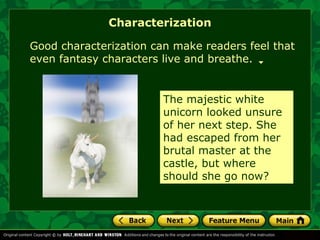
Good characterization can make readers feel that 
even fantasy characters live and breathe. 
The majestic white 
unicorn looked unsure 
of her next step. She 
had escaped from her 
brutal master at the 
castle, but where 
should she go now?
Characterization 
Quick Check Which words 
Tommy McSweeney really hated 
being the tallest boy in the eighth 
grade. Everyone assumed he was a 
good basketball player, but he had no 
athletic interest or skill. 
Instead, his talent emerged far from 
a court or ball field. No one beyond 
Tommy’s family knew that the pale, 
muscular kid with curly hair and 
freckles was a classical pianist—and 
Tommy intended to keep it that way. 
create 
characterization 
to clarify your 
image of Tommy? 
[End of Section]
Characterization: Creating Characters 
The two types of characterization are direct 
characterization and indirect characterization. 
If a writer tells you what a 
character is like, the method 
is called direct 
characterization. 
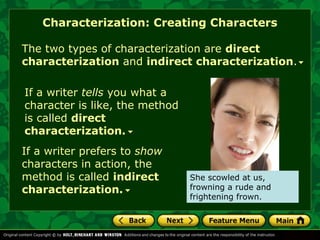
If a writer prefers to show 
characters in action, the 
method is called indirect 
characterization. 
Always She sco wa lgerdu matp u, ss,h e. . . . 
frowning a rude and 
frightening frown.
Characterization: Direct Characterization 
The two types of characterization are direct 
characterization and indirect characterization. 
If a writer tells you that a 
character is mean-tempered 
or friendly, that is direct 
characterization. 
When a writer uses direct 
characterization, you 
don’t have to do any 
detective work to figure out 
the character.
Characterization: Direct Characterization 
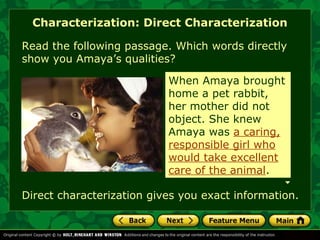
Read the following passage. Which words directly 
show you Amaya’s qualities? 
When Amaya brought 
home a pet rabbit, 
her mother did not 
object. She knew 
Amaya was a caring, 
responsible girl who 
would take excellent 
care of the animal. 
Direct characterization gives you exact information.
Characterization: Direct Characterization 
Quick Check What words give 
Dr. Chang was the best dentist in the 
practice. He had a charming smile, a 
gentle manner, and a warm 
personality. He made a trip to the 
dentist a pleasant experience— 
despite the discomfort. 
you direct 
information about 
Dr. Chang’s 
character? 
[End of Section]
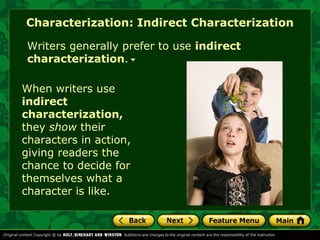
Characterization: Indirect Characterization 
Writers generally prefer to use indirect 
characterization. 
When writers use 
indirect 
characterization, 
they show their 
characters in action, 
giving readers the 
chance to decide for 
themselves what a 
character is like.
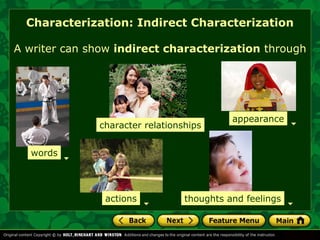
Characterization: Indirect Characterization 
A writer can show indirect characterization through 
character relationships 
appearance 
words 
actions thoughts and feelings
Characterization: Indirect Characterization 
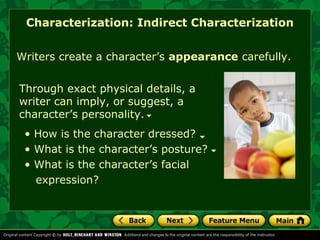
Writers create a character’s appearance carefully. 
Through exact physical details, a 
writer can imply, or suggest, a 
character’s personality. 
• How is the character dressed? 
• What is the character’s posture? 
• What is the character’s facial 
expression?
Characterization: Indirect Characterization 
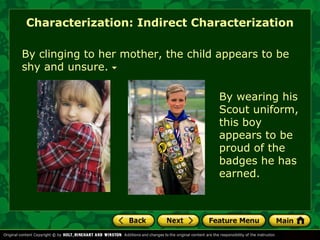
By clinging to her mother, the child appears to be 
shy and unsure. 
By wearing his 
Scout uniform, 
this boy 
appears to be 
proud of the 
badges he has 
earned.
Characterization: Indirect Characterization 
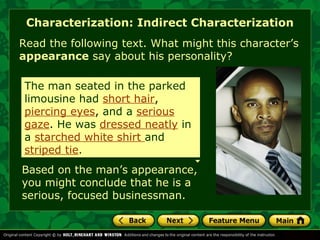
Read the following text. What might this character’s 
appearance say about his personality? 
The The man man seated seated in in the the parked 
parked 
limousine limousine had had short short hair, 
hair, 
piercing piercing eyes, eyes, and and a a serious 
serious 
gaze. gaze. He He was was dressed dressed neatly neatly in 
in 
a a starched starched white white shirt shirt and 
and 
striped striped tie. 
tie. 
Based on the man’s appearance, 
you might conclude that he is a 
serious, focused businessman.
Characterization: Indirect Characterization 
Read the following passage, paying attention to 
the character’s appearance. 
The girl in the fancy dress and high-heeled 
shoes squirmed uncomfortably on the hard 
wooden bench. Her eyes, lips, and hands 
were clenched. Her head drooped and her 
chin hung low. A tear slid down her face. 
How does this girl feel? What details suggest this 
feeling? 
She feels sad.
Characterization: Indirect Characterization 
Actions reveal a great deal about people. For 
example, people’s actions can show whether they’re 
or 
helpful and encouraging mean and mocking 
In stories, characters’ actions can also reveal their 
personalities.
Characterization: Indirect Characterization 
Characters’ actions reveal 
• personality, 
• motivation, 
• and situation. 
I love 
competition. 
We have 
to win 
this 
round. 
We 8th 
graders 
can’t lose to 
the 7th 
graders.
Characterization: Indirect Characterization 
Read the following passage, paying close attention 
to the character’s actions. 
It was a cold October day when Karisti’s alarm buzzed 
at 6:00 a.m. She pulled on her clothes and headed for 
the door. She carefully adjusted her headphones; then 
she pulled the sleeves of her turtleneck over her hands 
to keep out the cold. Here goes 10 miles, she thought 
as she headed out. I have to be ready for the spring 
marathon. 
began her run. I have to be ready for the spring 
What actions does Karisti take?
Characterization: Indirect Characterization 
What do Karisti’s actions imply about her character? 
It was a cold October day when Karisti’s alarm buzzed 
at 6:00 a.m. She pulled on her clothes and headed for 
the door. She carefully adjusted her headphones; then 
she pulled the sleeves of her turtleneck over her hands 
to keep out the cold. Here goes 10 miles, miles she she thought thought 
as 
as she she began began her her run. run. I have I have to be to be ready ready for for the the spring 
spring 
marathon. 
Karisti is getting up early to run on a cold morning 
as she prepares for a marathon. She’s probably a 
dedicated athlete.
Characterization: Indirect Characterization 
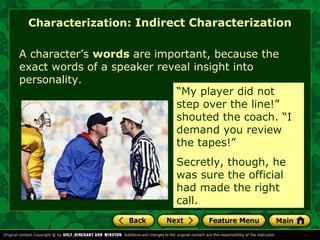
A character’s words are important, because the 
exact words of a speaker reveal insight into 
personality. 
“My player did not 
step over the line!” 
shouted the coach. “I 
demand you review 
the tapes!” 
Secretly, though, he 
was sure the official 
had made the right 
call.
Characterization: Indirect Characterization 
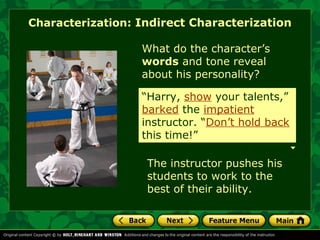
What do the character’s 
words and tone reveal 
about his personality? 
“Harry, show your talents,” 
barked the impatient 
instructor. “Don’t hold back 
this time!” 
The instructor pushes his 
students to work to the 
best of their ability.
Characterization: Indirect Characterization 
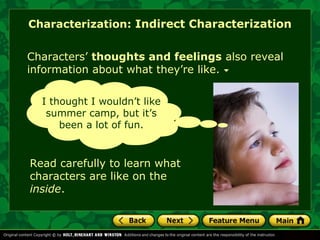
Characters’ thoughts and feelings also reveal 
information about what they’re like. 
I thought I wouldn’t like 
summer camp, but it’s 
been a lot of fun. 
Read carefully to learn what 
characters are like on the 
inside.
Characterization: Indirect Characterization 
Read the following passage, paying attention to 
the character’s thoughts and feelings. 
Frank insisted that he wasn’t tired or hungry, but 
really he was both. The long plane trip, with two 
delays, had left his patience in shreds. However, he 
didn’t want Aunt Judy to go to any trouble. 
What kind of person do you think Frank is? 
How do you know? 
Frank seems caring and considerate of others.
Characterization: Indirect Characterization 
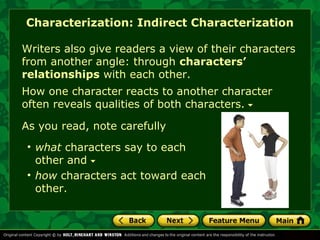
Writers also give readers a view of their characters 
from another angle: through characters’ 
relationships with each other. 
How one character reacts to another character 
often reveals qualities of both characters. 
As you read, note carefully 
• what characters say to each 
other and 
• how characters act toward each 
other.
Characterization: Indirect Characterization 
Read the following passage, paying attention to 
the characters’ words and how they’re said. 
Michael hugged Annie before he got out of the car. 
“I’ll call you tomorrow,” he said. 
She laughed smiled and and replied, replied, “You “You always always say say that, that, and 
and 
you never do!” 
He smiled. laughed. “Okay, “Okay, I’ll I’ll e-e-mail, mail, then.” 
then.” 
“You’d better!” Annie grinned, but her eyes were 
sad. 
What does the conversation suggest about each 
character’s personality? 
Michael is friendly but unreliable. Annie is unsure 
about her feelings for Michael.
Characterization: Indirect Characterization 
Which three 
methods of 
indirect 
characterization 
appear in this 
passage? 
Quick Check 
I’m tired of being ignored, Maura 
thought. When I walk into a room, 
it’s like no one sees me. No more— 
I’m going to get noticed at the dance. 
When the big night came, though, 
nothing went right. Maura’s dress 
didn’t fit correctly, and her shawl had 
a hole in it. Worst of all, as she 
walked into the gym, the heel broke 
on her right shoe, sending her 
sprawling across the floor. 
[End of Section]
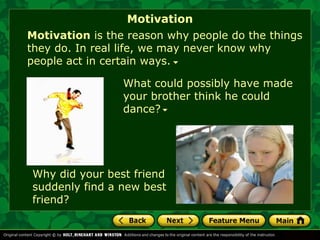
Motivation 
Motivation is the reason why people do the things 
they do. In real life, we may never know why 
people act in certain ways. 
What could possibly have made 
your brother think he could 
dance? 
Why did your best friend 
suddenly find a new best 
friend?
Motivation 
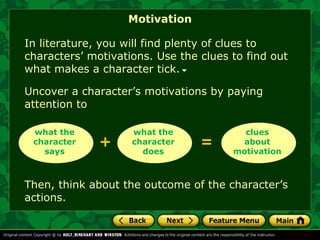
In literature, you will find plenty of clues to 
characters’ motivations. Use the clues to find out 
what makes a character tick. 
Uncover a character’s motivations by paying 
attention to 
what the 
character 
+ = 
what the 
character 
says 
does 
clues 
about 
motivation 
Then, think about the outcome of the character’s 
actions.
Which words 
reveal Sheila’s 
motivation for 
working after 
school? 
Motivation 
Quick Check 
“Hey Sheila,” said Jesuka. “I haven’t 
seen you at the mall all week. Where 
have you been?” 
Sheila shrugged. “I’m babysitting for 
Mrs. Davies.” 
“Babysitting? Why are wasting your 
time with some crying kid? You 
should be with your friends.” 
“My parents said that if I want to 
take ballet lessons, I have to pay for 
them myself.” [End of Section]
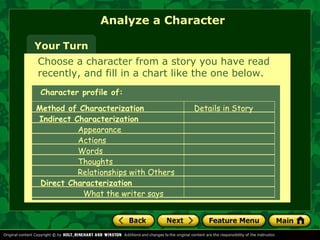
Analyze a Character 
Your Turn 
Choose a character from a story you have read 
recently, and fill in a chart like the one below. 
Character profile of: 
Method of Characterization Details in Story 
Indirect Characterization 
Appearance 
Actions 
Words 
Thoughts 
Relationships with Others 
Direct Characterization 
What the writer says
The End

Characterization

  • 1.
    How Do WritersIntroduce You to Their Characters? Feature Menu Characterization Creating Characters Direct Characterization Indirect Characterization Motivation Your Turn
  • 2.
    Characterization Have youever gotten to know a character so well that you were a little sad when the story was over?
  • 3.
    Characterization How isit that a writer can create a character on a page and make readers feel as if they have met a real person? He rushed down the courthouse stairs, glancing anxiously at his watch and worrying about his missed appointment with the new client.
  • 4.
    Characterization The waya writer reveals character is called characterization. Poor characterization can make a character uninteresting, because that character may lack focus and clarity.
  • 5.
    Characterization Good characterizationcreates a clear picture in the reader’s mind. Dressed in a colorful blue and yellow costume, the matador prepared his satin cape for the charging bull.
  • 6.
    Characterization Good characterizationcan make readers feel that even fantasy characters live and breathe. The majestic white unicorn looked unsure of her next step. She had escaped from her brutal master at the castle, but where should she go now?
  • 7.
    Characterization Quick CheckWhich words Tommy McSweeney really hated being the tallest boy in the eighth grade. Everyone assumed he was a good basketball player, but he had no athletic interest or skill. Instead, his talent emerged far from a court or ball field. No one beyond Tommy’s family knew that the pale, muscular kid with curly hair and freckles was a classical pianist—and Tommy intended to keep it that way. create characterization to clarify your image of Tommy? [End of Section]
  • 8.
    Characterization: Creating Characters The two types of characterization are direct characterization and indirect characterization. If a writer tells you what a character is like, the method is called direct characterization. If a writer prefers to show characters in action, the method is called indirect characterization. Always She sco wa lgerdu matp u, ss,h e. . . . frowning a rude and frightening frown.
  • 9.
    Characterization: Direct Characterization The two types of characterization are direct characterization and indirect characterization. If a writer tells you that a character is mean-tempered or friendly, that is direct characterization. When a writer uses direct characterization, you don’t have to do any detective work to figure out the character.
  • 10.
    Characterization: Direct Characterization Read the following passage. Which words directly show you Amaya’s qualities? When Amaya brought home a pet rabbit, her mother did not object. She knew Amaya was a caring, responsible girl who would take excellent care of the animal. Direct characterization gives you exact information.
  • 11.
    Characterization: Direct Characterization Quick Check What words give Dr. Chang was the best dentist in the practice. He had a charming smile, a gentle manner, and a warm personality. He made a trip to the dentist a pleasant experience— despite the discomfort. you direct information about Dr. Chang’s character? [End of Section]
  • 12.
    Characterization: Indirect Characterization Writers generally prefer to use indirect characterization. When writers use indirect characterization, they show their characters in action, giving readers the chance to decide for themselves what a character is like.
  • 13.
    Characterization: Indirect Characterization A writer can show indirect characterization through character relationships appearance words actions thoughts and feelings
  • 14.
    Characterization: Indirect Characterization Writers create a character’s appearance carefully. Through exact physical details, a writer can imply, or suggest, a character’s personality. • How is the character dressed? • What is the character’s posture? • What is the character’s facial expression?
  • 15.
    Characterization: Indirect Characterization By clinging to her mother, the child appears to be shy and unsure. By wearing his Scout uniform, this boy appears to be proud of the badges he has earned.
  • 16.
    Characterization: Indirect Characterization Read the following text. What might this character’s appearance say about his personality? The The man man seated seated in in the the parked parked limousine limousine had had short short hair, hair, piercing piercing eyes, eyes, and and a a serious serious gaze. gaze. He He was was dressed dressed neatly neatly in in a a starched starched white white shirt shirt and and striped striped tie. tie. Based on the man’s appearance, you might conclude that he is a serious, focused businessman.
  • 17.
    Characterization: Indirect Characterization Read the following passage, paying attention to the character’s appearance. The girl in the fancy dress and high-heeled shoes squirmed uncomfortably on the hard wooden bench. Her eyes, lips, and hands were clenched. Her head drooped and her chin hung low. A tear slid down her face. How does this girl feel? What details suggest this feeling? She feels sad.
  • 18.
    Characterization: Indirect Characterization Actions reveal a great deal about people. For example, people’s actions can show whether they’re or helpful and encouraging mean and mocking In stories, characters’ actions can also reveal their personalities.
  • 19.
    Characterization: Indirect Characterization Characters’ actions reveal • personality, • motivation, • and situation. I love competition. We have to win this round. We 8th graders can’t lose to the 7th graders.
  • 20.
    Characterization: Indirect Characterization Read the following passage, paying close attention to the character’s actions. It was a cold October day when Karisti’s alarm buzzed at 6:00 a.m. She pulled on her clothes and headed for the door. She carefully adjusted her headphones; then she pulled the sleeves of her turtleneck over her hands to keep out the cold. Here goes 10 miles, she thought as she headed out. I have to be ready for the spring marathon. began her run. I have to be ready for the spring What actions does Karisti take?
  • 21.
    Characterization: Indirect Characterization What do Karisti’s actions imply about her character? It was a cold October day when Karisti’s alarm buzzed at 6:00 a.m. She pulled on her clothes and headed for the door. She carefully adjusted her headphones; then she pulled the sleeves of her turtleneck over her hands to keep out the cold. Here goes 10 miles, miles she she thought thought as as she she began began her her run. run. I have I have to be to be ready ready for for the the spring spring marathon. Karisti is getting up early to run on a cold morning as she prepares for a marathon. She’s probably a dedicated athlete.
  • 22.
    Characterization: Indirect Characterization A character’s words are important, because the exact words of a speaker reveal insight into personality. “My player did not step over the line!” shouted the coach. “I demand you review the tapes!” Secretly, though, he was sure the official had made the right call.
  • 23.
    Characterization: Indirect Characterization What do the character’s words and tone reveal about his personality? “Harry, show your talents,” barked the impatient instructor. “Don’t hold back this time!” The instructor pushes his students to work to the best of their ability.
  • 24.
    Characterization: Indirect Characterization Characters’ thoughts and feelings also reveal information about what they’re like. I thought I wouldn’t like summer camp, but it’s been a lot of fun. Read carefully to learn what characters are like on the inside.
  • 25.
    Characterization: Indirect Characterization Read the following passage, paying attention to the character’s thoughts and feelings. Frank insisted that he wasn’t tired or hungry, but really he was both. The long plane trip, with two delays, had left his patience in shreds. However, he didn’t want Aunt Judy to go to any trouble. What kind of person do you think Frank is? How do you know? Frank seems caring and considerate of others.
  • 26.
    Characterization: Indirect Characterization Writers also give readers a view of their characters from another angle: through characters’ relationships with each other. How one character reacts to another character often reveals qualities of both characters. As you read, note carefully • what characters say to each other and • how characters act toward each other.
  • 27.
    Characterization: Indirect Characterization Read the following passage, paying attention to the characters’ words and how they’re said. Michael hugged Annie before he got out of the car. “I’ll call you tomorrow,” he said. She laughed smiled and and replied, replied, “You “You always always say say that, that, and and you never do!” He smiled. laughed. “Okay, “Okay, I’ll I’ll e-e-mail, mail, then.” then.” “You’d better!” Annie grinned, but her eyes were sad. What does the conversation suggest about each character’s personality? Michael is friendly but unreliable. Annie is unsure about her feelings for Michael.
  • 28.
    Characterization: Indirect Characterization Which three methods of indirect characterization appear in this passage? Quick Check I’m tired of being ignored, Maura thought. When I walk into a room, it’s like no one sees me. No more— I’m going to get noticed at the dance. When the big night came, though, nothing went right. Maura’s dress didn’t fit correctly, and her shawl had a hole in it. Worst of all, as she walked into the gym, the heel broke on her right shoe, sending her sprawling across the floor. [End of Section]
  • 29.
    Motivation Motivation isthe reason why people do the things they do. In real life, we may never know why people act in certain ways. What could possibly have made your brother think he could dance? Why did your best friend suddenly find a new best friend?
  • 30.
    Motivation In literature,you will find plenty of clues to characters’ motivations. Use the clues to find out what makes a character tick. Uncover a character’s motivations by paying attention to what the character + = what the character says does clues about motivation Then, think about the outcome of the character’s actions.
  • 31.
    Which words revealSheila’s motivation for working after school? Motivation Quick Check “Hey Sheila,” said Jesuka. “I haven’t seen you at the mall all week. Where have you been?” Sheila shrugged. “I’m babysitting for Mrs. Davies.” “Babysitting? Why are wasting your time with some crying kid? You should be with your friends.” “My parents said that if I want to take ballet lessons, I have to pay for them myself.” [End of Section]
  • 32.
    Analyze a Character Your Turn Choose a character from a story you have read recently, and fill in a chart like the one below. Character profile of: Method of Characterization Details in Story Indirect Characterization Appearance Actions Words Thoughts Relationships with Others Direct Characterization What the writer says
  • 33.